
Judge, 1890-06-07 · page 2 of 16
Judge — June 7, 1890 — page 2: what you’re looking at
What you’re looking at
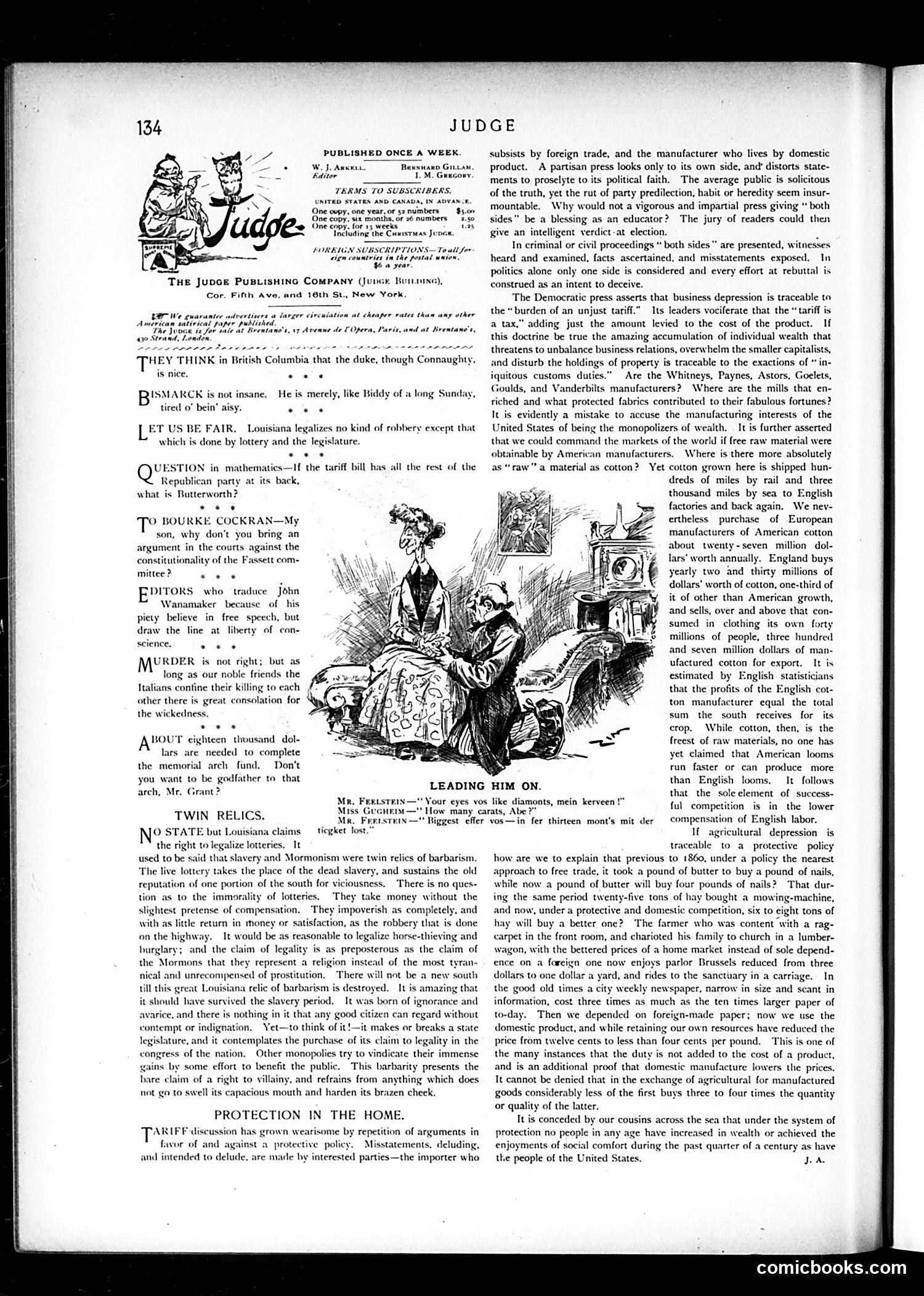
The main cartoon titled "LEADING HIM ON" depicts a woman showing a man fabric swatches or samples, likely representing domestic American textiles. This satirizes debates over **protective tariffs on manufactured goods**. The surrounding editorial text discusses the "tariff question," arguing that American manufacturers—particularly cotton producers—deserve protection from cheaper foreign imports. The piece critiques the Democratic Party's "free trade" stance as naive, asserting that tariffs safeguard American labor and industry. The cartoon's "leading him on" suggests the woman (representing American industry) is manipulating the man (likely a politician or consumer) through appeals to buy domestic products. This reflects 1890s-era tensions between protectionist and free-trade economic philosophies that dominated American politics.
📄 Transcribed text from this page (OCR, searchable)
Machine-transcribed from the original scan — historical spelling and the odd misread are preserved.
JUDGE PUBLISHED ONCE A WEEK. Brownaxn Gitiax. 1. M. Grecory TERMS TO SUBSCRIBERS. UNITED STATES AND CANADA, IN ADVAN. One copy, one year. or 2 numbers $5.00 One copy. six months, or 26 numbers "2.50 One copy. for 13 weeks 13s Including the Cweistatas Junon. FOREIGN SUBSCRIPTIONS To ail for digm countries in the postal union, $6 a year THE JUDGE PuBLISHING Company (Juncr Bu Finth Ave. and 16th St, New York. nine), Cor. 87 We guarantee udvertiven American satirical paper published. : The Juocn 11 for sate at Brentano's, 17 Avenue de Opera, Paris, and at Brentane's, 430 Strand, London larger circulation at cheaper rates than any other THEY THINK in British Columbia that the duke, though Connaughty, is nice. ate BISMARCK jis not insane, He is merely, like Biddy of « long Sunday, tired 0° bein’ aisy. a ea ET US BE FAIR. Louisiana legalizes no kind of robbery except that which is done by lottery and the legislature. Q’ ION in mathematics—If the tariff bill has all the rest of the Republican party at its back, what is Butterworth? eee (0 BOURKE COCKRAN—My son, why don’t you bring an argument in the courts against the constitutionality of the Fassett com- mittee? ‘wie DITORS who traduce John Wanamaker because of his piety believ speech, but draw the line at liberty of con- science. in free URDER is not right; but as long as our noble friends the Italians contine their killing to each other there is great consolation for the wickedness. BOUT eighteen thousand dol- lars are needed to complete the memorial arch fund. Don't you want to be godfather to that arch, Mr. Grant? Miss Gucne Mr. Feetsrein— ticgket lost.” TWIN RELICS, O STATE but Louisiana claims the right to legalize lotteries, It used to be said that slavery and Mormonism were twin relics of barbarism. The live lottery takes the place of the dead slavery, and sustains the old reputation of one portion of the south for v There is no ques- tion as to the immorality of lotteries, They take money without the slightest pretense of compensation. They impoverish as completely, and with as little return in money or satisfaction, as the robbery that is done on the highway. It would be as reasonable to legalize horse-thieving and burglary; and the claim of legality is as preposterous as the claim of the Mormons that they represent a religion instead of the most tyran- nical and unrecompensed of prostitution. ‘There will not be a new south till this great Louisiana relic of barbarism is destroyed. It is amazing that it should have survived the slavery period. It was born of ignorance and avarice, and there is nothing in it that any good citizen can regard without contempt or indignation, Yet—to think of it!—it makes or brea legislature, and it contemplates the purchase of its congress of the nation. uusness, Sa state m to legality in the Other monopolies try to vindicate their immense some effort to benefit the public. This barbarity presents the bare claim of a right to villainy, and refrains from anything which does not go to swell its capacious mouth and harden its brazen cheek. gains by PROTECTION IN THE HOME. RIFF discussion pwn wearisome by repetition of arguments in favor of and against a protective policy. Misstatements. deluding, and intended to delude, are made by interested parties—the importer who LEADING HIM ON. —"Your eyes vos like diamonts, mein kerveen !” —"* How many carats, Abe ?” Biggest effer vos—in fer thirteen mont’s mit der subsists by foreign trade, and the manufacturer who lives by domestic product. A partisan press looks only to its own side, and’ distorts state- ments to proselyte to its political faith, The average public is solicitous of the truth, yet the rut of party predilection, habit or heredity seem insur- mountable. Why would not a vigorous and impartial press giving ** both sides” be a blessing as an educator? The jury of readers could then give an intelligent verdict-at election. : In criminal or civil proceedings “ both sides" are presented, witnesses heard and examined, facts ascertained, and misstatements exposed. In politics alone only one side is considered and every effort at rebuttal is construed as an intent to deceive. The Democratic press asserts that business depression is traceable to the “burden of an unjust tariff.” Its leaders vociferate that the “tariff is a tax,” adding just the amount levied to the cost of the product. If this doctrine be true the amazing accumulation of individual wealth that threatens to unbalance business relations, overwhelm the smaller capitalists, and disturb the holdings of property is traceable to the exactions of * in- iquitous customs duties.” Are the Whitneys, Paynes, Astors, Goelets, Goulds, and Vanderbilts manufacturers? Where are the mills that en- riched and what protected fabrics contributed to their fabulous fortunes? It is evidently a mistake to accuse the manufacturing interests of the United States of being the monopolizers of wealth. . It is further asserted that we could command the markets of the world if free raw material were obtainable by American manufacturers. Where is there more absolutely as “raw” a material as cotton? Yet cotton grown here is shipped hun- dreds of miles by rail and three thousand miles by sea to English factories and back again, We nev- ertheless purchase of European manufacturers of American cotton about twenty-seven million dol- lars’ worth annually. England buys yearly two and thirty millions of dollars’ worth of cotton, one-third of it of other than American growth, and sells, over and above that con- sumed in clothing its own forty millions of people, three hundred and seven million dollars of man- ufactured cotton for export. It is estimated by English statisticians that the profits of the English cot- ton manufacturer equal the total sum the south receives for i crop. While cotton, then, is the freest of raw materials, no one has yet claimed that American looms run faster or can produce more than English looms. It follows that the soleclement of suc ful competition is in the lower compensation of English labor. If agricultural depression is traceable to a protective policy how are we to explain that previous to 1860, under a policy the nearest approach to free trade, it took a pound of butter to buy a pound of nails, while now a pound of butter will buy four pounds of nails? That dur- ing the same period twenty-five tons of hay bought a mowing-machine, and now, under a protective and domestic competition, six to eight tons of hay will buy a better one? The farmer who was content with a rag- carpet in the front room, and charioted his family to church in a lumber- wagon, with the bettered prices of a home market instead of sole depend- ence on a foreign one now enjoys parlor Brussels reduced from three dollars to one dollar a yard, and rides to the sanctuary in a carriage. In the good old times a city weekly newspaper, narrow in size and scant in information, cost three times as much as the ten times larger paper of to-day. Then we depended on foreign-made paper; now we use the domestic product, and while retaining our own resources have reduced the price from twelve cents to less than four cents per pound. This is one of the many instances that the duty is not added to the cost of a product, and is an additional proof that domestic manufacture lowers the prices. It cannot be denied that in the exchange of agricultural for manufactured goods considerably less of the first buys three to four times the quantity or quality of the latter. It is conceded by our cousins across the sea that under the system of protection no people in any age have increased in wealth or achieved the enjoyments of social comfort during the past quarter of a century as have the people of the United States. yee comicbooks.com