
A complete issue · 16 pages · 1890
Judge — May 24, 1890
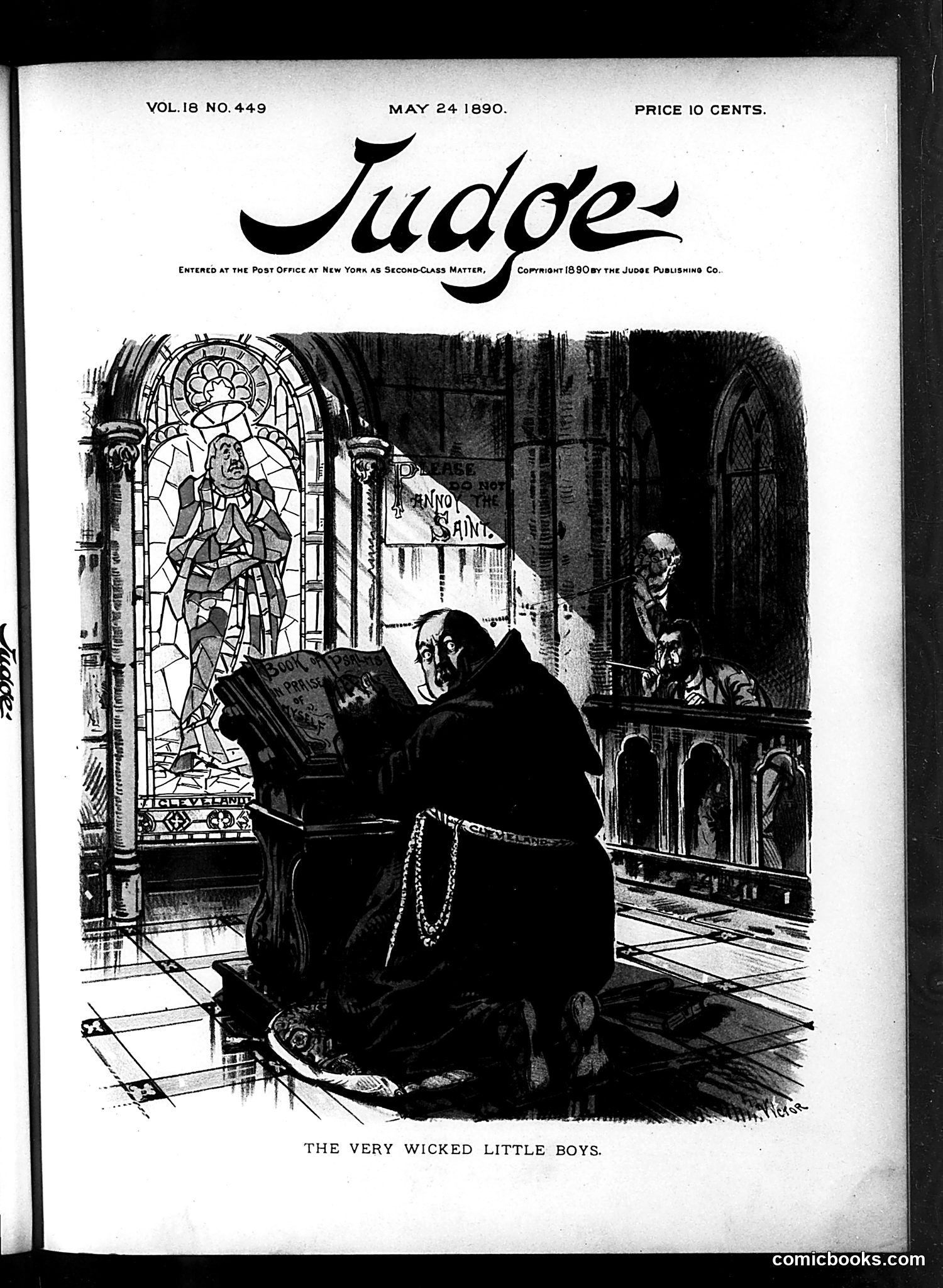
This Judge magazine cover from May 24, 1890, depicts a priest or monk kneeling in prayer inside a Gothic church, while mischievous boys appear in the background near a balcony. The title "The Very Wicked Little Boys" suggests satire about childhood misbehavior in religious settings. The cartoon likely mocks either: 1. Boys' disruptive conduct during church services, or 2. The contrast between religious solemnity and children's inability to maintain proper behavior The ornate stained-glass window and architectural details establish the sacred setting, emphasizing the incongruity of the boys' apparent pranks. This appears to be gentle social satire about a common Victorian concern—maintaining order and decorum during religious observance—rather than commentary on specific political events.
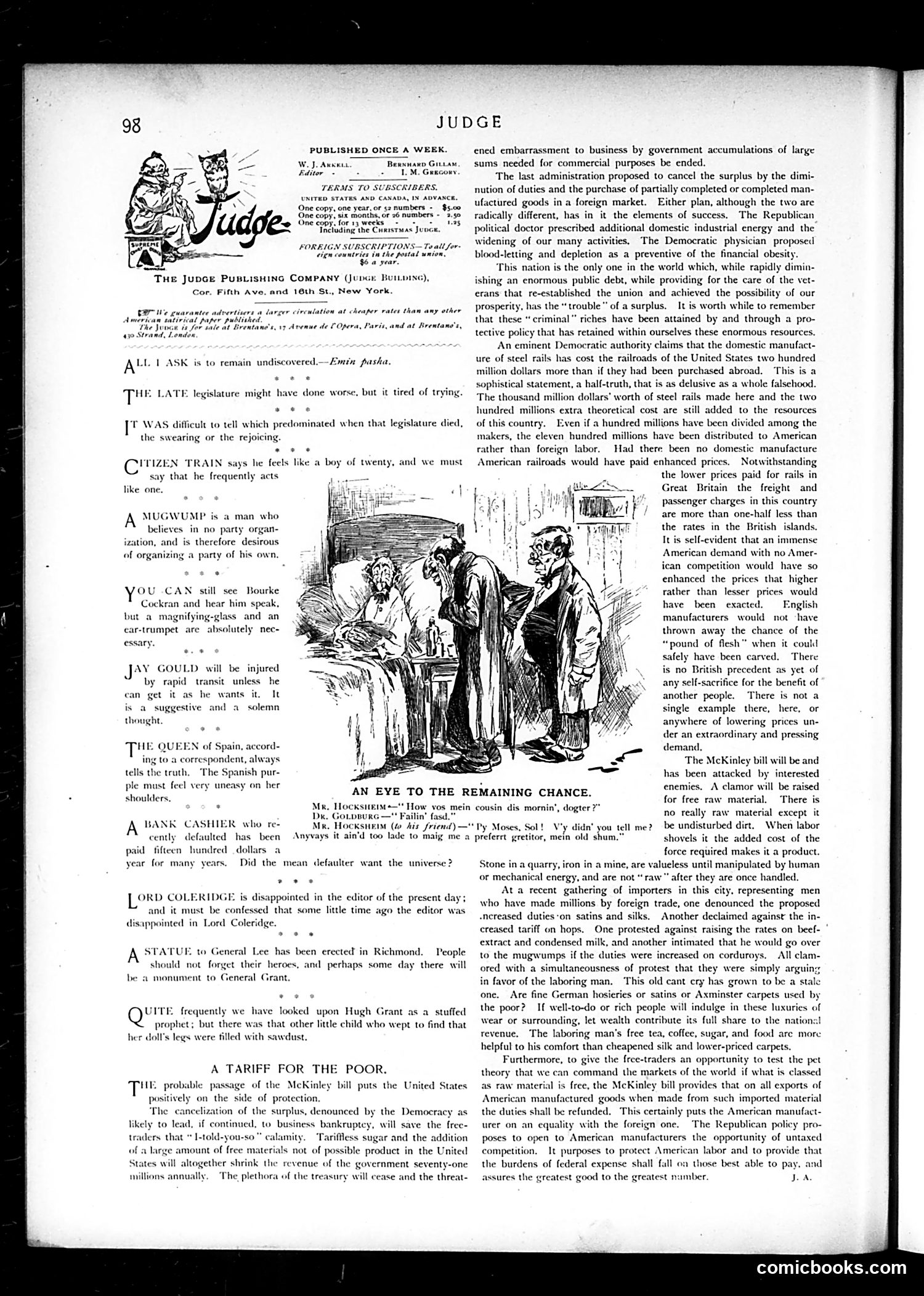
This cartoon appears to satirize political or business negotiations, likely from the early 20th century. The image shows several figures in conversation, with dialogue indicating discussion about financial matters and competing interests. The text references the McKinley bill (likely the Tariff of 1890), debates over protective tariffs versus free trade, and disputes about American manufacturing versus foreign competition. The accompanying editorial argues that protective tariffs harm American workers and consumers by raising prices, while defenders claim tariffs protect domestic industry. The cartoon's title suggests characters are calculating their advantage in ongoing political or economic debates. Without clearer identification of the specific figures depicted, the precise satirical targets remain somewhat unclear, though the content clearly concerns tariff policy and its economic consequences.
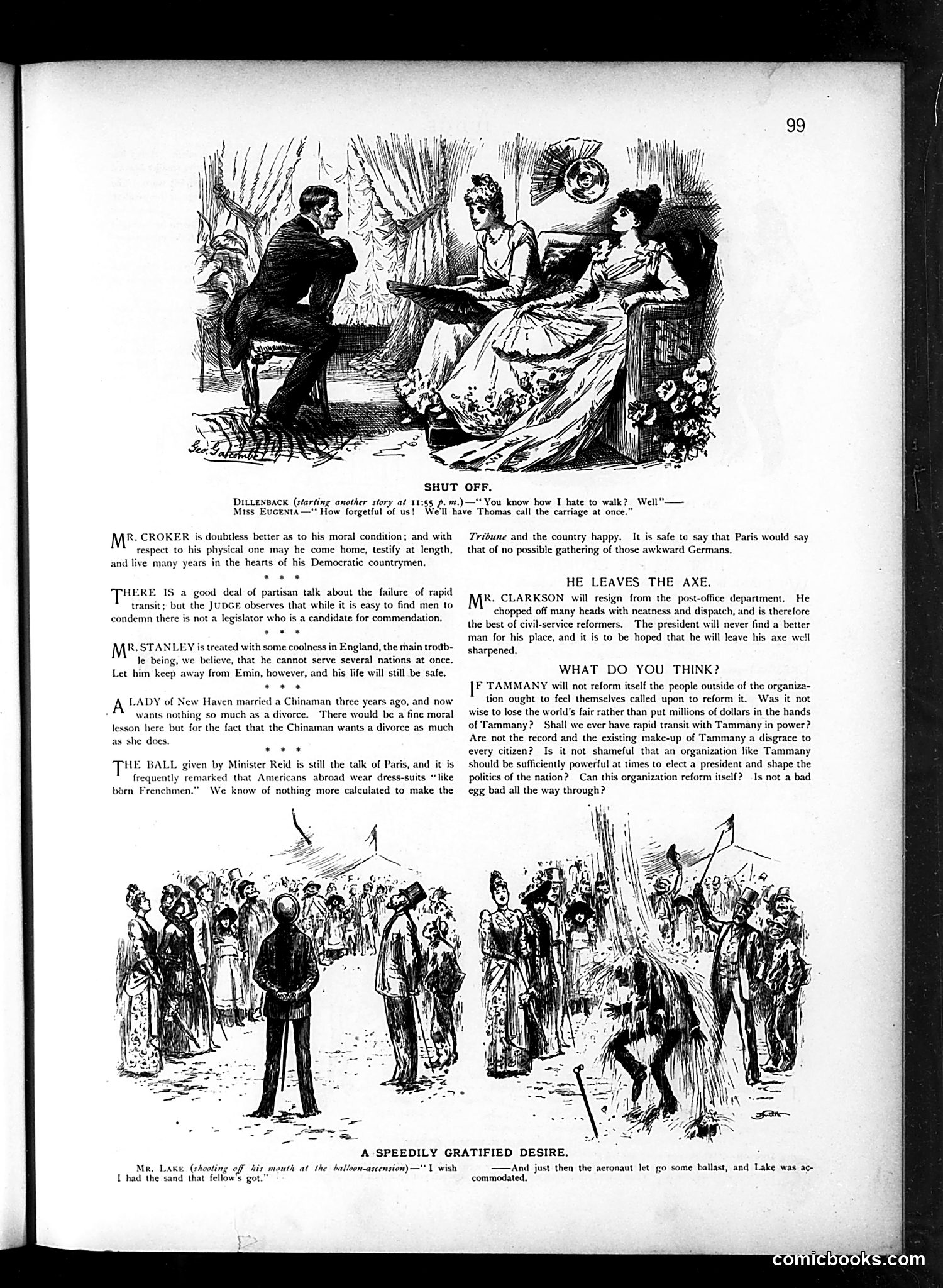
This page contains political commentary from an era of American partisan journalism. The top cartoon, "Shut Off," depicts a domestic scene where a man (appears to be a politician or public figure) is being told by women to stop discussing politics—suggesting male political figures dominated conversation annoyingly. The text sections discuss several political figures: Mr. Croker (likely Richard Croker, Tammany Hall leader), Mr. Clarson (post-office official), Mr. Stanley, and reference Tammany Hall—the Democratic political machine. The bottom illustration, "A Speedily Gratified Desire," shows a public crowd scene, likely satirizing political ambitions or public sentiment regarding a specific political event or figure. The overall tone criticizes Democratic politics and Tammany Hall's influence on American governance.
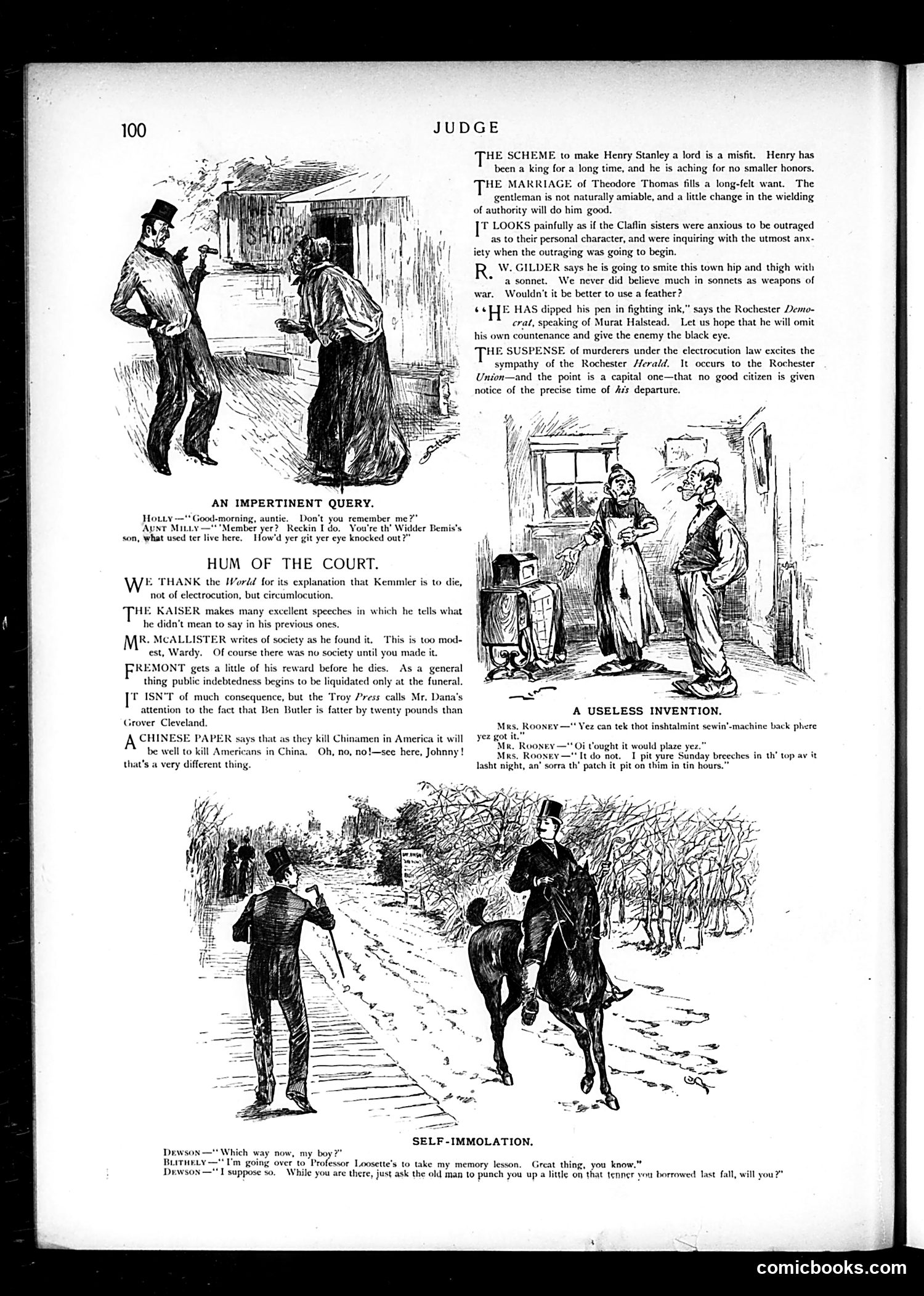
This page contains several brief satirical items typical of Judge's commentary on contemporary issues: **Main cartoons:** - "An Impertinent Query" and "A Useless Invention" are domestic humor sketches with Irish-immigrant characters (indicated by dialect), depicting awkward social encounters and marital disputes—standard fare for the era. - "Self-Immolation" mocks a student seeking a "memory lesson," suggesting intellectual pretension and financial irresponsibility. **Satirical notes** reference: - Kemmler's execution (likely William Kemmler, early electrocution case), mocking euphemistic language - Kaiser Wilhelm II's contradictory speeches - Henry Morton Stanley's potential peerage - Theodore Thomas (conductor) marrying, improving his temperament - Ben Butler and Grover Cleveland (political figures being compared) - Anti-Chinese sentiment in America The page exemplifies Judge's mix of domestic humor and political commentary, targeting public figures, social hypocrisy, and contemporary events through brief quips and illustrations. Most references require historical knowledge to fully decode.
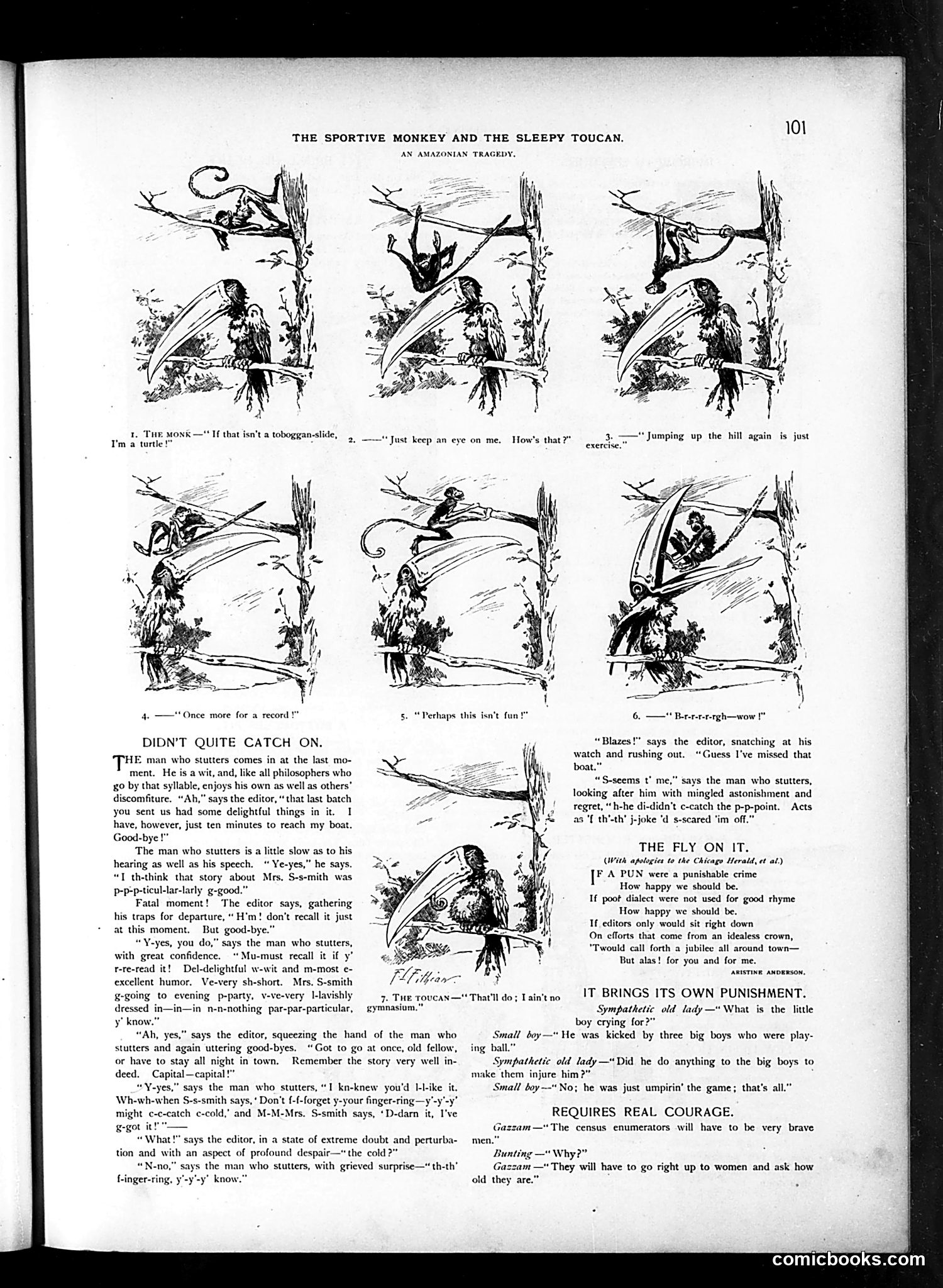
This page contains three unrelated satirical pieces typical of *Judge* magazine's humor: **Top section**: An illustrated six-panel comic showing a monkey and toucan engaged in physical antics on tree branches—a wordless "Amazonian tragedy" playing on slapstick and animal behavior for comedic effect. **"Didn't Quite Catch On"**: A lengthy story-joke about a stammering man trying to tell his editor a humorous anecdote. The editor repeatedly tries to leave but the stammerer misinterprets his politeness, eventually launching into an incomprehensible story about Mrs. Smith and a "gymnasium" (apparently the punchline involves confusion over words). The satire mocks both the stammerer's obliviousness and the editor's forced patience. **Remaining sections**: Brief, lighter jokes about punning, an umpire being kicked, and census takers needing courage to ask women their ages—period humor relying on puns and gender stereotypes. The page represents *Judge*'s mix of longer observational humor and quick gags rather than cohesive political satire.
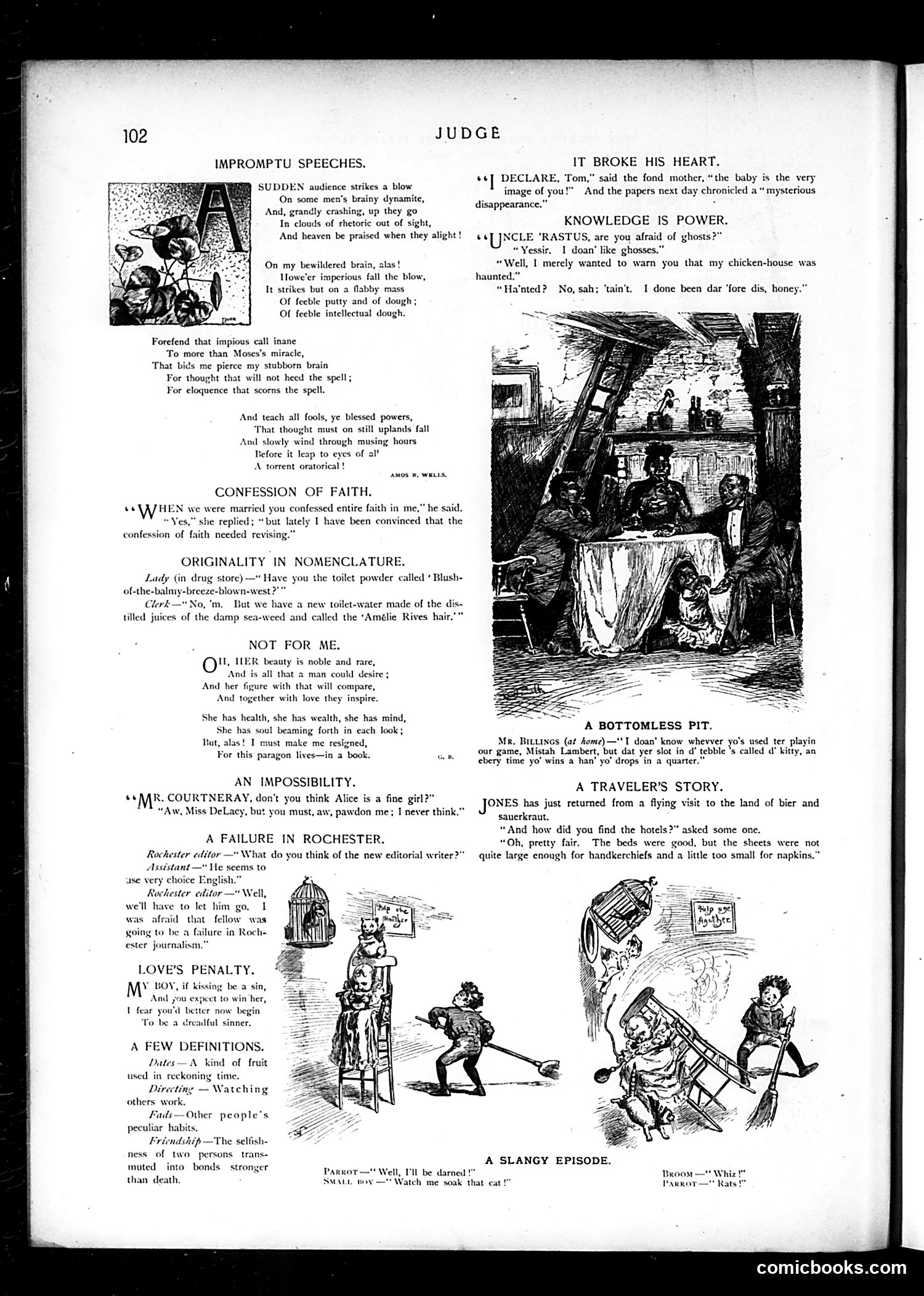
This page from *Judge* contains multiple brief humorous sketches typical of late-19th/early-20th-century American satire: **"Impromptu Speeches"** mocks public speakers—those with "brainy dynamite" deliver grand rhetoric, while the author's "flabby mass" of intellect cannot produce eloquence on demand. This satirizes the era's oratorical culture. **"Confession of Faith"** plays on marital disillusionment: a wife admits her faith in her husband "needed revising." **"Not for Me"** ironically describes an ideal woman who exists only in books—contemporary satire on impossible romantic standards. **"A Failure in Rochester"** jokes that an editorial writer using "very choice English" will fail in journalism, implying provincial American newspapers valued plain speech over sophistication. **"A Traveler's Story"** pokes fun at German hotel accommodations (sheets too small for both handkerchiefs and napkins), stereotyping Germanic frugality. The cartoons feature ethnic caricatures, particularly the dialect-heavy "Uncle 'Rastus" sketch using racist stereotypes common to period humor.
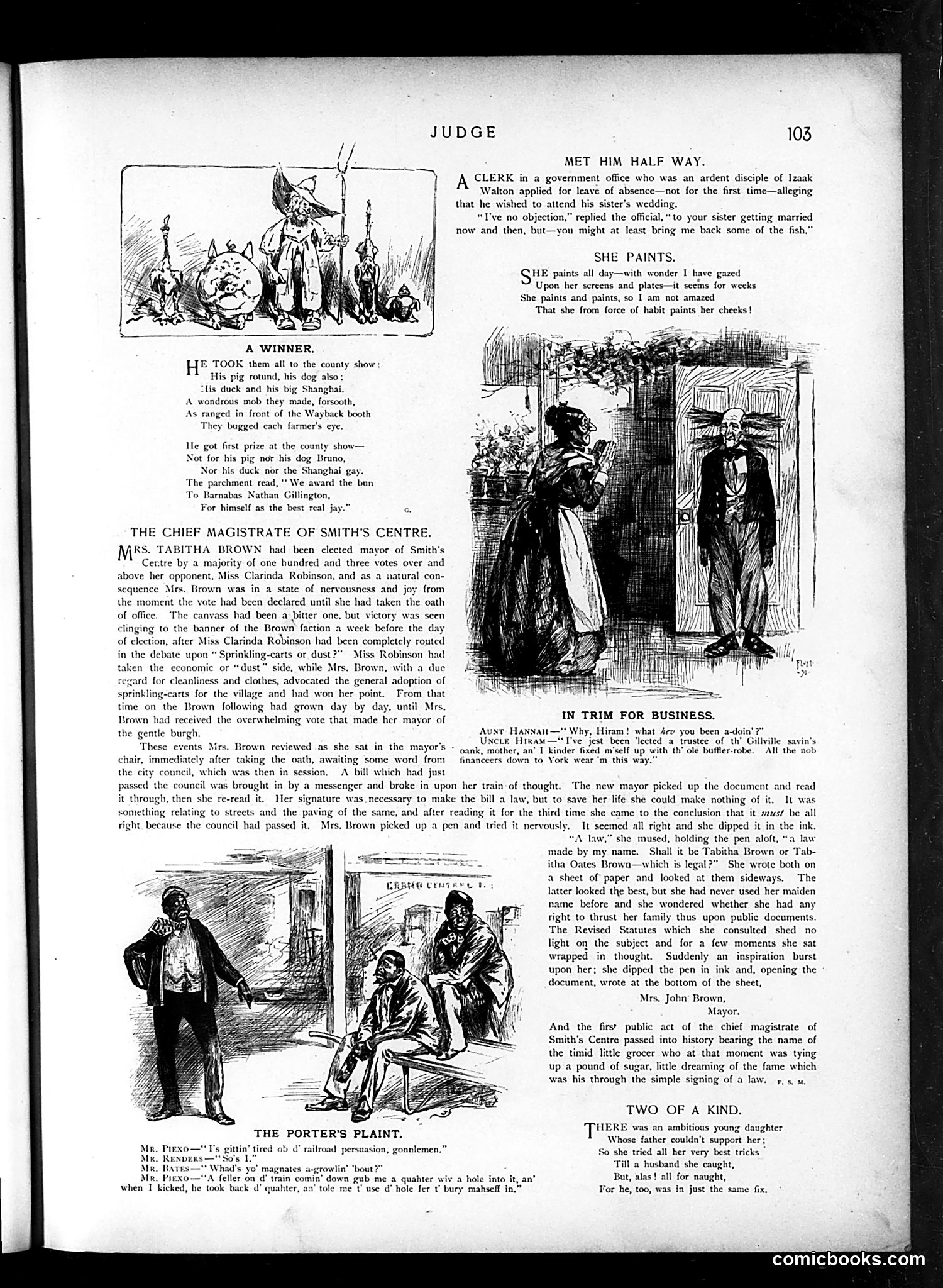
This page contains several brief humorous sketches satirizing American life, primarily targeting pretension and incompetence. **"A Winner"** mocks rural vanity: a farmer wins the county fair prize—not for his livestock, but for himself, suggesting rural boastfulness outweighs actual achievement. **"She Paints"** ridicules a woman who paints so obsessively that she literally paints her cheeks with makeup, conflating artistic pretension with cosmetic artifice. **"The Chief Magistrate of Smith's Centre"** lampoons female political incompetence. Mrs. Brown, newly elected mayor, cannot understand a simple street-paving bill and obsesses over whether to sign her maiden or married name—suggesting women lack capacity for governance. **"In Trim for Business"** depicts a rural man dressed absurdly in a buffalo robe, claiming this impresses city financiers, mocking small-town naïveté about urban sophistication. The page reflects Progressive-era anxieties about both rural simplicity and women's expanding political participation.
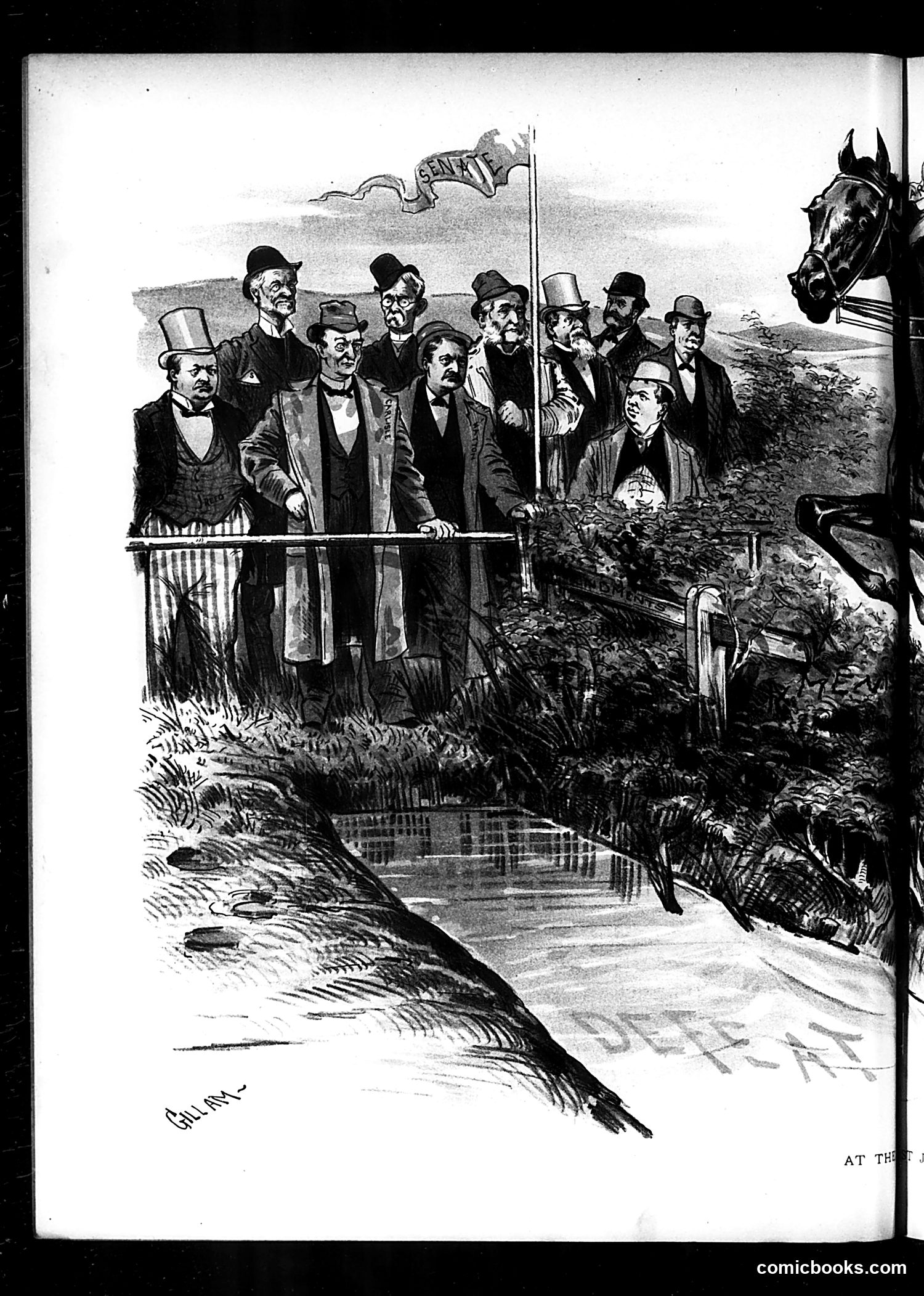
This appears to be a late 19th-century satirical cartoon from *Judge* magazine, signed by the artist (signature visible lower left). The image shows a group of well-dressed men in top hats gathered at what appears to be a waterside or canal, with a flag visible and a horse's head prominent on the right side. The cartoon likely satirizes a political or social event—possibly related to infrastructure, corruption, or a public ceremony. The formal dress and gathered crowd suggest officialdom or dignitary involvement. Without clearer text identifying the specific figures or event, the exact target of satire is unclear, though the composition suggests mockery of political pretense or a failed public works project.
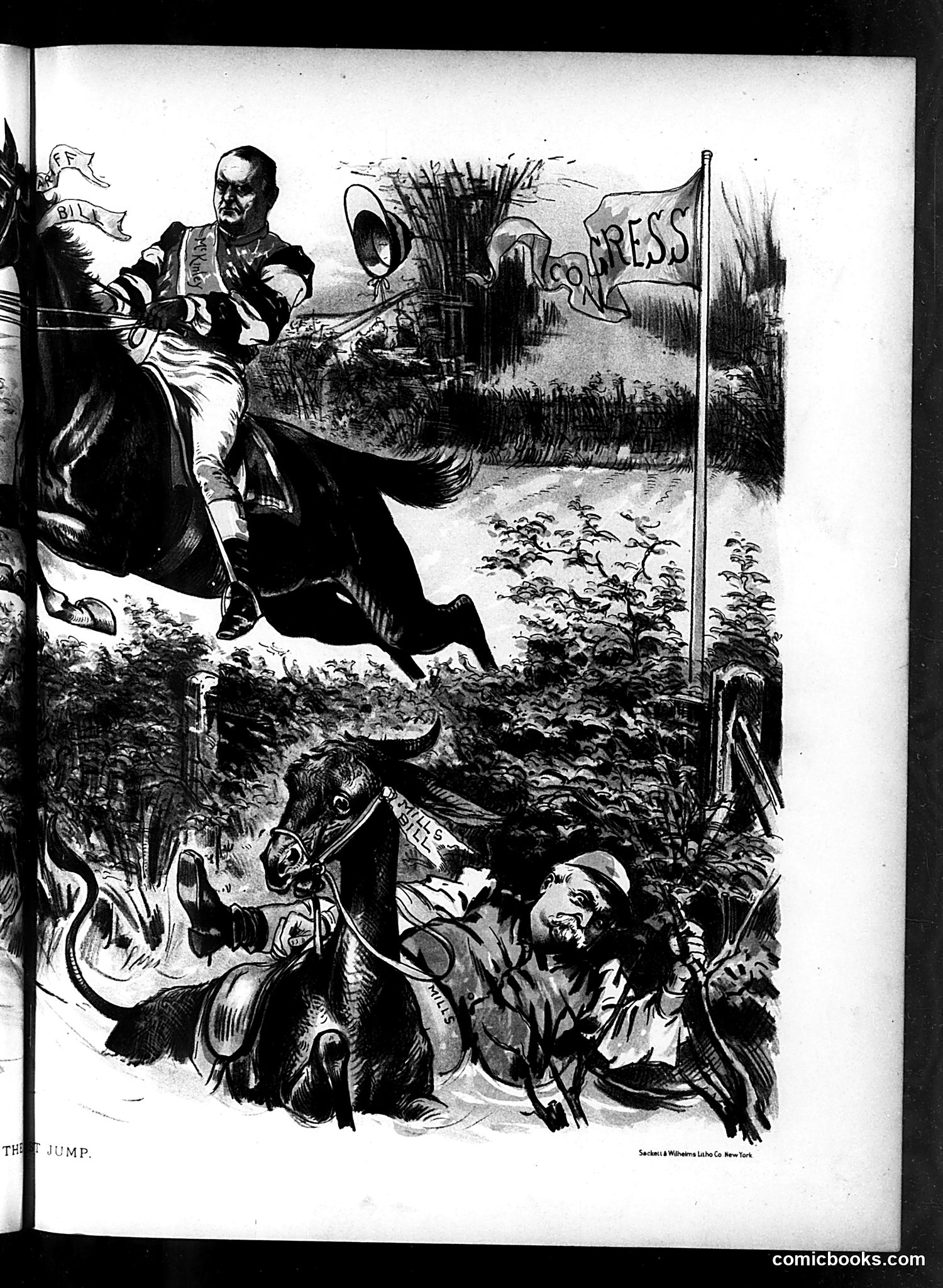
This Judge magazine cartoon satirizes a military or political leader (upper left, in uniform) who appears to be jumping or fleeing from a dangerous situation. Below, soldiers or workers struggle amid what looks like a battlefield or agricultural crisis marked by a "PRESS" flag. The cartoon's title "THE JUMP" suggests the leader is abandoning his post or responsibilities. The contrast between the elevated, comfortable position of the uniformed figure and the hardship below critiques leadership that escapes consequences while subordinates suffer. Without visible date or specific names, the exact historical context remains unclear, but the imagery suggests commentary on military command failures, cowardice, or political leadership abandoning public welfare during crisis. The "PRESS" flag indicates media attention to these failings.
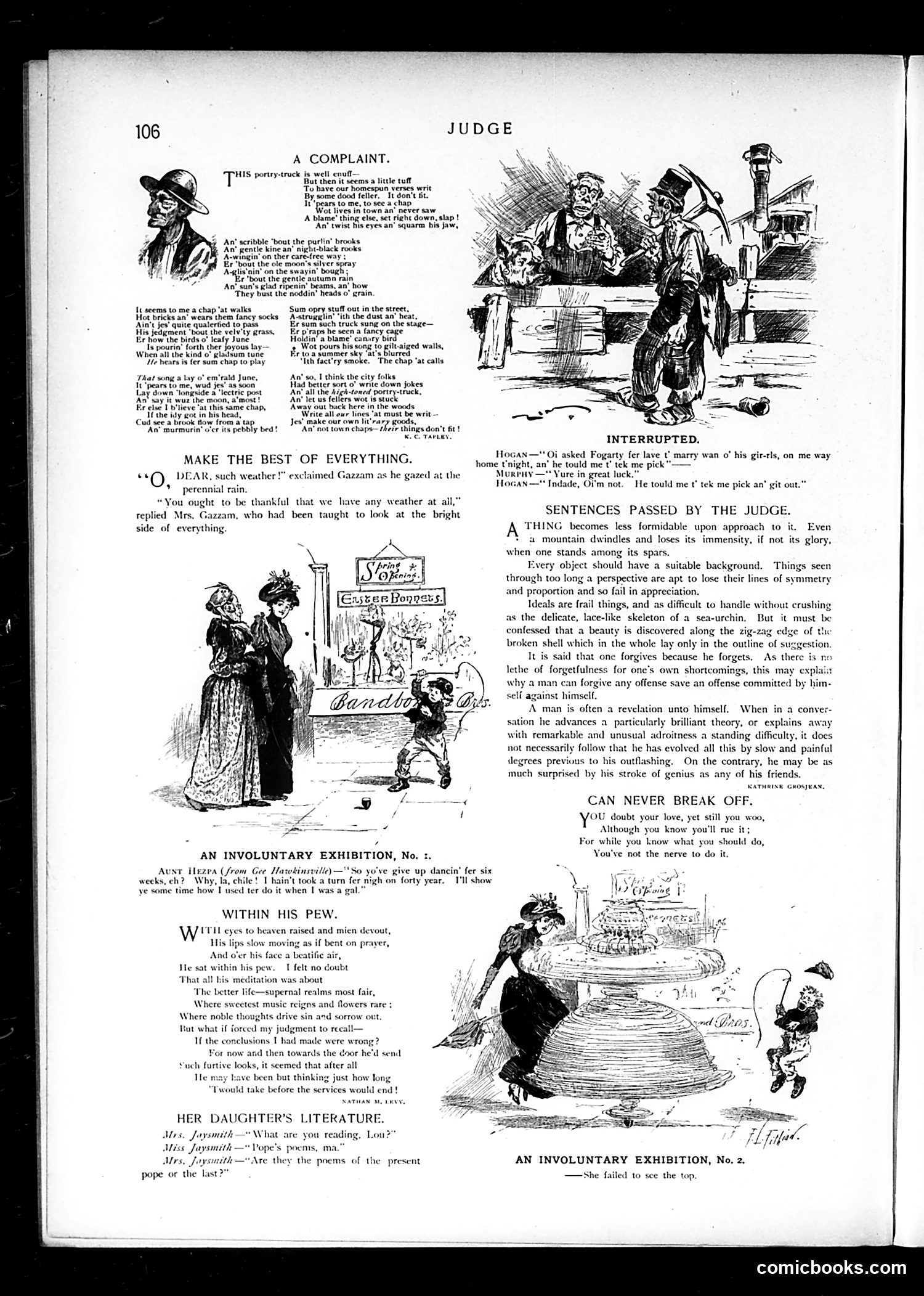
This page from *Judge* magazine contains several satirical pieces: **"A Complaint"** mocks urban poets who write romantically about rural life they've never experienced. A country speaker complains that city dwellers in fancy clothes shouldn't presume to write about "purlin' brooks" and pastoral scenes they only imagine. The satire targets the pretentiousness of urban intellectuals appropriating rural imagery. **"Make the Best of Everything"** shows Mrs. Gazzam's relentless optimism, teaching gratitude even for unpleasant weather—a gentle jab at forced positivity. **Other sketches** include humorous dialogues: an Irish immigrant couple discussing marriage permissions with unfortunate results; a man appearing pious in church while actually eager for services to end; and a daughter reading contemporary poetry to her mother. The overall tone satirizes hypocrisy, pretension, and the gap between appearance and reality in Gilded Age American society—common *Judge* themes targeting both urban elites and their social affectations.
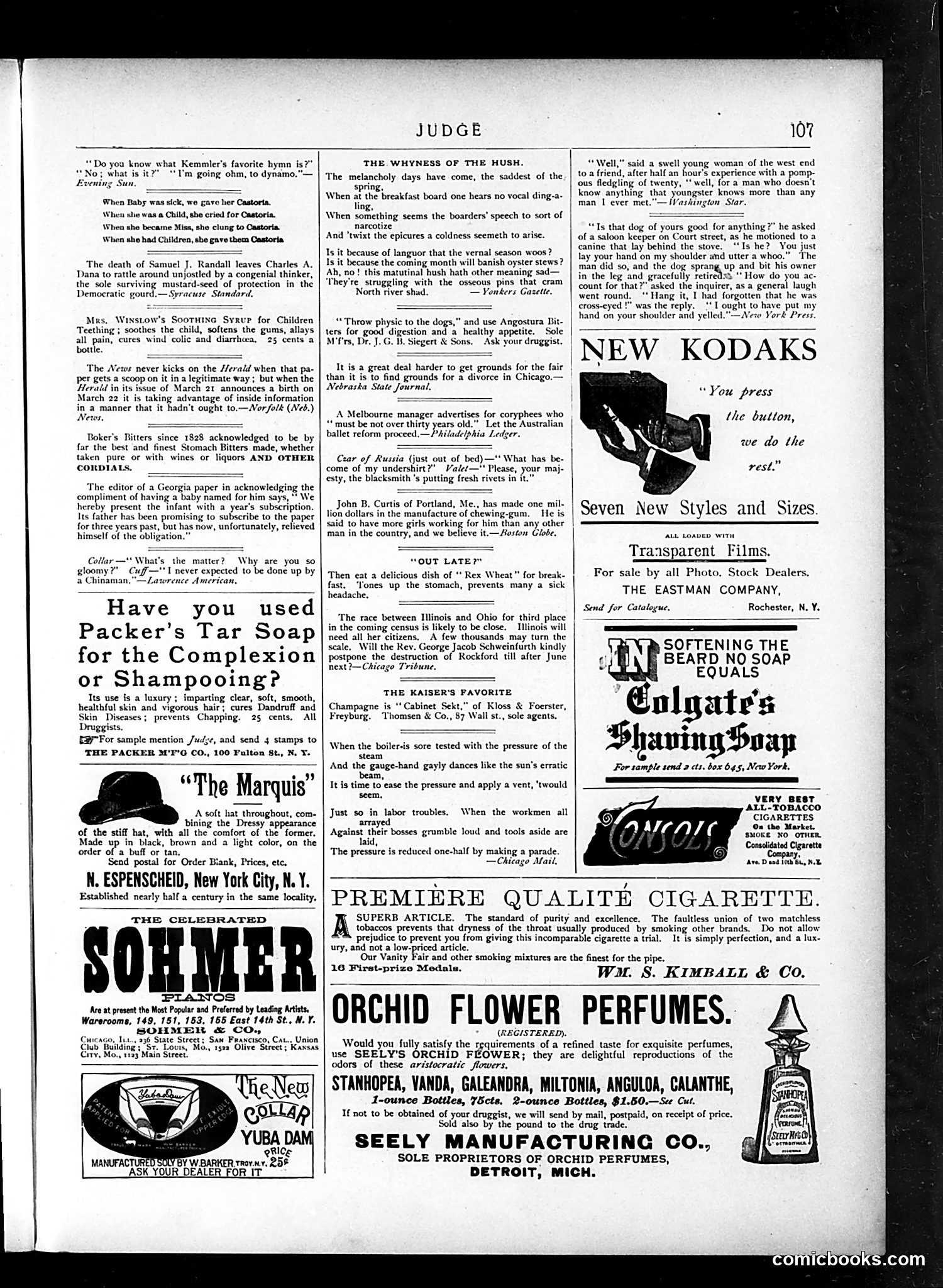
This page is primarily **advertisements with one satirical poem** ("The Whyness of the Hush"). The poem is a humorous explanation for why boardinghouse breakfasts have become silent and tense. The joke: Boarders at shared dining tables are struggling awkwardly to eat **shad with many bones**—particularly from the Hudson River ("North river shad"). The "coldness" and silence arise not from spring melancholy or lost oyster season, but from everyone concentrating intensely on navigating the fish's numerous small bones without embarrassing themselves. The satire is mild domestic humor typical of Judge magazine: it pokes fun at the common boardinghouse experience and the fish itself, which was apparently notoriously difficult to eat. The poem's mock-serious tone—using elaborate language about "vernal season" and "matutinal hush"—creates comedy by treating an embarrassing, mundane dining problem as a grand mystery. No specific political figures or events are referenced in this content.
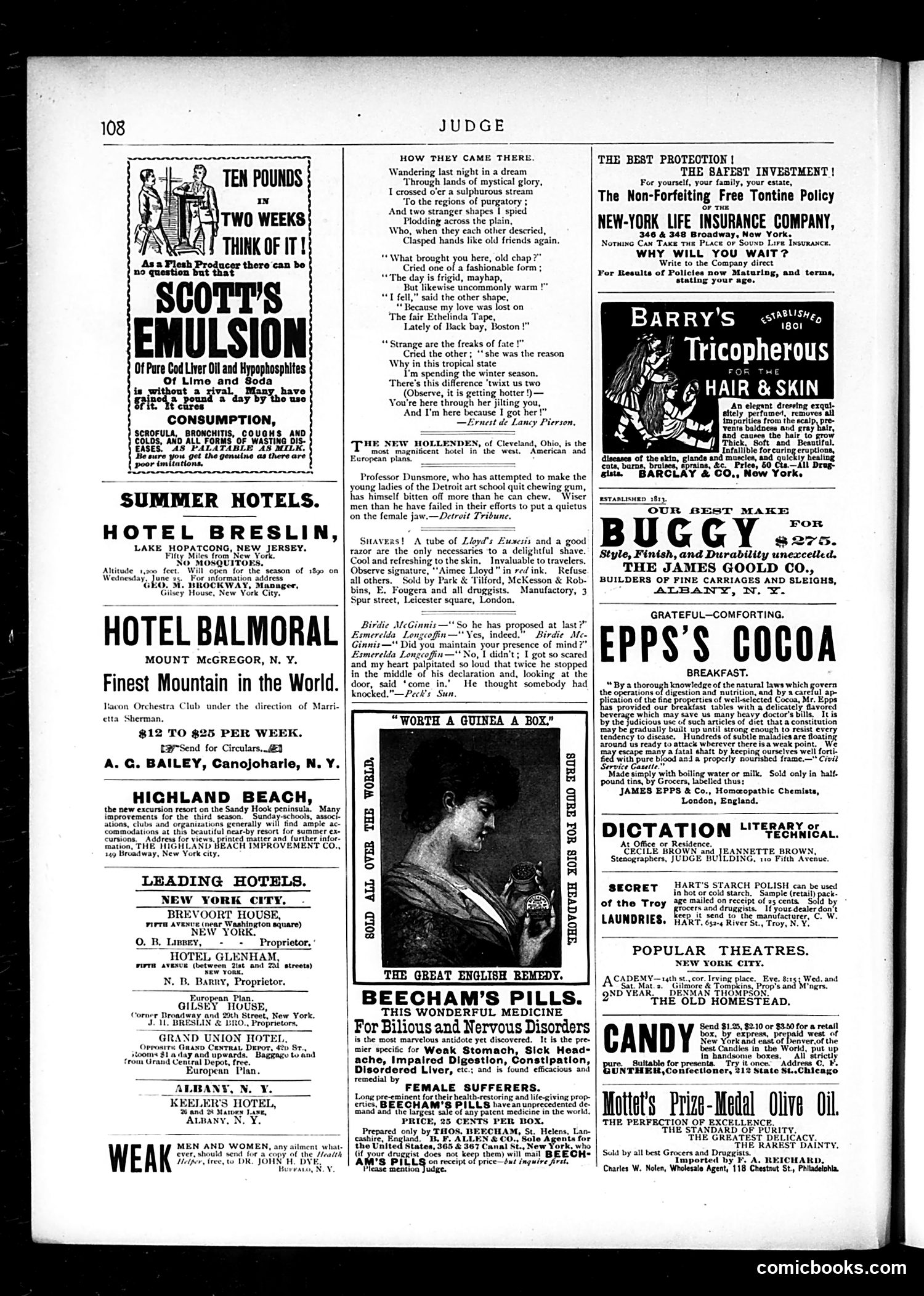
This page is primarily **advertising**, not satirical content. Judge magazine's business model relied heavily on paid advertisements for patent medicines, hotels, and consumer products. The notable exception is a brief **humorous poem** titled "How They Came There" by Ernest de Lancy Pierson. It's a lighthearted piece about two souls in purgatory who meet and discover they're both there because of the same woman—one was jilted by her, the other married her. The joke plays on romantic misfortune as eternal punishment, a common Victorian-era humor trope. The advertisements reflect 1890s concerns: Scott's Emulsion (cod liver oil marketed as a "flesh producer" for consumption and wasting diseases), various resort hotels, and Beecham's Pills for "nervous disorders"—products reflecting period anxieties about health and leisure. The page contains no political satire or caricatures—it's primarily commercial content typical of Judge's revenue model.
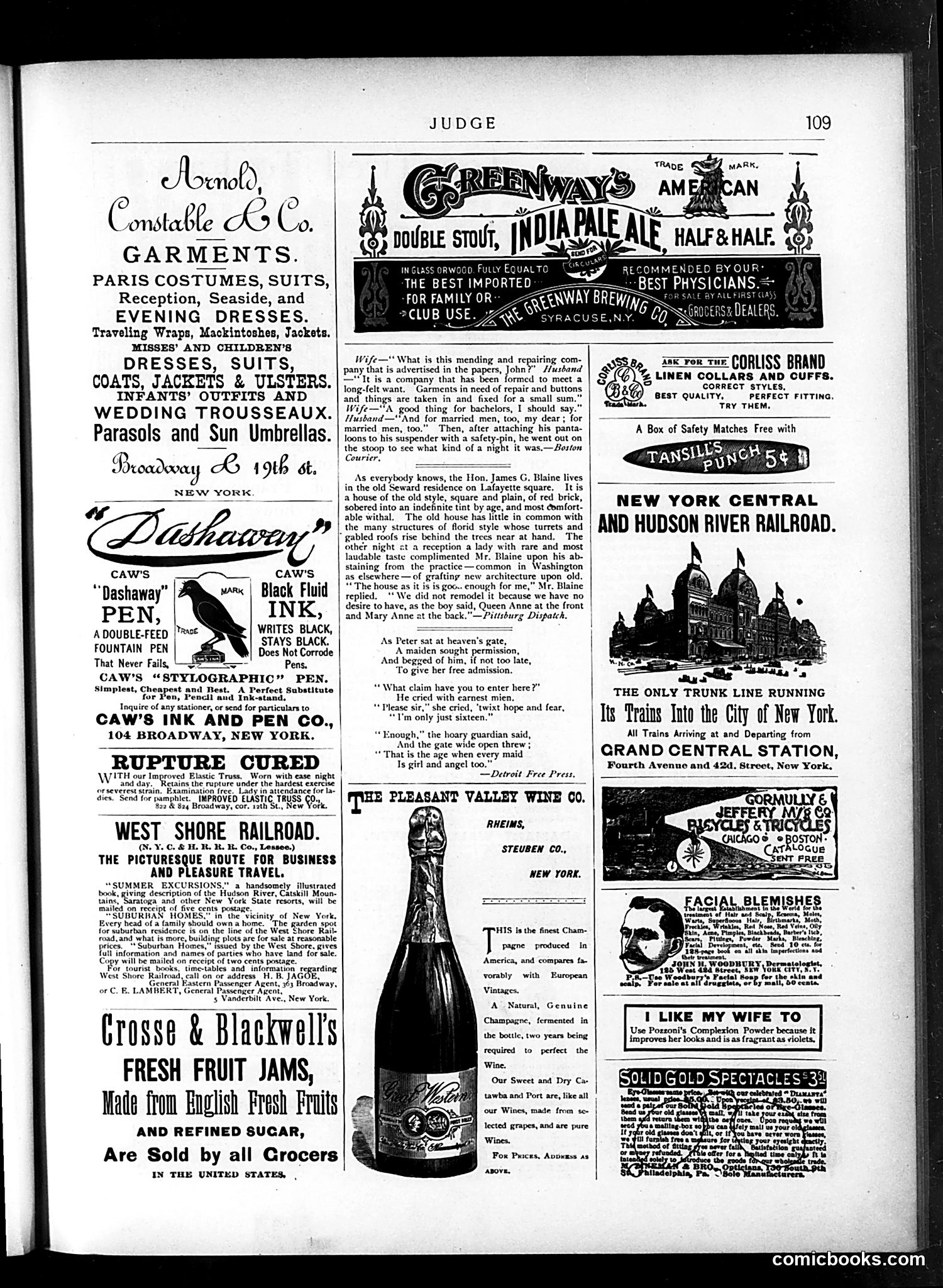
This page is **primarily advertisements** with minimal editorial content. The satirical pieces are brief anecdotes rather than cartoons. The main humor appears in two short jokes: 1. **"Wife's Question"** (top right): A domestic comedy about a husband who, after praising a new garment-repair service, is shown attaching his own pants to suspenders with a safety pin—undermining his endorsement through obvious hypocrisy. The joke satirizes male incompetence at domestic tasks. 2. **"James G. Blaine anecdote"** (center): References the prominent politician/statesman living in Washington D.C., joking about his refusal to modernize his old house. Blaine's quip about "Queen Anne at the front and Mary Anne at the back" is a pun on architectural styles versus female names—mild Victorian wordplay. The remainder consists entirely of **period product advertisements**: fountain pens, clothing, railroads, wine, jams, and medical devices (rupture trusses). No political cartoons are present on this page.
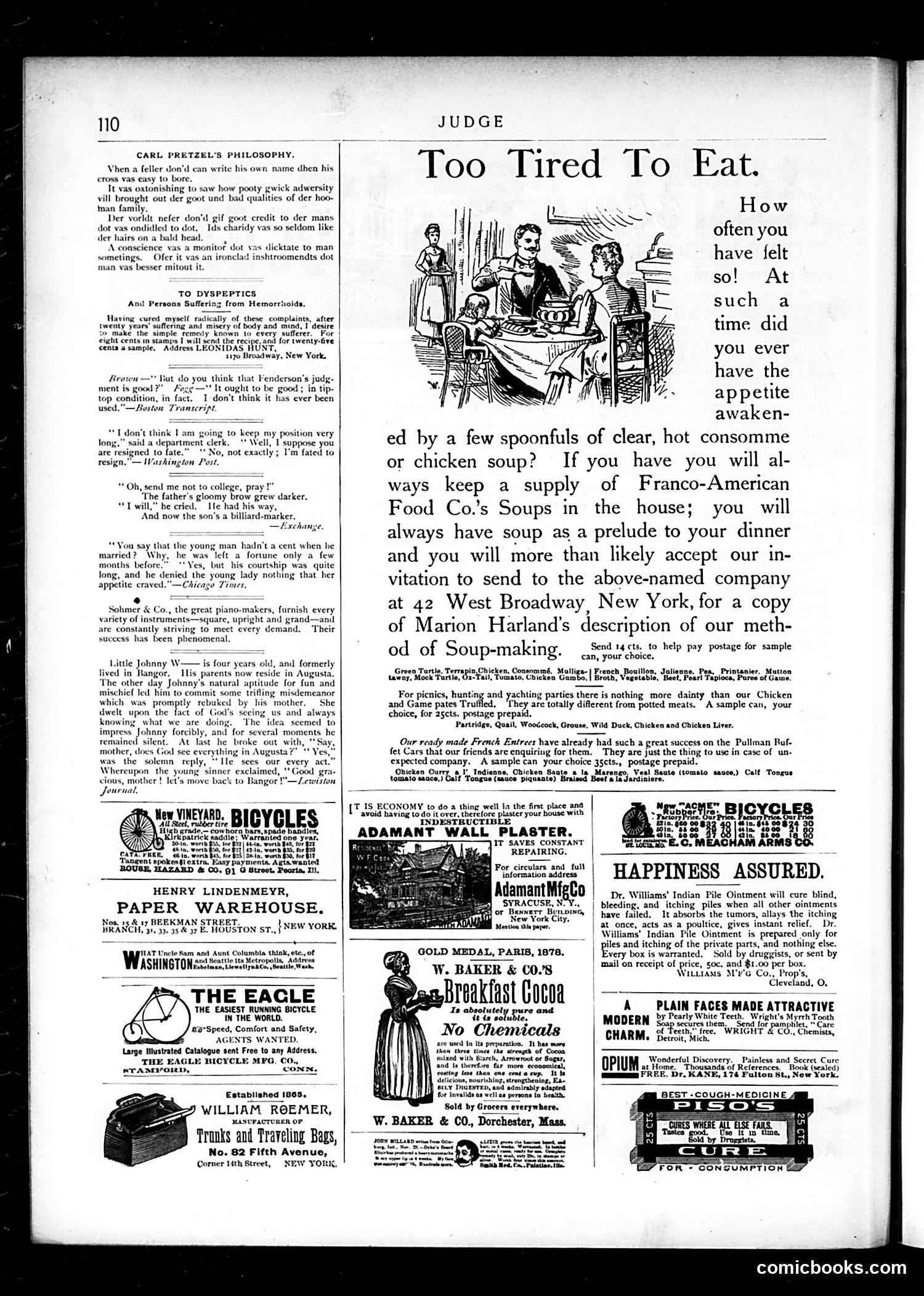
This page is primarily **advertising and light humor** rather than political satire. The main content is a Franco-American Food Co. advertisement promoting canned soups as appetite stimulants, featuring a domestic dinner scene illustration. The page also includes "Carl Pretzel's Philosophy"—a recurring humor column using a German-immigrant character (indicated by phonetic dialect spelling: "vhen," "goot," "oxtonishing") offering folksy observations about human nature and morality. This was typical Judge content: gentle social commentary through working-class immigrant characters. Other miscellaneous humor items include brief jokes about college, courtship, and childhood misbehavior—standard magazine filler of the era. The remaining content is classified advertising for bicycles, pianos, trunks, and patent medicines—typical of late-19th-century magazine pages. Nothing here appears to target specific political figures or contemporary events.
**Mostly advertising page** This is primarily an advertising page from Judge magazine. The main content comprises commercial advertisements for products like Van Houten's Cocoa, bicycles, railroads, tea, carriages, and Liebig Extract of Beef. **The single joke visible** appears at the top of the page: a brief domestic humor quip from Yale Record about a husband's dog remaining silent while the husband ate the wife's fifteen-dollar trousers—a play on the phrase "held his peace," suggesting the dog didn't object or eat the trousers that the husband had consumed instead. No political cartoons or satirical commentary are evident on this page. It serves primarily as commercial space rather than editorial content.
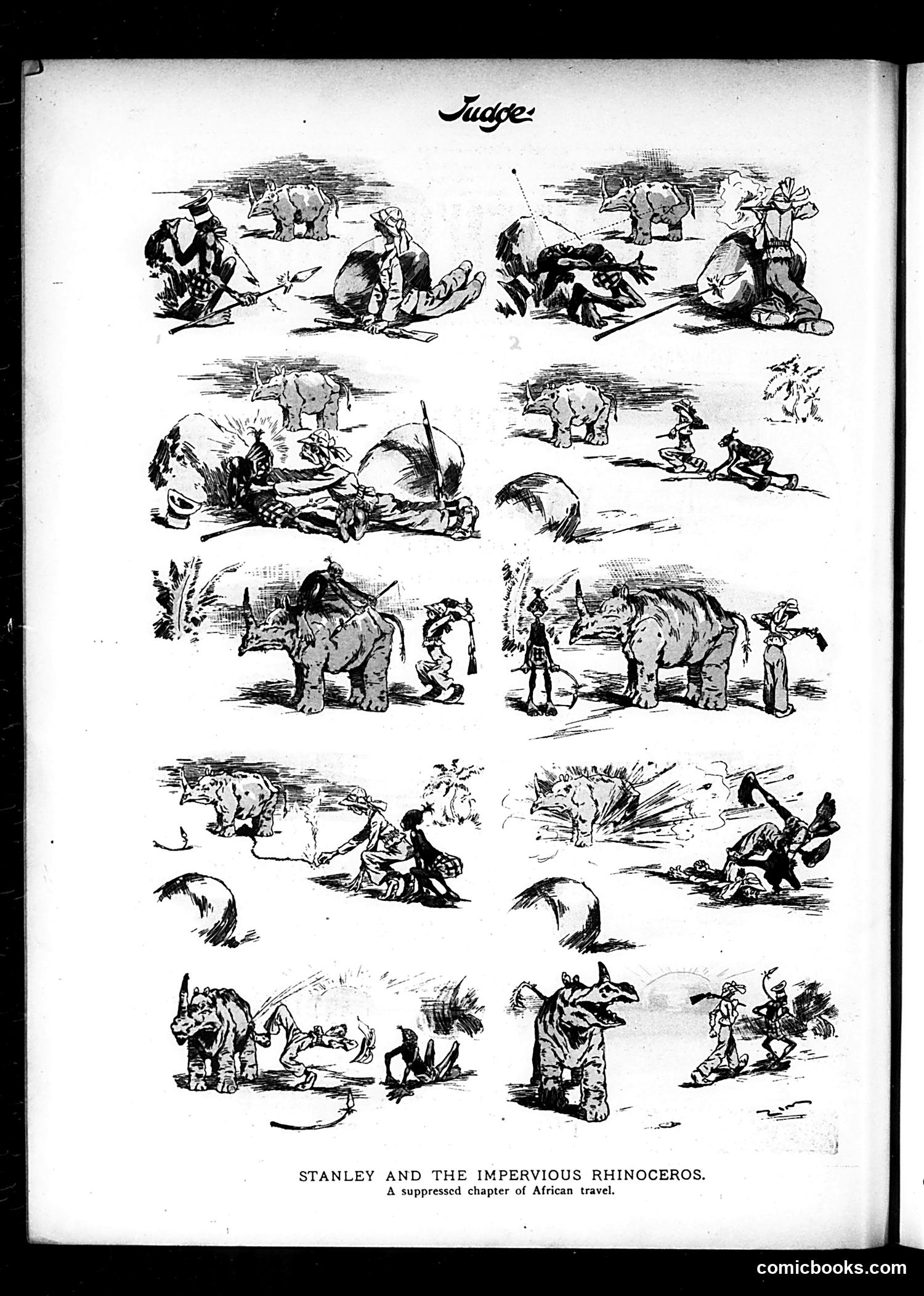
This is a satirical comic strip spoofing African exploration narratives, likely referencing Henry Morton Stanley's famous travels. The repeated scenes show a man (Stanley) encountering a rhinoceros in various confrontational situations—attacking with weapons, being charged, falling, and fleeing—yet the rhinoceros remains unaffected and "impervious" to all attempts. The satire mocks the grandiose adventure tales popular in late 19th-century magazines, where explorers claimed dramatic confrontations with dangerous wildlife. By showing Stanley repeatedly failing to harm or intimidate the rhino despite escalating efforts, Judge ridicules the exaggerated heroism of such travel narratives. The subtitle "suppressed chapter" adds ironic humor—suggesting this embarrassing truth was omitted from actual accounts. It's essentially a deflating parody of colonial adventure mythology.