
Judge, 1890-05-24 · page 2 of 16
Judge — May 24, 1890 — page 2: what you’re looking at
What you’re looking at
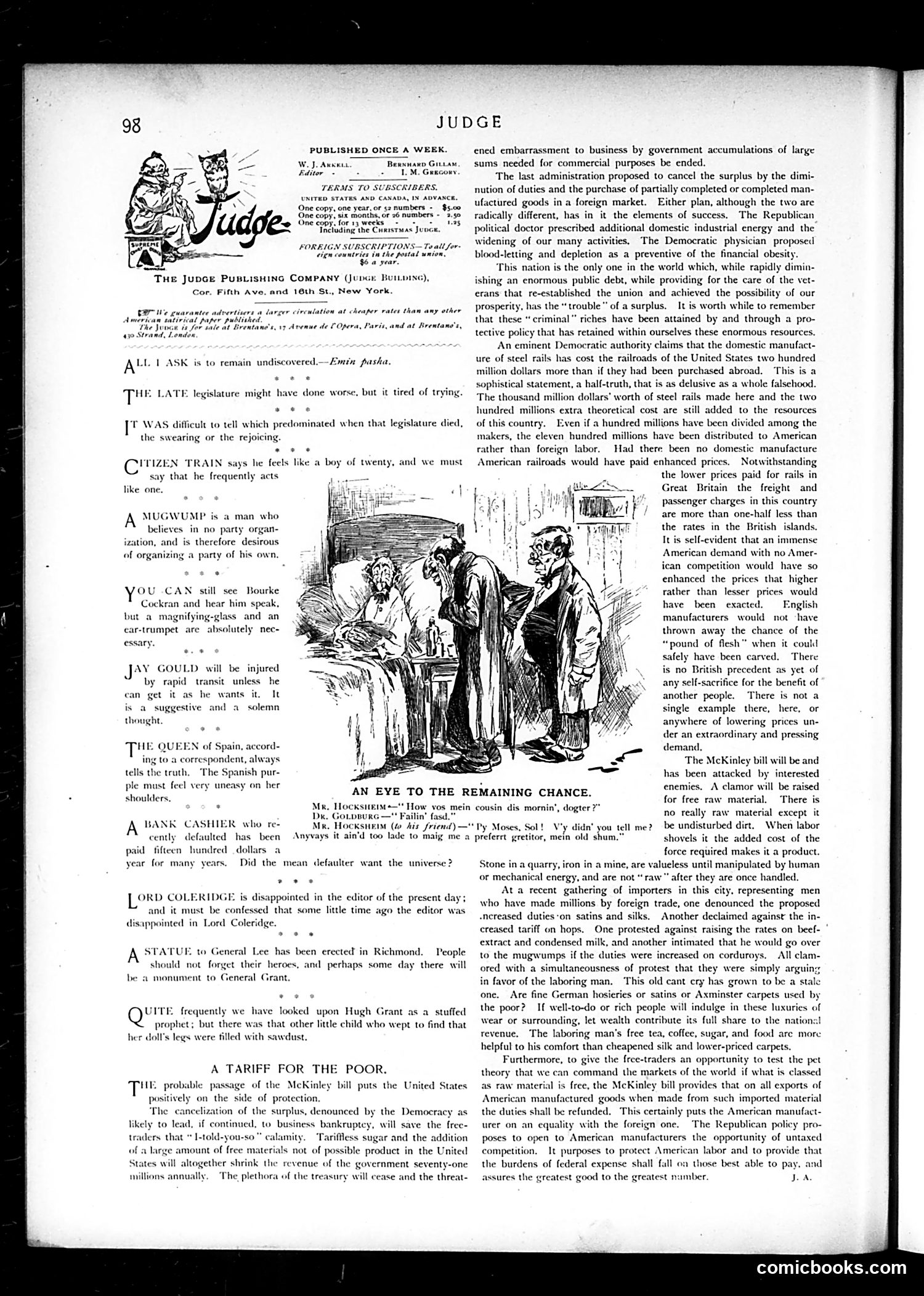
This cartoon appears to satirize political or business negotiations, likely from the early 20th century. The image shows several figures in conversation, with dialogue indicating discussion about financial matters and competing interests. The text references the McKinley bill (likely the Tariff of 1890), debates over protective tariffs versus free trade, and disputes about American manufacturing versus foreign competition. The accompanying editorial argues that protective tariffs harm American workers and consumers by raising prices, while defenders claim tariffs protect domestic industry. The cartoon's title suggests characters are calculating their advantage in ongoing political or economic debates. Without clearer identification of the specific figures depicted, the precise satirical targets remain somewhat unclear, though the content clearly concerns tariff policy and its economic consequences.
📄 Transcribed text from this page (OCR, searchable)
Machine-transcribed from the original scan — historical spelling and the odd misread are preserved.
JUDGE PUBLISHED ONCE A WEEK. W. J. Acuna Bexxnany Gites Editer = + +1. M. Gucowy. UNITED STATRS AND CANADA, IN ADVANCE, FOREIGN SUBSCR cign countries in the postal union $6 @ year. THE JUDGE PUBLISHING COMPANY (JupGE HutLvNc), Cor. Fifth Ave, and 16th St., New York. r published Att 1 ASK is to remain undiscovered.—Emin pasha. THE LATE. legislature might have done worse, but it tired of tr I" WAS difficult to tell which prede pinated when that legislature died, the swearing or the rejoicing. ITIZEN TRAIN says he feels like a boy of twenty, and we must say that he frequently acts like on MUGWUMP is a man who believes in no party organ- ization, and is therefore desirous of organizing a party of his own. OU CAN still see Bourke Cockran and hear him spe but a magnif car-trumpet are absolutely nec- essary JAY GOULD will be injured “by rapid transit unless he can get it as he wants it, It is a suggestive and a solemn thought, THE QUEEN of Spain, accord- ing to a correspondent, always tells the truth, ‘The Spanish pur- ple must feel very uneasy on her shoulders. : Mr. Hocksieim« Dk. GoppurG —" Failin’ fasd. BANK CASHIER who re paid fifteen hundred dollars a year for many years. Did the mean defaulter want the universe? LORD COLERIDGE is disappointed in the editor of the present dai and it must be confessed that some little time ago the editor was disappointed in Lord Coleridge. STATUE, to General Lee has been erected in Richmond. People should not forget their heroes, and perhaps some day there will be a monument to General Grant. UITE, frequently we have looked upon Hugh Grant as a. stuffed prophet; but there was that other little child who wept to find that her dolls legs were filled with sawdust. A TARIFF FOR THE POOR. HIE probable age of the McKinley bill puts the United § positively on the side of protection. ‘The cancelization of the surplus, denounced by the Democracy as y to lead, if continued, to business bankruptcy, will save the free- traders that * I-told-you-so” calamity. ‘Tariffless sugar and the addition of a large amount of free materials not of possible product in the United States will altogether shrink the revenue of the government seventy-one millions annually, The, plethora of the treasury will cease and the th AN EYE TO THE REMAINING CHANCE. Tow vos mein cousin dis mornin’, dogter?” ened embarrassment to business by government accumulations of large sums needed for commercial purposes be ended. The last administration proposed to cancel the surplus by the dimi- nution of duties and the purchase of partially completed or completed man- ufactured goods ina foreign market. Either plan, although the two are radically different, has in it the elements of success. The Republican political doctor prescribed additional domestic industrial energy and the widening of our many activities. The Democratic physician proposed blood-letting and depletion as a preventive of the financial obesity. This nation is the only one in the world which, while rapidly dimin- ishing an enormous public debt, while providing for the care of the vet- erans that re-established the union and achieved the possibility of our prosperity, has the “trouble” of a surplus. It is worth while to remember that these “criminal” riches have been attained by and through a pro- tective policy that has retained within ourselves these enormous resources. An eminent Democratic authority claims that the domestic manufact- ure of steel rails has cost the railroads of the United States two hundred million dollars more than if they had been purchased abroad. This is a sophistical statement, a half-truth, that is as delusive as a whole falschood. The thousand million dollars’ worth of steel rails made here and the two hundred millions extra theoretical cost are still added to the resources of this country. Even if a hundred millions have been divided among the makers, the eleven hundred millions have been distributed to American rather than foreign labor. Had there been no domestic manufacture American railroads would have paid enhanced prices. Notwithstanding the lower prices paid for rails in Great Britain the freight and passenger charges in this country are more than one-half less than the rates in the British islands. It is self-evident that an immense American demand with no Amer- ican competition would have so enhanced the prices that higher rather than lesser prices would have been exacted. English manufacturers would not “have thrown away the chance of the “pound of flesh” when it could safely have been carved, There is no British precedent as yet of any self-sacrifice for the benefit of another people. There is not a single example there, here, or anywhere of lowering prices un- der an extraordinary and pressing demand, The McKinley bill will be and has been attacked by interested enemies, A clamor will be raised for free raw material. ‘There is no really raw material except it Mx. Hocksitrint (to Ais friend)—" Dy Moses, Sol! V"y didn’ you tell me? be undisturbed dirt. When labor cently defaulted has been Anyvays it ain'd too lade to maig me a preferrt gretitor, mein old shum.” shovels it the added cost of the force required makes it a product. Stone in a quarry, iron in a mine, are valueless until manipulated by human or mechanical energy, and are not “raw” after they are once handled. Ata recent gathering of importers in this city, representing men who have made millions by foreign trade, one denounced the proposed <nereased duties-on satins and silks. Another declaimed against the in- creased tariff on hops. One protested against raising the rates on beef- extract and condensed milk, and another intimated that he would go over to the mugwumps if the duties were increased on corduroys. All clam- ored with a simultancousness of protest that they were simply arguin; in favor of the laboring man. This old cant cry has grown to be a stale one. Are fine German hosicries or satins or Axminster carpets used by the poor? If well-to-do or rich people will indulge in these luxuries of wear or surrounding, let wealth contribute its full share to the national revenue. The laboring man’s free tea, coffee, sugar, and food arc more helpful to his comfort than cheapened silk and lower-priced carpets. Furthermore, to give the free-traders an opportunity to test the pet theory that we can command the markets of the world if what is classed as raw material is free, the McKinley bill provides that on all exports of American manufactured goods when made from such imported material the duties shall be refunded. This certainly puts the American manufact- turer on an equality with the foreign one. The Republican policy pro- poses to open to American manufacturers the opportunity of untaxed competition. It purposes to protect American labor and to provide that the burdens of federal expense shall fall on those best able to pay, and assures the gr r e Joa comicbooks.com