
Judge, 1890-05-24 · page 10 of 16
Judge — May 24, 1890 — page 10: what you’re looking at
What you’re looking at
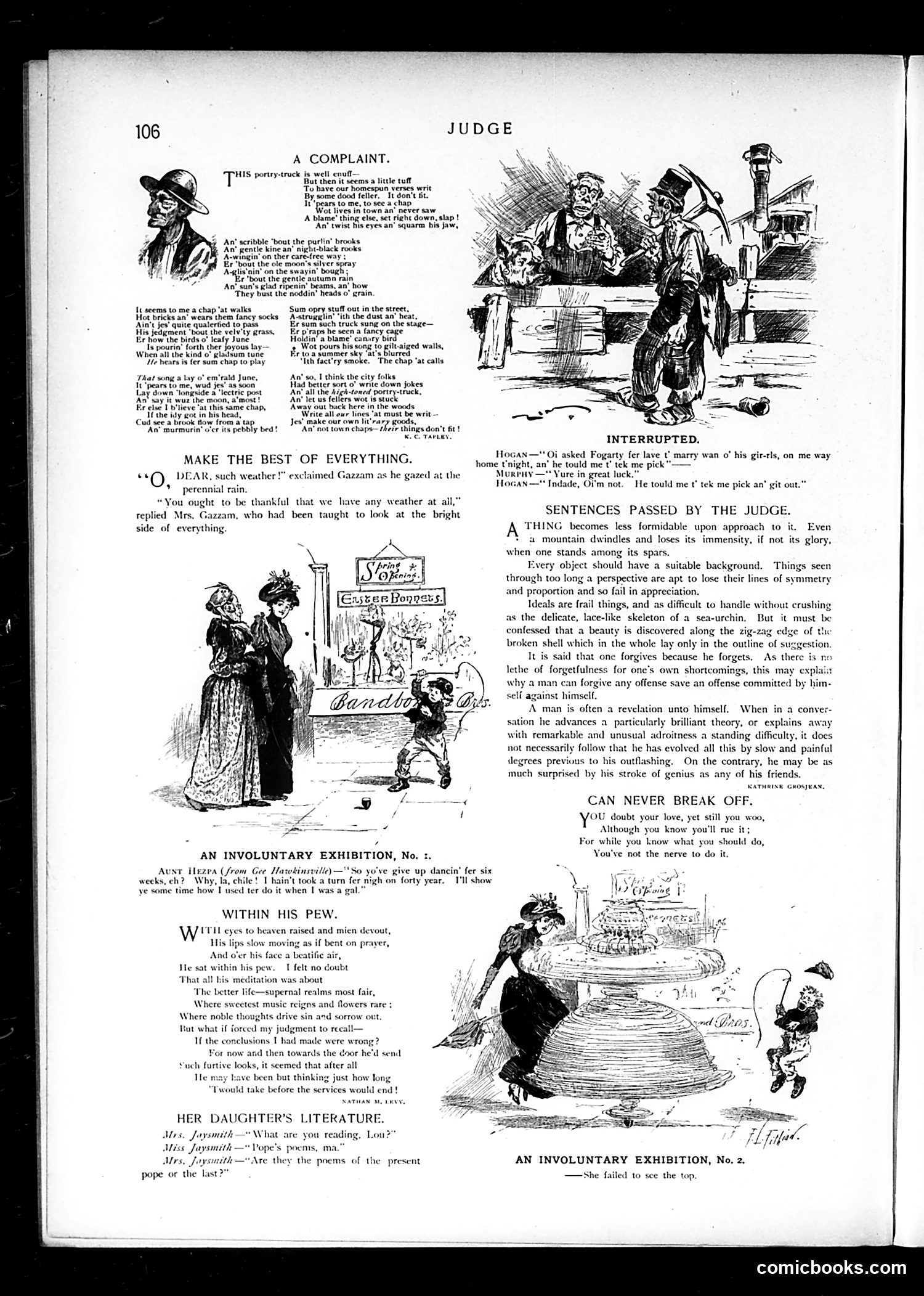
This page from *Judge* magazine contains several satirical pieces: **"A Complaint"** mocks urban poets who write romantically about rural life they've never experienced. A country speaker complains that city dwellers in fancy clothes shouldn't presume to write about "purlin' brooks" and pastoral scenes they only imagine. The satire targets the pretentiousness of urban intellectuals appropriating rural imagery. **"Make the Best of Everything"** shows Mrs. Gazzam's relentless optimism, teaching gratitude even for unpleasant weather—a gentle jab at forced positivity. **Other sketches** include humorous dialogues: an Irish immigrant couple discussing marriage permissions with unfortunate results; a man appearing pious in church while actually eager for services to end; and a daughter reading contemporary poetry to her mother. The overall tone satirizes hypocrisy, pretension, and the gap between appearance and reality in Gilded Age American society—common *Judge* themes targeting both urban elites and their social affectations.
📄 Transcribed text from this page (OCR, searchable)
Machine-transcribed from the original scan — historical spelling and the odd misread are preserved.
A COMPLAINT. HIS portry-truck is well enuff But then it scems a little tuft To have our homespun verses writ By some dood feller. It don't ft. W' pears to me, to see a chap, Vot lives in town an’ never saw A blame’ thing else, set right down, slap ! ‘An’ twist his eyes an’ squarm his jaw, An’ scribble “bout the purlin’ brooks ‘An’ gentle kine an’ night-black rooks ‘A-wingin’ on ther care-free way: Er ‘bout the ole moon's silver spray A-glis'nin’ on the swayin’ bough ; ¢ "bout the gentle autumn rai An’ sun's glad ripenin® beams, an’ how ‘They bust the noddin’ heads o* grain. 11 seems to me a chap at walks Hot bricks an’ wears them fancy socks Ain't jes’ quite qualerfed to pass His jedgment ‘bout the velv'ty grass, Er how the Bids 0 leaty June Is pourin’ forth ther Joyous lay— Wher all the kind o”gladsumtuse Er ‘Te hears s fer sum chap to play ‘Sum opry stuff out inthe street, A-strowelin’ ith the dust anv heat, B7sum such truck sung on the stage— Er prraps he seen a fancy cage ia blame” ca ot pours his song fo gilt-aiged walls, toa summer sky ‘ats blurred ‘ith fact'ry smoke. The chap ‘at calls, That song a lay 0° em'rald June, It ‘pears to. me, wud jes’ as soon Lay down “lonjgside a “lectric post moon, a'most ! his same chap, r s head, Cu see a brook flow from a tap ‘An’ murmurin’ o'er its pedbly bed ! An’ so, I think the city folks Had better sort o' write down jokes An’ all the Aigh-foned portry-truck, ‘An’ let us fellers wot is stuck ‘Away out back here in the woods Write all our lines ‘at must be writ — Jes’ make our own lit'rary goods, ‘An’ rot town chaps— their things don’t fit ! MAKE THE BEST OF EVERYTHING. 66Q)_ DEAR, such weather O perennial rain. You ought to be thankful that we have any weather at all," replied Mrs. Gazzam, who had been taught to look at the bright side of everything. exclaimed zam as he gazed at the é 14) ‘ORR ning 5 Fe Bonnets. 1 A “ is ee w AN INVOLUNTARY EXHIBITION, No. :. Aust HLezea (from kinsville)—"'So yo've give up dancin’ fer six t took a turn fer nigh on forty year. I'll show used ter do it when I was a gal.” WITHIN HIS PEW. W'!T Leyes to heaven raised and mien devout, His lips slow moving as if bent on prayer, And o'er his face a beatific air, I felt no doubt ion was about He sat within his pew ‘That all his medita ‘The better life—supernal realms most fair, Where sweetest music 1 Where noble th s and flowers rare ; hts drive sin and sorrow out. Rut what if forced my judgment to recall— If the conclusions T had made were wro For now and then towards the door he'd send Such furtive looks, it scemed that after all Ie may have been but thinking just how long “Twould take before the services would end! HER DAUGHTER'S LITERATURE. Mors. Jaysmith "What are you reading, Lou?” Miss Jaysmith — Vor th—"Are they the poems of the present 's poems, ma INTERRUPTED. Hocax —"‘Oi asked Fogarty fer lave t’ marry wan o' his gir-rls, on me way home t' —_ Murray — Hogan ight, an’ he tould me t’ tek me pi Vure in great luck.” *Indade, Oi'm not. He tould me t’ tek me pick an’ git out.” SENTENCES PASSED BY THE JUDGE. THING becomes less formidable upon approach to it. Even a mountain dwindles and loses its immensity, if not its glory, when one stands among its spars. Every object should have a suitable background. Things seen through too long a perspective are apt to lose their lines of symmetry and proportion and so fail in appreciation. Ideals are frail things, and as difficult to handle without crushing as the delicate, lace-like skeleton of a sea-urchin, But it must be confessed that a beauty is discovered along the zig-zag e¢ broken shell which in the whole lay only in the outline of sugg It is said that one forgives because he forgets. As there is lethe of forgetfulness for one’s own shortcomings, this may why a man can forgive any offense save an offense committed by him- self agai nselt. A man is often a revelation unto himself. When in a conver- sation he advances a particularly brilliant theory, or explains away with remarkable and unusual adroitness a standing difficulty, it docs not necessarily follow that he has evolved all this by slow and degrees previous to his outflashing. On the contrary, much surprised by his stroke of genius as any of his friend: CAN NEVER BREAK OFF. YOU doubt your love, yet still you woo, Although you know you'll ruc it; For while you know what you should do, ¢ not the nerve to do it. AN INVOLUNTARY EXHIBITION, No. 2. —She failed 10 sce the top. comicbooks.com