
A complete issue · 16 pages · 1890
Judge — May 10, 1890
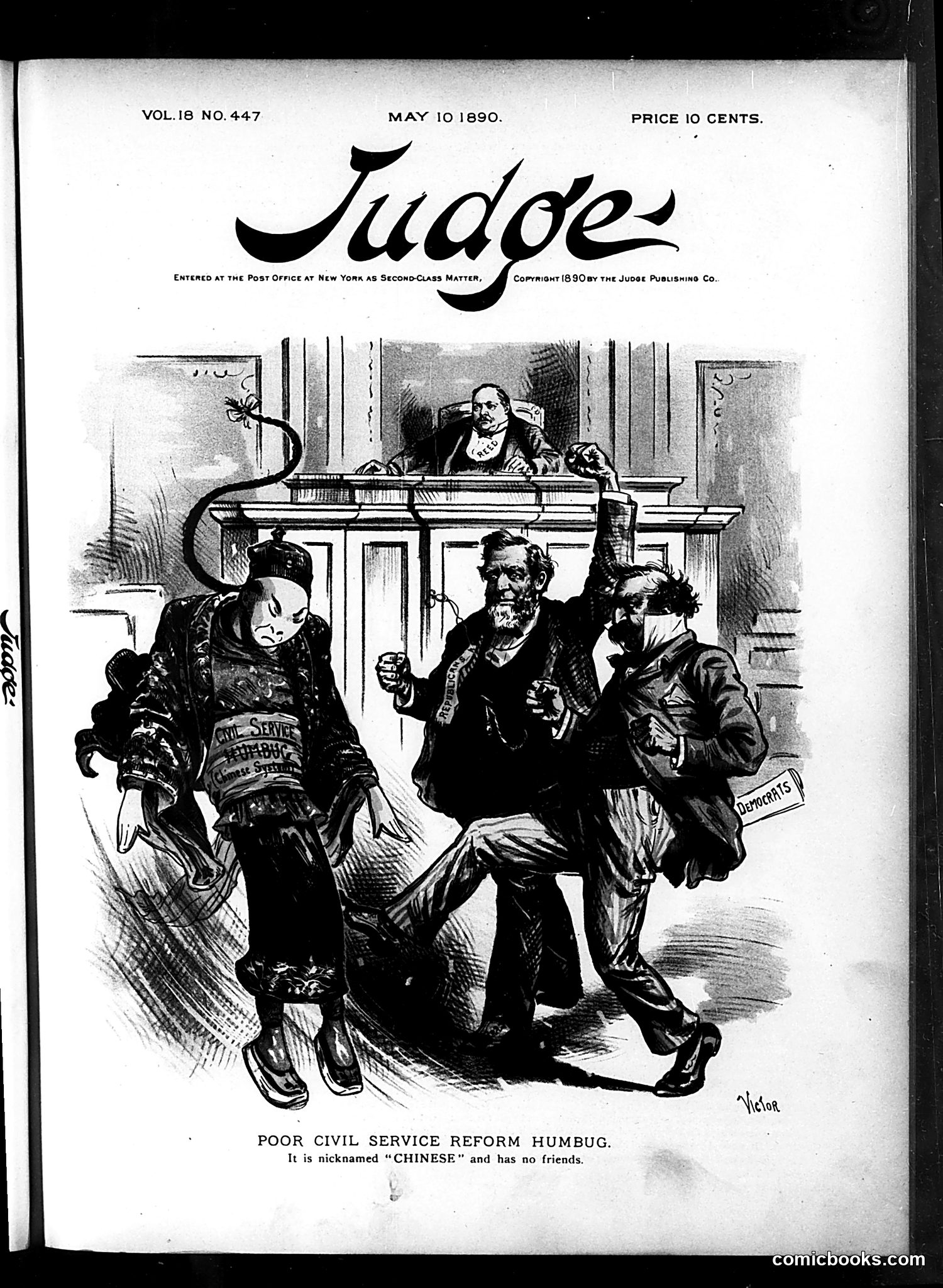
This 1890 *Judge* cartoon satirizes civil service reform efforts as ineffective. A judge presides from the bench while three men below—labeled with references to "Civil Service" and "Appointments"—appear to be in conflict or distress, suggesting the reform process is chaotic rather than improving governance. The caption calls reform a "humbug" "nicknamed 'CHINESE'" with "no friends," implying the policy was unpopular and foreign to American practice. The cartoon criticizes that despite reform rhetoric, patronage and political favoritism still dominated appointment processes. The judge observing from above may represent the public or press watching these failures unfold, unable to enforce actual change.
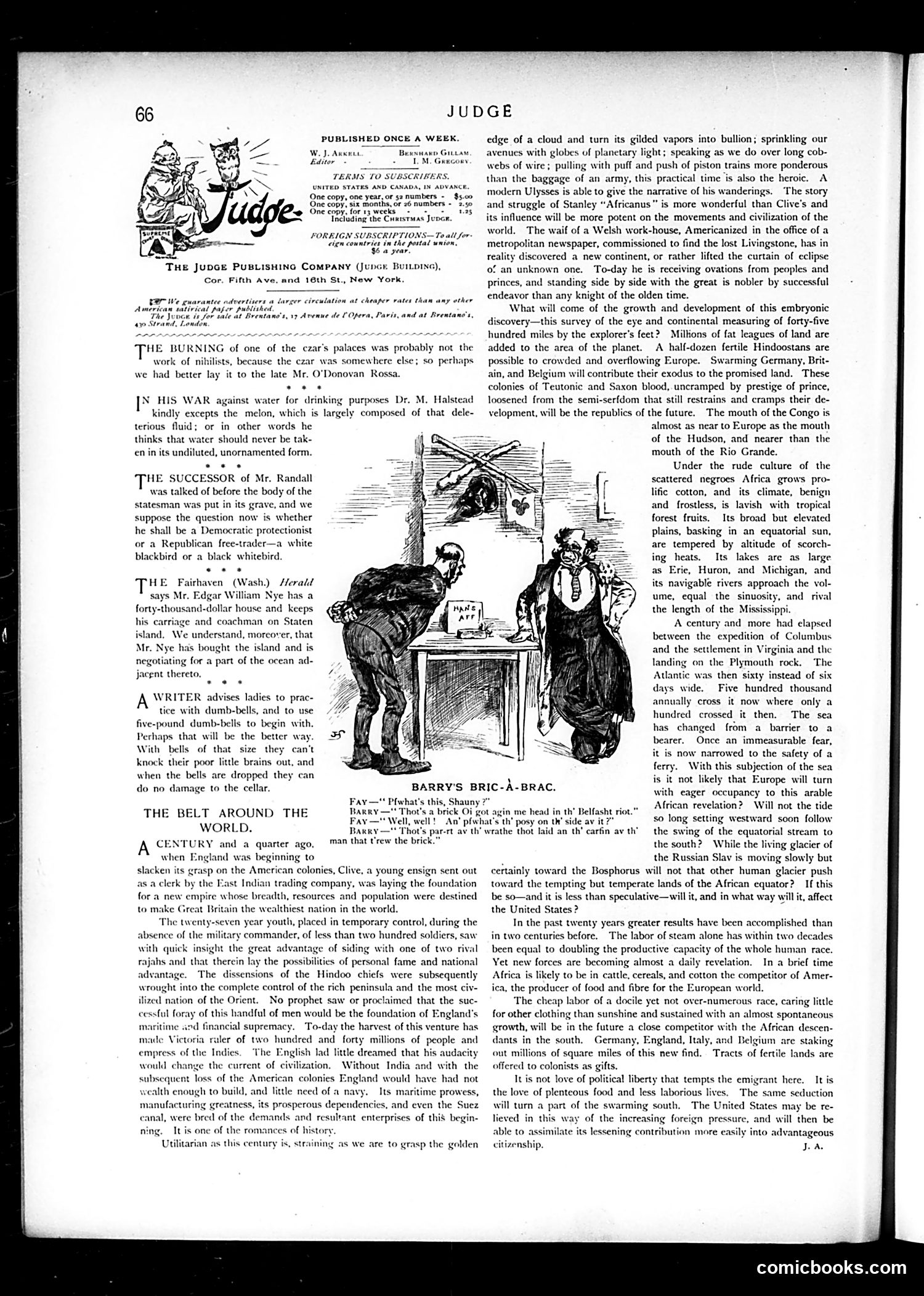
This page contains several satirical pieces and a prominent cartoon titled "Barry's Bric-à-Brac." The main illustration depicts two figures at what appears to be a bar or counter—one appears to be a bartender or server, the other a customer. The dialogue below suggests a humorous exchange about drinks and their effects. The surrounding text discusses serious political and colonial matters: the burning of a Russian palace, debates about Mr. Randall's political successor, and extensive commentary on American colonial expansion in Africa and the potential of African resources for European development. The juxtaposition of lighthearted bar humor with weighty imperialist discourse reflects Judge's characteristic satirical approach—using comedy to comment on contemporary political debates about American expansion and colonialism in the late 19th/early 20th century.
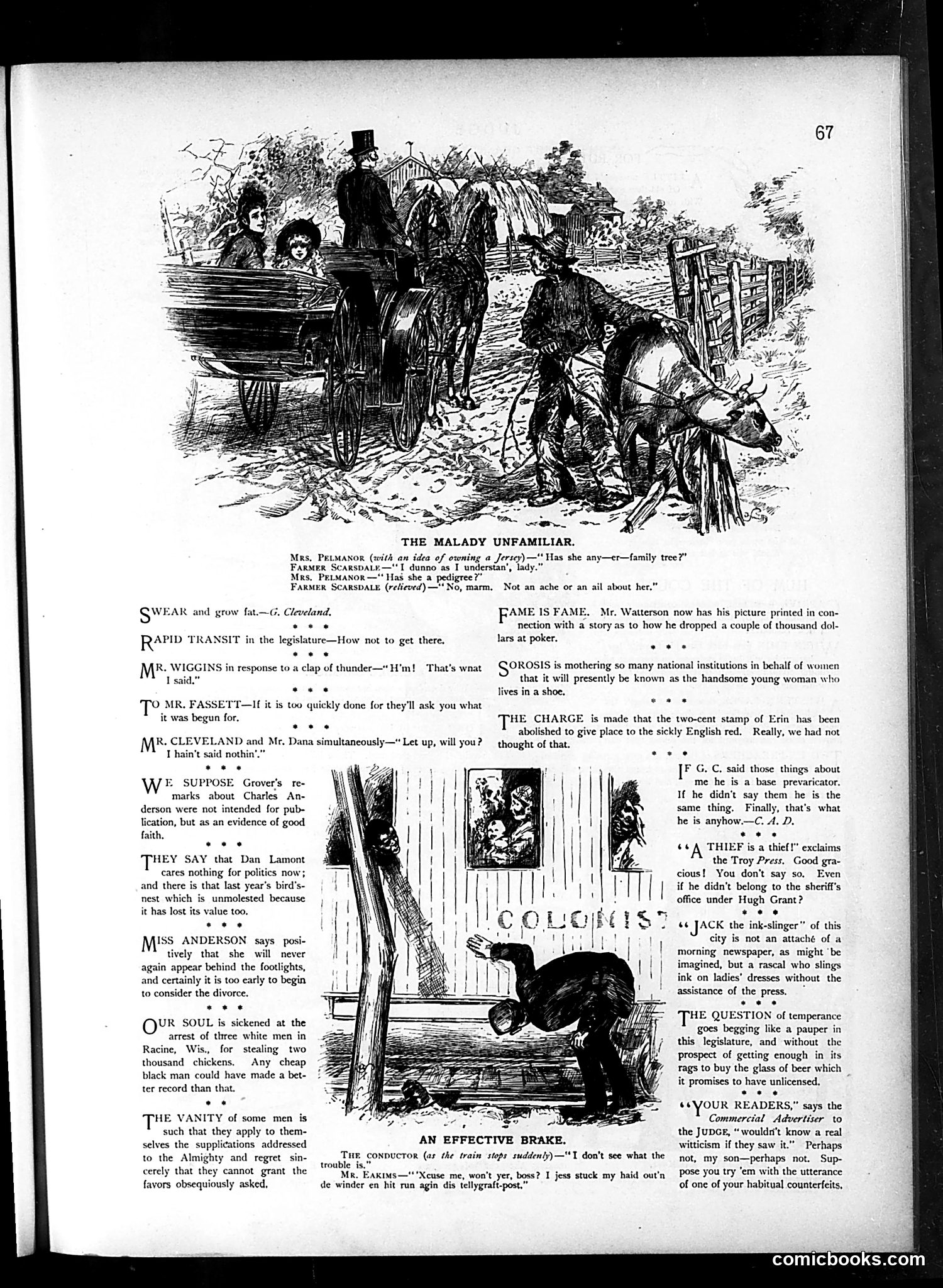
This page contains two distinct satirical pieces: **"The Malady Unfamiliar"** (top): A cartoon depicting rural/farming characters discussing a woman's unfamiliar appearance or behavior. The humor appears to derive from country folk encountering something outside their experience. **"An Effective Brake"** (bottom): Shows a man apparently stuck or trapped, with a conductor making a railway reference ("I don't see what the trouble is"). This likely satirizes either a transportation problem or uses the train scenario as metaphor for some social/political issue. The right column contains brief satirical commentary on contemporary topics—mentions of politics, poker, women's institutions, and newspaper editors—typical of Judge's format of short, punchy social critiques. Without more contextual documentation, the specific political figures or events referenced remain unclear.
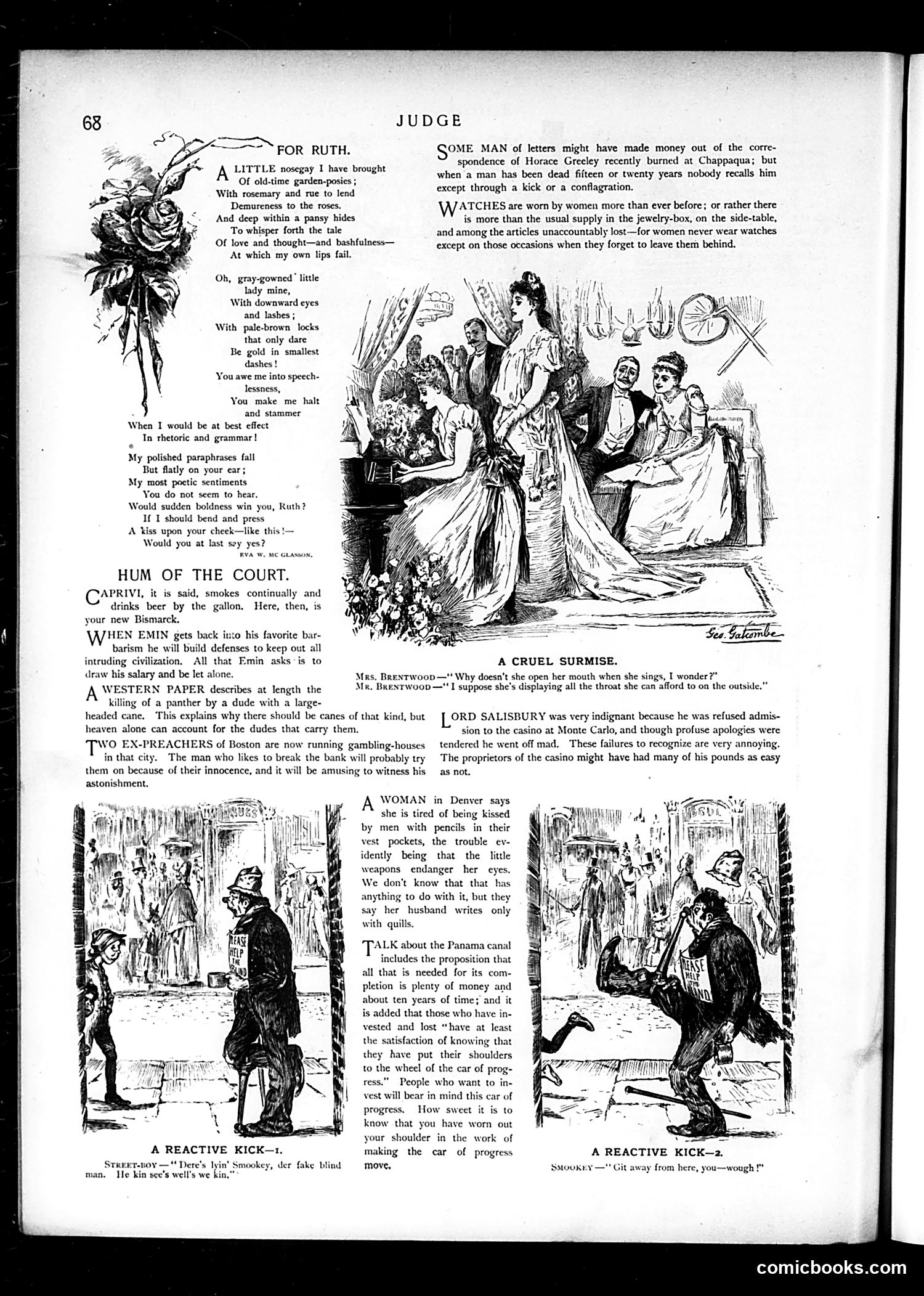
This page from the satirical magazine *Judge* contains several brief humor pieces targeting contemporary figures and social issues: **"A Cruel Surmise"** mocks a woman's singing ability through a joke about her closed mouth while performing—implying her throat appearance wouldn't improve the performance. **Political/Social Commentary** includes jabs at: - Lord Salisbury's rejection from Monte Carlo casino (British nobility embarrassment) - The Panama Canal project, satirizing investors as naive, sacrificing their efforts for dubious returns - A Denver woman kissed by men with pencils in pockets, endangering her eyes—absurdist humor about workplace hazards **"A Reactive Kick"** cartoons show street scenes with apparent vagrant or street-character interactions, using period dialect humor. The page also includes a romantic poem "For Ruth" and miscellaneous court gossip about figures like Caprivi and Emin Pasha. Overall, it's typical of *Judge's* light satirical approach—mixing social observation, political figures, and absurdist humor for American audiences of the era.
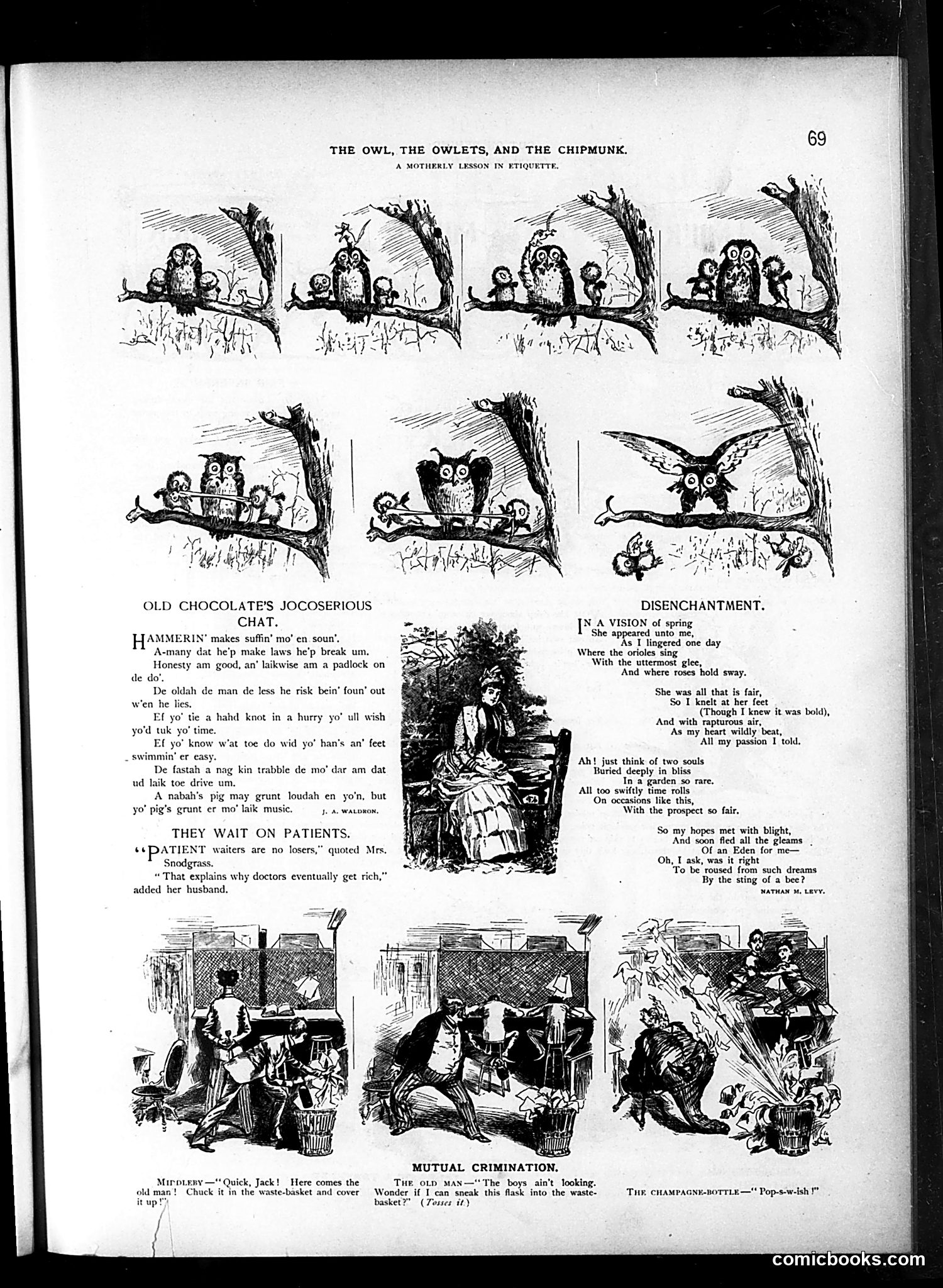
This page contains three separate humorous pieces typical of Judge's satirical style: **"The Owl, The Owlets, and the Chipmunk"** (top): A visual sequence showing an owl mother instructing her young on etiquette—likely a metaphor for human parenting and social instruction through animal characters. **"Old Chocolate's Jocose Chat"** (left middle): Dialect humor featuring an elderly Black speaker offering folksy wisdom about human nature—a common but problematic stereotype of the era. The jokes concern lying, effort, and natural behavior. **"Disenchantment"** (right middle): A romantic poem about a man's spring dreams shattered when a bee stings him—sentimental verse satirizing romantic idealism. **"They Wait on Patients"** and **"Mutual Crimination"** (bottom): Short joke sequences about waiters/servants and workplace mischief, depicting class dynamics and petty workplace corruption—the final image showing someone hiding alcohol (the champagne bottle "wishes" to escape). The page reflects Victorian-era American humor: animal fables, dialect comedy, romantic satire, and working-class hijinks.
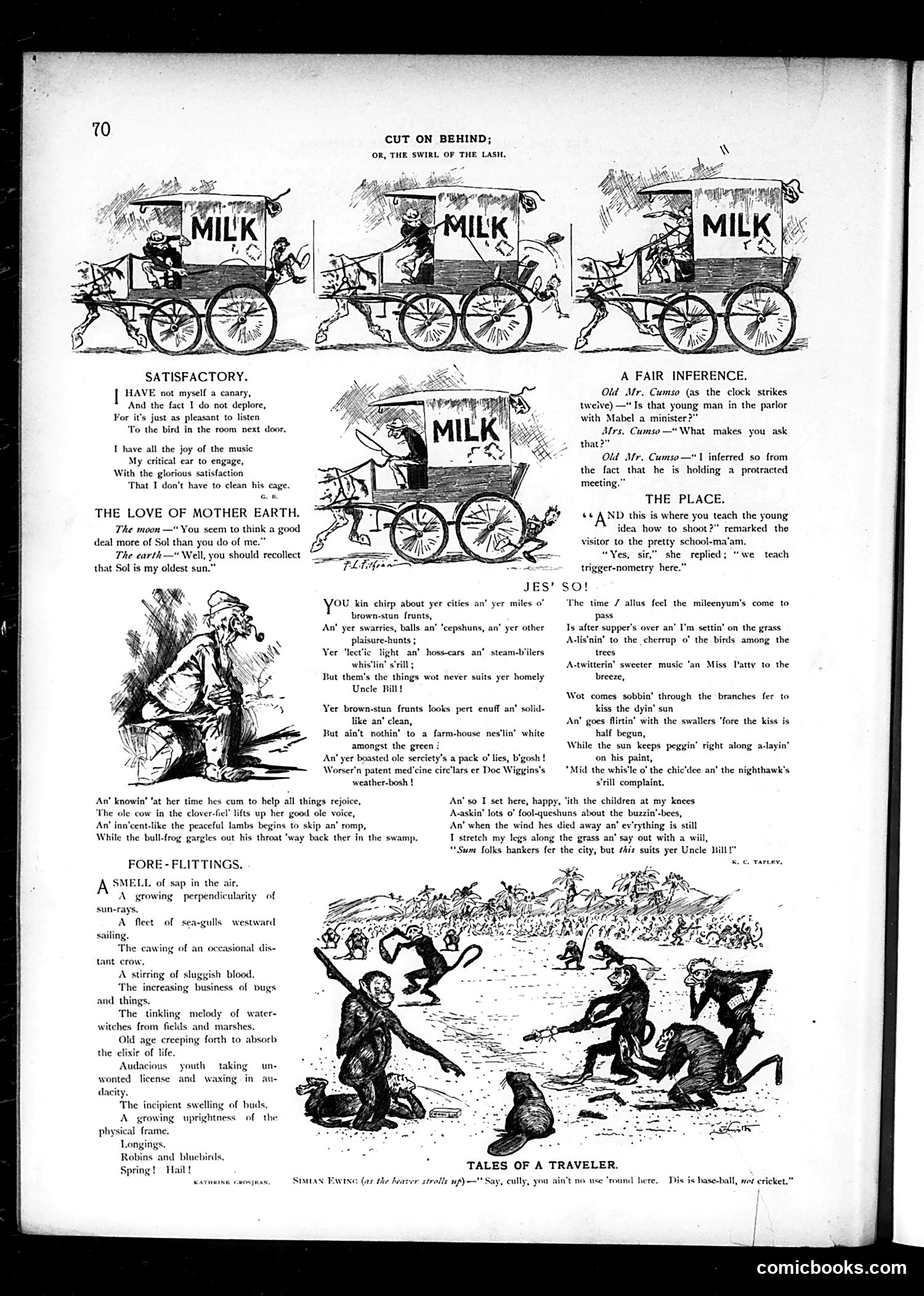
This page satirizes courtship and social pretense through several jokes. The top section shows a milk wagon being pulled by increasingly chaotic horses and figures, illustrating slapstick humor about loss of control. The "Fair Inference" joke mocks young men courting women: Mr. Cumso assumes the parlor visitor is a minister because he's holding a "protracted meeting" (religious terminology) with Mabel—satirizing how long-winded suitors lingered during calls. The school joke plays on "trigger-nometry," pun-based humor about teaching marksmanship. "Jes' So!" celebrates rural simplicity over urban sophistication—Uncle Bill rejects city "swarries" and "brown-stun frunts" (brownstone fronts) in favor of farm life, nature sounds, and family. This reflects period tension between rural and urban values, celebrating agrarian simplicity as morally superior to fashionable city pretense. The poems celebrate pastoral spring imagery and homespun wisdom, typical of Judge magazine's mix of humor, sentiment, and social observation for middle-class readers nostalgic for rural life.
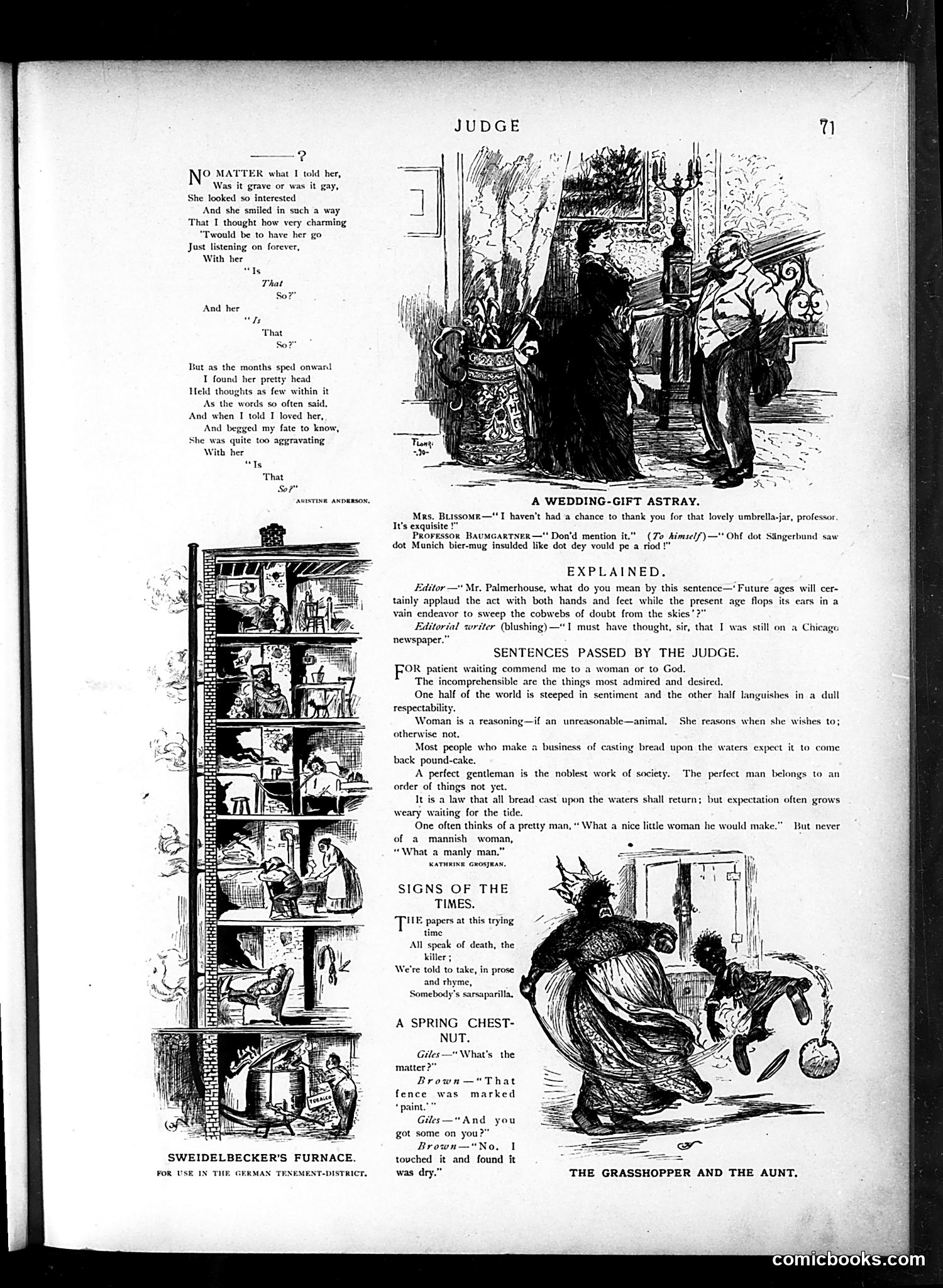
This page contains multiple satirical pieces typical of Judge magazine's humor: **"A Wedding-Gift Astray"** mocks a German professor (likely an immigrant, given the dialect spelling "dot" for "that") who receives credit for an umbrella jar he didn't give, while secretly lamenting a lost beer mug from Munich's Saingerbund (singing society). **"Sentences Passed by the Judge"** offers aphoristic social commentary on women's reasoning, sentimentality, and expectations—typical Victorian-era gender satire. The quip about casting bread upon waters returning as pound-cake mocks people's unrealistic hopes. **"Signs of the Times"** satirizes newspapers exploiting fear about crime ("death, the killer") to advertise patent medicines like sarsaparilla. **"Sweidelbecker's Furnace"** appears to reference German immigrant housing conditions in tenement districts. The illustrations, including "The Grasshopper and the Aunt," suggest Aesop's fable adaptations. Overall, the page targets immigrants (Germans specifically), Victorian sentimentality, and commercial quackery.
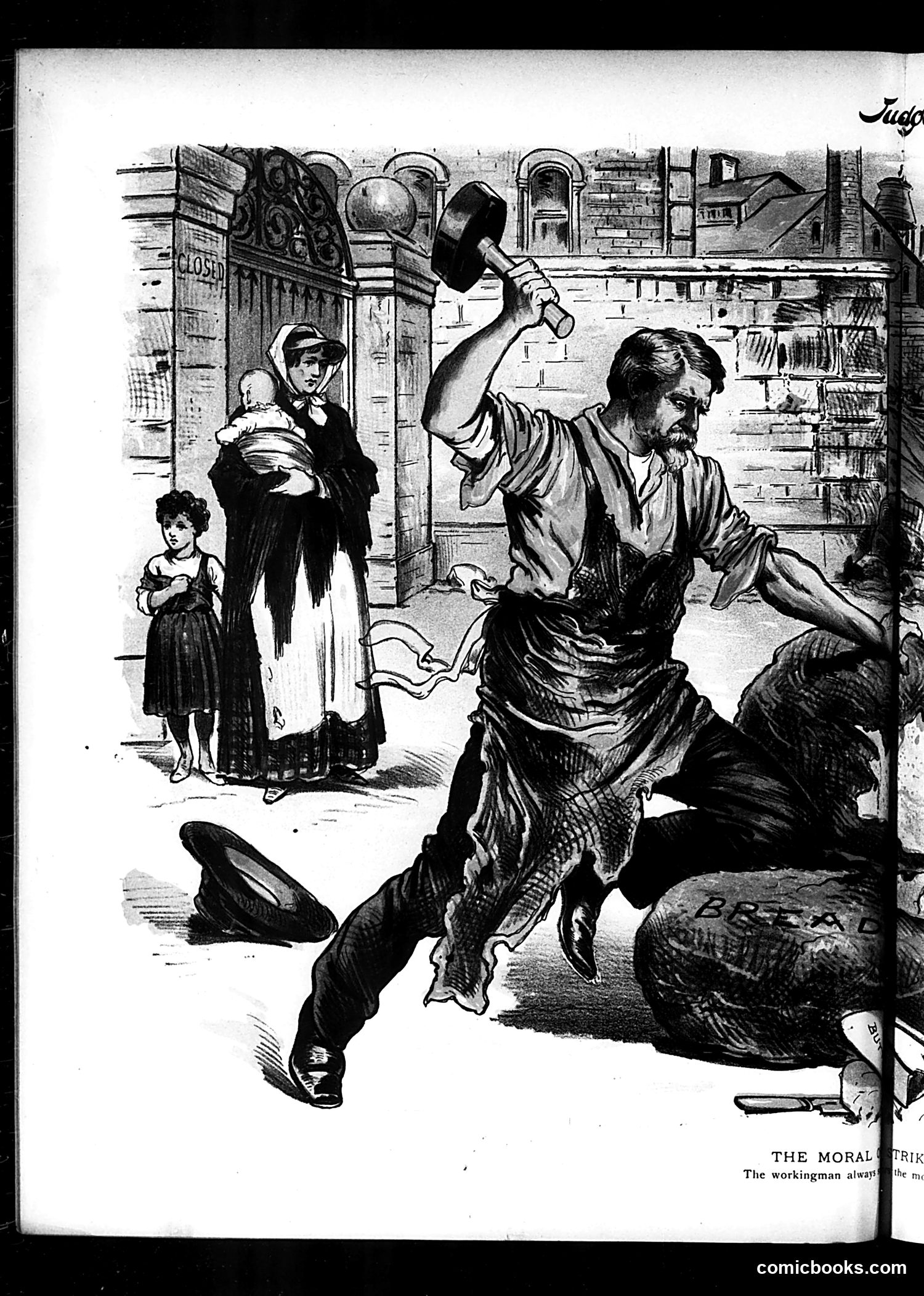
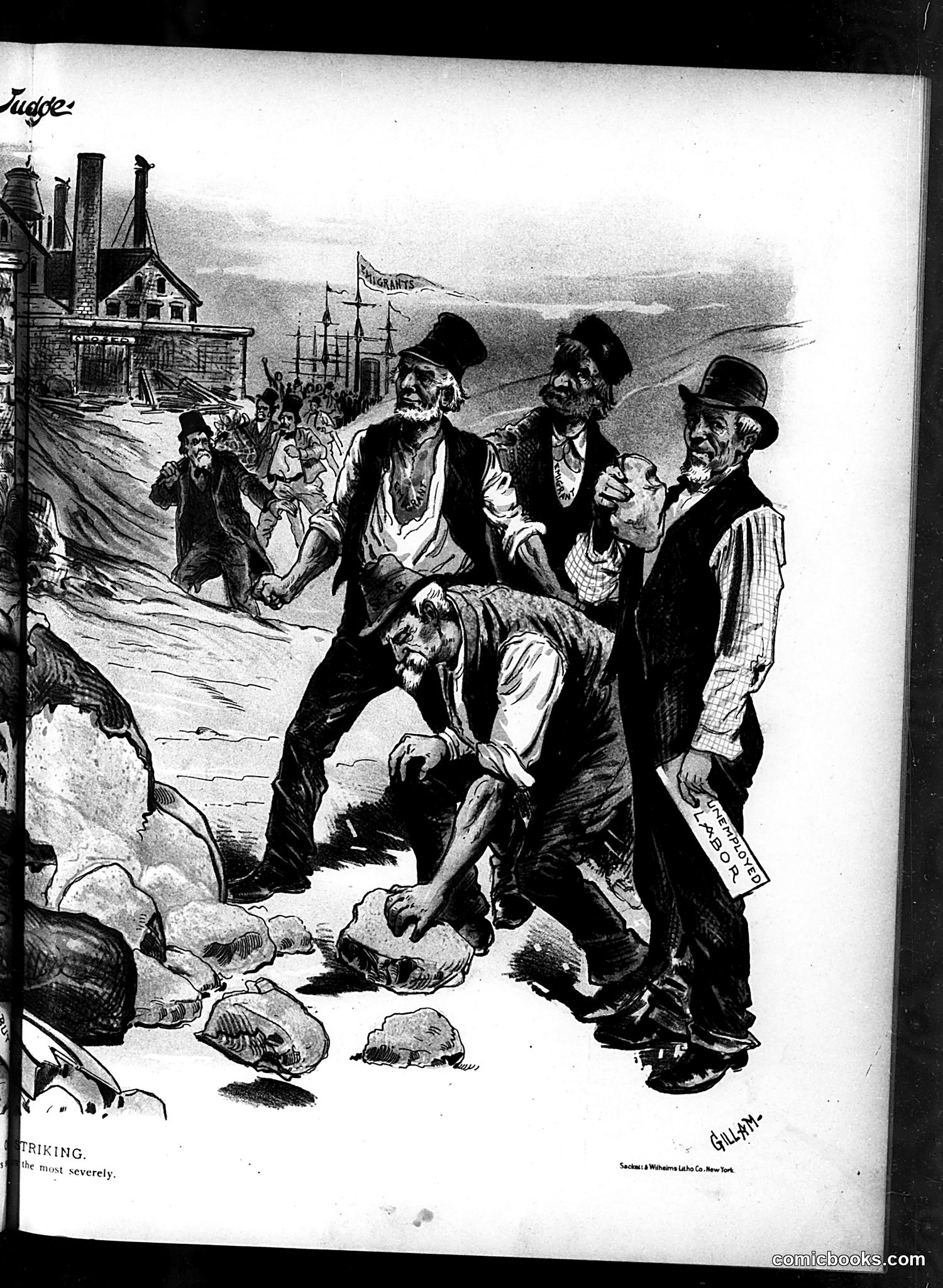
This political cartoon depicts striking workers and their supporters gathered at what appears to be a waterfront or industrial site (note the factory and flags in background). The exaggerated facial features and caricatured style was typical of 19th-century satirical imagery, though by modern standards such depictions appear offensive. The title "Striking" references labor unrest. The well-dressed men surrounding a fallen or distressed worker suggest either union organizers, politicians, or wealthy observers of labor disputes. The cartoon likely satirizes either worker militancy or, conversely, the indifference of authorities to labor suffering—Judge magazine's stance on this particular issue is unclear from the image alone. The rocky, barren setting emphasizes hardship.
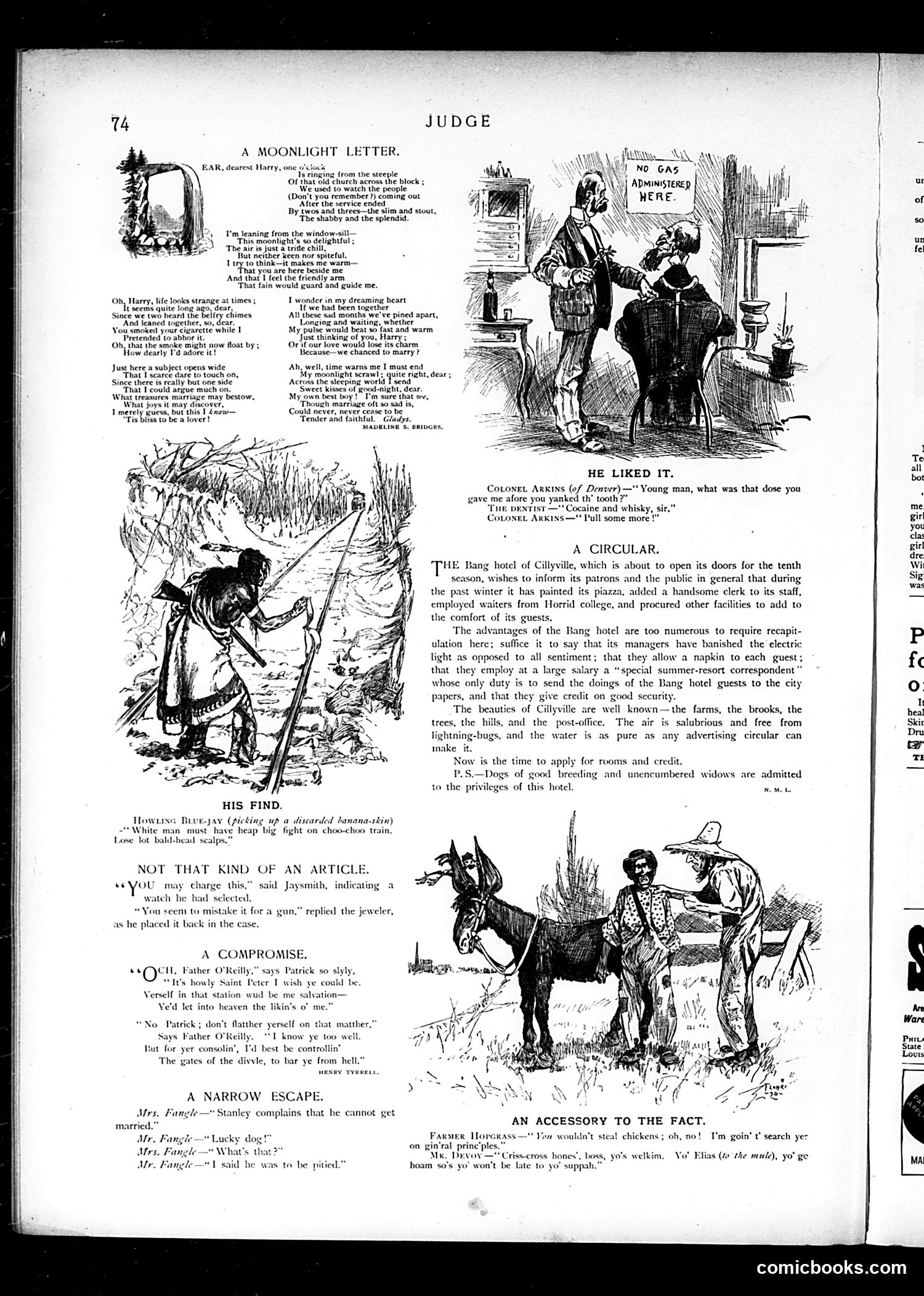
This page from **Judge** magazine contains several brief humorous pieces typical of late 19th-century American satire: **"A Moonlight Letter"** is a sentimental poem by Madeline S. Bridges about a woman writing to her absent lover Harry, reflecting on their relationship and wondering if marriage would diminish their romance—a common Victorian theme about love versus domesticity. **"He Liked It"** jokes about a Denver colonel who receives cocaine and whisky before tooth extraction, then asks the dentist to "pull some more"—satirizing both frontier roughness and the casual use of drugs in dentistry. **"A Circular"** mocks pretentious small-town hotels advertising dubious amenities like banning electric lights as "unromantic" and extending credit "on good security." **"Not That Kind of Article"** is a brief joke about a customer mistaking a jeweler's watch for a gun. The remaining pieces are similarly brief, pun-based humor. The illustrations are generic Victorian-era line drawings accompanying the text. Overall, the page reflects Judge's focus on genteel domestic humor and social satire rather than hard political commentary.
This page is primarily **advertisements and filler content** rather than political satire. The main content includes: **"Carl Pretzel's Philosophy"** — A recurring humor column featuring a German-accented character offering homespun wisdom in deliberately garbled English ("It vos a shplainded shtudy"). This represents period-typical ethnic humor common in late 19th-century American magazines, using exaggerated dialect for comedic effect. The remaining content consists almost entirely of **product advertisements** (Castoria, Packer's Tar Soap, Sohmer Pianos, various patent medicines and liquors) and reprinted humorous snippets and poetry from other publications. There are **no identifiable political cartoons or caricatures** on this page—no public figures, no pointed social commentary beyond mild domestic humor. The page demonstrates how Judge magazine filled space: mixing light comedy with extensive advertising revenue from patent medicines and consumer goods popular in the Gilded Age.
This is primarily a **advertisements and notices page** from Judge magazine, with one brief anecdote. The main content includes patent medicine ads (Scott's Emulsion for consumption, remedies for obesity and rupture), typewriters, bicycles, and carriages—typical late 19th-century commercial pitches. The sole satirical element is a short **dialogue joke** about inherited wealth: A man explains his great fortune was lost first to a dishonest cashier's embezzlement, then to a corrupt court-appointed receiver. The humor targets **corruption in both private business and the legal system**—suggesting that the average person cannot trust either their employees or the courts meant to protect them. The anecdote about "the Blizzard" appears to be a testimonial for a patent medicine for stomach trouble, following the magazine's typical advertising format.
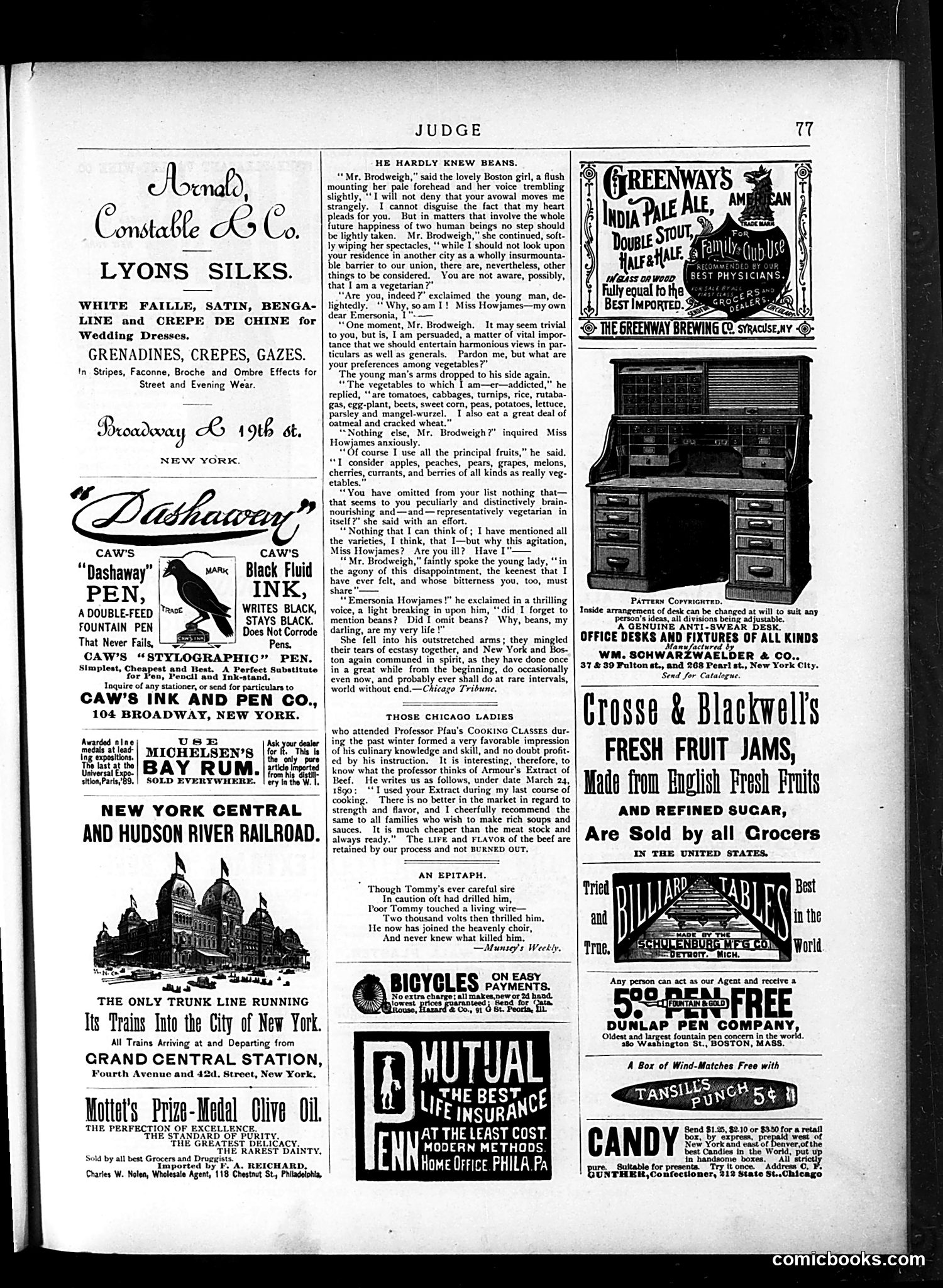
This page is primarily **advertisements** with one satirical story titled "He Hardly Knew Beans." The story mocks pretentious Boston intellectuals and their obsession with vegetarianism as a marker of refined, philosophical living. A Boston girl tests her suitor's worthiness by interrogating his vegetable preferences, treating dietary choices as spiritually significant. The joke's absurdity peaks when she nearly rejects him for omitting beans—apparently the ultimate "brain-nourishing" vegetable for proper vegetarians. The satire targets: snobbish New England intellectuals, vegetarian ideology presented as affected and ridiculous, and the tendency to make trivial matters into tests of compatibility and moral character. The resolution—both declaring beans central to their lives—mocks how easily such "principled" people compromise when romance is at stake. The punchline: their shared passion for beans (mundane, lowbrow) contradicts their pretensions to refined vegetarian philosophy.
This page is primarily **advertisements and filler content** rather than editorial cartoons or satire. The text section titled "DON'T Get Funny" is light satirical advice poetry (credited to St. Paul Pioneer Press) warning readers against excessive joking, exaggeration, and affected speech in conversation—a gentle social commentary on Victorian-era propriety and the annoyance of affected humor. A brief anecdote about a Kansas banker illustrates frontier skepticism: a stranger inquiring to open a "private bank" is refused because previous such renters' depositors have lynched the bankers, damaging the property. This reflects **real historical concerns about banking fraud and frontier vigilante justice** in late 19th-century America. The remainder consists of product advertisements: cough remedies, tea, collars, pianos, razors, bicycles, and cosmetics—typical Judge magazine content. No major political figures or sustained satirical commentary appear on this page.
This page is primarily **advertising**, not editorial content or political cartoons. It comprises various commercial advertisements from the late 19th/early 20th century. Notable ads include: - **Van Houten's Cocoa**: Emphasizing European quality and global sales - **Beecham's Pills**: A patent medicine claiming to cure digestive and nervous disorders - **Dr. Williams' Indian Pile Ointment**: A remedy for hemorrhoids - **Crandall & Co.**: Wholesale/retail dealer - **Highland Beach**: A new resort development on Sandy Hook peninsula - **Lithographed Office Stationery**: Printing services The page also contains brief humorous items (anecdotes about rats and dish-washing) typical of Judge's filler content. The **"Indian Pile Ointment"** and similar patent medicines reflect the era's largely unregulated medical marketplace, before FDA oversight. References to "Indian" remedies were common marketing tropes suggesting natural or folk effectiveness. This represents a typical monetized magazine page balancing editorial space with revenue-generating advertisements.
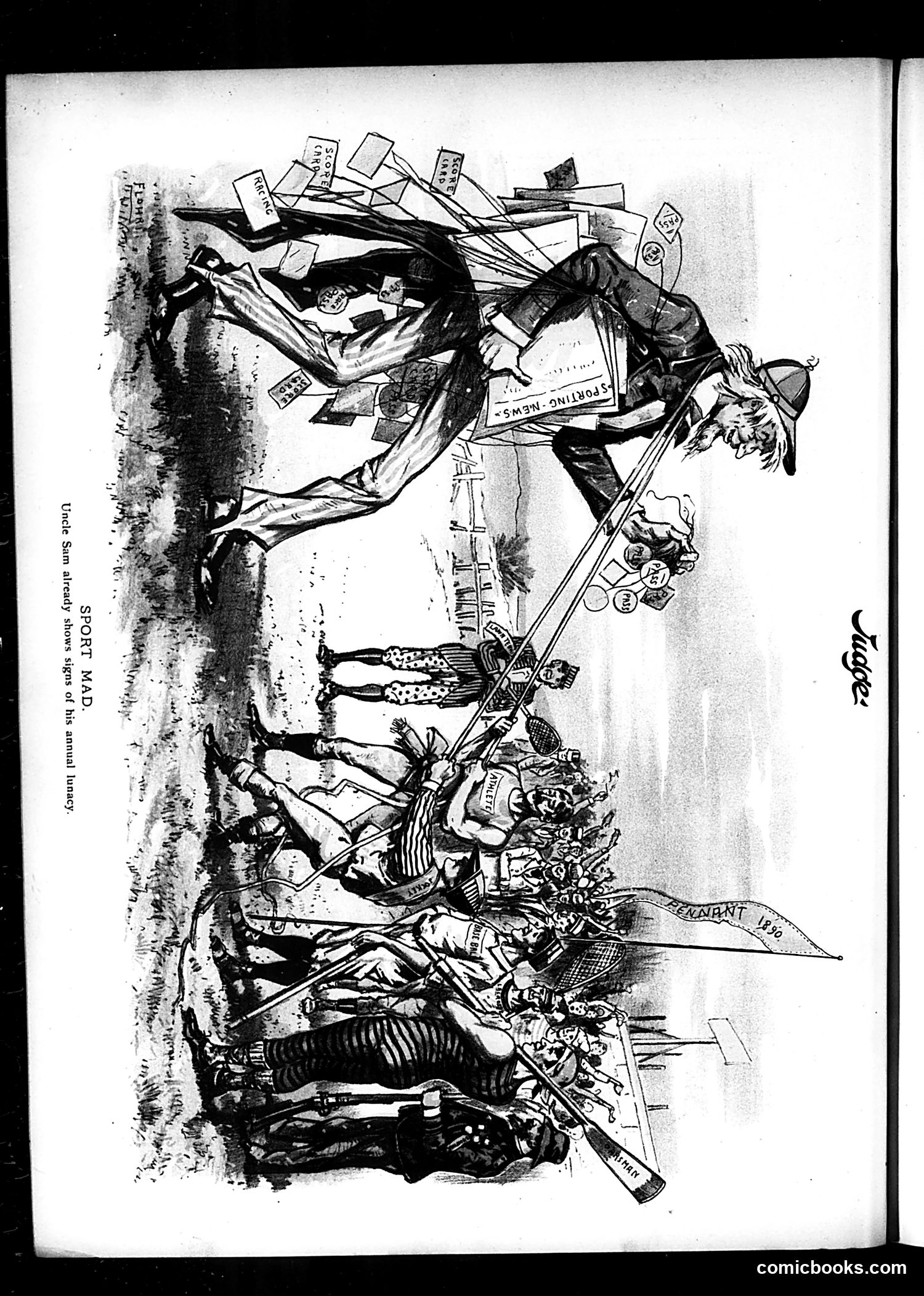
This satirical cartoon depicts **Uncle Sam** (the personified United States) surrounded by chaotic scenes of athletic excess and gambling-related madness. The figure appears disheveled and overwhelmed, buried under scattered papers, money, and sporting equipment—suggesting America's obsession with sports. The caption "Uncle Sam already shows signs of his annual lunacy" indicates this was likely published during a major sports season (possibly baseball's World Series or similar annual sporting event). The satire mocks how Americans become irrationally consumed by sports competition, losing their composure and good judgment during "sport mad" season. The scattered documents and financial imagery suggest concerns about gambling, wasted resources, and the frivolous distraction sports betting represents—a critique of how national focus shifts from serious matters to sporting spectacle.