
Judge, 1890-05-10 · page 2 of 16
Judge — May 10, 1890 — page 2: what you’re looking at
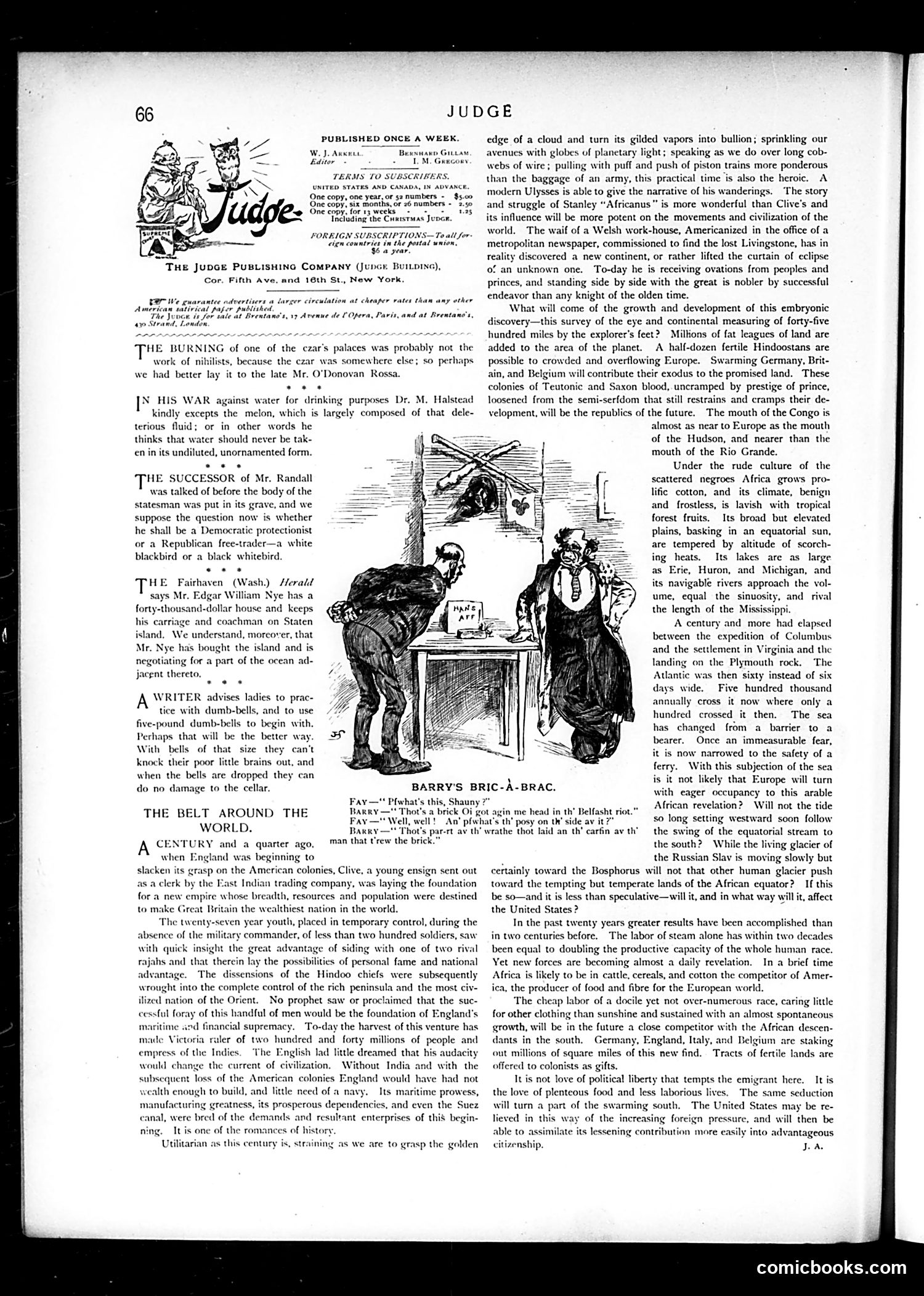
What you’re looking at
This page contains several satirical pieces and a prominent cartoon titled "Barry's Bric-à-Brac." The main illustration depicts two figures at what appears to be a bar or counter—one appears to be a bartender or server, the other a customer. The dialogue below suggests a humorous exchange about drinks and their effects. The surrounding text discusses serious political and colonial matters: the burning of a Russian palace, debates about Mr. Randall's political successor, and extensive commentary on American colonial expansion in Africa and the potential of African resources for European development. The juxtaposition of lighthearted bar humor with weighty imperialist discourse reflects Judge's characteristic satirical approach—using comedy to comment on contemporary political debates about American expansion and colonialism in the late 19th/early 20th century.
📄 Transcribed text from this page (OCR, searchable)
Machine-transcribed from the original scan — historical spelling and the odd misread are preserved.
JUD PUBLISHED ONCE A WEEK. W. J. Ace Bexnwaxn Gita Editor LM . TERMS TO SUBSCRIBERS. UNITED STATES AND CANADA, IN ADVANCE. One copy, one year, or s2 numbers = $5.00 One copy, six months, or 26 numbers - "2.50 ‘One copy: forty weeks = == 1.35, Including the Curistatas Jena. FOREIGN SUBSCRIPTIONS—To all for- ign countries in the postal union. $6 a year. THE JUDGE PUBLISHING COMPANY (JunGE BUILDING), Cor. Fifth Ave, and 16th St., New York. ERI guarantee advertisers a larger circulation at cheaper rates the ‘or published London any other and at Brentano's, 49 Strand, HE BURNING of one of the czar’s palaces was probably not the work of nihilists, because the czar was somewhere else; so perhaps we had better lay it to the late Mr. O'Donovan Rossa. N HIS WAR against water for drinking purposes Dr, M. Halstead kindly excepts the melon, which is largely composed of that dele- terious fluid; or in other words he thinks that water should never be tak- en in its undiluted, unornamented form. HE SUCCESSOR of Mr. Randall was talked of before the body of the statesman was put in its grave, and we suppose the question now is whether he shall be a Democratic protectionist or a Republican free-trader—a white blackbird or a black whitebird. HE Fairhaven (Wash.) Herald says Mr. Edgar Wil forty-thousand-dollar house and kee; his carriage and coachman on Staten We understand, moreover, that Mr. Nye has bought the island and is negotiating for a part of the ocean ad- jacent thereto, island, WRITER advises ladies to prac- tice with dumb-bells, and to use five-pound dumb-bells to begin with, Perhaps that will be the better way. With bells of that size they can’t knock their poor little brains out, and when the bells are dropped they can do no damage to the cellar. —** Pfwhat's this, THE BELT AROUND THE WORLD. CENTURY and a quarter ago, when England was beginning to slacken its grasp on the American colonies, Clive, a young ensign sent out as a clerk by the East Indian trading company, was laying the foundation for a new empire whose breadth, resources and population were destined to make Great Britain the wealthiest nation in the world. The twenty-seven year youth, placed in temporary control, during the absence of the military commander, of less than two hundred soldiers, saw with quick insight the great advani —"* Well, well ! man that t'rew the brick.” ge of siding with one of two rival s and that thercin lay the possibilities of personal fame and national advantage. The dissensions of the Hindoo chiefs were subsequently wrought into the complete control of the rich peninsula and the most civ- ilized nation of the Orient. No prophet saw or proclaimed that the suc- cessful foray of this handful of men would be the foundation of England’s maritime and financial supremacy. To-day the harvest of this venture has made Victoria raler of two hundred and forty millions of people and empress of the Indies. ‘The English lad little dreamed that his audacity would change the current of civilization, Without India and with the subsequent loss of the American colonies England would have had not wealth enough to build, and little need of a navy manufacturing greatness, its prosperous dependenci nal, were bred of the demands and resultant enterprises of thi begin- ning. It is one of the romances of histor Utilitarian as this century is, strainin: Its maritime prowess, and even the Suez AS We are to grasp the golden BARRY'S BRIC-A-BRAC. Shauny 7” Thot's a brick Oi got ag An’ pfwhat's th’ posy on th’ side av it?” Thot's par-rt av th’ wrathe thot laid an th’ carfin av th’ GE edge of a cloud and turn its gilded vapors into bullion; sprinkling our avenues with globes of planetary light; speaking as we do over long cob- webs of wire; pulling with puff and push of piston trains more ponderous than the baggage of an army, this practical time is also the heroic. A modern Ulysses is able to give the narrative of his wanderings. The story and struggle of Stanley “Africanus” is more wonderful than Clive’s and its influence will be more potent on the movements and civilization of the world. The waif of a Welsh work-house, Americanized in the office of a metropolitan newspaper, commissioned to find the lost Livingstone, has in reality discovered a new continent, or rather lifted the curtain of eclipse of an unknown one. To-day he is receiving ovations from peoples and princes, and standing side by side with the great is nobler by successful endeavor than any knight of the olden time. What will come of the growth and development of this embryonic discovery—this survey of the eye and continental measuring of forty-five hundred miles by the explorer’s feet? Millions of fat leagues of land are added to the area of the planet. A half-dozen fertile Hindoostans are possible to crowded and overflowing Europe. Swarming Germany, Brit- ain, and Belgium will contribute their exodus to the promised land. These colonies of Teutonic and Saxon blood, uncramped by prestige of prince, loosened from the semi-serfdom that still restrains and cramps their de- velopment, will be the republics of the future. The mouth of the Congo is almost as near to Europe as the mouth of the Hudson, and nearer than the mouth of the Rio Grande. Under the rude culture of the scattered negroes Africa grows pro- lific cotton, and its climate, benign and frostless, is lavish with tropical forest fruits. Its broad but elevated plains, basking in an equatorial sun, are tempered by altitude of scorch- ing heats. Its lakes are as large as Erie, Huron, and Michigan, and its navigable rivers approach the vol- ume, equal the sinu i the length of the Mississippi. A century and more had elapsed between the expedition of Columbus and the settlement in Virginia and the landing on the Plymouth rock. The Atlantic was then sixty instead of six days wide. Five hundred thousand annually cross it now where only a hundred crossed it then. The sea has changed from a barrier to a bearer. Once an immeasurable fear, it is now narrowed to the safety of a ferry. With this subjection of the sea is it not likely that Europe will turn with eager occupancy to this arable African revelation? Will not the tide so long setting westward soon follow the swing of the equatorial stream to the south? While the living glacier of the Russian Slav is moving slowly but certainly toward the Bosphorus will not that other human glacier push toward the tempting but temperate lands of the African equator? If this be so—and it is less than speculative—will it, and in what way will it, affect the United States In the past twenty years greater results have been accomplished than in two centuries before. The labor of steam alone has within two decades been equal to doubling the productive capacity of the whole human race. Yet new forces are becoming almost a daily revelation. In a brief time Africa is likely to be in cattle, cereals, and cotton the competitor of Amer- ica, the producer of food and fibre for the European world, The cheap labor of a docile yet not over-numerous race, caring little for other clothing than sunshine and sustained with an almost spontaneous growth, will be in the future a close competitor with the African descen- dants in the south, Germany, England, Italy, and Bel out millions of square miles of this new find. offered to colonists as gifts. It is not love of political liberty that tempts the emigrant here. the love of plenteous food and less laborious lives. The same seduction will turn a part of the swarming south. The United States may be re- lieved in this way of the increasing foreign pressure, and will then be able to assimilate its lessening contribution more citizenship. nme head in th’ Belfasht riot.” um are staking Tracts of fe lands are It is yy into advantageous jek comicbooks.com