
A complete issue · 16 pages · 1890
Judge — April 19, 1890
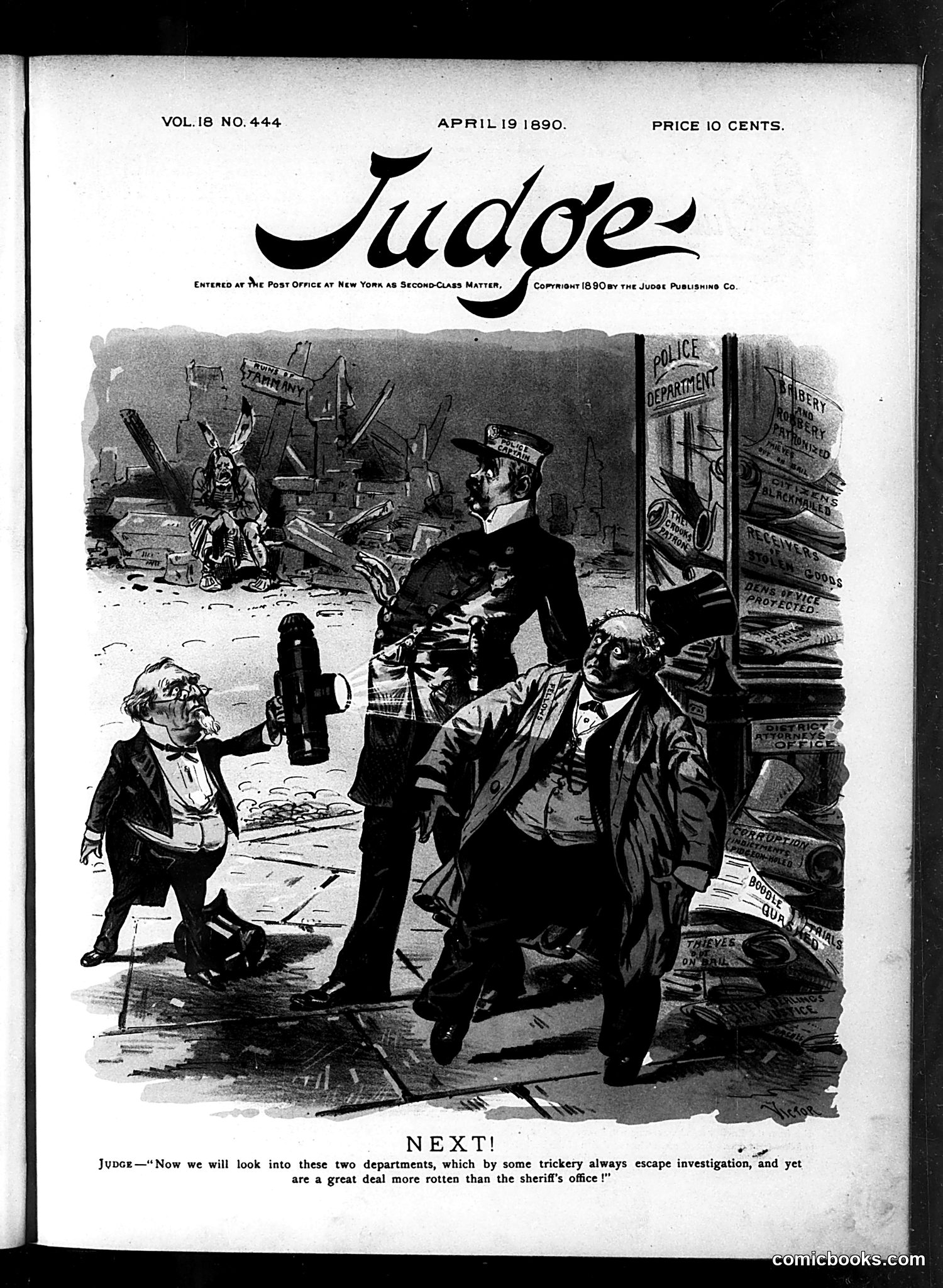
This political cartoon satirizes corruption in urban government. A well-dressed judge or official examines two departments—the Police Department and what appears to be a district attorney's office (visible signage on the right). The caption quotes the judge observing that these departments escape investigation through "trickery" despite being "a great deal more rotten than the sheriff's office." The cartoon critiques selective enforcement of accountability: while local sheriffs face scrutiny, more powerful urban institutions (police and prosecutors) evade oversight. The caricatured figures in shabby clothing represent either corrupt officials or those victimized by the system. This reflects late-19th-century concerns about machine politics and institutional corruption in American cities, particularly New York.
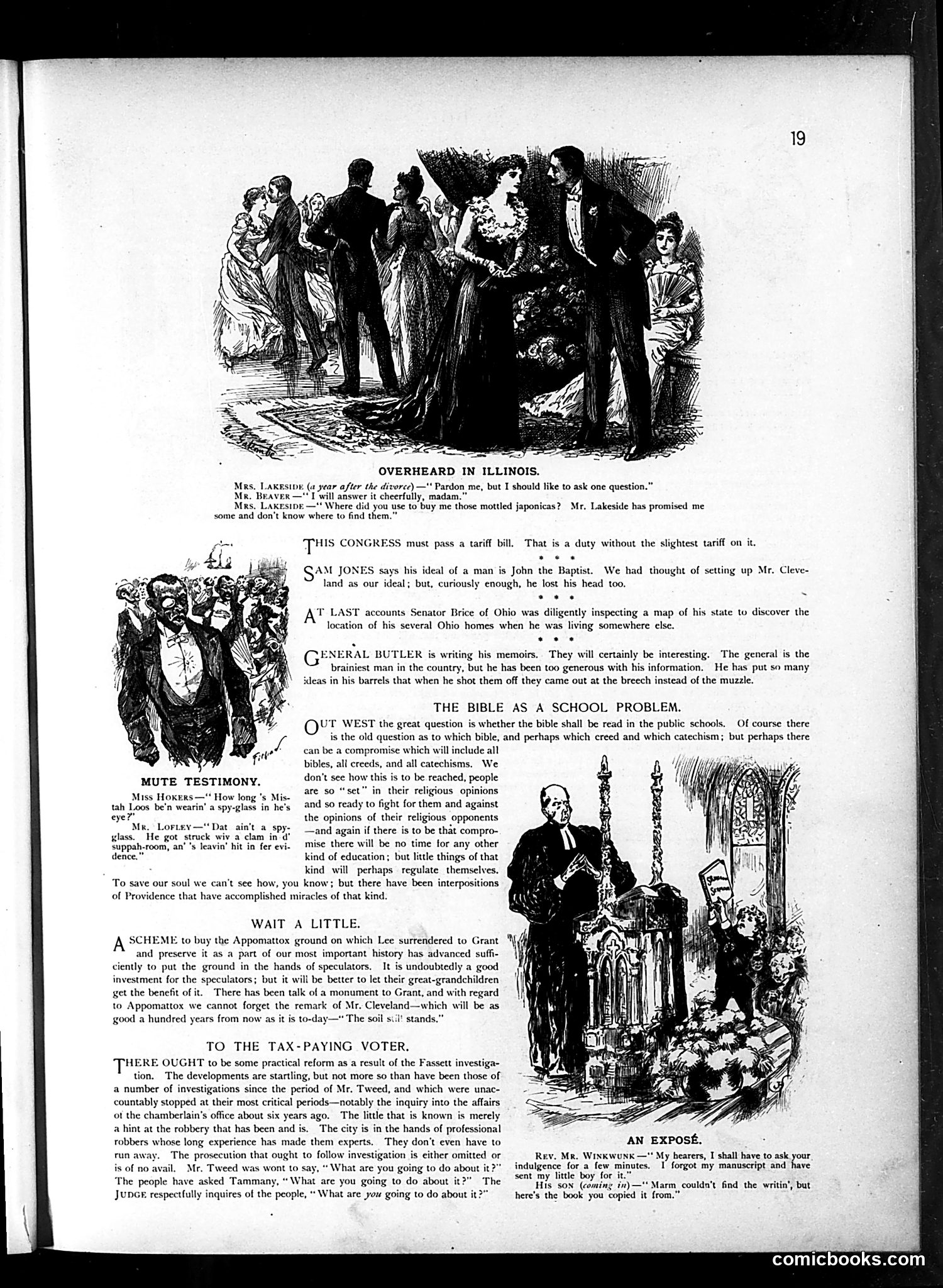
**Top Cartoon "Overheard in Illinois"**: A woman (Mrs. Lakeside) asks another about buying "mottled japonica" flowers, revealing she doesn't know what she's buying—satirizing wealthy people's pretentious ignorance about luxury goods. **Main Text Sections**: - Brief political anecdotes mocking Sam Jones, Senator Brice, and General Butler - "The Bible as a School Problem": Discusses whether public schools should teach the Bible, acknowledging religious diversity makes consensus impossible - "Wait a Little": Advocates preserving Appomattox battlefield as historical monument rather than letting speculators profit - "To the Tax-Paying Voter": Critiques corruption in city government, suggesting reform is needed but difficult to achieve **Overall Tone**: Satirizes political incompetence, religious hypocrisy, and urban corruption while advocating modest reforms.
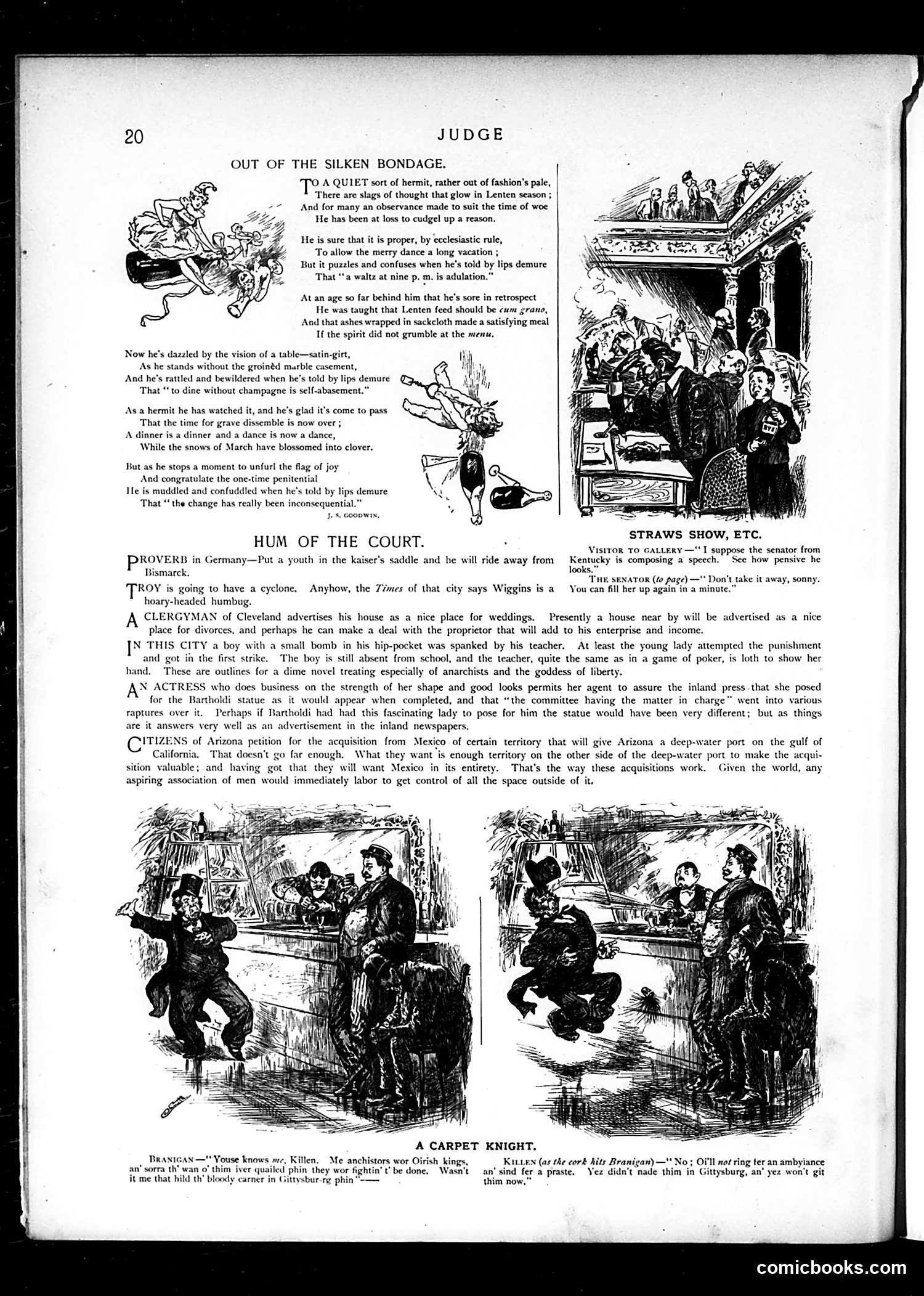
This page contains satirical commentary on social hypocrisy and modernization circa the early 1900s. **"Out of the Silken Bondage"** mocks an old-fashioned gentleman bewildered by changing Lenten observances. He was taught strict religious abstinence (plain food, no dancing), but now fashionable society celebrates openly with champagne and waltzing while still claiming spiritual propriety. The satire targets the contradiction: society has abandoned actual self-denial while maintaining the *appearance* of respectability. **"Hum of the Court"** consists of brief quips about contemporary absurdities: a German proverb; Cleveland clergy advertising wedding venues (implying divorce business follows); a teacher attacked by a bomb-carrying student; an actress falsely claiming to pose for the Statue of Liberty; and Arizona's territorial ambitions, humorously suggesting any acquired territory would only fuel demands for more. The illustrations depict saloon/bar scenes featuring working-class figures, likely related to the "Carpet Knight" dialogue below, where characters discuss Irish ancestry. Overall, the page satirizes social pretense, modern restlessness, and institutional hypocrisy.
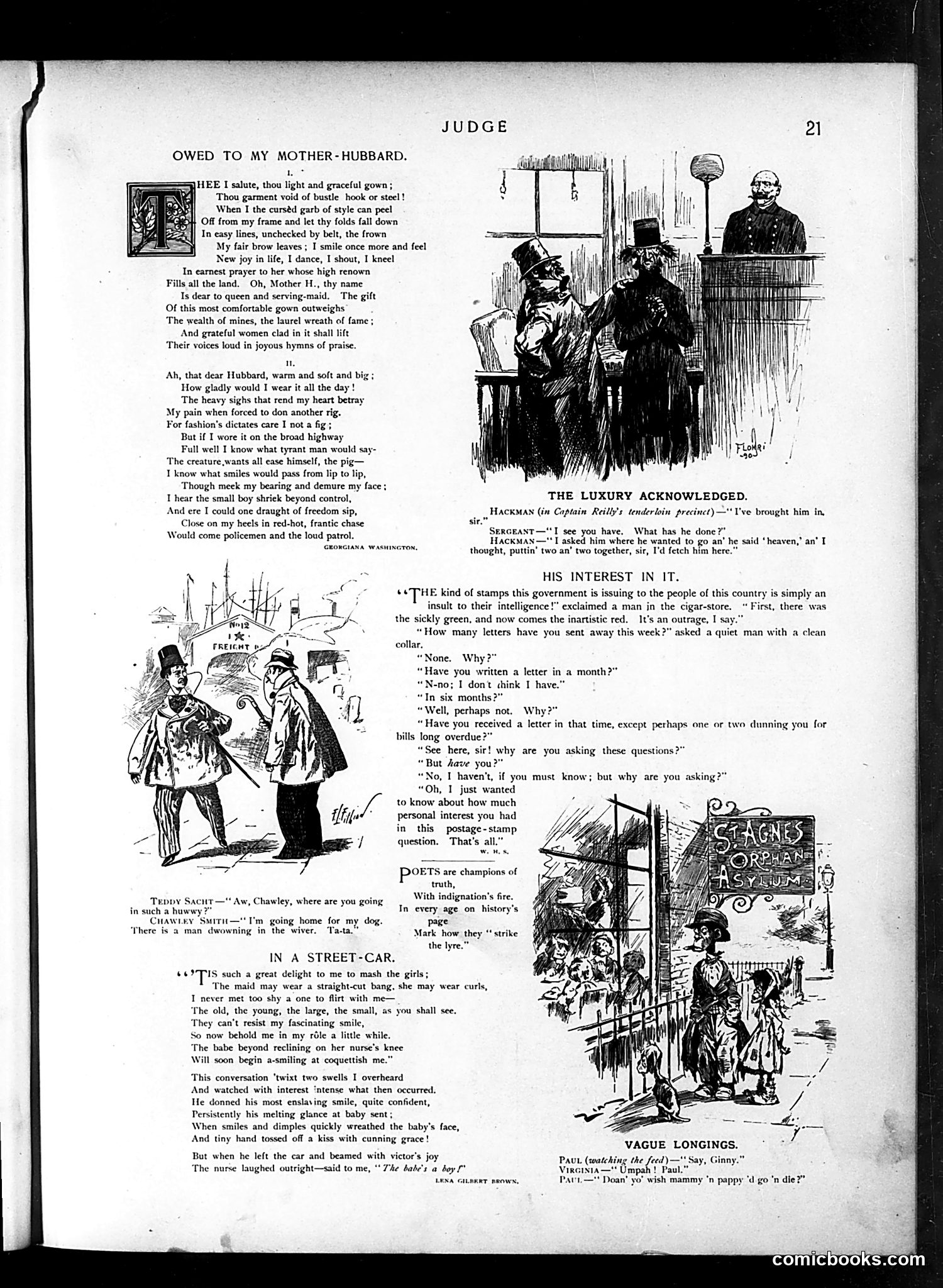
This page contains several satirical pieces critiquing Victorian social conventions and government inefficiency: **"Owed to My Mother-Hubbard"** mocks women's restrictive fashion. The poem celebrates the loose Mother Hubbard dress (comfortable, unstructured) while lamenting that wearing it publicly invites ridicule and police intervention—satirizing how society polices women's bodies and choices. **"The Luxury Acknowledged"** jokes about police corruption: a hackman (taxi driver) arrests a man for saying he wanted to go to "heaven," treating it as suspicious. The humor exposes casual absurdity in law enforcement. **"His Interest in It"** satirizes hypocrisy: a man complains vehemently about ugly government postage stamps while admitting he never writes letters or receives mail—attacking those who pontificate about issues without genuine stake in them. **"In a Street-Car"** depicts a man attempting to flirt with every woman, only to be embarrassed when he succeeds in charming what he thought was a baby girl—revealing the foolishness of his presumptuous behavior. The page overall targets social pretense, fashion tyranny, and masculine arrogance.
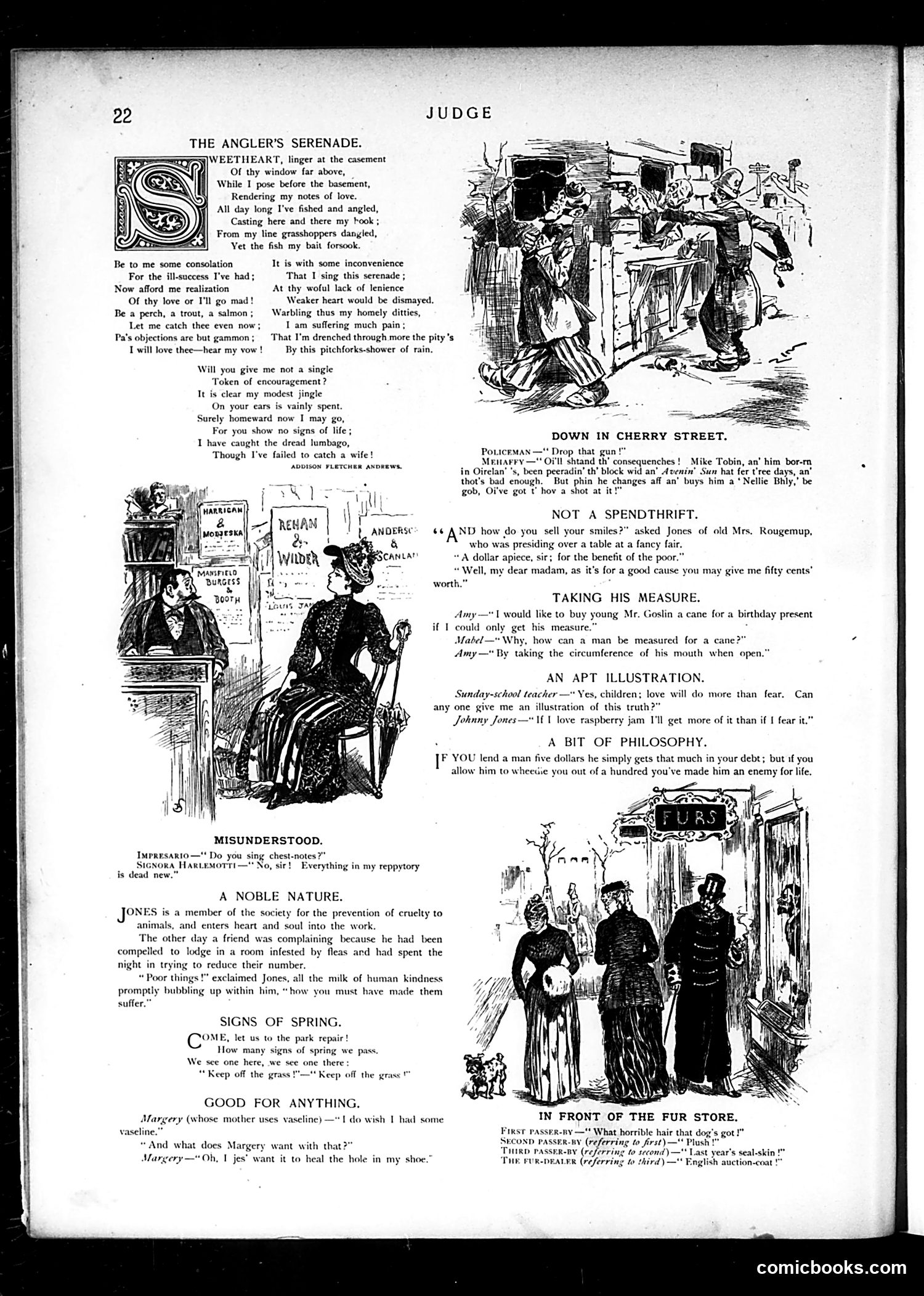
This page contains multiple brief satirical sketches typical of late-19th/early-20th-century humor magazines. Key pieces include: **"The Angler's Serenade"**: A mock-romantic poem mocking both failed fishing and unrequited love—the angler serenades a woman while drenched and unsuccessful, conflating romantic failure with literal failure to catch fish. **"Down in Cherry Street"**: An Irish immigrant character (Mike Tobin) is arrested for wearing a "Nellie Bly" hat—apparently a women's style hat that's caused neighborhood disruption. This relies on ethnic stereotyping common to the era. **Other sketches**: Include wordplay jokes ("Taking His Measure"—measuring a man's mouth for a cane), class commentary ("Not a Spendthrift"), and observational humor about urban life and social conventions. The humor depends heavily on puns, ethnic caricature, and gentle mockery of courtship, vanity, and social pretension rather than pointed political satire. The illustrations are period-appropriate line drawings supporting the text-based jokes.
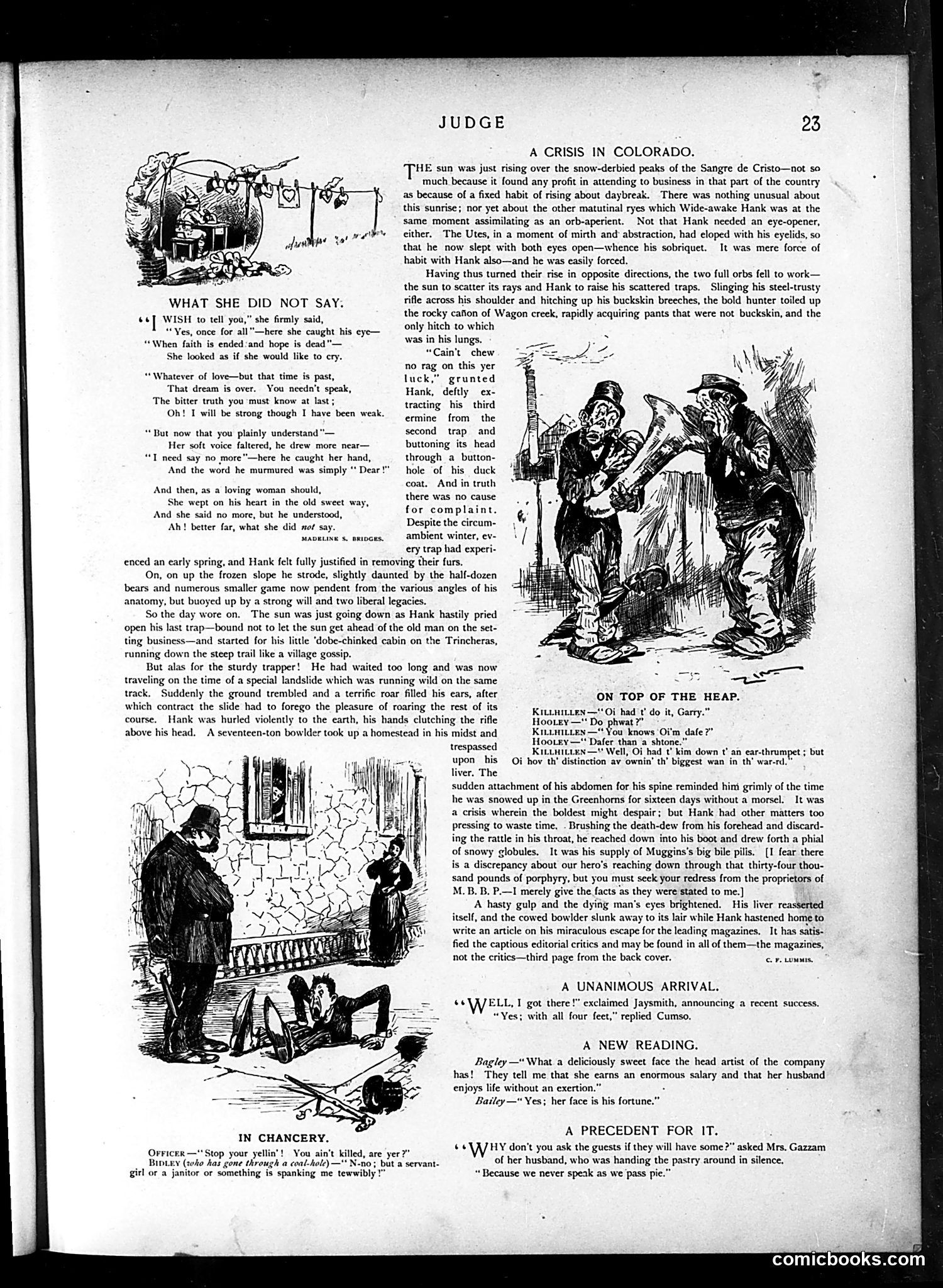
This page contains three distinct pieces of satirical content: **"A Crisis in Colorado"** (main story with illustrations): A tall tale about "Wide-awake Hank," a trapper in Colorado's Sangre de Cristo mountains. The humor derives from exaggeration—Hank has such wide-open eyes (supposedly because Utes stole his eyelids) that he sleeps with them open. The narrative employs frontier vernacular and absurdist humor typical of 19th-century American comic journalism, depicting survival struggles and mishaps with mock-dramatic intensity. **"What She Did Not Say"** (left column poem): A sentimental poem about an unspoken breakup, where the woman's emotional restraint speaks louder than words—satirizing Victorian-era romantic melodrama and emotional speechifying. **"On Top of the Heap"** and other shorter pieces: Brief comedic dialogues with Irish immigrant characters (suggested by dialect), typical of period humor that often relied on ethnic stereotyping. The page represents Judge's mix of frontier adventure parody, sentimental satire, and ethnic humor characteristic of 1880s-90s American comic publications.
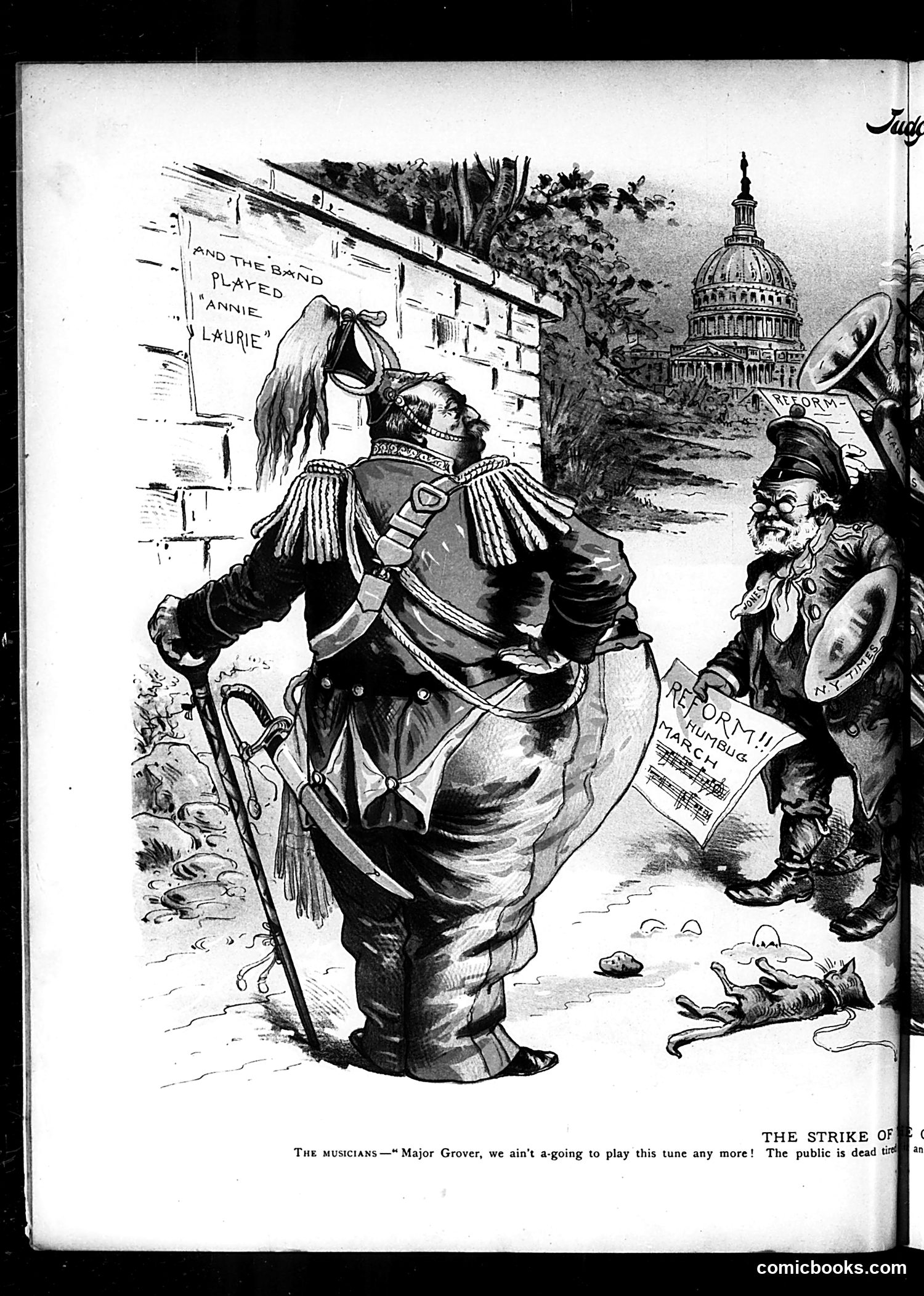
This satirical cartoon depicts a military figure (labeled "Major Grover," likely President Grover Cleveland) being confronted by musicians who refuse to play "Annie Laurie"—a popular tune written on a placard he's posting on a wall. The Capitol Building appears in the background. The cartoon uses the metaphor of a musicians' strike to comment on public dissatisfaction with Cleveland's policies or political direction. "The public is dead tired" of the current "tune" (policies), the musicians declare. The caricatured figure on the right appears to represent a political opponent or critic. This is political commentary on Cleveland's unpopularity or a specific controversial policy, using the strike imagery popular during the Gilded Age labor disputes to suggest widespread public rejection of his administration's direction.
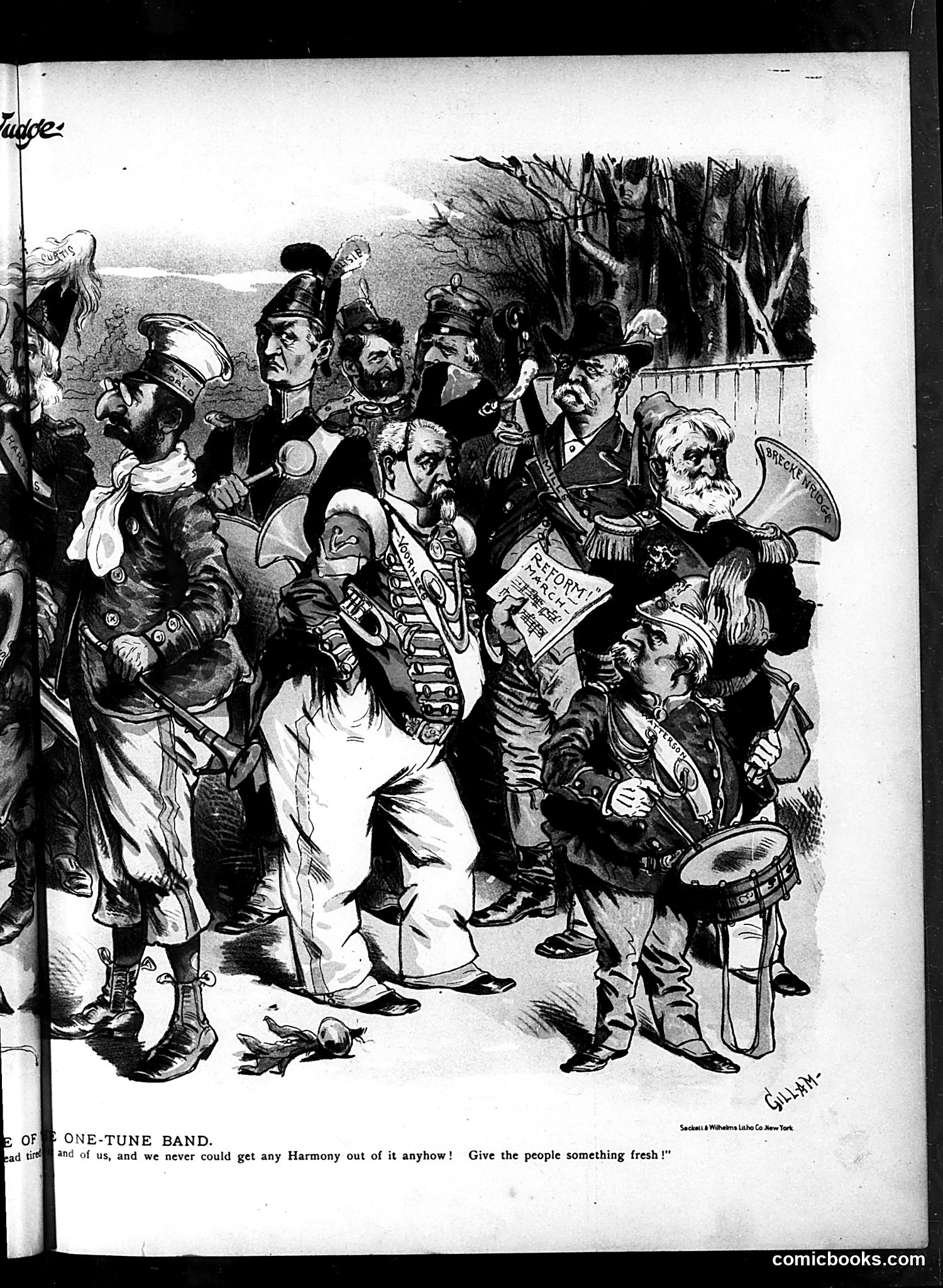
This satirical cartoon depicts a group of military and political figures (likely European leaders and generals from the early 20th century) assembled as a chaotic "band" playing discordantly. The title "One-Tune Band" suggests these leaders, despite their different nations and uniforms, are fundamentally playing the same tune—likely war or militarism. The visible caption reads: "...and we never could get any Harmony out of it anyhow! Give the people something fresh!" The satire critiques how various national leaders, despite appearing distinct, pursue identical destructive policies (war/military buildup) that lack coordination and harmony. The plea to "Give the people something fresh" suggests public frustration with repetitive, failed militaristic approaches to governance. The exaggerated caricatures and chaotic composition emphasize the absurdity and cacophony of their collective leadership. This likely comments on pre-World War I or interwar period European tensions.
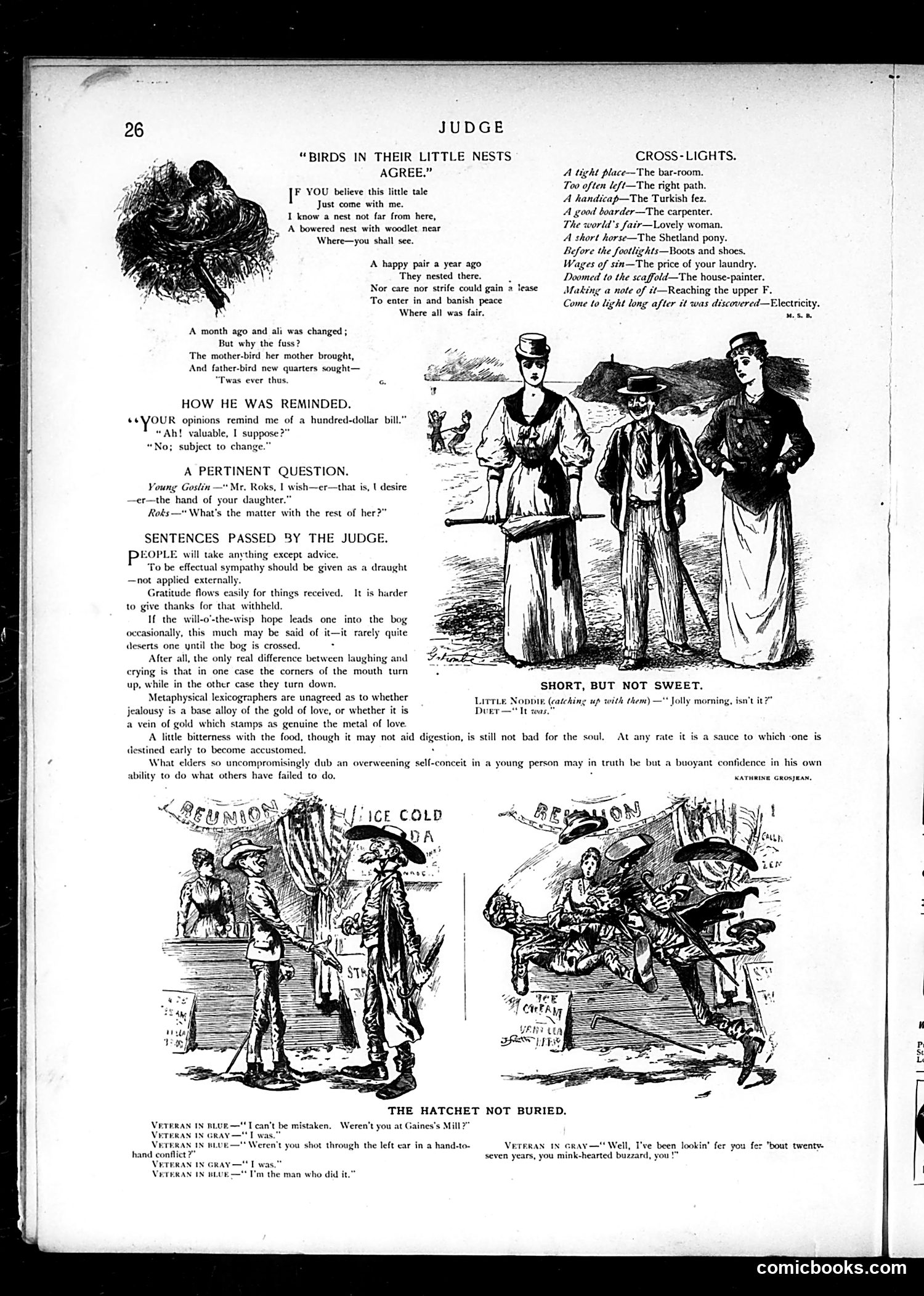
This page contains several distinct satirical pieces typical of Judge's 1880s-90s humor: **"Birds in Their Little Nests Agree"** uses a bird family metaphor to satirize domestic discord—parents' arrival disrupts a young couple's peaceful marriage, suggesting in-laws as unwelcome intrusions. **"How He Was Reminded"** jokes that opinions are like worthless currency—subject to change without notice, mocking inconsistent argumentation. **"The Hatchet Not Buried"** depicts two Civil War veterans (identifiable by "Veteran in Blue" and "Veteran in Gray") whose post-war animosity remains unhealed. One admits shooting the other through the ear decades earlier, and they're still seeking revenge. This satirizes how sectional tensions persisted long after the war's 1865 conclusion—the "hatchet" (peace) was never truly buried between North and South. The remaining sections include philosophical aphorisms and light domestic humor typical of the magazine's satirical tone.
This page is primarily **advertisements and light humor**, not political satire. The content includes: **Humorous Sketches:** - A mistaken-identity joke about a new Irish servant girl confusing visitors named "Mr. White" and "Mr. Black" - A "tender feet" joke mocking eastern city-dwellers unable to walk long distances - A flower dialogue pun about a lily having no "scent" - A comical fight scene where two men remove false teeth and hang coats before politely agreeing to postpone their brawl **Advertisements:** The page is dominated by period product ads (Pax cigarettes, Youmans hats, Sohmer pianos, Mrs. Winslow's Soothing Syrup, Phillips Cocoa, "The Marquis" hat). **One Literary Reference:** "The Lost Chord Found" appears to be a sentimental romantic poem about lovers in a church choir loft. The page reflects typical early 1900s Judge content: genteel humor, no serious political commentary, and heavy advertising. The jokes rely on ethnic stereotypes and physical comedy common to the era.
This page is primarily **advertising** with one substantial narrative poem titled "The Auctioneer's Gift." The poem tells a touching story about a hardened auctioneer conducting a furniture sale from a foreclosure. He's crude and comedic, making jokes as he sells items. When a baby's chair comes up for auction, a heckler bids one cent. A grief-stricken woman cries out—it was her dead baby's chair. The auctioneer, himself having lost a child, is moved to tears. He gives her the chair for free, revealing his hidden humanity beneath his callous exterior. The story represents **sentimental Victorian morality**: even the coarsest man possesses a heart, and shared suffering creates compassion. The "gift" is both the chair and the auctioneer's emotional redemption. The surrounding content is typical **late 19th-century advertising**—patent medicines, bicycles, hotels, tooth powder—with occasional brief jokes and notices at bottom of page.
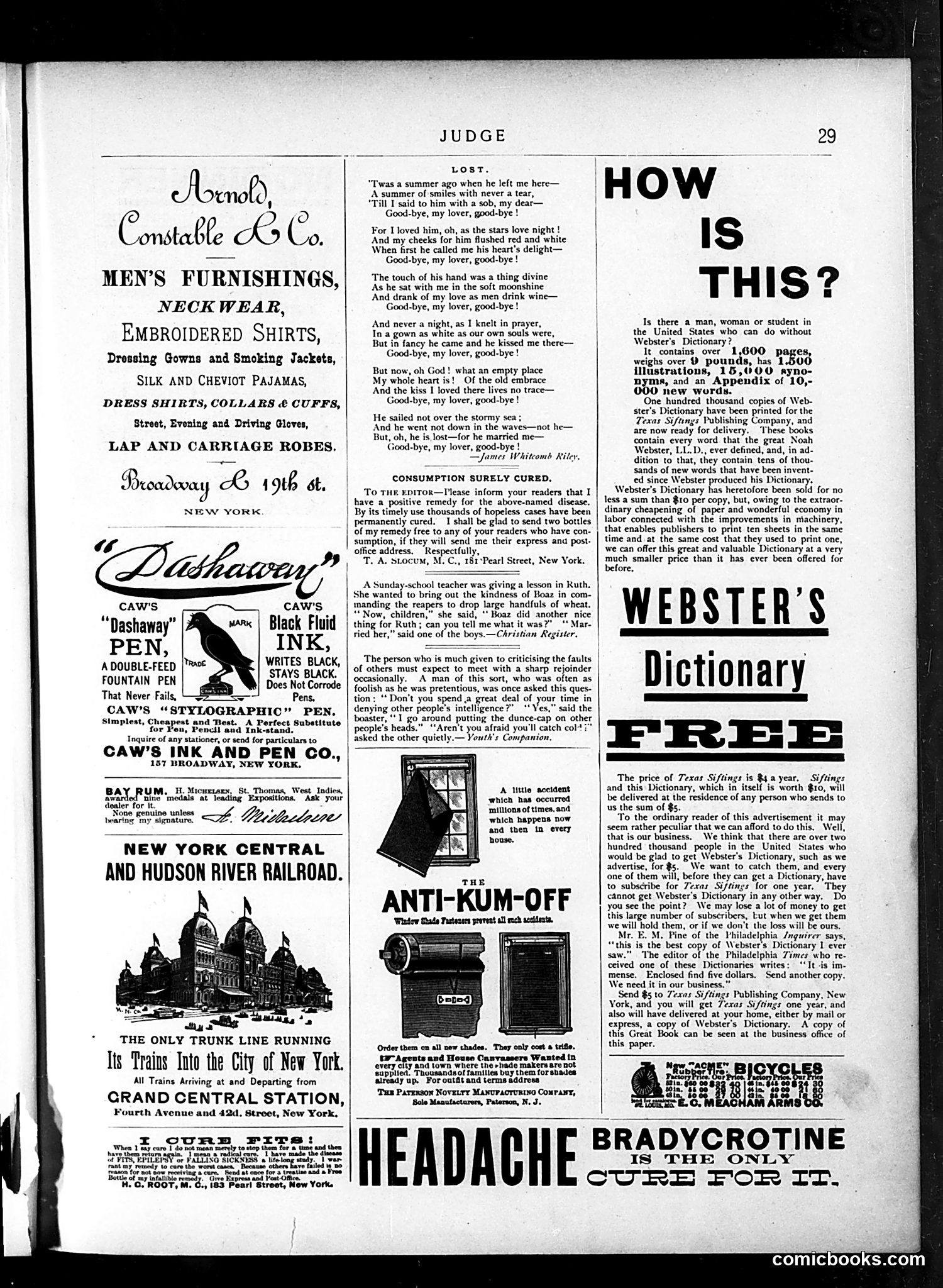
This page is primarily **advertising and filler content** with minimal editorial cartoons. The main items include: **Central Content:** A sentimental poem titled "Lost" by James Whitcomb Riley—a popular American poet of the era. The poem's twist ending reveals the speaker's lover is "lost" not through death or separation, but through marriage, suggesting marriage destroys romantic idealism. This reflects turn-of-the-century anxieties about matrimony. **Surrounding Elements:** Mostly period advertisements (men's furnishings, fountain pens, railroad services, patent medicines) and filler anecdotes—a Sunday school joke and a joke about a pretentious person being criticized for calling others foolish. **Social Context:** The inclusion of Riley's poem reflects *Judge*'s satirical approach to domestic life and romance. The message—that marriage transforms passionate love into mundane reality—was a common theme in American humor magazines of this period, targeting middle-class anxieties about courtship and matrimony. No significant political cartoons or caricatures appear on this page.
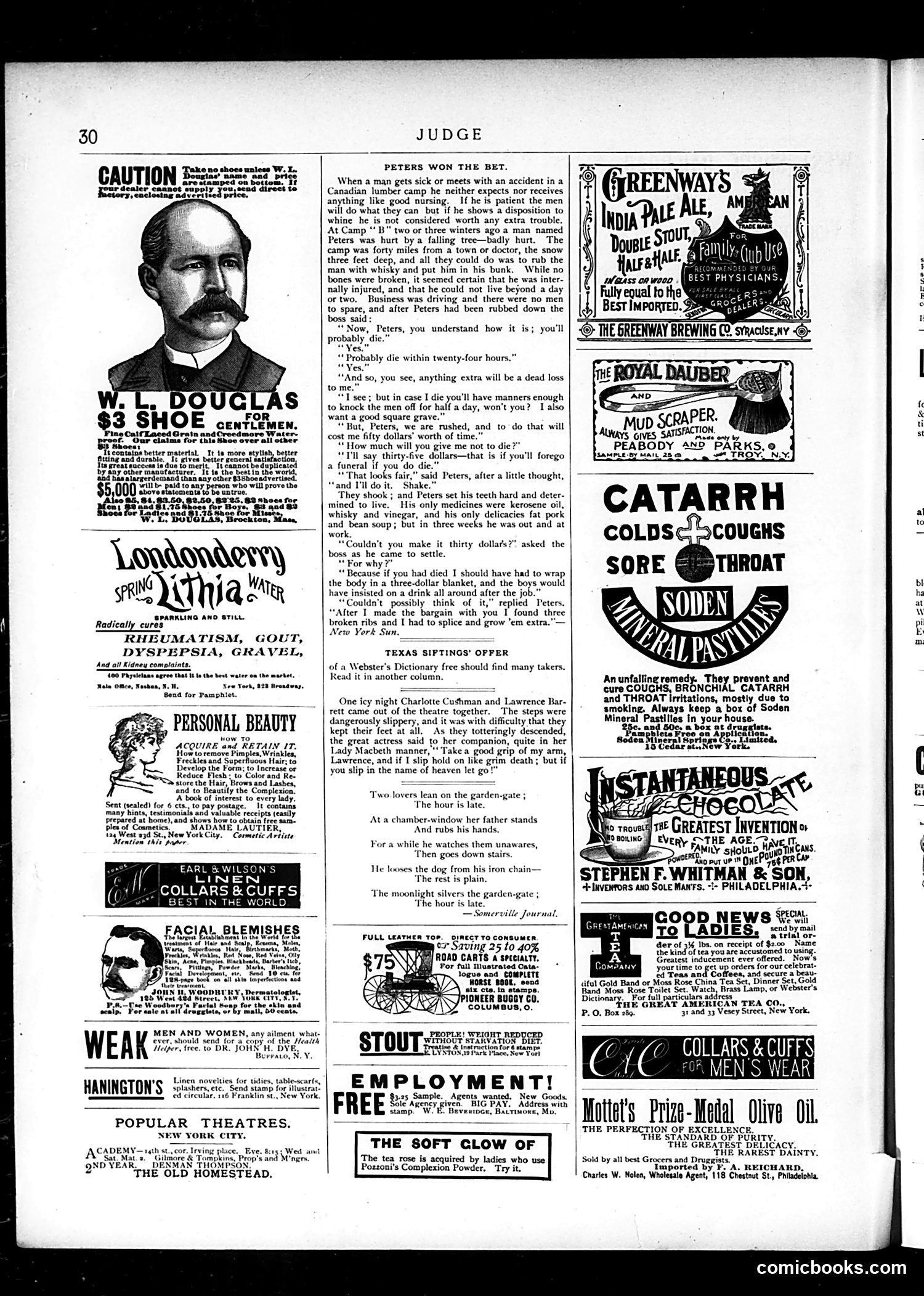
This page is primarily **advertisements and commercial notices** typical of Judge magazine, interspersed with one brief narrative piece. The main editorial content is "**Peters Won the Bet**"—a frontier humor story about a lumber camp worker injured by a falling tree. The joke centers on a darkly comic negotiation: the camp boss, calculating losses from Peters's expected death (burial costs, workers' time off), offers him $35 to die quickly and forego a funeral. Peters accepts, then survives through sheer willpower on minimal care. When settling accounts, he argues the boss owes him more because the boss would have spent money on a blanket and workers' drinks had he died—a macabre punchline playing on frontier parsimony and grim practicality. The surrounding ads promote patent medicines, shoe brands, beauty treatments, and theatrical performances—standard Judge fare offering little political or social satire beyond typical period advertising claims.
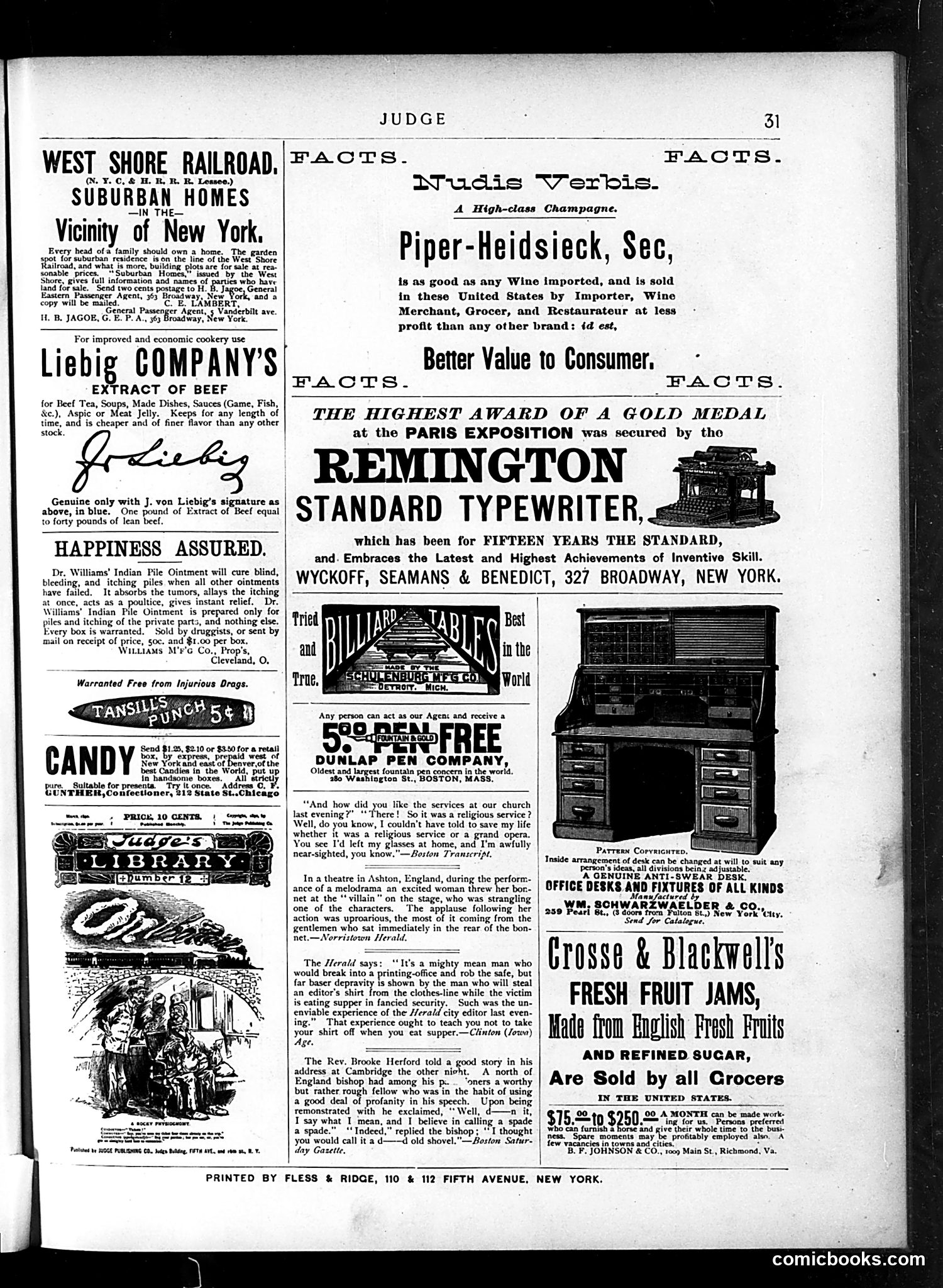
This is primarily an **advertising page** with minimal satirical content. The page features commercial advertisements for various products: suburban real estate, Liebig's beef extract, Dr. Williams' Indian Pile Ointment, candy, Piper-Heidsieck champagne, Remington typewriters, Dunlap pens, and Crosse & Blackwell jams. The few satirical pieces are brief **humorous anecdotes** rather than political cartoons: 1. A joke about someone unable to distinguish a church service from grand opera due to forgetting glasses—mocking either religious indifference or theatrical excess in worship. 2. A story about a woman throwing her bonnet at a stage villain, with applause from gentlemen—satirizing either melodrama's absurdity or audience gullibility. 3. A quip about an editor's stolen shirt, mocking editors' vulnerability. These are lightweight social humor without political commentary. The page exemplifies Judge's dual nature as both satirical publication and advertising vehicle.
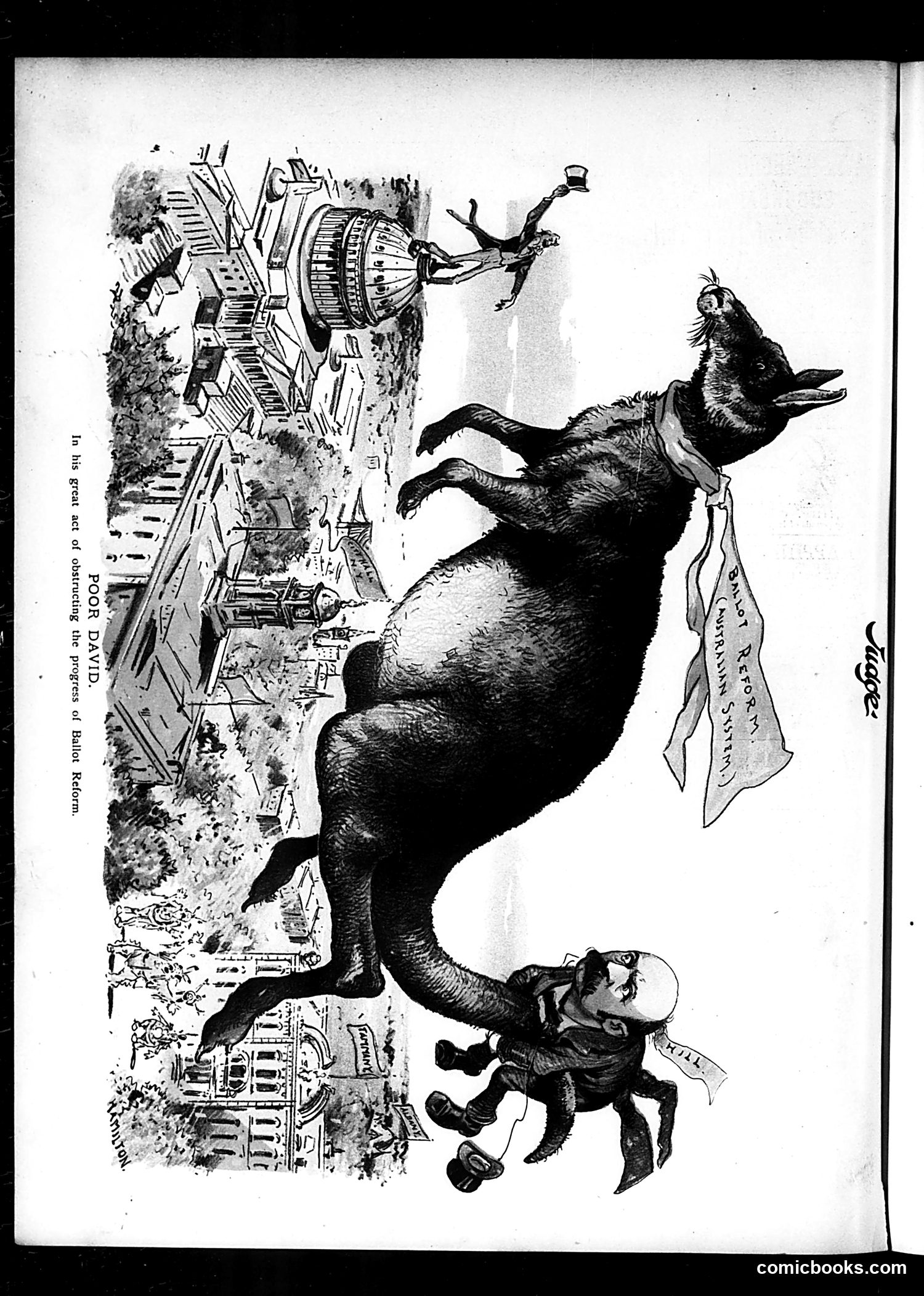
This Judge magazine cartoon depicts a large elephant—the Republican Party symbol—actively obstructing "Ballot Reform" progress. The elephant appears to be deliberately blocking or trampling efforts toward voting reform, while smaller human figures (likely representing reform advocates) struggle against it. The cartoon criticizes Republican opposition to ballot reform measures, suggesting the party was using its political power to prevent democratic voting improvements. The exaggerated, dominating elephant visually emphasizes the GOP's obstruction as forceful and difficult to overcome. Without a visible date, the specific reform context remains unclear, though ballot reform was a recurring progressive-era issue. The satire's point: Republicans were portrayed as anti-democratic obstructionists preventing legitimate electoral improvements.