
Judge, 1890-04-19 · page 2 of 16
Judge — April 19, 1890 — page 2: what you’re looking at
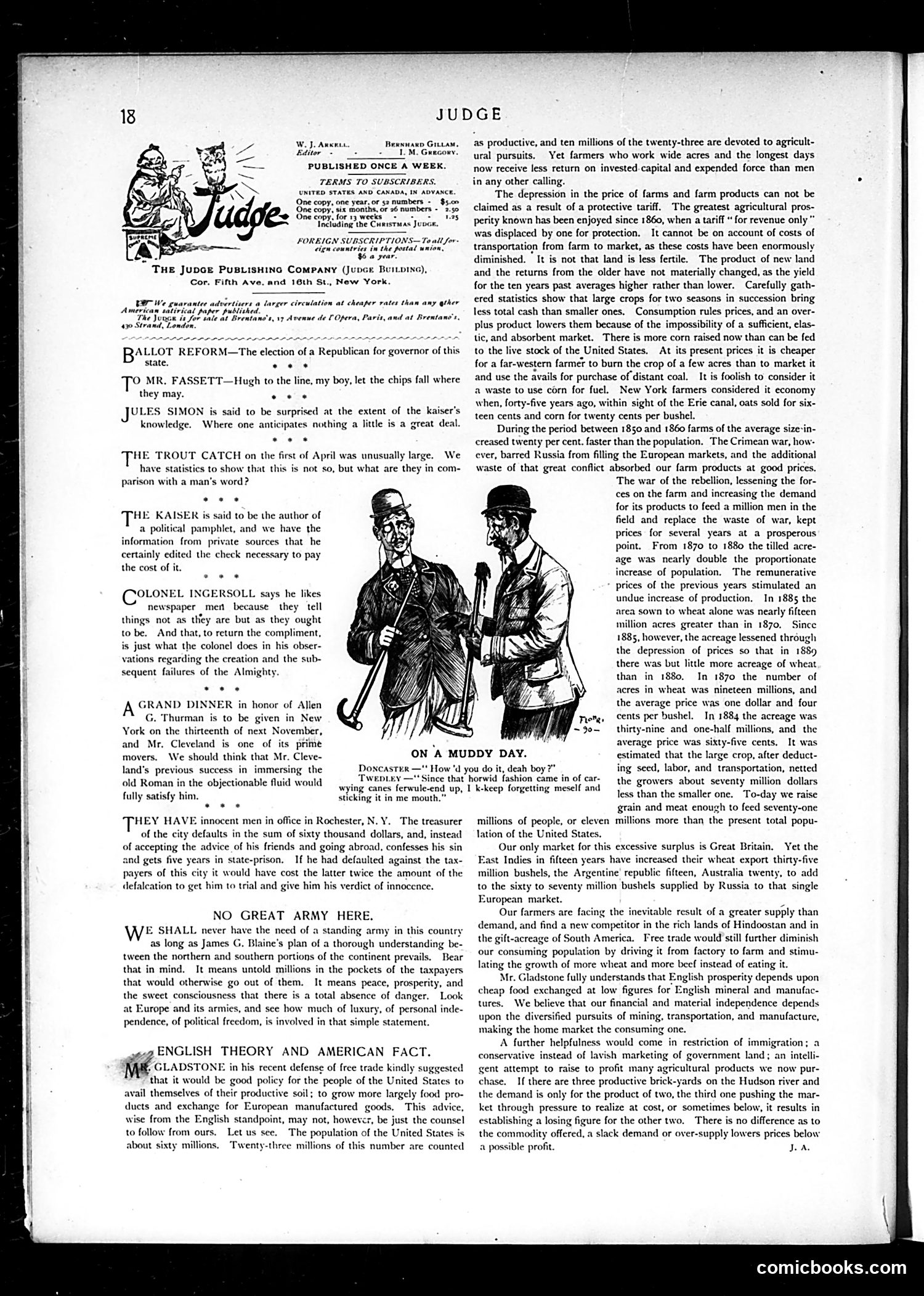
A restored page from Judge, 1890-04-19. Page through the whole issue in the reader above.
📄 Transcribed text from this page (OCR, searchable)
Machine-transcribed from the original scan — historical spelling and the odd misread are preserved.
JUDGE W. J. Ament Brennanp Gittam. Editor ~~ _- _1.M.Guecony. PUBLISHED ONCE A WEEK. TERMS TO SUBSCRIBERS. UNITED STATES AND CANADA, IN ADVANCE. One copy, one year. or $2 numbers - $5.00 One copy, six months, or 26 numbers = "2.50 One copysfor iy weeks ens tas Taclading the CnmisTaas JuDGK, FOREIGN SUBSCRIPTIONS— To alt for- cign countries in the postal union. $6 @ year. THE JuDGE PUBLISHING Company (Jupce Buitpinc), Cor. Fifth Ave, and 16th St., New York. ER We guarantee advertisers a larger circulation at cheaper rates than any qther American satirical paper published. The Juucn ts for sale at Brentans’ 17 Avenue de COpera, Paris, and at Brentano's, 430 Strand, London BALLOT REFORM—The election of a Republican for governor of this state. goeue TO MR. FASSETT—Hugh to the line, my boy, let the chips fall where they may. ULES SIMON is said to be surpri knowledge. THE TROUT have statistic: parison with am eee dat the extent of the kaiser's Where one anticipates nothing a little is a great deal. CATCH on the first of April was unusually large. We to show that this is not so, but what are they in com- word? HE KAISER is said to be the author of a political pamphlet, and we have the information from private sources that he certainly edited the check necessary to pay the cost of it. COLONEL INGERSOLL says he likes newspaper ment because they tell things not as they are but as they ought to be. And that, to return the compliment, is just what the colonel does in his obser- vations regarding the creation and the sub- sequent failures of the Almighty. A GRAND DINNER in honor of Allen G. Thurman is to be given in New York on the thirteenth of next November, and Mr. Cleveland is one of its prime We should think that Mr. Cleve- land's previous success in immersing the old Roman in the objectionable fluid would fully satisfy him. movers. Twepey sticking it in me mouth.” ‘THEY HAVE innocent men in office in Rochester, N.Y. ‘The treasurer of the city defaults in the sum of sixty thousand dollars, and, instead of accepting the advice of his friends and going abroad, confesses his sin and gets five years in state-prison, If he had defaulted against the tax- payers of this city it would have cost the latter twice the amount of the defalcation to get him to trial and give him his verdict of innocence. NO GREAT ARMY HERE, WE SHALL never have the need of a standing army in this country as long as James G. Blaine’s plan of a thorough understanding be- tween the northern and southern portions of the continent prevails. Bear that in mind. It means untold millions in the pockets of the taxpayers that would otherwise go out of them. It means peace, prosperity, and the sweet consciousness that there is a total absence of danger. Look at Europe and its armies, and see how much of luxury, of personal inde- pendence, of political freedom, is involved in that simple statement. NGLISH THEORY AND AMERICAN FACT. LADST! in his recent defense of free trade kindly suggested that it would be good policy for the people of the United States to avail themselves of their productive soil; to grow more largely food pro- ducts and exchange for European manufactured goods. This advice, wise from the English standpoint, may not, however, be just the counsel to follow from ours. The population of the United States is about sixty millions. Twenty-three millions of this number are counted Let us see. ON ‘A MUDDY DAY. Doncaster —"* How 'd you do it, deah boy?” Since that horwid fashion came in of car- wying canes ferwule-end up, I k-keep forgetting meself and as productive, and ten millions of the twenty-three are devoted to agricult- ural pursuits. Yet farmers who work wide acres and the longest days now receive less return on invested-capital and expended force than men in any other calling. The depression in the price of farms and farm products can not be claimed as a result of a protective tariff. The greatest agricultural pros- perity known has been enjoyed since 1860, when a tariff “ for revenue only” was displaced by one for protection. It cannot be on account of costs of transportation from farm to market, as these costs have been enormously diminished. "It is not that land is less fertile. The product of new land and the returns from the older have not materially changed, as the yield for the ten years past averages higher rather than lower. Carefully gath- ered statistics show that large crops for two seasons in succession bring less total cash than smaller ones, Consumption rules prices, and an over- plus product lowers them because of the impossibility of a sufficient, elas tic, and absorbent market. There is more corn raised now than can be fed to the live stock of the United States. At its present prices it is cheaper for a far-western farmer to burn the crop of a few acres than to market it and use the avails for purchase of distant coal. It is foolish to consider it a waste to use corn for fuel. New York farmers considered it economy when, forty-five years ago, within sight of the Erie canal, oats sold for six- teen cents and corn for twenty cents per bushel. During the period between 1850 and 1860 farms of the average size- creased twenty per cent. faster than the population. The Crimean war, how- ever, barred Russia from filling the European markets, and the additional waste of that great conflict absorbed our farm products at good prices. The war of the rebellion, lessening the for- ces on the farm and increasing the demand for its products to feed a million men in the field and replace the waste of war, kept prices for several years at a prosperous point. From 1870 to 1880 the tilled acre- age was nearly double the proportionate increase of population, The remunerative prices of the previous years stimulated an undue increase of production, In 1885 the area sown to wheat alone was nearly fifteen million acres greater than in 1870. Since 1885, however, the acreage lessened through the depression of prices so that in 1889 there was but little more acreage of wheat than in 1880. In 1870 the number of acres in wheat was nineteen millions, and the average price was one dollar and four cents per bushel. In 1884 the acreage was thirty-nine and one-half millions, and_ the average price was sixty-five cents, It was estimated that the large crop, after deduct- ing seed, labor, and transportation, netted the growers about seventy million dollars less than the smaller one. To-day we raise grain and meat enough to feed seventy-one millions of people, or eleven millions more than the present total popu- lation of the United States. Our only market for this excessive surplus is Great Britain, Yet the East Indies in fifteen years have increased their wheat export thirty-five million bushels, the Argentine’ republic fifteen, Australia twenty, to add to the sixty to seventy million bushels supplied by Russia to that single European market. Our farmers are facing the inevitable result of a greater supply than demand, and find a new competitor in the rich lands of Hindoostan and in the gift-acreage of South America. Free trade would still further diminish our consuming population by driving it from factory to farm and stimu- lating the growth of more wheat and more beef instead of eating it. Mr. Gladstone fully understands that English prosperity depends upon cheap food exchanged at low figures for English mineral and manufac- tures. We believe that our financial and material independence depends upon the diversified pursuits of mining, transportation, and manufacture, making the home market the consuming one. A further helpfulness would come in restriction of immigration; a conservative instead of lavish marketing of government land; an intelli- gent attempt to raise to profit many agricultural products we now pur- chase. If there are three productive brick-yards on the Hudson river and the demand is only for the product of two, the third one pushing the mar- ket through pressure to realize at cost, or sometimes below, it results in establishing a losing figure for the other two. There is no difference as to the commodity offered, a slack demand or over-supply lowers prices below a possible profit. Joa. comicbooks.com