
A complete issue · 16 pages · 1890
Judge — April 12, 1890
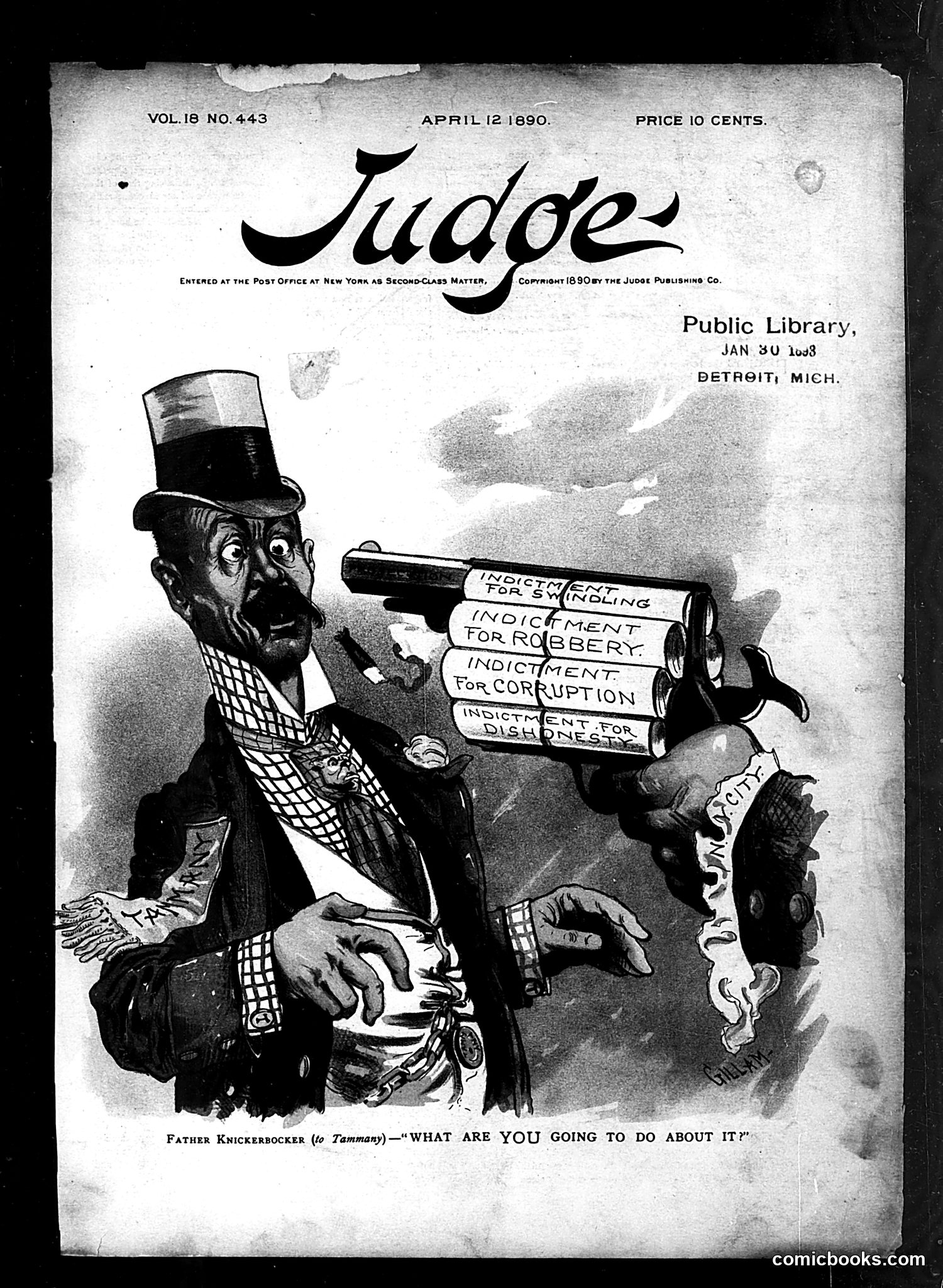
This Judge magazine cover from April 12, 1890 depicts "Father Knickerbocker" (a personification of New York City) holding a telescope labeled with indictments for swindling, robbery, corruption, and dishonesty. The cartoon satirizes widespread municipal corruption in New York during the Gilded Age. The exaggerated caricatured face and formal dress suggest a public figure or institution under scrutiny. The stacked indictments function as a visual joke—Knickerbocker wields corruption charges like a spyglass, perhaps implying he can "see" or is investigating these crimes, or ironically, that corruption is so prevalent it's the city's defining characteristic. The caption—"What are you going to do about it?"—directly challenges readers and civic leaders to address systemic governmental corruption plaguing 1890s New York City.
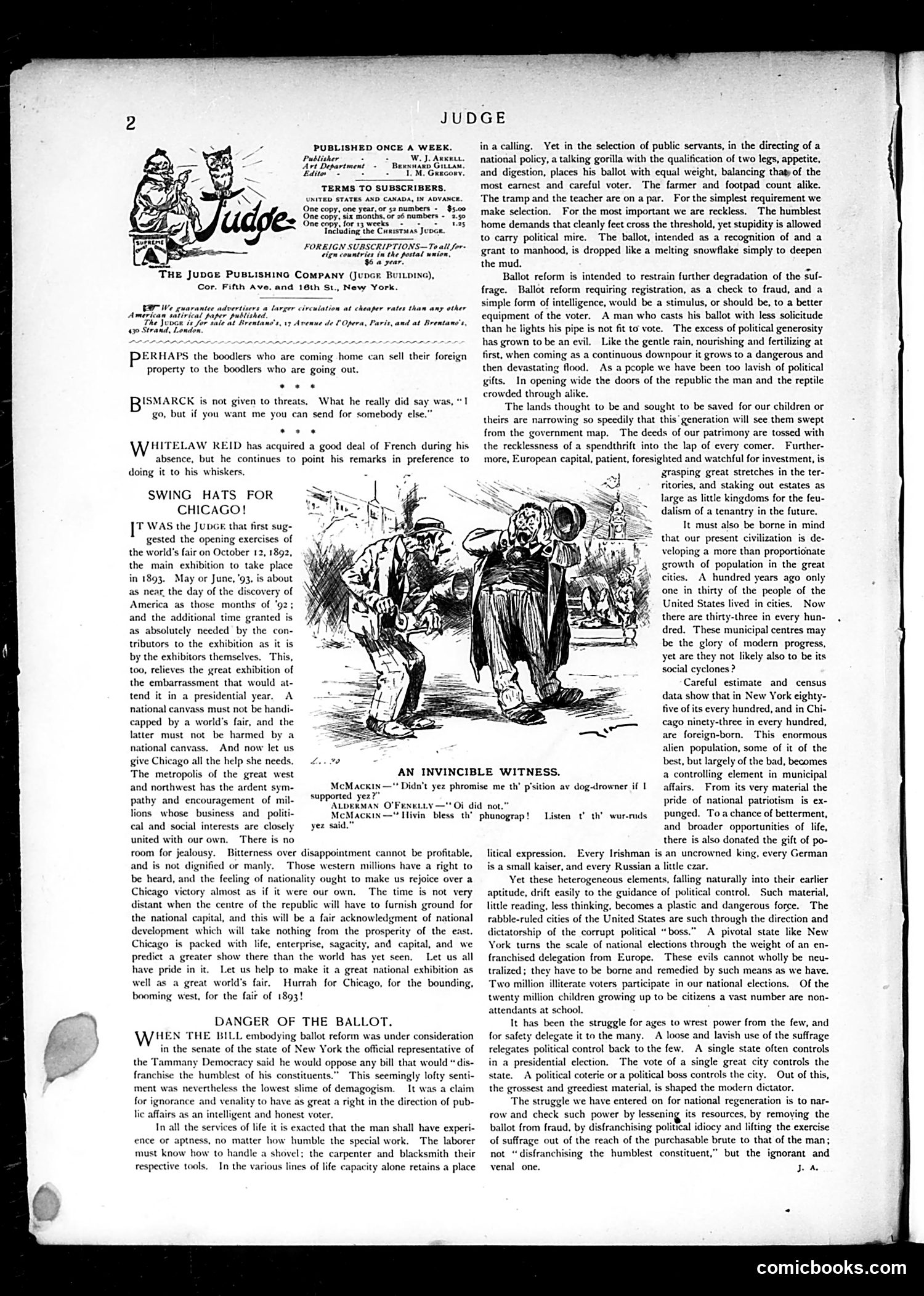
This cartoon satirizes immigrant voters and political corruption in American cities. The dialogue shows "McMackin" claiming he witnessed something "in poison as dog-drowner" (possibly "as a dog-drowner"), while another figure dismisses his credibility, saying "Oh did not." The satire targets the perceived unreliability of foreign-born urban voters in elections—a common nativist concern of the era. The accompanying article criticizes "heterogeneous elements" in cities and "illiterate voters" participating in elections, warning that two million illiterate children and non-attendees at school represent a threat to American democracy. The cartoon's "invincible witness" title suggests these immigrant voters' testimony or participation in elections is beyond challenge yet fundamentally untrustworthy—reflecting era-specific anxieties about urbanization and immigration's effect on democratic integrity.
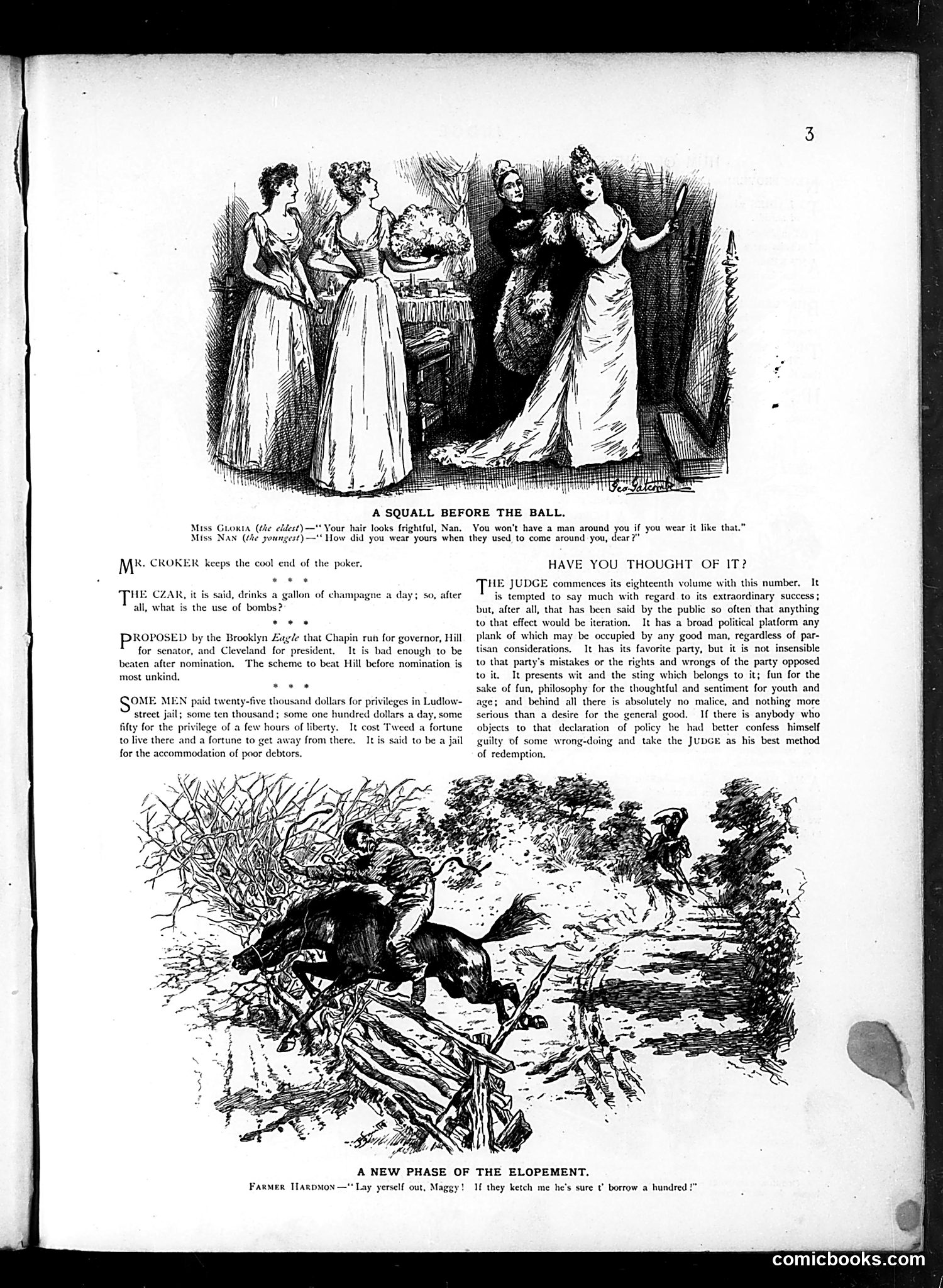
**Top cartoon "A Squall Before the Ball":** A social satire depicting upper-class women discussing fashion before a formal event. The younger woman (Miss Gloria) has styled her hair in a way that alarms her elder (Miss Nan), who warns it will frighten away potential male suitors. This mocks Victorian-era anxieties about women's appearance and marriageability. **"Have You Thought of It?" section:** Political commentary referencing the Czar, Brooklyn Eagle's gubernatorial endorsements, and paid voting privileges in Ludlow Street jail. It critiques political corruption and bribery. **Bottom cartoon "A New Phase of the Elopement":** A horse bolts with a couple, with Farmer Harding warning they'll need to "borrow a hundred" if caught. This likely satirizes elopement scandals and rural consequences.
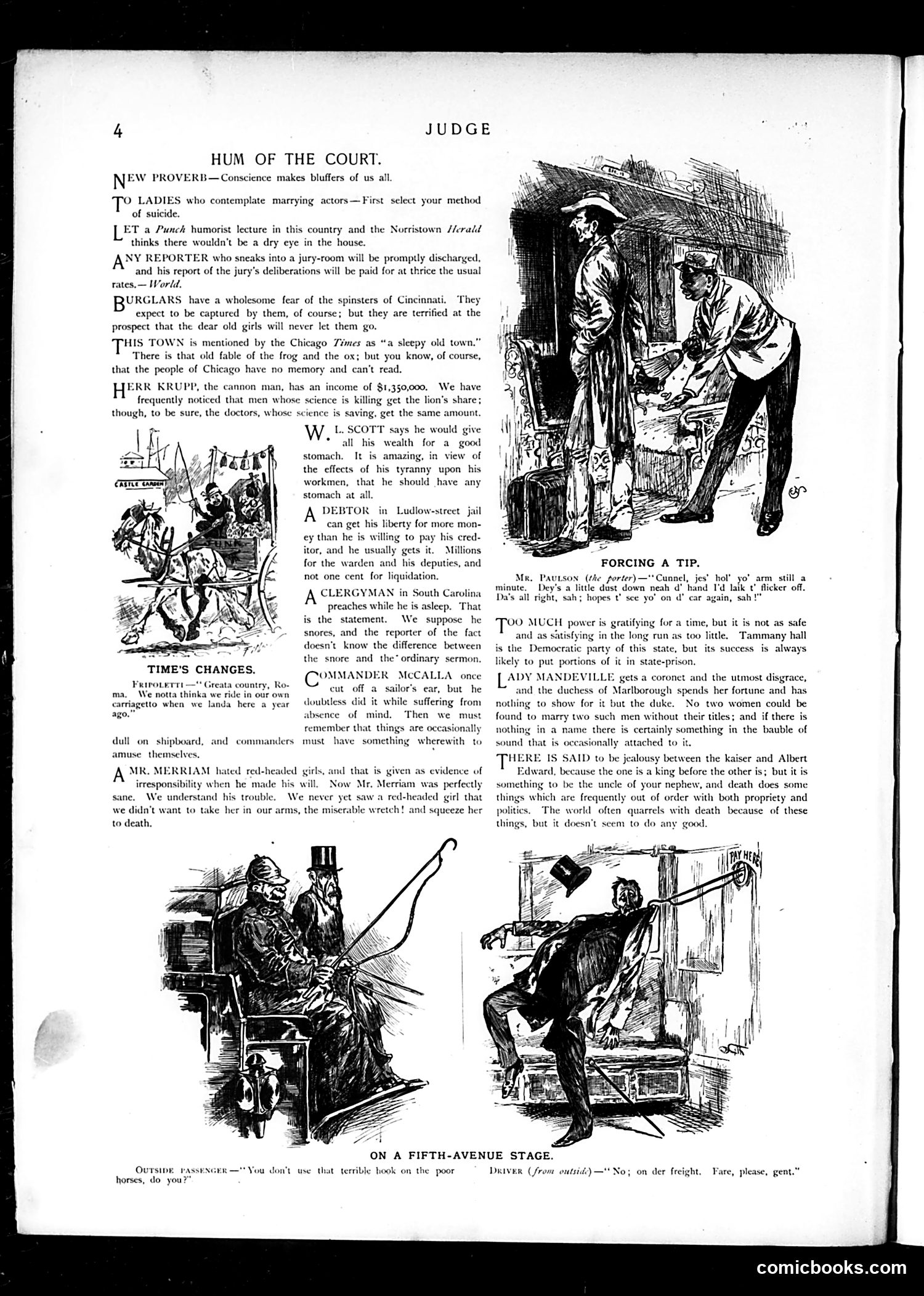
This page collects brief satirical jabs at American society and figures of the era. Key targets include: **Social commentary**: The items mock journalists sneaking into jury rooms for paid reports, burglars fearing Cincinnati spinsters, and Chicago's supposed lack of literacy. **Class/labor criticism**: References to industrialist Herr Krupp's massive income versus doctors earning similarly while "killing" (suggesting munitions manufacturing versus medicine), and a Ludlow Street jail debtor unable to afford freedom—critiquing both wealth inequality and prison corruption. **Absurdist humor**: A South Carolina clergyman who preaches while asleep; a man's will expressing hatred of red-headed girls; a commander (McCalla) who cut off a sailor's ear. **Fifth Avenue stage cartoon**: A driver refuses to use a "hook" on poor horses for regular passengers, only on freight—satirizing class-based cruelty and indifference. The tone throughout is cynical, targeting corruption, hypocrisy, and social inequality with dark wit typical of 1890s-era satirical magazines.
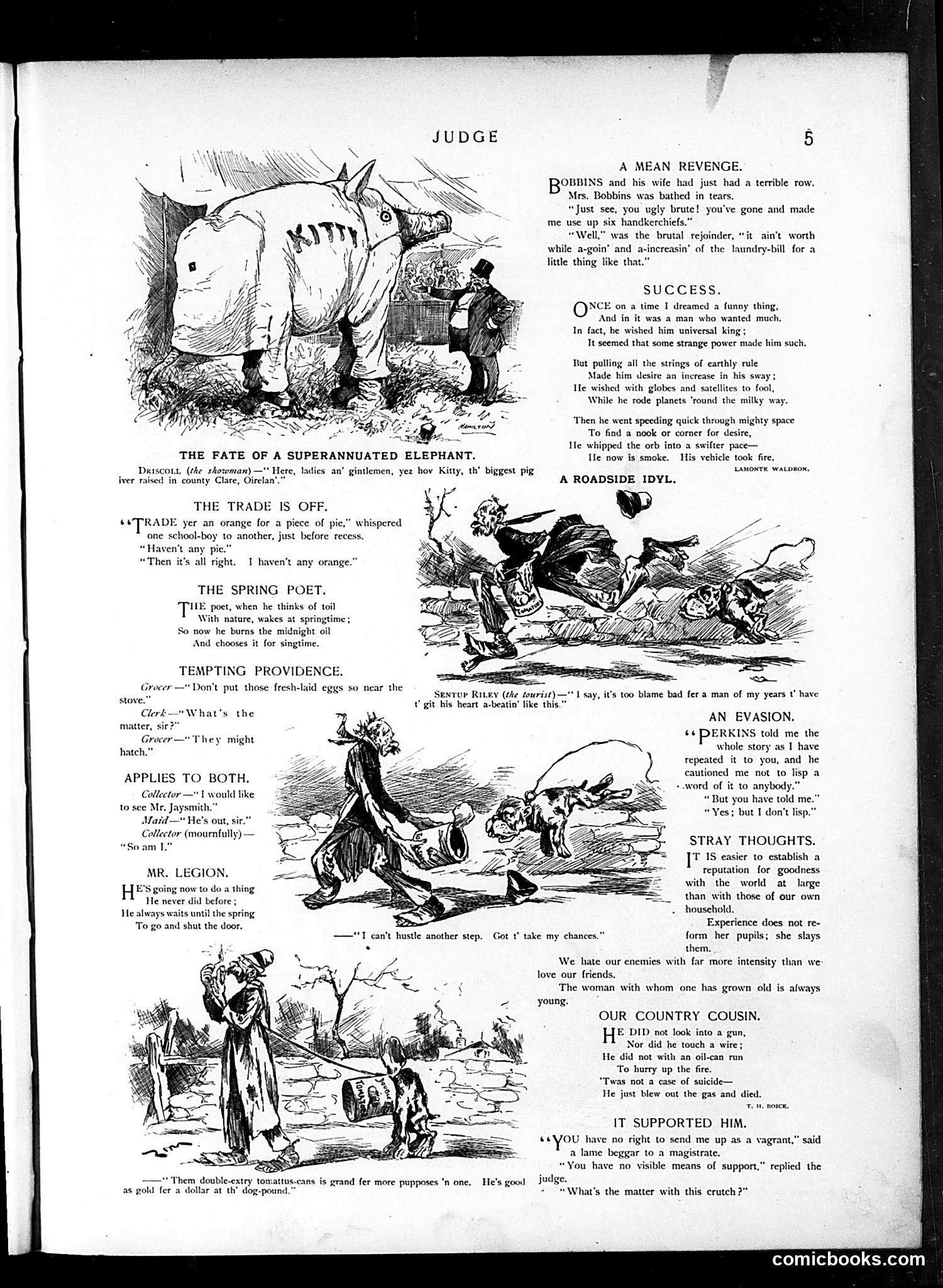
This page contains multiple short satirical pieces typical of Judge's format—humorous observations on everyday life and social foibles. **Key pieces:** - **"The Fate of a Superannuated Elephant"**: A showman's advertisement for an aging elephant raised in Ireland, likely mocking both circus culture and Irish stereotypes. - **"A Mean Revenge"**: A domestic dispute joke where Mr. Bobbins callously dismisses his crying wife's distress, resenting laundry costs—satire on miserly husbands and indifference to wives' emotions. - **"Success"**: A philosophical poem about ambition and cosmic desire ending in the protagonist's literal immolation—mocking overreaching ambition. - **"A Roadside Idyl" and "An Evasion"**: Brief anecdotes on character flaws—physical hardship and semantic evasion of truth-telling. - **"Our Country Cousin"**: Dark humor about accidental death (blowing out gas instead of a candle)—commentary on rural ignorance. The cartoons throughout use exaggerated drawings to underscore the satirical text, targeting common Victorian-era social behaviors and attitudes.
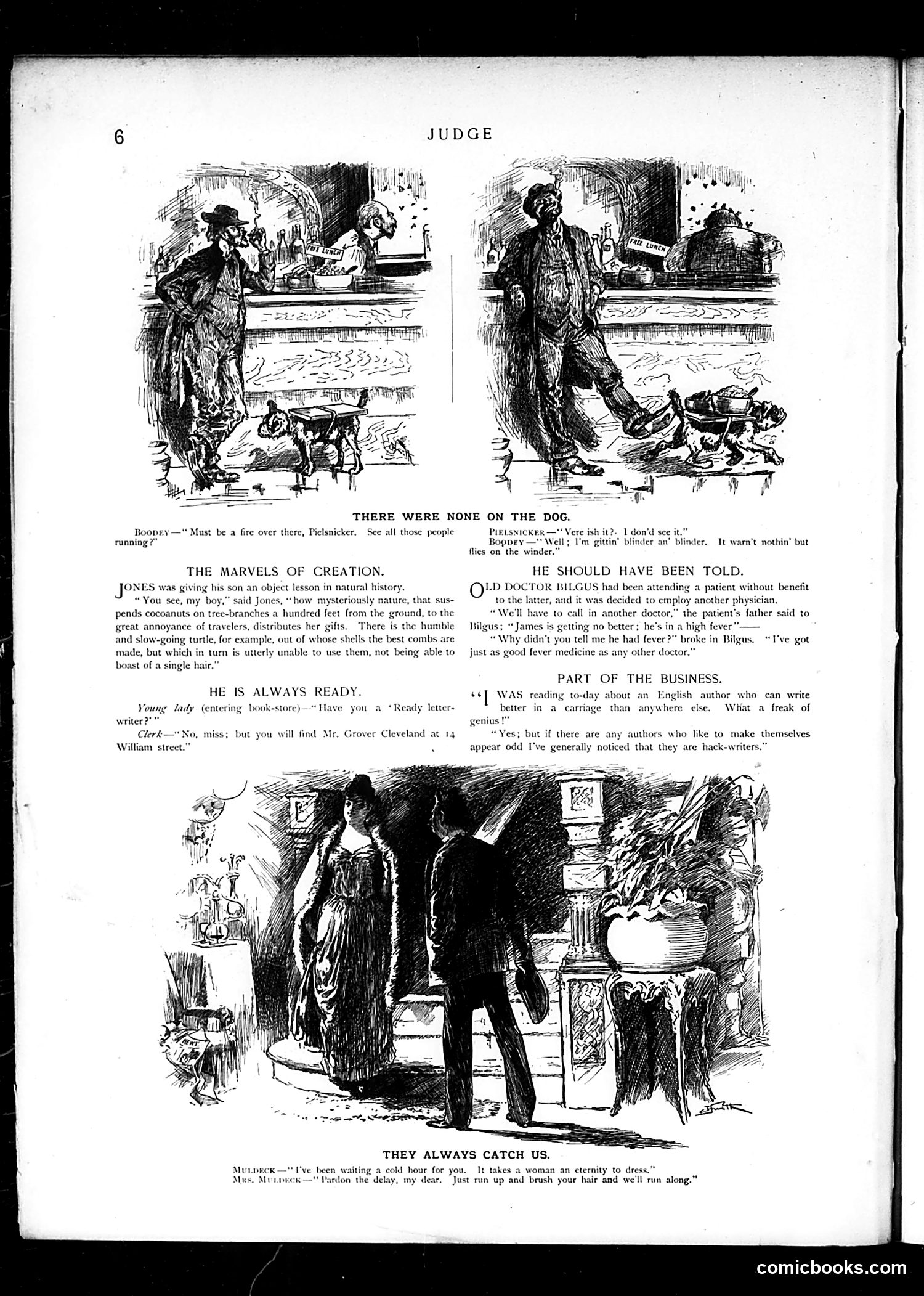
This page contains several unrelated satirical vignettes typical of Judge's humor: **"There Were None on the Dog"**: Two working-class men (Boonry and Pielsnicker) observe a crowd and mistake it for a fire, but it's actually flies on a window—a simple visual gag about misperception. **"The Marvels of Creation"**: Jones lectures his son on nature's illogical design, noting coconuts hang dangerously high and turtles can't use their own shells for combs. This mocks pseudo-intellectual naturalism popular in the era. **"He Should Have Been Told"**: Doctor Bilgus dismisses a patient's high fever as treatable with any "fever medicine," suggesting medical incompetence or quackery. **"He Is Always Ready"**: A bookstore clerk boasts that ready-made letters are available, and quips that authors who seem eccentric are actually just hack-writers—poking fun at literary pretension. **"They Always Catch Us"**: A husband complains about his wife's slow dressing routine, then she delays further—domestic humor about female tardiness, a common period stereotype. All are lighthearted social satire rather than political commentary.
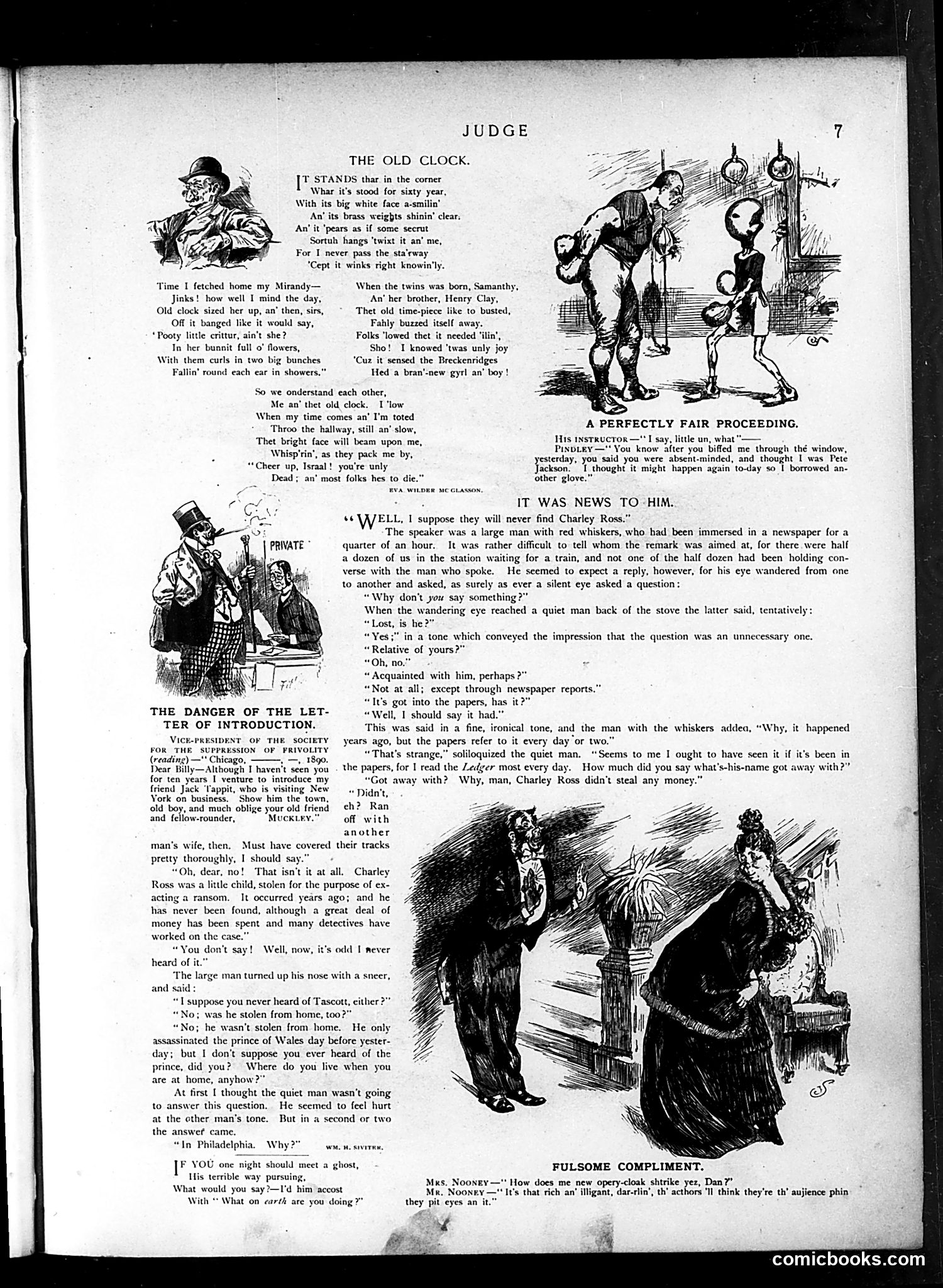
This page contains three distinct satirical pieces from *Judge* magazine: **"The Old Clock"** is sentimental rural dialect verse about a grandfather clock that seems to celebrate family milestones—a nostalgic, non-political piece. **"A Perfectly Fair Proceeding"** shows a schoolboy comedy: a student who borrowed another's glove after fighting him, then claims absent-mindedness as an excuse to borrow it again today—satirizing weak excuses and repeated misbehavior. **"It Was News to Him"** satirizes a man who monopolizes conversation about the Charley Ross case (a famous unsolved 1870s child abduction that newspapers covered constantly), only to discover his captive audience knows nothing about it. The joke: he assumes everyone follows the news obsessively, when in fact a quiet man hasn't heard of this "famous" case at all—mocking both sensationalist newspaper coverage and the self-important chatterer who overestimates public interest in stories. **"The Danger of the Letter of Introduction"** is a brief humorously cautionary note about introducing visiting friends.
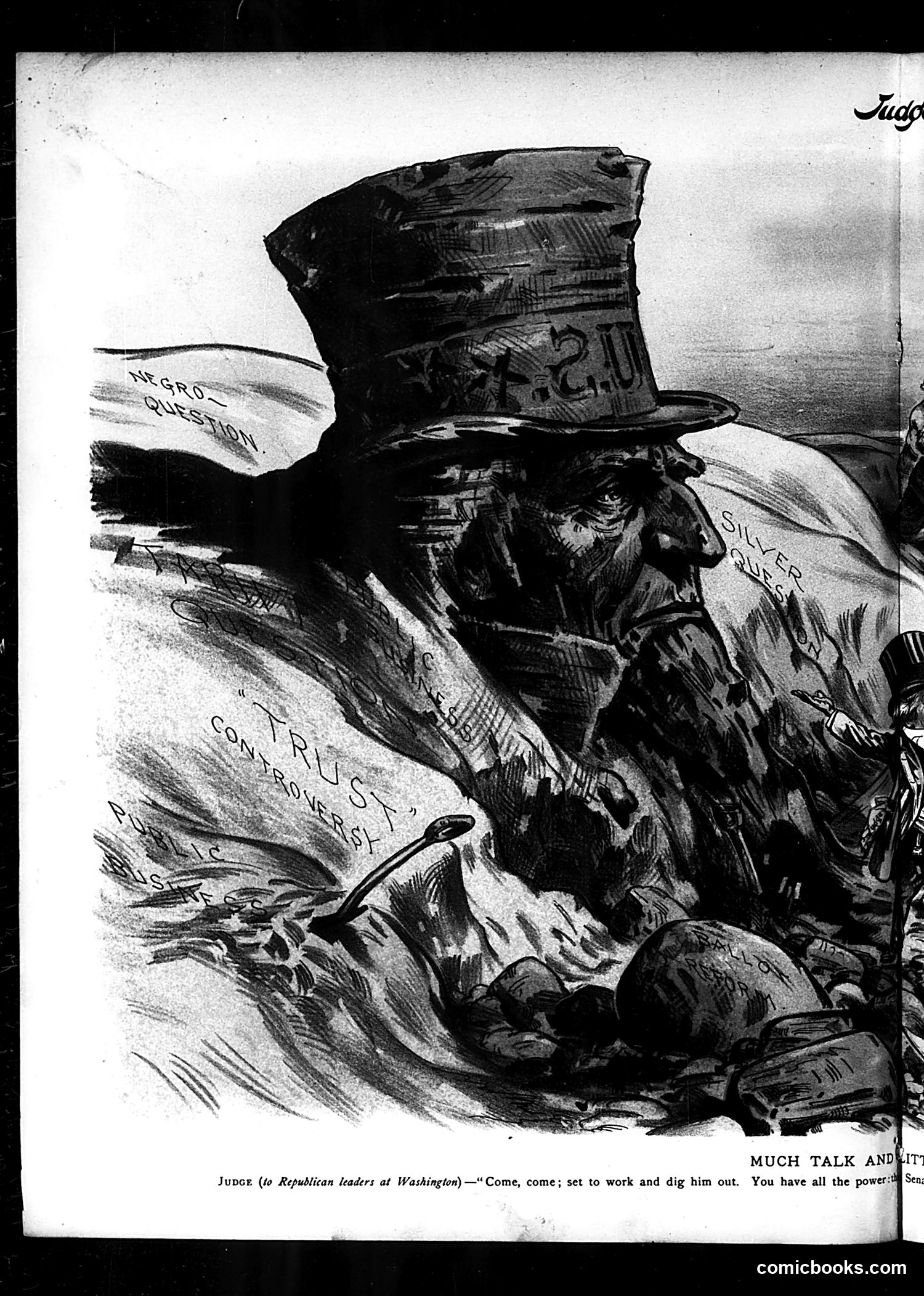
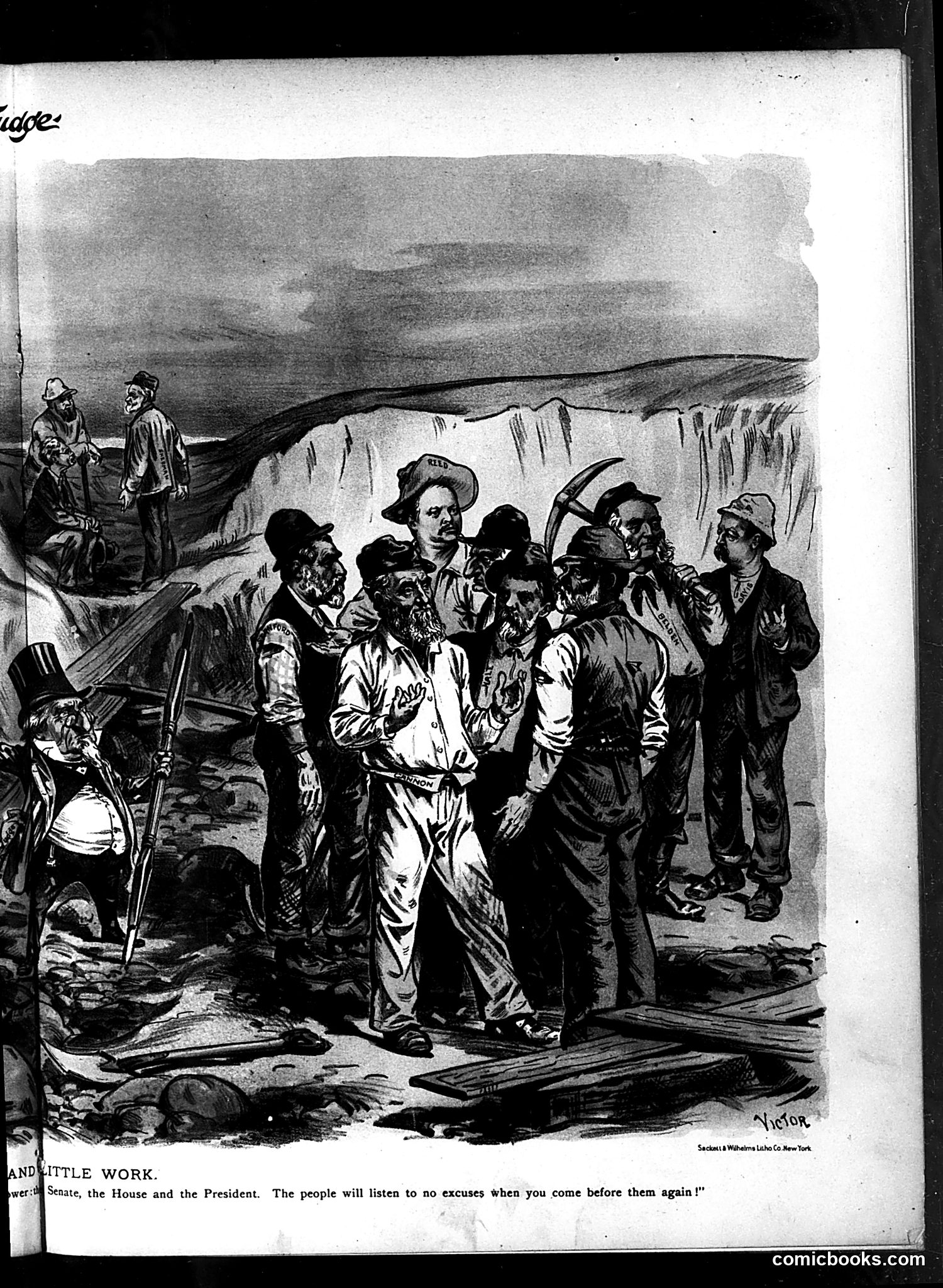
This Judge magazine cartoon depicts a skeletal figure labeled "Judge" addressing Republican leaders in Washington. The skeleton wears a tall hat marked with what appears to be a date or seal, and is surrounded by labels including "SILVER QUESTION," "CORRUPTION," and other partially visible text referencing political issues. The caption reads: "Come, come; set to work and dig him out. You have all the power." The satire appears to criticize Republican leadership for failing to address corruption or resolve a significant political crisis (likely related to the silver question, a major 1890s political debate). The skeletal "Judge" personifies the withering political situation, pressuring Republicans to take action. The cartoon suggests they possess the political power but are failing in their responsibility to clean up or resolve the problem.
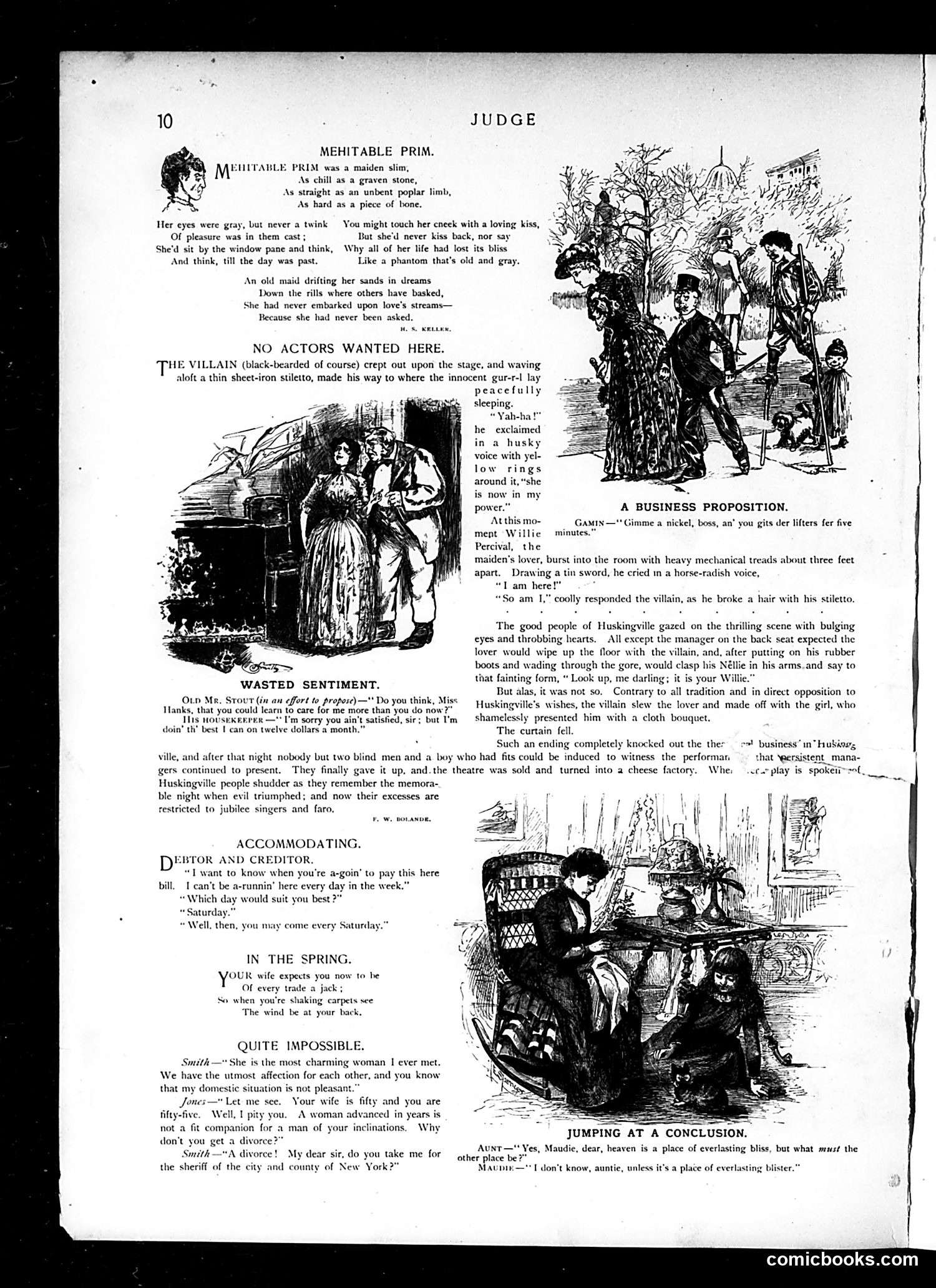
This page from *Judge* magazine contains several short satirical pieces typical of late 19th/early 20th-century American humor: **"Mehitable Prim"** is a poem mocking spinsters—specifically unmarried women who remain passive and emotionally unavailable, never experiencing love because they never initiated romance ("Because she had never been asked"). **"No Actors Wanted Here"** satirizes melodramatic theater conventions. It describes a villain's predictable stage villainy, but the joke is that Huskingville's actual production defies theatrical tradition—the villain wins, shocking audiences so thoroughly the theater closes and becomes a cheese factory. This mocks both overwrought stage drama and small-town naïveté. The remaining pieces ("Wasted Sentiment," "Accommodating," "In the Spring," "Quite Impossible," "A Business Proposition," "Jumping at a Conclusion") are brief comic dialogues about courtship, class differences, domestic life, and working-class speech patterns—typical *Judge* fare targeting middle-class readers with gentle social observation and ethnic/class-based humor now considered dated.
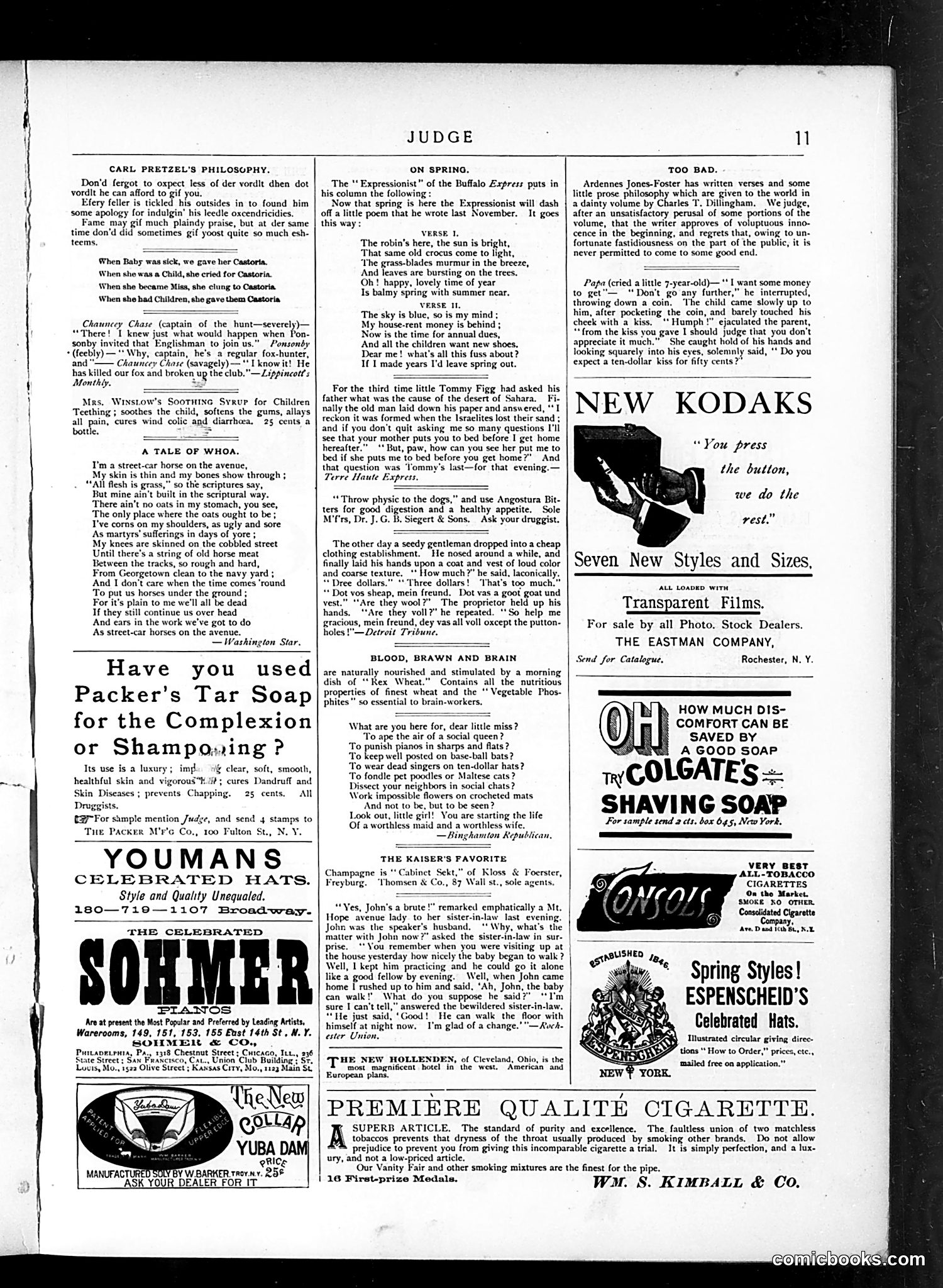
This page is primarily **advertisements with some satirical content**. The main illustrated cartoon appears to be a hunting scene where Captain Chauncey Chase blames an English fox-hunter (Ponsonby's guest) for killing their fox and disrupting their club—the satire being that the Englishman was *too good* at fox-hunting, defeating the purpose of the sport. The other notable content is **"A Tale of Whoa,"** a poem from the *Washington Star* about an overworked streetcar horse in poor condition—social commentary on animal welfare and labor exploitation disguised as verse. Lines like "I don't care when the time comes 'round / To put us horses under the ground" express the animal's despair at brutal working conditions. The remainder consists of period advertisements (Castoria, Youmans Hats, Packer's Tar Soap, etc.) and light humor pieces, including a joke about a father's sarcastic answer to his son's question about the Sahara Desert.
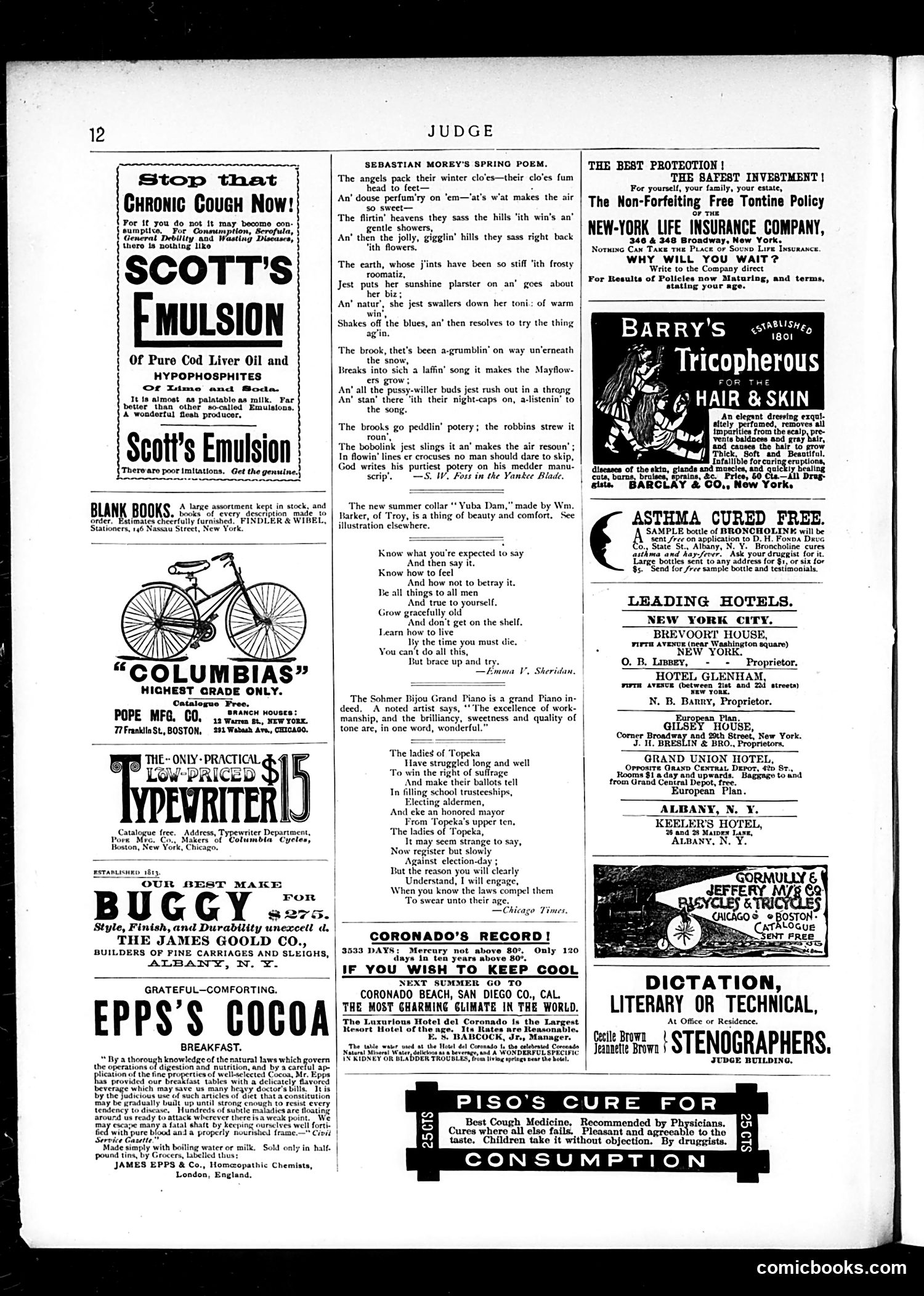
This page is primarily **advertising with some light verse content**, typical of Judge magazine's format. The main satirical poem is "Sebastian Morey's Spring Poem," a humorous personification of nature's seasonal awakening. Using folksy dialect ("clo'es," "'ith"), the poem treats natural phenomena anthropomorphically—the earth shaking off "the blues," nature swallowing "her toni" (tonic), brooks "laffin'"—to create comedic effect. The tone is whimsical rural Americana rather than politically biting. The page is dominated by period product advertisements (Scott's Emulsion for consumption, bicycles, buggies, cocoa, typewriters), which funded the magazine. One advertisement references a new collar design "Yuba Dam" by William Barker, suggesting this is mid-to-late 1890s. The remaining text appears to be untitled aphorisms about social behavior ("Know what you're expected to say / And then say it"), and promotional copy for pianos and hotels. **This is primarily a commercial/advertising page with minimal political satire.**
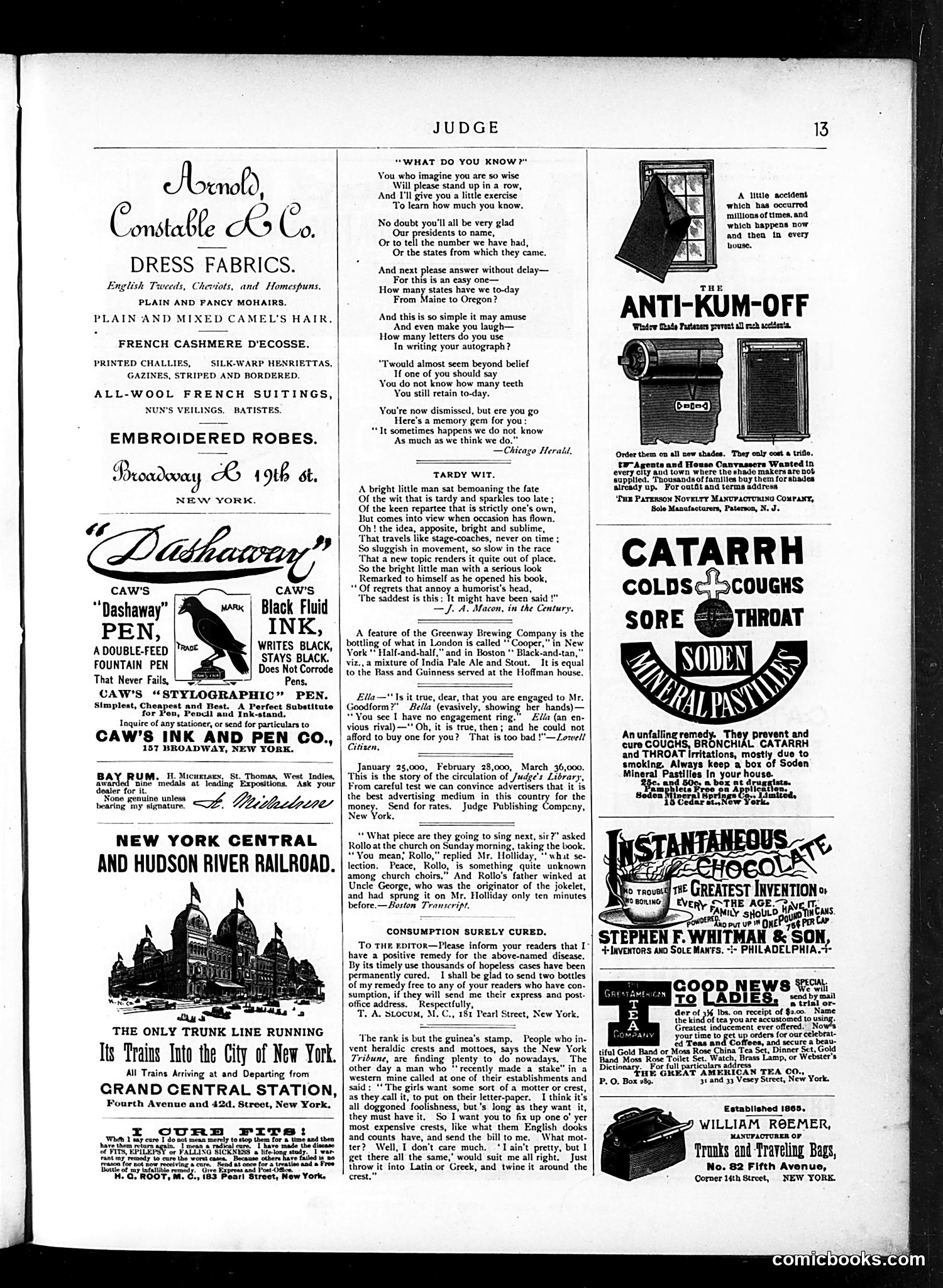
This page is primarily **advertising** for Judge magazine and related products (fabrics, pens, railroads, patent medicines). The only substantive editorial content is a poem titled **"What Do You Know?"** — a humorous quiz poem from the Chicago Herald that mocks people who think themselves wise by asking absurdly simple questions (naming U.S. presidents, counting states, how many teeth they have, letters in their signature). The joke is that even these trivial facts stump people. A second piece, **"Tardy Wit,"** plays on the frustration of thinking of clever remarks too late—a relatable human experience. There's also a brief anecdote about "Ella" and "Bella" concerning an engagement ring, which appears to be light social satire about women and marriage. The page contains no visible political cartoons or caricatures—it's mostly classified advertisements typical of Judge's format, showing the magazine mixed commercial interests with humor and social commentary.
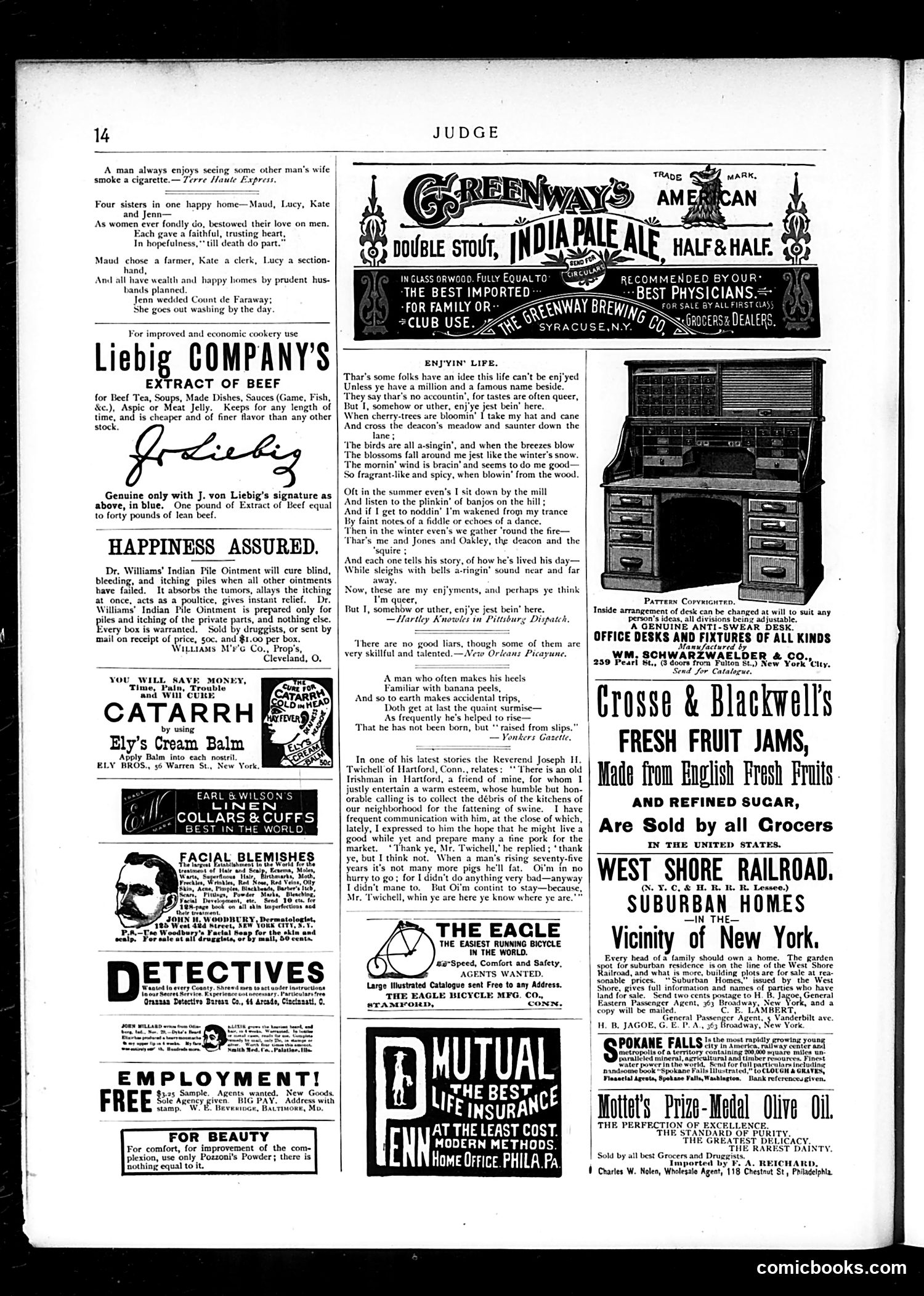
This page is primarily **advertisements and light verse**, not political satire. The dominant content includes ads for patent medicines (pile ointment, catarrh cure), food products (Liebig beef extract, Grosse & Blackwell jams), and real estate. The editorial content consists of: 1. **A moral poem** about four sisters with different husbands—three prudent, one (married to "Count de Faraway") reduced to washing clothes. The satire targets imprudent marriage choices and financial mismanagement rather than politics. 2. **Humorous rural dialect verses** ("Enj'yin' Life") celebrating simple pleasures—cherry blossoms, mill sounds, winter gatherings—rather than wealth or status. This reflects late-19th-century sentimental Americana. 3. **Brief quips** about human nature (lying, marital behavior). The page reflects *Judge*'s typical mix: moralistic humor, domestic comedy, and commercial advertising targeting middle-class readers. No specific political figures or events appear identifiable.
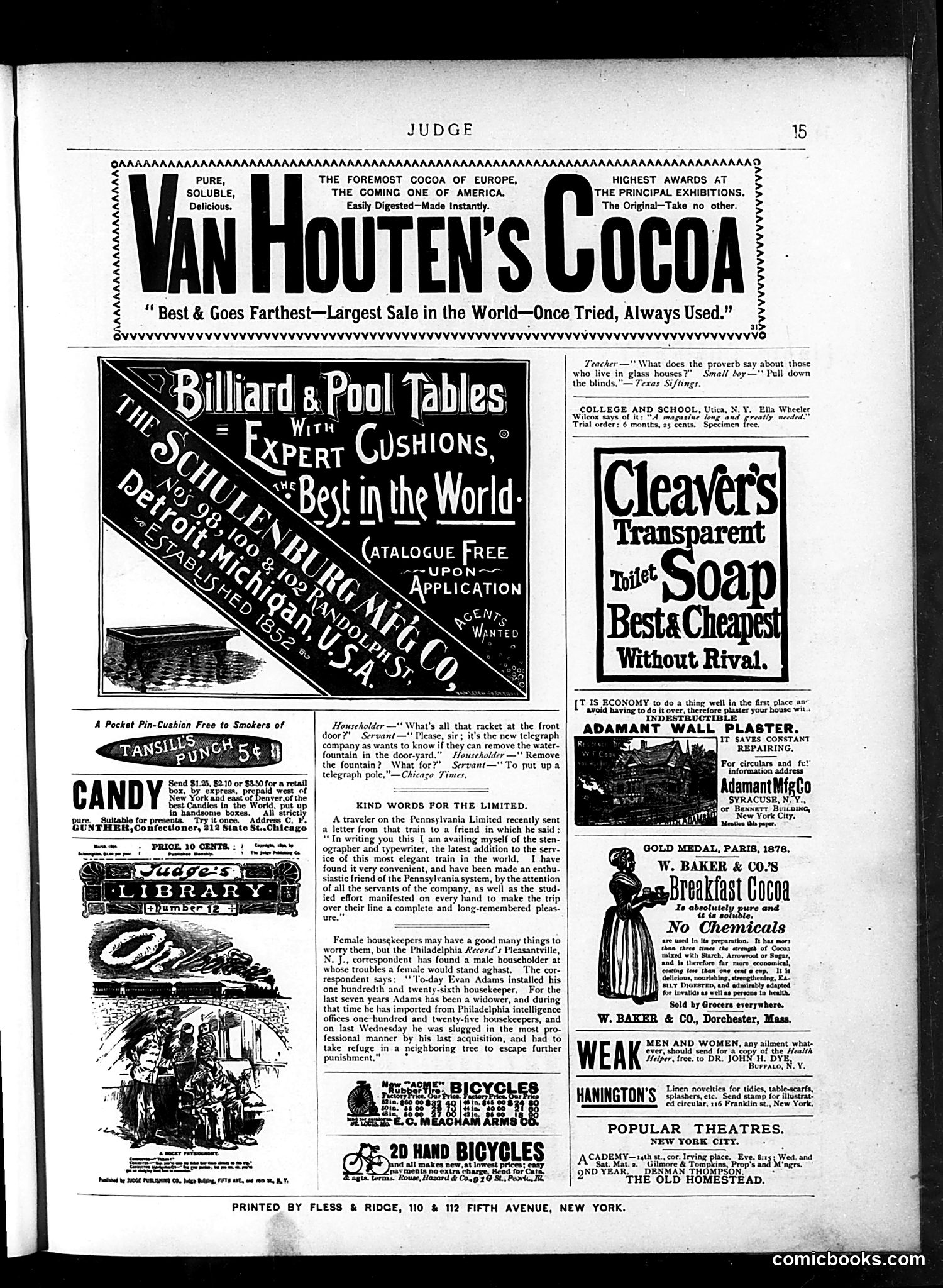
This is primarily an **advertisement page** from Judge magazine, not a political cartoon or satirical content page. The page consists almost entirely of commercial advertisements typical of the late 19th century. **Notable elements:** - **Top banner**: Van Houten's Cocoa advertisement claiming superiority as "foremost cocoa of Europe" and "coming one of America" - **Large ads**: Billiard tables, candy, bicycles, soap, cocoa, plaster, and patent medicines - **Embedded humor**: One genuine satirical piece—a brief dialogue joke about a servant informing a householder that telegraph workers want to remove his water fountain to install a pole ("Chicago Times") - **Content focus**: Promotional materials for consumer goods, health products, and entertainment The page reflects turn-of-the-century American consumer culture and advertising practices, not political or social satire. The single joke present is lightweight domestic humor rather than substantive commentary.
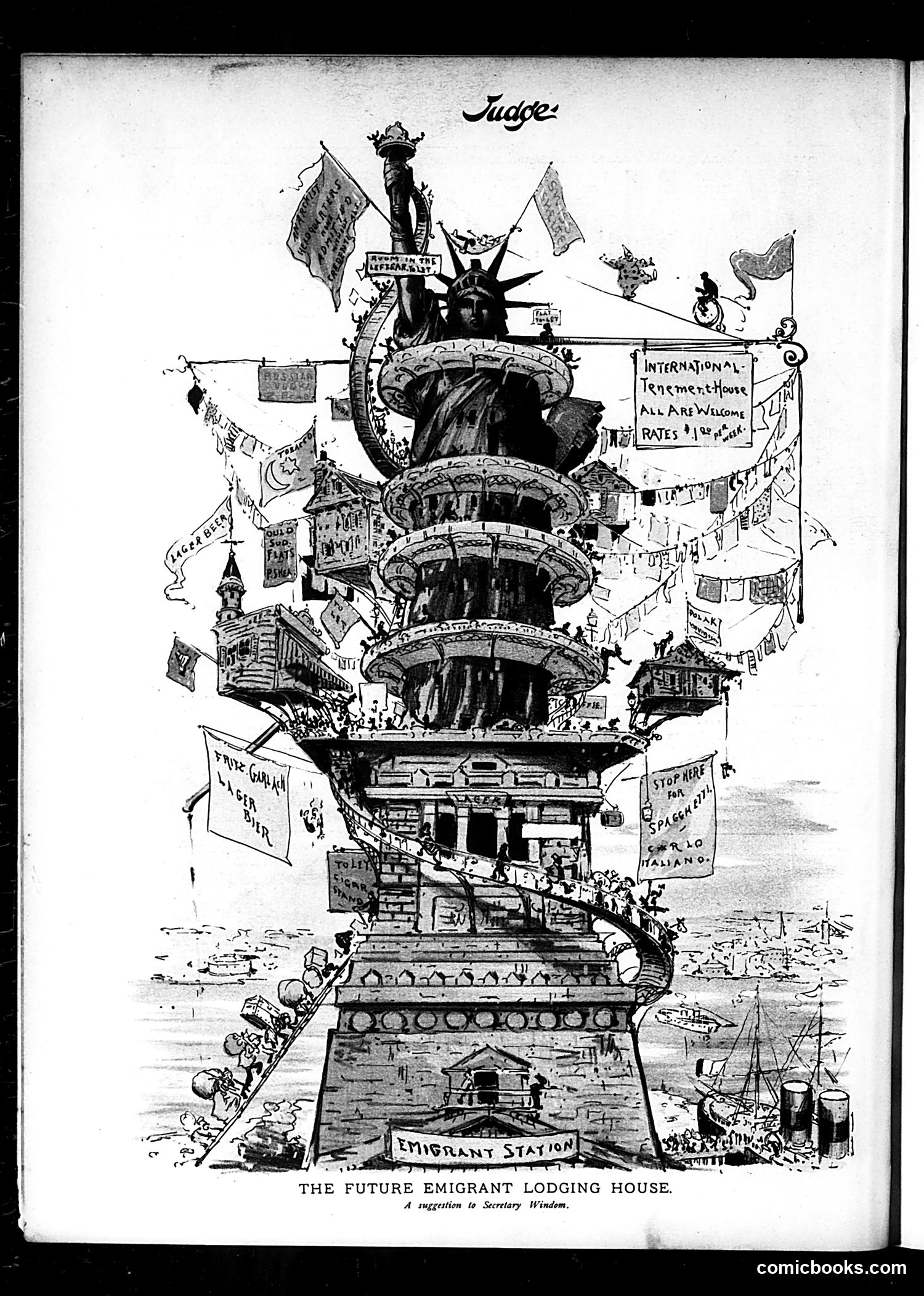
This Judge satirical cartoon mocks a proposal by Secretary Windom (likely Treasury Secretary William Windom, circa 1880s-1890s) regarding immigrant housing facilities. The cartoon depicts the Statue of Liberty grotesquely transformed into a towering, chaotic tenement building with multiple levels, overcrowded platforms, and commercial signage advertising "Free Lodging," "International Kitchenhouse," and various rates. The satire suggests that Windom's immigration policy would convert America's welcoming symbol into an overcrowded, profit-driven tenement operation. Signs for "Emigrant Station" and "Steerage" emphasize the dehumanizing treatment of immigrants. The visual absurdity—stacking immigrant housing within Liberty itself—critiques governmental neglect and exploitative commercialization of newly arrived foreigners, questioning whether America truly welcomes immigrants or merely processes them as commodities.