
Judge, 1890-04-12 · page 2 of 16
Judge — April 12, 1890 — page 2: what you’re looking at
What you’re looking at
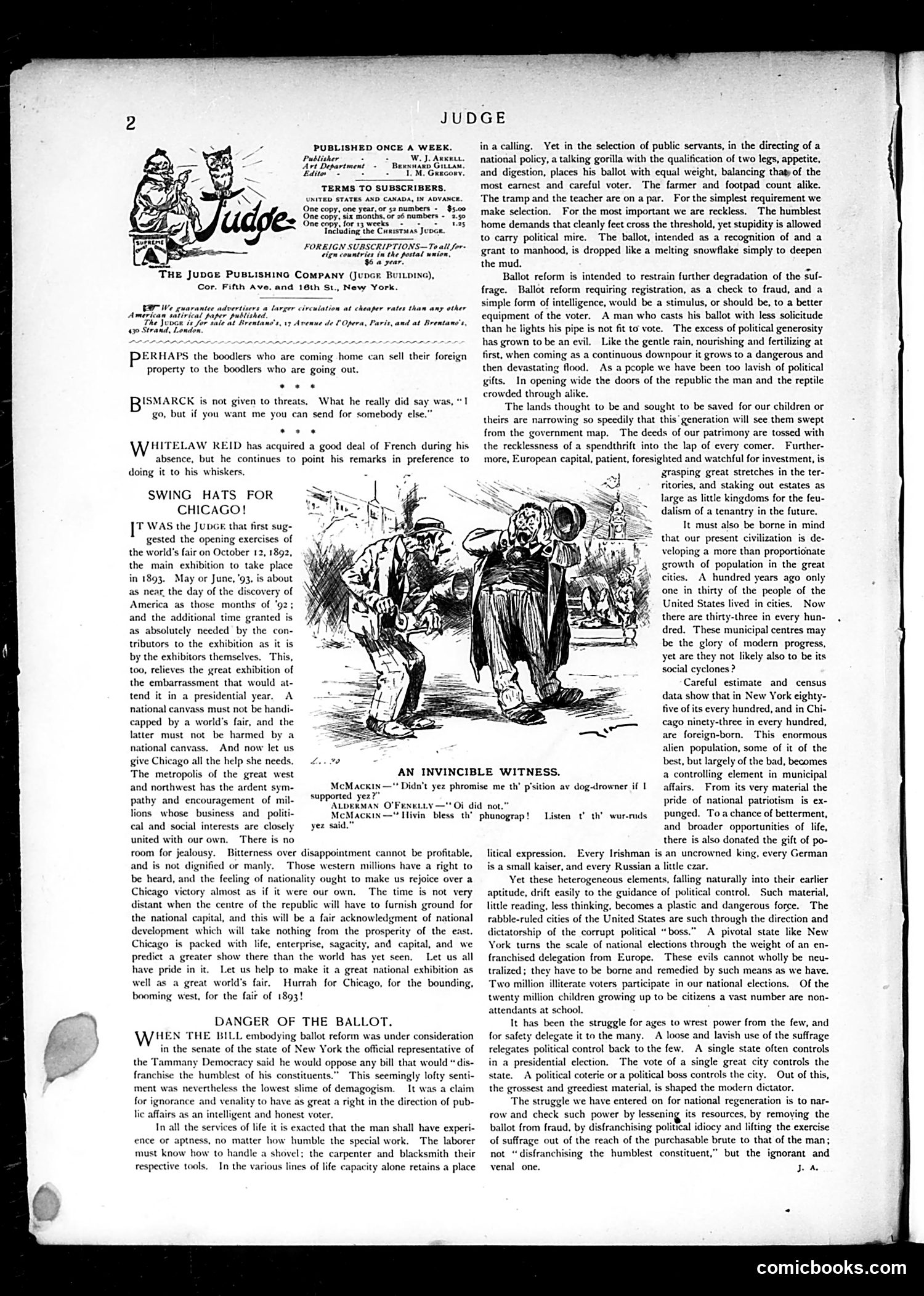
This cartoon satirizes immigrant voters and political corruption in American cities. The dialogue shows "McMackin" claiming he witnessed something "in poison as dog-drowner" (possibly "as a dog-drowner"), while another figure dismisses his credibility, saying "Oh did not." The satire targets the perceived unreliability of foreign-born urban voters in elections—a common nativist concern of the era. The accompanying article criticizes "heterogeneous elements" in cities and "illiterate voters" participating in elections, warning that two million illiterate children and non-attendees at school represent a threat to American democracy. The cartoon's "invincible witness" title suggests these immigrant voters' testimony or participation in elections is beyond challenge yet fundamentally untrustworthy—reflecting era-specific anxieties about urbanization and immigration's effect on democratic integrity.
📄 Transcribed text from this page (OCR, searchable)
Machine-transcribed from the original scan — historical spelling and the odd misread are preserved.
JUDGE PUBLISHED ONCE A WEEK. Publisher == Wa J. Auman. Art Department - — Bexxwaxd Gitta Edito i TERMS TO SUBSCRIBERS. UNITED STATES AND CANADA, IN ADVANCE, One copy, one year, or s2 numbers - $5.00 ‘One copy, six months, or 26 numbers - "2.50 One copy. for 13 weeks = == 1.35 Including the Cxstaas Juocn. FOREIGN SUBSCRIPTIONS—Te all for- cign countries in the postal union, $6 a year. THE JUDGE PUBLISHING Company (Juncr Burtt Cor. Fifth Ave. and 16th St., New York. ER We guarantee advertisers a larger circulation at cheaper rates than any other American satirical paper published. The Juvce is for sale at Brentano's, 17 Avenue de Opera, Paris, and at Brentano's, 490 Strand, London ERHAPS the boodlers who are coming home can sell their foreign property to the boodlers who are going out. ISMARCK is not given to threats. What he really did say was, “1 go, but if you want me you can send for somebody else.” WHITELAW REID has acquired a good deal of French during his absence, but he continues to point his remarks in preference to doing it to his whiskers. SWING HATS FOR CHICAGO! T WAS the JUDGE that first sug- gested the opening exercises of the world’s fair on October 12, 1892, the main exhibition to take place in 1893. May or June, 93, is about as near, the day of the discovery of America as those months of 92; and the additional time granted is as absolutely needed by the con- tributors to the exhibition as it is by the exhibitors themselves. This, too, relieves the great exhibition of the embarrassment that would at- tend it in a presidential year. A national canvass must not be handi- capped by a world’s fair, and the latter must not be harmed by a ional canvass. And now let us give Chicago all the help she needs. The metropolis of the great west and northwest has the ardent sym- pathy and encouragement of mil- lions whose business and_ politi- cal and social interests are closely united with our own. There is no room for jealousy. Bitterness over disappointment cannot be profitable, and is not dignified or manly. Those western millions have a right to be heard, and the feeling of nationality ought to make us rejoice over a Chicago victory almost 3 The time is not very distant when the centre of the republic will have to furnish ground for the national capital, and this will be a fair acknowledgment of national development which will take nothing from the prosperity of the east. Chicago is packed with life, enterpris pital, and we predict a greater show there than the world has yet seen, Let us all have pride in it. Let us help to make it a great national exhibition well as a great world’s fair. Hurrah for Chicago, for the bounding, booming west, for the fair of 1893! supported yez ALDERMAN O! MeMackin — yez said.” ENELL if it were our own, DANGER OF THE BALLOT. BILL embodying ballot reform was under consideration nate of the state of New York the official representative of the Tammany Democracy said he would oppose any bill that would * di franchise the humblest of his constituents.” ment was nevertheless the lowest slime of demagogism. It was a claim for ignorance and venality to have as great a right in the direction of pub- lic affairs as an intelligent and honest voter. In all the services of life it is exacted that the man shall have experi- tness, no matter how humble the special work. The laborer must know how to handle a shovel; the carpenter and blacksmith their ¢ tools. In the various lines of life capacity alone retains a place HEN TE in the This seemingly lofty senti- AN INVINCIBLE WITNESS. McMackin—" Didn't yez phromise me th’ p'sition av dog-drowner if 1 *Oi did not.” Hivin bless th’ phunograp! in acalling. Yet in the selection of public servants, in the directing of a national policy, a talking gorilla with the qualification of two legs, appetite, and digestion, places his ballot with equal weight, balancing that of the most earnest and careful voter. The farmer and footpad count alike. ‘The tramp and the teacher are on a par. For the simplest requirement we make selection. For the most important we are reckless. The humblest home demands that cleanly feet cross the threshold, yet stupidity is allowed to carry political mire. The ballot, intended as a recognition of and a grant to manhood, is dropped like a melting snowflake simply to deepen the mud. ai Ballot reform is intended to restrain further degradation of the suf- frage. Ballot reform requiring registration, as a check to fraud, and a simple form of intelligence, would be a stimulus, or should be, to a better equipment of the voter. A man who casts his ballot with less solicitude than he lights his pipe is not fit to vote. The excess of political generosity has grown to be an evil. Like the gentle rain, nourishing and fertilizing at first, when coming as a continuous downpour it grows to a dangerous and then devastating flood. As a people we have been too lavish of political gifts. In opening wide the doors of the republic the man and the reptile crowded through alike. The lands thought to be and sought to be saved for our children or theirs are narrowing so speedily that this’ generation will see them swept from the government map. The deeds of our patrimony are tossed with the recklessness of a spendthrift into the lap of every comer. Further- more, European capital, patient, foresighted and watchful for investment, is grasping great stretches in the ter- ritories, and staking out estates as large as little kingdoms for the feu- dalism of a tenantry in the future. It must also be borne in mind that our present civilization is de- veloping a more than proportionate growth of population in the great cities. A hundred years ago only one in thirty of the people of the United States lived in cities. Now there are thirty-three in every hun- dred. These municipal centres may be the glory of modern progress, yet are they not likely also to be its social cyclones? Careful estimate and census data show that in New York eighty- five of its every hundred, and in Chi- cago ninety-three in every hundred, are foreign-born. This enormous alien population, some of it of the best, but largely of the bad, becomes a controlling element in municipal affairs. From its very material the pride of national patriotism is ex- punged. Toa chance of betterment, and broader opportunities of life, there is also donated the gift of po- litical expression. Every Irishman is an uncrowned king, every German is a small kaiser, and every Russian a little czar. Yet these heterogeneous elements, falling naturally into their earlier aptitude, drift easily to the guidance of political control. Such material, little reading, less thinking, becomes a plastic and dangerous force. The rabble-ruled cities of the United States are such through the direction and dictatorship of the corrupt political “boss.” A. pivotal state like New York turns the scale of national elections through the weight of an en- sed delegation from Europe. These evils cannot wholly be neu- tralized; they have to be borne and remedied by such means as we have. Two million illiterate voters participate in our national elections. Of the twenty million children growing up to be citizens a vast number are non- attendants at school. It has been the struggle for ages to wrest power from the few, and for safety delegate it to the many. A loose and lavish use of the suffrage relegates political control back to the few. A single state often controls in a presidential election. The vote of a single great city controls the state. A political coterie or a political boss controls the city. Out of this, the grossest and greediest material, is shaped the modern dictator. The struggle we have entered on for national regeneration is to nar- row and check such power by lessening its resources, by removing the ballot from fraud, by disfranchising political idiocy and lifting the exercise of suffrage out of the reach of the purchasable brute to that of the man; not “disfranchising the humblest constituent,” but the ignorant and venal one. JA Listen t) th’ wur-ruds comicbooks.com