
A complete issue · 17 pages · 1890
Judge — April 5, 1890
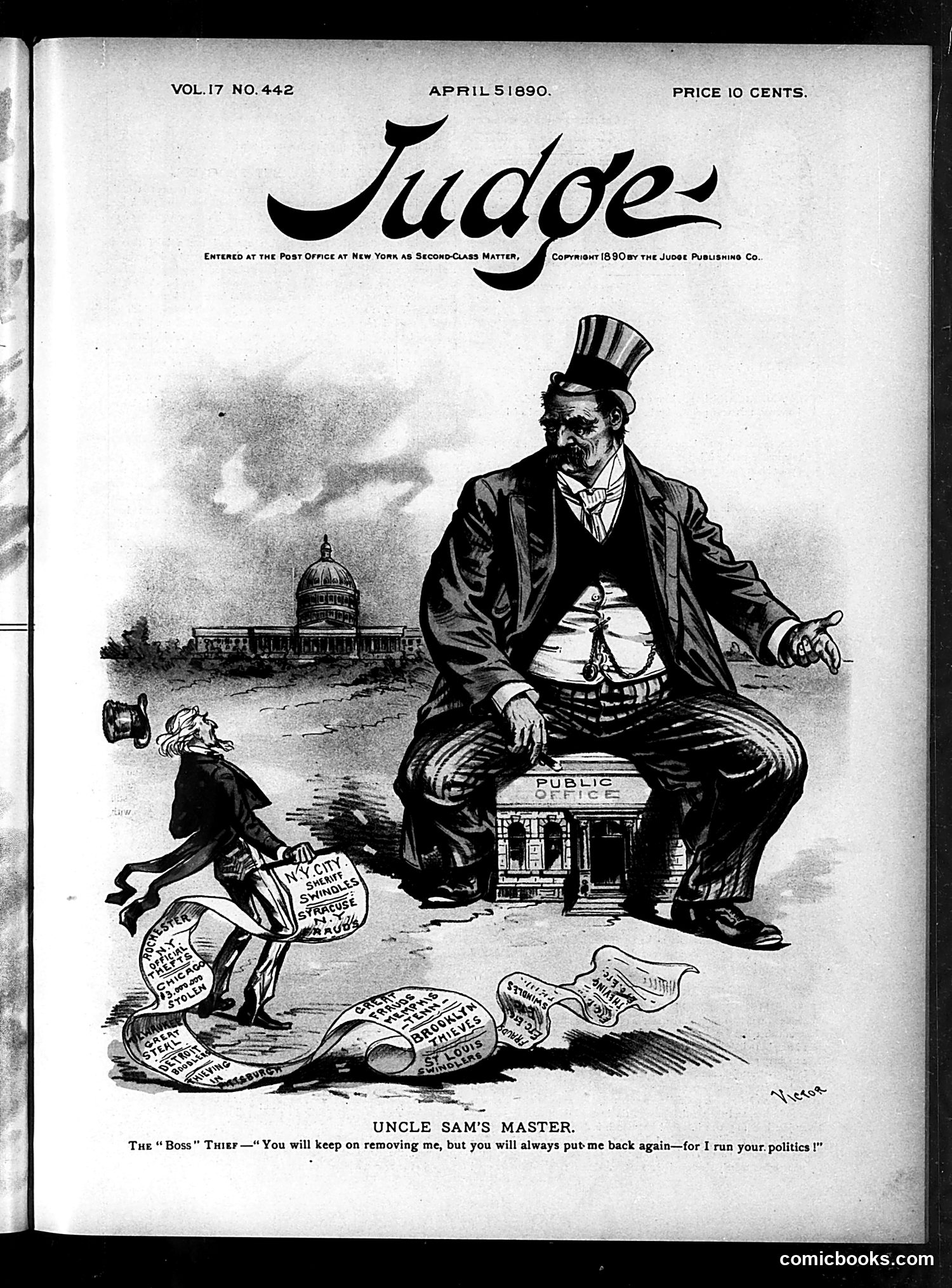
This cartoon depicts a large figure in a top hat sitting atop a "Public Office" building, representing corrupt political control of government. The figure appears to be a caricatured "Boss"—likely referring to a political machine boss or party leader of the Gilded Age era. The smaller figure crawling beneath him, labeled as a "Thief," represents corruption or graft operating within public institutions. The scattered papers and documents around them suggest misappropriated public funds and fraudulent schemes. The caption's quote—"You will keep on removing me, but you will always put me back again—for I run your politics!"—satirizes the cyclical nature of political corruption, suggesting that despite reform efforts, corrupt political machines remained deeply entrenched in American governance during this period.
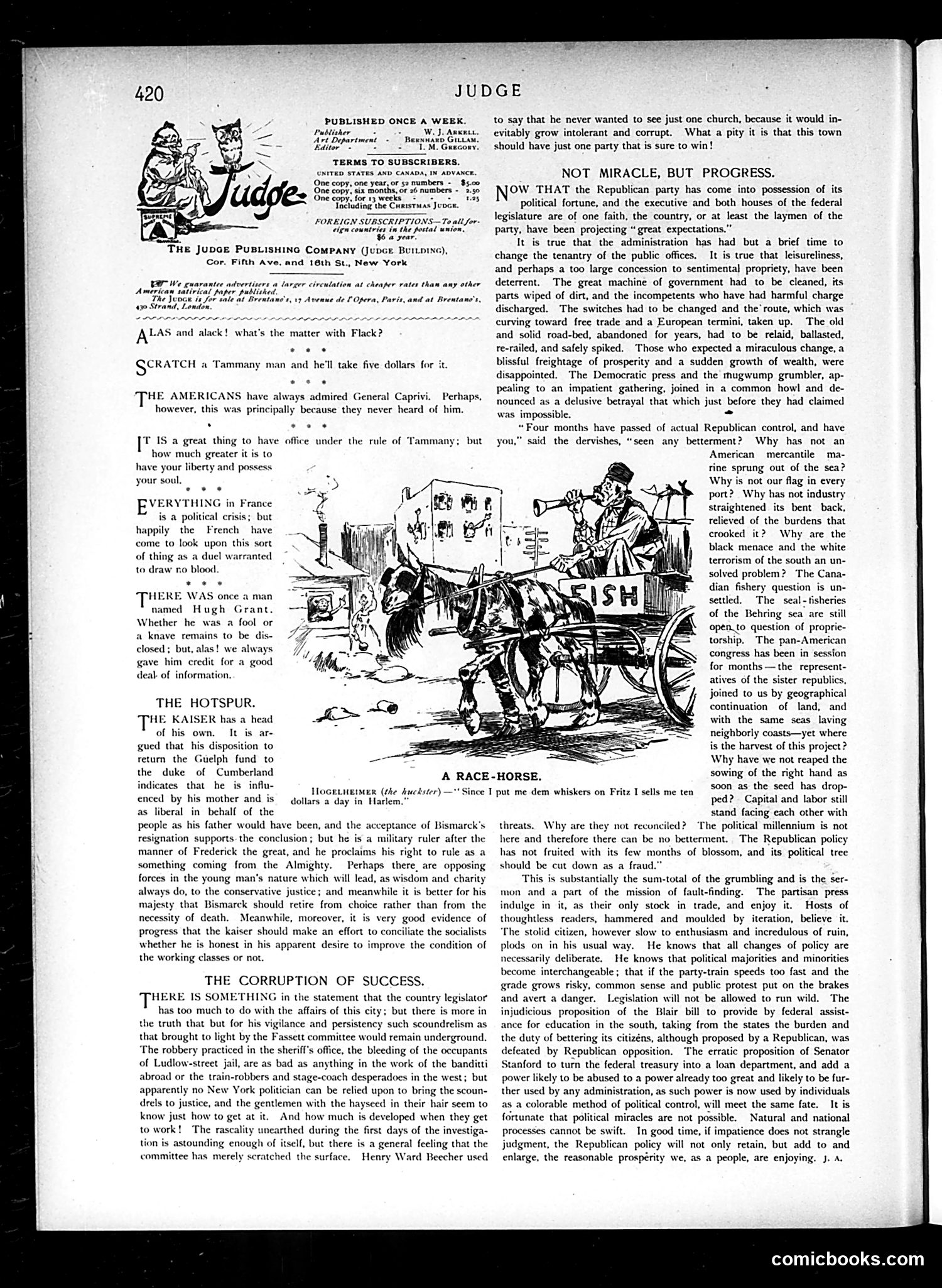
This cartoon satirizes Republican economic promises following their political victory. The image depicts a man (likely representing a Republican politician or the party's leadership) driving a cart labeled "FISH" pulled by an emaciated, struggling horse—a visual metaphor for the nation's failing economy. The accompanying text explains the joke: a hogsplayer says "Since I put me dem whiskers on Fitz I sells me ten dollars a day in fishes." The satire suggests Republicans promised prosperity ("great expectations") but delivered only hardship. The starving horse represents how their policies are exhausting the country's resources rather than generating promised wealth. The cartoon mocks the gap between Republican campaign rhetoric and actual economic results for ordinary citizens.
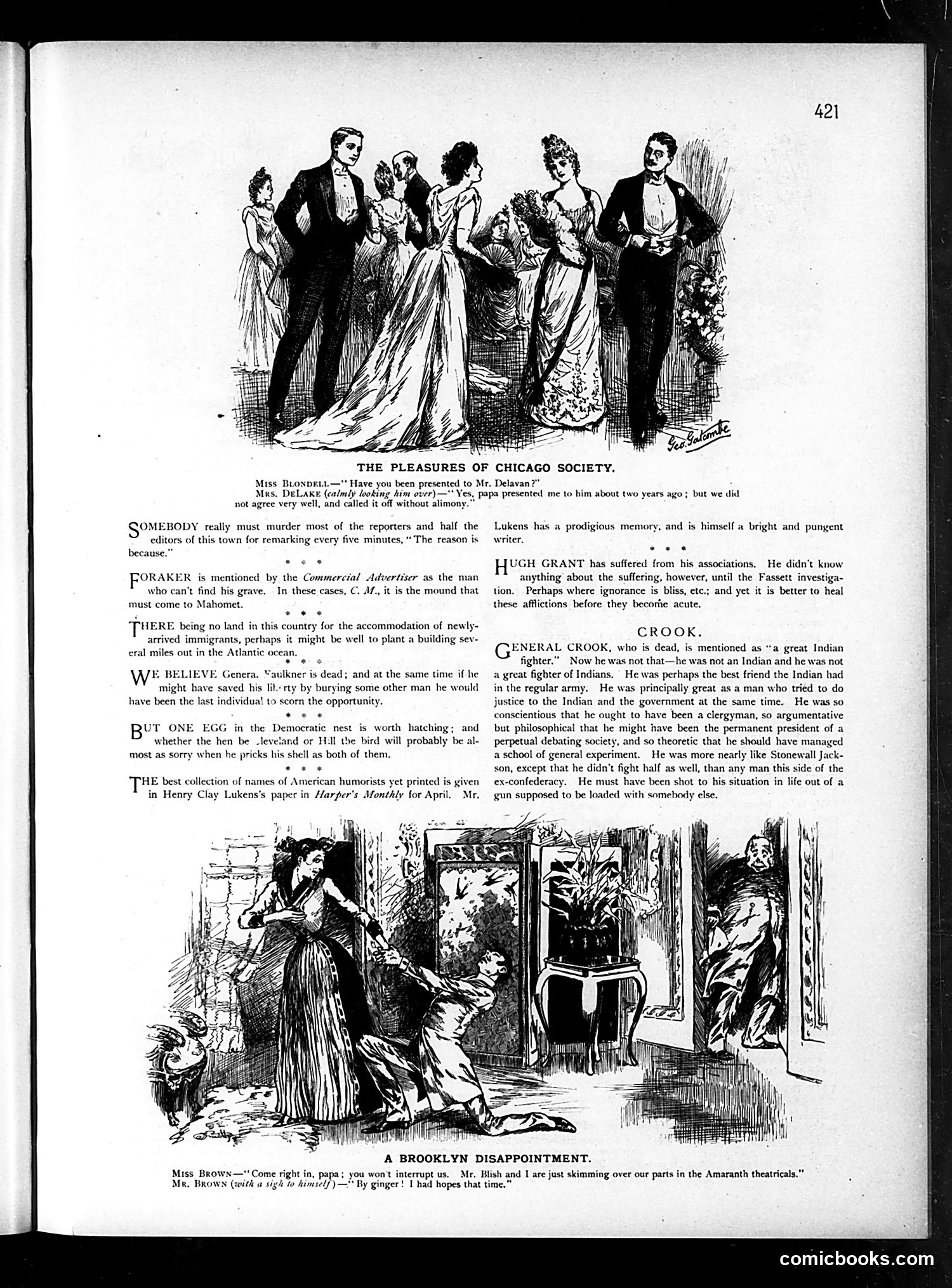
This page from *Judge* magazine contains two satirical sections: **"The Pleasures of Chicago Society"** (top) mocks Chicago's social elite through brief gossip items about local figures. The cartoon depicts a formal society gathering, satirizing the pretensions of wealthy Chicagoans. **"A Brooklyn Disappointment"** (bottom) shows a domestic scene where Miss Brown interrupts two men examining theatrical costumes or props, making a joke about their claimed trip to the Amaranth theatricals (likely a real venue). The humor derives from catching them in what appears to be a deception about their outing. Both sections exemplify *Judge*'s satirical approach: mocking urban middle and upper-class social pretensions and domestic hypocrisies through humor. The specific individuals referenced are local Chicago and Brooklyn figures whose identities would have been known to contemporary readers but remain unclear today.
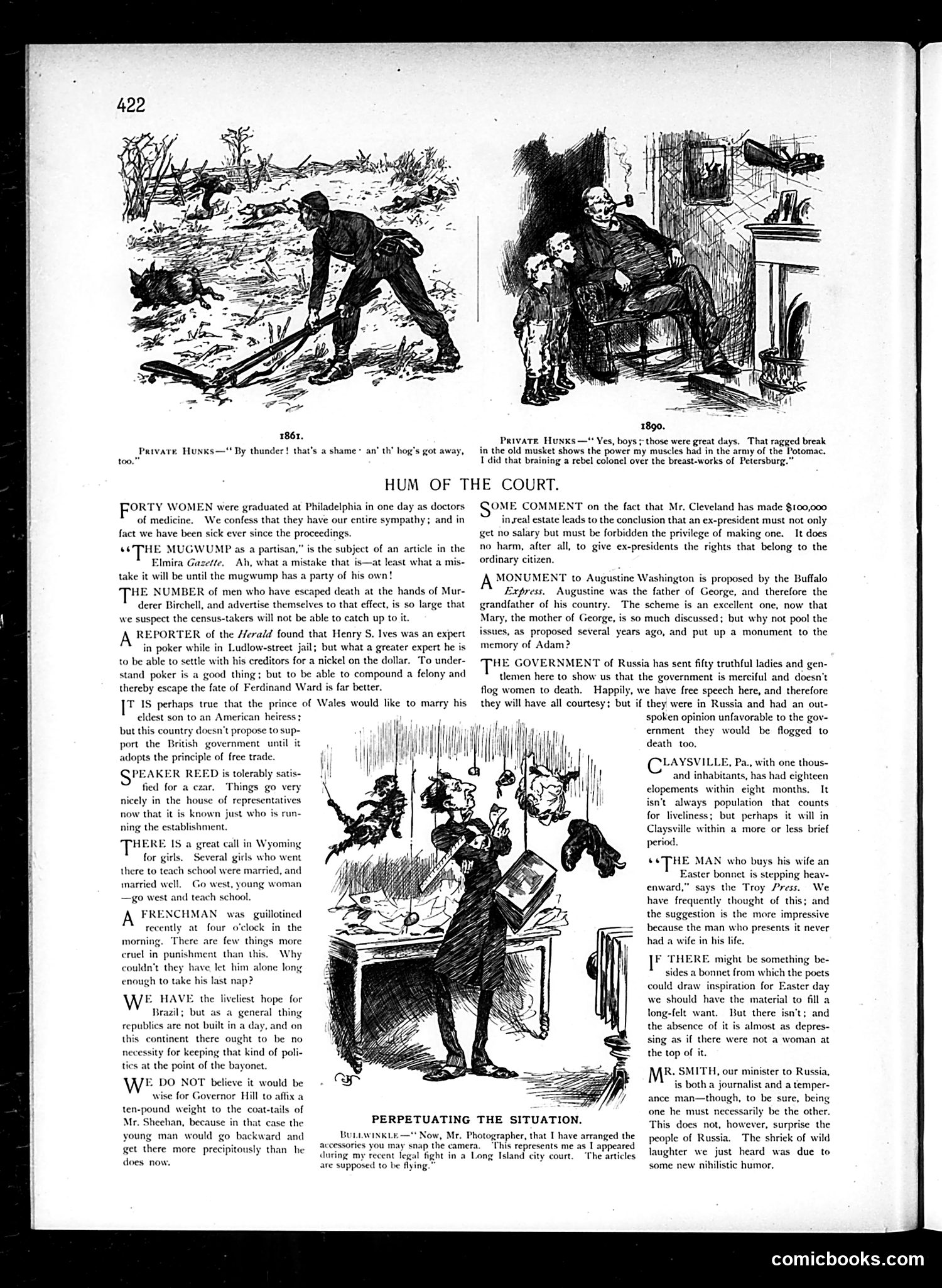
This page from Judge contains several short satirical commentaries and illustrations typical of 1880s American humor: **Top illustrations**: Two sketches labeled "Private Hunks" (dated 1861 and 1890) mock an aging Civil War veteran boasting about his military service and strength, contrasting his current feebleness with past glory—a common target of period satire. **Main content**: Short quips on contemporary issues include: - **Women doctors**: Mocking the graduation of forty female physicians as unseemly - **Prince of Wales**: Joking that America won't support British royalty marrying American heiresses - **Russia's "truthful ladies"**: Satirizing Russia's sending propagandists to deny flogging women, suggesting Russian dissidents would face punishment for speaking freely **Political references**: Mentions of "mugwumps" (independent Republicans), Governor Hill, and various scandals reflect 1880s political drama. The humor relies on readers' familiarity with contemporary events, scandal, and political figures. Most jokes target women's advancement, foreign governments, and political hypocrisy.
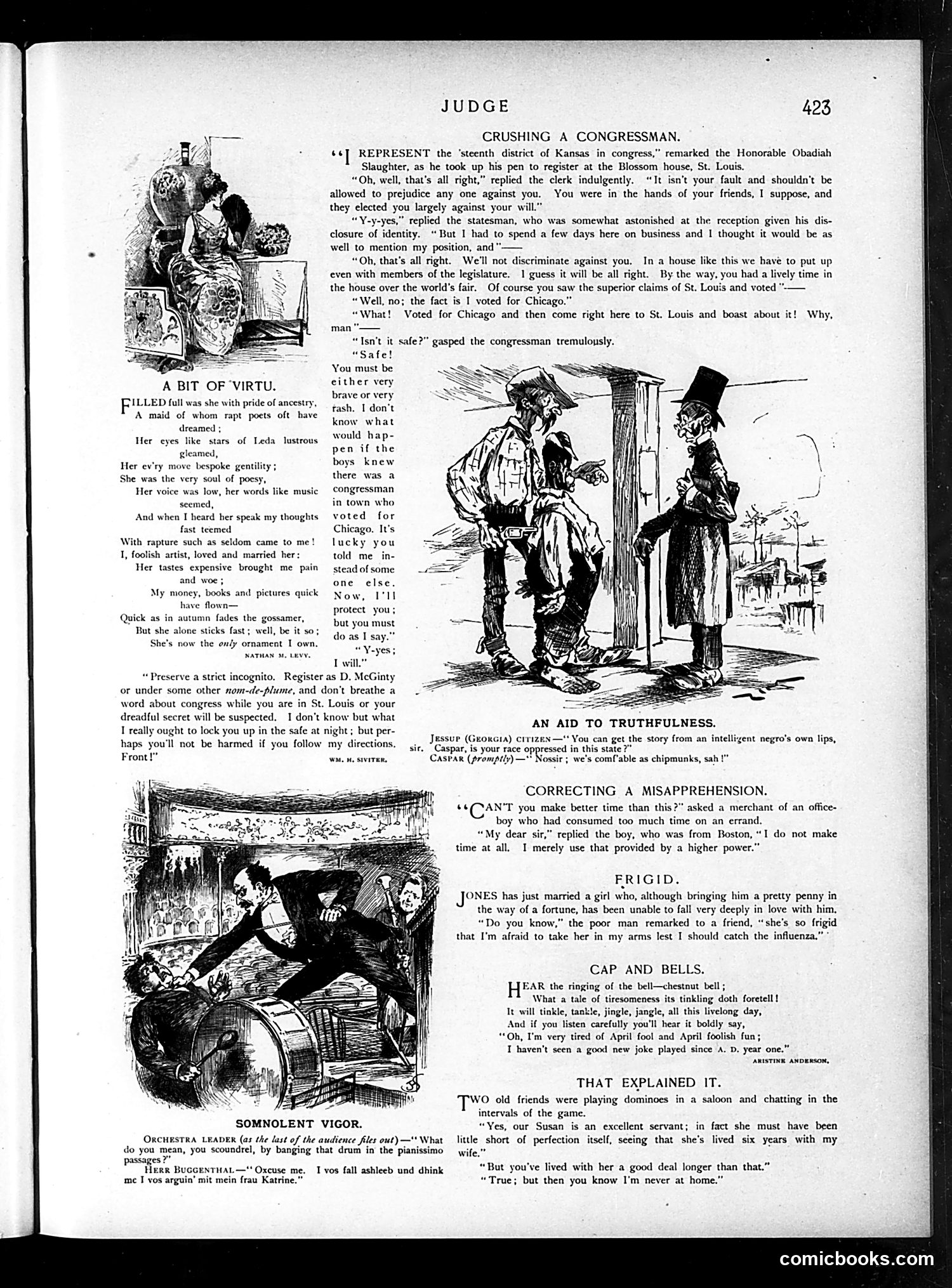
This cartoon mocks a Kansas congressman named Obadiah Slaughter who voted for Chicago over St. Louis in the World's Fair competition, then arrived in St. Louis to conduct business. The hotel clerk's barbed "welcome" exposes the congressman's political cowardice: he's terrified his vote will be discovered and resents his constituents' apparent control over him. The satire targets the congressman's hypocrisy—claiming to represent his district while admitting his friends "elected you largely against your will"—and suggests politicians are spineless creatures dependent on backroom power brokers rather than genuine representatives. The accompanying poem "A Bit of Virtu" ridicules a man who married an aristocratic woman whose expensive tastes bankrupted him, leaving her as his only remaining possession—satirizing both social climbing and marriage as economic transaction. These pieces reflect Gilded Age anxieties about political corruption, urban rivalry, and changing social hierarchies.
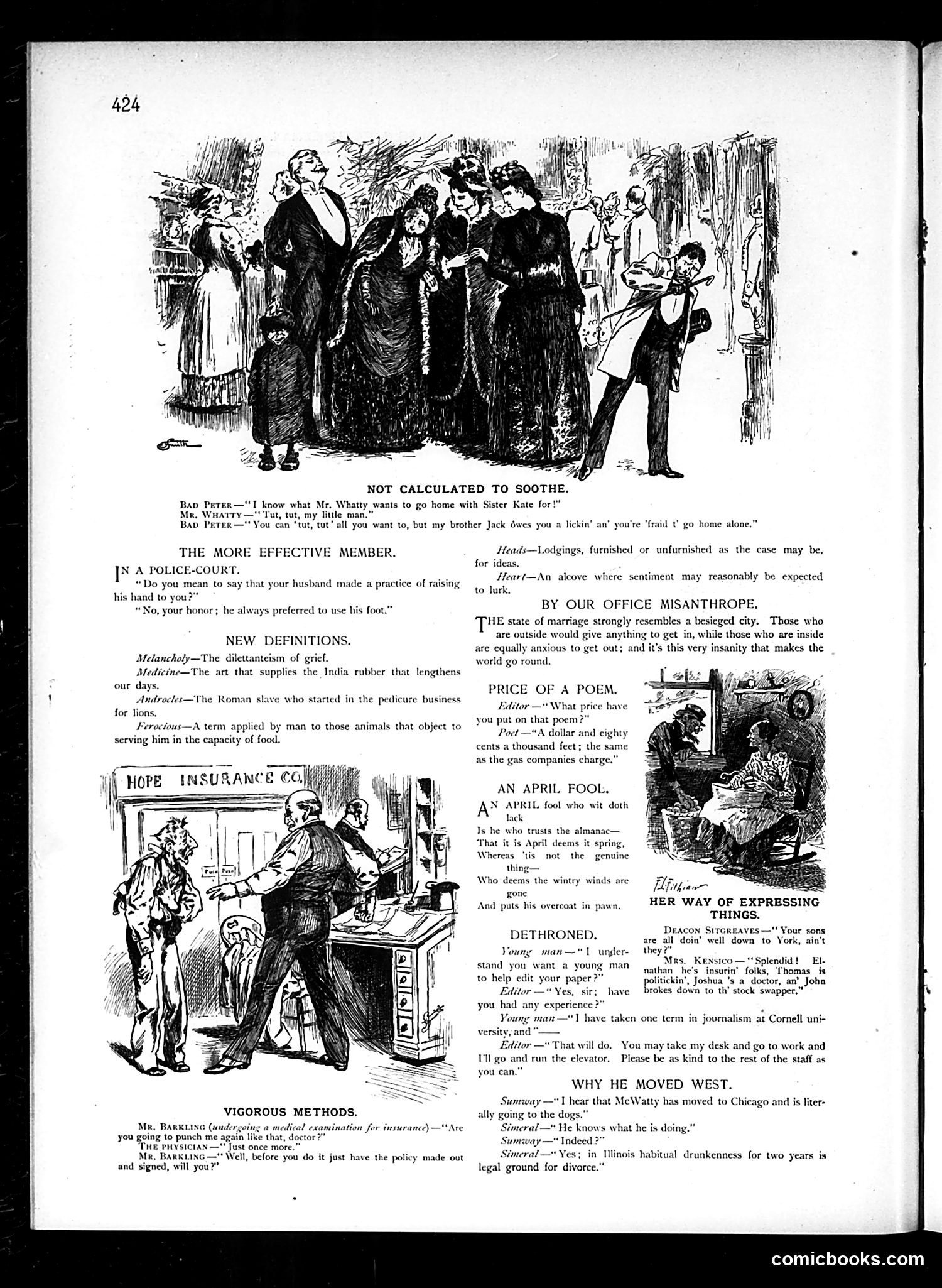
This page contains multiple satirical vignettes typical of late-19th-century American humor: **"Not Calculated to Soothe"** depicts a domestic dispute where a wife defends her brother against her husband's threats, using her sibling as leverage—satirizing marital discord and false bravado. **"The More Effective Member"** jokes about a wife in police court revealing her husband preferred kicking to hand-raising, mocking domestic violence and courtroom testimony. **"Vigorous Methods"** shows a man requesting his insurance policy be signed *before* the doctor completes a painful examination—satirizing both medical practices and insurance fraud concerns. **"Price of a Poem"** jokes that poetry costs as much per thousand feet as gas, mocking both the low value placed on poetry and standardized utility pricing. The remaining items are brief satirical definitions, marriage commentary, and jokes about journalism, religion, and divorce laws in different states—typical Judge content targeting contemporary American social follies and pretensions.
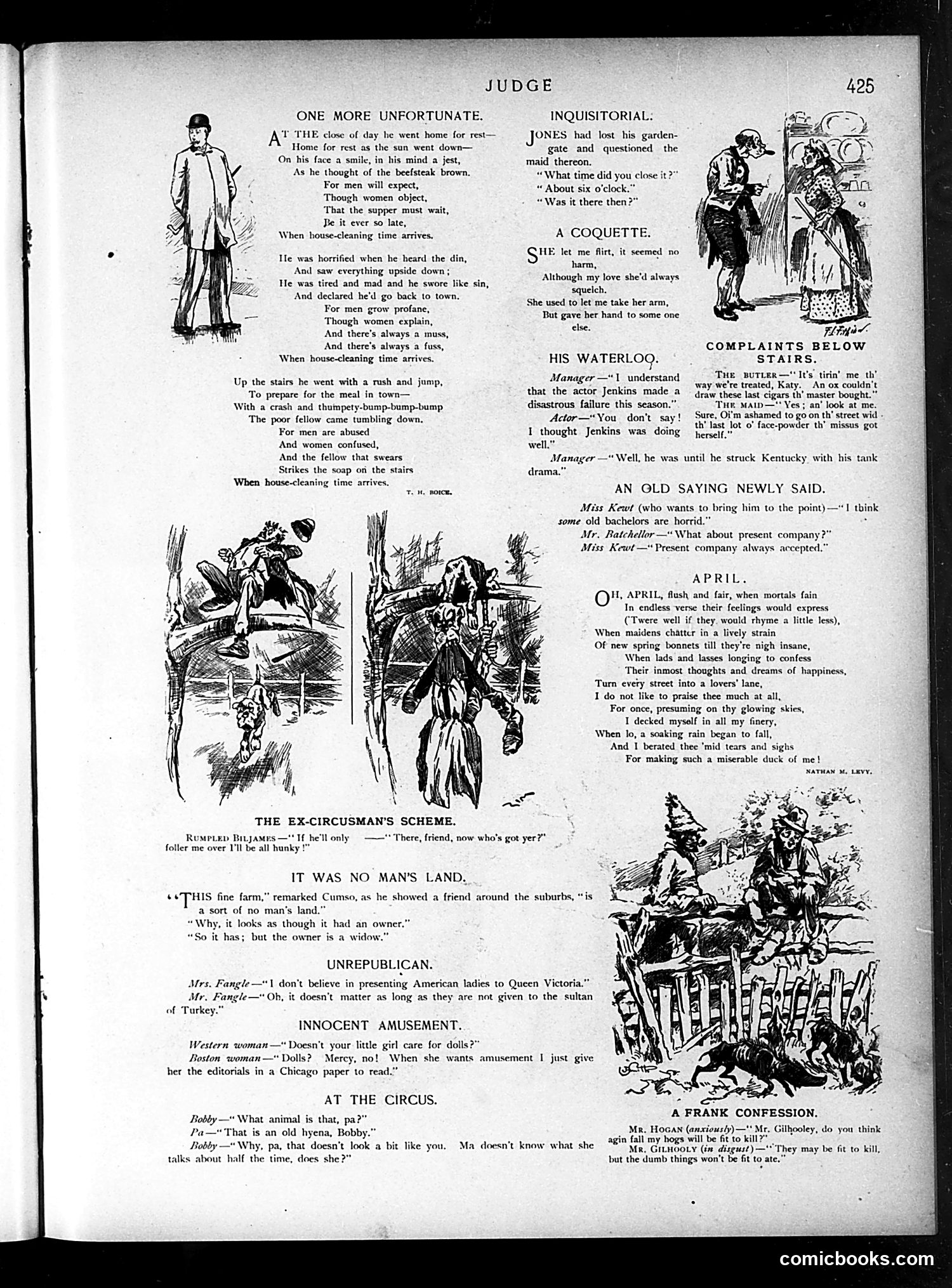
This page from Judge presents multiple short satirical pieces typical of the era's humor magazine format. The main visual cartoon, "One More Unfortunate," illustrates domestic chaos during house-cleaning day—a husband returns home expecting dinner, finds the house in disarray, rushes upstairs to prepare to eat out, and tumbles down the stairs. The satire mocks both male expectations of domestic service and the disruption caused by spring cleaning, a major household event. Other brief pieces lampoon social conventions: "A Coquette" jokes about a flirtatious woman, "An Old Saying Newly Said" features awkward courtship banter, and "April" humorously complains about spring weather ruining one's outfit. "Complaints Below Stairs" presents servants griping about their employers' cheapness. The remaining items are short, light satirical quips on politics ("Unrepublican"), gender stereotypes ("Innocent Amusement"), and family dynamics ("At the Circus"). Overall, the page reflects upper and middle-class anxieties about gender roles, domestic service, courtship, and social propriety—standard Judge Magazine fare.
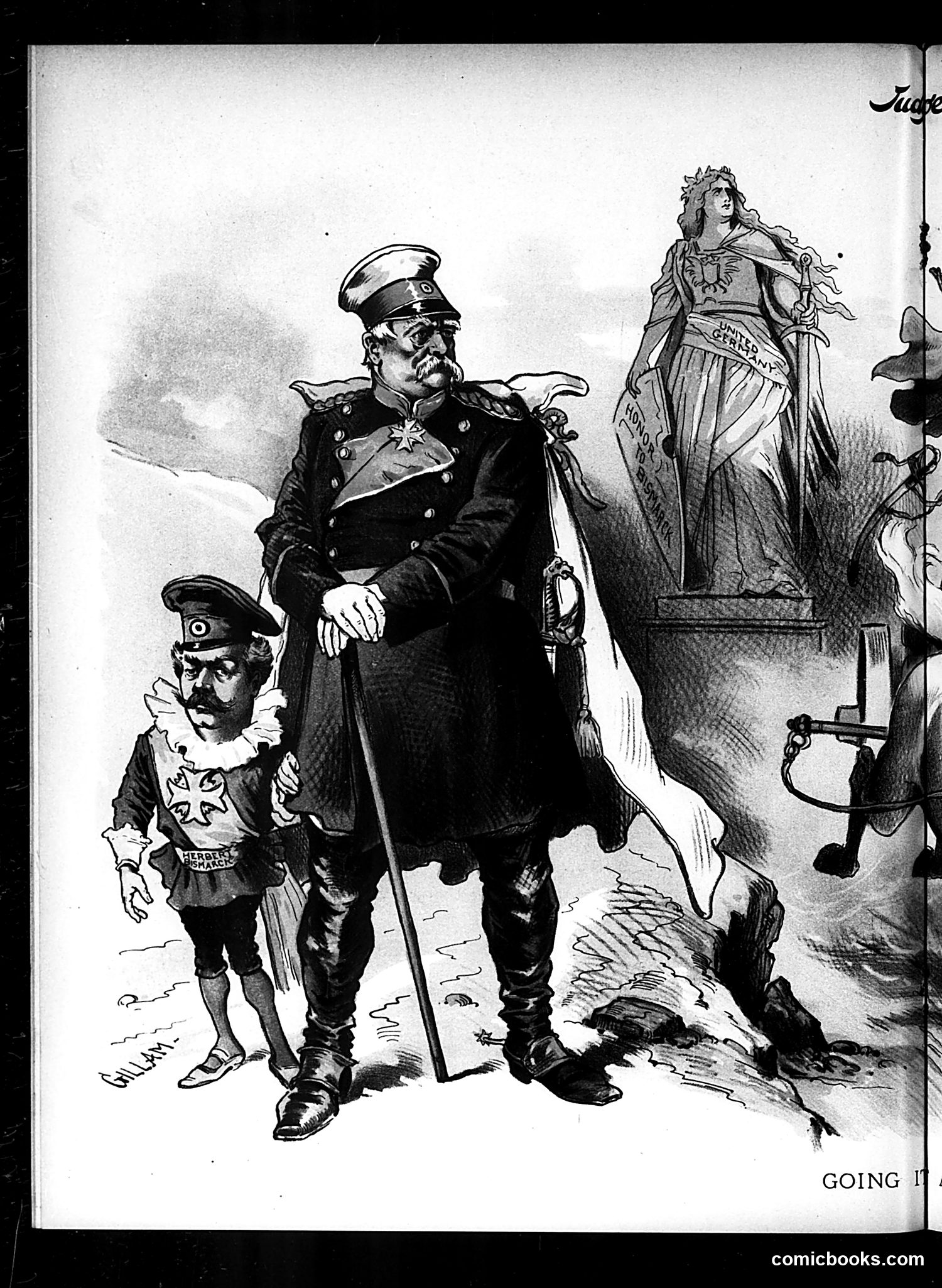
This appears to be a satirical cartoon from *Judge* magazine showing a military figure in formal Prussian or German-style uniform with decorations standing beside a smaller uniformed figure (likely representing a subordinate or colonial ruler). Behind them stands an allegorical female figure—possibly representing a nation or empire—holding symbols of authority. The caption reads "GOING I!" (incomplete), and the artist's signature appears to be "Gillam." The satire likely critiques imperial military ambition or German expansionism, a common theme in American political cartoons of the late 19th/early 20th century. The juxtaposition of the commanding officer with the smaller figure suggests commentary on power dynamics or subordination within empires. Without the complete caption or publication date, the specific historical event remains unclear.
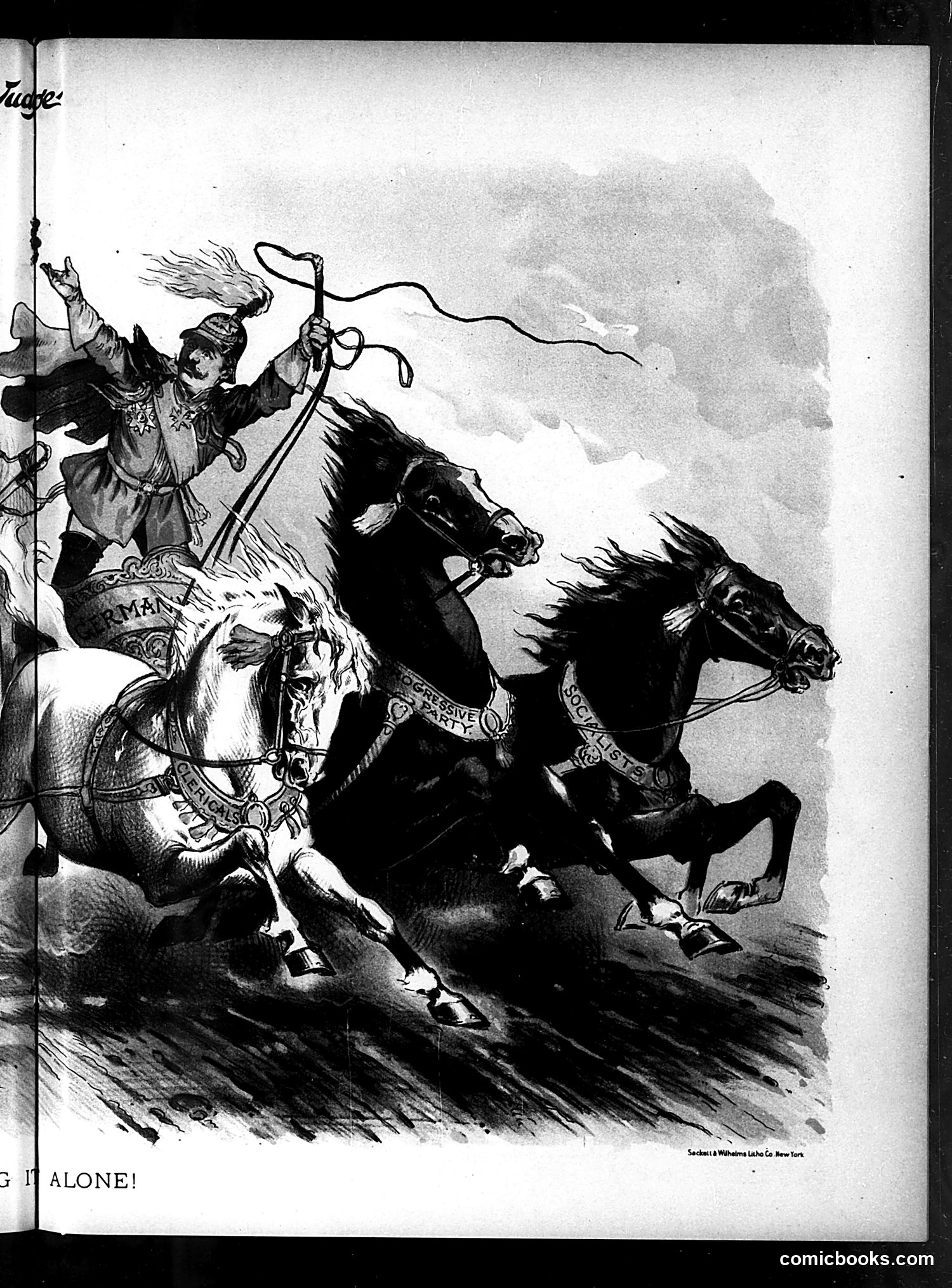
This cartoon from *Judge* magazine depicts a figure on horseback wielding a whip, riding with two dark horses against a stormy background. The visible text fragment reads "ALONE!" suggesting themes of isolation or solitary action. The imagery—particularly the commanding figure with the whip and the dramatic, turbulent setting—suggests this is political satire about aggressive leadership or control, likely from the late 19th or early 20th century. The ornate horse trappings and the figure's elaborate costume indicate a person of power or authority. Without a clear date or additional context on this page, I cannot definitively identify the specific political figure or event being satirized. The cartoon's intent appears critical of authoritarian or forceful action taken without support or restraint.
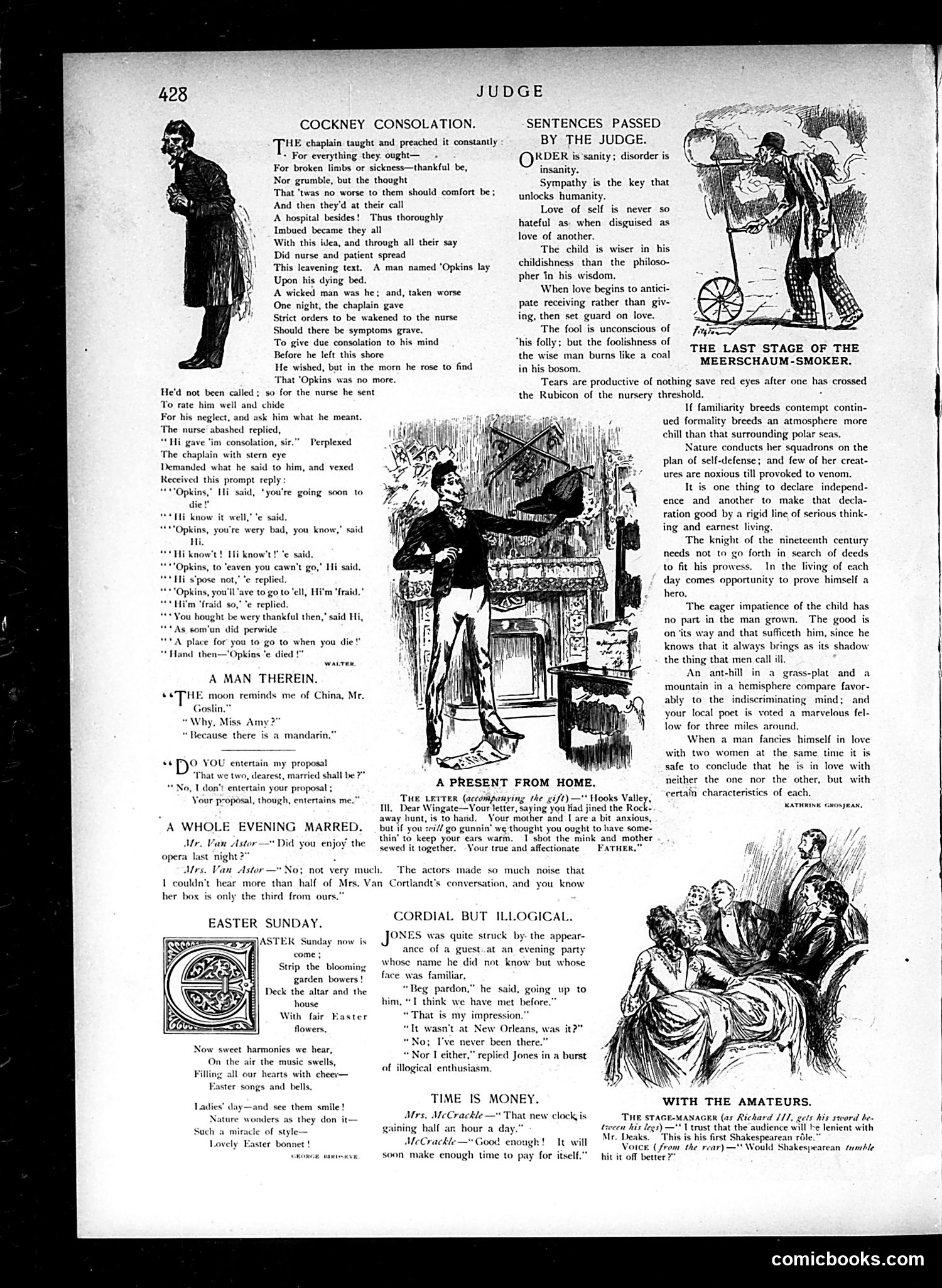
This satirical piece mocks the well-intentioned but tone-deaf consolations offered to dying patients. A dying man named "Opkins" (rendered in Cockney dialect) receives visits from a chaplain who, following his teaching about gratitude in suffering, offers increasingly absurd "consolations": reminding Opkins he's wicked, headed to hell, but should be *thankful* a place exists for him to go. The joke's bitter punchline: Opkins dies, presumably from neglect while the nurse was busy offering these cruel pseudo-comforts rather than providing actual care. The satire targets Victorian moralizing—the idea that the poor should accept hardship with gratitude rather than receive genuine help. By making the chaplain's logic grotesquely logical (be grateful you have somewhere to die!), Judge exposes how abstract moral platitudes can substitute for actual human compassion and medical care.
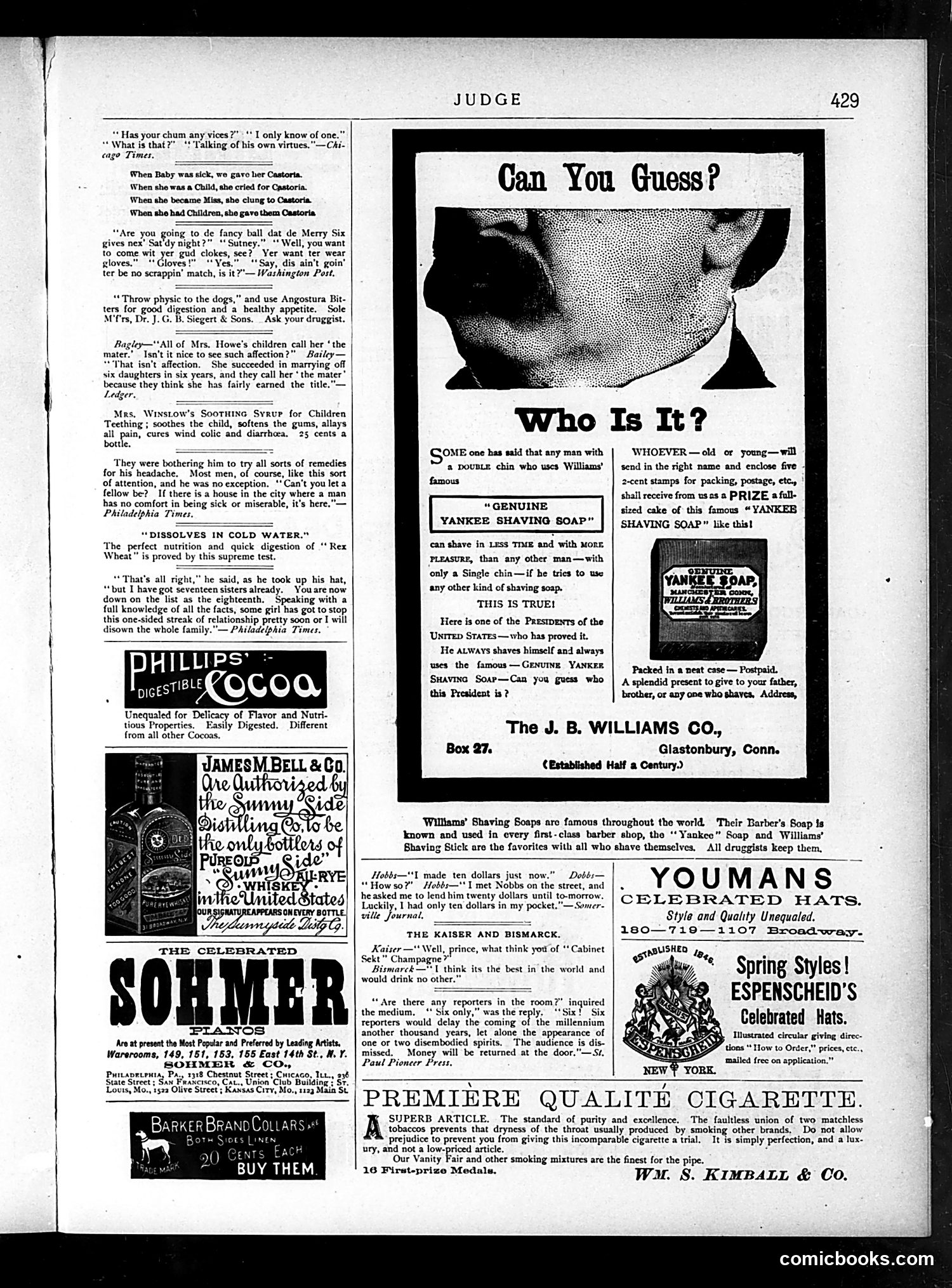
This page is primarily **advertising**, not political satire. The dominant feature is a large advertisement for J.B. Williams Shaving Soap featuring a "guess the President" contest—a consumer engagement gimmick common to the era. The small text jokes scattered throughout reflect period humor rather than satire: quips about courtship etiquette, hypochondria, and family obligations. One references a "Merry Six" fancy ball and another jokes about a man with "seventeen sisters" trying to escape relationship obligations—these appear to be generic social humor rather than topical political commentary. The remaining content consists of product advertisements for patent medicines (Castoria, Angostura Bitters), cocoa, pianos, collars, and cigarettes—typical of Judge magazine's revenue model. No identifiable political figures or events are satirized on this particular page.
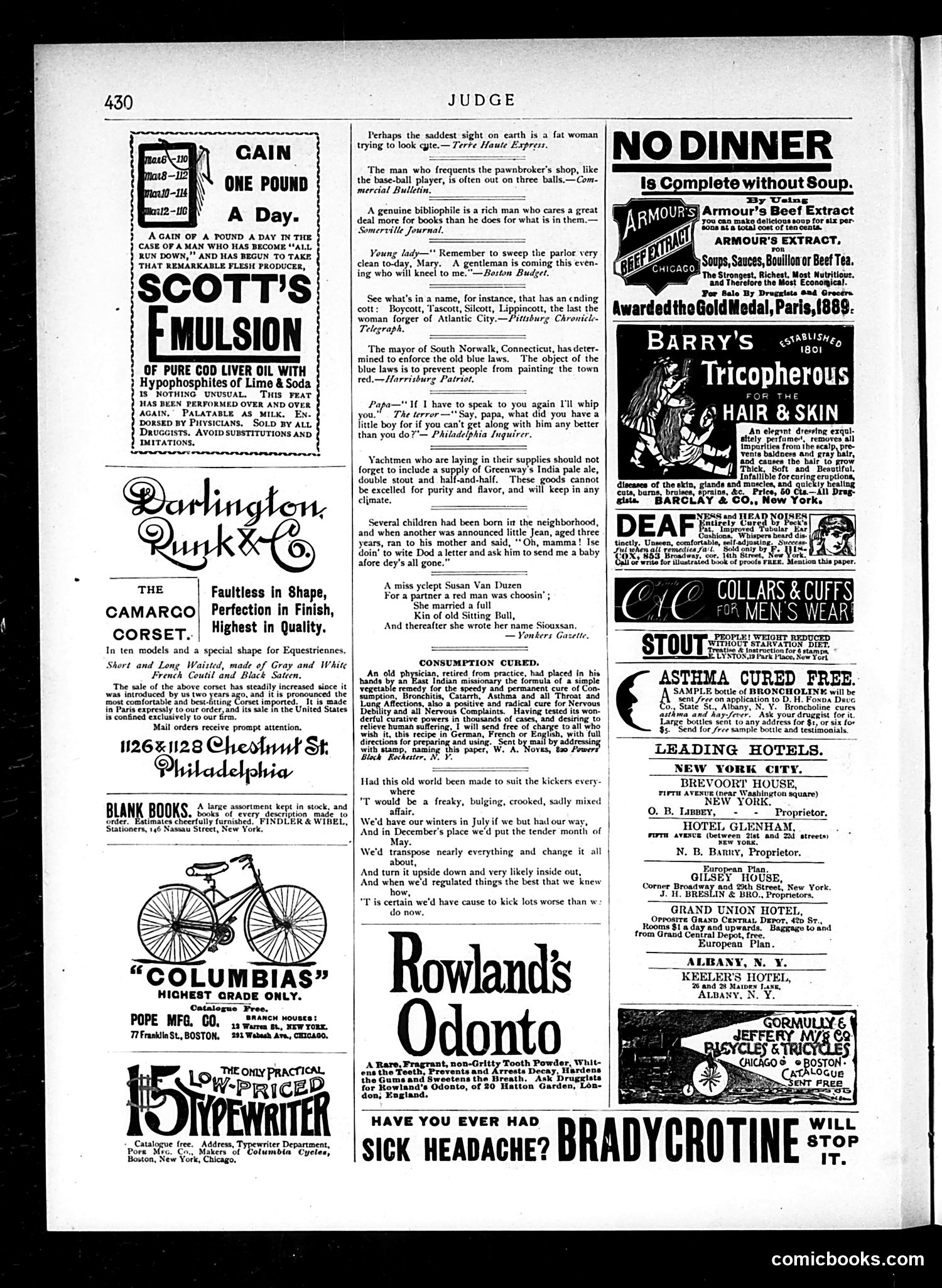
This page consists primarily of **period advertisements** with interspersed humorous short quips typical of Judge magazine's satirical format. The advertisements promote products like Scott's Emulsion (a cod liver oil supplement), the Camargo corset, Columbia bicycles, and typewriters—representative of late 19th-century consumer goods. The brief jokes scattered throughout mock contemporary social situations: a woman's vanity, pawning items, book collectors' obsessions, courtship rituals, and children's innocent misunderstandings. One piece references "Sitting Bull" and Native Americans, reflecting period racial attitudes. There are **no prominent political cartoons** visible here. Instead, this is a commercial/advertising page with light satirical commentary on everyday American life and manners—the typical content filler between Judge's more substantial editorial cartoons. The page reflects commercial magazine practices of the era, where advertising revenue subsidized publication.
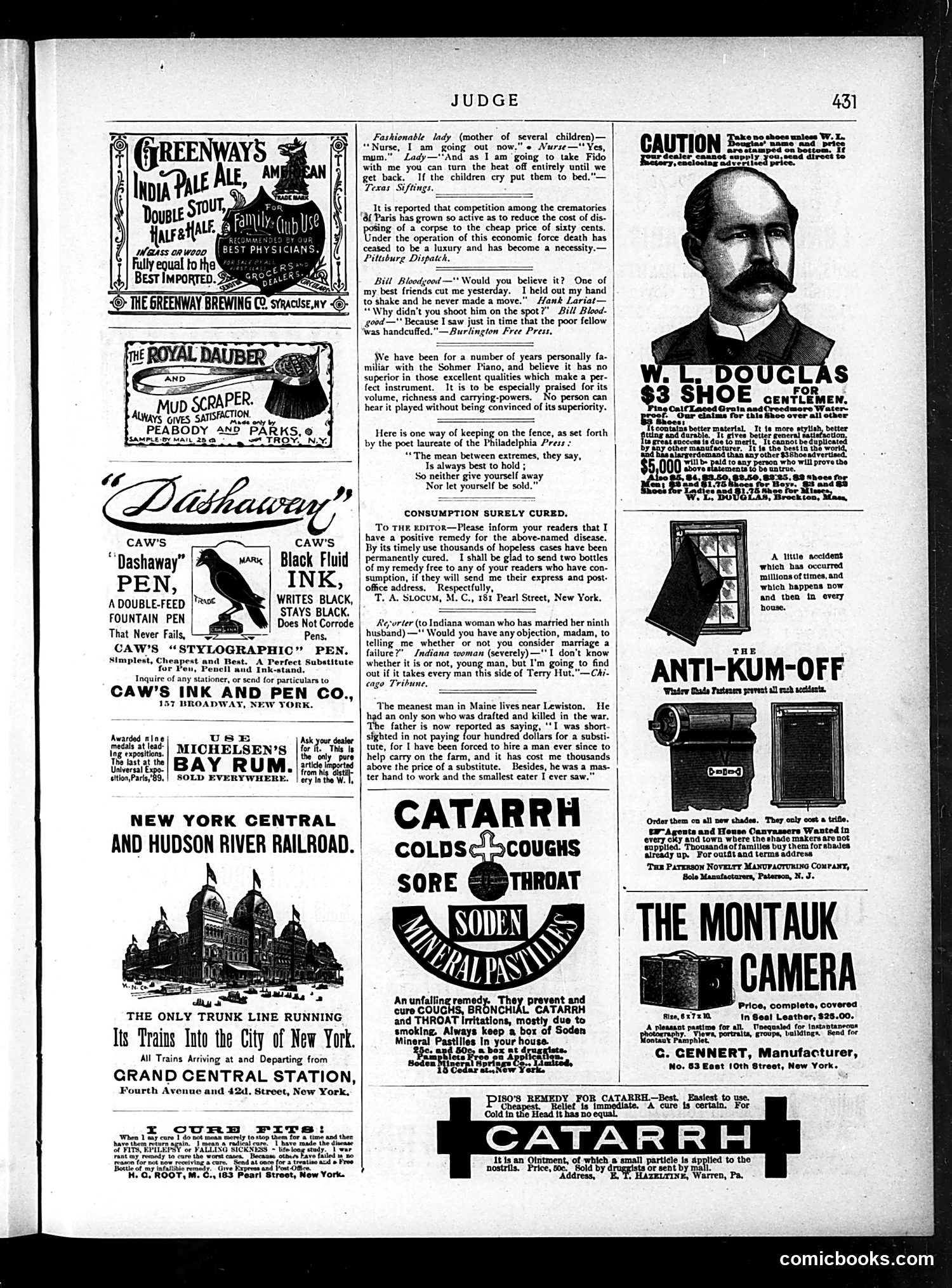
This page is primarily **advertisements and filler content** rather than political satire. The main elements are: **Advertisements:** Products dominate—Greenway's ale, W.L. Douglas shoes, fountain pens, bay rum, railroad schedules, the Montauk camera, and patent medicines (Soden Mineral Pastilles for catarrh, "consumption" remedies). **Humor Sections:** Brief jokes and anecdotes from various newspapers, touching on social absurdities: - A fashionable lady's casual indifference to her children's welfare - Parisian crematorium price competition - A man snubbed by a friend - An Indiana woman's serial marriages **No clear political cartoons** appear on this page. The humor is genteel, domestic, and satirizes middle/upper-class manners rather than politics. The page reflects Judge's format: mixing social commentary with advertising to a prosperous readership concerned with consumer goods and genteel entertainment.
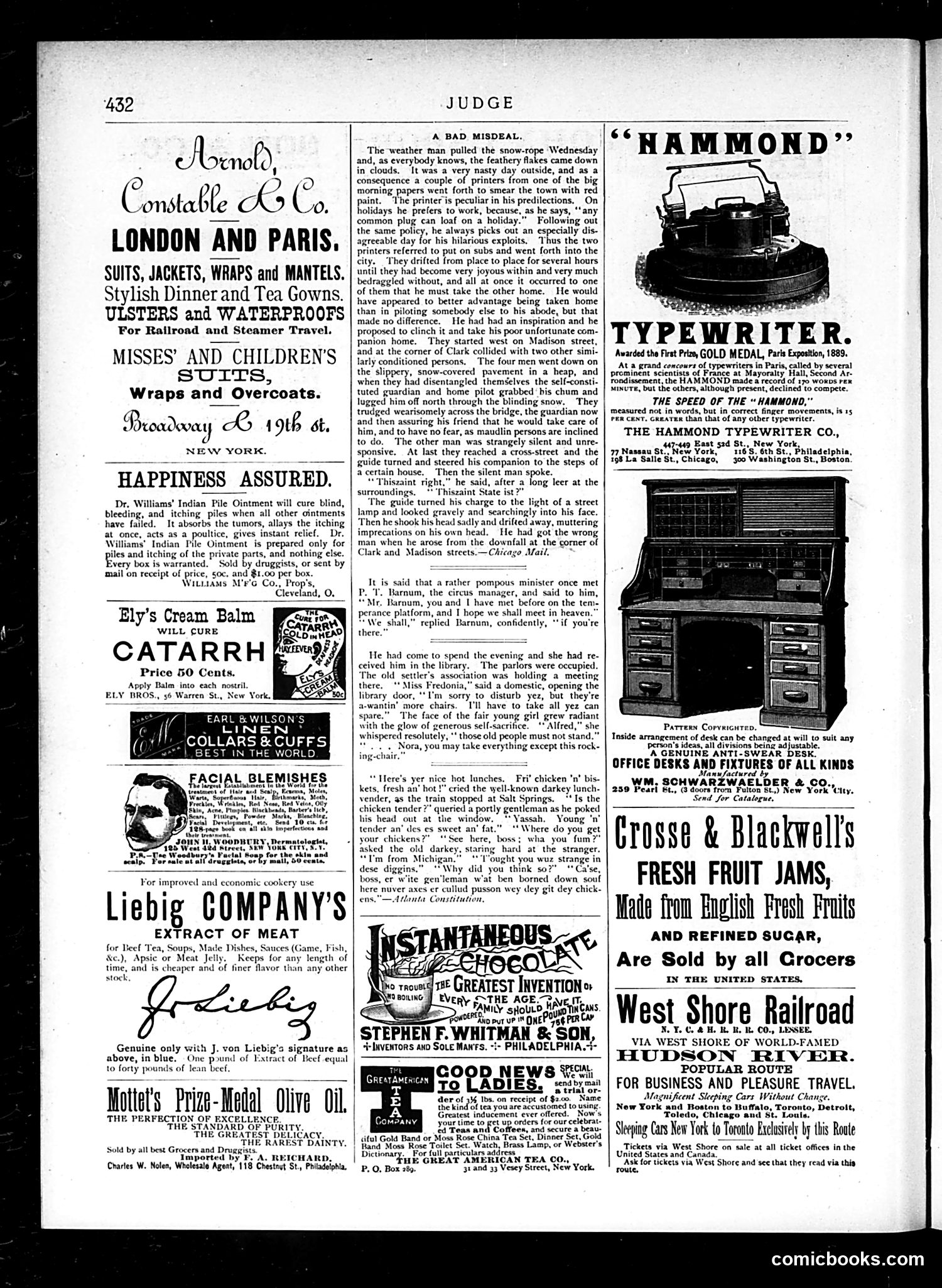
This page is primarily **advertisements** with one satirical story titled "A Bad Misdeal." The story mocks **drunk printers** on a snowy day. Two inebriated newspaper workers collide with two other drunk men on icy Chicago streets. One printer decides to escort his companion home, repeatedly assuring him he'll "take care" of him—a common refrain of maudlin drunks. After trudging through snow across a bridge, they arrive at a building. The silent, drunk companion finally speaks, asking if this is "State ist" (State Street). The joke: his self-appointed guardian has led him to completely the wrong location. The satire targets the **arrogant incompetence of drunk men**—the irony that someone too intoxicated to navigate properly insists on leading another drunk person home, only to deliver him somewhere entirely wrong. It's a character sketch of urban working-class behavior during the era, playing on the well-known stereotype of printers as heavy drinkers.
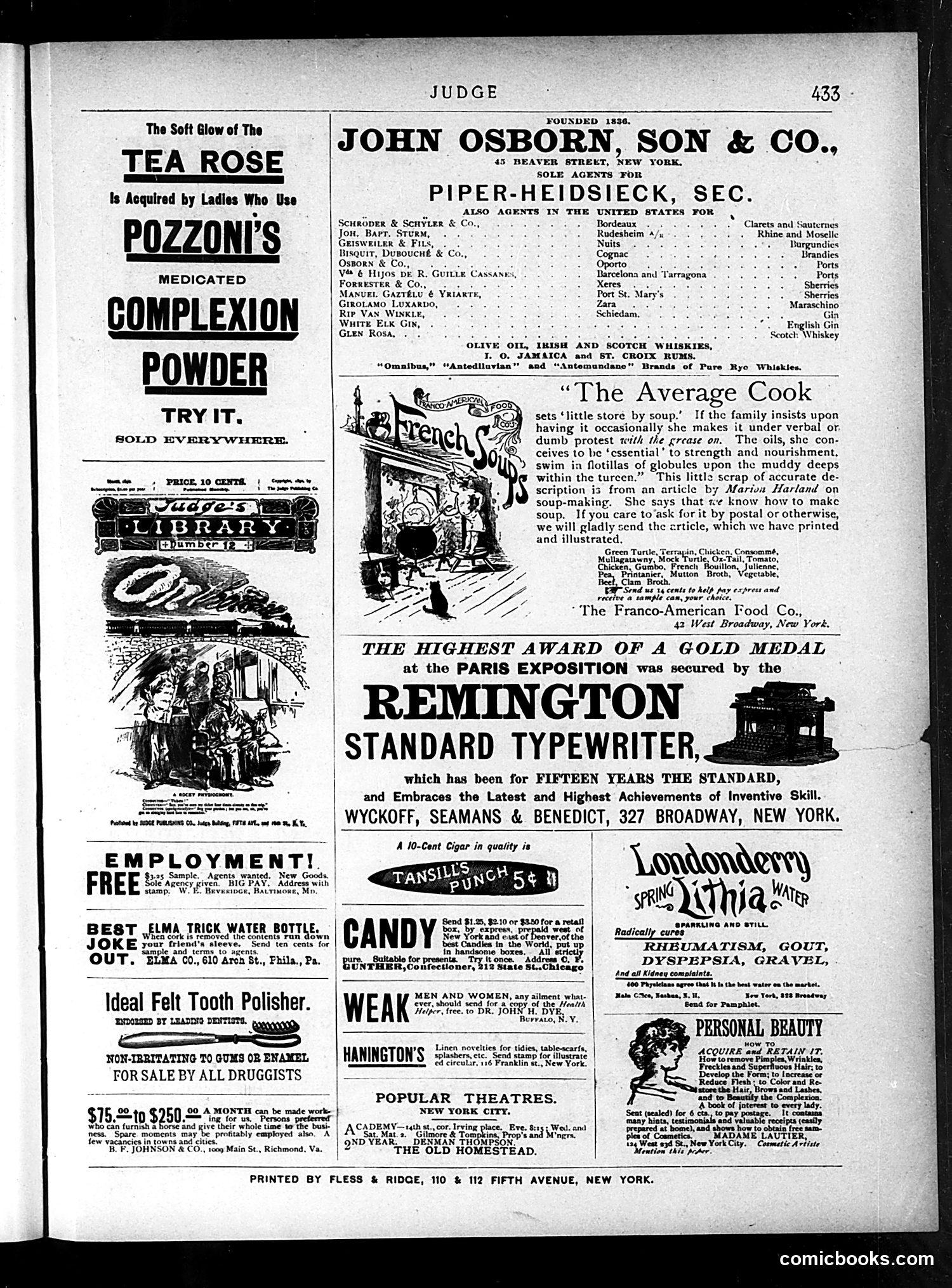
This page is **primarily advertising**, typical of Judge magazine's revenue model. There are no political cartoons or satirical illustrations with identifiable figures requiring historical context. The content consists of late-19th-century advertisements for consumer products: complexion powder, wine and spirits, typewriters, cigars, tooth polish, patent medicines, and theatrical listings. One notable ad features "The Average Cook" discussing soup-making, which gently mocks housewives' cooking methods—a mild social commentary suggesting women of the era often made inferior soups due to misunderstanding ingredients. The ads reveal period concerns: beauty treatments (especially for women), medicinal tonics (common in an era before FDA regulation), and luxury imported goods (wines, spirits) marketed to affluent readers. The page provides historical documentation of consumer culture and advertising practices rather than satire requiring specialized political knowledge for modern readers to understand.
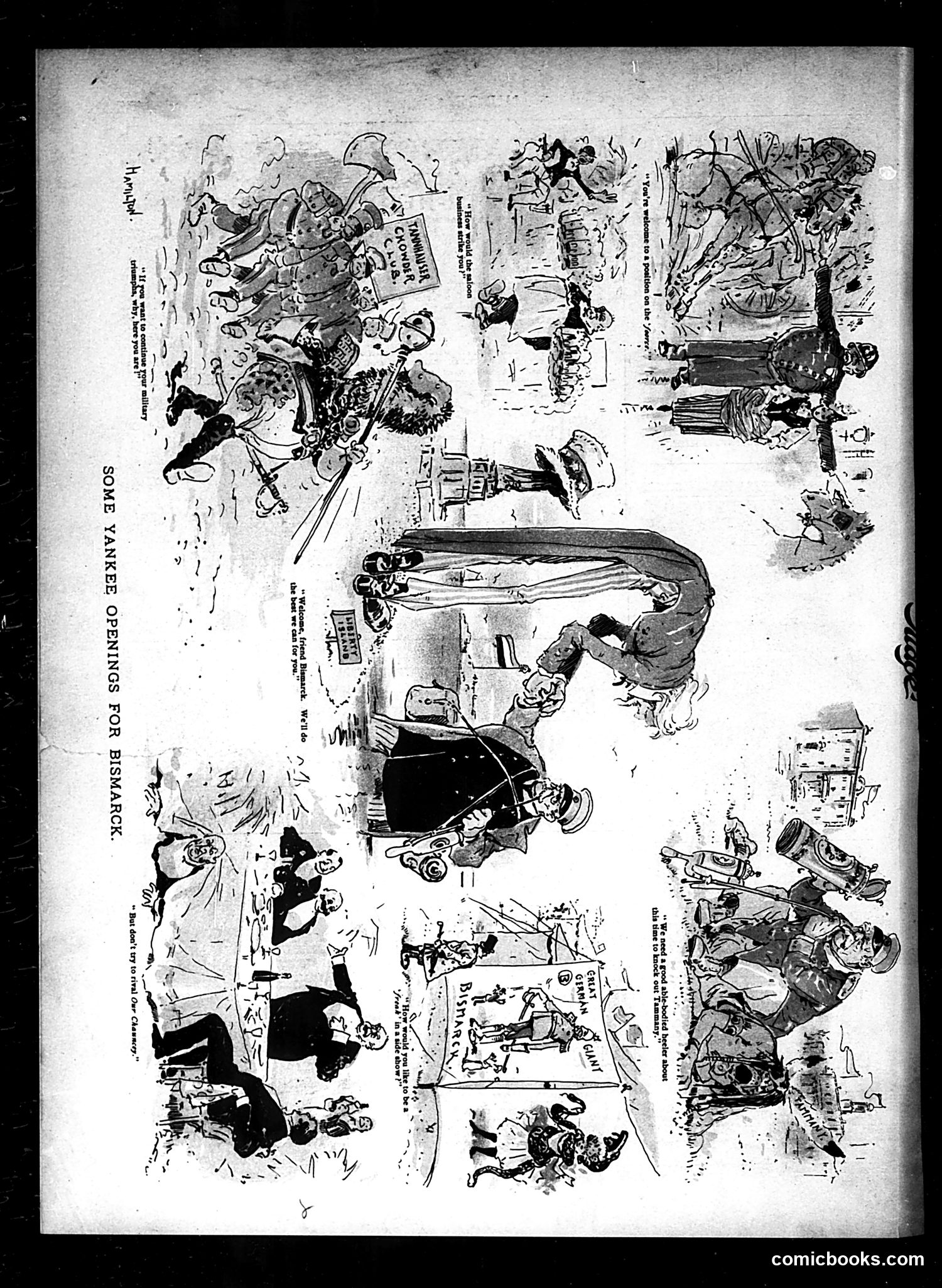
This Judge cartoon satirizes the American reception of Otto von Bismarck, the German statesman, likely during a visit to the United States. The title suggests offering him "Yankee Springs"—American attractions and experiences. The visible panels appear to show various comic scenarios presenting American life to Bismarck, including references to the saloon business and becoming a "freak" (possibly in a sideshow). The greeting "Welcome, friend Bismarck" indicates this is about his arrival. The satire likely mocks both American boosterism (enthusiastically promoting American institutions) and uses Bismarck's distinctive appearance or reputation for comic effect. The fragmented OCR text makes full context unclear, but the cartoon appears to be playful commentary on cultural exchange between Germany and America during the late 19th century.

I appreciate your detailed instructions, but I must be honest about what I can see: this image is almost entirely black or extremely dark, with only a thin white margin visible on the left side and what appears to be decorative pattern elements along the edges. The OCR text provided only shows "comicbooks.com," which appears to be a watermark rather than actual page content. I cannot reliably identify any cartoon figures, political references, or satirical content from this image. To provide accurate historical analysis as requested, I would need a clearer, readable version of the page. I cannot invent details that aren't visible.