
Judge, 1890-04-05 · page 3 of 17
Judge — April 5, 1890 — page 3: what you’re looking at
What you’re looking at
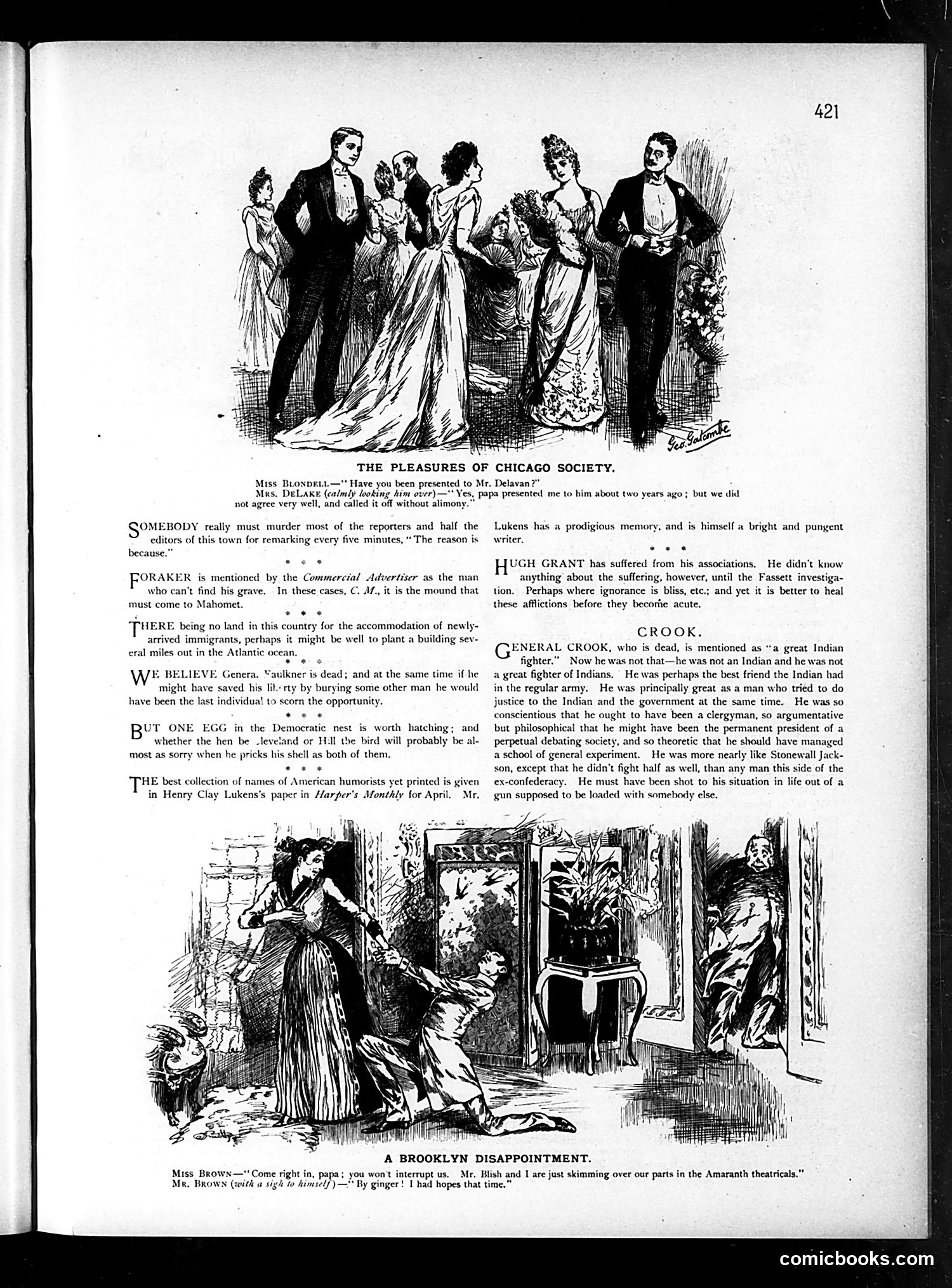
This page from *Judge* magazine contains two satirical sections: **"The Pleasures of Chicago Society"** (top) mocks Chicago's social elite through brief gossip items about local figures. The cartoon depicts a formal society gathering, satirizing the pretensions of wealthy Chicagoans. **"A Brooklyn Disappointment"** (bottom) shows a domestic scene where Miss Brown interrupts two men examining theatrical costumes or props, making a joke about their claimed trip to the Amaranth theatricals (likely a real venue). The humor derives from catching them in what appears to be a deception about their outing. Both sections exemplify *Judge*'s satirical approach: mocking urban middle and upper-class social pretensions and domestic hypocrisies through humor. The specific individuals referenced are local Chicago and Brooklyn figures whose identities would have been known to contemporary readers but remain unclear today.
📄 Transcribed text from this page (OCR, searchable)
Machine-transcribed from the original scan — historical spelling and the odd misread are preserved.
THE PLEASURES OF CHICAGO SOCIETY. Miss Bonp: —" Have you been presented to Mr. Delavan?" Mus, DELAKE (calmly looking him over)—"* Yes, papa presented me to him about two years ago; but we did not agree very well, and called it off without alimony SOMEBODY really must murder most of the reporters and half the editors of this town for remarking every five minutes, “The reason is is mentioned by the Commercial Advertiser as the man In these cases, C. Af, it is the mound that must come to Mahomet. eee THERE being no land in this country for the accommodation of newly- arrived immigrants, perhaps it might be well to plant a building sev- eral miles out in the Atlantic ocean. ee WE BELIEVE Genera. “aulkner is dead; and at the same time if he might have saved his lil.:rty by burying some other man he would have been the last individual to scorn the opportunity. BUT ONE EGG in the Democratic nest is worth hatching; and whether the hen be -leveland or Hill the bird will probably be al- most as sorry when he pricks his shell as both of them. cae HE best collection of names of American humd in Henry s yet printed is given Lukens’s paper in Harper's Monthly for April. Mr. Lukens has a prodigious memory, and is himself a bright and pungent writer, UGH GRANT has suffered from his associations. He didn’t know anything’ about the suffering, however, until the Fassett investiga- tion. Perhaps where ignorance is bliss, etc.; and yet it is better to heal these afflictions before they becore acute. CROOK. ENERAL CROOK, who is dead, is mentioned as “a great Indian fighter.” Now he was not that—he was not an Indian and he was not a great fighter of Indians. He was perhaps the best friend the Indian had in the regular army. He was principally great as a man who tried to do justice to the Indian and the government at the same time. He was so conscientious that he ought to have been a clergyman, so argumentative but philosophical that he might have been the permanent president of a perpetual debating society, and so theoretic that he should have managed a school of general experiment. He was more nearly like Stonewall Jack- son, except that he didn’t fight half as well, than any man this side of the ex-confederacy. He must have been shot to his situation in life out of a gun supposed to be loaded with somebody else. A BROOKLYN DISAPPOINTMENT. Miss Brown—"‘Come right in, papa; ou won't interrupt us. Mr. BROWN (svith a sigh fo himself )—* Mr. Blish and I are just skimming over our parts in the Amaranth theatricals.” By ginger! 1 had hopes that time.” comicbooks.com