
Judge, 1890-04-05 · page 2 of 17
Judge — April 5, 1890 — page 2: what you’re looking at
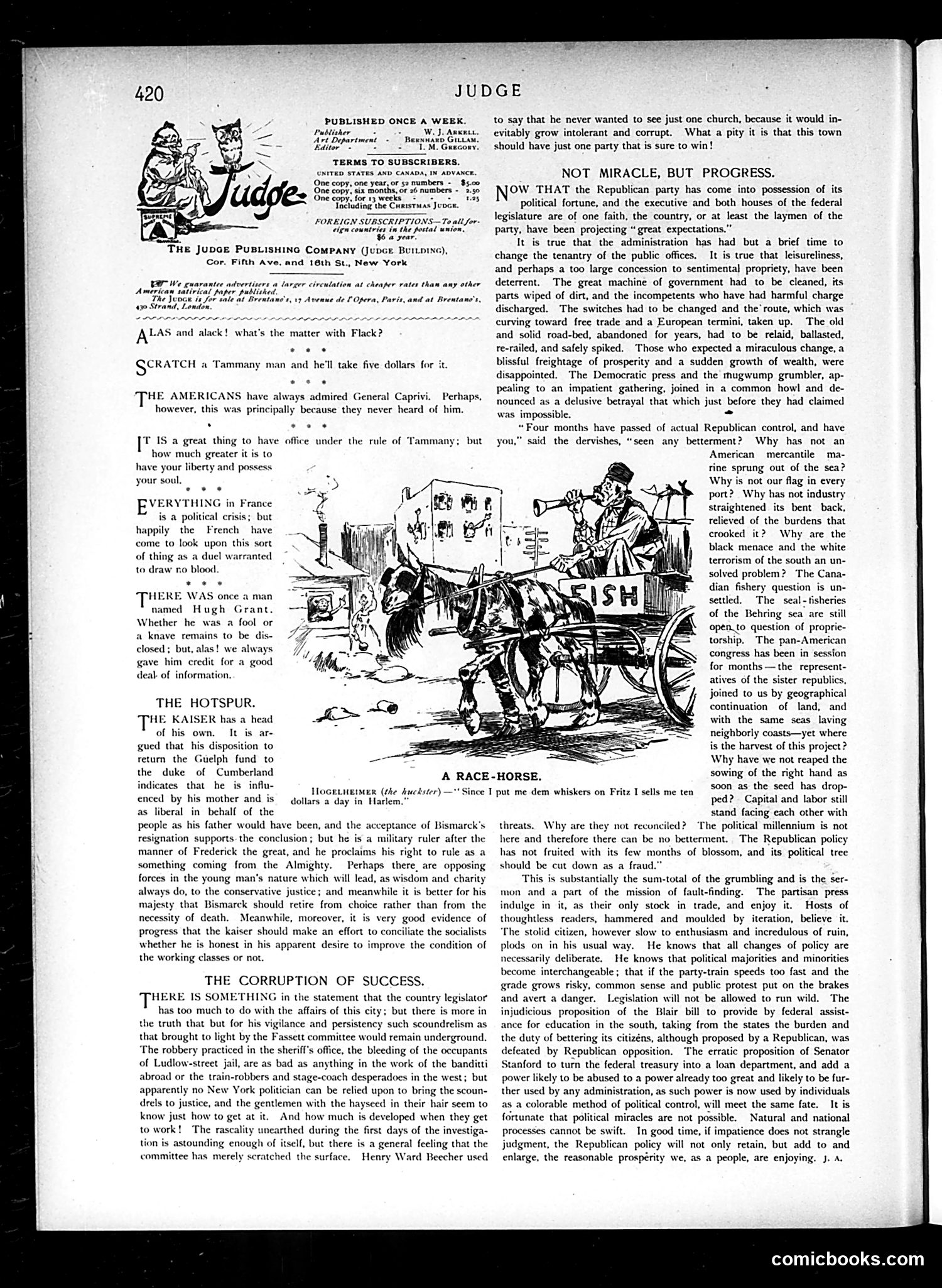
What you’re looking at
This cartoon satirizes Republican economic promises following their political victory. The image depicts a man (likely representing a Republican politician or the party's leadership) driving a cart labeled "FISH" pulled by an emaciated, struggling horse—a visual metaphor for the nation's failing economy. The accompanying text explains the joke: a hogsplayer says "Since I put me dem whiskers on Fitz I sells me ten dollars a day in fishes." The satire suggests Republicans promised prosperity ("great expectations") but delivered only hardship. The starving horse represents how their policies are exhausting the country's resources rather than generating promised wealth. The cartoon mocks the gap between Republican campaign rhetoric and actual economic results for ordinary citizens.
📄 Transcribed text from this page (OCR, searchable)
Machine-transcribed from the original scan — historical spelling and the odd misread are preserved.
JUDGE PUBLISHED ONCE A WEEK. Publier pean ds AMEE. Art Department - Been wand Gittam, Biter” TM: Guacory. TERMS TO SUBSCRIBERS. UNITRD STATES AND CANADA, IN ADVANCE. One copy, one year, or 52 numbers - $5.00 ‘One copy, six months, or 26 numbers - 2.50 One copy, for 13 weeks = = = nas Including the Curistatas Juocn. ThE Jupce PuBLIsHING Company (Jubce Buitnrnc), Cor. Fifth Ave, and 16th St, New York TR We guarantee advertisers a larger circulation at cheaper rates than any other American satirical paper published. The Juoce 11 for sale at Brentano's, 17 Avenue de COpera, Parit, and at Brentane’s, 490 Strand, London. ALAS and alack! what's the matter with Flack? SCRATCH a Tammany man and he'll take five dollars for it. ‘THE AMERICANS have always admired General Caprivi. Perhaps, however, this was principally because they never heard of him. T IS a great thing to have office under the rule of Tammany; but how much greater it is to have your liberty and possess your soul. > in France is a political crisis; but happily the French have come to look upon this sort of thing as a duel warranted to draw no blood. eee THERE wa named Hugh Grant. Whether he was a fool or a knave remains to be dis- closed; but, alas! we always gave him credit for a good deal of information. THE HOTSPUR. HE KAISER has a of his own, It is ar- gued that his disposition to retum the Guelph fund to the duke of Cumberland indicates that he is influ- enced by his mother and is as liberal in behalf of the people as his father would have been, and the acceptance of Bismarck’s resignation supports: the conclusion ; but he is a military ruler after the manner of Frederick the great, and he proclaims his right to rule as a something coming from the Almighty. Perhaps there, are opposing forces in the young man’s nature which will lead, as wisdom and charity ys do, to the conservative justice; and meanwhile it is better for his jesty that Bismarck should retire from choice rather than from the necessity of death. Meanwhile, moreover, it is very good evidence of progress that the kaiser should make an effort to conciliate the socialists whether he is honest in his apparent desire to improve the condition of the working classes or not. dollars a day in Harlem.” THE CORRUPTION OF SUCCESS. HERE 1S SOMETHING in the statement that the country legislator has too much to do with the affairs of this city; but there is more in the truth that but for his vigilance and persistency such scoundrelism as that brought to light by the Fassett committee would remain underground. The robbery practiced in the sheriff's office, the bleeding of the occupants of Ludlow-street jail, are as bad as anything in the work of the banditti abroad or the train-robbers and stage-coach desperadoes in the west; but apparently no New York politician can be relied upon to bring the scoun- drels to justice, and the gentlemen with the haysced in their hair seem to know just how to get at it. And how much is developed when they get to work! The rascality unearthed during the first days of the investiga- tion is astounding enough of itself, but there is a general feeling that the committee has merely scratched the surface. Henry Ward Beecher used A RACE-HORSE. Hocetnemer (the huckster) —"' Since 1 put me dem whiskers on Fritz I sells me ten to say that he never wanted to see just one church, because it would in- evitably grow intolerant and corrupt. What a pity it is that this town should have just one party that is sure to win! NOT MIRACLE, BUT PROGRESS. OW THAT the Republican party has come into possession of its political fortune, and the executive and both houses of the federal legislature are of one faith, the country, or at least the laymen of the party, have been projecting “ great expectations.” It is true that the administration has had but a brief time to change the tenantry of the public offices. It is true that leisureliness, and perhaps a too large concession to sentimental propriety, have been deterrent. The great machine of government had to be cleaned, its parts wiped of dirt, and the incompetents who have had harmful charge discharged. The switches had to be changed and the’ route, which was curving toward free trade and a European termini, taken up. The old and solid road-bed, abandoned for years, had to be relaid, ballasted, re-railed, and safely spiked. Those who expected a miraculous change, a blissful freightage of prosperity and a sudden growth of wealth, were disappointed. The Democratic press and the mugwump grumbler, ap- pealing to an impatient gathering, joined in a common howl and de- nounced as a delusive betrayal that which just before they had claimed was impossible. - “Four months have passed of actual Republican control, and have seen any betterment? Why has not an American mercantile ma- rine sprung out of the sea? Why is not our flag in every port?) Why has not industry straightened its bent back, relieved of the burdens that crooked it? Why are the black menace and the white terrorism of the south an un- solved problem? The Cana dian fishery question is un- settled. The seal-tisheries of the Behring sea are still open.to question of propric- torship. The pan-American congress has been in session for months —the represent- atives of the sister republics, joined to us by geographical continuation of land, and with the same seas _laving neighborly coasts—yet where is the harvest of this project ? Why have we not reaped the sowing of the right hand as soon as the seed has drop- ped? Capital and labor still stand facing each other with threats. Why are they not reconciled? ‘The political millennium is not here and therefore there can be no betterment. The Republican policy has not fruited with its few months of blossom, and its political tree should be cut down as a fraud.” This is substantially the sum-total of the grumbling and is the ser- mon and a part of the mission of fault-finding. The partisan press indulge in it, as their only stock in trade, and enjoy it. Hosts of thoughtless readers, hammered and moulded by iteration, believe it. ‘The stolid citizen, however slow to enthusiasm and incredulous of ruin, plods on in his usual way. He knows that all changes of policy are necessarily deliberate. He knows that political majorities and minorities become interchangeable; that if the party-train speeds too fast and the grade grows risky, common sense and public protest put on the brakes and avert a dan Legislation will not be allowed to run wild. The injudicious proposition of the Blair bill to provide by federal assist- ance for education in the south, taking from the states the burden and the duty of bettering its citizéns, although proposed by a Republican, was defeated by Republican opposition. The erratic proposition of Senator Stanford to turn the federal treasury into a loan department, and add a power likely to be abused to a power already too great and likely to be fur- ther used by any administration, as such power is now used by individuals as a colorable method of political control, will meet the same fate. It is fortunate that political miracles are not possible. Natural and national processes cannot be swift. In good time, if impatience does not strangle judgment, the Republican policy will not only retain, but add to and enlarge, the reasonable prospérity we, as a people, are enjoying. J. A. comicbooks.com