
A complete issue · 28 pages · 1890
Judge — March 29, 1890
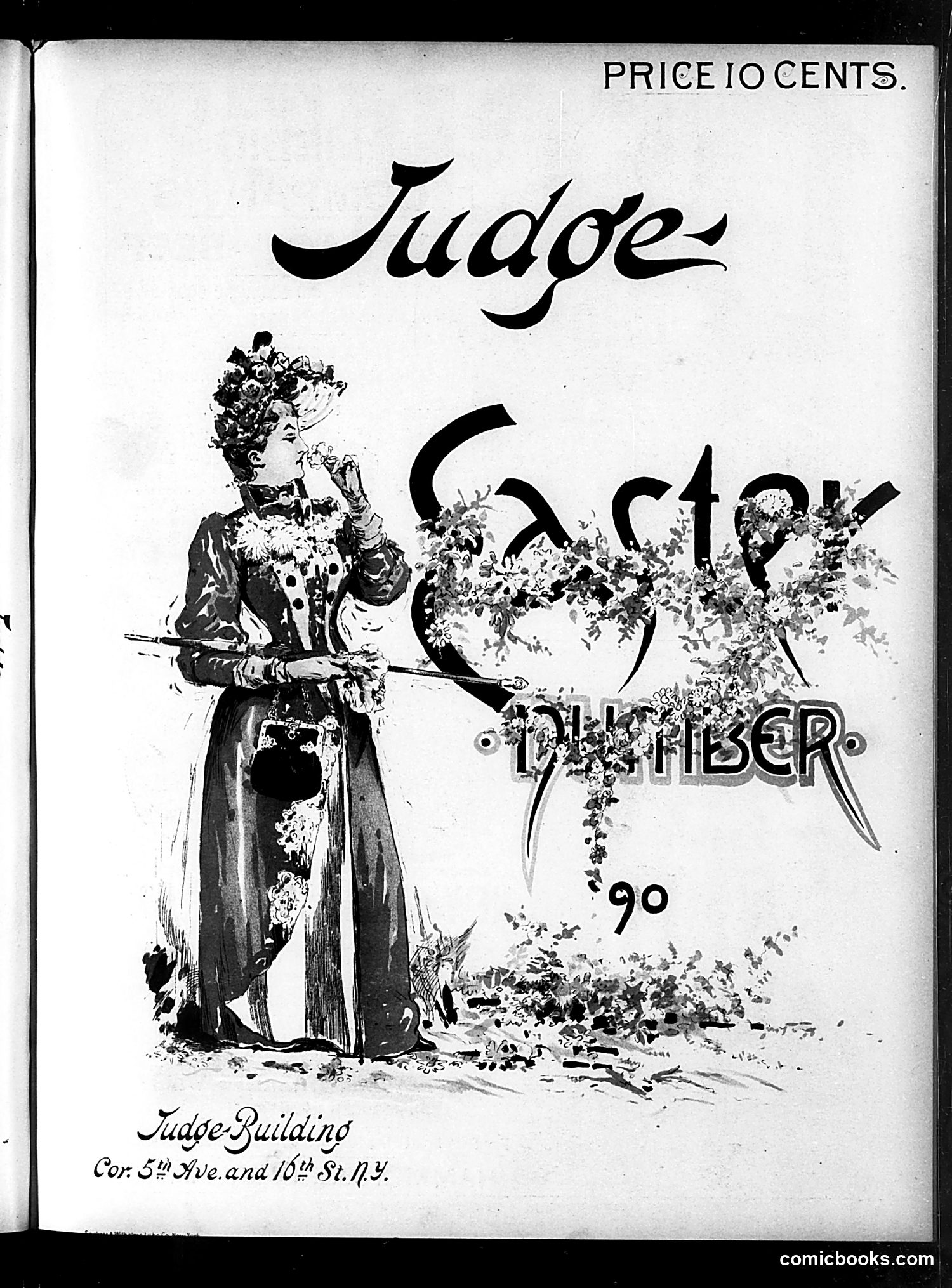
This appears to be a Judge magazine cover from the late 1800s or early 1900s featuring an elegantly dressed woman with an elaborate hat wielding a large paintbrush or broom against flowering ivy or vines. The title "Judge" and the large number "654" suggest this is issue 654. The woman's refined clothing and determined posture suggest she represents a figure of authority or reform. The flourishing vegetation she's attacking likely symbolizes something overgrown or out of control that needs pruning—possibly corrupt institutions, excessive wealth, or social problems. The satirical point appears to be about a powerful female figure (possibly a political or social reformer) taking action to "clean up" or restrain something unwanted in society. However, without additional context about the specific issue date or contemporary events, the precise target remains unclear.
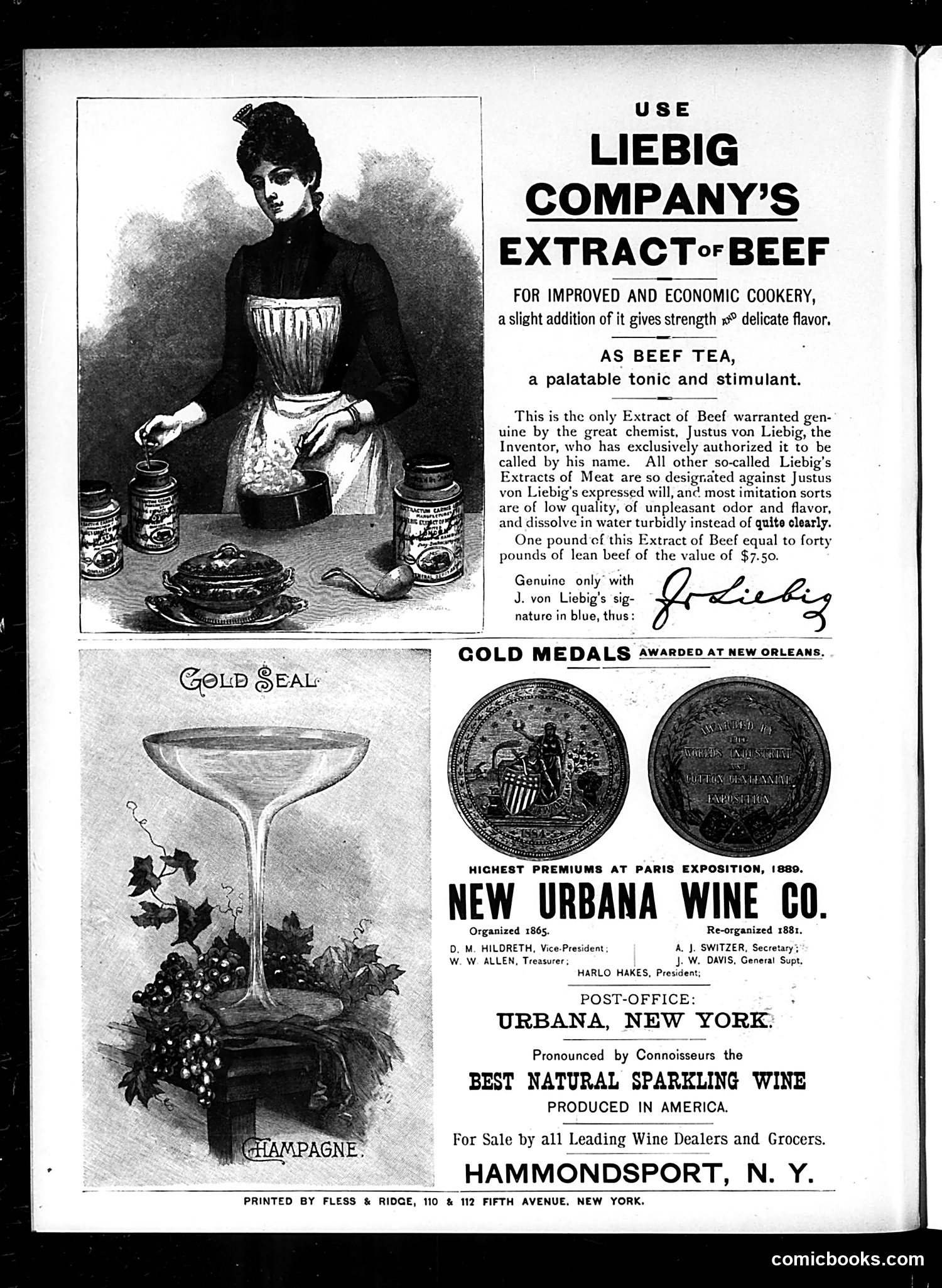
This page is primarily **advertising**, not satire or political commentary. It contains two distinct advertisements: 1. **Liebig Company's Extract of Beef** (top): Features a Victorian-era woman in elegant dress endorsing the product as a cooking ingredient and "beef tea" tonic. The ad emphasizes that this is the "only" genuine extract authorized by chemist Justus von Liebig himself, distinguishing it from inferior imitations. One pound allegedly equals forty pounds of lean beef in nutritional value. 2. **New Urbana Wine Company** (bottom): Advertises sparkling wine from Urbana, New York, claiming gold medals from Paris (1889) and promoting it as "the best natural sparkling wine produced in America." Both ads reflect late 19th-century marketing tactics: celebrity/expert endorsement and competitive product claims targeting affluent consumers.
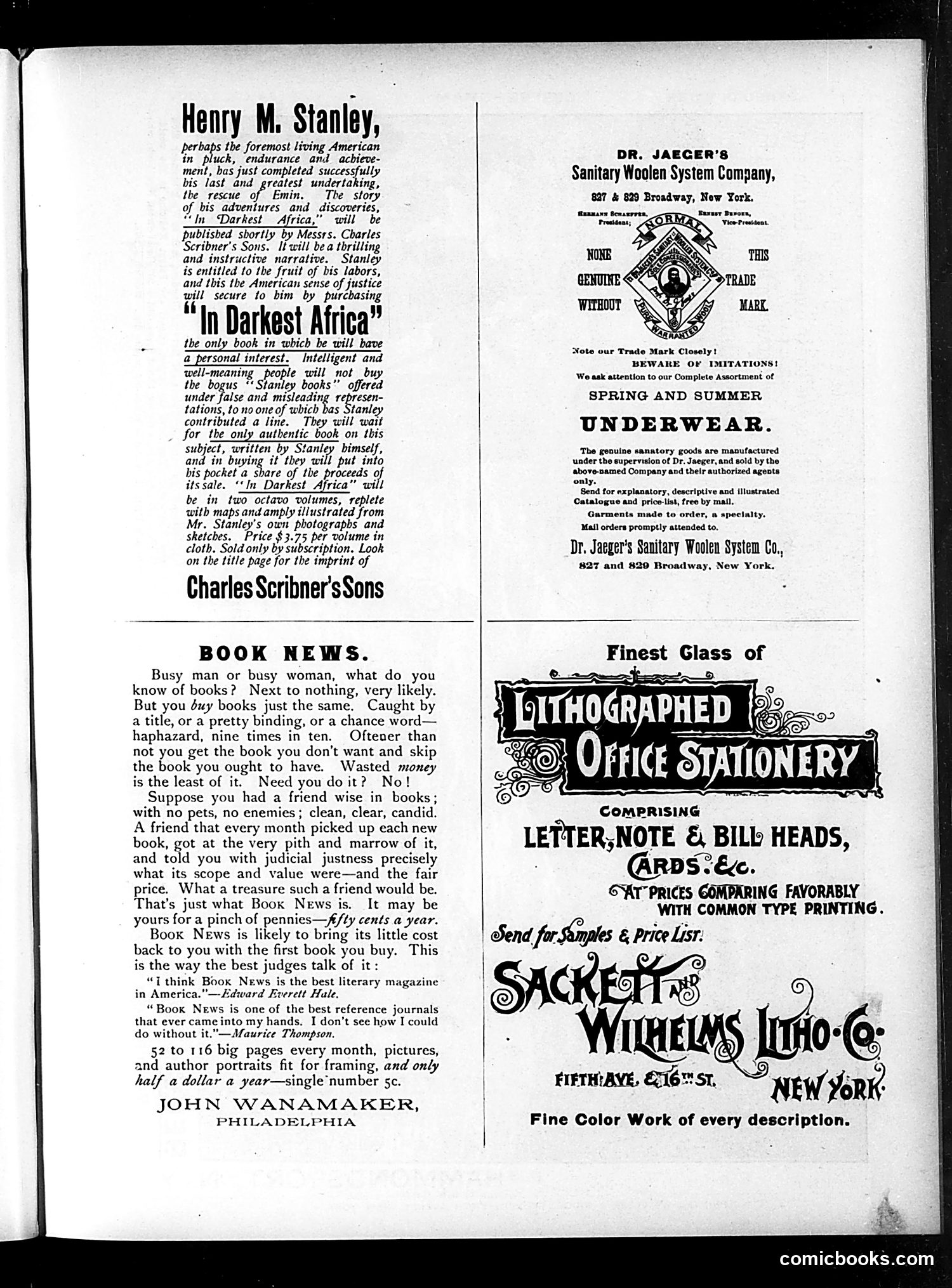
This page consists primarily of **advertisements and book notices** rather than political cartoons or satirical content. The left side advertises Henry M. Stanley's book "In Darkest Africa" (published by Charles Scribner's Sons), describing it as an authentic account of his African adventures. Below that is a "Book News" section promoting the literary magazine *Book News*, which featured author portraits and cost 5¢. The right side contains advertisements for Dr. Jaeger's Sanitary Woolen System Company (underwear) and Sackett & Wilhelms Litho Co. (office stationery). **No political satire or cartoon content appears on this page.** It represents typical magazine advertising and promotional material from the period rather than editorial commentary.
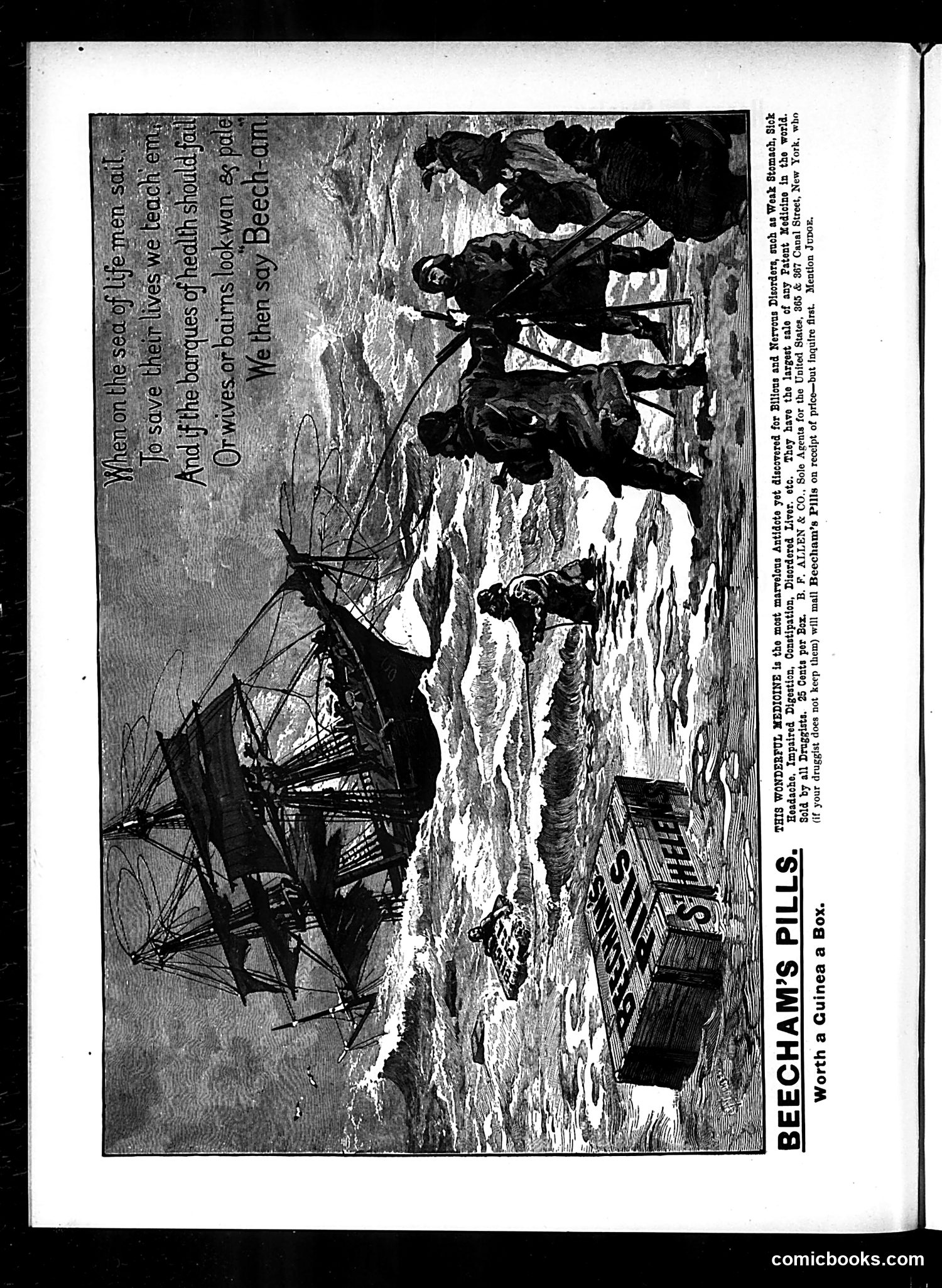
This page is primarily **advertising, not political satire**. The OCR text is heavily corrupted and largely unreadable, making precise interpretation difficult. The image shows what appears to be a maritime or nautical scene—possibly a shipwreck or sea rescue—rotated 90 degrees. The caption mentions "When on the sea/I'll serve their lives" and references "Beacham's" (or similar) with text about "burglies of bullish" and "Owes a burden so Beech one" (heavily OCR-corrupted). The large text "BECHAM'S PILLS" and "Worth a Guinea a Box" at bottom right indicates this is a **product advertisement for a patent medicine** popular in the era. The dramatic maritime imagery likely served as attention-getting commercial content rather than political commentary. Without clearer text or context, the specific satirical message—if any exists—remains unclear from this reproduction.
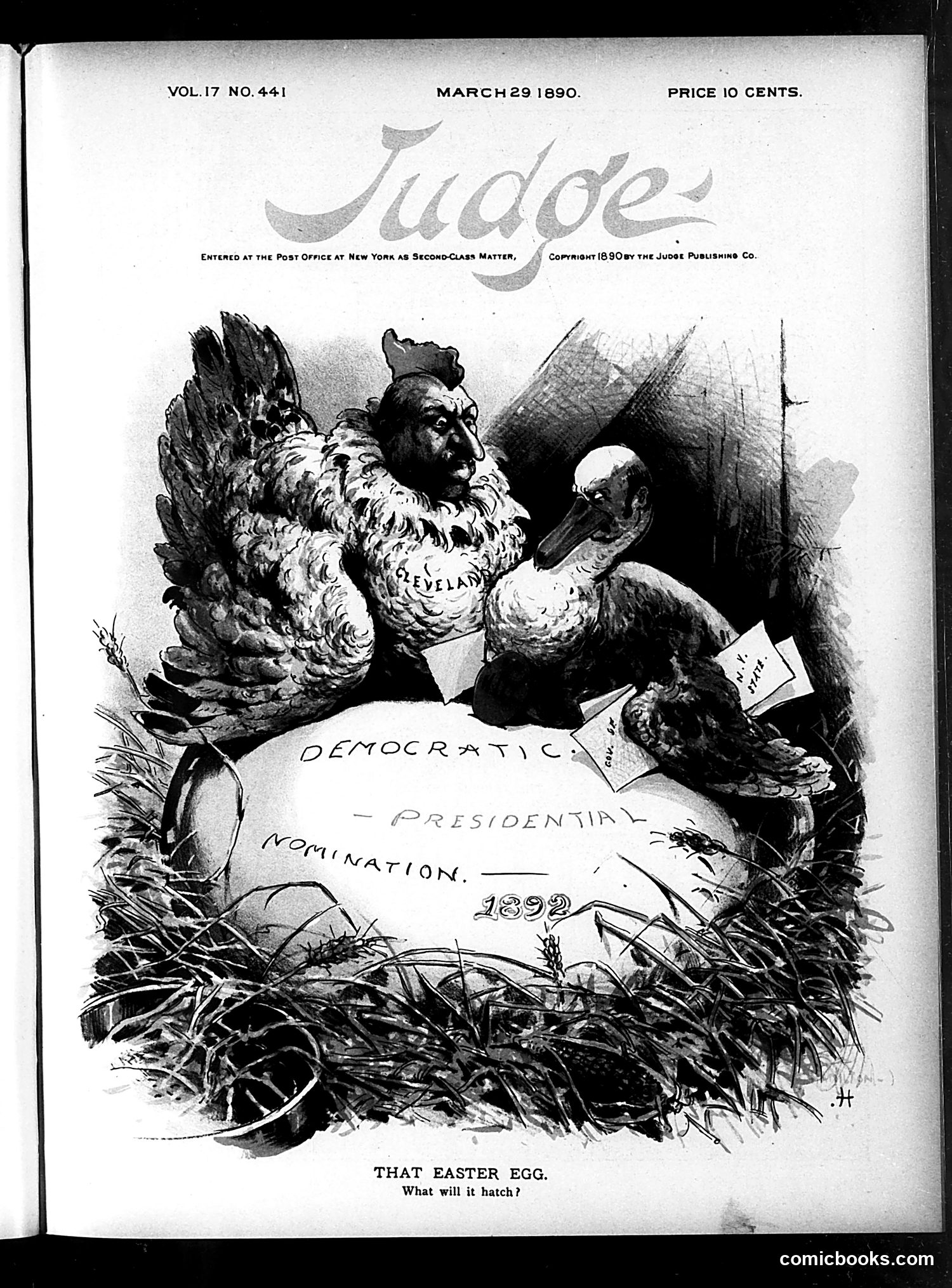
This March 1890 *Judge* cartoon satirizes the upcoming 1892 Democratic presidential nomination. The large egg labeled "Democratic Presidential Nomination 1892" sits in a nest, with anthropomorphic birds (representing Democratic candidates or party factions) gathered around it anxiously. The birds appear caricatured, suggesting specific political figures of the era, though their identities are unclear from visual details alone. One bird wears what appears to be Cleveland imagery ("Cleveland" visible on the chest), possibly referencing President Grover Cleveland. The satire's central joke: "What will it hatch?" — the Democrats don't yet know who their nominee will be, treating the nomination process as an uncertain outcome. The Easter egg imagery suggests spring renewal and unpredictability, mocking Democratic party divisions or internal uncertainty about their 1892 candidate selection.
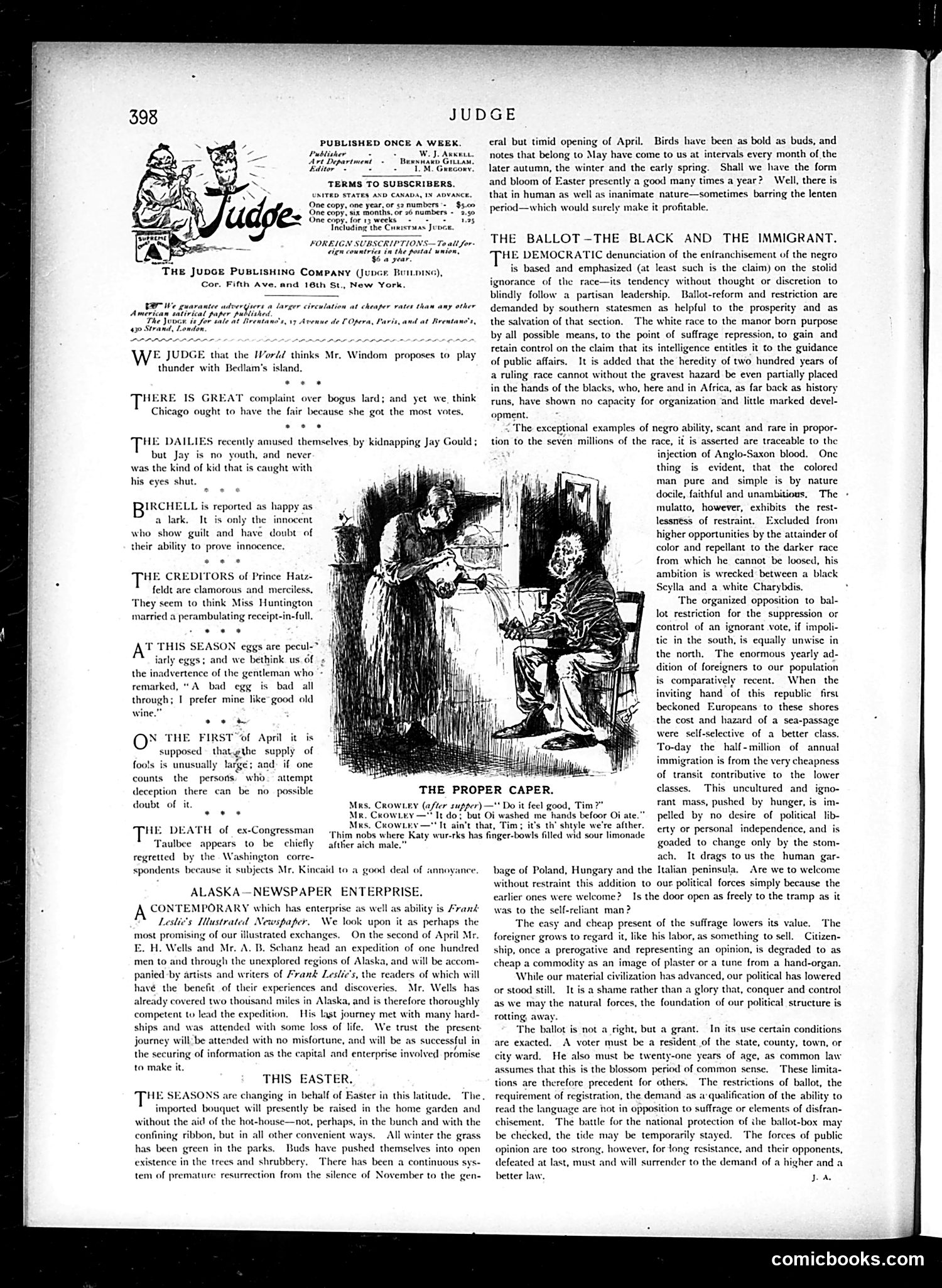
This page contains brief satirical commentary on contemporary issues rather than a single focused political cartoon. The visible cartoon, "The Proper Caper," depicts a working-class couple (the Crowleys) where the husband Tim describes eating at a fancy establishment that serves finger bowls with "sour lemonade"—mocking pretentious middle-class dining customs and the gap between wealthy affectation and working-class reality. The surrounding editorial snippets target various subjects: bogus lard scandals, Jay Gould's business dealings, Prince Hatzeldt's creditors, and April Fools' Day foolishness. A lengthy article criticizes Democratic opposition to Black voting rights as ignorant and harmful to national progress, arguing against racist restrictions on the ballot. The cumulative effect satirizes both high society pretension and political hypocrisy regarding racial equality—Judge positioning itself as defending democratic principles against both class snobbery and racial discrimination.
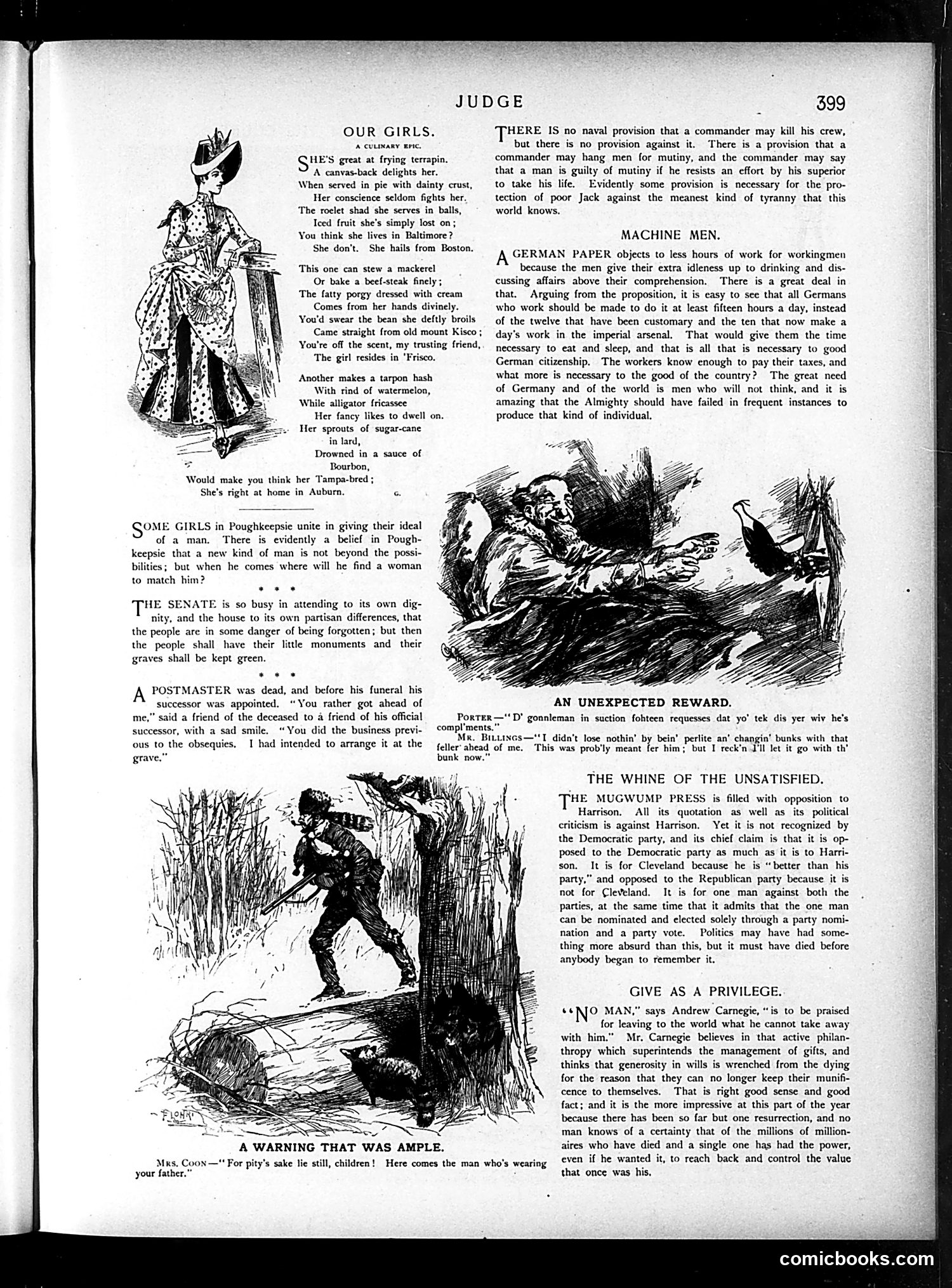
This page contains multiple satirical pieces typical of late-19th-century American humor: **"Our Girls"** is a lighthearted poem mocking regional stereotypes. It describes women from various American cities (Boston, San Francisco, Auburn, Tampa) who are skilled cooks, yet their culinary excellence contradicts their hometowns' expected cuisines—suggesting that talent and sophistication exist everywhere, defying geographic assumptions. **"Machine Men"** satirizes German labor policy, sarcastically arguing that workers shouldn't get shorter hours because they'd spend free time drinking and discussing "affairs above their comprehension." The piece criticizes German authorities for wanting compliant, unthinking workers, implying this makes for poor citizenship. **"An Unexpected Reward"** (illustrated) appears to be a brief joke about a porter receiving unexpected gratitude. **"The Whine of the Unsatisfied"** critiques the Mugwump press (Republican defectors), noting their opposition to Harrison while claiming Democratic allegiance—attacking them for political inconsistency and self-serving positions during the Harrison presidency era. The page blends domestic humor with political commentary typical of Judge's satirical approach.
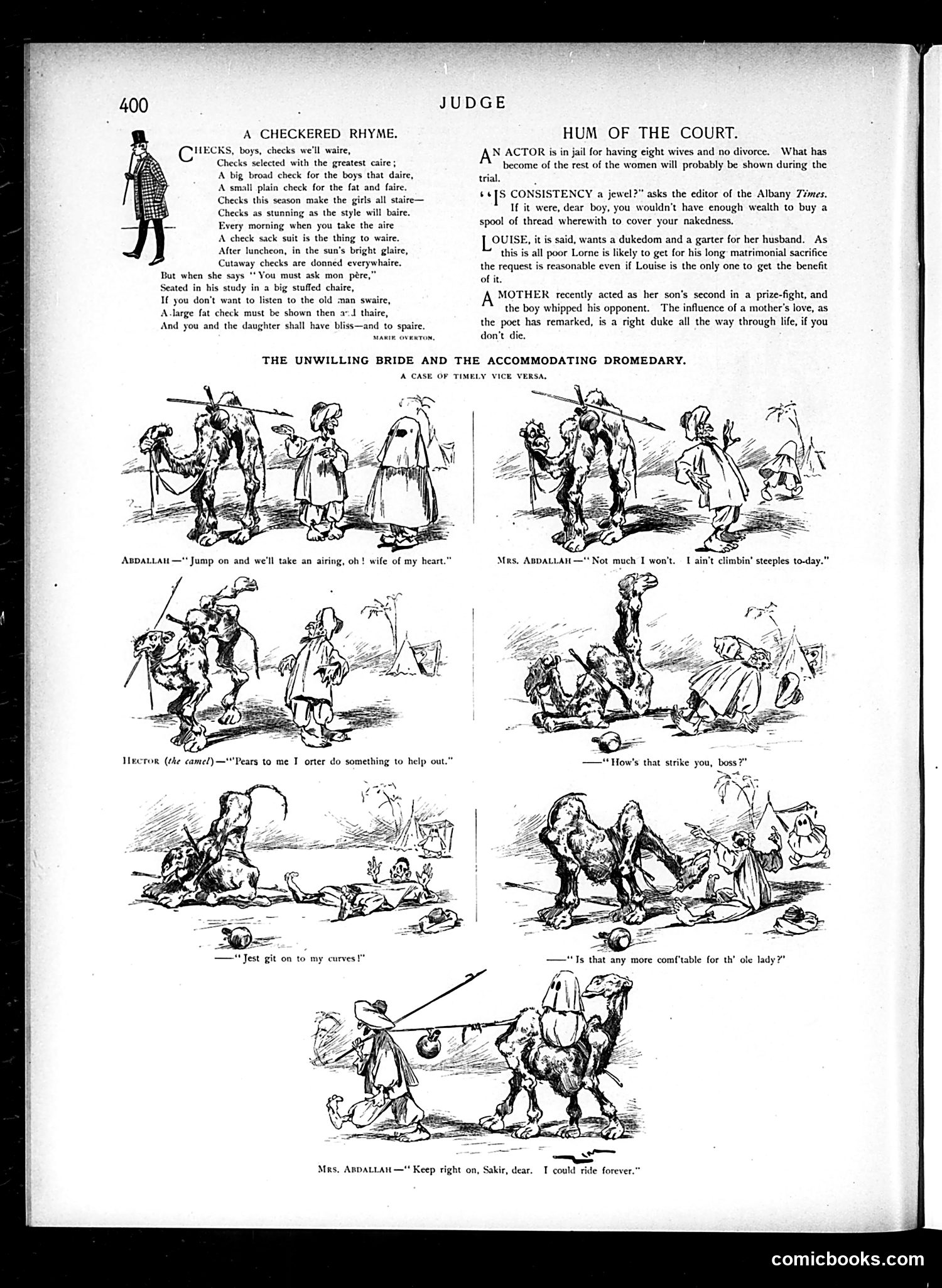
This page contains two distinct pieces of Victorian-era satire: **"A Checkered Rhyme"** mocks fashionable men's clothing—specifically checked patterns dominating 1880s menswear. The poem satirizes how ubiquitous these garish checks had become across all social classes and occasions. **"Hum of the Court"** presents three brief satirical news items: an actor jailed for bigamy (eight wives, no divorces); criticism of the *Albany Times* for inconsistency; and commentary on a noblewoman ("Louise," likely referencing a British scandal) seeking titles/honors through marriage to an impoverished lord. **"The Unwilling Bride and the Accommodating Dromedary"** is a visual comic strip showing a reluctant bride on her honeymoon repeatedly thrown from a camel while her husband (Abdallah) remains mounted. The "vice versa" joke plays on role-reversal: the bride willingly rides despite discomfort while the groom wishes to dismount. The satire targets either uncomfortable marriages or spousal dynamics of the era. All pieces employ typical *Judge* humor: social commentary through exaggeration, wordplay, and visual absurdity targeting contemporary fashions, scandals, and marital conventions.
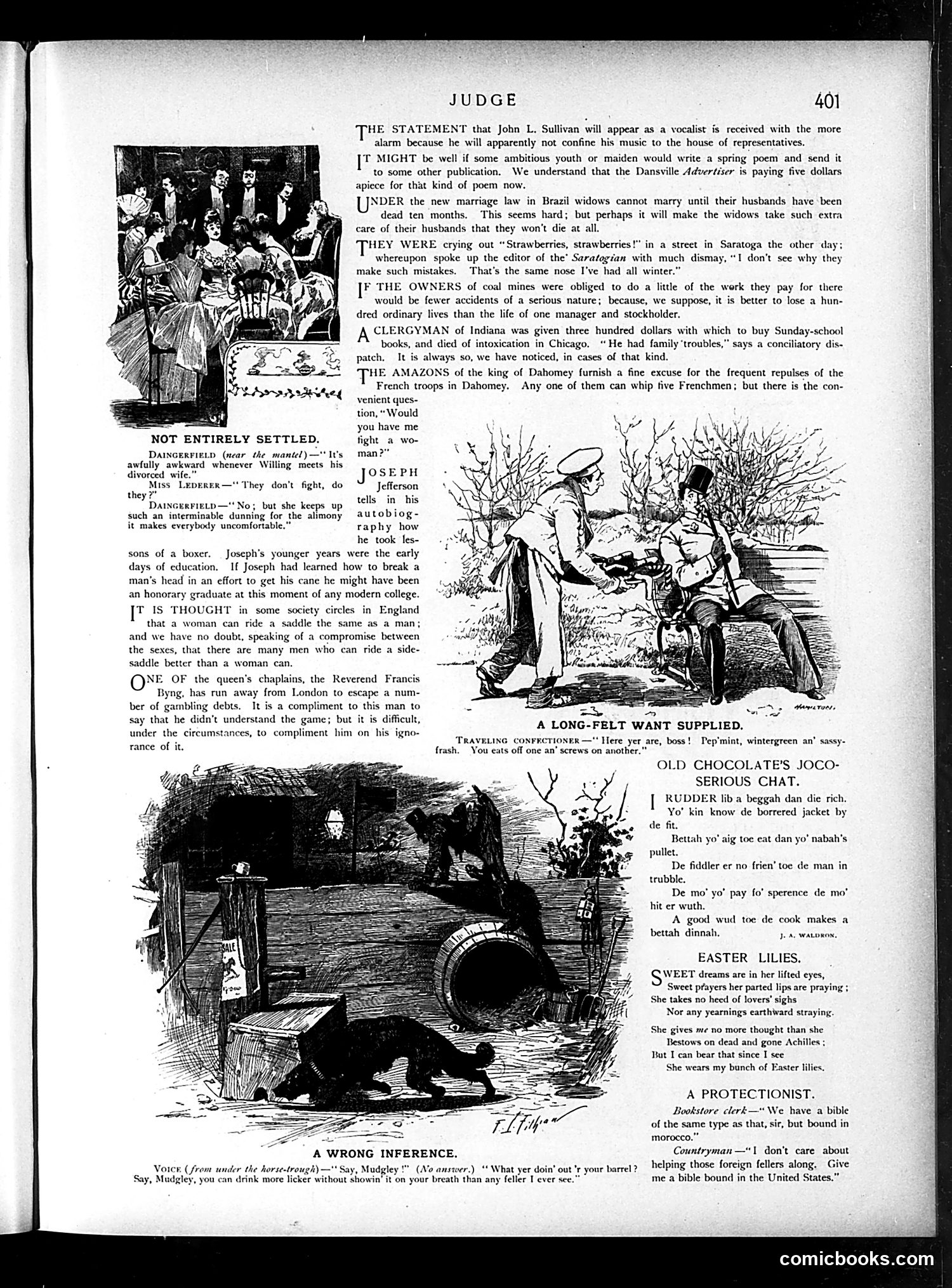
This page contains multiple brief satirical items typical of Judge magazine's format: **"Not Entirely Settled"** depicts a domestic dispute: a man mentions his awkwardness encountering his divorced wife, and another responds that while they don't physically fight, her constant alimony demands make everyone uncomfortable. The satire targets messy divorces and financial disputes. **Joseph Jefferson reference** jokes that if the young Joseph (likely the famous 19th-century actor) had learned boxing, he'd deserve a college degree—satirizing both physical education and easy academic credentials. **The "Long-Felt Want Supplied"** cartoon shows traveling candy vendors, with humor in their sales pitch about interchangeable confections. **"Old Chocolate's Joco-Serious Chat"** presents dialect humor (common to the era, now offensive) offering folk wisdom about poverty, borrowing, and paying for experience. **"Easter Lilies"** is sentimental poetry about unrequited love. **"A Protectionist"** is a brief joke about book binding preferences—likely referencing tariff debates of the era. The page reflects Judge's mix of social commentary, domestic humor, and period-typical racial stereotyping.
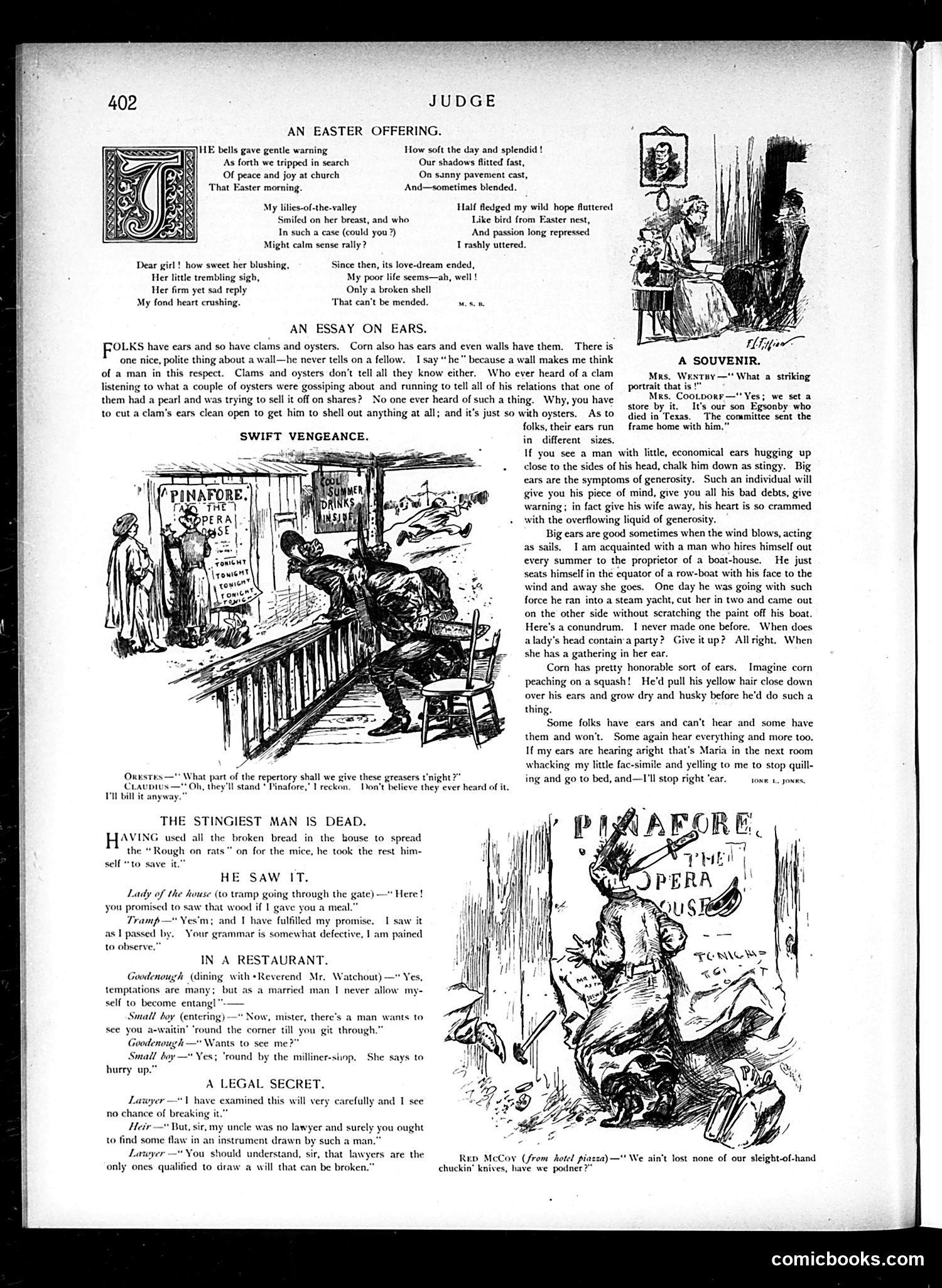
This page from Judge magazine (a 19th-century American satirical weekly) contains several unrelated humorous pieces typical of the publication's format. **"An Easter Offering"** is sentimental poetry about unrequited love, unrelated to satire. **"An Essay on Ears"** is absurdist humor comparing human ears to those of animals (clams, oysters, corn) and walls, making ridiculous claims: that large ears indicate generosity, small ones indicate stinginess, and one man's ears function as sails for a boat. The humor is purely nonsensical wordplay. **"Swift Vengeance"** depicts theater managers (Oneates and Claudius) planning to perform *H.M.S. Pinafore* for working-class audiences ("greasers"), assuming they've never heard of it—mocking both the condescension toward poor audiences and the play's popularity. Other brief comic vignettes follow similar patterns of domestic humor and absurdist jokes. The page is primarily entertainment without specific political commentary, representing Judge's typical mix of sentimental verse, puns, and social observation through exaggeration.
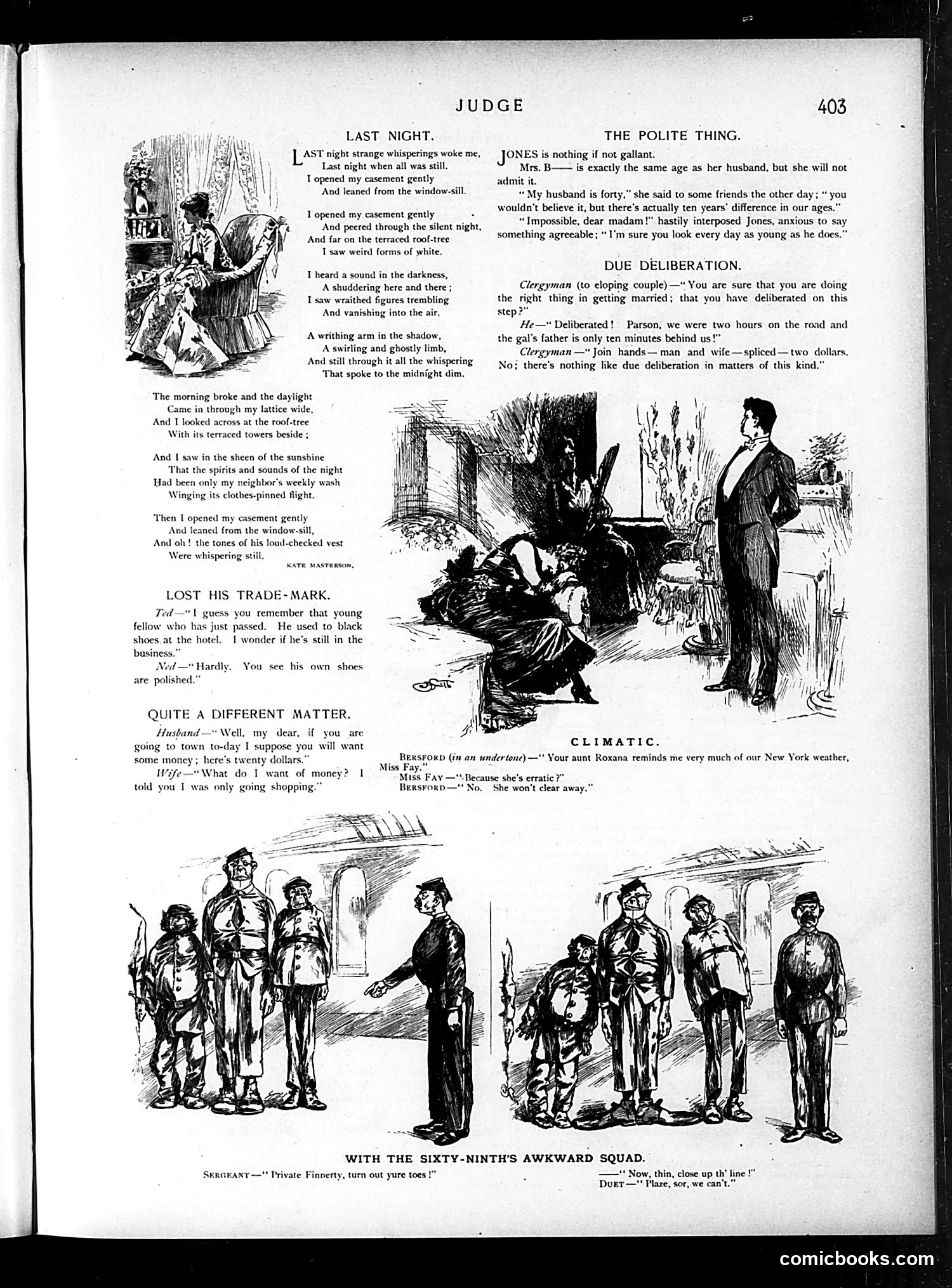
This page contains several brief comedic sketches typical of Judge magazine's satirical humor: **"Last Night"** is a romantic poem mocking overwrought Gothic sensibilities—a man imagines supernatural terrors on his neighbor's roof, only to discover it's merely laundry drying (clotheslines with pinned garments). The satire targets melodramatic imagination versus mundane reality. **"Lost His Trade-Mark"** jokes about a shoeshiner whose own shoes are now unpolished—he's lost the very marker of his profession, suggesting social decline or loss of respectability. **"The Polite Thing"** satirizes social courtesy: a gallant man (Jones) must compliment a woman's youth while she claims to be ten years younger than her actual age, forcing him into awkward flattery. **"Due Deliberation"** mocks hasty elopements: a clergyman asks if the couple has deliberated, but they've only spent two hours traveling while her father pursues them—hardly careful consideration. **"With the Sixty-Ninth's Awkward Squad"** depicts military drill sergeants struggling with incompetent soldiers, poking fun at military discipline and training. All reflect Judge's characteristic light social satire of American life.
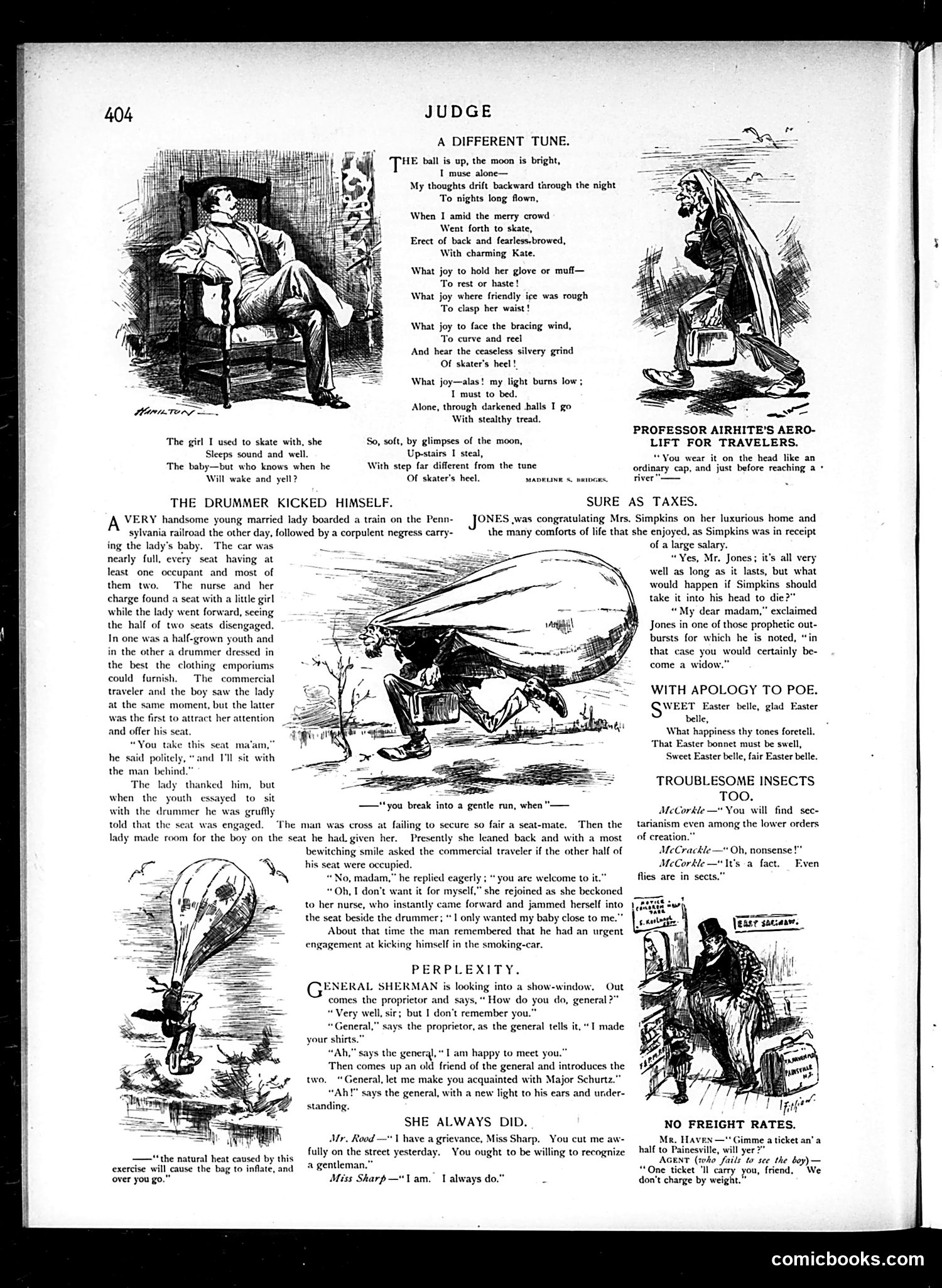
This page contains several humorous short stories and poems typical of late 19th-century satirical magazines. **"A Different Tune"** contrasts a man's youthful skating romance with Kate against his present solitary, cautious nighttime existence—moving from energetic ice-skating to tiptoeing through darkened halls to avoid waking his baby. **"The Drummer Kicked Himself"** satirizes male behavior on a train. A well-dressed traveling salesman ("drummer") refuses his seat to a lady but is outwitted when she uses the space for her nursemaid and baby instead—forcing him to cede the seat anyway, prompting self-recrimination. **"Sure as Taxes"** features Jones making a darkly prophetic joke to Mrs. Simpkins: her luxurious lifestyle depends on her husband's continued survival. **Minor pieces** include Easter poetry, a brief exchange mocking religious sectarianism, and a joke about insects being classified as "sects" (pun). The humor relies on class observations, gender dynamics, domestic situations, and wordplay typical of Judge's satirical approach.
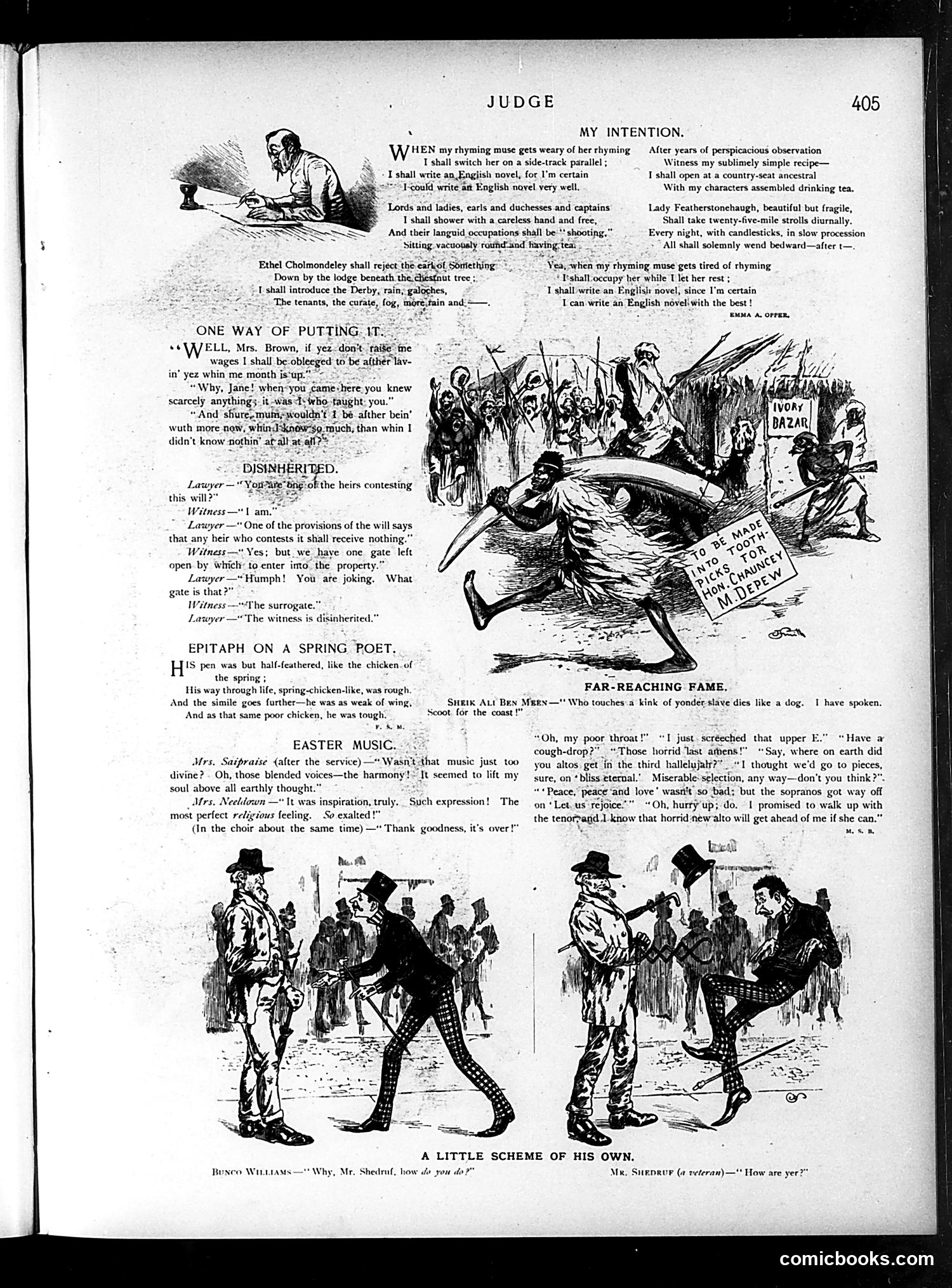
This page satirizes English literary conventions and contemporary social absurdities. **"My Intention" and "One Way of Putting It"** mock the formulaic English novel—featuring aristocratic characters (Lady Featherstonehaugh, Ethel Cholmondeley) engaged in vapid activities: shooting, tea-drinking, and romantic rejections "by the lodge." The satire suggests such novels are predictable and poorly written. **"Disinherited"** jokes about legal loopholes: a witness attempts to contest a will despite a clause punishing contestants, exploiting a technicality involving "the surrogate" (courthouse official). **"Easter Music"** contrasts public piety with backstage reality—choir members praising the "inspired" performance while privately complaining it's tedious and over. **"Far-Reaching Fame"** depicts opera singers' dramatic posturing (a "Sheik" threatening death) undercut by trivial backstage chatter about cough drops and soloists. The overall theme: exposing the gap between pretense and reality in refined society—whether literary, legal, musical, or social.
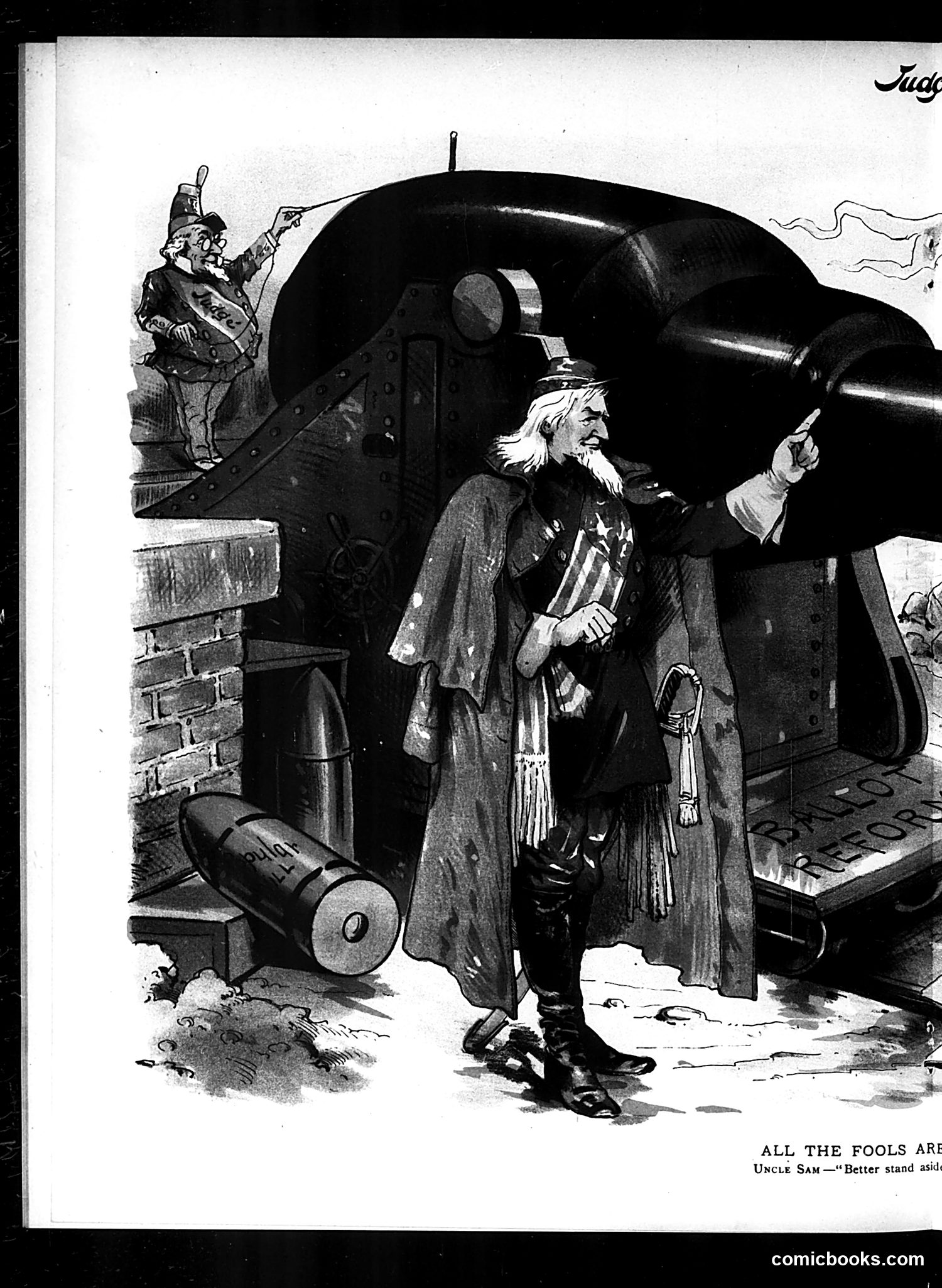
This cartoon depicts **Uncle Sam** (personified as America, identifiable by his distinctive beard and top hat) standing before a large cannon. A military figure stands on the cannon's mounting, pointing/gesturing as if directing fire. The caption reads "ALL THE FOOLS ARE / Uncle Sam—'Better stand aside.'" The satire suggests that Uncle Sam is being positioned as a "fool" who should get out of the way of military action or aggression. The cannon symbolizes military force or warfare. Without seeing the publication date, the exact historical context is unclear, but this appears to criticize American military intervention or policy—suggesting the nation's leadership is foolish and should withdraw from some conflict or military endeavor. The cartoon uses the contrast between Uncle Sam's civilian identity and the looming military apparatus to make its point.
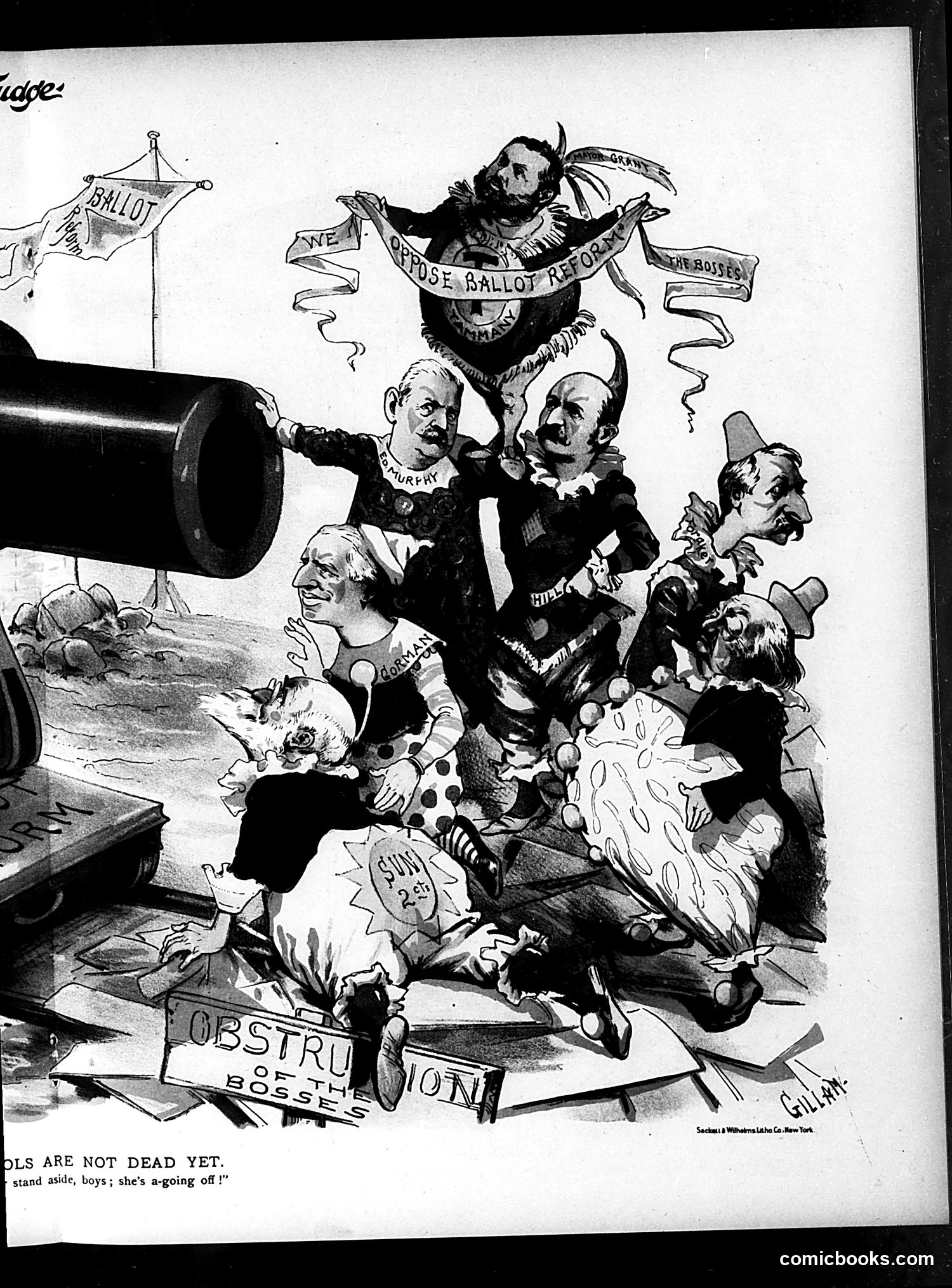
This political cartoon satirizes opposition to women's suffrage. The central figure labeled "SUFFRAGE" is depicted as an explosive device or cannon being ignited by various male political figures, including those labeled "MURPHY" and others wearing formal dress. The "BALLOT" flag flies in the background, and scattered papers read "OBSTRUCTION OF THE BOSSES," suggesting political machine opposition to voting rights. The joke plays on the metaphor of suffrage as a dangerous, unstoppable force—the men are warned to "stand aside, boys; she's a-going off!" treating women's voting rights as an inevitable explosion they cannot prevent. The cartoonist appears sympathetic to suffrage, portraying resistance as futile obstruction by corrupt political bosses. This likely dates to the early 20th-century suffrage movement.
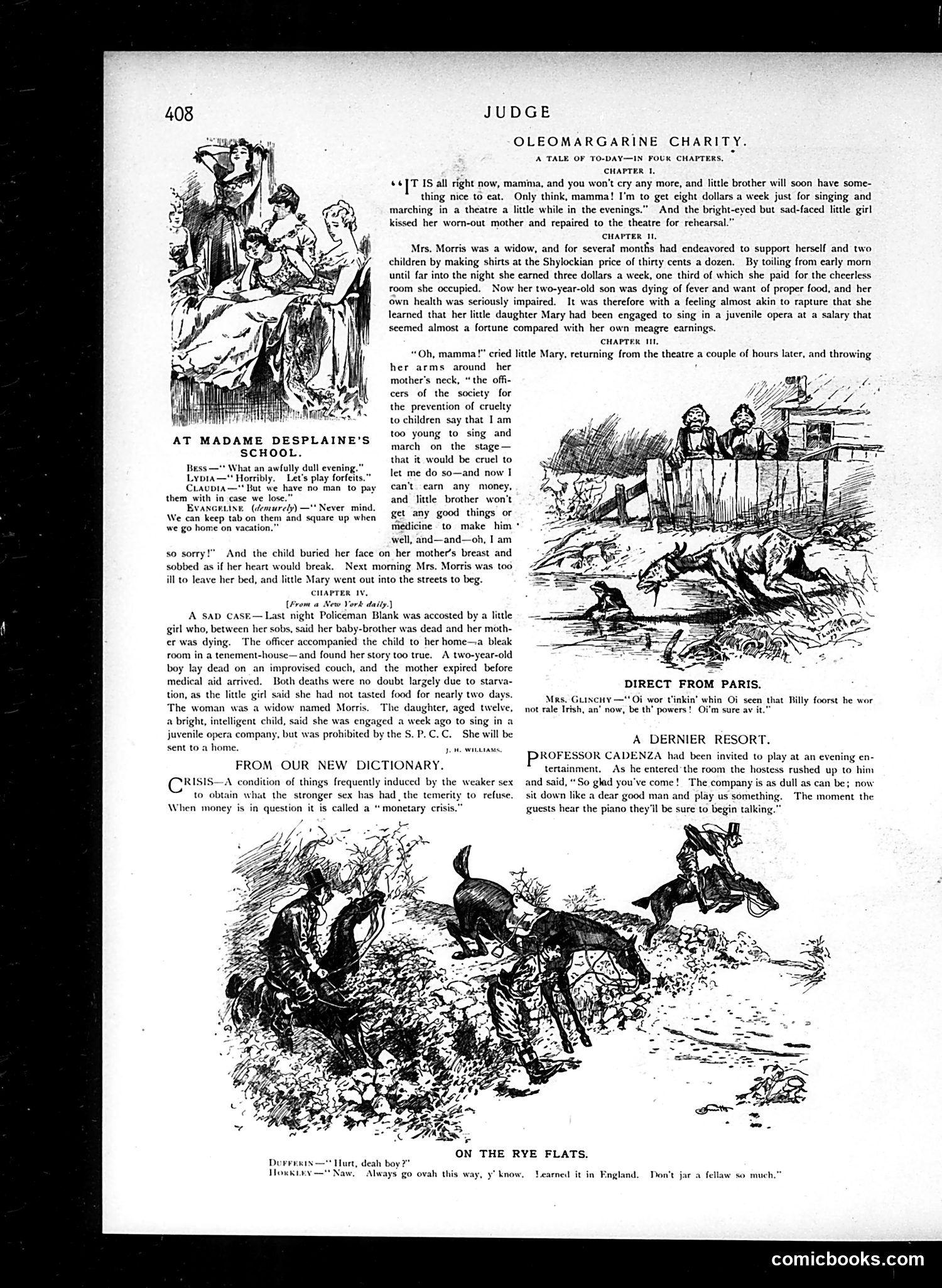
This page satirizes the hypocrisy of child-welfare organizations through "Oleomargarine Charity"—a four-chapter narrative about a poor widow, Mrs. Morris, and her daughter Mary. **The Satire:** The story exposes the Society for the Prevention of Cruelty to Children (S.P.C.C.), a real organization. When Mary, age 12, is hired to sing in a juvenile opera for desperately needed wages, the S.P.C.C. officers *prohibit* her from working, deeming it "cruel"—yet offer no alternative support. Result: the boy dies from starvation, the mother dies, and Mary becomes a street beggar. The "charity" prevents the family's only income source while providing nothing to prevent actual suffering. **The Point:** The cartoon attacks sanctimonious reformers who enforce rigid rules against child labor without addressing the poverty forcing families into desperation. Their intervention is performative "charity"—hence "oleomargarine" (artificial butter), suggesting fake benevolence. The accompanying jokes and illustrations lighten the heavy critique with unrelated humor and social commentary typical of Judge's satirical approach.
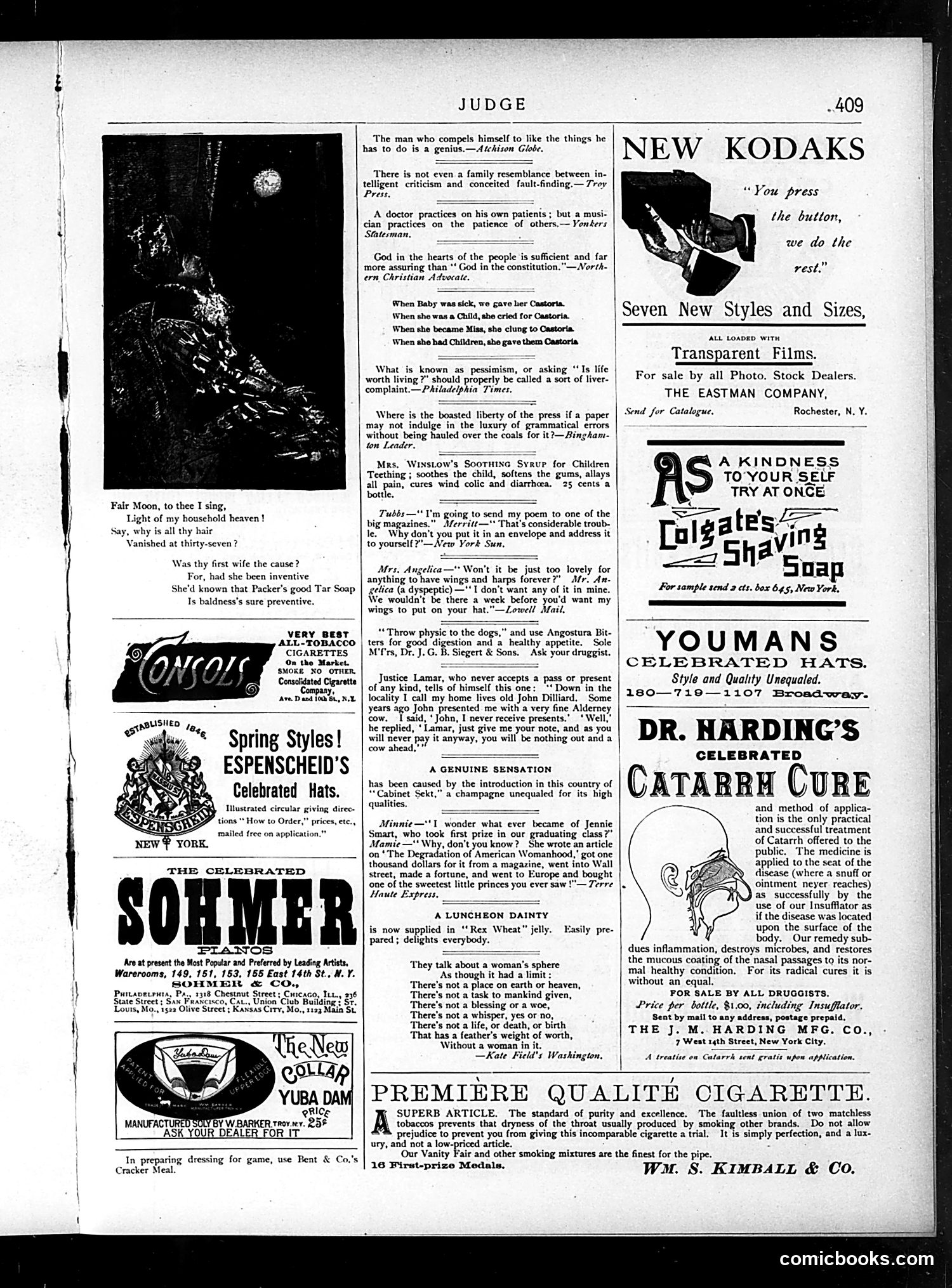
This page is primarily **advertising with interspersed humorous quotes and anecdotes**—typical of Judge magazine's format. The main cartoon appears to be a **social commentary on baldness**, presented as a domestic scene. A husband has lost his hair by age 37, and his wife asks if his *first* wife caused it. The joke satirizes both marital discord and contemporary anxieties about male hair loss, while using the situation to advertise "Packer's good Tar Soap" as a baldness remedy. Scattered throughout are **brief satirical quips** mocking various subjects: pessimism (equated with liver complaints), press freedom, and doctors' patience with patients. The **advertisements** dominate—for pianos, hats, cigarettes, Castoria (a children's laxative), and notably, **Kodak cameras** with their famous slogan "You press the button, we do the rest." The anecdotes about Justice Lamar and others appear designed as **humorous filler** rather than political satire. Overall, this page reflects Gilded Age consumer culture and genteel domestic humor rather than sharp political commentary.
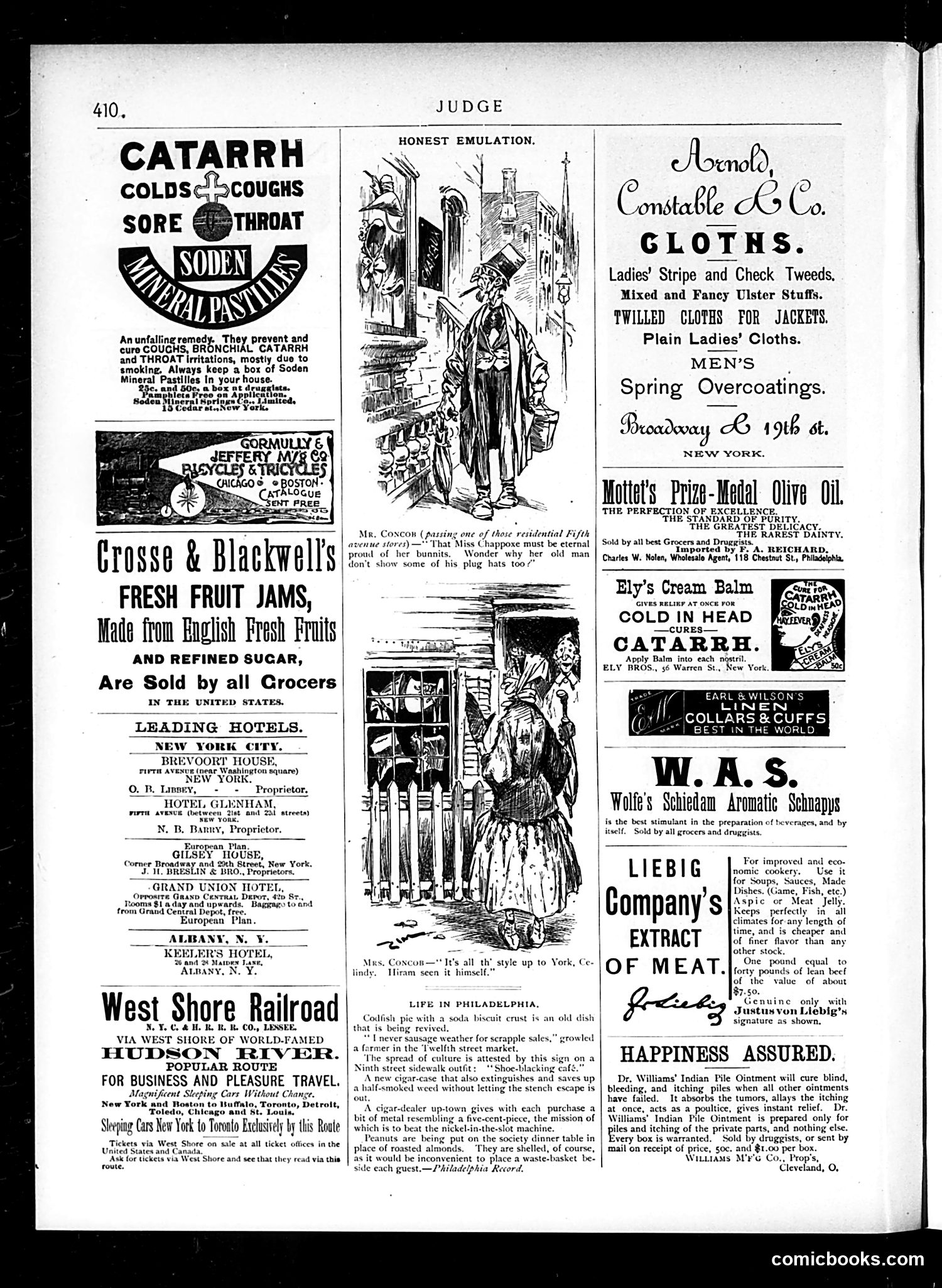
This page is **primarily advertising** with two brief satirical vignettes embedded among product ads. ## The Cartoons: **"Honest Emulation"** depicts a social-climbing joke: Mr. Concon admires a wealthy neighbor's fashionable bonnets on Fifth Avenue and wonders why the neighbor's husband doesn't display his fine plug hats too. His wife responds that the neighbor ("Hiram") has already seen them—suggesting the wealthy man doesn't need to constantly flaunt his possessions like social climbers do. The humor targets nouveau-riche pretension and ostentatious display. **"Life in Philadelphia"** is a brief column of observational humor about Philadelphia street life, mocking cultural pretensions (spreading "culture"), commercial innovation (a shoe-shining device that traps smoke), and social climbing (serving peanuts instead of almonds at dinner parties to save money). ## Context: These are gentle, class-based satires typical of *Judge*'s Gilded Age humor—poking fun at middle-class aspirational behavior and the contradictions of social climbing rather than attacking the wealthy directly.
This page is primarily **advertising**, typical of late 19th-century American magazines. However, it includes one notable literary piece: **"I Knowed Them Eyes Wuz Ellen's"** by Ernest McGaffey is a sentimental poem about a rural father recognizing his long-absent daughter by her eyes, despite years of physical change. She'd relocated to Idaho twenty years prior and returns unrecognized by appearance alone—yet her distinctive blue eyes betray her identity to him. The poem trades in period-appropriate dialect humor and emotional pathos, celebrating maternal/paternal bonds transcending time and distance. The remainder consists of period advertisements for goods (dry goods, bicycles, typewriters, blank books) and patent medicines—notably **Scott's Emulsion** for consumption/tuberculosis and various other remedies. These represent the era's aggressive medical marketing, often making dubious health claims. The ads reflect both commercial culture and the desperation surrounding tuberculosis before modern medicine. No political satire appears on this particular page.
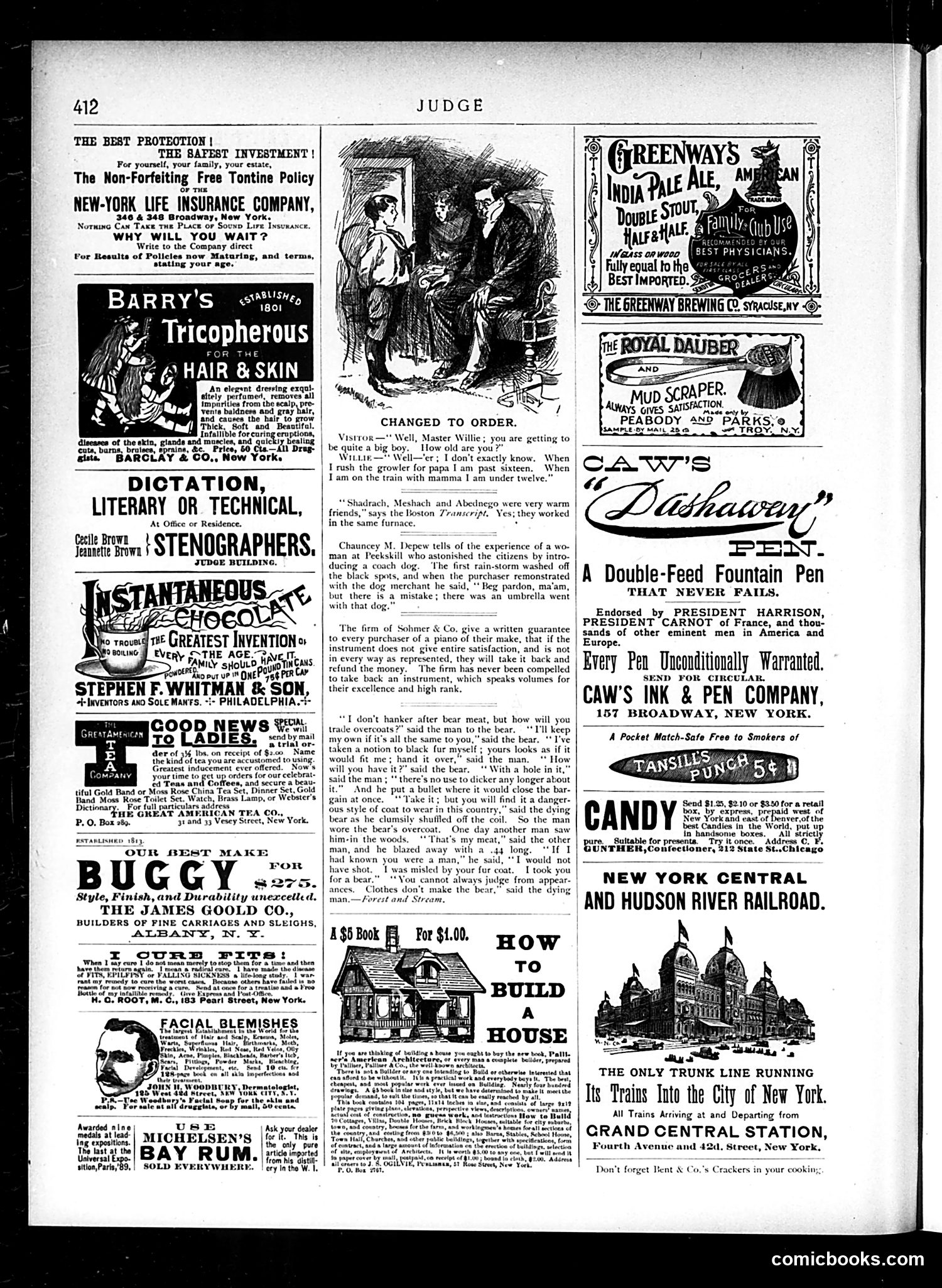
This page is primarily **advertisements** for late 19th-century products (insurance, hair tonic, carriages, chocolate). However, the central cartoon titled **"CHANGED TO ORDER"** presents a satirical dialogue about subjective identity. The cartoon depicts a conversation between an adult visitor and young Willie about his age. Willie's answer reveals the satire: his reported age changes depending on context—he claims to be "past sixteen" when running errands for his father, but "under twelve" when traveling with his mother. **The joke**: Willie strategically performs different ages to suit circumstances (likely to avoid responsibilities or gain sympathy/privileges). This mocks how people manipulate their public identity based on convenience rather than truth—a common human hypocrisy Judge's satirical tradition targeted. The surrounding anecdotes (about the coach dog losing spots in rain, the bear negotiation) continue this theme of deceptive appearances versus reality, reinforcing the magazine's wit about social pretense.
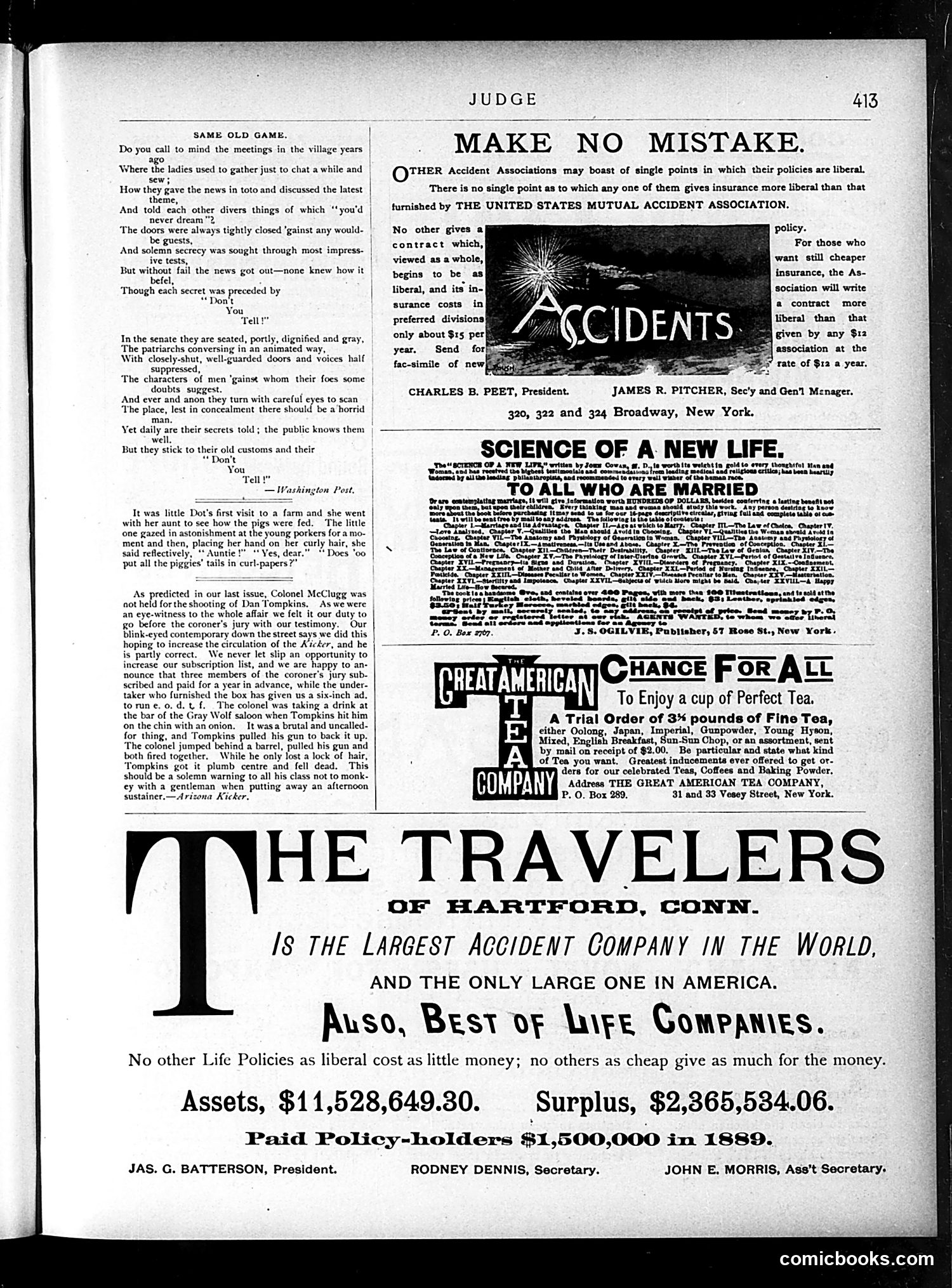
This page is primarily **advertisements** for insurance and consumer products, with minimal satirical cartoon content. The main visual element is an **insurance company advertisement** for the United States Mutual Accident Association, featuring a dramatic image of a lightning bolt labeled "ACCIDENTS." The ad boasts superior coverage compared to competitors, claiming their policies are more liberal and comprehensive than rivals—a competitive pitch typical of the Gilded Age insurance industry. Below that is **The Travelers of Hartford, Connecticut** insurance ad, claiming to be "the largest accident company in the world," with substantial assets ($11.5 million) cited as proof of stability. A small humorous anecdote about "little Dot" visiting a farm appears mid-page, unrelated to the advertisements. The page also includes ads for **Great American Tea Company** and **"Science of a New Life"** (a marital/reproductive advice book). Overall, this is a **commercial page** rather than satirical content—reflecting how 19th-century magazines blended editorial and advertising material.
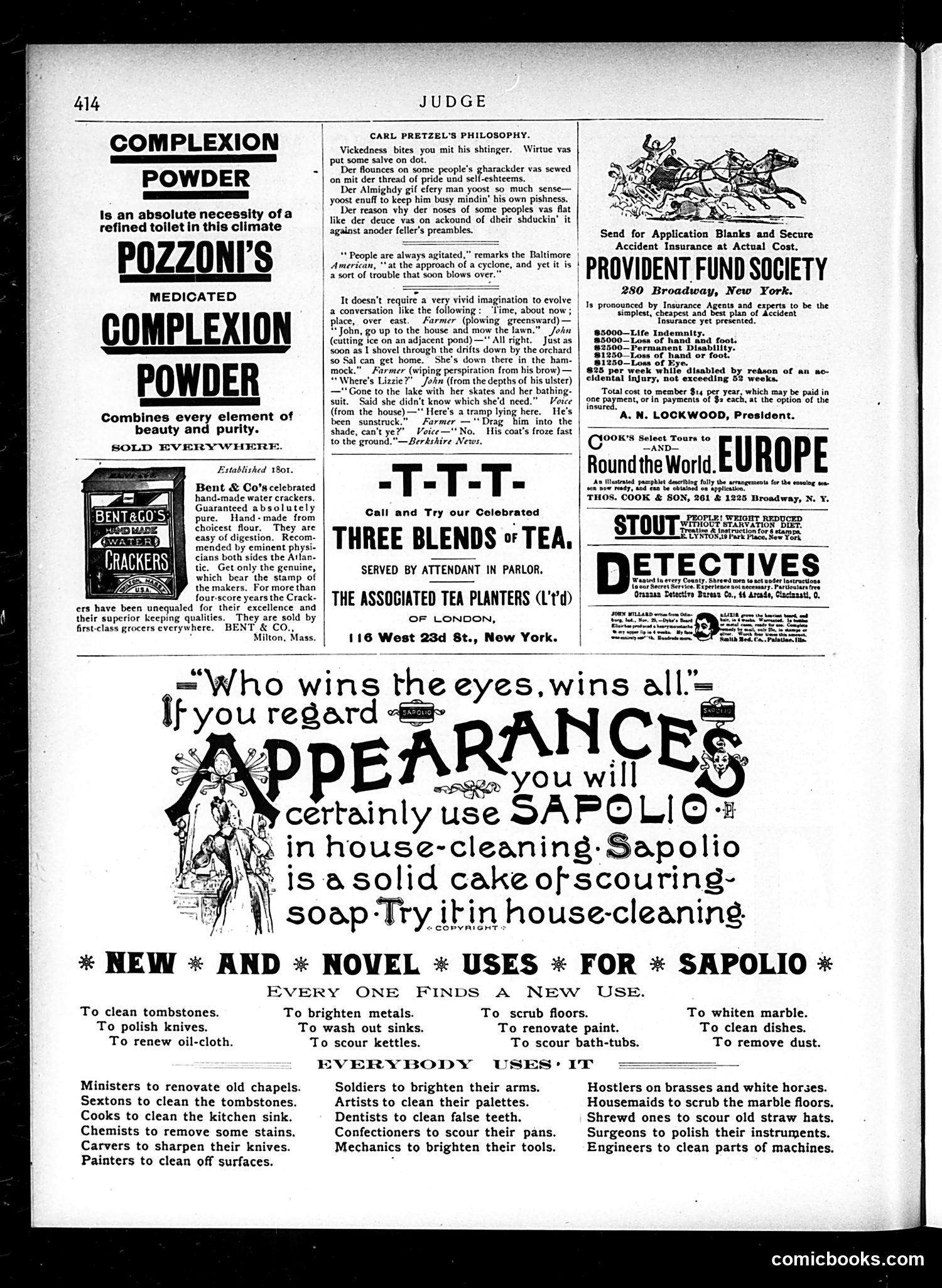
This page is primarily **advertising**, not political satire. The dominant content consists of commercial advertisements for consumer products (complexion powder, tea, crackers, soap, insurance, and travel services). The only satirical content is **"Carl Pretzel's Philosophy,"** a humor column featuring a character with a German accent offering folksy observations. Pretzel appears to be a working-class ethnic character—common in early-20th-century American humor—dispensing wisdom about human nature in fractured English ("shtinger," "gharackder," "pishness"). The jokes rely on wordplay and observations about rural life rather than political commentary. The **Sapolio soap advertisement** uses the slogan "Who wins the eyes, wins all," promoting appearance-consciousness to consumers. Overall, this represents Judge's commercial model: entertainment and light humor surrounding paid advertising for the affluent readership of that era.
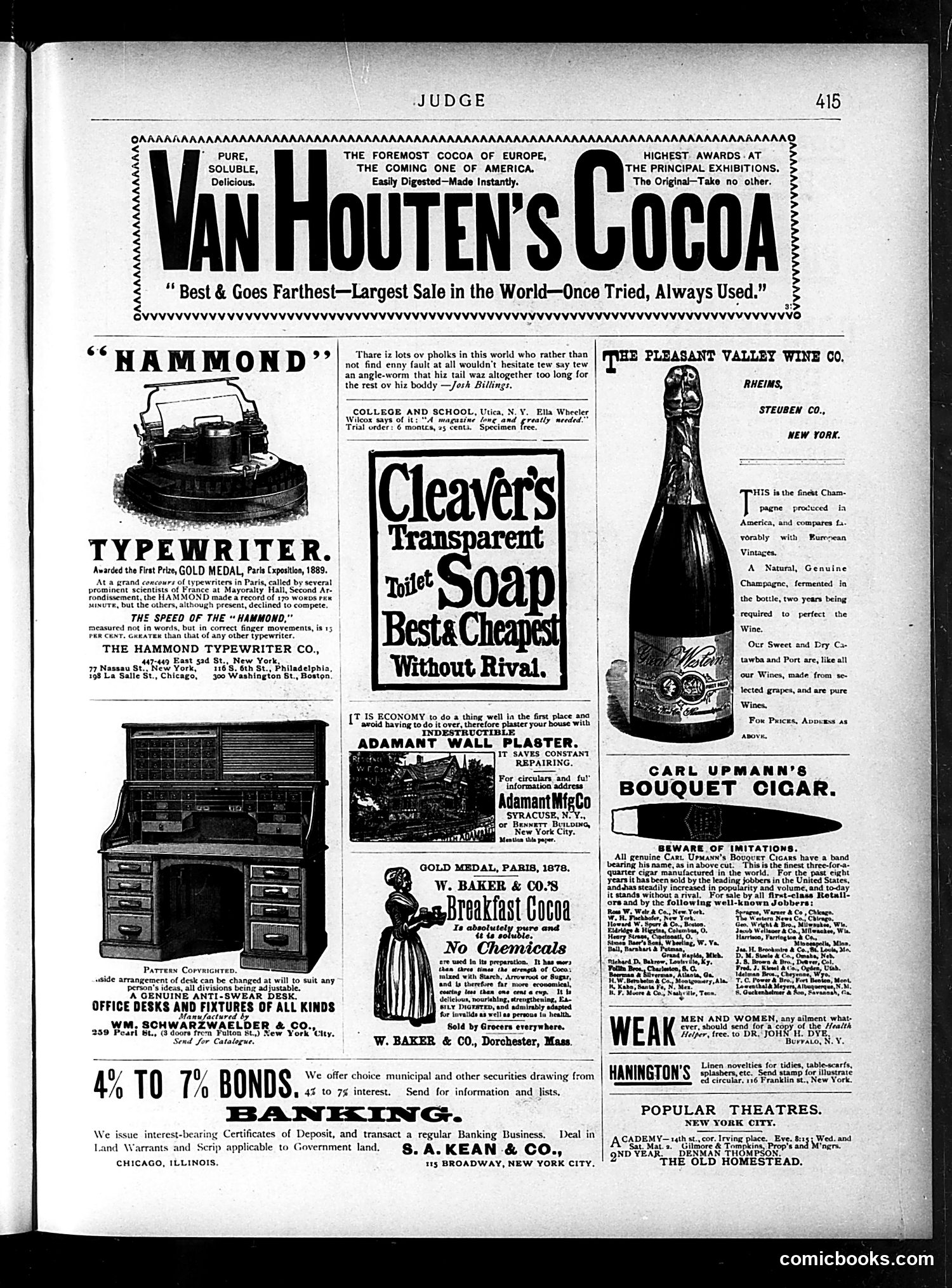
This is primarily a **late 19th-century advertising page** with minimal satirical content. The dominant feature is a large Van Houten's Cocoa advertisement claiming superiority as "the foremost cocoa of Europe" and "the coming one of America." The only apparent cartoon/joke is a brief quote attributed to "Josh Billings" (a 19th-century humorist persona) about people who complain excessively—comparing fault-finders to an angle-worm with too-long a tail. This is gentle satire on human nature rather than political commentary. The remaining content consists of product advertisements: Hammond typewriters, Cleaver's soap, Adamant wall plaster, W. Baker & Co. breakfast cocoa, Pleasant Valley wine, Carl Upmann cigars, office furniture, bonds, and banking services. **There is no identifiable political cartoon, caricature, or social satire on this page**—it functions as a classified advertising section typical of Judge's revenue model during this period.
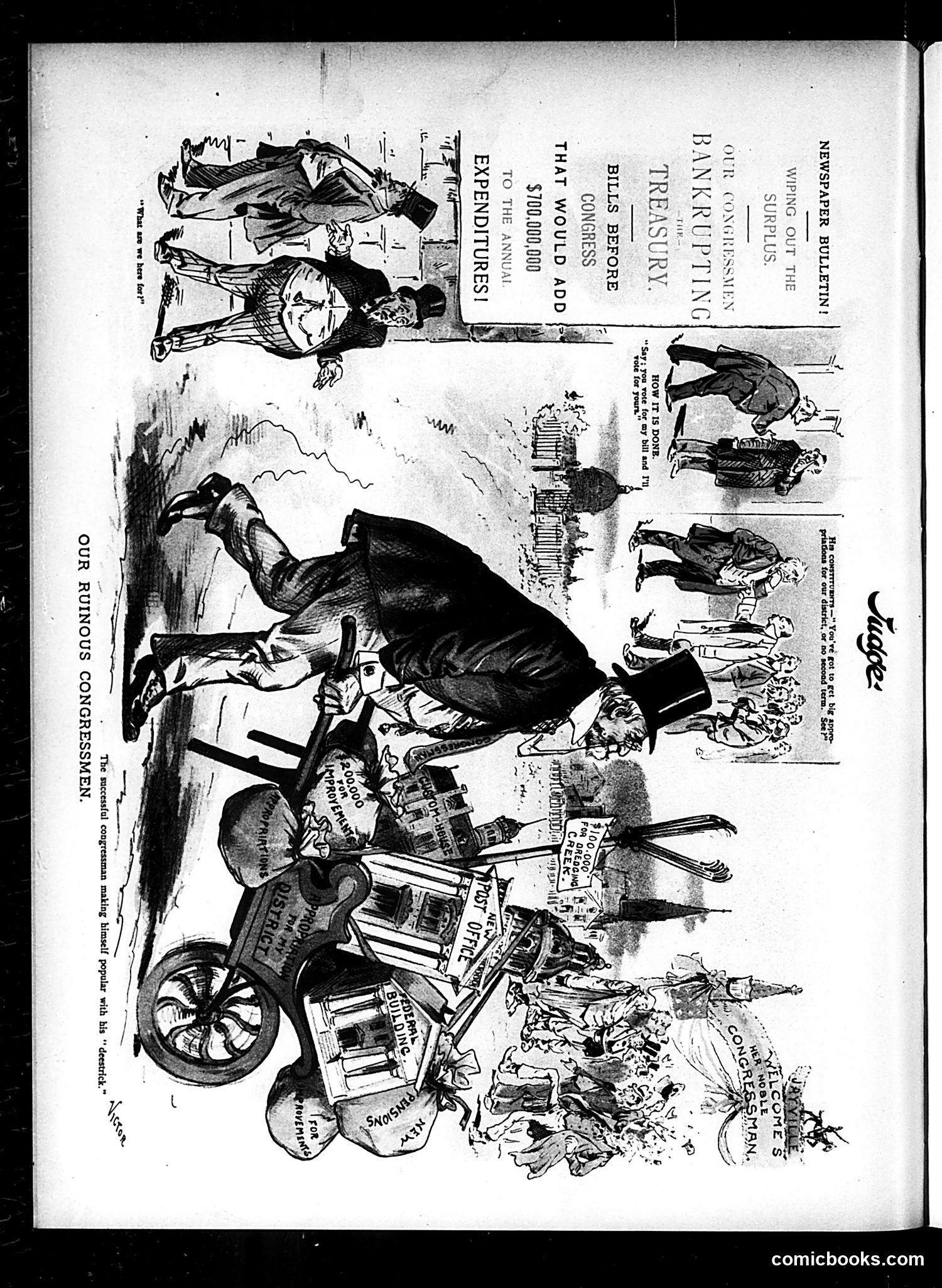
This political cartoon critiques Congressional spending practices. The main image shows a congressman being pressured by constituents demanding large appropriations ("appro-priation") for their district, with the threat of denying him a second term if he doesn't deliver. The satire highlights the contradiction: while bills totaling $700,000,000 in additional annual expenditures await Congressional action, individual congressmen prioritize local projects to secure re-election. The caption's sarcastic question—"What are we here for?"—suggests Congress's real purpose has become pandering to districts rather than fiscal responsibility. The smaller figures on the right appear to represent various special interests or constituent groups competing for federal funds. The overall message satirizes how electoral pressure drives wasteful "pork barrel" spending, ultimately bankrupting the national treasury while congressmen secure personal political survival.
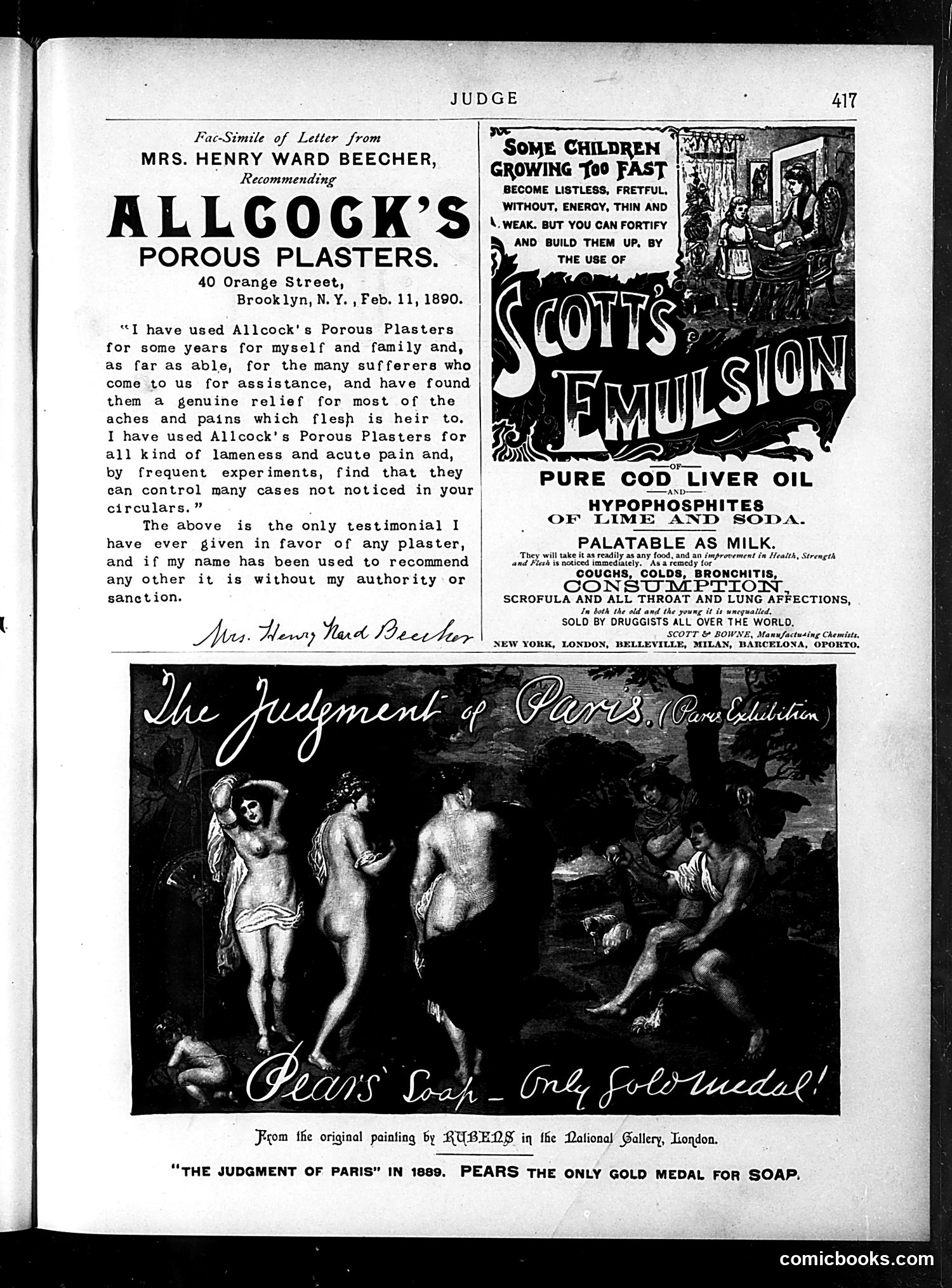
This page consists primarily of **product advertisements** rather than satirical cartoons. The top features a testimonial letter from Mrs. Henry Ward Beecher (wife of the famous preacher) endorsing Allcock's Porous Plasters—a common 19th-century medical product. The letter appears designed to lend authority through her prominent name. The right side advertises Scott's Emulsion (cod liver oil), marketed to parents of rapidly-growing children, emphasizing health benefits for respiratory ailments. The lower third reproduces "The Judgment of Paris"—a classical painting by Rubens from London's National Gallery—as an advertisement for Pears Soap. The caption jokes that in 1889, Pears won the "only gold medal for soap," cleverly appropriating the famous mythological judgment (where Paris chose among goddesses) to promote their product. These ads reflect late-Victorian marketing: leveraging celebrity endorsements, classical allusions, and health claims to sell patent medicines and consumer goods.
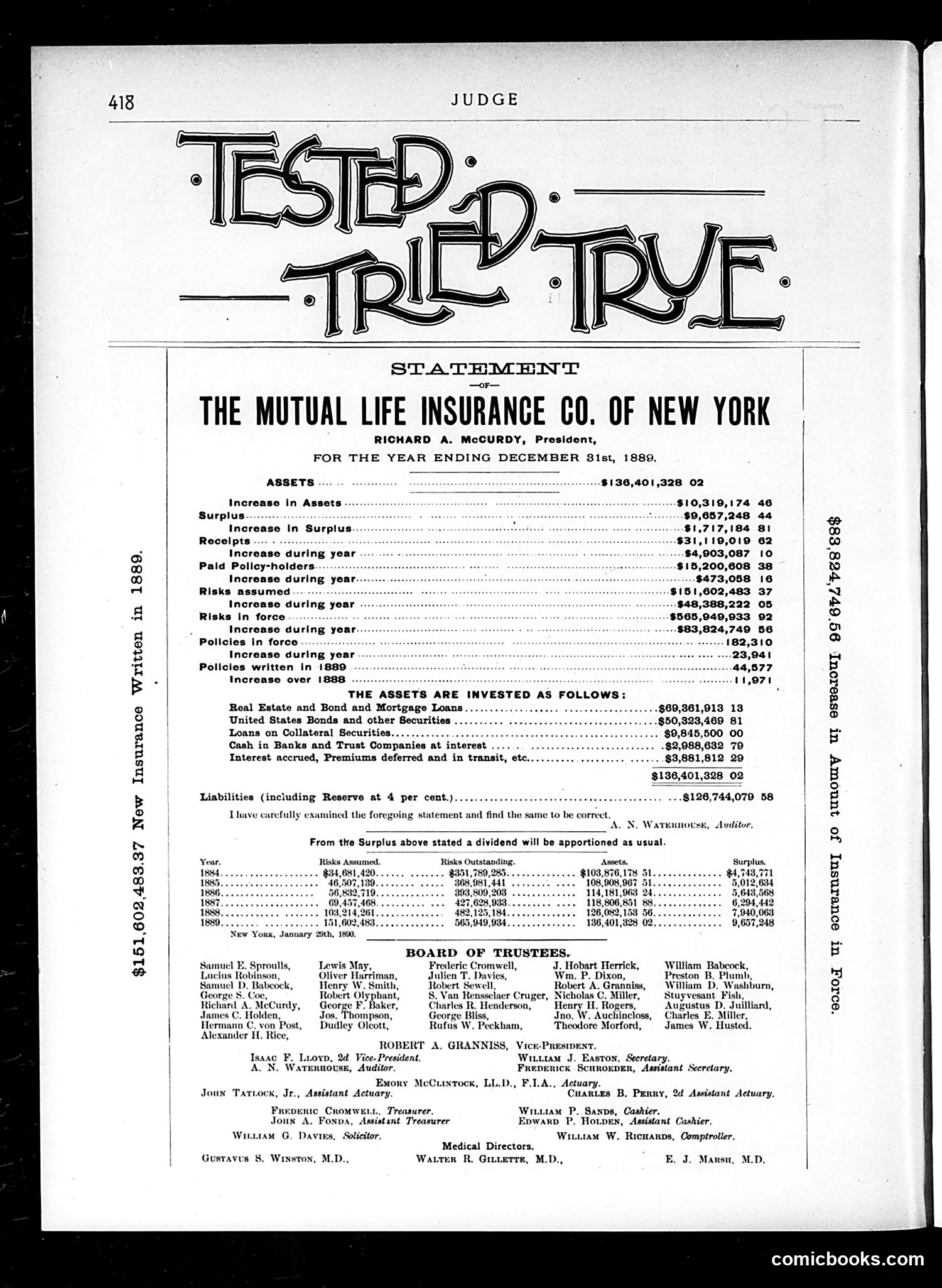
This page is primarily a **financial statement**, not a cartoon or satirical content. It presents The Mutual Life Insurance Company of New York's annual report for 1889, showing assets of approximately $136 million under President Richard A. McCurdy. The document lists detailed financial information—receipts, paid claims, policies, and asset investments—along with the company's Board of Trustees and officers. Given that this appears in *Judge*, a satirical magazine, the likely commentary would target the **insurance industry's wealth and power** or McCurdy's management. However, no visible cartoons or explicit satire accompany this statement on this page. The inclusion itself may be the humor—presenting corporate financial data in a humor magazine, possibly critiquing corporate excess during the Gilded Age.
This page is **entirely an advertisement**, not satire or political commentary. It's a full-page promotion for Carter's Little Liver Pills appearing in *Judge* magazine. The ad uses a raven (likely evoking Poe's famous poem) holding a sign for the product. The pitch emphasizes the pills' small size and price—"homeopathic in size" but "allopathic in action" (medical terms suggesting small doses with powerful effects). The verse promises that taking one pill nightly will cure "grievous ills" and that users will become repeat customers ("who takes them once will take them twice"). Notably, the ad includes a **warning against counterfeits**—suggesting the product was popular enough to be widely imitated, a common problem for successful patent medicines of this era. The bottom credits the magazine's ink supplier, a typical practice in period publications.
This page is primarily **an advertisement**, not a political cartoon. It promotes Decker Brothers' "Matchless Pianos" from Union Square, New York, and showcases "The Famous Four Hundred Buckboard"—a horse-drawn carriage manufactured by The Biddle & Smart Company of Amesbury, Massachusetts (established 1870). The advertisement features an illustration of well-dressed passengers in a four-wheeled buckboard pulled by a horse, positioned as aspirational imagery for wealthy consumers. The text claims they manufacture "the largest variety of pleasure vehicles in the world." This represents **period advertising** targeting the upper classes, emphasizing luxury transportation during the horse-and-buggy era. There is no political satire evident on this page—it's straightforward commercial promotion appearing in *Judge* magazine.