
Judge, 1890-03-29 · page 16 of 28
Judge — March 29, 1890 — page 16: what you’re looking at
What you’re looking at
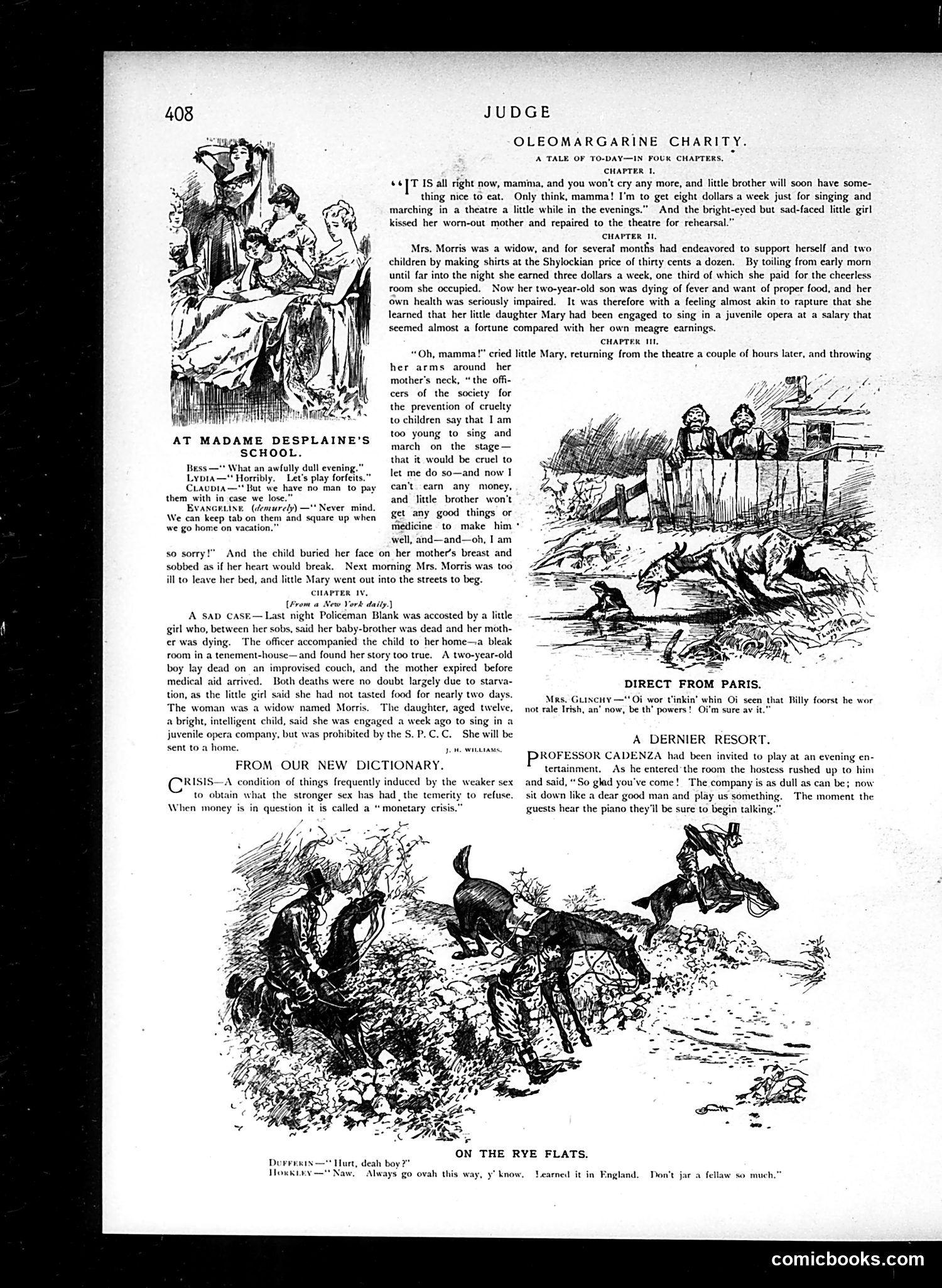
This page satirizes the hypocrisy of child-welfare organizations through "Oleomargarine Charity"—a four-chapter narrative about a poor widow, Mrs. Morris, and her daughter Mary. **The Satire:** The story exposes the Society for the Prevention of Cruelty to Children (S.P.C.C.), a real organization. When Mary, age 12, is hired to sing in a juvenile opera for desperately needed wages, the S.P.C.C. officers *prohibit* her from working, deeming it "cruel"—yet offer no alternative support. Result: the boy dies from starvation, the mother dies, and Mary becomes a street beggar. The "charity" prevents the family's only income source while providing nothing to prevent actual suffering. **The Point:** The cartoon attacks sanctimonious reformers who enforce rigid rules against child labor without addressing the poverty forcing families into desperation. Their intervention is performative "charity"—hence "oleomargarine" (artificial butter), suggesting fake benevolence. The accompanying jokes and illustrations lighten the heavy critique with unrelated humor and social commentary typical of Judge's satirical approach.
📄 Transcribed text from this page (OCR, searchable)
Machine-transcribed from the original scan — historical spelling and the odd misread are preserved.
JUDGE OLEOMARGARINE CHARITY. A TALE OF TO-DAY—IN FOUK CHAPTERS, = CHAPTER 1. ¢¢]T IS all right now, mamma, and you won't cry any more, and little brother will soon have some- thing nice to eat. Only think, mamma! I'm to get eight dollars a week just for singing and marching in a theatre a little while in the evenings.” And the bright-eyed but sad-faced little girl kissed her worn-out mother and repaired to the theatre for rehearsal.” CHAPTER I. Mrs. Morris was a widow, and for severat months had endeavored to support herself and two children by making shirts at the Shylockian price of thirty cents a dozen. By toiling from early morn until far into the night she earned three dollars a week, one third of which she paid for the cheerless room she occupied. Now her two-year-old son was dying of fever and want of proper food, and her wn health was seriously impaired. It was therefore with a feeling almost akin to rapture that she learned that her little daughter Mary had been engaged to sing in a juvenile opera at a salary that seemed almost a fortune compared with her own meagre earnings. CHAPTER 111, “Oh, mamma!" cried little Mary, returning from the theatre a couple of hours later, and throwing her arms around her ' mother’s neck, “the offi- cers of the society for the prevention of cruelty to children say that Iam ‘ too young to sing and AT MADAME DESPLAINE’S chon the sage — h i Tally dull evening.” {hat it would be cruel to ess —"* What an awfully dull evening. si ; LypIa—"Horribly. Let's play forfeits.” let me do so—and now I Ctavbia—""But we have no man to pay can't. earn any money, theme with in case bi Laas 1 aa and little brother won't VANGELINE (demurely) —"* Never mind. ae We can keep tab on them and square up when Set any good things or we go home on vacation,” medicine to make him * well, and—and—oh, I am so sorry!” And the child buried her face on her mother’s breast and sobbed as if her heart would break, Next morning Mrs. Morris was too ill to leave her bed, and little Mary went out into the streets to beg. CHAPTER IV, [From a New York daily.) A SAD CASE—Last night Policeman Blank was accosted by a little girl who, between her sobs, said her baby-brother was dead and her moth- er was dying. The officer accompanied the child to her home—a bleak room in a tenement-house—and found her story too true. A two-year-old boy lay dead on an improvised couch, and the mother expired before = medical aid arrived. Both deaths were no doubt largely due to starva- DIRECT FROM PARIS. tion, as the little girl said she had not tasted food for nearly two days. The woman was a widow named Morris. The daughter, aged twel a bright, intelligent child, said she was engaged a week ago to sing in a juvenile opera company, but was prohibited by the S.P.C.C. She will be sentio_a'home, a . PROFESSOR CADENZA had been invited to play at an evening en- FROM OUR NEW DICTIONARY. tertainment. As he entered’ the room the hostess rushed up to him A condition of things frequently induced by the weaker sex and said, “So glad you've come! The company is as dull as can be; now n what the stronger sex has had, the temerity to refuse, sit down like a dear good man and play us s ‘The moment the When money is in question it is called a “monetary crisis. si Mrs. Guincuy —*Oi wor t'inkin’ whin Oi seen that Billy foorst he wor not rale Irish, an’ now, be th’ powers! Oi'm sure av it." A DERNIER RESORT. Jo Me WHLLaAats, CRisis to ob es ON THE RYE FLATS. Dorrrkin—* Hurt, deah boy?" Hoxkiey ays go ovah this way, y" know, Learned it in England, Don’t jar a fellaw so much.” comicbooks.com