A complete issue · 16 pages · 1890
Judge — January 11, 1890
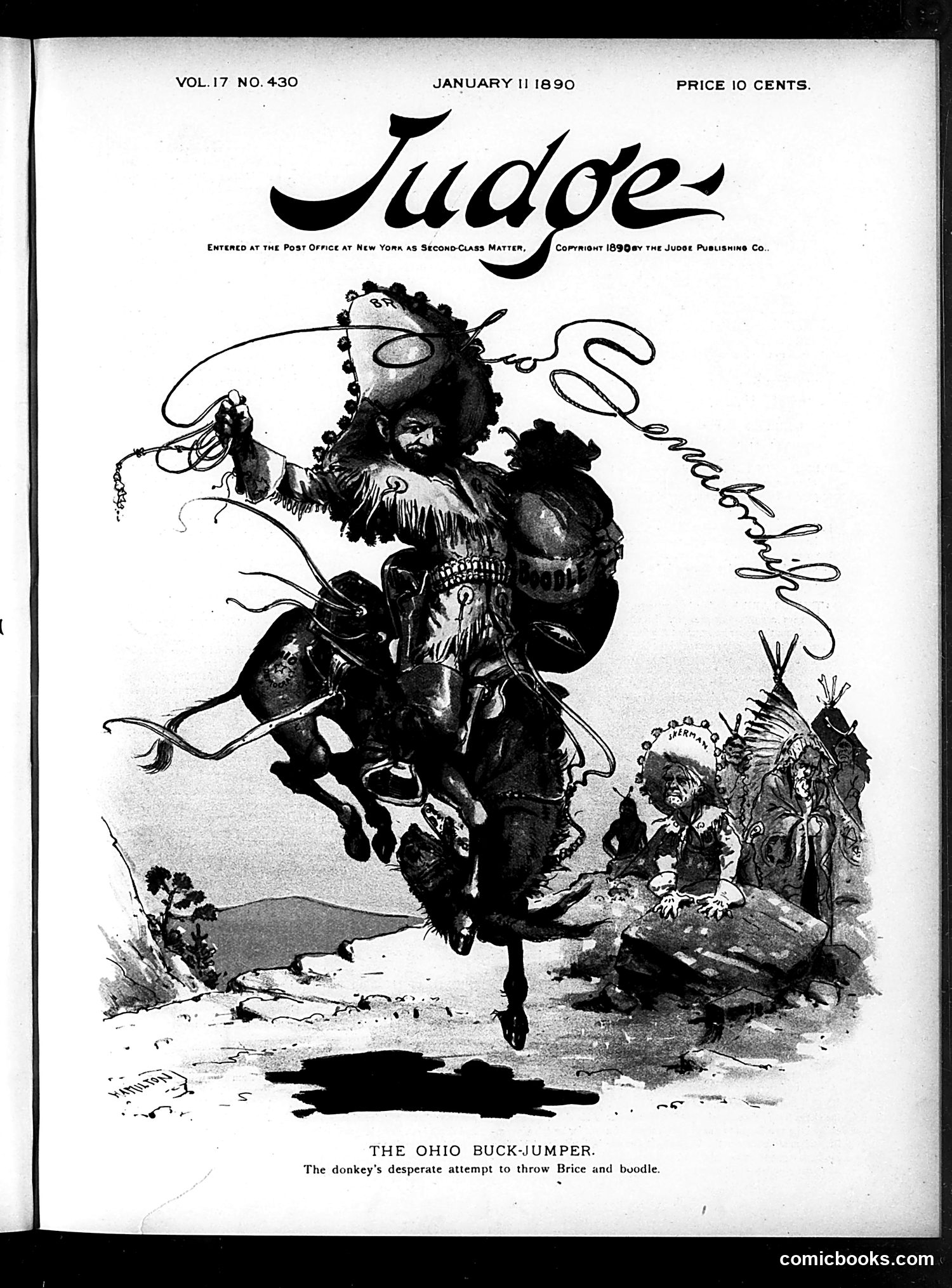
This January 1890 Judge cartoon satirizes what appears to be a political figure from Ohio—likely a governor or state politician of that era. The caricature shows a grotesque rider on a bucking donkey, desperately trying to maintain control while Native Americans watch from the right. The caption states "The donkey's desperate attempt to throw Brice and boodle." The "boodle" reference suggests corruption or bribery. While the specific identity remains unclear from this image alone, the satire mocks an Ohio politician's instability and association with corrupt practices. The bucking donkey represents political chaos or loss of control, a common metaphor in Gilded Age political cartooning. The grotesque facial features reflect period caricature conventions.
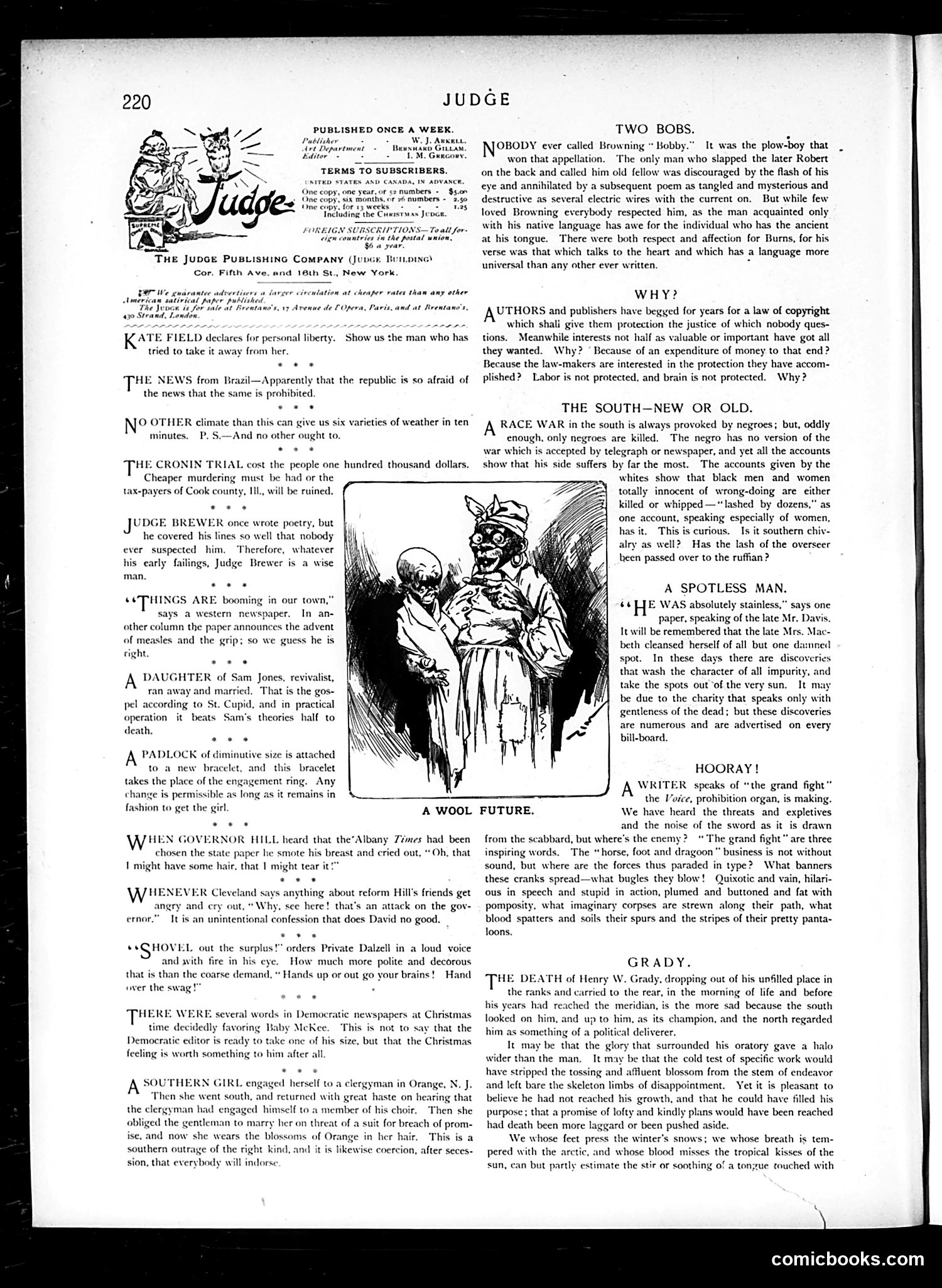
This cartoon depicts a confrontation between what appears to be a Black woman and a white man in period dress. The accompanying article "The South—New or Old" discusses race violence in the South, where accounts show Black victims being "lashed by dozens" while white perpetrators claim innocence. The cartoon's title "A Wool Future" uses a racial slur referring to Black hair texture. It illustrates the article's critique: despite claims of progress in post-Civil War America, the South perpetuates racial violence with impunity. The visual juxtaposition of confrontation emphasizes Judge magazine's satirical point—that Southern racial brutality contradicts claims of sectional reconciliation or moral improvement. The satire targets Southern hypocrisy and Northern complacency about ongoing racial injustice.
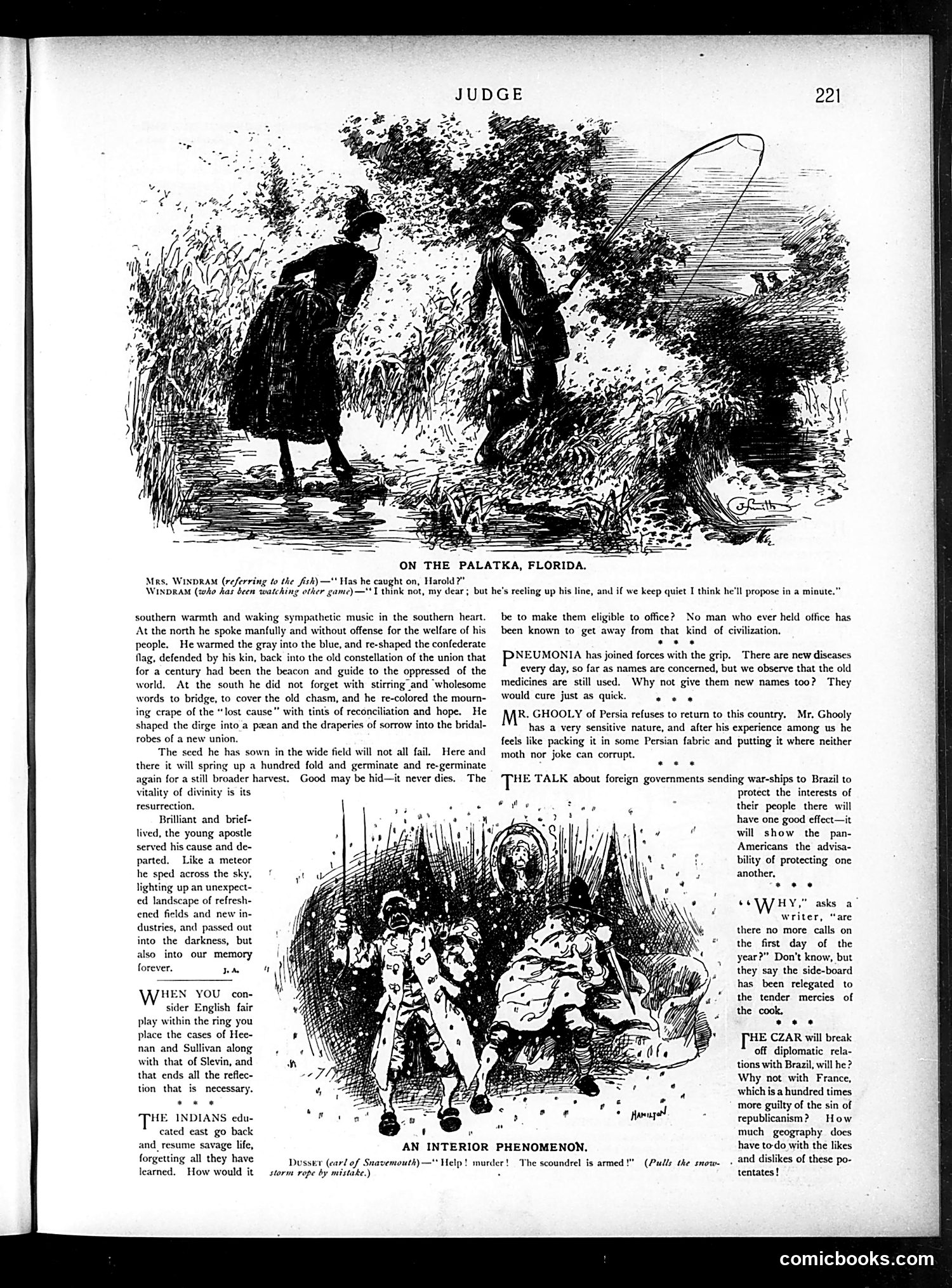
This page contains two distinct satirical pieces from Judge magazine: **Top cartoon ("On the Palatka, Florida"):** Shows Mrs. Windram instructing her husband on fishing technique, offering domestic advice disguised as fishing wisdom. The satire mocks the stereotype of wives constantly directing their husbands' behavior. **Bottom cartoon ("An Interior Phenomenon"):** Depicts what appears to be a chaotic domestic scene with multiple figures in distress, captioned with dialogue about a "scoundrel" being "armed." The specific context is unclear without additional historical information, but it satirizes some social or domestic upheaval of the period. The page also includes several editorial opinion pieces critiquing political matters—pneumonia prevention, a Persian official (Mr. Ghooly), foreign policy regarding Brazil, and czarist diplomacy—typical of Judge's mix of visual and written satire on contemporary issues.
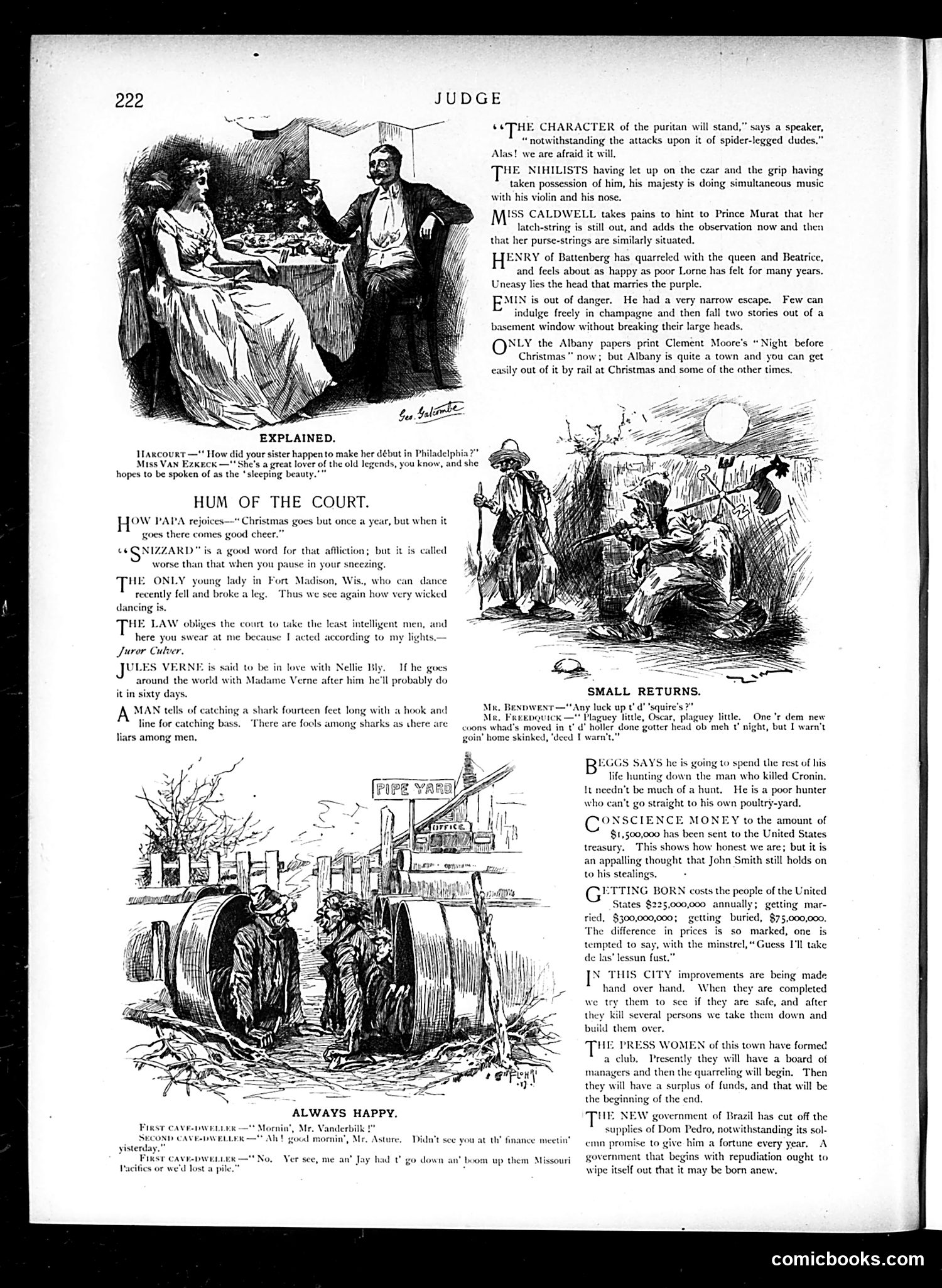
This satirical page combines brief political and social commentary with humorous anecdotes typical of late-19th-century American humor magazines. **Major items:** The "HUM OF THE COURT" section mocks contemporary figures: references to Henry of Battenberg (Queen Victoria's son-in-law), Jules Verne supposedly courting "Nellie Bly" (the famous journalist), and various social absurdities. **"SMALL RETURNS"** section appears to ridicule the Cronin murder case (unclear which specific incident) and includes crude period humor about "getting born," marriage costs, and city improvements. **Bottom item** references Brazil's government cutting Dom Pedro's stipend—likely referencing the 1889 Brazilian republican coup that deposed the emperor. The illustrations support general social satire rather than specific political commentary. The overall tone is lighthearted mockery of aristocracy, legal systems, and contemporary news events rather than serious political advocacy.
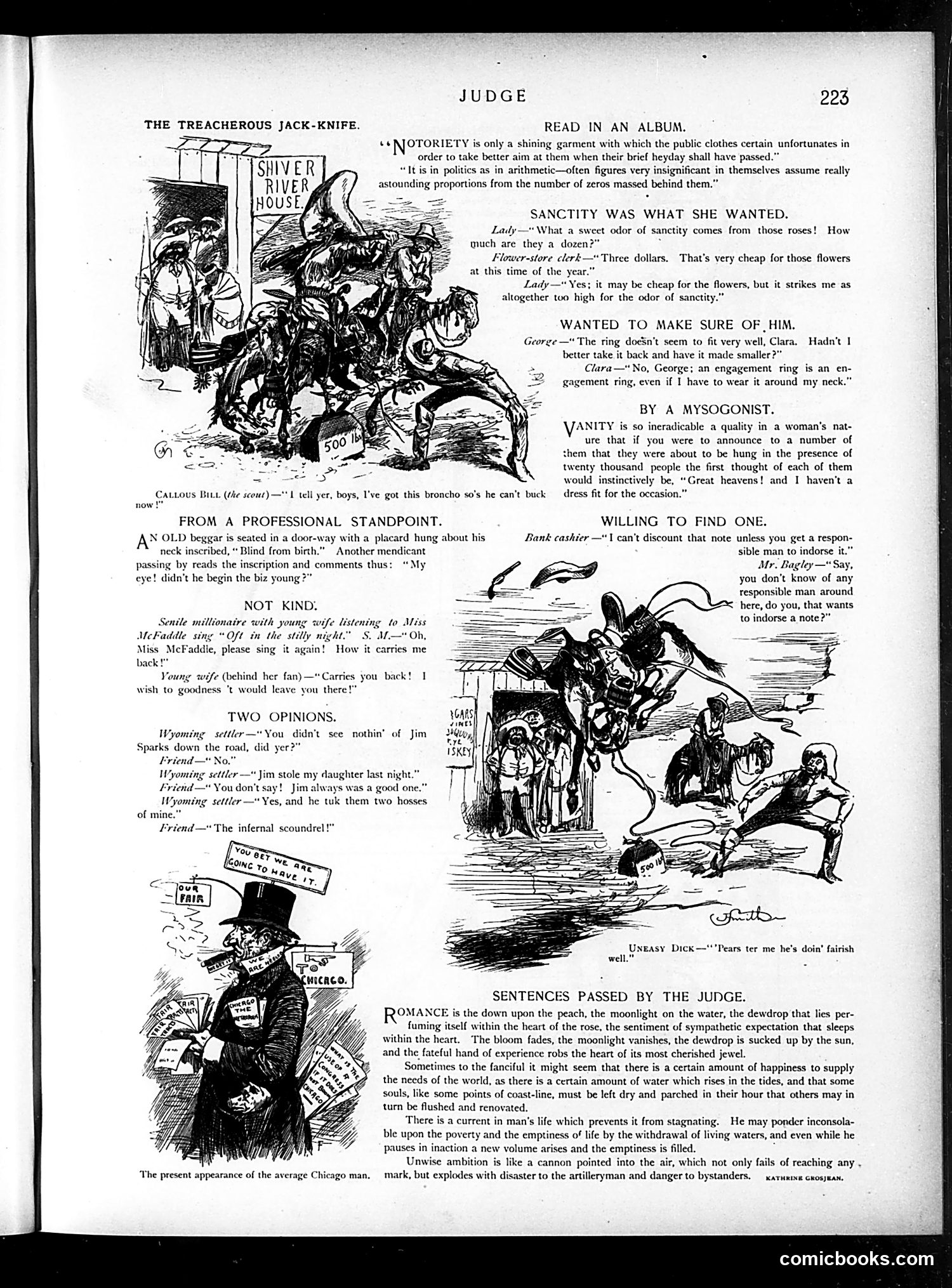
This page from *Judge* magazine comprises several short satirical pieces mocking social pretenses and hypocrisy circa early 20th century. **Key Content:** - **"Sanctity Was What She Wanted"**: A woman haggling over expensive flowers, calling them cheap yet objecting to their cost—satirizing female vanity masquerading as piety. - **"Wanted to Make Sure of Him"**: A fiancée refusing to resize her engagement ring, wearing it around her neck instead—mocking women's desperation to publicly display engagement status. - **"By a Mysogonist"**: A misogynistic observation that women facing execution would worry most about lacking proper dress—attacking female vanity as pathological. - **"Wyoming settler" anecdotes**: Contrasting reactions to a man who stole someone's daughter and horses—satirizing frontier morality's inconsistency. - **"Sentences Passed by the Judge"**: Philosophical musings on romance's inevitable disappointment and ambition's dangers—typical *Judge* moralizing. The page's satirical target is primarily women's perceived vanity and social pretense, presented through working-class and frontier perspectives.
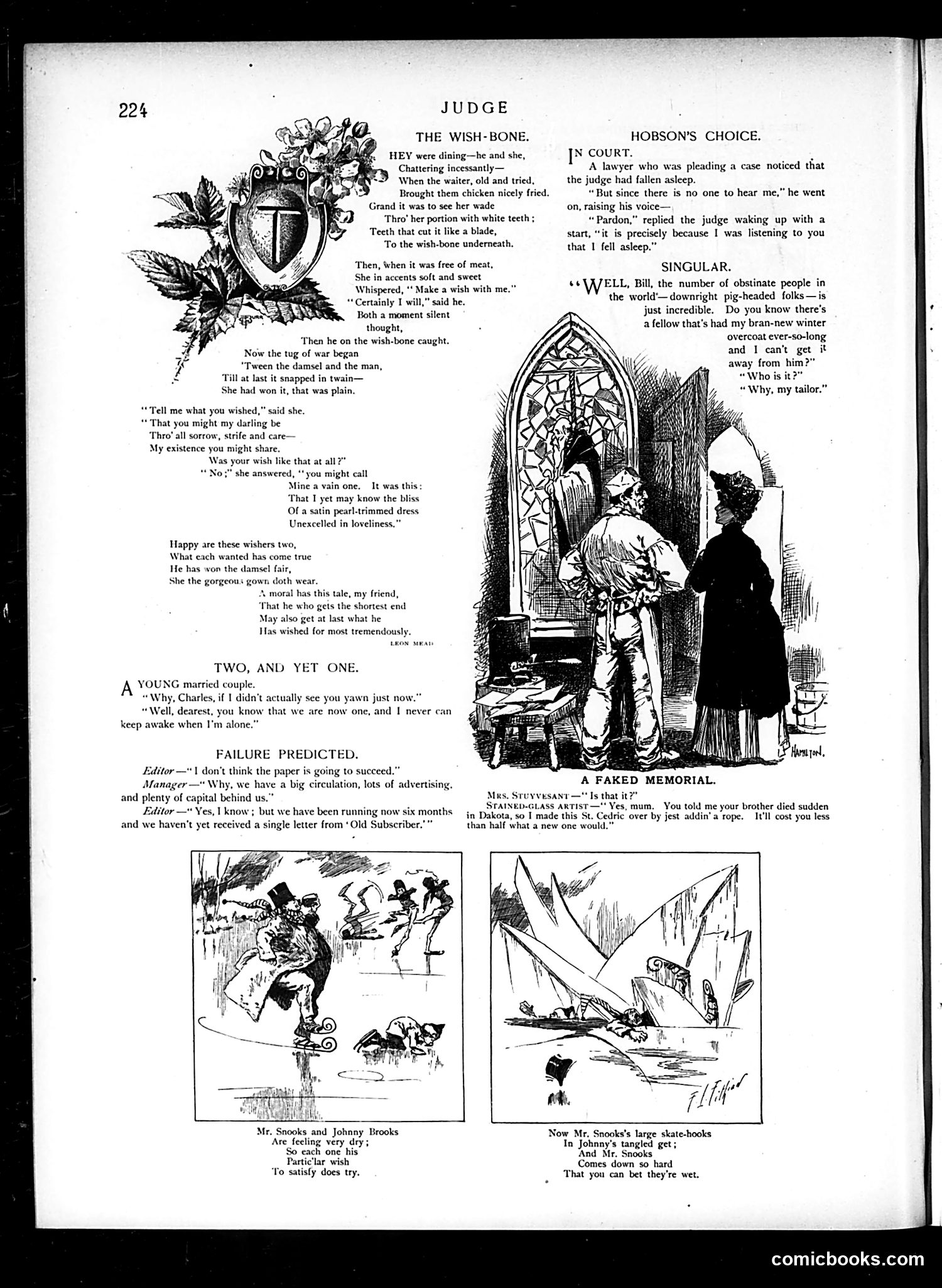
This page contains several brief satirical pieces typical of Judge's humor: **"The Wish-Bone"** is a sentimental poem mocking romantic idealism. A couple shares a wishbone: he wishes for her love through hardship; she wishes for an expensive satin dress. The joke's moral suggests materialism trumps romance—she "wins" her trivial desire while his romantic wish succeeds almost accidentally. **"Two and Yet One"** jokes about marriage, using the legal concept that married couples become "one person." The husband yawns because being alone (with his wife as "one") bores him—a jab at marital tedium. **"Hobson's Choice"** presents a judge falling asleep during a lawyer's argument, then claiming he was listening. The irony: the lawyer's dull voice caused sleep despite his attention. **"Singular"** mocks a man unable to recover his winter coat from his tailor—suggesting tailors routinely retain customers' garments indefinitely. The cartoons show skating mishaps and a stained-glass artist faking memorial work. These are lighthearted domestic and social observations rather than political commentary.
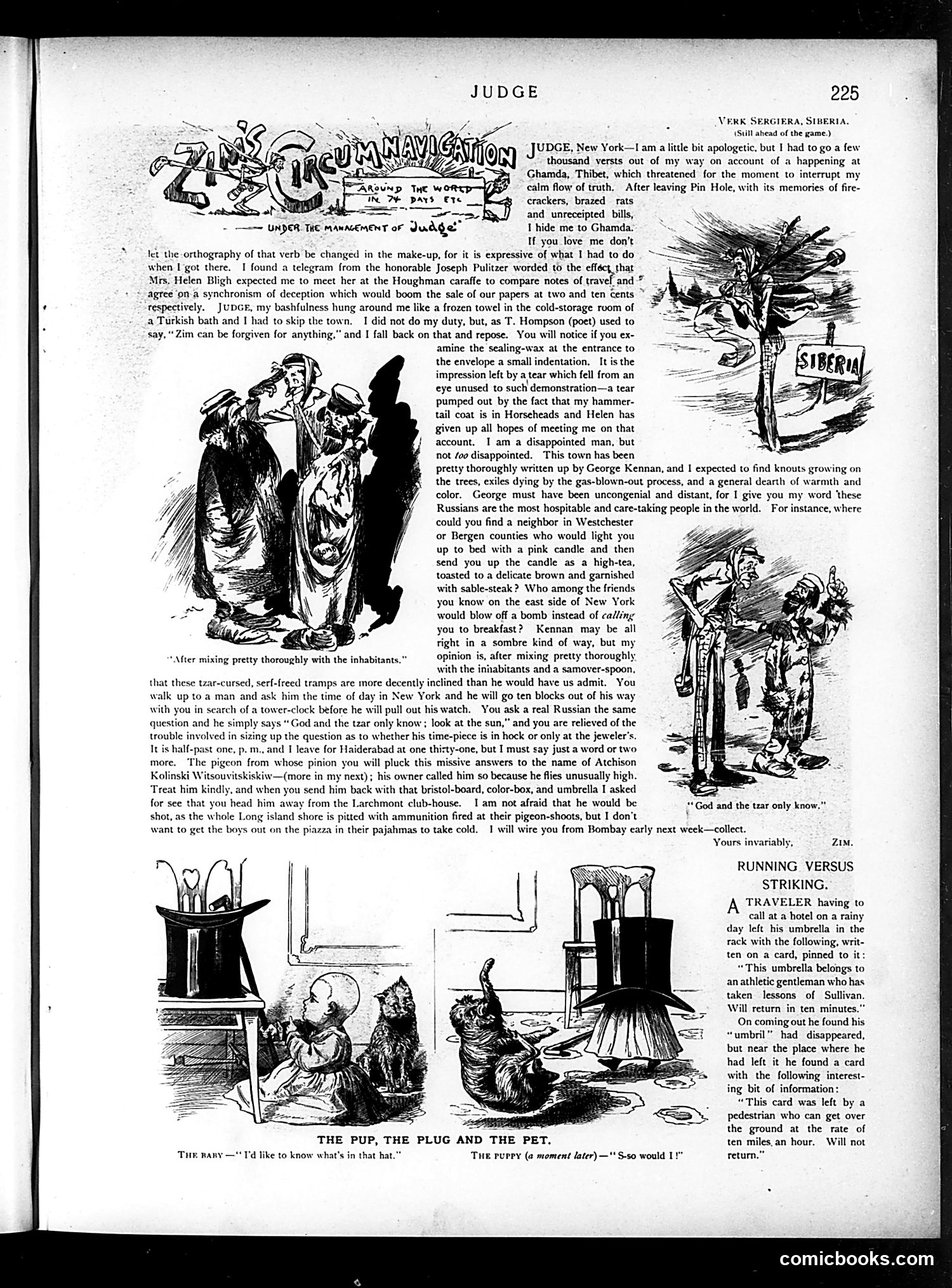
This page features a humorous travel letter from a correspondent reporting on Siberia as part of a "Around the World in 70 Days" series. The main satire targets **George Kennan's** negative characterization of Russians as brutal and oppressed under the tsar. The writer claims Russians are actually hospitable and kind—far more so than New Yorkers. He uses absurdist humor: a Russian neighbor would "blow off a bomb instead of calling you to breakfast" as a greeting; another would light you to bed with a pink candle, then serve it as high tea garnished with sable-steak. The piece mocks both **Kennan's grim Siberian reportage** and American pretensions. It also jabs at **Joseph Pulitzer** (mentioned in the telegram) and references **Helen Bly** (likely Helen Bly/Nellie Bly), competing journalists in the era's competitive newspaper circulation wars. The accompanying illustrations are unrelated domestic humor about puppies and pets. The overall tone is tongue-in-cheek, using exaggeration to deflate both Russian stereotypes and American self-regard.
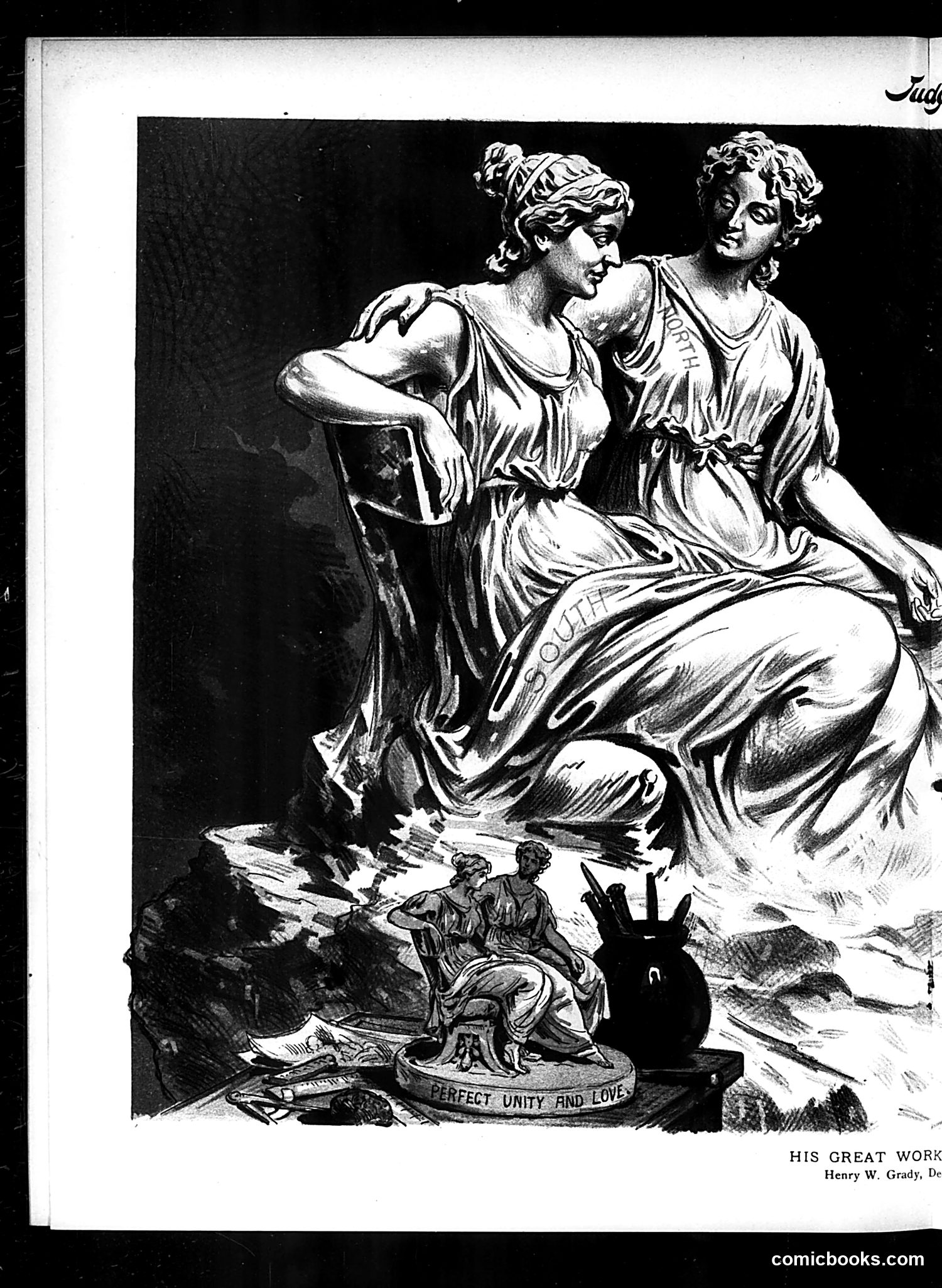
This appears to be a classical allegorical illustration rather than a political cartoon. Two large female figures in Greco-Roman dress dominate the upper portion, likely representing abstract virtues or concepts. The inscription at the base reads "PERFECT UNITY AND LOVE," suggesting the work celebrates harmony and affection as ideals. The smaller figures below appear to represent mortals or humanity benefiting from these virtues. The credit to "Henry W. Grady" (likely the prominent 19th-century Georgia journalist and orator) suggests this may commemorate his work promoting reconciliation, possibly between North and South post-Civil War. Without additional context from *Judge* magazine's publication date, the precise satirical or editorial point remains unclear, though the classical imagery suggests celebration rather than mockery of Grady's legacy.
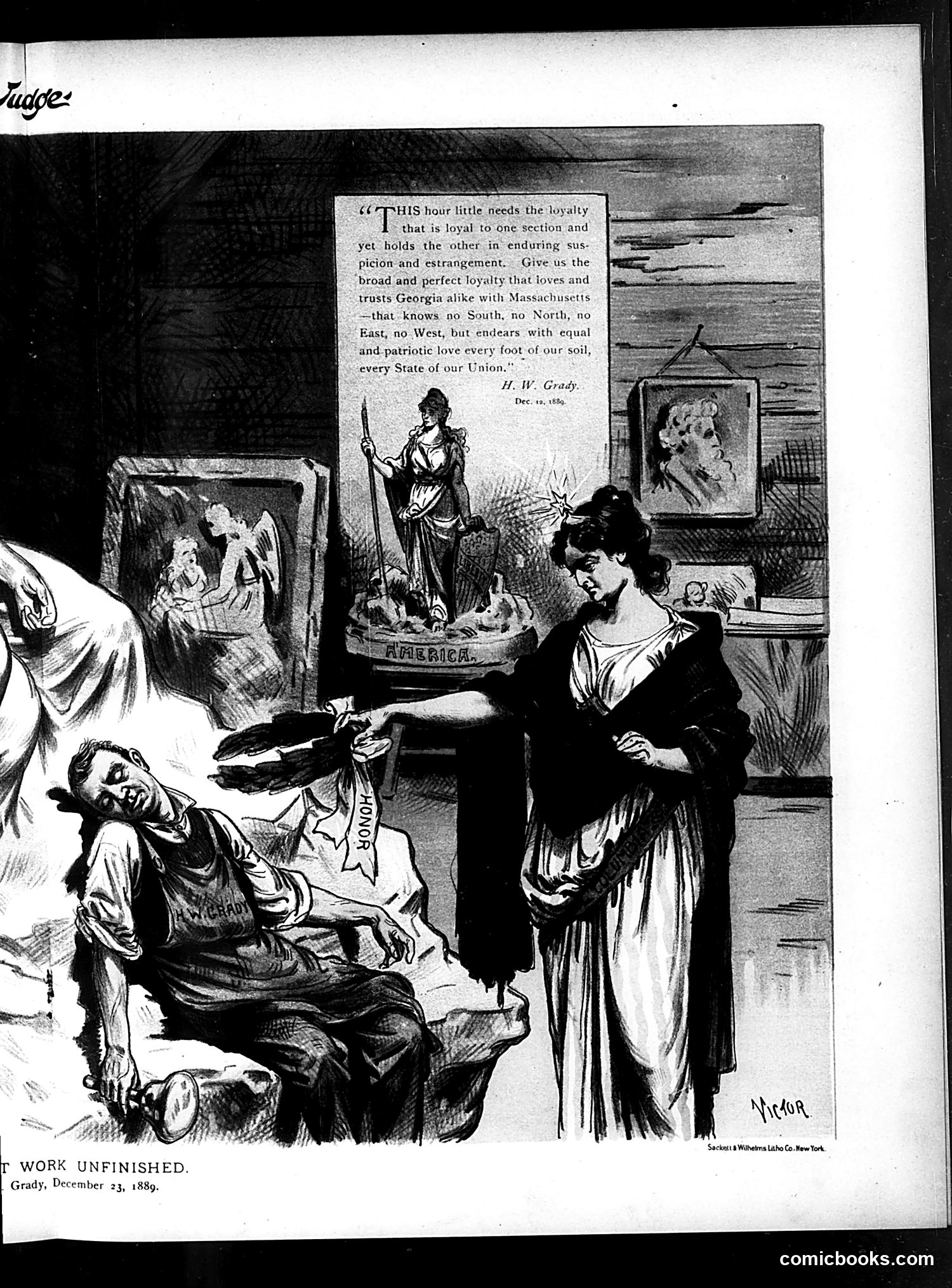
This 1889 Judge cartoon by artist Nidor critiques incomplete American Reconstruction efforts. The central figure is a wounded soldier labeled "The Union," attended by a woman representing America or Liberty. The quote from H.W. Grady (a prominent Atlanta editor) advocates for national unity transcending regional divisions—"no South, no North, no East, no West." However, the cartoon's title and imagery suggest this unity remains unachieved. The wounded soldier, surrounded by symbolic imagery including what appears to be sectional representations on the walls, indicates that despite Grady's 1889 plea for reconciliation, the nation's wounds from the Civil War (ended 1865) remain unhealed. The satire critiques the gap between noble rhetoric about national loyalty and the persistent regional suspicion and estrangement the quote itself acknowledges still existing.
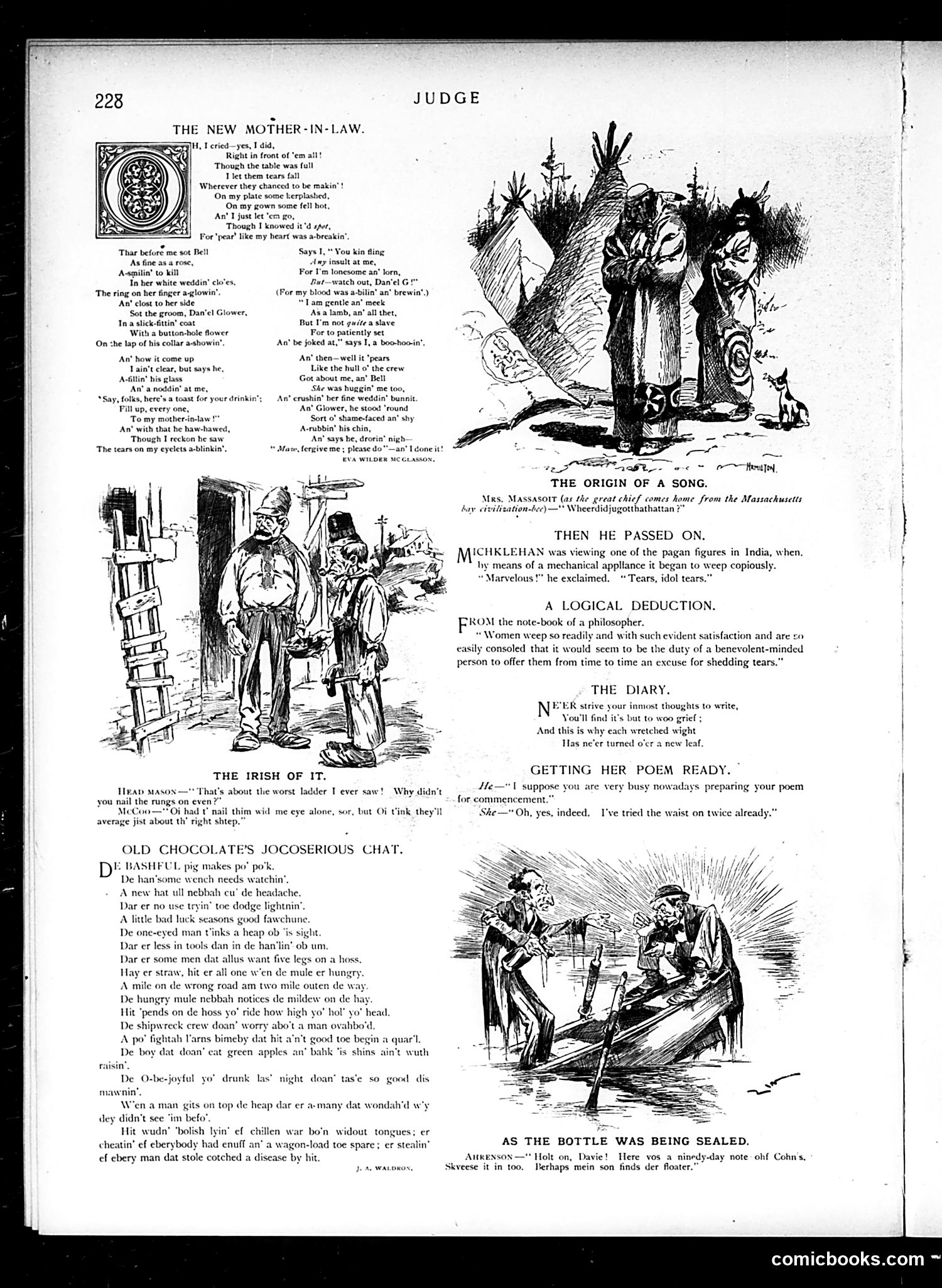
This page collects several humorous pieces typical of Judge's satirical content: **"The New Mother-in-Law"** is a dialect poem about a bride's mother emotionally reacting to the groom's toast mocking his mother-in-law. She tearfully defends herself, establishing boundaries against being treated as a joke. The piece satirizes family wedding dynamics and the stereotype of difficult mothers-in-law. **"The Irish of It"** presents a brief exchange mocking Irish immigrant speech patterns—a common stereotype of the era. **"Old Chocolate's Jocose Chat"** appears to be racial dialect humor, using exaggerated African American vernacular for comedic effect (common but offensive by modern standards). The remaining pieces—"The Origin of a Song," "A Logical Deduction," "The Diary," "Getting Her Poem Ready," and "As the Bottle Was Being Sealed"—are brief joke vignettes about relationships, philosophy, and social situations. The illustrations support these humorous pieces. This reflects Judge's mix of social satire with period stereotypes.
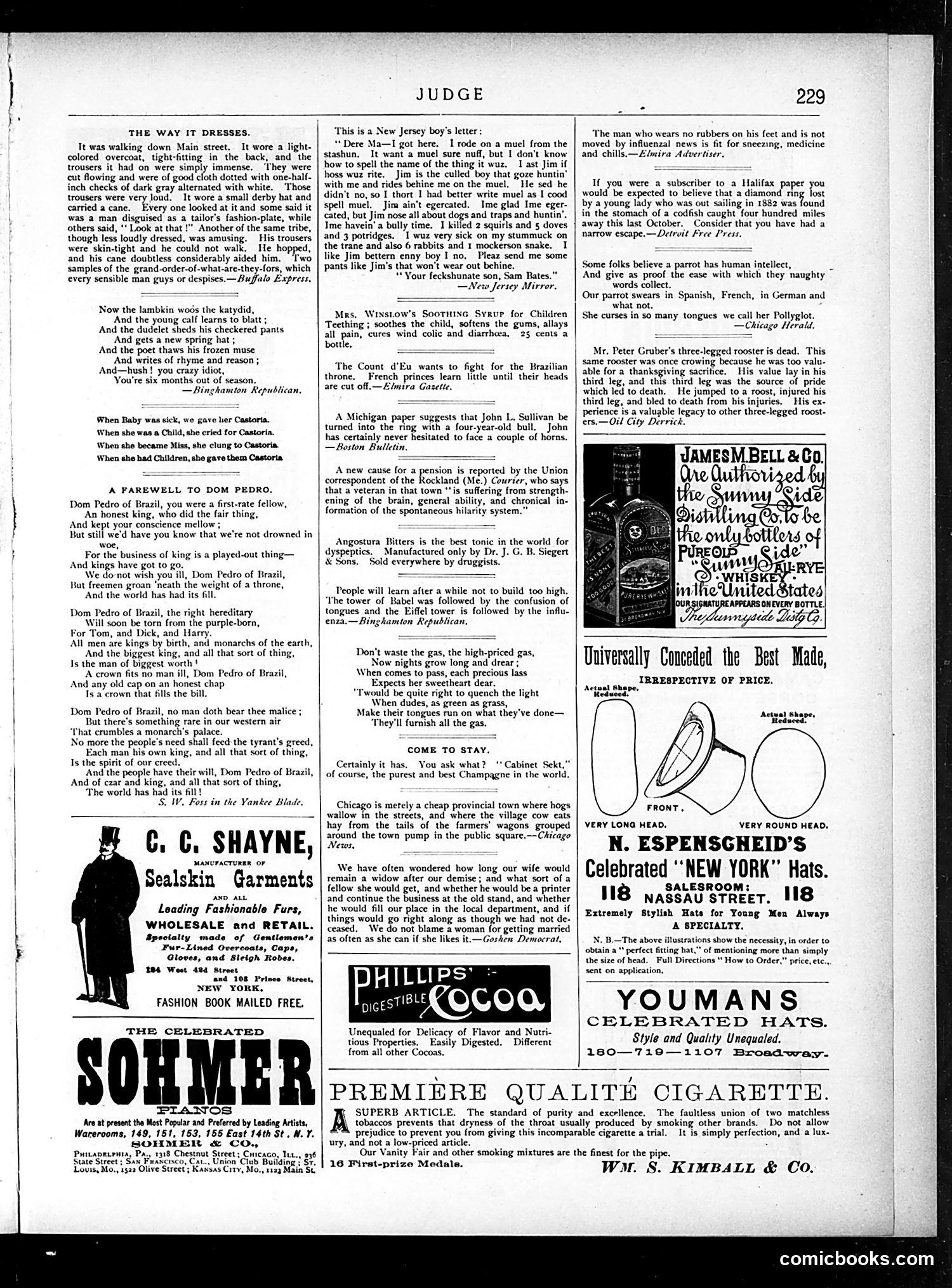
This page is primarily **advertisements and filler content** rather than political satire. The main noteworthy elements: **"The Way It Dresses"** critiques men's fashion—specifically mocking exaggerated sartorial choices: one man wears absurdly baggy checked trousers with a tight coat (appearing to dress as a "fashion-plate"), while another wears skin-tight trousers so restrictive he must hop rather than walk. The satire targets pretentious, impractical male fashion trends of the era. **"A Farewell to Dom Pedro"** celebrates the abdication of Brazil's Emperor Pedro II (though the specific date isn't stated here). The poem frames his departure as inevitable progress: monarchies are "played-out," and democratic principles—"all men are kings"—represent superior values. This reflects 19th-century American republican ideology celebrating the decline of monarchical authority. The remainder consists of period advertisements for furs, pianos, cocoa, hats, and cigarettes—standard Judge magazine content.
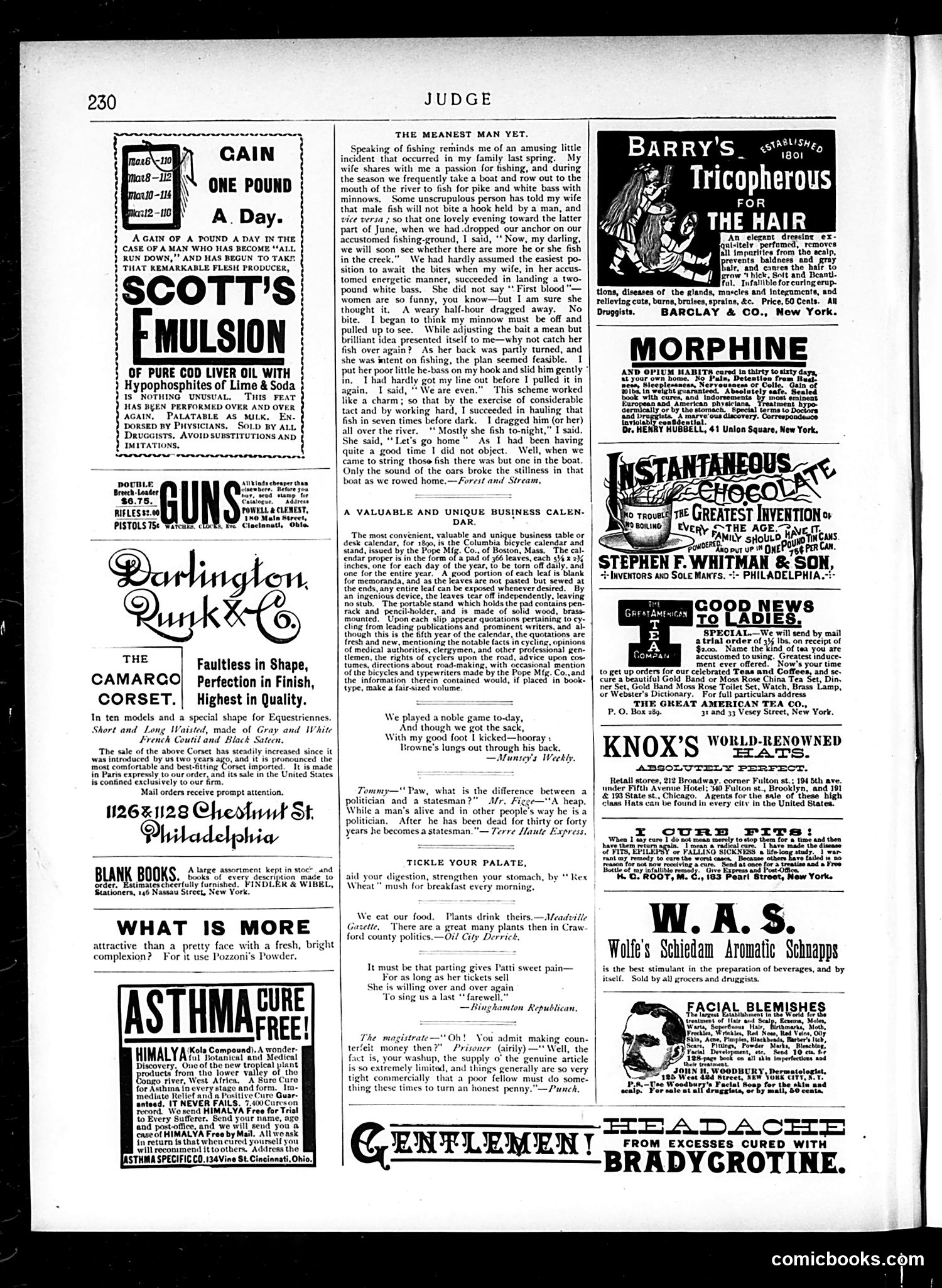
This page is primarily **advertisements** with one brief humorous anecdote titled "The Meanest Man Yet." The story describes a husband's prank on his fishing wife: After she catches a two-pound bass, he repeatedly re-catches the same fish by secretly switching it onto her line, making her believe she's catching multiple fish. He repeats this deception seven times before they leave, falsely claiming "mostly she fish to-night." The joke relies on the husband's smugness about his petty trick and the implied comeuppance when they string the catch and discover the truth. The humor targets **marital dynamics and male vanity**—the husband's competitive need to "even the score" against his wife's fishing success, combined with his elaborate deception scheme. It's gentle domestic satire typical of Judge magazine's era, poking fun at both spousal rivalry and masculine pettiness. The remaining content consists entirely of period patent medicine and consumer goods advertisements (corsets, firearms, skin treatments, etc.).
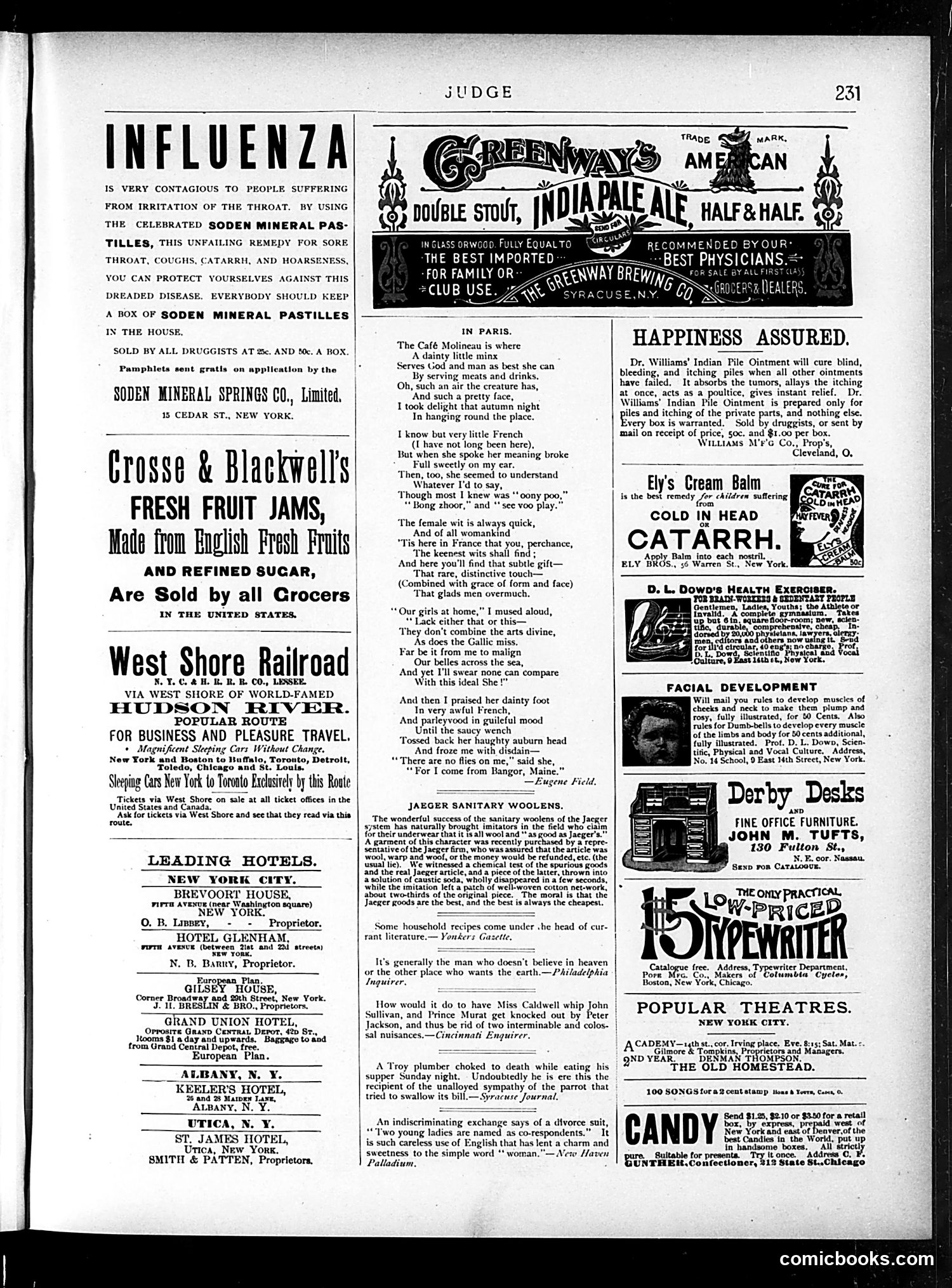
This page is primarily **advertisements and filler content**, not political satire. The dominant feature is a poem by Eugene Field titled "In Paris," a humorous tale about an American man's infatuation with a French waitress at Café Molineau. The joke's punchline: after he praises her as superior to American women, she reveals she's actually from Bangor, Maine—undermining his romanticized view of French femininity. The page is otherwise filled with period advertisements: Soden Mineral Pastilles (claiming to prevent influenza), Crosse & Blackwell jams, West Shore Railroad, and hotel listings. A brief note about Jaeger sanitary woolens discusses counterfeit products. The content reflects early 20th-century concerns (influenza remedies, travel advertising) and casual American attitudes toward French culture and women. There are no identifiable political figures or sustained satirical commentary—this represents Judge's typical mix of light humor and commercial content.
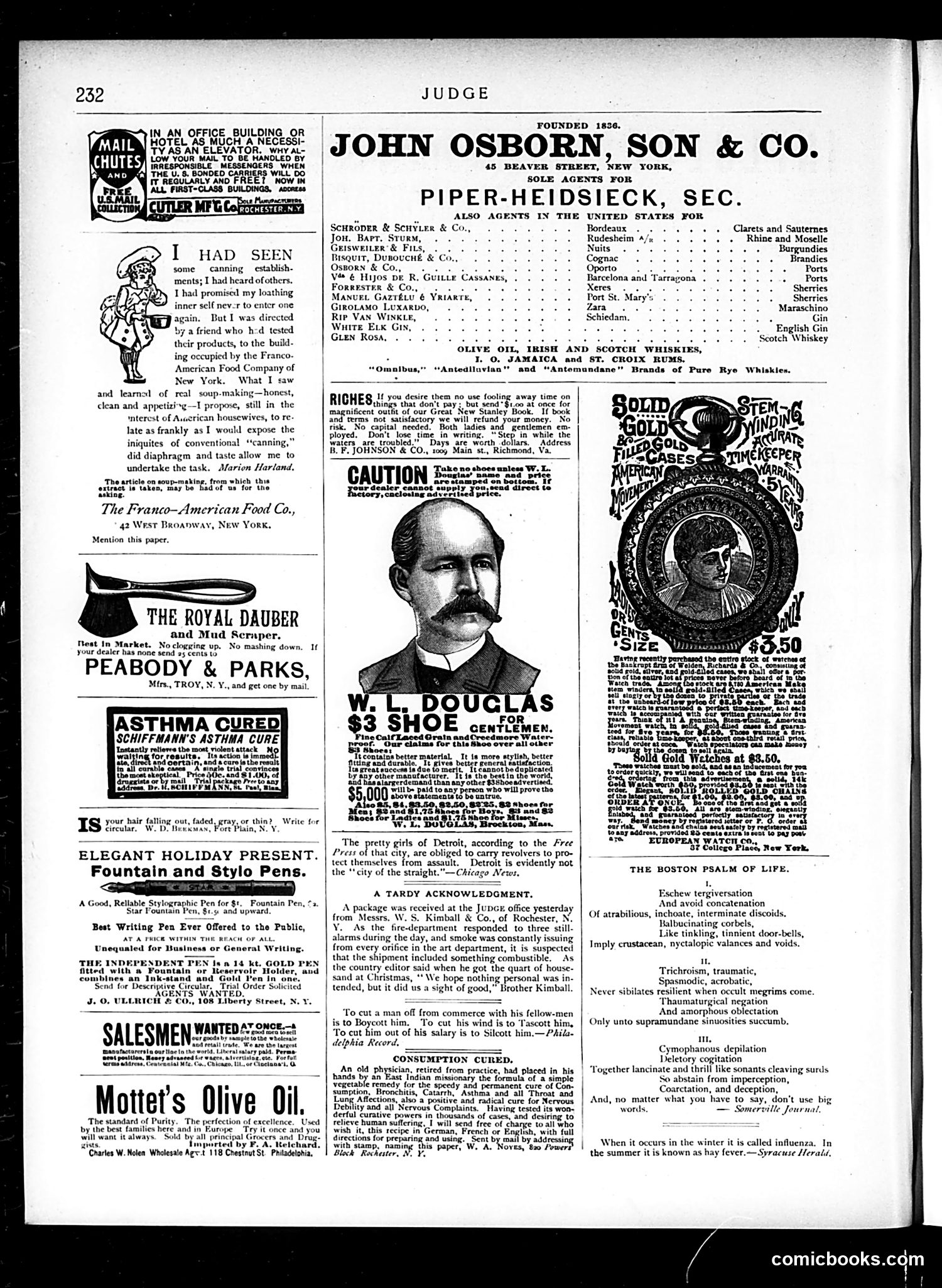
This page is primarily **advertising** rather than political satire or editorial cartoons. It contains: 1. **A food industry testimonial** (top left) from Marion Harland endorsing Franco-American Food Company's canning practices—positioning their products as superior to conventional "canning." 2. **Commercial advertisements** for various products (Royal Dauber scraper, asthma cure, fountain pens, hair treatments, olive oil, wines/spirits, shoes) typical of late-19th-century magazine content. 3. **A portrait** of W. L. Douglas, shoe manufacturer, promoting his "$3 Shoe for Gentlemen"—a major brand of the era known for quality at accessible prices. 4. **Literary content** (bottom right): "The Boston Psalm of Life," a poem about ambition and perseverance—not satirical. The page reflects Judge's business model: mixing editorial content with paid advertisements from manufacturers and distributors. There is no identifiable political cartoon or social satire on this particular page.
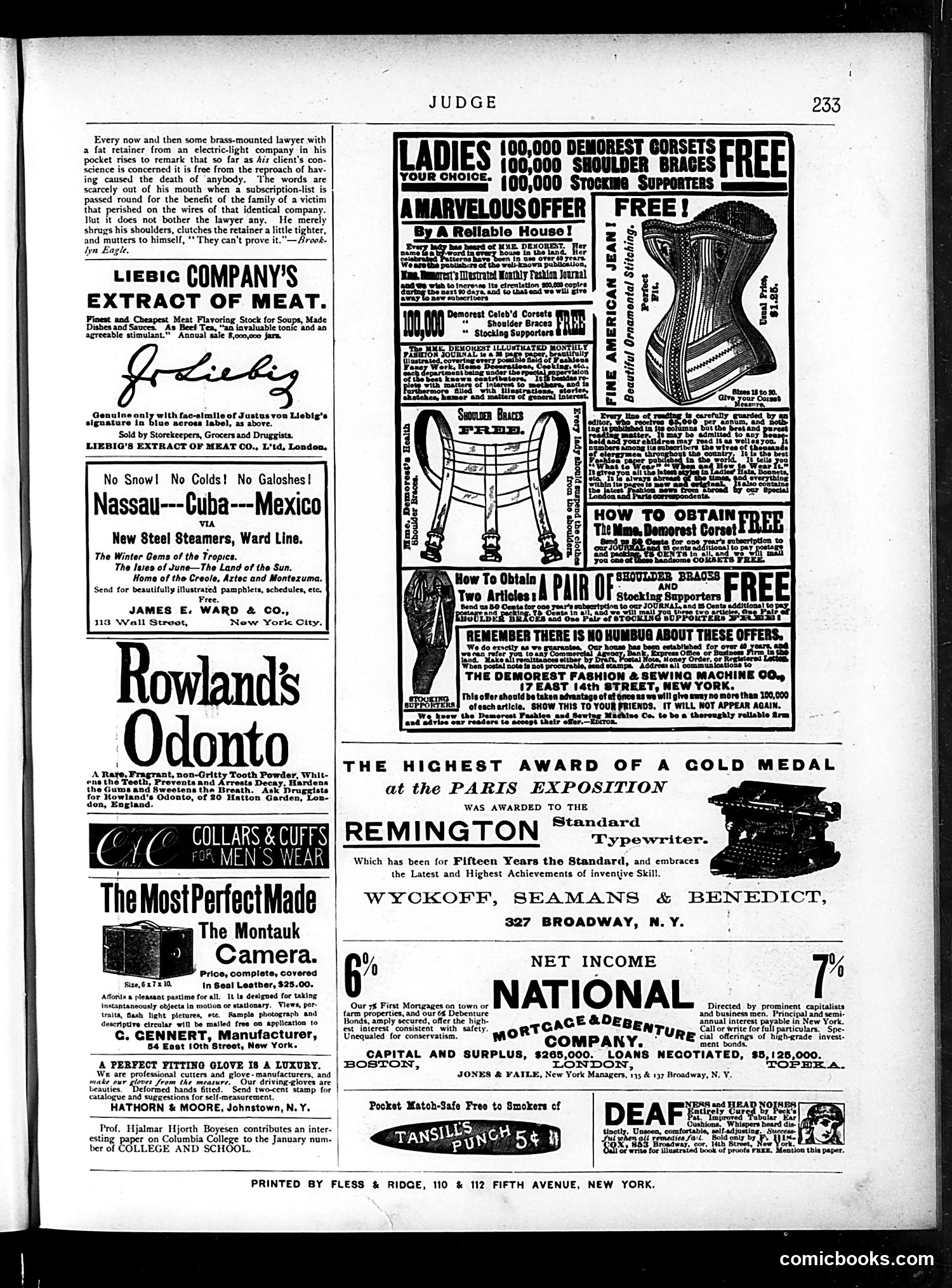
This page is primarily **advertising** but opens with a significant **political cartoon** attacking corporate negligence and legal corruption. The cartoon, attributed to the *Brooklyn Eagle*, satirizes **electric utility companies** and their retained lawyers. The setup: a company lawyer claims his client (the utility) bears no moral responsibility for deaths caused by exposed electrical wires. Yet immediately after, a collection is taken for victims' families—proof the company *is* culpable. The satire's bite: the lawyer remains unmoved, clutching his "fat retainer" (lucrative fee) and muttering "They can't prove it"—exposing how corporate money insulates executives from accountability. This reflects **Progressive Era** concerns about dangerous working conditions, inadequate safety standards, and wealthy interests using legal sophistry to evade responsibility for preventable deaths. The cartoon critiques both corporate indifference and the legal system's complicity in protecting powerful business interests from consequences. The remainder of the page consists of period advertisements for corsets, cameras, typewriters, and travel services.