
Judge, 1890-01-11 · page 2 of 16
Judge — January 11, 1890 — page 2: what you’re looking at
What you’re looking at
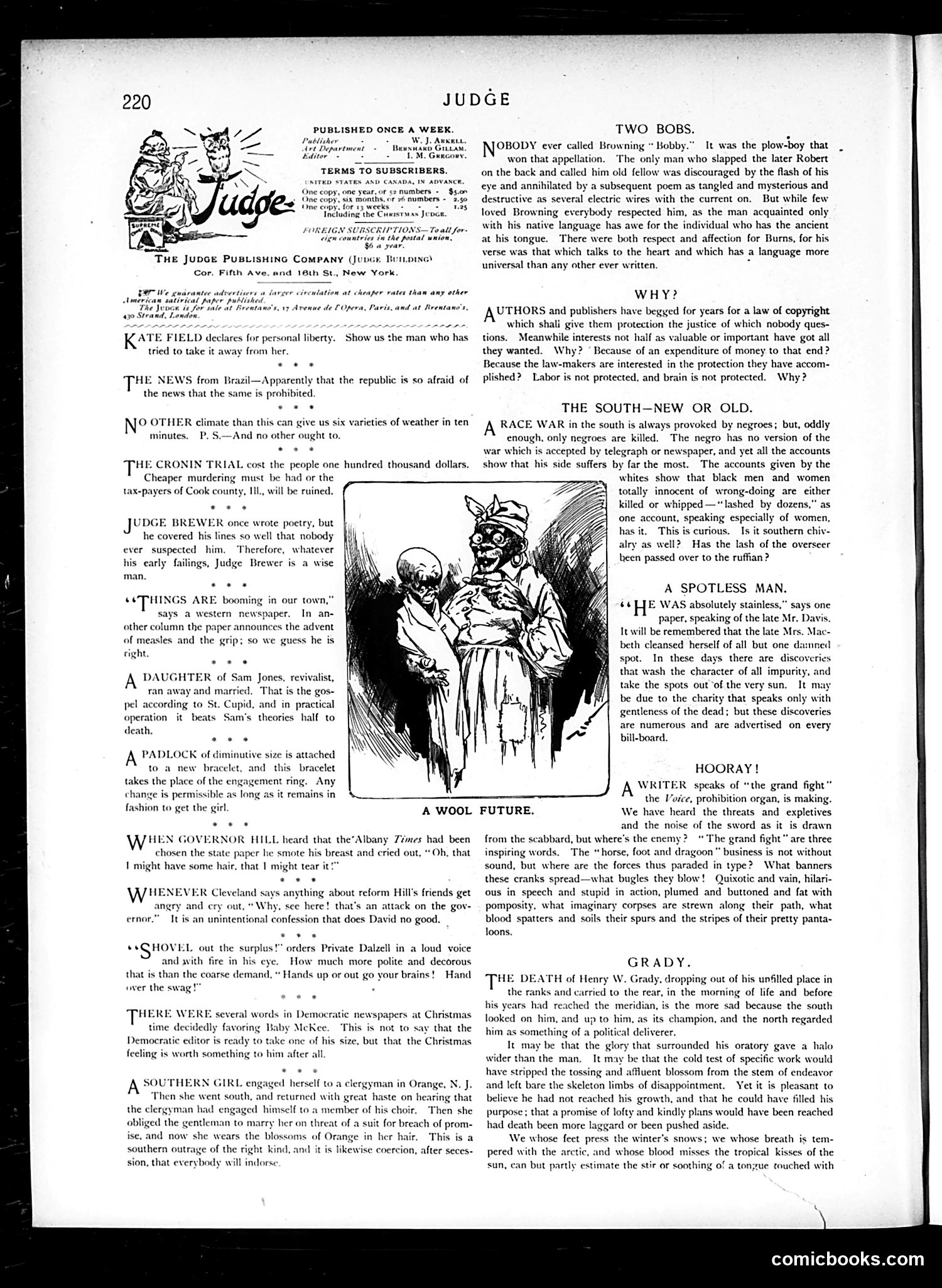
This cartoon depicts a confrontation between what appears to be a Black woman and a white man in period dress. The accompanying article "The South—New or Old" discusses race violence in the South, where accounts show Black victims being "lashed by dozens" while white perpetrators claim innocence. The cartoon's title "A Wool Future" uses a racial slur referring to Black hair texture. It illustrates the article's critique: despite claims of progress in post-Civil War America, the South perpetuates racial violence with impunity. The visual juxtaposition of confrontation emphasizes Judge magazine's satirical point—that Southern racial brutality contradicts claims of sectional reconciliation or moral improvement. The satire targets Southern hypocrisy and Northern complacency about ongoing racial injustice.
📄 Transcribed text from this page (OCR, searchable)
Machine-transcribed from the original scan — historical spelling and the odd misread are preserved.
JUDGE PUBLISHED ONCE A WEEK. Publisher W. J. Awxnut. int Departmen Baaswano Gian, Batten TM Gaaconv TERMS TO SUBSCRIBERS. NITED STATES AND CANADA, IN| ADVANCE. copy, one year, or s2 numbers - $5.0» °F se numbers + "2.30 copy. tor igweeks sss tas Tnclading the Cumistuas Jepae. FOREIGN SUBSCRIPTIONS—Te all for- cign countries in the postal union, $5 a year THE JUDGE PUBLISHING ComPANy (Jupcr Retpine Cor. Fifth Ave. and 16th St, New York P87 We cuarantee advertisers a larger circulation at chea slmerican satirical paper published The Juocn 11 for sale at Brentano's, 430 Strand, London rates than any other 7 Avenue de LOper nd at Brentano ATE FIELD declares for personal liberty. Show us the man who has tried to take it y from her, HE NEWS from Brazil—Apparently that the republic is so afraid of the news that the same is prohibited NO OTHER climate than this ean give us six varie minutes. P. of weather in ten And no other ought to. THE CRONIN TRIAL cost the people one hundred thousand dollars. Cheaper murdering must be had or the tax-payers of Cook county, IIl., will be ruined. UDGE BREWER once wrote poetry, but he covered his lines so well that nobody ever suspected him. ‘Therefore, whatever his early failings, Judge Brewer is a wise man. ‘THINGS ARE booming in our town,” ays a western newspaper. In an- other column the paper announces the advent of measles and the gr right 3 So we guess he is A DAUGHTER of Sam Jones, reviv ran away and married. That is the pel Cupi operation itt death. cording to iminutive size is a to a new bracelet, and this bri takes the place of the engagement ring. A PADLOCK of change is permissible as long as it remai fashion to get the girl HEN GOVERNOR HILL heard that the’Albany 7émes had been chosen the state paper he smote his breast and cried out, “Oh, that I might have some hair, that | might tear i SEVER Cleveland says anything about reform Hill's friends get d cry out, “Why, see here! that's « ck on the gov- ernor.” It is an unintentional confession that does David no good. orders Private Dalzell in a loud voice How much more polite and decorous Hand SSGHOVEL out the surplu and with fire in his eye. that is than the coarse demand, Hands up or out go your brains ! over the swag!” HERE WERE several words in Democratic newspapers at Christmas time decidedly favoring Baby McKee. ‘This is not to say that the nocratic editor is ready to take one of his size, but that the Christmas feeling is worth something to him after all A SOUTHERN GIRL engaged herself to a clergyman in Orange, N. J. ‘Then she went south, and returned with great haste on hearing the clergyman had engaged himself to a member of his choir, Then she obliged the gentleman to marry her on threat of a suit for breach of prom- ise, and now she wears the blossoms of Orange in her hair, ‘Th southern outrage of the right kind, and it is likewise coercion, after seces- sion, that everybody will indorse TWO BOBS. ' OBODY ever called Browning “ Bobby.” It was the plow-boy that won that appellation. The only man who slapped the later Robert on the back and called him old fellow was discouraged by the flash of his eye and annihilated by a subsequent poem as tangled and mysterious and destructive as several electric wires with the current on. But while few loved Browning everybody respected him, as the man acquainted only with his native language has awe for the individual who has the ancient at his tongue. There were both respect and affection for Burns, for his verse was that which talks to the heart and which has a language more universal than any other ever written 5 WHY? AUTHORS and publishers have begged for years for a law of copyright which shali give them protection the justice of which nobody ques- tions, Meanwhile interests not half as valuable or important have got all they wanted. Why? ‘Because of an expenditure of money to that end? Because the law-makers are interested in the protection they have accom- plished? Labor is not protected, and brain is not protected. Why? THE SOUTH—NEW OR OLD. RACE WAR in the south is always provoked by negroes; but, oddly enough, only negroes are killed. The negro has no version of the war which is accepted by telegraph or newspaper, and yet all the accounts show that his side suffers by far the most. The accounts given by the whites show that black men and women totally innocent of wrong-doing are either killed or whipped—“lashed by dozens,” as one account, speaking especially of women, has it. This is curious. Is it southern chiv- alry as well? Has the lash of the overseer been passed over to the ruffian ? A SPOTLESS MAN. 4«LJE WAS absolutely stainless,” says one paper, speaking of the late Mr. Davis, It will be remembered that the late Mrs. Mac- beth cleansed herself of all but one damned spot. In these days there are discoveries that wash the character of all impurity, and ake the spots out-of the very sun. It may be due to the charity that speaks only with gentleness of the dead; but these discoveries are numerous and are advertised on every bill-board. HOORAY ! A WRITER speaks of “the grand fight” the Voice, prohibition organ, is making. We have heard the threats and expletives and the noise of the sword as it is drawn from the scabbard, but where's the enemy?“ The grand fight are three The “horse, foot and dragoon™ business is not without sound, but where are the forces thus paraded in type? What banners these cranks spread—what bugles they blow! Quixotic and vain, hilari- ous in speech and stupid in action, plumed and buttoned and fat with pomposity, what imaginary corpses are strewn along their path, what blood spatters and soils their spurs and the stripes of their pretty panta- loons. FUTURE. inspiring words. GRADY. THE DEATH of Henry W. Grad: the dropping out of his unfilled place in anks and carried to the rear, in the morning of life and before ars had reached the meridian, is the more sad because the south looked on him, and up to him, as its champion, and the north regarded him as something of a political deliverer. It may be that the glory that surrounded his oratory gave a halo wider than the man. It may be that the cold test of specific work would have stripped the tossing and affluent blossom from the stem of endeavor and left bare the skeleton limbs of disappointment. Yet it is pleasant to believe he had not reached his growth he could have filled his purpose ; that a promise of lofty and kindly plans would have been reached had death been more laggard or been pushed aside. We whose feet press the winter's snows; we whose breath is tem- pered with the arctic, and whose blood misses the tropical kisses of the sun, can but partly estimate the stir or soothing of a tonzue touched with comicbooks.com