
A complete issue · 16 pages · 1889
Judge — November 23, 1889
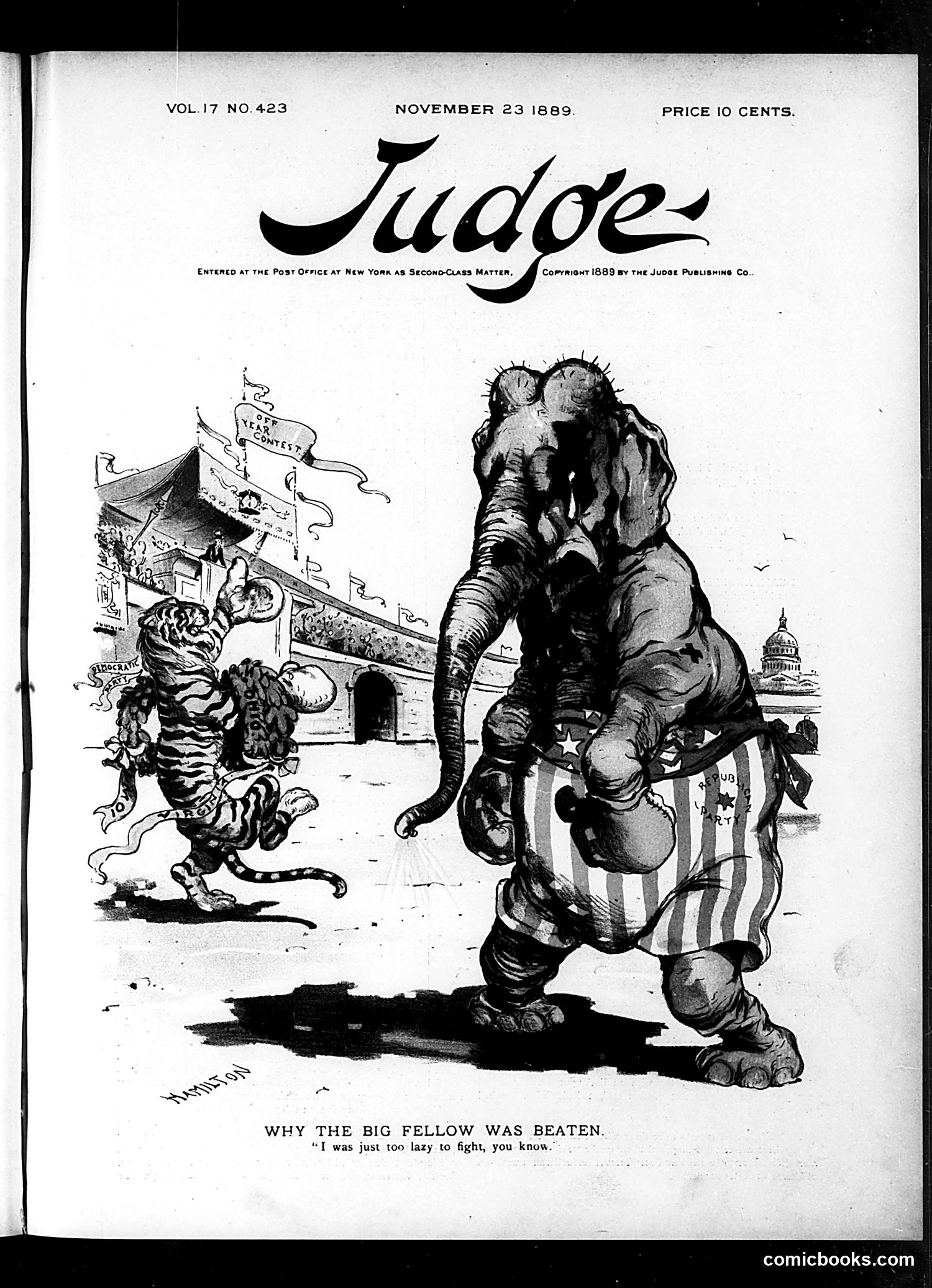
This *Judge* magazine cover from November 23, 1889 depicts a confrontation titled "Why the Big Fellow Was Beaten." The cartoon shows an elephant (representing the Republican Party) wearing American flag-patterned clothing being struck by a tiger figure. The elephant's explanation—"I was just too lazy to fight, you know"—suggests Republican electoral defeat due to lack of effort or preparation. The tiger likely represents the Democratic Party or political opposition. In the background appears to be a classical building (possibly the Capitol). The artist is identified as Hamilton in the signature. The satire criticizes Republican complacency leading to electoral losses, a common theme in late-19th-century political cartooning. The specific 1889 election context remains unclear without additional documentation.
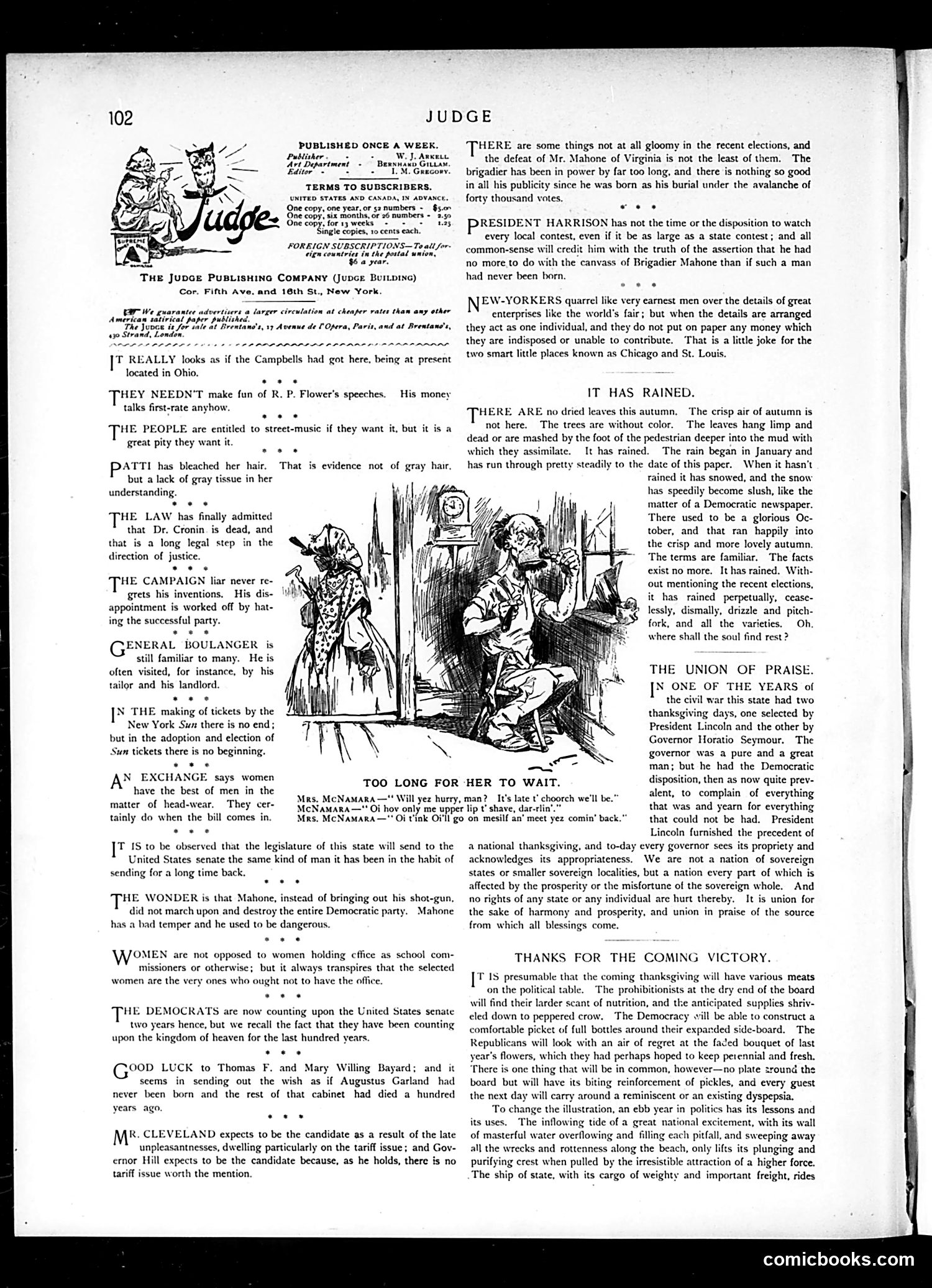
This cartoon depicts **Mrs. McNamara** (likely a political figure's wife) waiting anxiously while her husband attends to political business. The dialogue reveals her impatience: she wants to hurry home because "it's late" and suggests they "go on mesiff" (dialect for "go on myself") to meet her husband coming back. The satire targets **political wives' frustrations** with their husbands' endless campaign activities and public obligations. Judge mocks how women, even those married to prominent politicians, must wait idle while men conduct political affairs—suggesting the tedium and powerlessness of political spouses. The cartoon exemplifies Judge's regular commentary on **election season chaos** and its domestic consequences, a recurring theme throughout this issue.
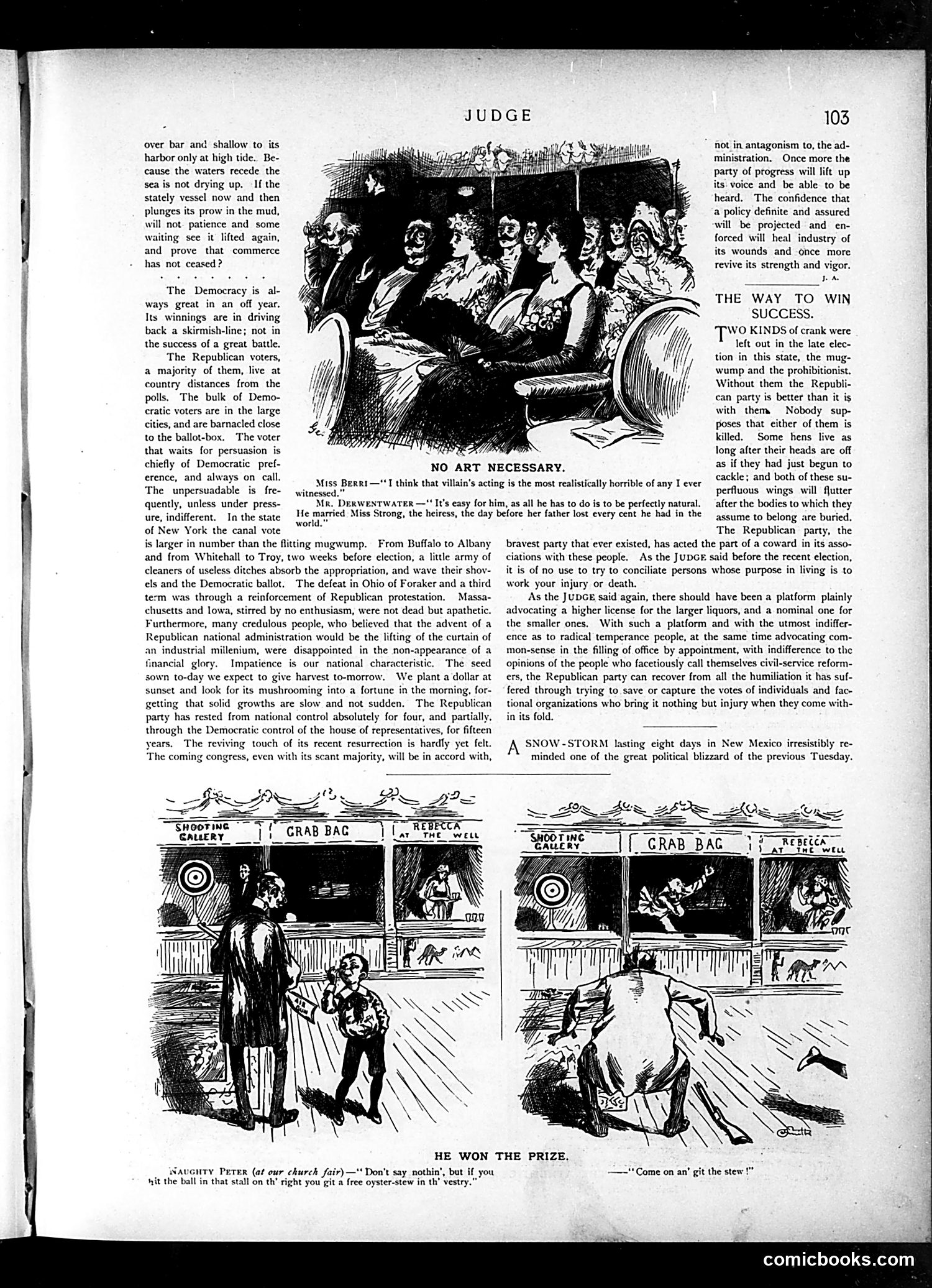
This page contains editorial commentary on Republican electoral challenges and strategy. The main article criticizes two groups that hurt Republicans in recent elections: mugwumps (independent Republicans who defected) and prohibitionists. The piece argues these factions should be abandoned rather than appeased, since they actively work against Republican interests. The article also addresses Republican voter apathy, noting that Democratic voters in cities vote reliably while Republican rural voters are less motivated. It defends the Republican Party's recent performance, suggesting that disappointment stems from unrealistic expectations about how quickly an administration could revive the economy. The two bottom cartoons appear to be unrelated humorous vignettes about carnival games and theatrical acting, serving as filler entertainment typical of Judge magazine's satirical format.
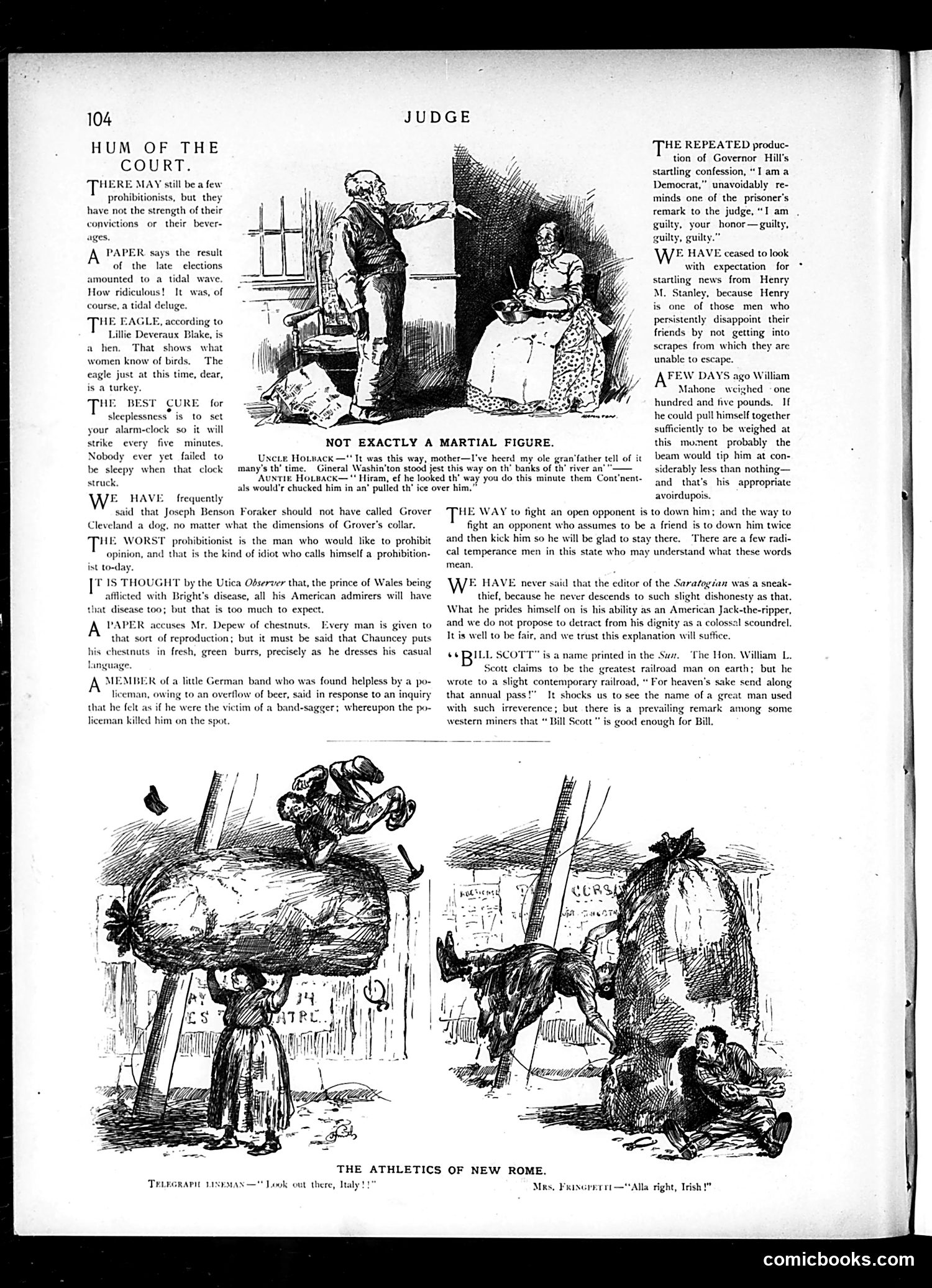
This page from Judge contains several brief satirical pieces and two political cartoons mocking contemporary figures and social issues. **Top cartoon** ("Not Exactly a Martial Figure"): Depicts Uncle Hoarback and Auntie Hoarback discussing a poorly-dressed man, contrasting him unfavorably with General Washington's appearance during the Revolutionary War—satire on standards of dignity and military bearing. **Bottom cartoons** ("The Athletics of New Rome"): Two scenes mocking Italian immigrants or Italian-American stereotypes. A telegraph lineman warns "Look out there, Italy!!" while figures are struck by debris, and Mrs. Fringetti responds "Alla right, Irish?"—ethnic humor playing on Irish and Italian working-class caricatures. The text pieces satirize prohibition advocates, political figures (Joseph Foraker, Grover Cleveland, Governor Hill), and various social pretensions. References to Prince of Wales's illness and William Mahone's thinness are topical jabs at contemporary public figures, though specific dates are unclear without additional context.
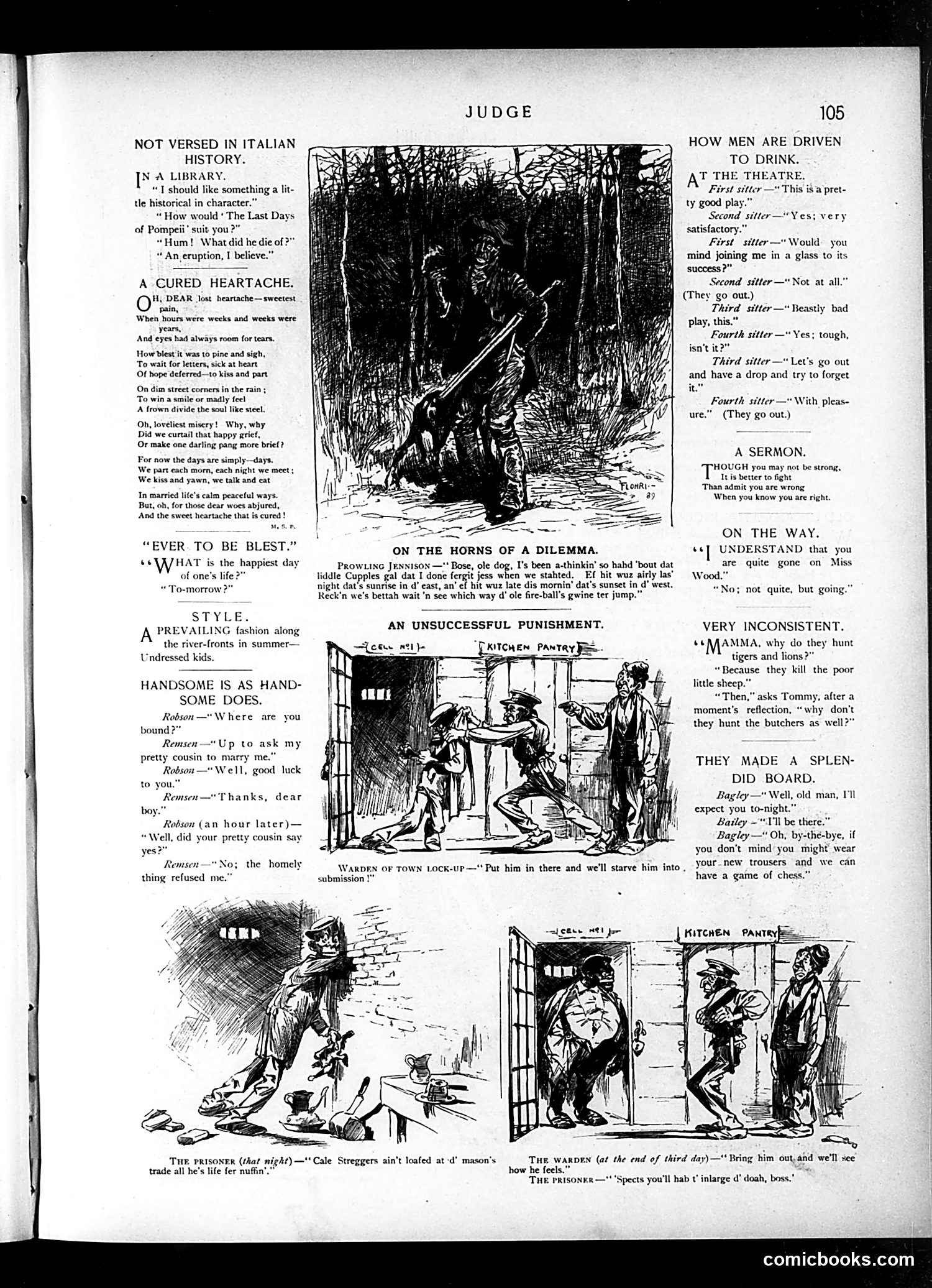
This page contains multiple brief satirical pieces typical of Judge's humor: **"Not Versed in Italian History"**: A library patron confuses Pompeii's destruction by volcanic eruption with a person's death—simple wordplay humor. **"A Cured Heartache"**: Nostalgic verse lamenting that married life lacks the romantic drama of courtship, satirizing sentimental attitudes about love. **"How Men Are Driven to Drink"**: Theater-goers justify drinking by the play's quality—good play requires celebration, bad play requires forgetting. Social commentary on drinking culture as excuse-making. **"On the Horns of a Dilemma"**: A Black character (written in exaggerated dialect) debates timing based on celestial observation—appears to be rural/folk humor, though the specific reference is unclear. **"An Unsuccessful Punishment"**: Prison scenes showing a prisoner's size prevents effective confinement—physical comedy. **Other pieces**: Brief jokes on inconsistent logic, fashion, and courtship. The page emphasizes domestic/social satire rather than political commentary, with heavy reliance on dialect humor and class-based comedy typical of the era.
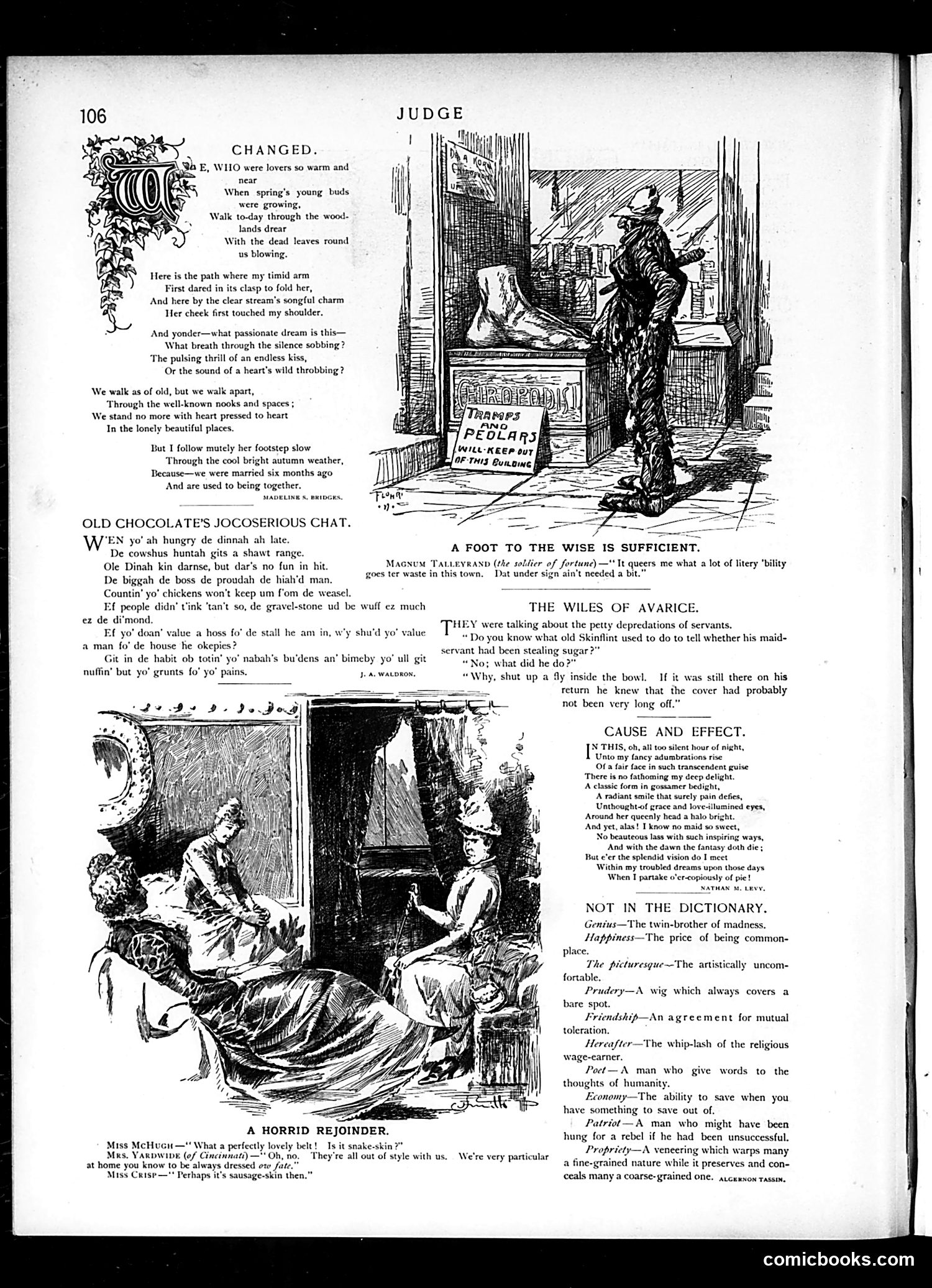
This page from the satirical magazine **Judge** contains several humorous pieces mocking Victorian sentimentality and social pretense: **"Changed"** satirizes romantic disillusionment—a couple who once walked passionately through woods now trudge together out of marital habit, having lost all spark after six months of marriage. **"Old Chocolate's Jocoserous Chat"** features dialect humor (common in period satire) presenting folk wisdom attributed to an African American character, typical of era's racial stereotyping. **"A Horrid Rejoinder"** is a brief joke about a woman's belt, likely made of unfashionable material. **"The Wiles of Avarice"** mocks miserly employers who obsessively watch servants for theft. **"Cause and Effect"** parodies overwrought romantic poetry, revealing the speaker's elevated vision of feminine beauty was merely indigestion from eating pie—deflating pretentious idealization. **"Not in the Dictionary"** cynically redefines common words (Patriot as an "unsuccessful rebel," Happiness as "commonplace"), expressing fin-de-siècle disillusionment with society's values. The page collectively ridicules Victorian affectation and romantic excess.
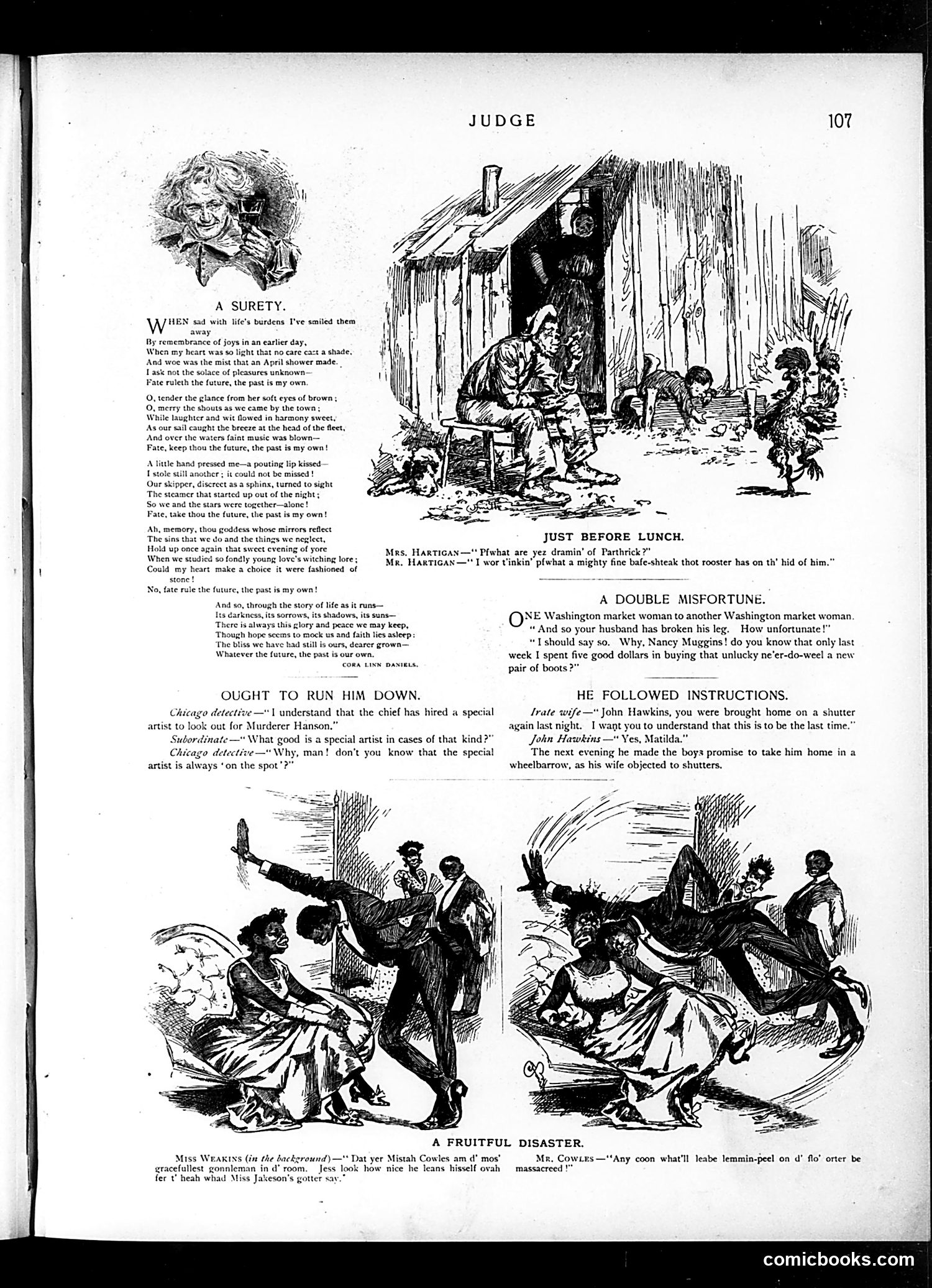
This page contains multiple satirical cartoons and humorous dialogues typical of late 19th-century American humor. Key sections: **"A Surety"** is a sentimental poem about cherishing past memories while accepting fate's future uncertainties. **The comic dialogues mock working-class and immigrant speech patterns:** - "Just Before Lunch" features Irish-accented characters (Hartigan), with humor derived from mispronunciation ("pfwhat," "bafe-shteak") - "A Double Misfortune" jokes about a poor husband's repeated injuries costing his wife money - "He Followed Instructions" depicts a drunk husband comically obeying his wife's ultimatum by using a wheelbarrow instead of a shutter to get home **"A Fruitful Disaster"** uses racist caricature and dialect ("d' mos' gracefullest"), depicting Black characters in servant roles—reflective of the magazine's era but deeply offensive by modern standards. The page exemplifies Judge's mix of sentimental verse and crude ethnic/racial humor targeting immigrants and Black Americans.
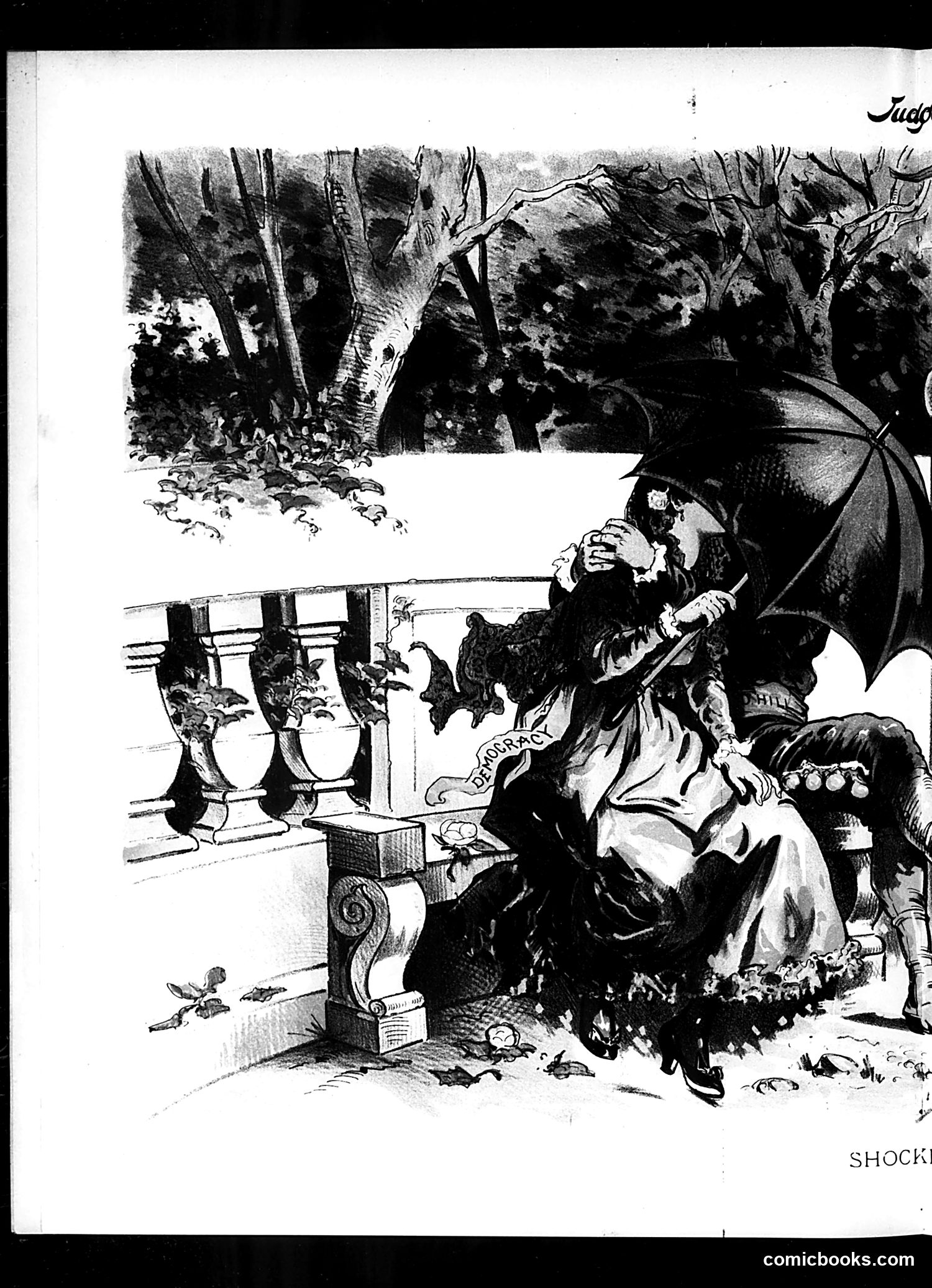
This appears to be a Judge magazine cartoon titled "Shock!" The illustration shows a well-dressed woman with an umbrella seated on a park bench, recoiling in apparent alarm or disgust. She's positioned near what looks like classical garden ornaments or urns. The scene includes a wooded background and appears to depict a moment of social embarrassment or surprise in a public park setting. Without additional context or visible caption text beyond the title, the specific political or social commentary remains unclear. The cartoon likely satirizes contemporary social conventions, public behavior, or the sensibilities of upper-class women, but the exact target of the satire cannot be definitively determined from the image alone.
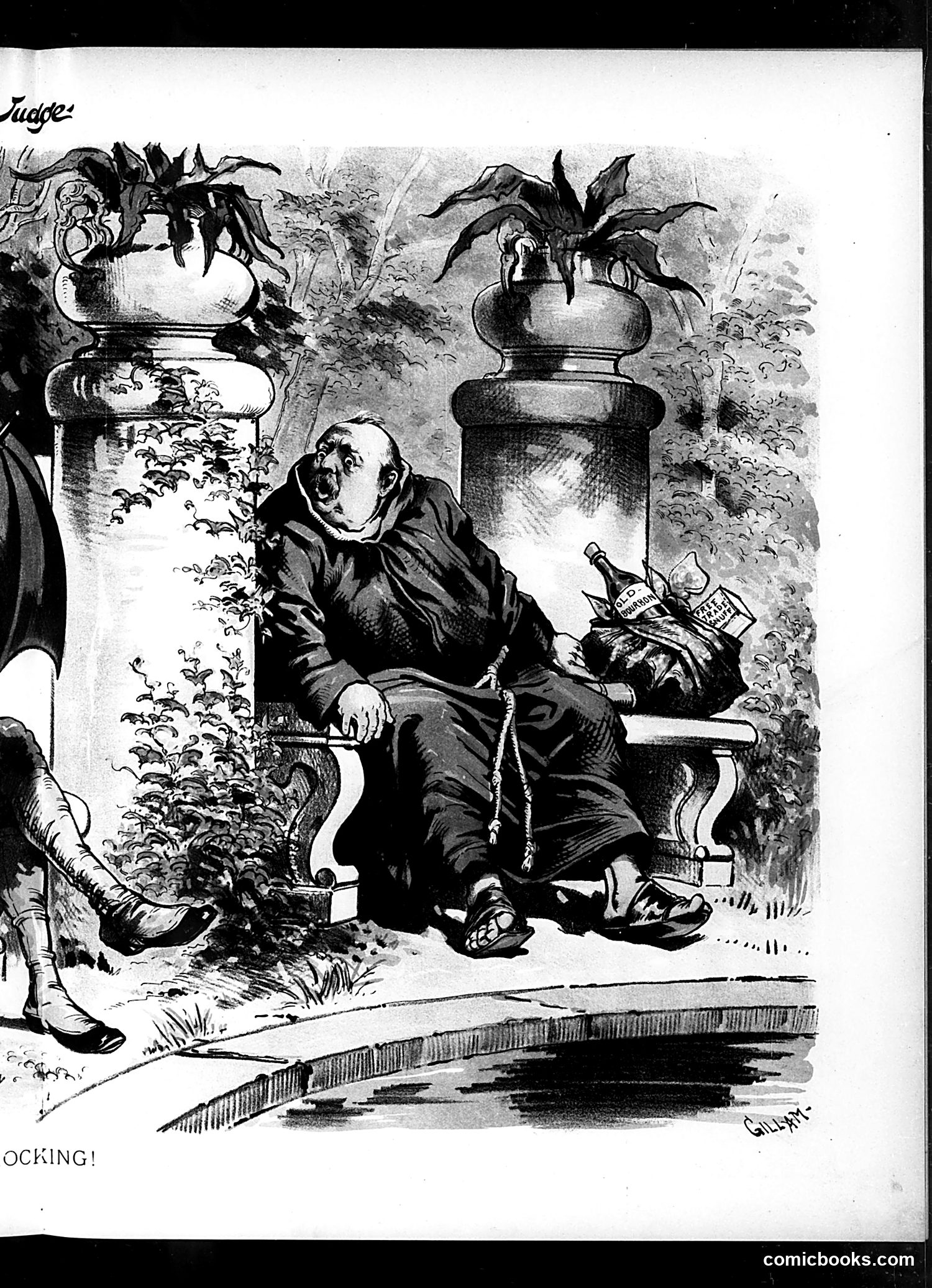
This political cartoon depicts a portly, distressed man sitting in what appears to be a garden or courtyard setting, flanked by two large ornamental urns with aggressive plants or flowers sprouting from them. The man clutches bottles (possibly alcohol) beside him and appears to be reacting with shock or dismay to his surroundings. The title "Ocking!" suggests mockery or ridicule. Without additional context about the publication date or political figures of the era, the exact target remains unclear. However, the cartoon likely satirizes a public figure caught in an uncomfortable or compromising situation—possibly involving excess (the bottles), poor judgment, or entrapment in an undesirable circumstance. The ornate garden setting may symbolize false gentility masking scandal or corruption.
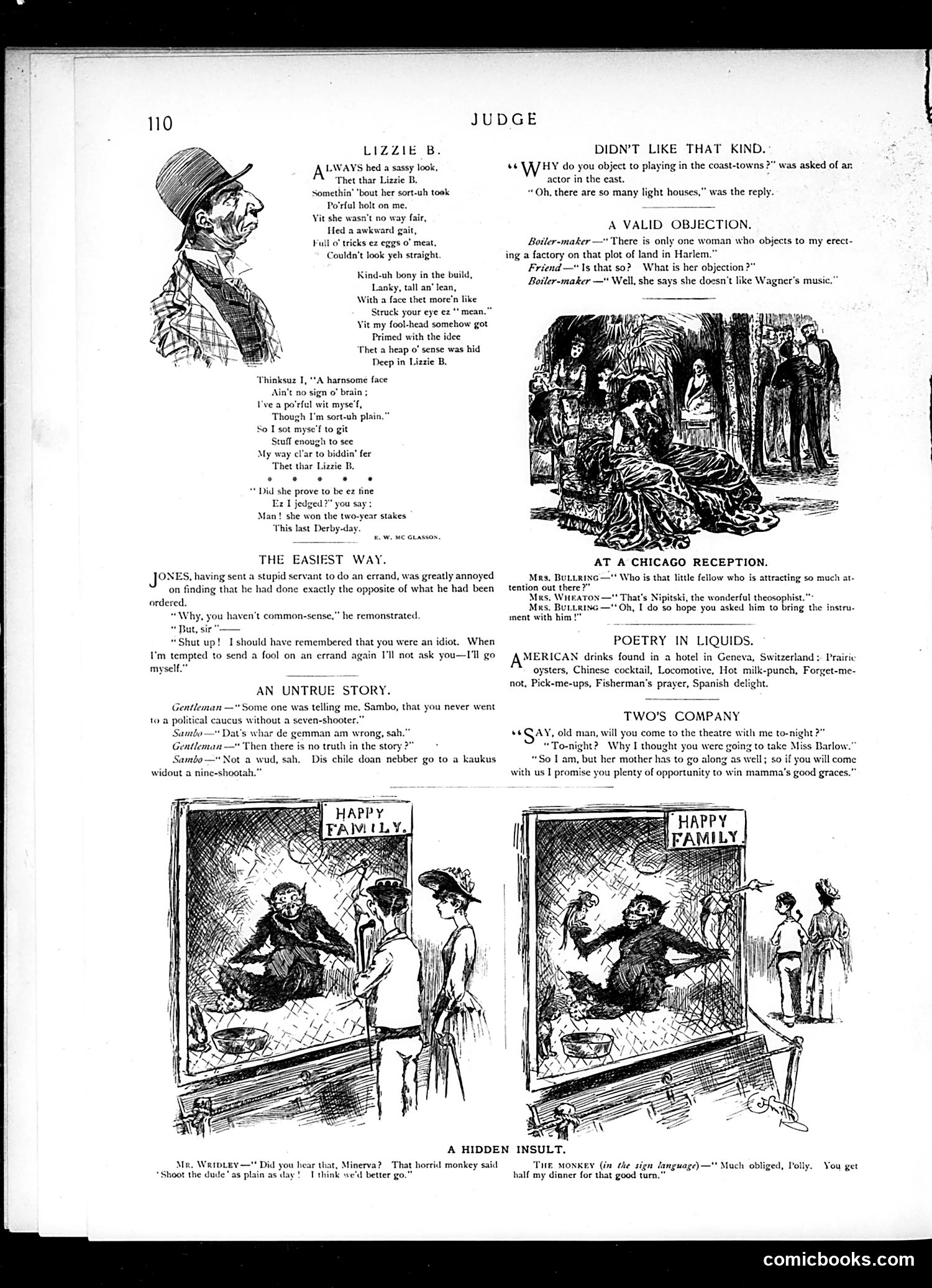
This page contains multiple short humorous pieces typical of 1890s American satirical humor: **"Lizzie B."** is a dialect poem about a man attracted to an unattractive, sassy woman, written in rural/backwoods vernacular that was popular comic fodder of the era. **"The Easiest Way"** mocks servant incompetence—a master learns that giving foolish orders to a fool produces the opposite result. **"An Untrue Story"** uses racist dialect humor, featuring "Sambo" correcting a gentleman's false assumption about attending political caucuses armed—a reference to violence at 19th-century voting events. **Various short jokes** mock actors (light house pun), factory builders (Wagner music complaint), wealthy Chicago society (theosophists), exotic cocktails, and social etiquette. **"Happy Family" cartoons** show primates in human clothing, a recurring Judge motif mocking human behavior. **"A Hidden Insult"** presents a joke about a monkey insultingly compared to a "dude." The page reflects period attitudes: ethnic stereotyping, class mockery, and slapstick humor dominating American comic publications of this era.
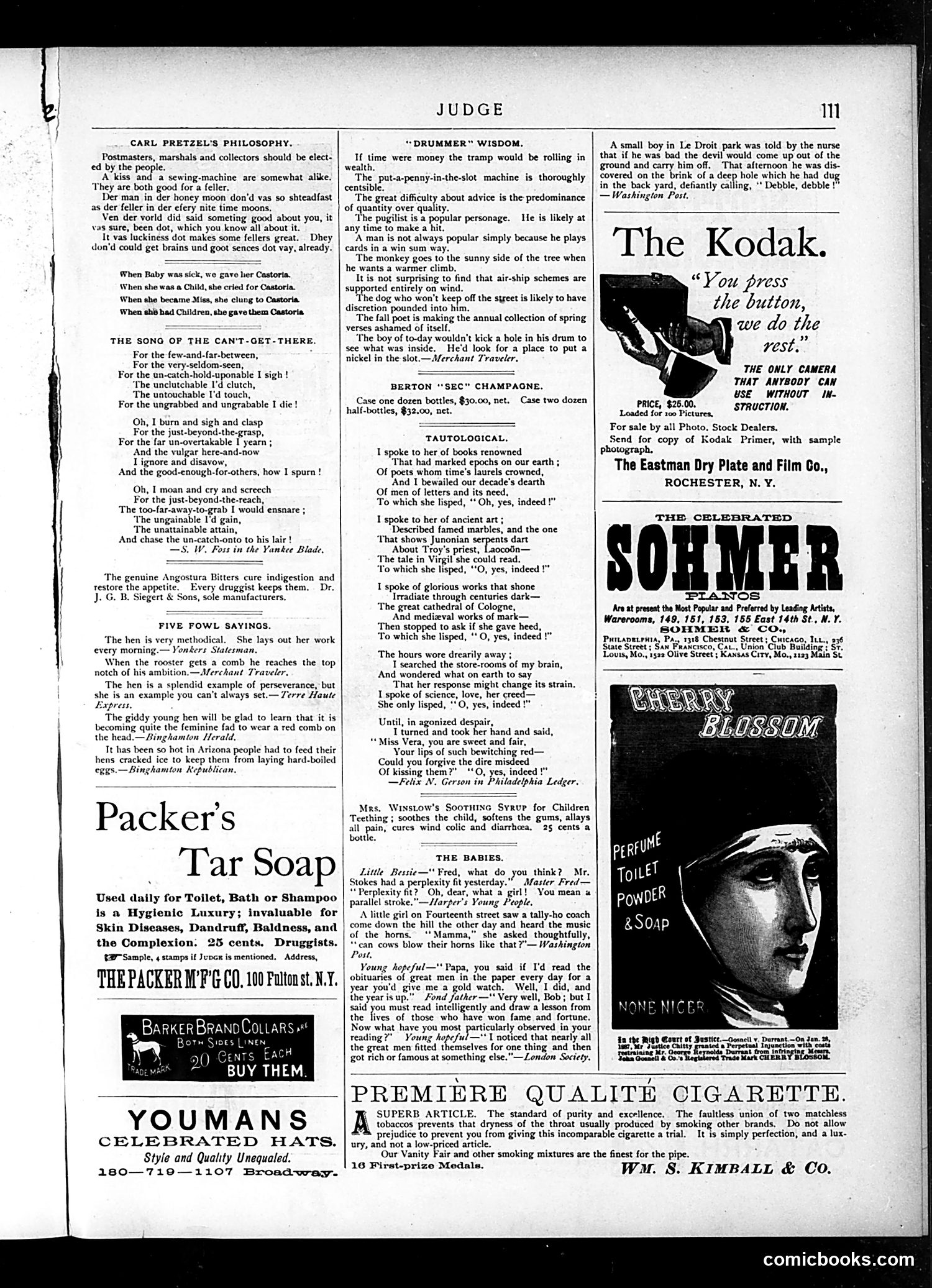
This page is primarily **advertisements and light satirical humor** rather than political cartooning. The content includes: **"Carl Pretzel's Philosophy"**: Ethnic humor featuring a German-accented character offering folksy observations (e.g., "Postmasters...should be elected by the people"). This represents common early 1900s ethnic stereotyping. **"Drummer Wisdom"**: Brief jokes about traveling salesmen ("drummers"), a stock character of the era. **Poems and Quips**: Sentimental verses and puns about animals and everyday life—typical Judge magazine filler. **Advertisements**: The bulk of the page—Kodak cameras, Packer's Tar Soap, Youmans Hats, Sohmer Pianos, and other products. **No significant political satire is visible.** The page reflects Judge's typical format: light, domestic humor mixed with extensive advertising. The ethnic stereotyping and sentimental tone date it clearly to the early 20th century.
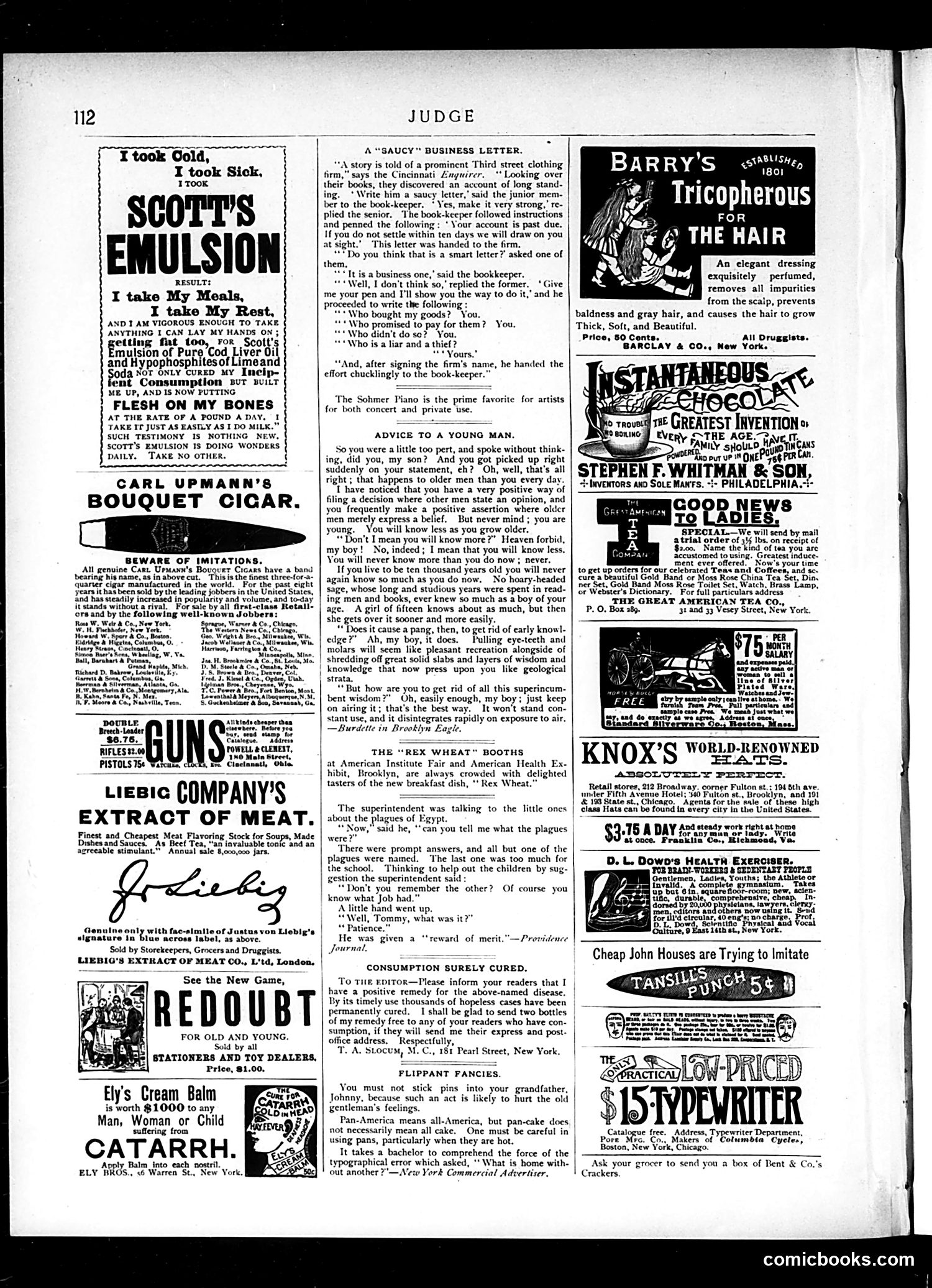
This is primarily an **advertising page** from Judge magazine, not a political cartoon. The page contains multiple product advertisements typical of late 19th/early 20th-century publications: Scott's Emulsion (a cod liver oil supplement), Carl Upmann's cigars, Liebig's Extract of Meat, and various other remedies and products. The only editorial content is a brief humorous story titled "A 'Saucy' Business Letter"—a joke about a clothing firm's debt collection attempt. A junior bookkeeper writes a formal demand letter, but a senior partner rewrites it more directly, sarcastically asking: "Who bought my goods? You... Who is a liar and a thief? You." The humor derives from the contrast between formal business language and blunt accusation. There is also a short piece called "Advice to a Young Man" offering sardonic life wisdom about knowing less as one ages. No political figures or satirical commentary are present on this page.
This page is primarily **advertising and light verse** rather than political satire. The main content is "Sebastian Morey's Baby," a sentimental rural dialect poem (credited to S.W. Foss in the Yankee Blade) celebrating fatherhood. A farmer defends his infant son against a critic who calls babies "a tarnal bother," describing the child's laughter and joy in elaborate pastoral metaphors—comparing giggles to brooks and birdsong. The poem celebrates sentimental Victorian ideals of childhood innocence and paternal devotion. The surrounding content consists entirely of **period advertisements** for consumer goods: Epps's Cocoa, safes, traveling bags, pens, crackers, and various services. There is no political commentary or satirical cartoon visible on this page. This appears to be a standard Judge issue mixing light verse content with commercial advertisements typical of late 19th-century American magazines.
This page is primarily a **collection of advertisements** rather than editorial cartoons. It represents typical late 19th-century magazine advertising. Notable content includes: - **Product ads** for crackers, corsets, mineral water, and remedies typical of the era - **"Autumn Quips"** section: short humorous verses about poets, a false rumor that the Prince of Wales has gout (causing fashionable "dudes" to pretend they do too out of embarrassment), and a silent scene ending a cat-and-gun mishap - **Modène hair removal ad**: Features a woman and promises to remove unwanted facial/body hair "safely" — reflecting period beauty standards and the era's dubious cosmetic remedies - **Shipman's Fountain Pen** marketed as a "Holiday Present" The satire is mild: the "Charley horse" joke mocks aristocratic affectation, and the silent-scene poem is gentle wordplay. The page captures advertising and light humor typical of Judge's commercial content circa 1890s.
This *Judge* page mixes advertisements with light satirical commentary on wealth and class. **The Cartoons/Jokes:** The top section contains brief witticisms—one about a wealthy man's perspective: when a millionaire gives away a quarter, it seems worthless to him, yet represents significant value. The accompanying verse jokes about a man who pursues a woman with a "cold heart" (the ice-man's daughter) and becomes wealthy through marriage, using irony about his "gold." **The "When is a Dinner Not a Dinner?" Piece:** This references Marion Harland's advice that refined society views soup as essential to proper dining, contrasting high-society standards with working-class practices. **Content:** The page is primarily **advertisement-heavy**: soup products, asthma cures (Broncholine), gloves, soaps, facial blemishes remedies, and hotels dominate. The "testimonials" are period-typical advertising claims about medicinal products (many likely ineffective by modern standards). The satire is gentle, targeting class pretensions and consumer culture rather than politics or current events.
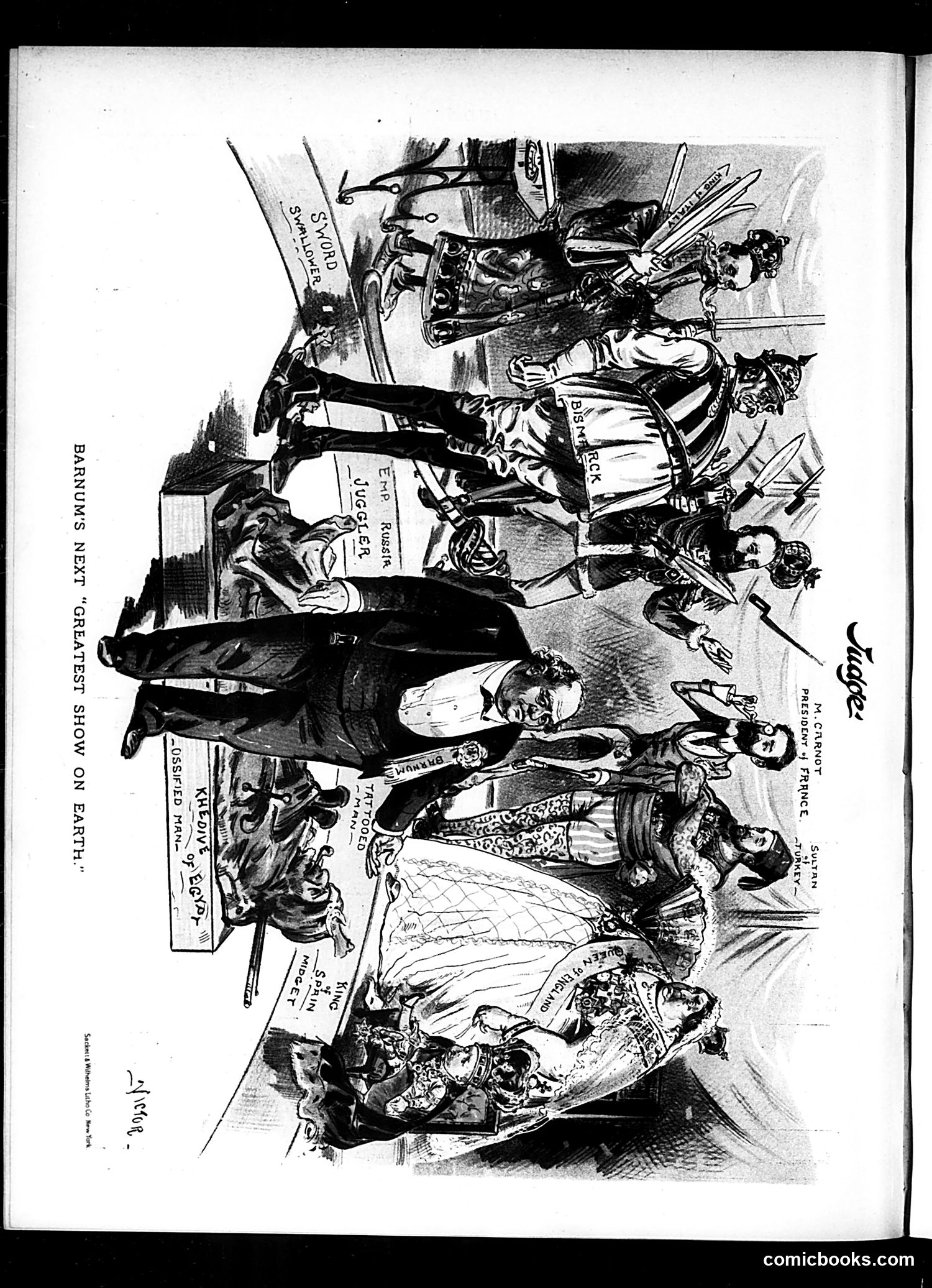
This is a satirical cartoon comparing contemporary political figures to P.T. Barnum's circus attractions. The title "Barnum's Next 'Greatest Show on Earth'" suggests these are public figures being ridiculed as mere curiosities or oddities suitable for exhibition. The visible labels reference "Emp. Russia" (likely the Russian Emperor), "Khedive" (Egyptian ruler), and "Ossified Man," positioning various international leaders as freakish attractions. The satire mocks these figures' apparent inflexibility, antiquated governance, or peculiar characteristics by treating them as carnival oddities rather than serious statesmen. This reflects late-19th-century American skepticism toward foreign monarchs and autocratic rulers, suggesting they belong in a sideshow rather than in legitimate political power.