
A complete issue · 16 pages · 1889
Judge — October 26, 1889
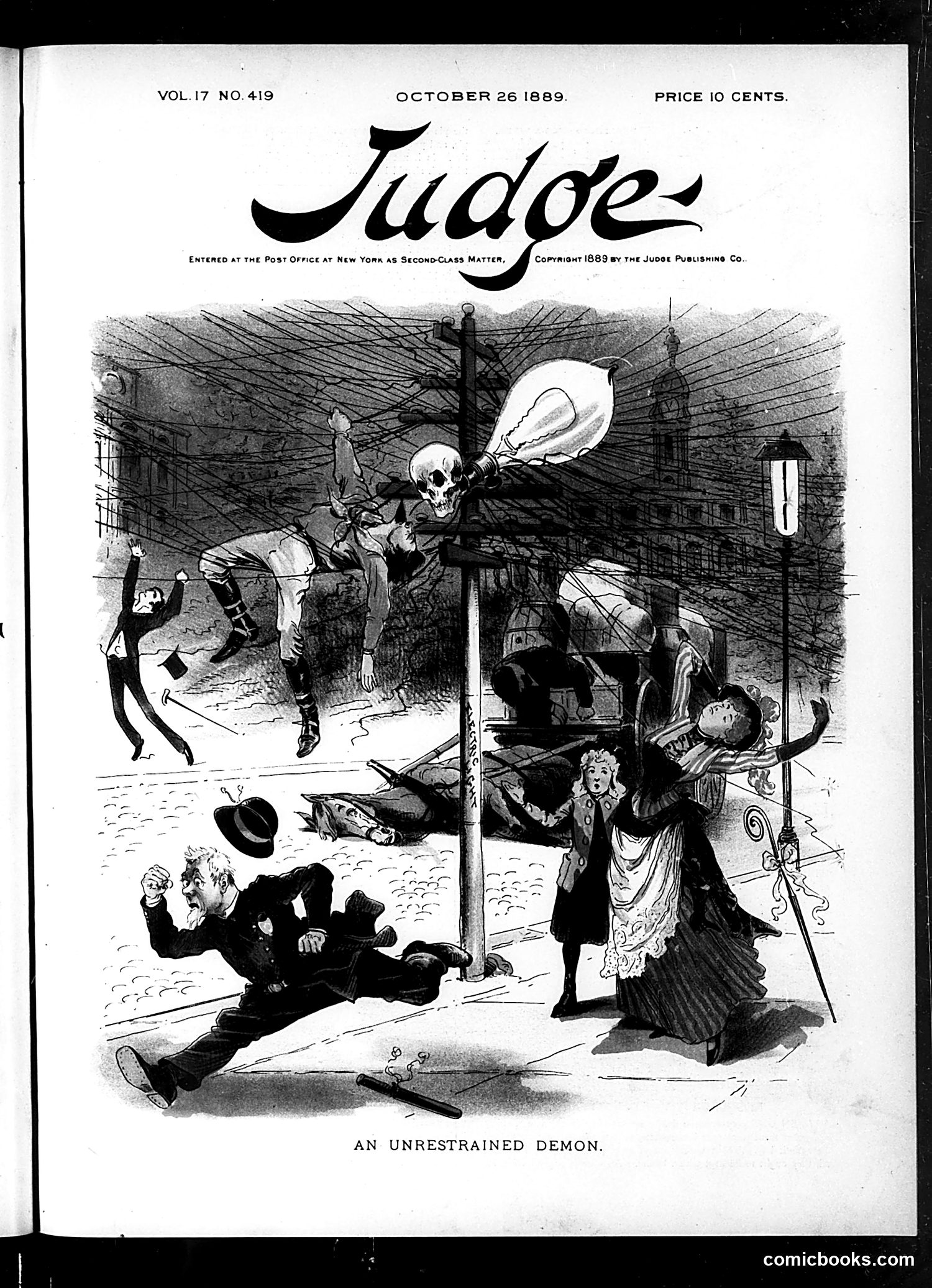
This satirical cartoon depicts a skeletal Death figure unleashed in an urban street scene, causing chaos among pedestrians. The caption "An Unrestrained Demon" suggests the image critiques an uncontrolled force causing public harm. Given the 1889 date, this likely addresses a contemporary public health crisis—possibly cholera, yellow fever, or another epidemic ravaging American cities at that time. The skeleton personifies Death itself running wild through the streets while citizens panic and flee. The cartoon's message appears to be political commentary on government's failure to contain or prevent disease spread, portraying the disaster as a preventable "demon" that authorities allowed to escape restraint. The imagery emphasizes public vulnerability and institutional negligence during health emergencies.
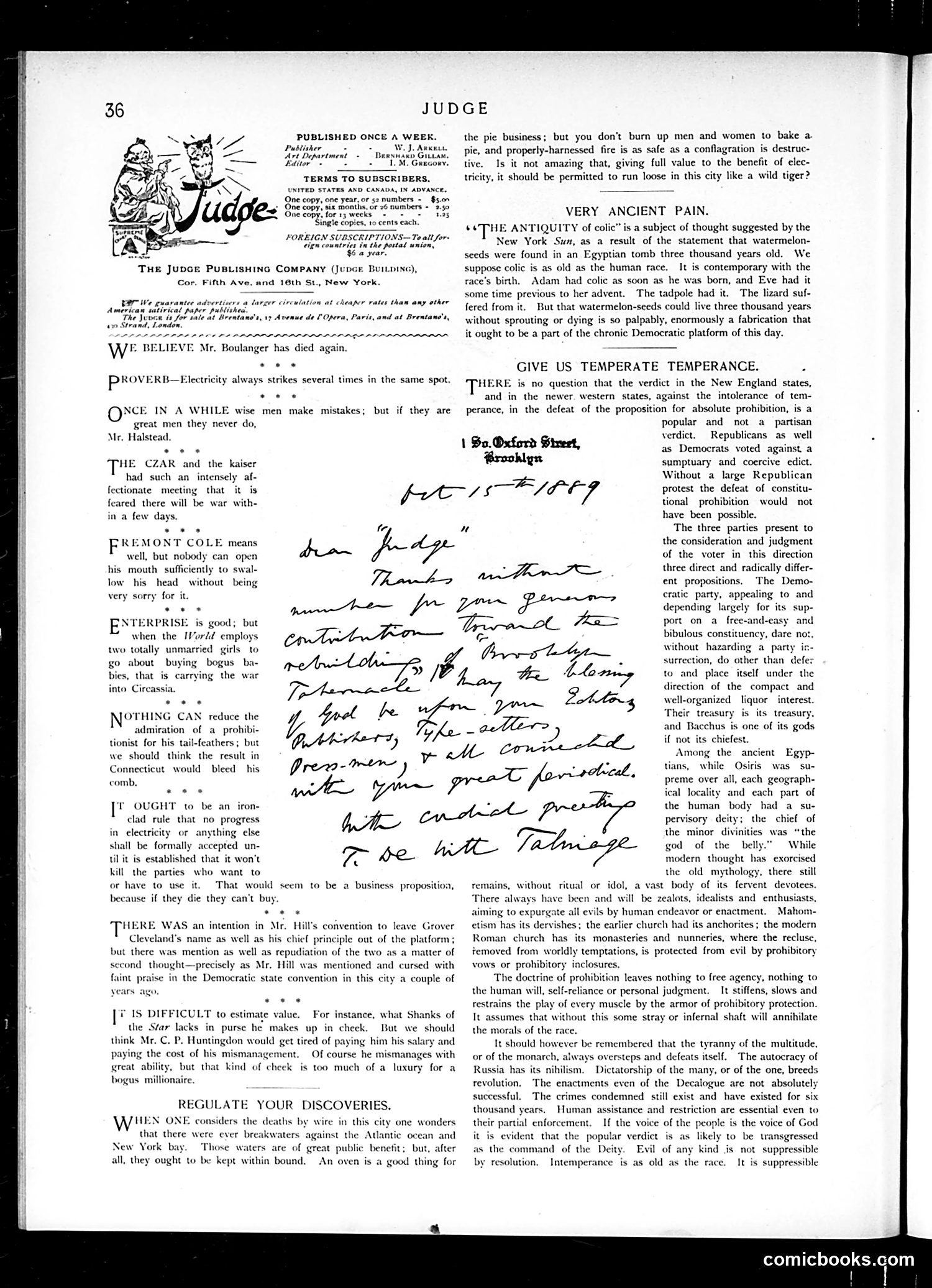
This page contains editorial content rather than cartoons. The handwritten note at top appears to be correspondence addressed to "Judge" (the magazine itself), dated what looks like 1917, from Brooklyn. The printed articles include commentary on various political topics: criticism of electricity monopolies, discussion of temperance and prohibition debates, and extended commentary on Democratic vs. Republican positions regarding "temperate temperance" and liquor regulation. The satire targets political inconsistency—particularly parties' opportunistic stances on prohibition depending on their constituencies. The "VERY ANCIENT PAIN" section appears to discuss colic as an eternal human problem, likely using it as metaphor for chronic political ailments. Without identifying specific cartoon figures, this page primarily delivers political editorial commentary typical of Judge's satirical approach to early 20th-century American politics.
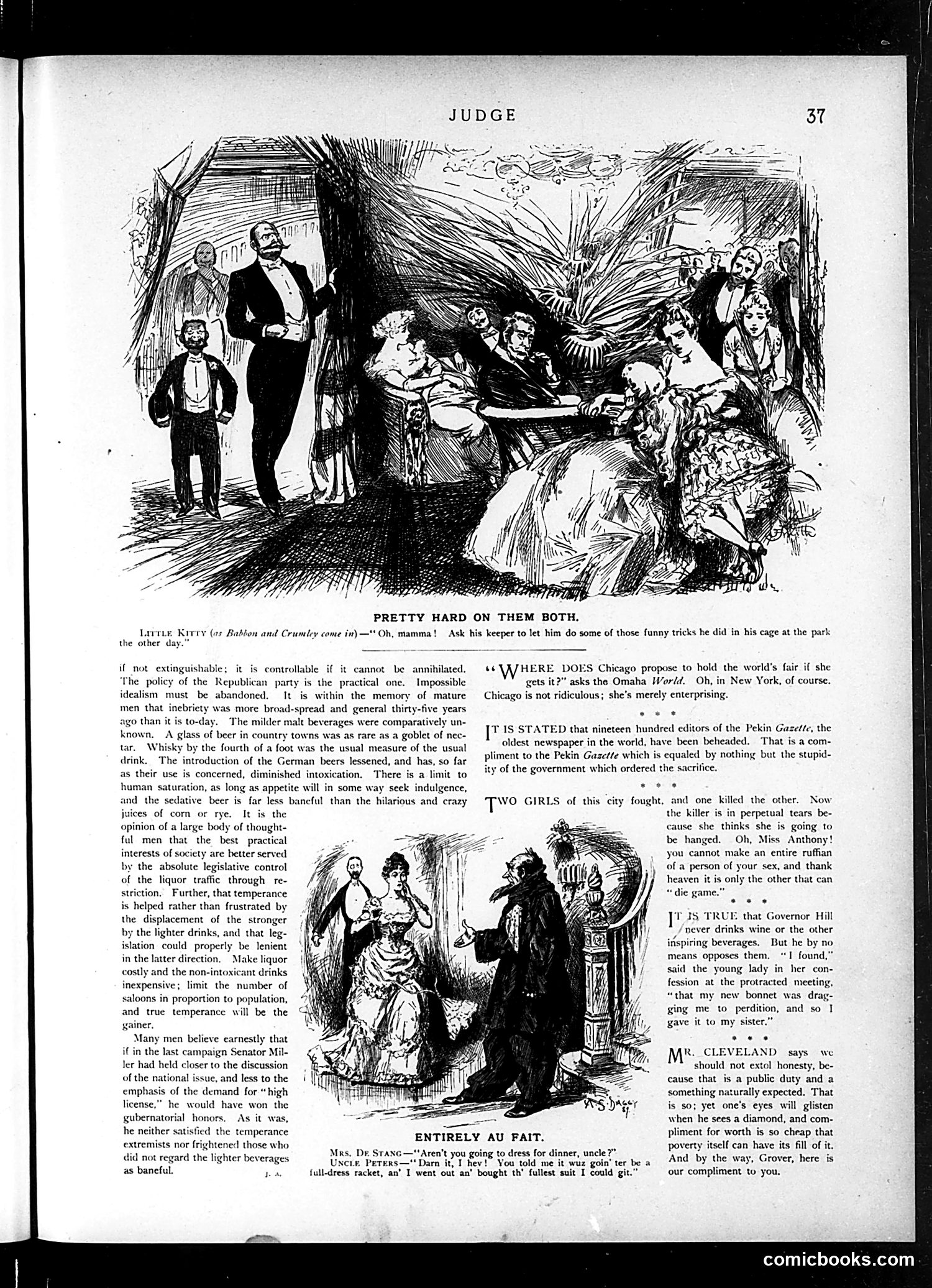
This page from Judge (an American satirical weekly) contains multiple brief satirical pieces typical of the publication's format. **"Pretty Hard on Them Both"** (top): A child compares two visiting gentlemen to circus animals, asking one's "keeper" to make him perform tricks—crude satire suggesting the men lack intelligence or dignity. The figures appear to be political rivals or public figures. **"Entirely Au Fait"** (bottom left): Uncle Peter claims he bought "the fullest suit" for formal dinner, misunderstanding "full dress" as maximum clothing quantity—a class-based joke about rural/working-class confusion with upper-class conventions. The remaining items are brief editorial quips about: Chicago's world's fair ambitions, executions at a Chinese newspaper, a woman convicted of murder, Governor Hill's temperance stance, and President Cleveland's views on honesty. The page predominantly satirizes American politics, social pretension, and current events through short, punchy observations rather than elaborate visual cartoons. The actual illustrations are modest sketches accompanying text rather than detailed political cartoons.
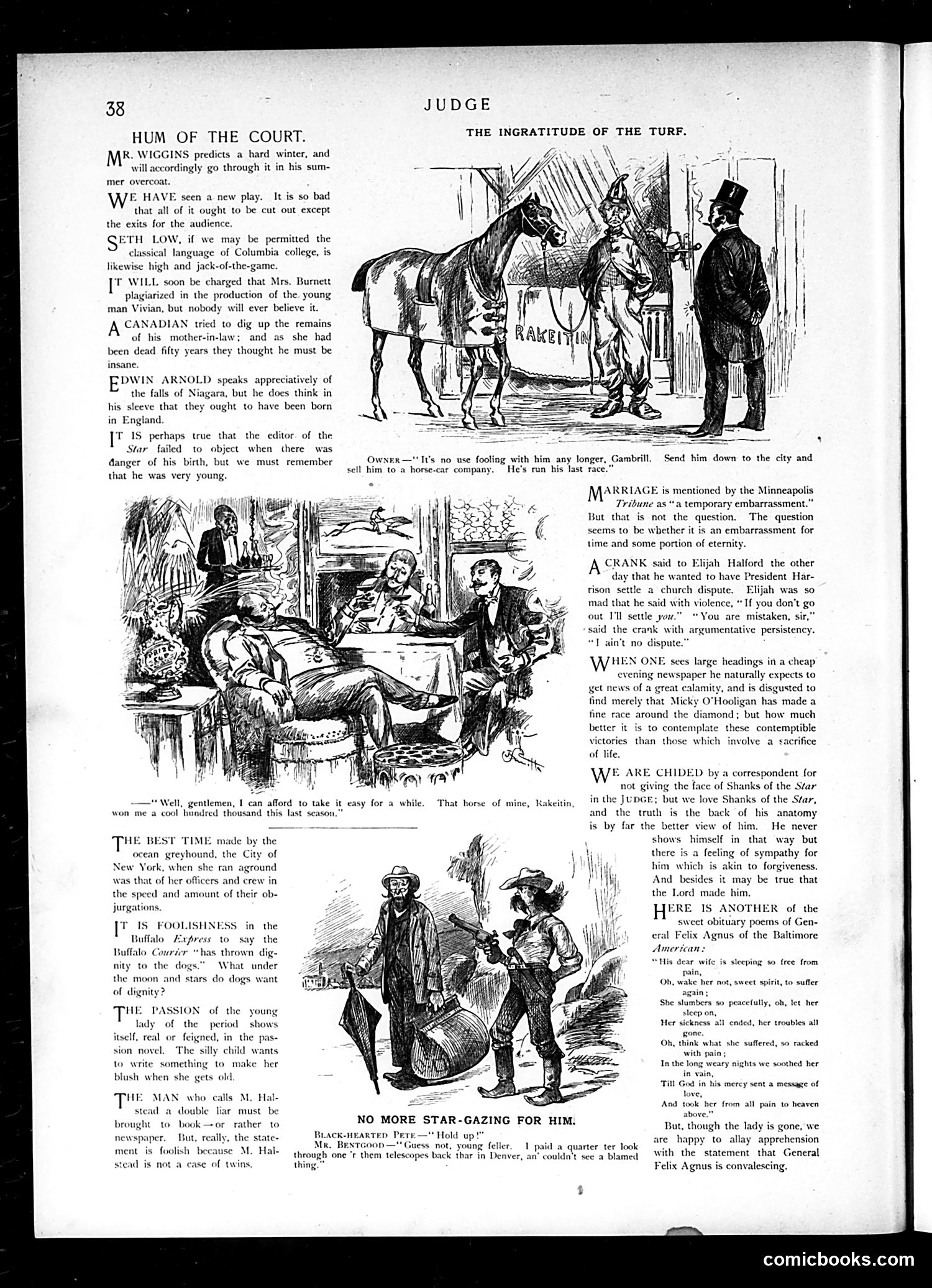
This page contains brief satirical commentary on contemporary figures and events, plus three illustrated jokes: **"The Ingratitude of the Turf"**: A horse owner callously discards his aging racehorse "Rakentin" to a horse-car company after it can no longer race profitably—satirizing the disposable treatment of animals. **"No More Star-Gazing for Him"**: An unclear reference, but likely mocking someone (possibly a journalist or public figure) caught looking through telescopes, with the punchline suggesting discreditable behavior. **The main text** comprises brief witticisms about contemporary figures: Seth Low (Columbia College president), Edwin Arnold (travel writer), and others—typical of Judge's format of short, caustic one-liners about public personalities. The page also includes a poem mocking the flowery obituaries of General Felix Agnus of the Baltimore *American*, suggesting Agnus wrote excessively sentimental death notices. Overall, this demonstrates Judge's approach: short satirical barbs targeting public figures, politicians, and social pretension.
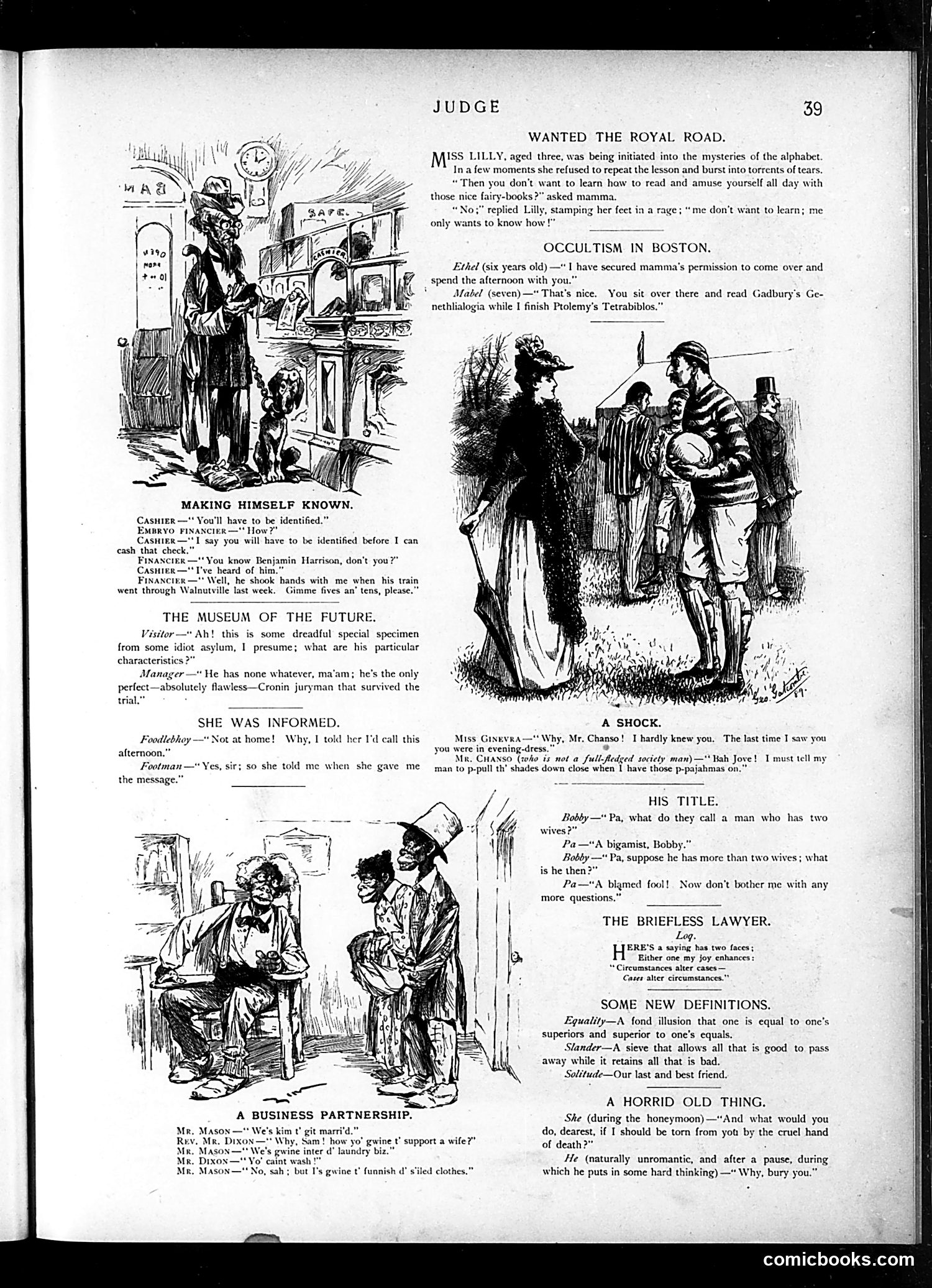
This page contains multiple brief satirical sketches typical of Judge's humor: **"Making Himself Known"** mocks a man trying to cash a check by name-dropping Benjamin Harrison (U.S. President 1889-1893), claiming a handshake during Harrison's train visit proves his identity. The joke: such a tenuous connection is worthless for identification. **"The Museum of the Future"** satirizes the Cronin trial (likely the 1889 Dr. Patrick Cronin murder case in Chicago). It suggests the only "perfect" person emerging from that trial was a juror—dark humor about the trial's controversy. **"Occultism in Boston"** jokes about Boston's intellectual pretension: two young girls discuss obscure occult texts (Gadbury's Genethlialoga and Ptolemy's Tetrabiblos) as casual afternoon reading—absurdist humor mocking pseudointellectual affectation. The remaining sketches offer gentler domestic humor: a child wanting shortcuts to learning, a woman's surprise at a man in casual dress, a father's unromantic response to his honeymoon bride's death hypothetical. Overall, the page emphasizes Judge's focus on social pretension, legal absurdities, and contemporary personalities.
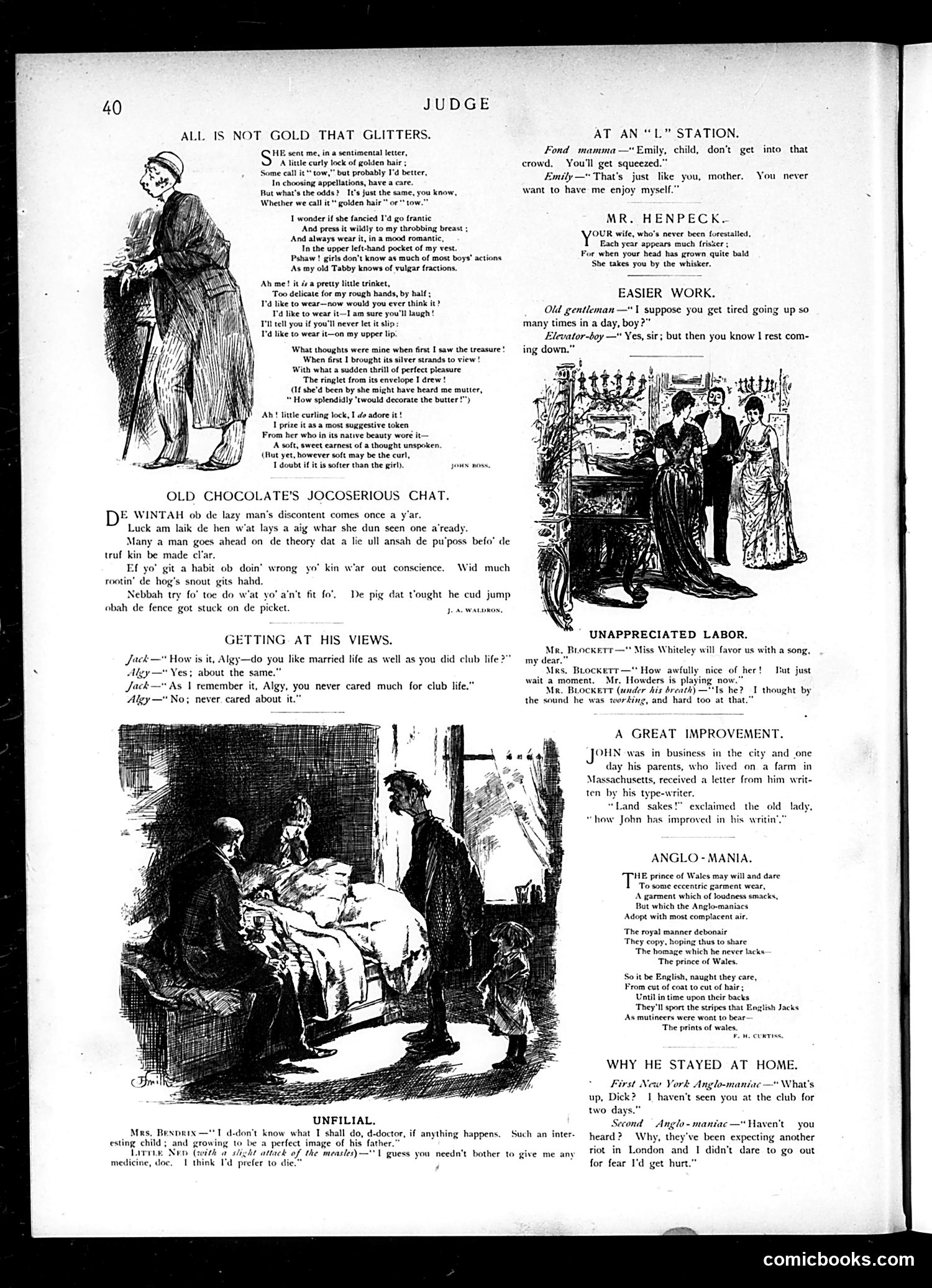
This page contains multiple humor pieces from *Judge* magazine (likely late 19th century): **"All Is Not Gold That Glitters"** mocks a young man who receives a lock of hair from a romantic interest, written as if from his perspective. The joke: he finds the "golden" hair disappointing—comparing it to "tow" (cheap fiber)—and fantasizes about wearing it as a fake mustache rather than treasuring it romantically. It's satirizing both sentimental romance and male vanity. **Other sketches** include brief comedic exchanges: a mother at a crowded train station, a henpecked husband, an elevator boy, and dialect humor from "Old Chocolate" (a racist caricature using stereotypical Black vernacular—typical of the era's offensive humor). **"Anglo-Mania"** satirizes wealthy Americans' obsession with copying British aristocratic fashion and manners, suggesting they'll eventually adopt even the ridiculous (prison stripes) if it's English. These represent typical *Judge* content: social satire, domestic humor, and period-specific class commentary.
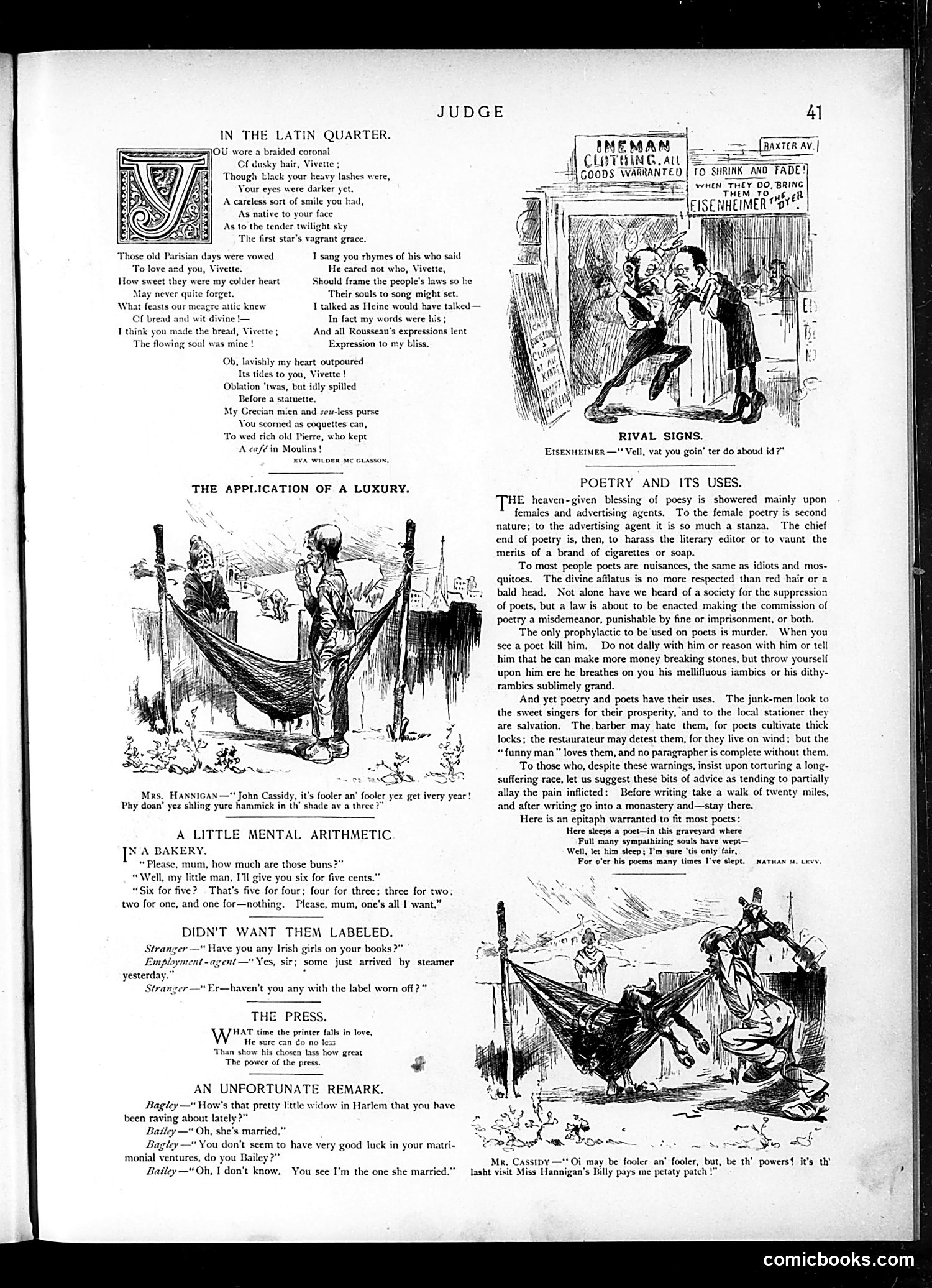
This page contains two main satirical pieces: **"Rival Signs"** (top right): A cartoon showing two competing storefronts—an "Ineman Clothing" shop and "Eisenheimer's"—with the proprietors arguing. The humor mocks German-Jewish immigrant business rivalry on the Lower East Side, using exaggerated accents ("Vell, vat you goin' ter do aboud id?"). The competing signs advertise nearly identical wares, satirizing how immigrant merchants clustered in the same neighborhoods selling the same goods. **"Poetry and Its Uses"** (main text): A scathing satirical essay dismissing poets as public nuisances comparable to "idiots and mosquitoes." Judge argues poetry serves only to annoy literary editors, help advertising agents, and benefit junk dealers (who collect discarded manuscripts). The piece sarcastically suggests murder as the only effective "prophylactic" against poets, reflecting late-19th-century American contempt for artistic pretension and bohemianism among the educated class.
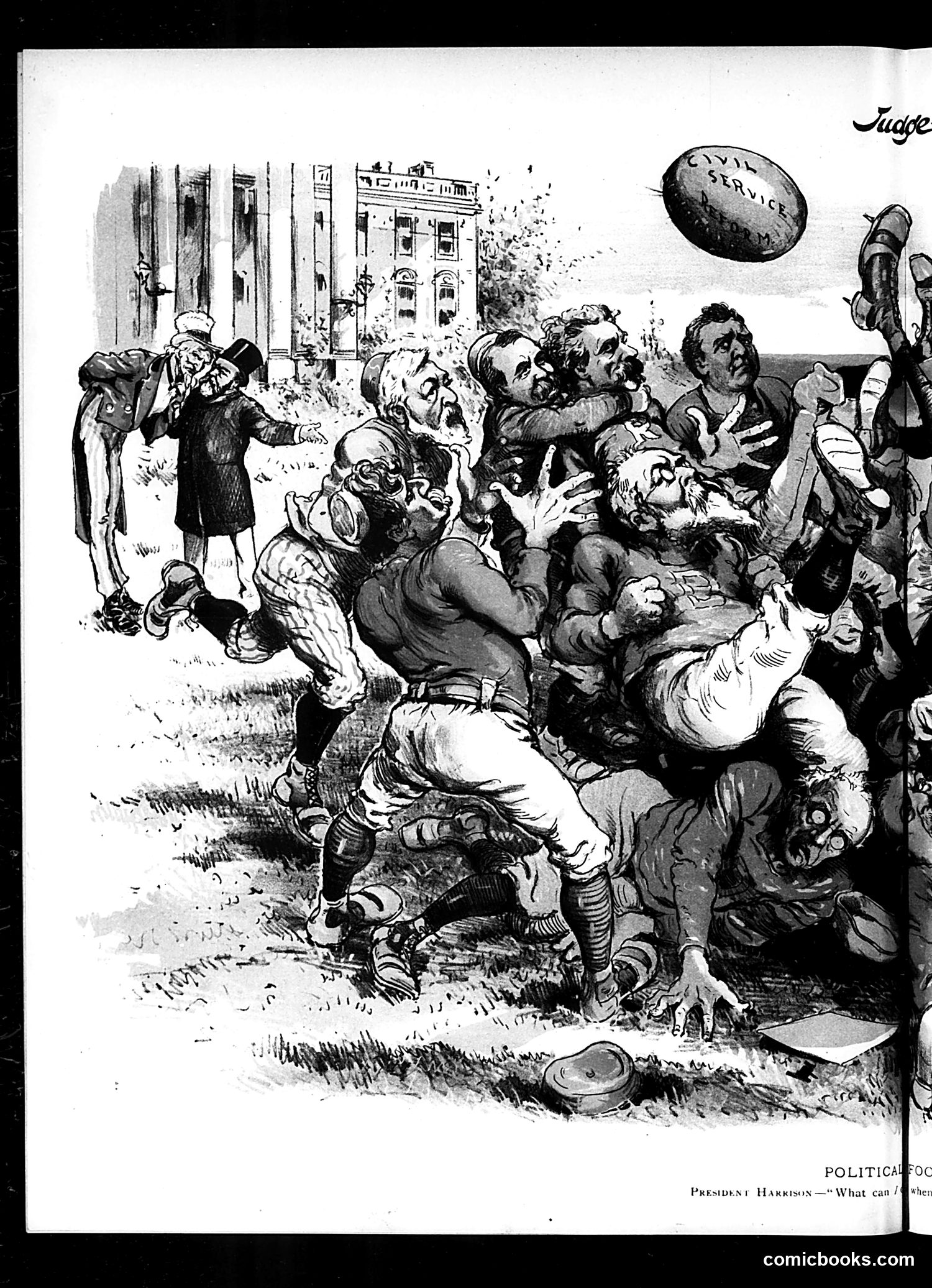
This appears to be a satirical cartoon titled "Political Foc[us]" referencing President Harrison. The OCR text is incomplete, making the specific critique unclear. The image shows a chaotic scene outside a government building with well-dressed men in top hats appearing distressed or arguing. A figure in the center seems to be the focus of attention or conflict. An object labeled "CIVIL SERVICE" floats above like a balloon, suggesting the cartoon criticizes civil service policy—likely President Harrison's approach to patronage or government appointments. The exaggerated caricatures and tumultuous scene typical of *Judge* magazine's style suggest mockery of either Harrison's administrative decisions or the political turmoil surrounding his tenure. Without complete caption text, the precise grievance remains unclear.
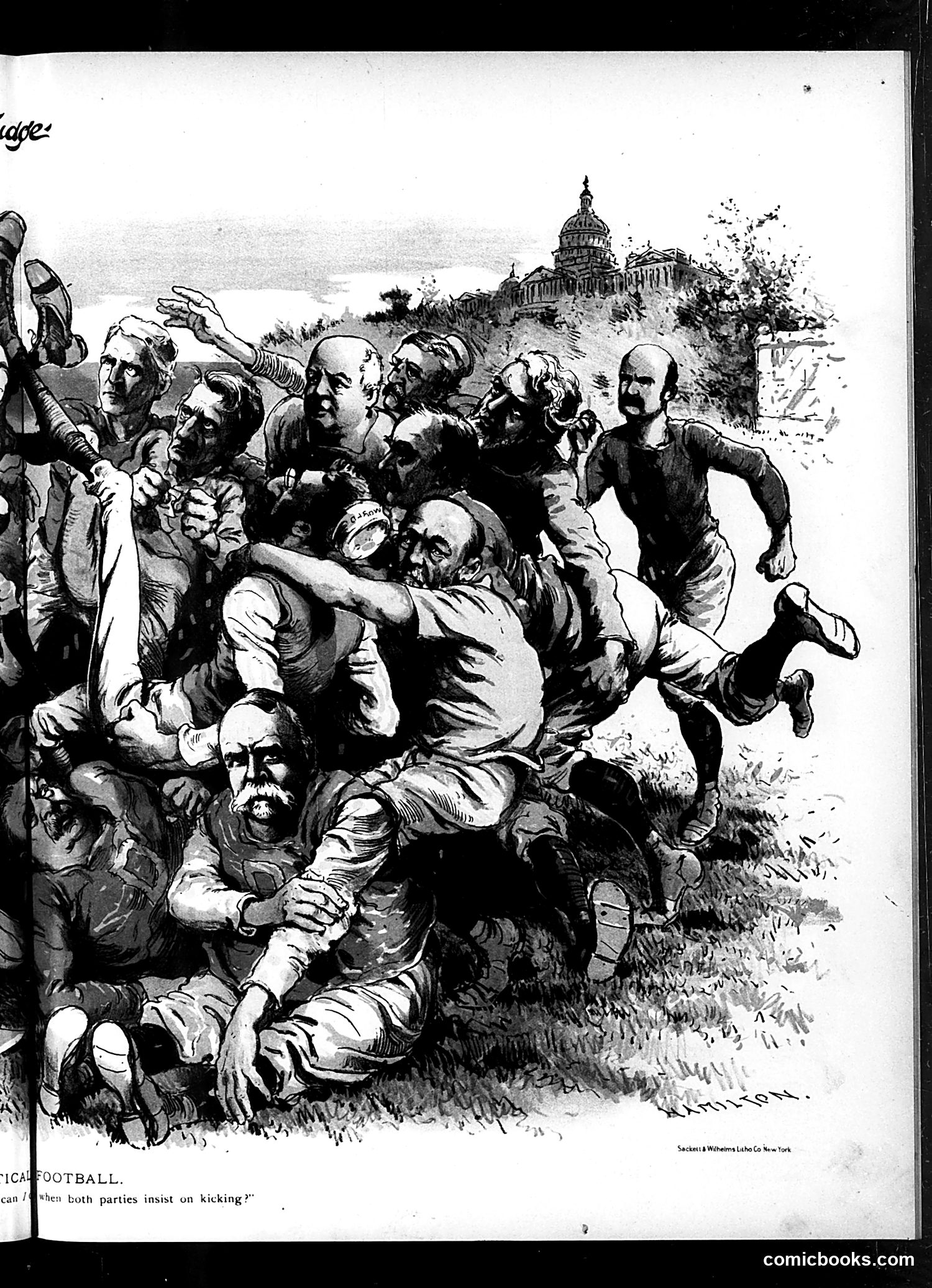
This Judge cartoon satirizes American political gridlock through a sports metaphor. Titled "'ICAMFOOTBALL" with the caption "When both parties insist on kicking," it depicts a chaotic scrum of men fighting over a football near the Capitol Building in the background. The cartoon suggests that Democratic and Republican politicians are so focused on partisan conflict—each side "kicking" (attacking)—that they've turned government into a meaningless struggle rather than constructive governance. The tangled mass of figures illustrates how political obstruction benefits no one. The Capitol looming overhead emphasizes this is commentary on Washington itself. This is a timeless critique: partisan gridlock that prioritizes winning against the opposition over actually accomplishing legislative goals for the public good.
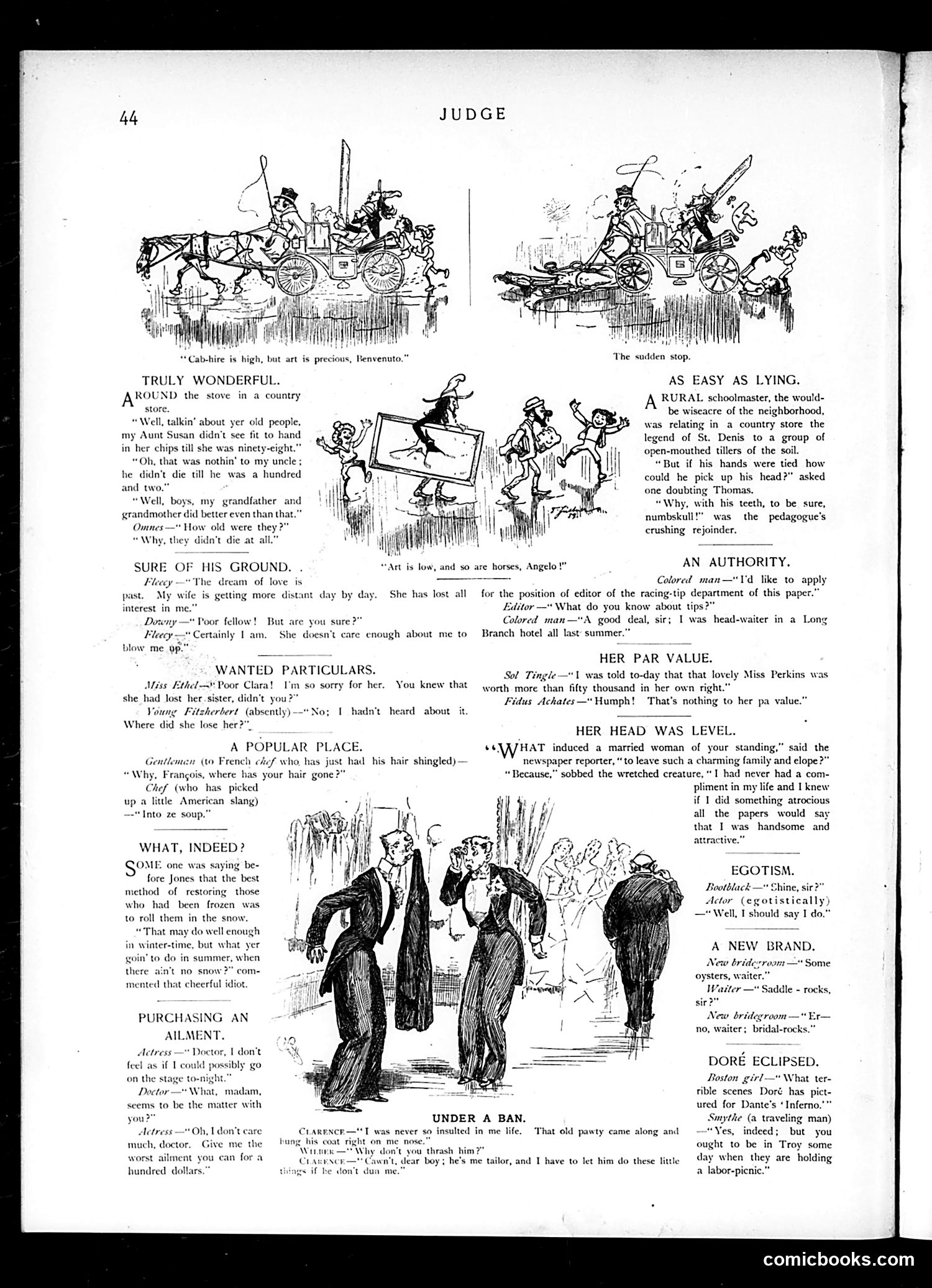
This page contains multiple short humorous anecdotes typical of Judge's satirical format, rather than a single political cartoon. The jokes mock various social types and pretensions of the era: **"Truly Wonderful"** satirizes rural tall-tale exaggeration—country men one-upping each other about relatives' extreme longevity. **"Sure of His Ground"** plays on marital dissolution and emotional distance using racing metaphors. **"As Easy as Lying"** mocks a pompous rural schoolmaster who invents absurd explanations (St. Denis picking up his own severed head with his teeth) to impress gullible farmers. **"An Authority"** jokes about a Black man seeking a newspaper job, implying unqualified applicants; reflects period racial stereotyping. Several other brief jokes target: romantic naiveté, French chef stereotypes, medical quackery, and theatrical vanity. The illustrations show typical Victorian-era dress and social settings. The satire targets pretension, ignorance, and affectation across class lines rather than specific political figures or events.
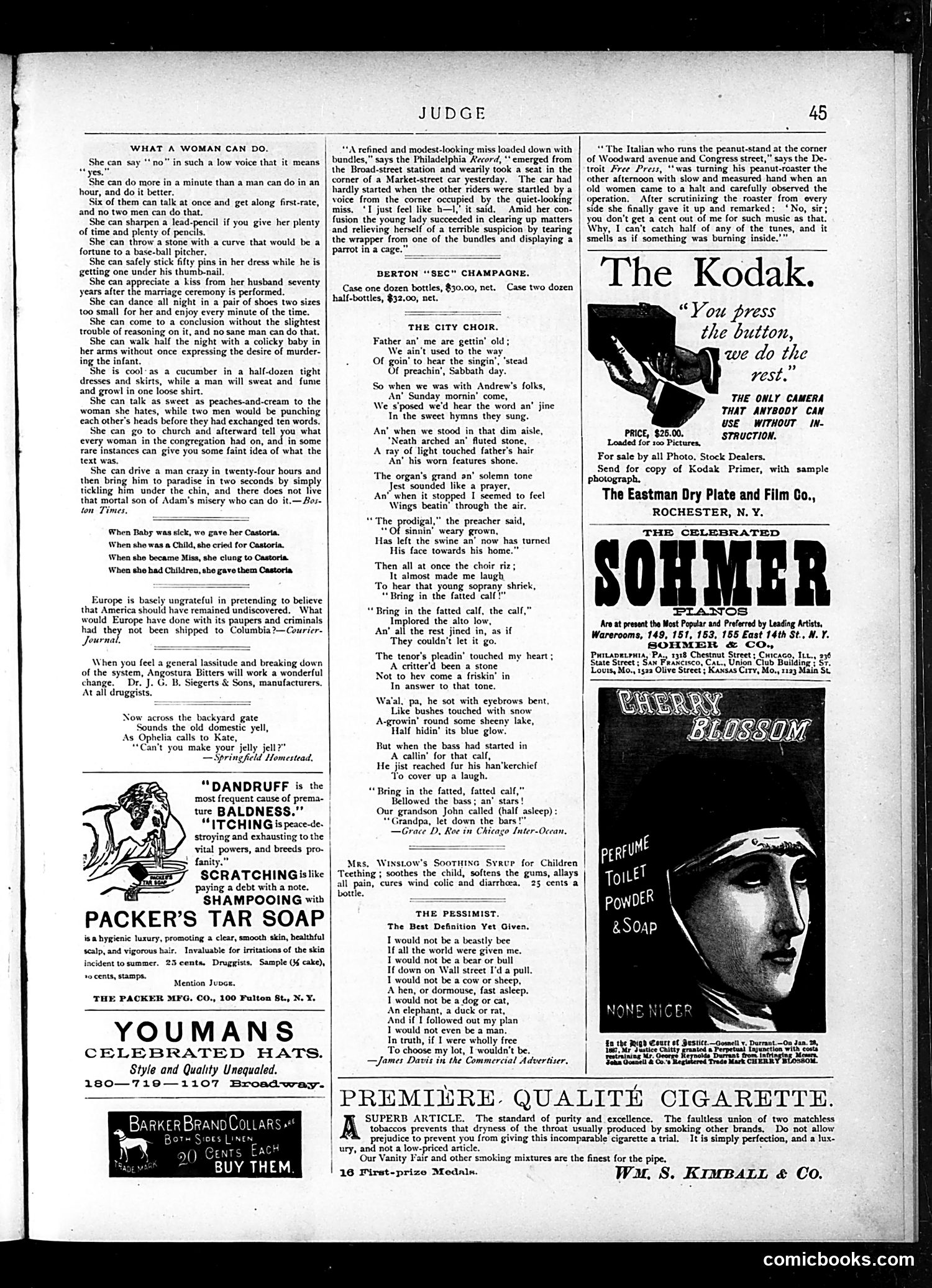
This is a humorous article listing women's supposed capabilities and contradictions, presented as satirical observations rather than serious commentary. It's vintage *Judge* magazine style—light social satire about gender differences. The piece catalogs exaggerated female abilities: talking simultaneously, appreciating old kisses, walking babies without murderous rage, and manipulating men emotionally. The humor relies on period stereotypes—women's irrationality, emotional volatility, and social obsessions (noting what other women wear at church). The final anecdote provides a punchline: a "refined and modest-looking" woman shocking streetcar passengers by exclaiming "I just feel like h—l," then defusing scandal by revealing the expletive came from a parrot in her luggage—not her lips. The satire cuts two ways: mocking both women's expected propriety (and its fragility) and the absurdity of strict behavioral codes. It's broadly comedic rather than biting social criticism, typical of early-1900s magazine humor that played on conventional gender roles without fundamentally challenging them.
This page is primarily **advertisements and miscellaneous content** rather than political cartoons requiring interpretation. The main text item is **"Sebastian Morey's Oration,"** a humorous dialect poem about a rural man bragging about his public-speaking abilities at a county fair, claiming he rivals famous orators like Robert Ingersoll (a prominent 19th-century speaker) and Cicero. The humor derives from his grandiose self-assessment and rustic dialect—a common satirical target in *Judge*, which frequently mocked rural America and small-town pretension. The page is dominated by period **advertisements** for medical tonics (Scott's Emulsion), clothing, catarrh remedies, and other consumer goods typical of 1889. A few **brief satirical quips** appear (about "pugilistic mill" boxing matches, "Blocks of Five" political manipulation), but lack sufficient context for detailed analysis. No identifiable political figures or events are caricatured here.
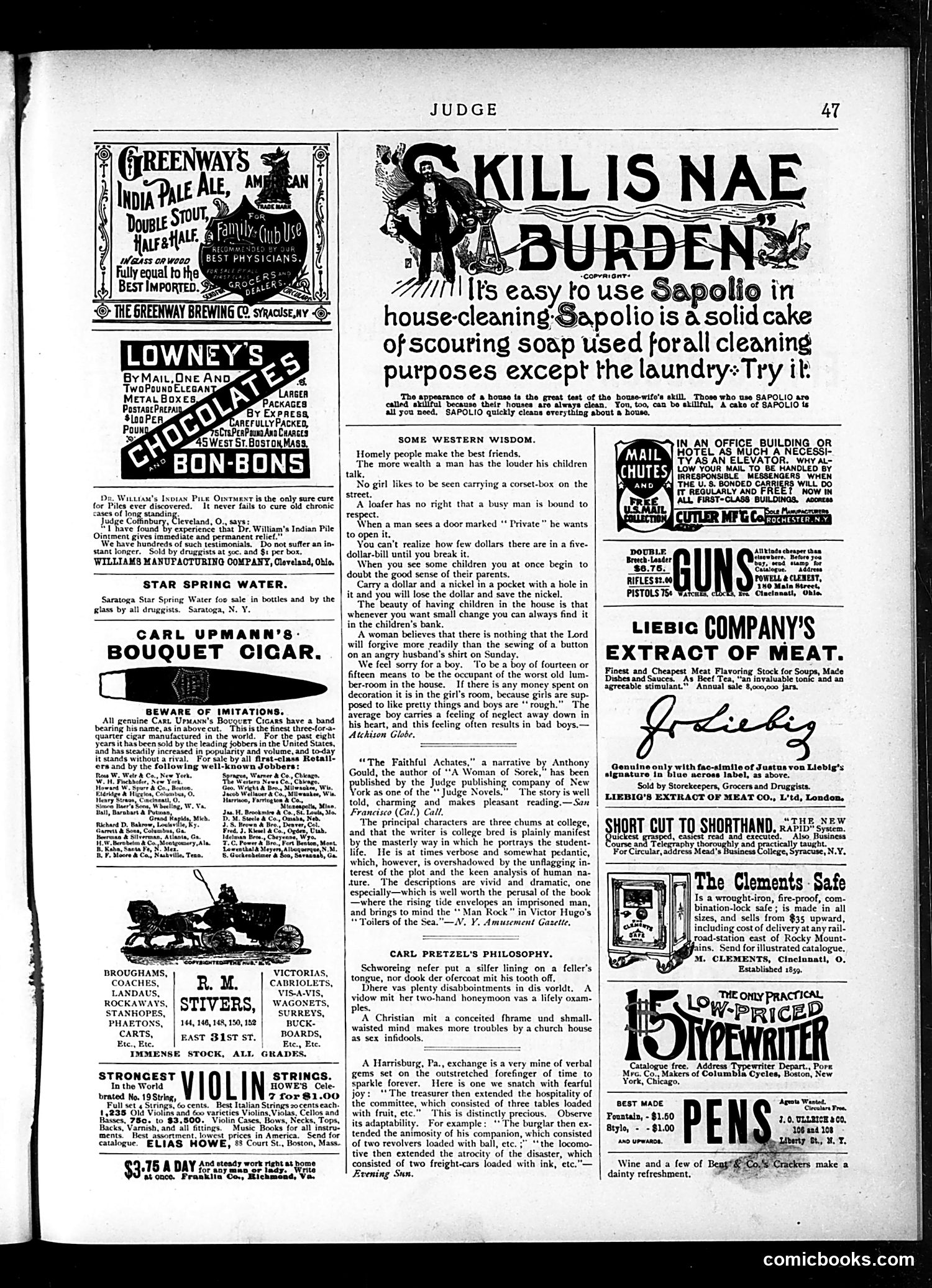
This page is primarily **advertising**, not political cartoons. It's from Judge magazine and features numerous Victorian-era product advertisements: Greenways ale, Lowney's chocolates, Carl Upmann cigars, Dr. Williams' Indian Pile Ointment, Sapolio soap, Liebig's Extract of Meat, typewriters, pens, and other goods. The only editorial content is a section titled "SOME WESTERN WISDOM"—homespun aphorisms about human nature, apparently reprinted from the *Atchison Globe*. These are gentle social observations about poverty, children, gender roles, and family life, not political satire. There are brief literary references to Anthony Trollope's "The Faithful Achates" and Victor Hugo's work, but these are book advertisements rather than satirical commentary. The page reflects Judge's dual nature: a humor magazine that relied heavily on advertising revenue.
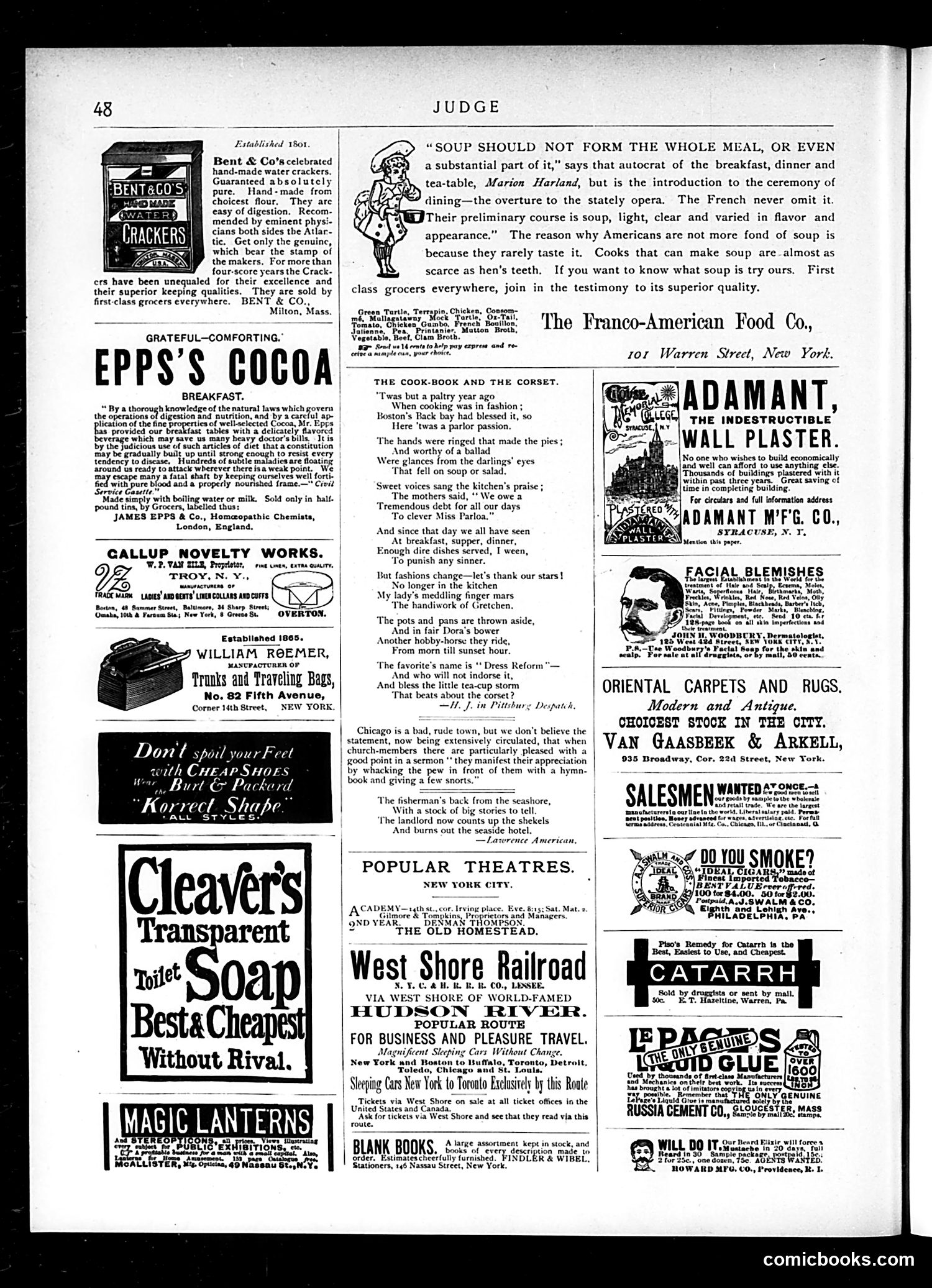
This page is primarily **advertising with one satirical poem**. The main content is a humorous verse titled "The Cook-Book and the Corset" that mocks Boston high society's fleeting cooking fad. **The Satire:** The poem ridicules upper-class women who briefly adopted cooking as a fashionable hobby around a year prior, treating it like parlor entertainment. It mocks their pretentious enthusiasm ("parlor passion," "darlings' eyes"), then celebrates that this ridiculous trend has mercifully ended—women have abandoned the kitchen to return to their proper leisure-class role. The poem presents cooking as something women shouldn't actually do, using sarcastic relief ("let's thank our stars!") that fashion has changed. **Historical Context:** This reflects late-19th century anxieties about gender roles. The satire targets upper-class women's occasional dabbling in "domestic science" as both ridiculous and unseemly, suggesting cooking should remain either servants' work or genuine domestic duty—not a fashionable hobby for leisured ladies. The remainder is typical period advertising: cocoa, soap, railroad travel, carpet dealers, and patent medicines.
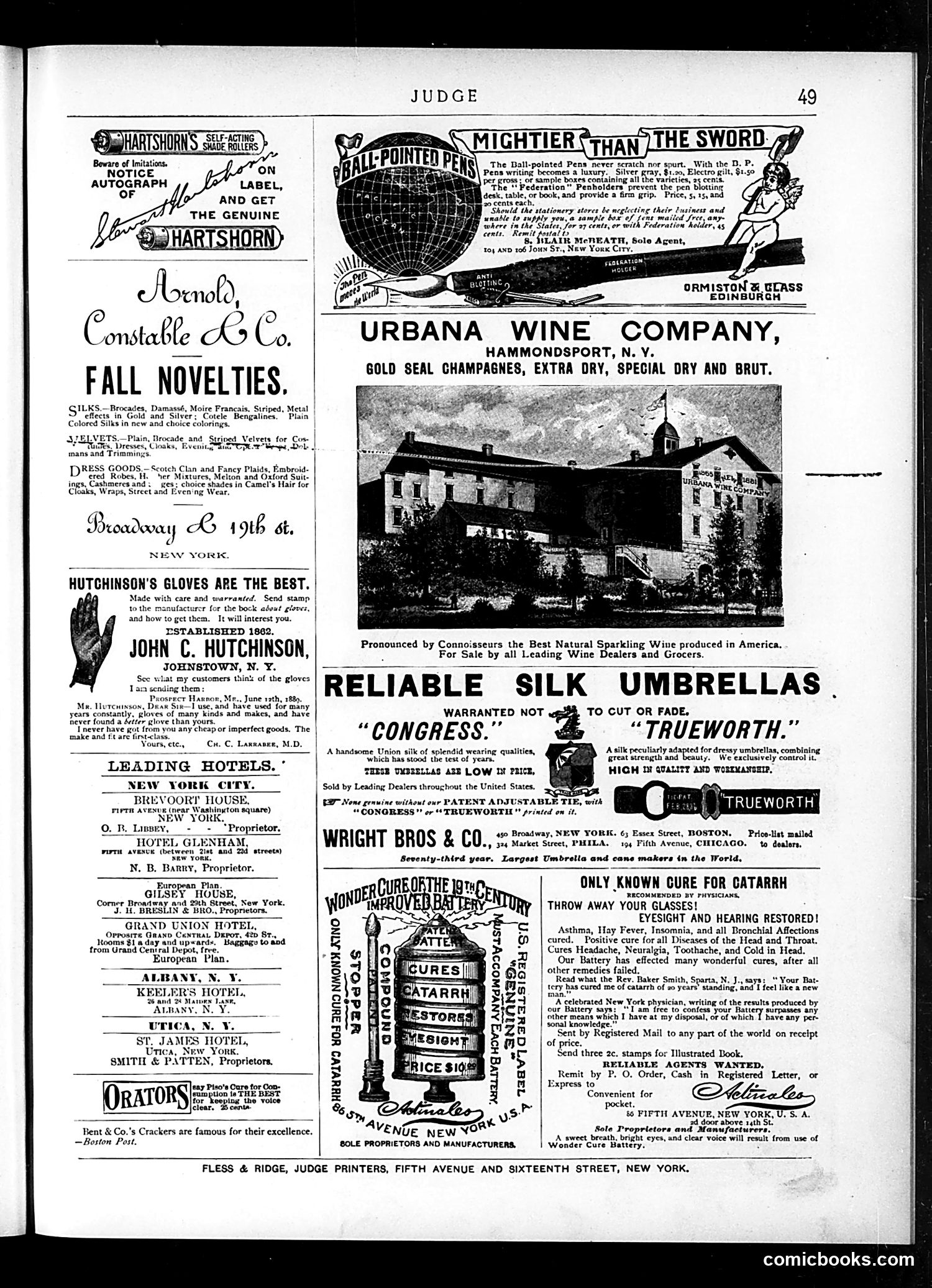
This page is **primarily advertising**, typical of Judge's revenue model in the late 19th century. The substantive content is a single cartoon at top: "Mightier Than the Sword." The cartoon depicts a **ball-pointed pen** (labeled) positioned above a globe, with an armed warrior figure below. The caption and surrounding text promote B.P. pens as superior writing instruments—"the ball-pointed pens never scratch nor spurt. With the B.P. pens writing becomes a luxury." The "mightier than the sword" reference plays on the famous phrase about the pen's power over weaponry, repurposing it as advertising copy. The satire is light: the cartoon humorously argues that elegant penmanship via quality pens surpasses military might—a playful commercial conceit rather than sharp political commentary. The remainder consists of hotel advertisements, product endorsements (gloves, umbrellas, champagne, patent medicine for catarrh), and notices. This mixed content reflects Judge's dual function as both satirical periodical and advertising vehicle.
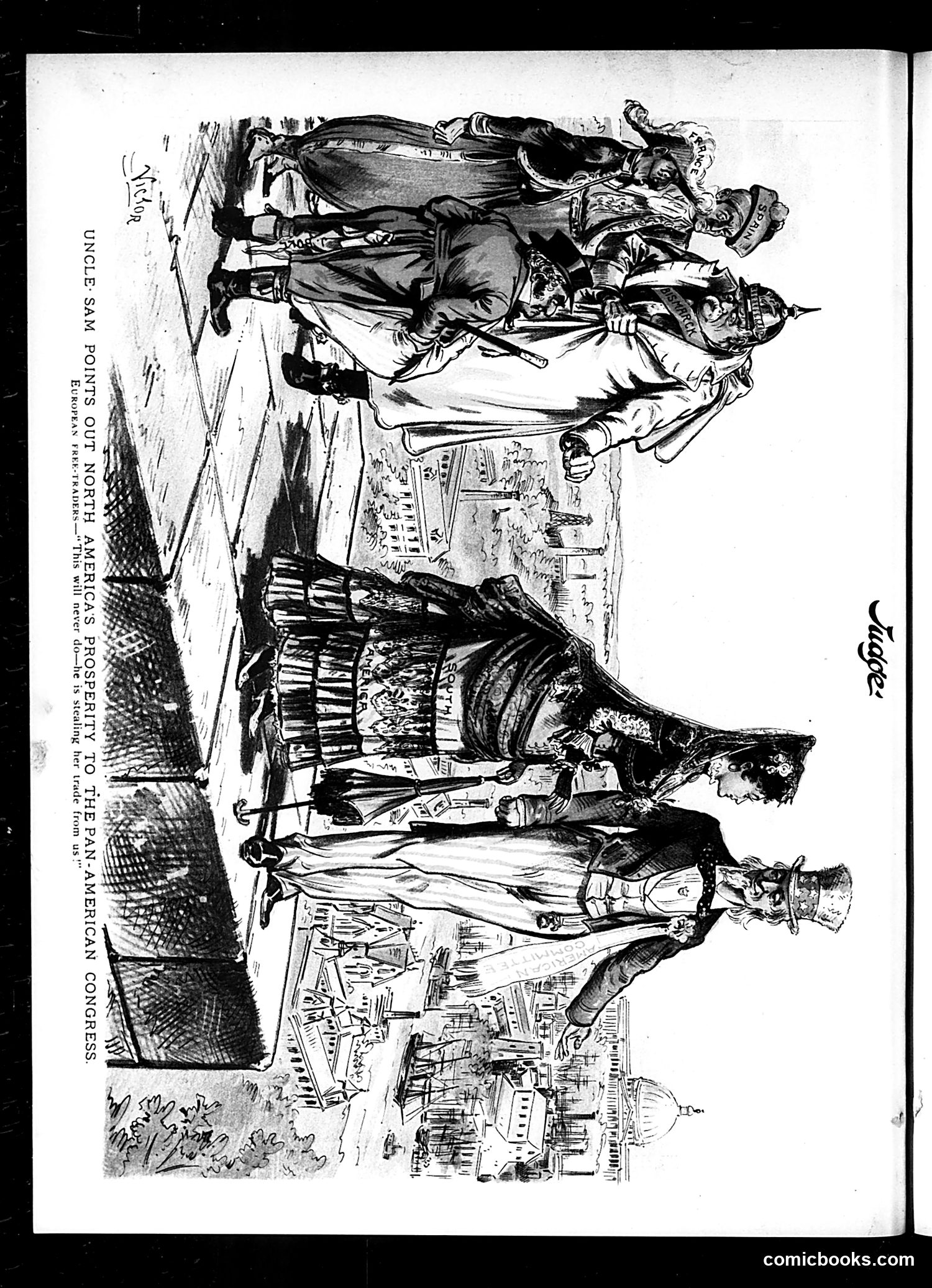
I can see this is a page from *Judge* magazine featuring a political cartoon, but the OCR text is largely corrupted and unreadable, making it difficult to identify specific figures or references with certainty. The image shows what appears to be a satirical scene with multiple figures in period dress (likely late 19th or early 20th century) gathered around a cityscape. There's a prominent figure on the left and various other characters in the composition. The artistic style is typical of *Judge's* satirical engravings. Without legible text identifying the figures or the specific political/social context, I cannot reliably explain what this cartoon satirizes or who the caricatured figures represent. To accurately interpret this cartoon's meaning for a modern reader, I would need either clearer OCR text or additional publication information (date, title) not visible here.