
Judge, 1889-10-26 · page 7 of 16
Judge — October 26, 1889 — page 7: what you’re looking at
What you’re looking at
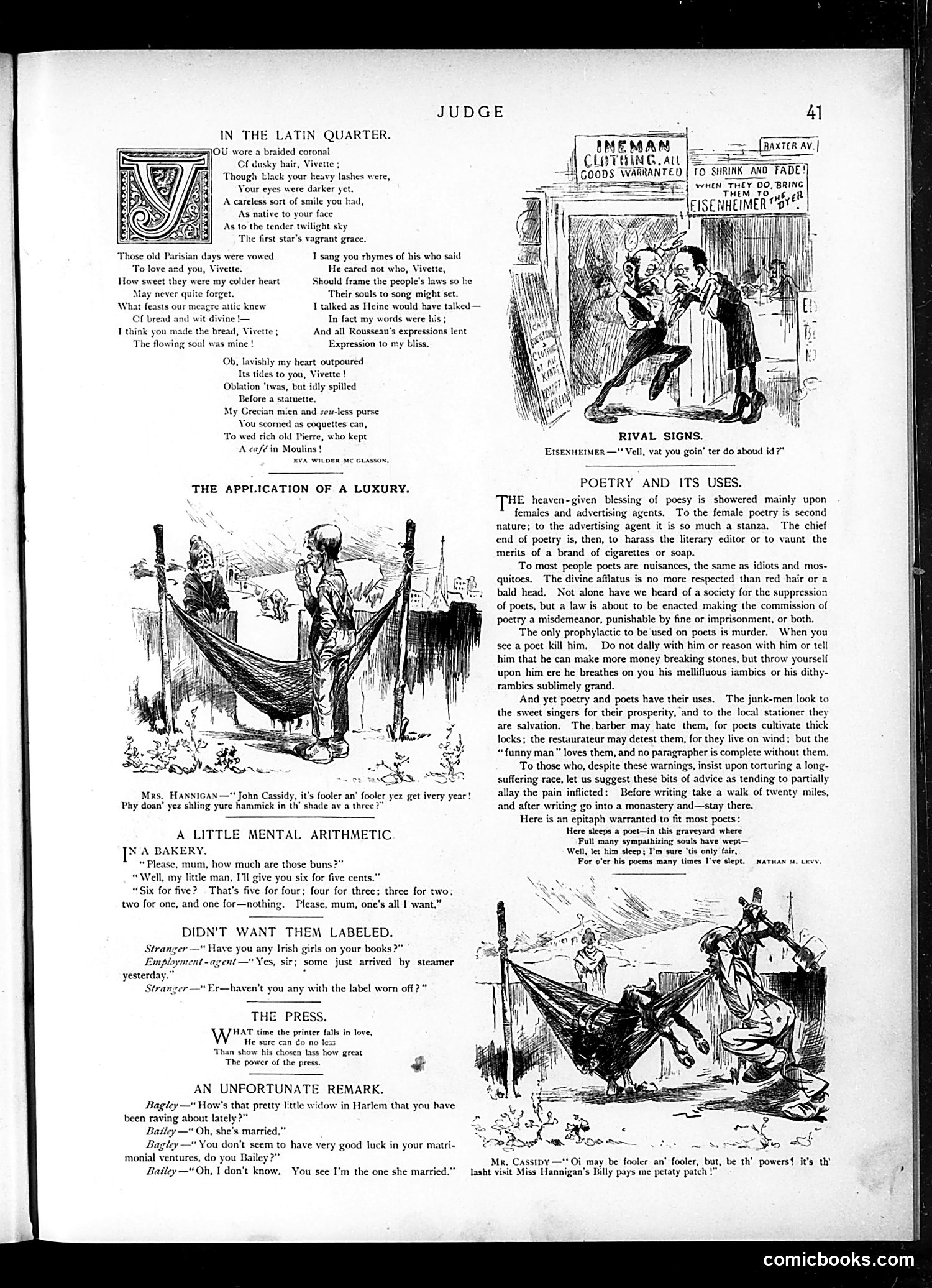
This page contains two main satirical pieces: **"Rival Signs"** (top right): A cartoon showing two competing storefronts—an "Ineman Clothing" shop and "Eisenheimer's"—with the proprietors arguing. The humor mocks German-Jewish immigrant business rivalry on the Lower East Side, using exaggerated accents ("Vell, vat you goin' ter do aboud id?"). The competing signs advertise nearly identical wares, satirizing how immigrant merchants clustered in the same neighborhoods selling the same goods. **"Poetry and Its Uses"** (main text): A scathing satirical essay dismissing poets as public nuisances comparable to "idiots and mosquitoes." Judge argues poetry serves only to annoy literary editors, help advertising agents, and benefit junk dealers (who collect discarded manuscripts). The piece sarcastically suggests murder as the only effective "prophylactic" against poets, reflecting late-19th-century American contempt for artistic pretension and bohemianism among the educated class.
📄 Transcribed text from this page (OCR, searchable)
Machine-transcribed from the original scan — historical spelling and the odd misread are preserved.
IN THE LATIN QUARTER. OU wore a braided coronal Cf dusky hair, Vivette ; Though black your heavy lashes were, Your eyes were darker yet. A careless sort of smile you kad, AS native to your face As to the tender twilight sky The first star's vagrant grace. ‘Those old Parisian days were vowed I sang you rhymes of his who said He cared not who, Vivette, Should frame the people's laws so ke Their souls to song might set. T talked as Heine would have talked— In fact my words were his ; And all Rousseau’s expressions lent Expression to my bliss, To love and you, Vivette. How sweet they were my colder heart May never quite forget. What feasts our Cf bread and wit divine | T think you made the bread, Vivette ; ‘The flowing soul was mine ! Ob, lavishly my heart outpoured tides to you, Vivette ! Oblation ‘twas, but idly spilled Before a statuette, My Grecian mien and sou-less purse You scorned as coquettes can, To wed rich old Pierre, who kept A café in Moulins ! AVA WILDER MC GLASSON, THE APPLICATION OF A LUXURY. 4l BAXTER AV. | AND FADE!) | INEMAN CLOTHING. Au GOODS WARRANTED SESS | wren THey 00, BRING —— qT WEIMER 1 RIVAL SIGNS. Eisexwenter—'* Vell, vat you goin’ ter do aboud id ?” POETRY AND ITS USES. THE heaven-given blessing of poesy is showered mainly upon females and adver ing agents. To the female poetry is second nature; to the advertising agent it is so much a stanza. The chief end of poetry is, then, to harass the literary editor or to vaunt the merits of a brand of cigarettes or soap. To most people poets are nuisances, the same as idiots and mos- quitoes. The divine afflatus is no more respected than red hair or a bald head, Not alone have we heard of a society for the suppression of poets, but a law is about to be enacted making the commission of poetry a misdemeanor, punishable by fine or imprisonment, or both. The only prophylactic to be used on poets is murder. When you see a poct kill him. Do not dally with him or reason with him or tell him that he can make more money breaking stones, but throw yourself upon him ere he breathes on you his mellifluous iambics or his dithy- rambics sublimely grand. And yet poetry and poets have their uses. The junk-men look to the sweet singers for their prosperity, ‘and to the local stationer they are salvation. The. barber may hate them, for poets cultivate thick locks; the restaurateur may detest them, for they live on wind; but the “funny man” loves them, and no paragrapher is complete without them. To those who, despite these warnings, insist upon torturing a long- suffering race, let us suggest these bits of advice as tending to partially allay the pain inflicted: Before writing take a walk of twenty miles, and after writing go into a monastery and—stay there. Here is an epitaph warranted to fit most poets: Here sleeps a poet—in this graveyard where Full many sympathizing souls have wept— Well, let kim sleep; I'm sure ‘tis only fair, For o'er his poems many times I've slept. Mrs, HansiGay—"* John Cassidy, it’s fooler an’ fooler Phy doan’ yez shling yure hammick in th’ shade av a three? 2 get ivery year! A LITTLE MENTAL 18 A BAKERY. “Please, mum, how much are those bun: “Well, my little man, I'll give you six for five cents.” “Six for five? That's five for four; four for three; three for two; two for one, and one for—nothing, Please, mum, one’s all I want, DIDN’T WANT THEM LABELED, Stranger —* Mave you any Irish girls on your books?” Employment -agent —" Yes, sit; some just arrived by steamer yesterday.” Stranger —"F-—haven't you any with the label worn off?” ARITHMETIC NATHAN MLE THE PRESS. HAT time the printer falls in tve, He sure can do no lea The power of te prem é AN UNFORTUNATE REMARK. Bagley —" How's that pretty little widow in Harlem that you have been raving about lately ?” Bailey —* Ob, she’s married.” Bagley —"You don't scem to have very good luck in your matri- monial ventures, do you Bailey?” Oi may be fooler an’ fooler Bailey —" Oh, | don’t know. y t, be th’ powers! it’s th’ iss Hannigan’s Lilly pays me petaty patch M You see I'm the one she married.” —_lasht visit comicbooks.com