
Judge, 1889-10-26 · page 6 of 16
Judge — October 26, 1889 — page 6: what you’re looking at
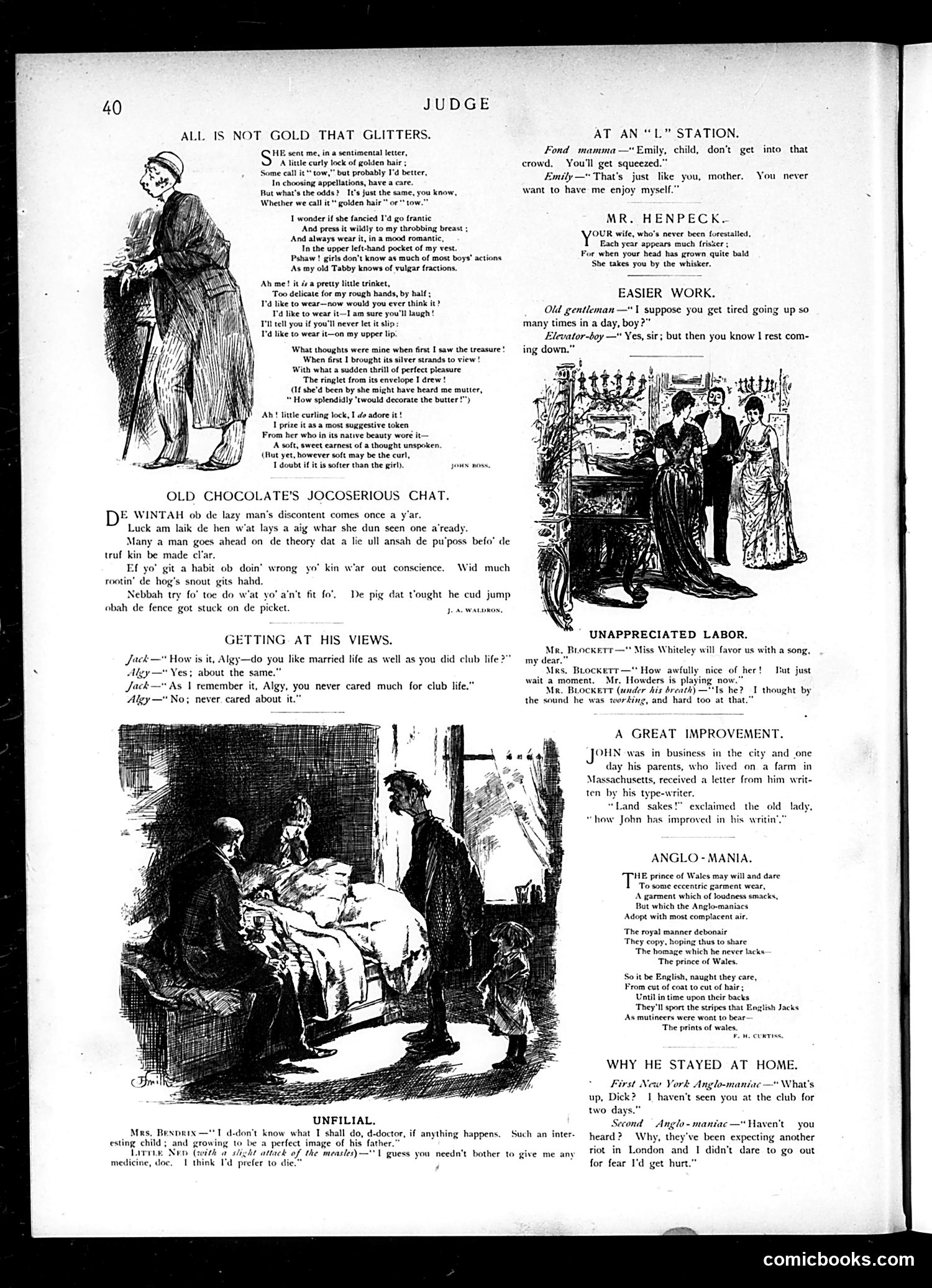
What you’re looking at
This page contains multiple humor pieces from *Judge* magazine (likely late 19th century): **"All Is Not Gold That Glitters"** mocks a young man who receives a lock of hair from a romantic interest, written as if from his perspective. The joke: he finds the "golden" hair disappointing—comparing it to "tow" (cheap fiber)—and fantasizes about wearing it as a fake mustache rather than treasuring it romantically. It's satirizing both sentimental romance and male vanity. **Other sketches** include brief comedic exchanges: a mother at a crowded train station, a henpecked husband, an elevator boy, and dialect humor from "Old Chocolate" (a racist caricature using stereotypical Black vernacular—typical of the era's offensive humor). **"Anglo-Mania"** satirizes wealthy Americans' obsession with copying British aristocratic fashion and manners, suggesting they'll eventually adopt even the ridiculous (prison stripes) if it's English. These represent typical *Judge* content: social satire, domestic humor, and period-specific class commentary.
📄 Transcribed text from this page (OCR, searchable)
Machine-transcribed from the original scan — historical spelling and the odd misread are preserved.
ALL JUDGE IS NOT GOLD THAT GLITTERS. HE sent me, in a sentimental letter, A little curly lock of golden hair ; ‘Some call it * tow,” but probably I'd better, In choosing appellations, have a care. But what's the odds? It's just the same, you know, Whether we call it golden hair” or tow."” 1 wonder if she fancied I'd go frantic And press it wildly to my throbbing breast ; And always wear it, in a mood romantic, In the upper left-hand pocket of my vest. Pshaw ! girls don’t know as much of most boys’ actions As my old Tabby knows of vulgar fractions. Ah me! it is a pretty little trinket, ‘Too delicate for my rough hands, by half; T'd like to wear—now would you ever think it? Td like to wear it—I am sure you'll laugh ! T'l tell you if you'll never let it slip. I'd like to wear it—on my upper lip: What thoughts were mine when first I saw the treasure ! When first I brought its silver strands to view ! With what a sudden thrill of perfect pleasure The ringlet from its envelope I drew ! (If she'd been by she might have heard me mutter, “ How splendidly "twould decorate the butter !") Ab! little curling lock, I do adore it ! I prize it as a most suggestive token From her who in its native beauty wore it— A soft, sweet earnest of a thought unspoken (But yet, however soft may be the curl, AT AN “L” STATION. Fond mamma —"Emily, child, don't get into that crowd. You'll get squeezed. Emily —" That's just like you, mother. want to have me enjoy myself.” You never MR. HENPECK. OUR wife, who's never been forestalled, Each year appears much fris when your head has grown quite bald She takes you by the whisker. EASIER WORK. Old gentleman —"\ suppose you get tired going up so many times in a day, boy? Elevator-boy —" Yes, sit; but then you know I rest com- I doubt if it is softer than the girl. JOHN moss, OLD CHOCOLATE’S JOCOSERIOUS CHAT. WINTAH ob de lazy man’s discontent comes once Luck am laik de hen w’at lays a aig whar she dun seen one a’ready. Many a man goes ahead on de theory dat a lie ull ansah de pu'poss befo’ de truf kin be made c Ef yo" g rootin’ de ho a habit ob doin’ wrong yo’ kin w'ar out conscience. Wid much 1S snout gits hahd. Nebbah try fo" toe do w’a yo'a’n't fit fo’, De pig dat tought he cud jump obah de fence got stuck on de picket. JA WALDRON, TING AT HIS VIEWS. UNAPPRECIATED LABOR. | ° Mr. Brocketr—" Miss Whiteley will favor us with a song, Jeck —" How is it, Algy—do you like married life as well as you did club life?" my dear Yes; about the same.” Mrs. Biocke tt ” wait a moment. ir. Howders is ‘ing now.” Jack—" As | remember it, Algy, you never cared much for club life. Mu, Buockert (under his brewehy ls he? Algy —" No; never. cared about it. the sound he was teorking, and hard too at that.” —"How awfully nice of her! But just I thought by A GREAT IMPROVEMENT. OHN was in business in the city and one day his parents, who lived on a farm in Massachusetts, received a letter from him writ- ten by his type-writer. “Lands: “how Jobn hi * exclaimed the old lady, improved in his writin’,” ANGLO - MANIA. HE prince of Wales may will and dare To some eccentric garment wear, A garment which of loudness smacks, But which the Anglo-maniacs Adopt with most complacent air. ‘The royal manner debonair They copy, hoping thus to share ‘The homage which he never lacks. The prince of Wales. So it be English, naught they care, From cut of coat to cut of hair; Until in time upon their backs ‘They'll sport the stripes that As mutincers were wont to bear The prints of wales. WHY HE STAYED First Ne up, Dick? two days.” Second Anglo- maniac —"Haven't you heard? Why, they've been expecting another riot in London and I didn’t dare to go out for fear I'd get hurt.” AT HOM York Anglo-maniae—* What's I haven't scen you at the club for UNFILIAL. Mrs, Bexpeix—"'1 d-don't know what T shall do, d-doctor, if anything happens. Such an inter esting child; and growing to be a perfect image of his father.” Larrie Nep (with a slight attack of the measles)—""\ guess you needn't bother to give me any medicine, doc. I think I'd prefer to die.” comicbooks.com