
A complete issue · 16 pages · 1889
Judge — September 14, 1889
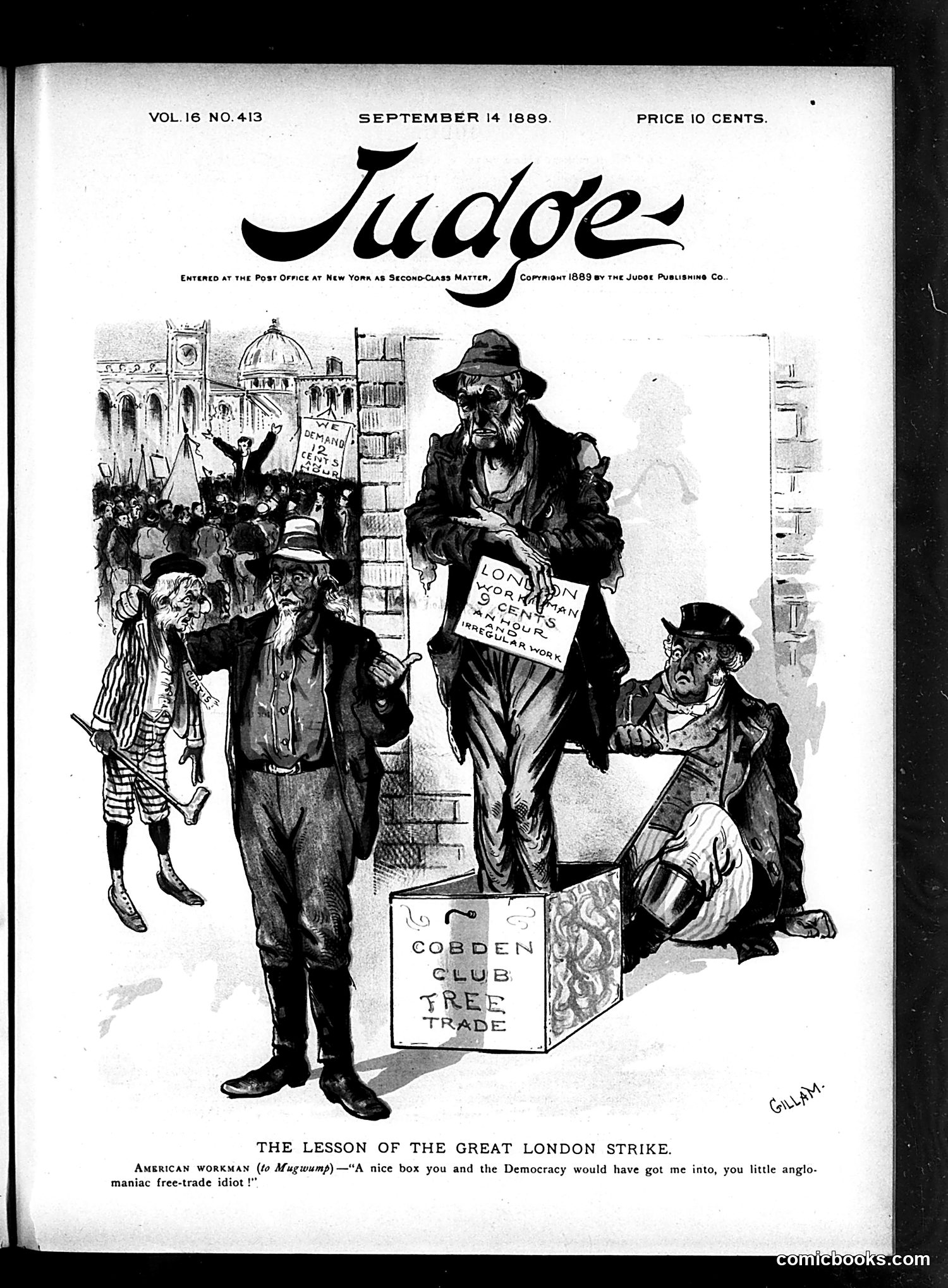
This 1889 cartoon satirizes the London Dock Strike's implications for American labor. The central tall figure labeled "Cobden Club Tree Trade" represents British free-trade ideology. The caption quotes an American workman warning that embracing such democracy and free-trade economics would harm American workers—calling the idea "idiotic." The caricatured figures surrounding the tree (appearing to include labor agitators and strikers) suggest the cartoon portrays the London strike as evidence that unfettered free trade and radical labor movements destabilize society. The satire targets American advocates of British-style free trade, arguing the 1889 London labor unrest proves such policies dangerous. The overall message warns American workers against adopting similar trade or labor philosophies.
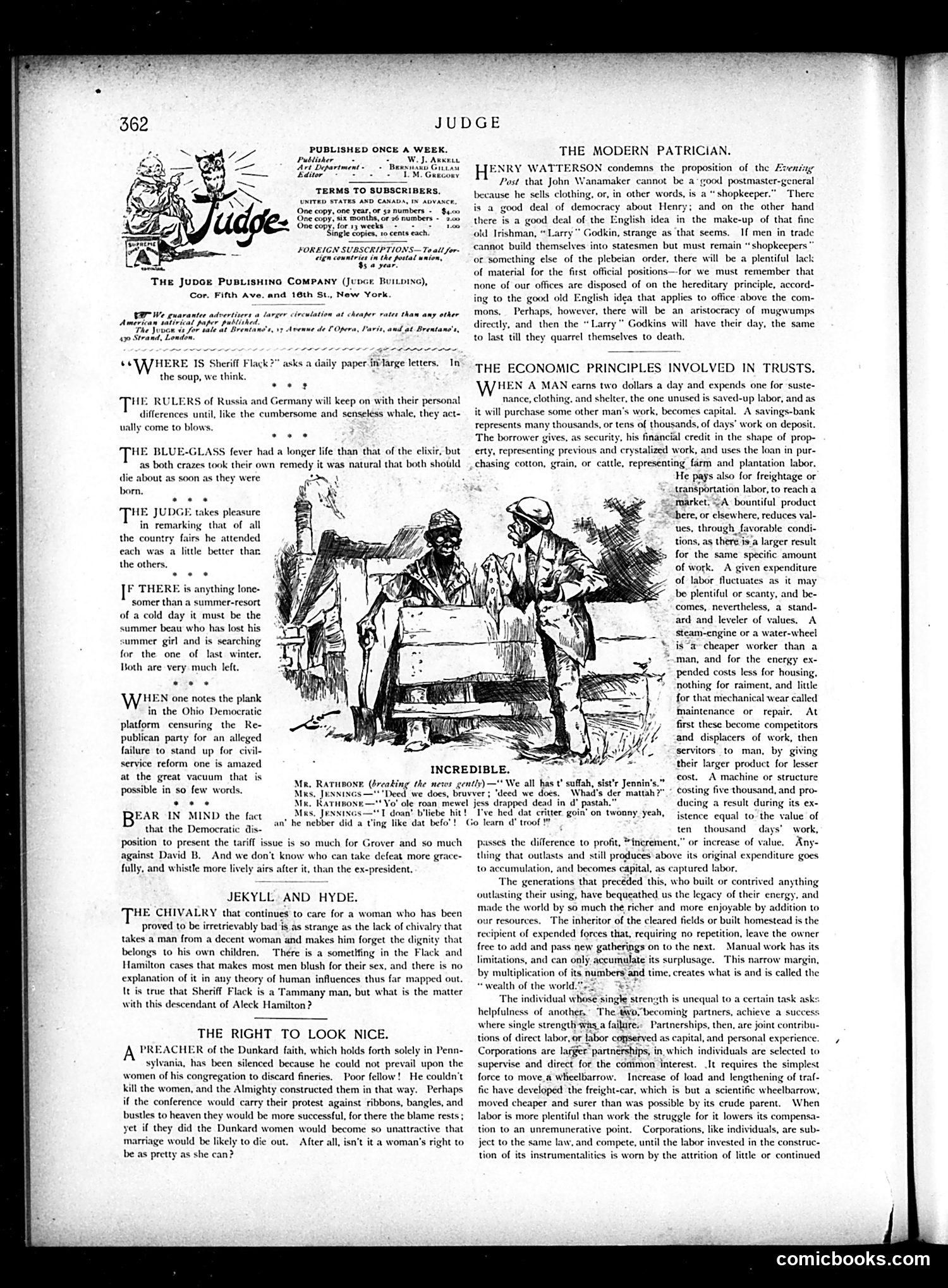
This page contains several brief satirical items rather than a unified cartoon. The key pieces include: **"Where is Sheriff Flack?"** — A short quip questioning a sheriff's whereabouts, likely a local political jab at an absent or ineffective official. **"The Modern Patrician"** — Henry Watterson condemns John Wanamaker's proposal for an Evening Post, criticizing Wanamaker's democratic pretensions while noting he's actually an old-money "patrician" who can't genuinely relate to common people. **"The Economic Principles Involved in Trusts"** — An illustrated article (with workers loading cargo) explaining how trusts and monopolies concentrate wealth and labor value, benefiting owners at workers' expense—typical Progressive-era economic critique. The page reflects early 20th-century American concerns about wealth inequality, monopolistic practices, and the gap between democratic ideals and plutocratic reality.
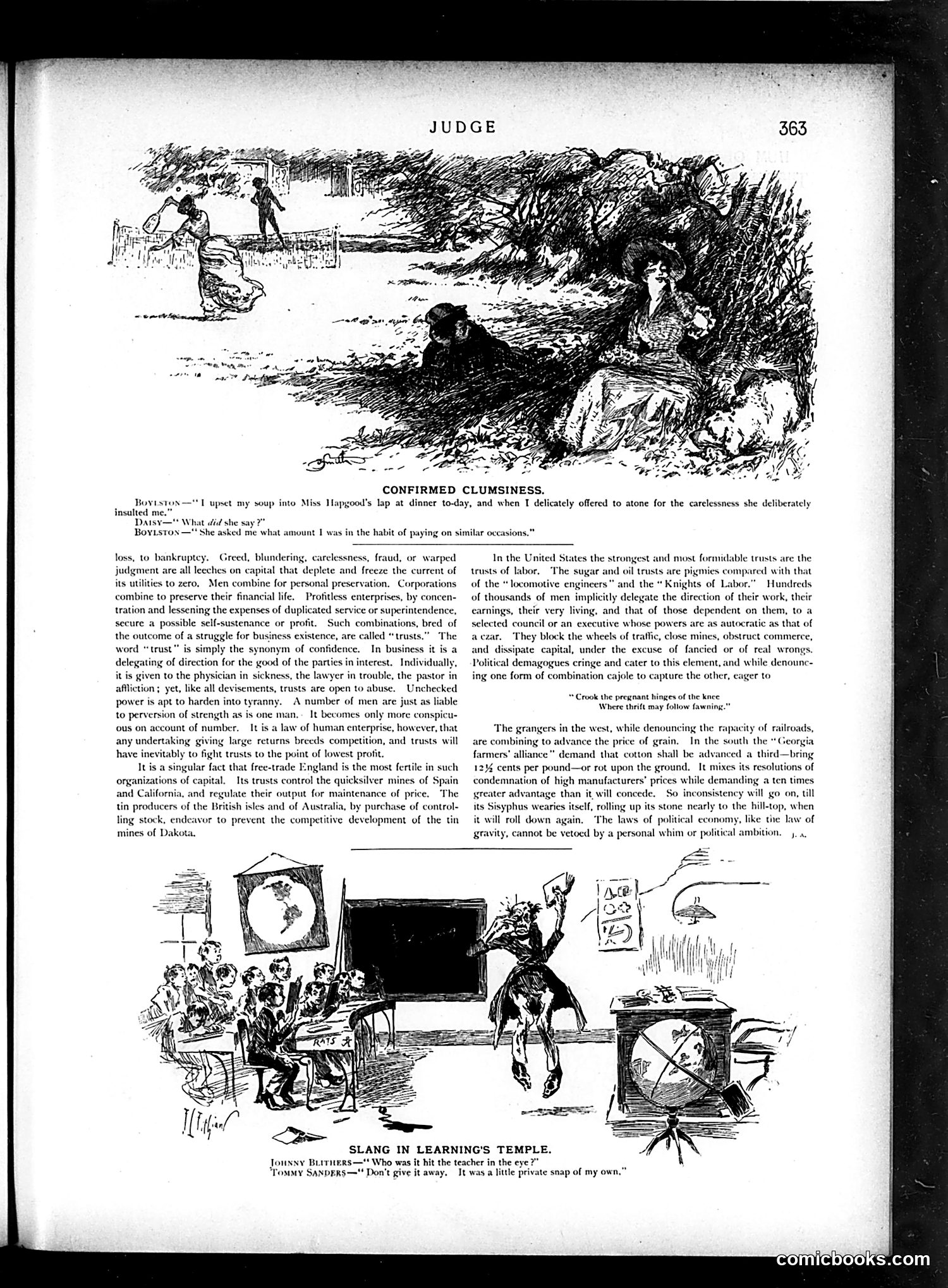
This page contains two separate satirical pieces: **"Confirmed Clumsiness"** (top): A brief comic dialogue where a woman intentionally spills soup on another's lap, then insults her by asking what payment she usually receives for such "accidents"—implying the victim is a servant or woman of low social standing. The joke turns on class assumptions and deliberate rudeness masked as clumsiness. **"Slang in Learning's Temple"** (bottom): A schoolyard joke where one boy asks another who hit their teacher in the eye. The response—"it was a little private snap of my own"—suggests the second boy struck the teacher himself but won't admit it publicly. The satire critiques schoolboy violence and lack of discipline. The long middle text essay discusses business trusts, labor unions, and economic monopolies—contemporary concerns in the Gilded Age. It argues trusts are both necessary and dangerous, prone to abuse when unchecked.
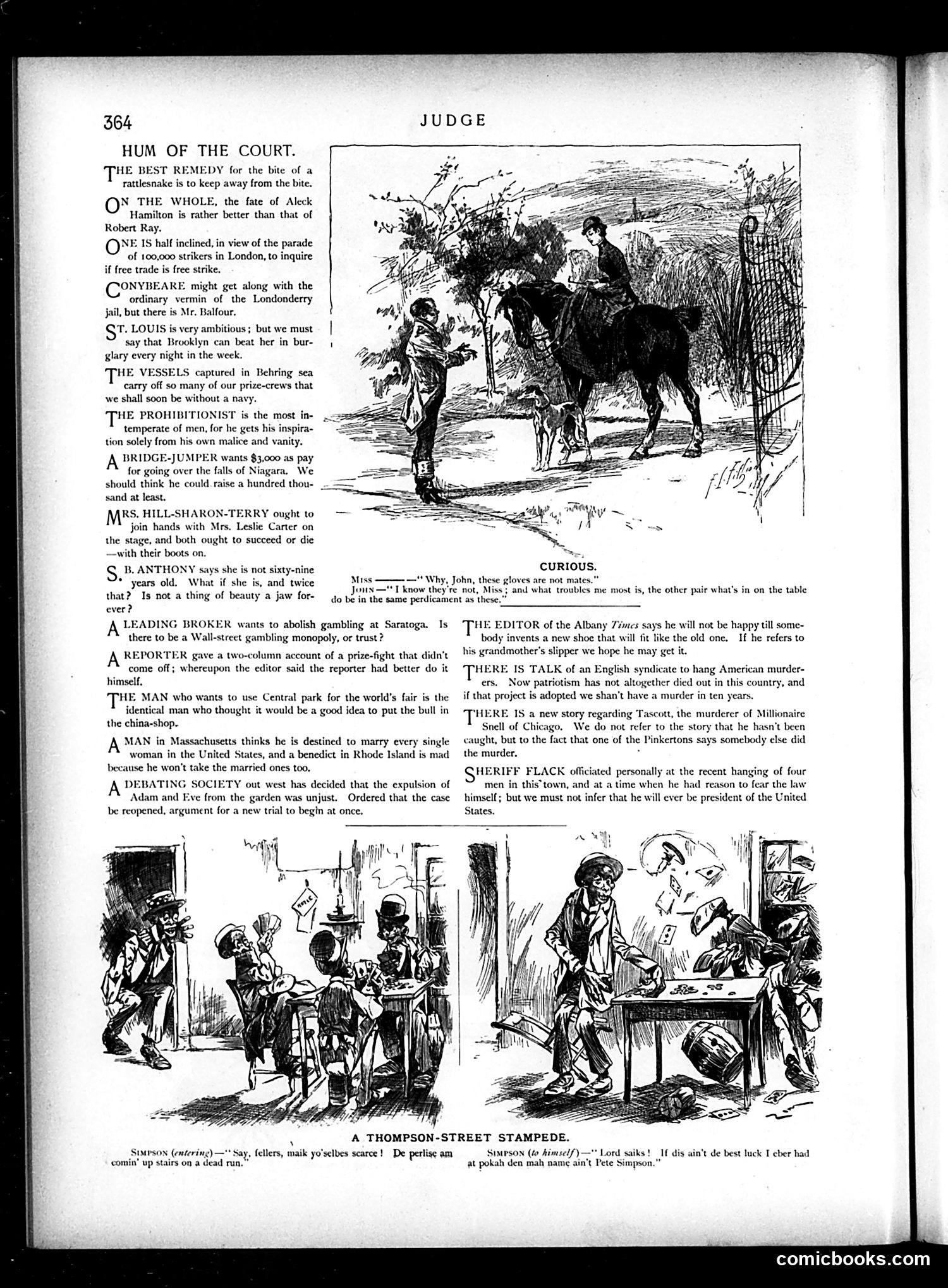
This page from Judge contains brief satirical commentary and two cartoon illustrations mocking contemporary issues and figures. ## "Hum of the Court" Section Short quips address topical concerns: labor unrest (London strikers), Irish politics (Balfour, Londonderry jail), naval disputes (Behring Sea vessel seizures), and American city crime (comparing St. Louis and Brooklyn). References to "Aleck Hamilton" and "Robert Ray" appear to be contemporary figures, though their specific identities are unclear from this context alone. ## Bottom Cartoons Two panels titled "A Thompson-Street Stampede" depict an African American character (Pete Simpson) playing poker when police arrive. The humor relies on racial stereotypes—dialect ("de perlise," "mah name") and the implication that he's relieved the police raid interrupts his gambling game, allowing him to claim good luck. ## Overall Point This represents typical Judge satire of the era: topical political commentary mixed with humor that by modern standards reflects deeply offensive racial caricature and stereotyping common to 1880s-90s American publications.
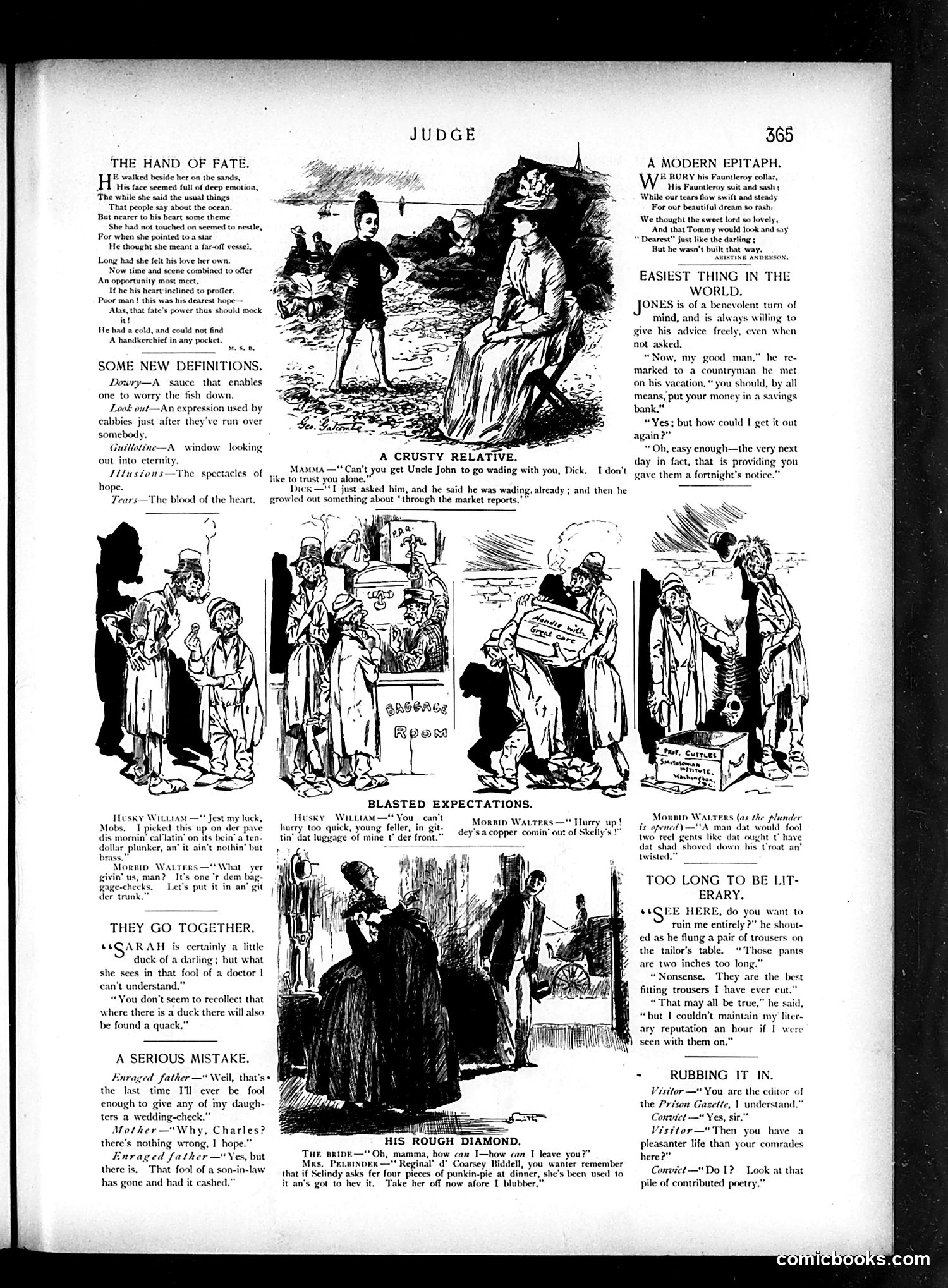
This page contains multiple short satirical pieces typical of Judge's humor circa early 1900s: **"The Hand of Fate"** mocks romantic clichés—a man attempts a dramatic seaside proposal but is thwarted by having a cold and no handkerchief. **"A Crusty Relative"** jokes about miserly uncles avoiding children's requests. **"Blasted Expectations"** features characters with exaggerated working-class accents (rendered as "Husky William," "Morris Walters") discovering disappointments—finding fake money, discovering a runaway, etc. The crude dialect humor reflects period attitudes. **"Too Long to Be Literary"** satirizes pretentious writers obsessed with image—a man won't wear properly-fitting trousers because it would damage his literary reputation. **"A Modern Epitaph"** mocks parents' disappointment that their child wasn't as picture-perfect as expected. The page relies heavily on class-based humor, dialect comedy (now considered offensive), and gentle domestic satire about courtship, family, and social pretension—standard Judge content for affluent urban readers.
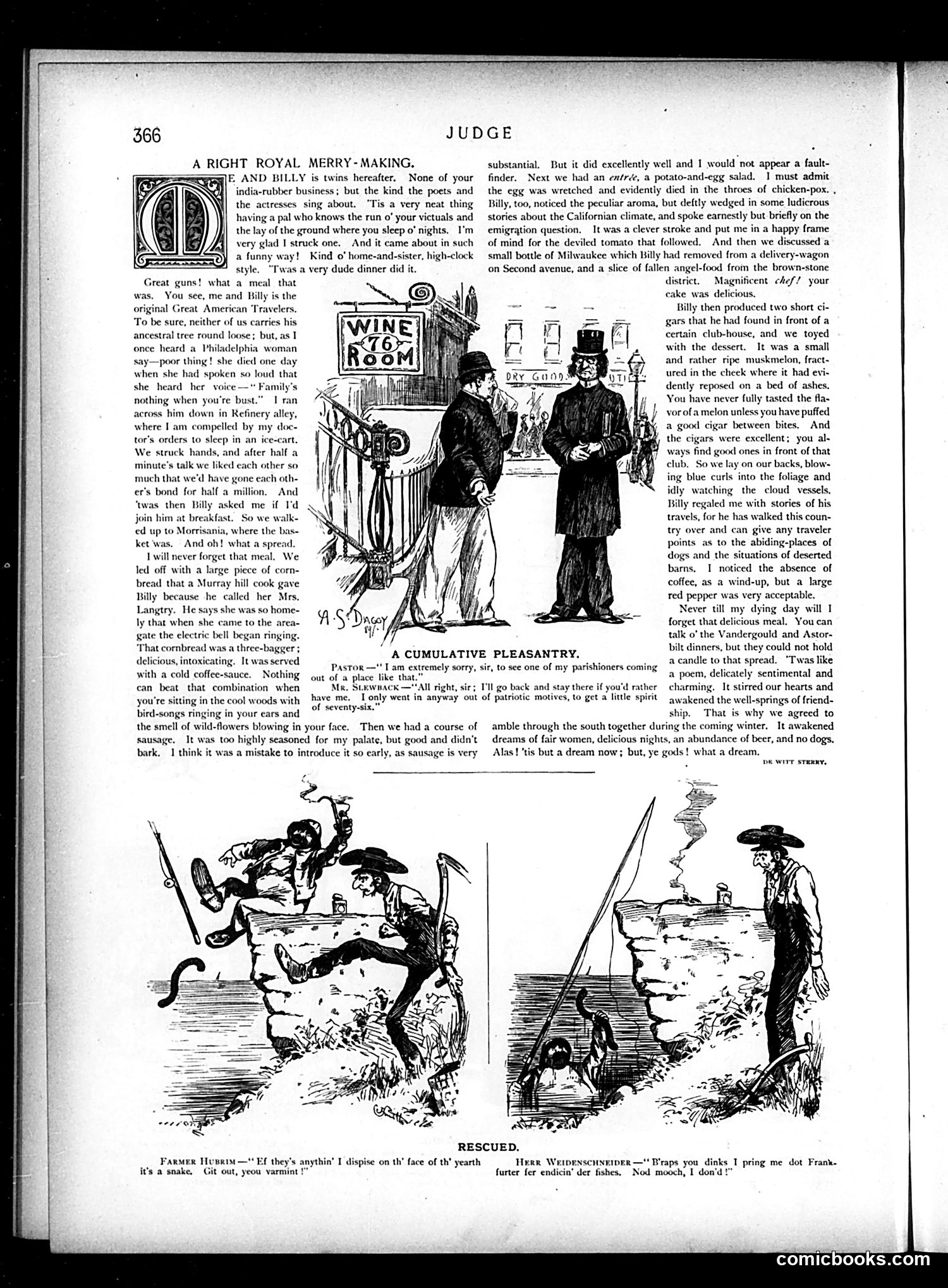
This page contains three distinct satirical pieces from *Judge* magazine: **"A Right Royal Merry-Making"** (top): Two vagrants bond over a makeshift meal of cornbread, sausage, and other humble foods. The humor lies in their mock-grandiose language describing garbage-tier cuisine—treating scraps as haute cuisine. This satirizes both class pretension and the romanticization of poverty among vagrants. **"A Cumulative Pleasantry"** (middle): A pastor apologizes for seeing a parishioner leaving a tavern, then launches into a sentimental monologue about dreams of travel and romance. The satire mocks self-righteous clergy who preach morality while indulging fantasies, and the gap between religious propriety and human desire. **"Rescued"** (bottom): Two cartoon vignettes showing a farmer and a cowboy each discovering something dangerous (a snake and a man in water). The humor appears to be slapstick physical comedy common to the era. The page exemplifies *Judge*'s style: social satire targeting hypocrisy, class absurdities, and human folly through exaggerated dialogue and crude woodcut illustrations.
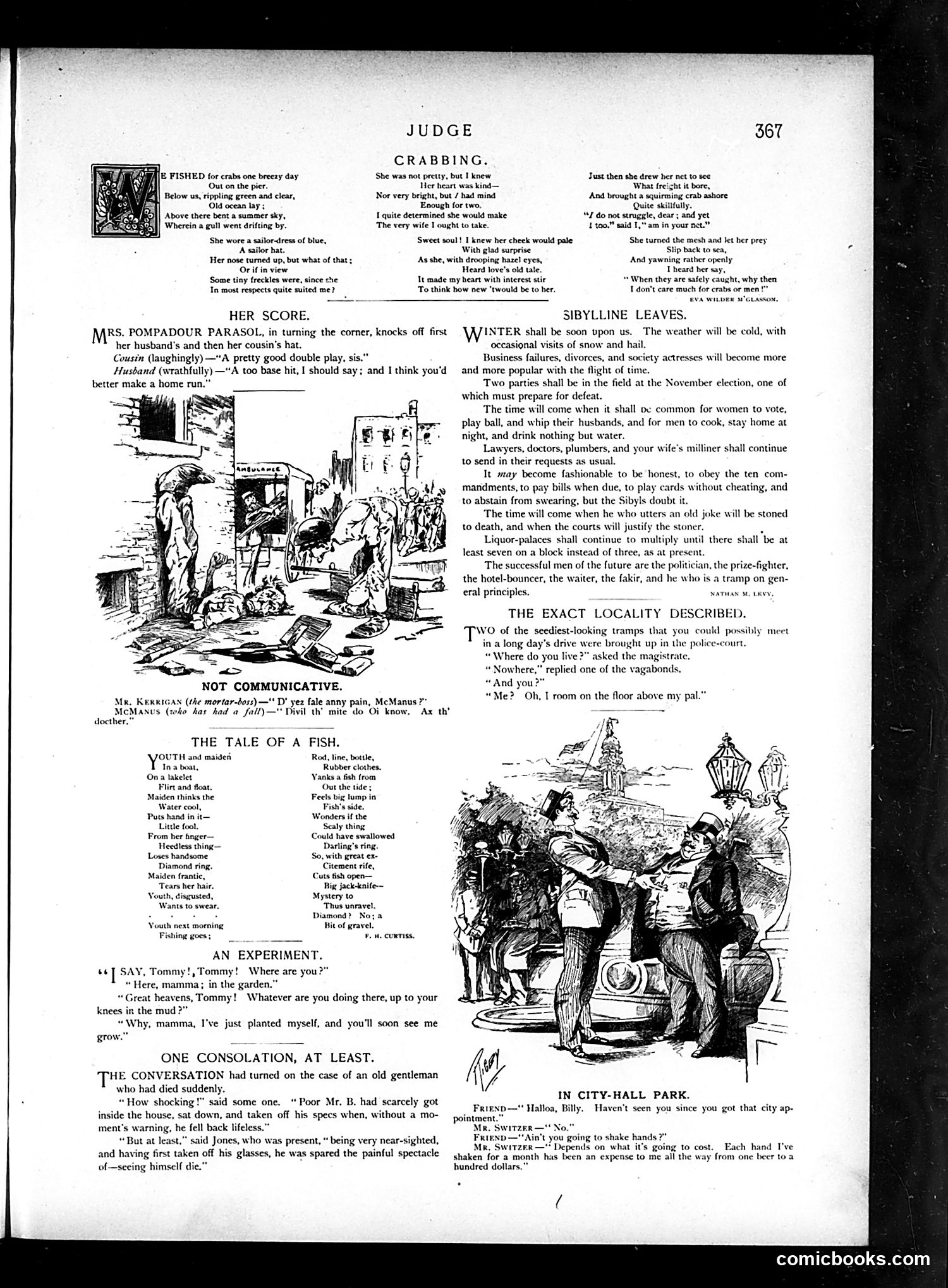
This page contains several satirical pieces typical of Judge magazine's humor: **"Crabbing"** (main poem with illustration): A romantic poem about a man courting a young woman while fishing. The satire lies in the anti-climax: despite his elaborate romantic setup, she indifferently releases the crabs and yawns, dismissing both the crabs and men with equal disinterest. It mocks both sentimental male romanticism and female apathy. **"Sibylline Leaves"**: Mock-prophetic predictions about winter and society. The satire targets social hypocrisy—predictions of women voting and men cooking are presented as absurdities, while predicting continued corruption among lawyers and proliferation of liquor establishments reveals cynicism about "progress." **Other brief pieces** include wordplay jokes ("Her Score," "Not Communicative") and "The Tale of a Fish"—a lighthearted narrative where a youth searches a fish for a lost diamond ring only to find gravel instead. The overall tone is genteel Victorian-era satire, poking fun at romance, social pretension, and urban life through accessible humor and illustration.
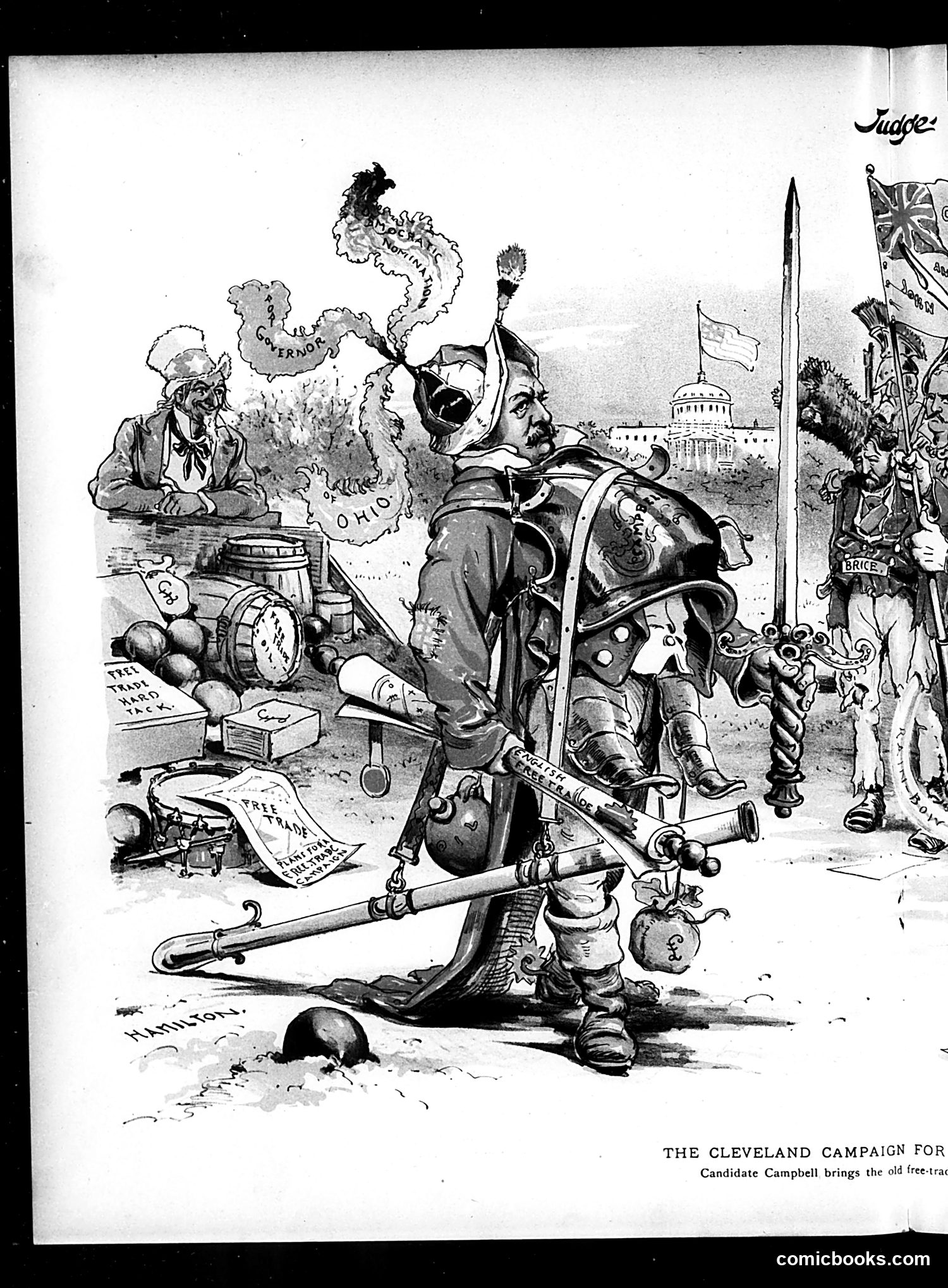
This *Judge* magazine cartoon satirizes "The Cleveland Campaign" involving candidate Campbell and free-trade policy. The central figure is a military man (likely representing a political candidate) laden with weapons and military gear, standing amid barrels, supplies, and trade-related documents. On the left, a figure (possibly representing Ohio or a state interest) watches from behind what appears to be a map showing "Governor" and state boundaries. The Capitol building is visible in the background, establishing a Washington political context. The satire appears to criticize a candidate for bringing militaristic or aggressive approaches to what should be a free-trade economic debate. The heavy weaponry contrasts ironically with commercial/trade materials, suggesting the cartoon mocks using aggressive political tactics on a trade policy issue. Without the full caption and date, the specific candidate and election year remain unclear.
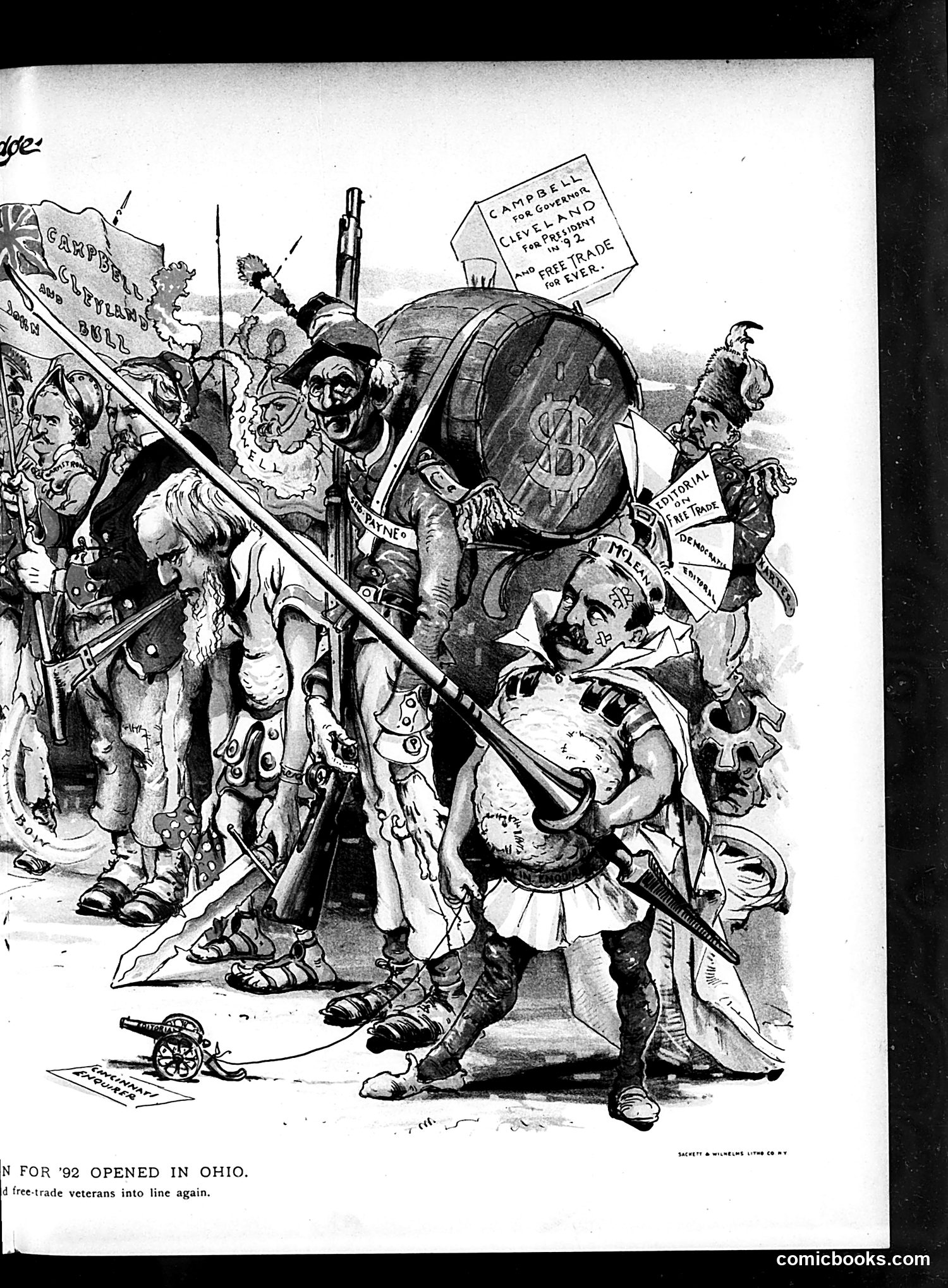
This is a satirical cartoon about the 1892 presidential campaign, apparently featuring political figures depicted as military soldiers carrying cannons and weapons marked with dollar signs. The visible signs reference "Campbell for Governor" and "Cleveland for President," suggesting this concerns Democratic Party politics in Ohio during that election year. The militaristic imagery with financial symbols appears to mock how politicians "mobilize" economic arguments and constituencies. The reference to "free-trade veterans" in the caption suggests the cartoon satirizes how candidates, particularly around tariff/trade policy debates, attempt to rally their base supporters. The grotesque caricatures and chaotic composition emphasize Judge magazine's skeptical view of campaign rhetoric and political maneuvering during the 1892 election cycle.
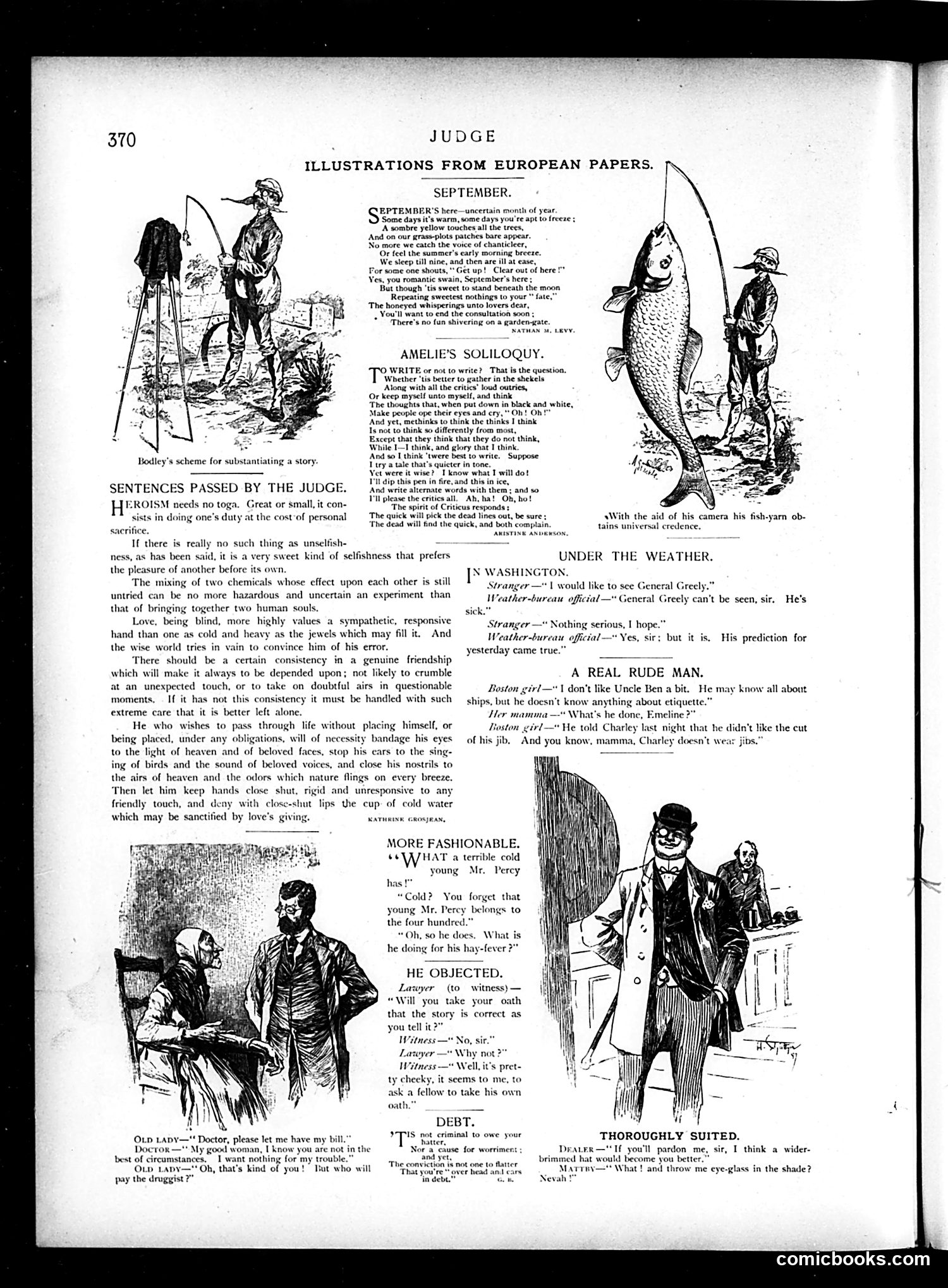
This is a collection of satirical vignettes and illustrations from a late 19th-century American humor magazine. The page includes: **"Amelie's Soliloquy"**: A parody of Hamlet's famous soliloquy, where a female writer agonizes over whether to publish her work, mocking both pretentious literary ambition and critics' harshness. **"Sentences Passed by the Judge"**: Philosophical aphorisms about heroism, selfishness, and love—typical of Judge's moralistic humor. **"Under the Weather" and "A Real Rude Man"**: Brief comic dialogues mocking social incompetence. One jokes about General Greely being "sick" after a weather prediction fails; another satirizes a man who uses nautical jargon ("jib") inappropriately in polite society. The cartoons illustrate fishing scenes and social situations. Overall, this page exemplifies Judge's brand of genteel satire targeting literary pretension, social awkwardness, and bureaucratic absurdity—humor aimed at educated middle and upper-class readers.
This dialect poem represents a **racist minstrel-show stereotype** common in late-19th-century American humor. The text depicts an enslaved or formerly enslaved person ("young nigga") being instructed to guide a mule toward "Abram's lan'" (the biblical promised land, used here as a euphemism for freedom or escape during flood conditions). The "satire" relies on **exaggerated African American vernacular dialect** and the figure of the struggling, frightened Black person—standard minstrel tropes. The reference to Noah's flood and "Abram's land" creates a religious framework, but the humor derives entirely from caricature and perceived inferiority. The Hartford Post attribution suggests this was syndicated popular humor. By modern standards, this represents **dehumanizing racist content** typical of the era's "respectable" publications, where such material appeared alongside advertisements and ostensibly serious articles.
This page is primarily **advertising**, not editorial satire. It features period patent medicines, household goods, and food products with typical late-19th-century marketing claims. The most prominent items are Beecham's Pills (claiming to cure stomach, digestive, and liver ailments "like magic"), and **Sapolio** scouring soap, which carries a warning against imitations—suggesting competitor fraud was common. Other ads include Lowney's chocolates (Boston-made luxury goods), Grosse & Blackwell jams, and Uncle Sam's Corn Salve. Small comic anecdotes appear (a child discussing circus attendance, a mother asking her son about losing buttons), but these are filler content typical of period magazines. The single editorial item discusses the New York Herald and Times favoring British interests in the Behring Sea controversy—a reference to late-1880s/early-1890s seal-hunting disputes. That brief comment criticizes American newspapers as unpatriotic appears to be Judge magazine's only editorial contribution to this page.
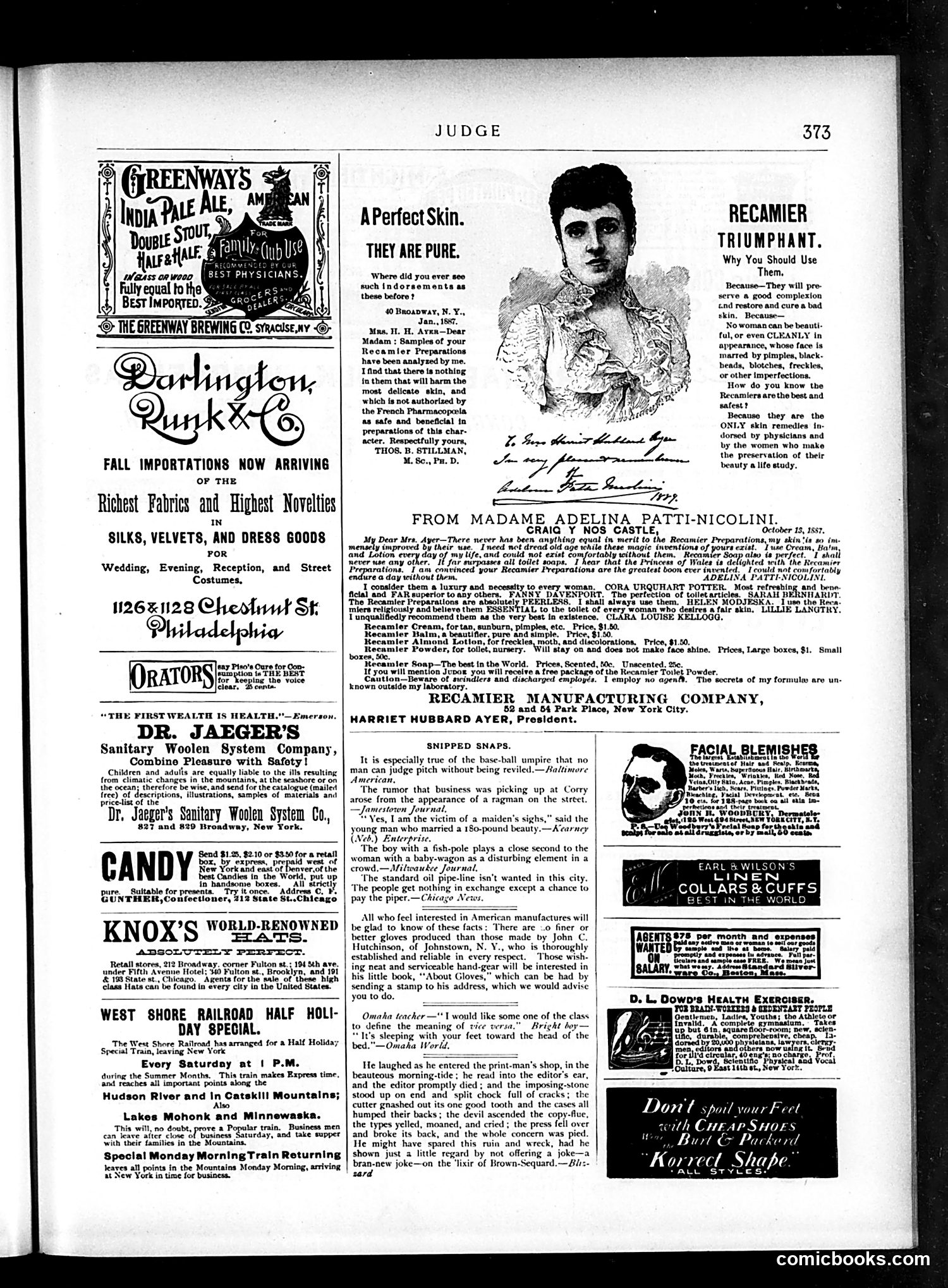
This page is primarily **advertising**, not political satire. It contains multiple product endorsements and commercials typical of late-19th-century magazines. The notable content includes testimonials for **Recamier Preparations** (skincare products), featuring endorsements from prominent figures including **Madame Adelina Patti-Nicolini**, a celebrated opera singer of the era. Her letter praises the cosmetics effusively, claiming they preserve youth and beauty. There's also a chemical analysis endorsement from **Dr. Thos. B. Stillman** validating the product's safety. The page demonstrates how celebrity endorsements functioned in Victorian-era advertising—famous women lending credibility to beauty products. Other ads promote Dr. Jaeger's health underwear, Knox hats, railroad excursions, and confectionery. The satirical intent, if any, is subtle—possibly mocking the exaggerated claims and testimonials common in patent medicine and cosmetic advertising of the period, though Judge's typical irreverent tone is largely absent here.
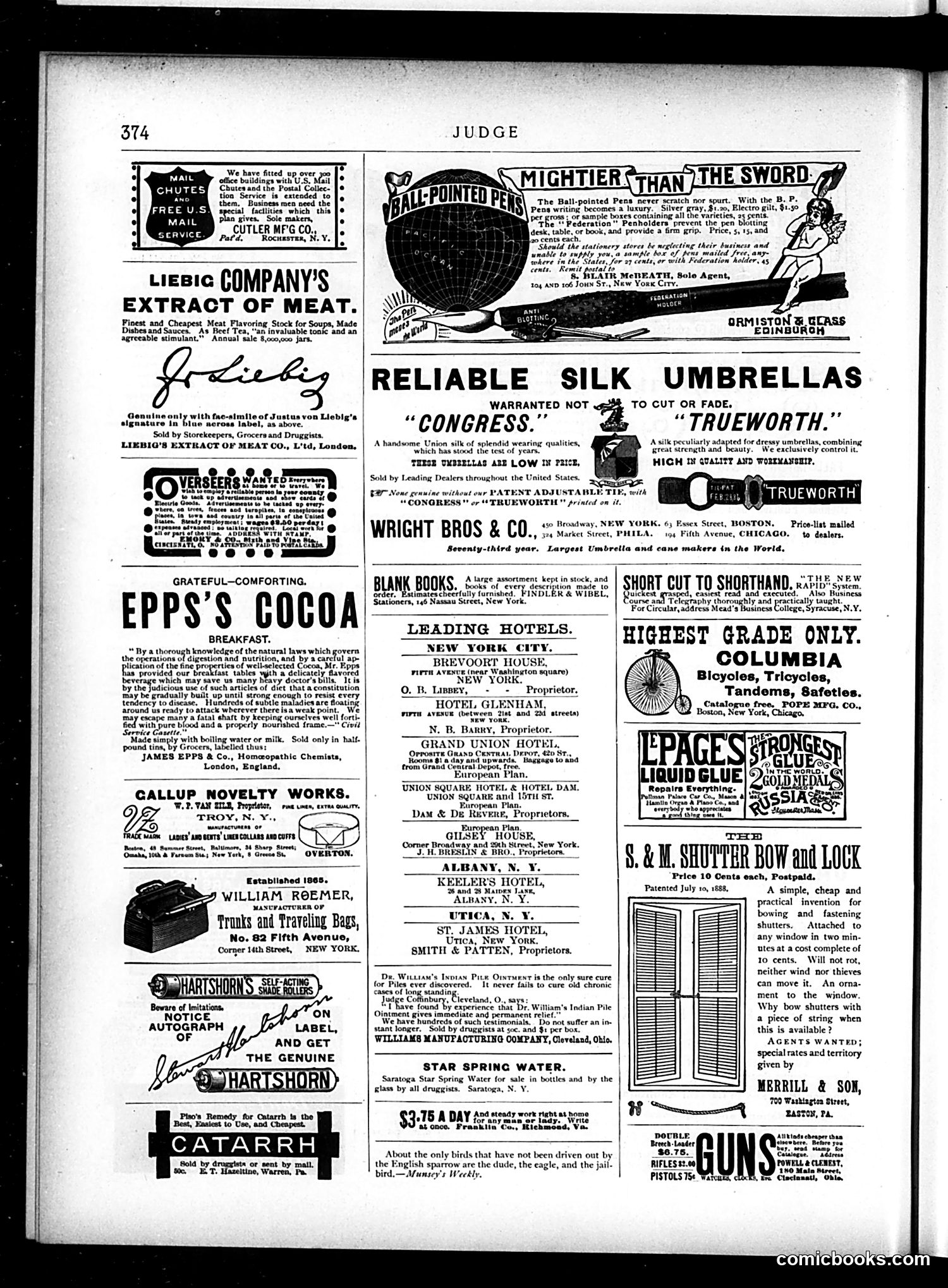
This page is primarily **advertising, not political cartoons**. It's page 374 from Judge magazine, filled with late 19th-century product advertisements. The only illustration with potential satirical content is the "Ball-Pointed Pen" advertisement (top right), which shows a figure labeled "Mightier Than The Sword"—a reference to the phrase "the pen is mightier than the sword," suggesting intellectual power over violence. This appears to be a straightforward product claim rather than political satire. The remaining content consists entirely of commercial advertisements for goods like cocoa, umbrellas, bicycles, hotels, and office equipment. There are signed endorsements (Liebig's Extract of Meat features a facsimile signature), a common advertising practice of the era for credibility. No identifiable political figures or events are present on this page. It represents Judge's advertising revenue model rather than its editorial content.
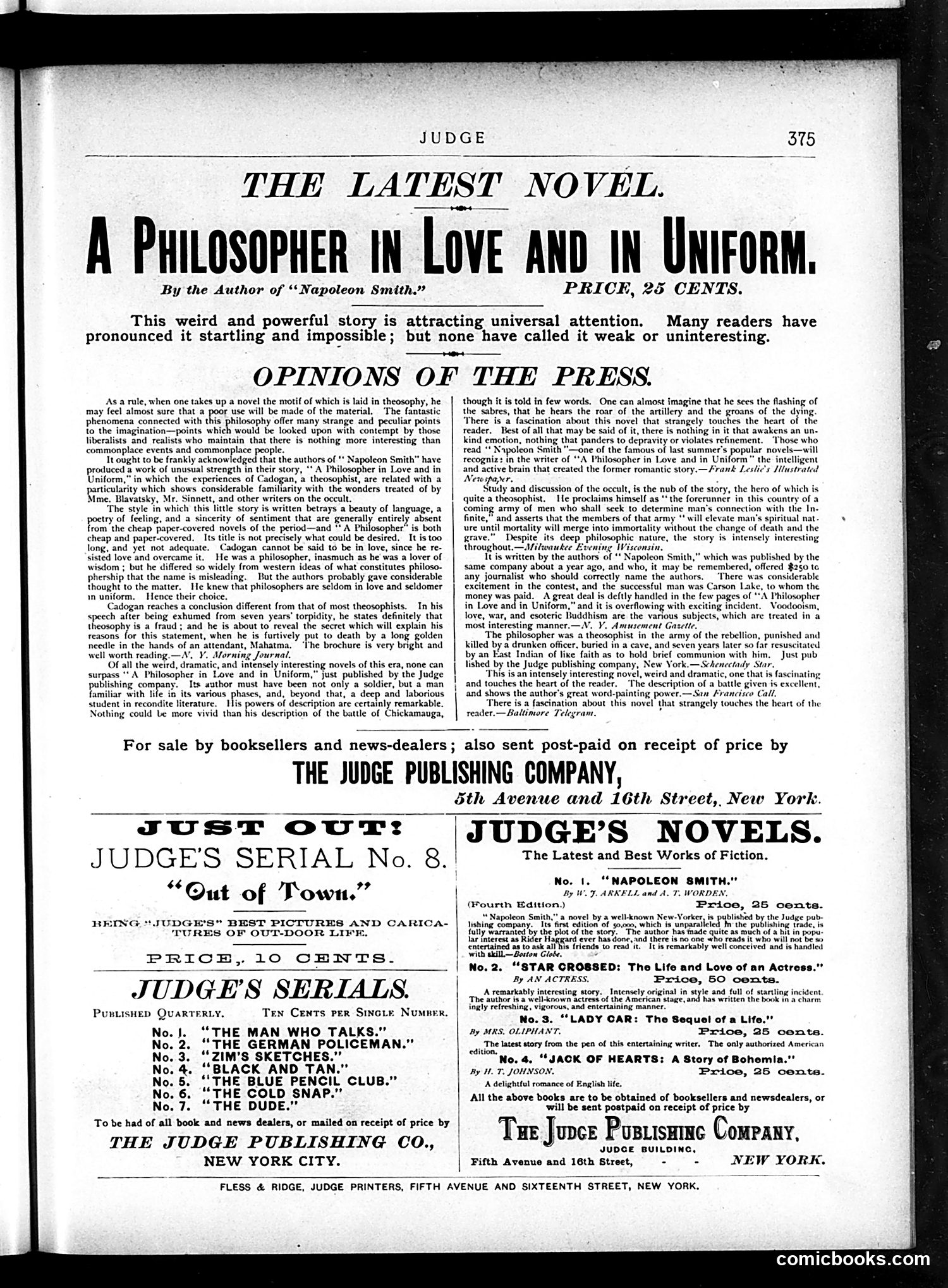
This page is primarily **advertising copy** for a novel published by Judge Publishing Company, priced at 25 cents. The book, by the author of "Napoleon Smith," blends theosophy (a spiritual philosophy popular in the late 19th century) with a military romance plot. The protagonist, Cadogan, is a theosophist-soldier who renounces theosophy as fraudulent, but is mysteriously killed before revealing why. Press excerpts praise the novel's literary quality despite its cheap paper binding, noting its vivid Civil War battle descriptions (Chickamauga) and emotional depth. The satire appears gentle—reviewers acknowledge the title is awkwardly long and that philosophers are "seldom in love and seldomer in uniform." The ads for other Judge serials and novels occupy the lower half, suggesting this was a standard promotional page in the magazine, not a political cartoon.
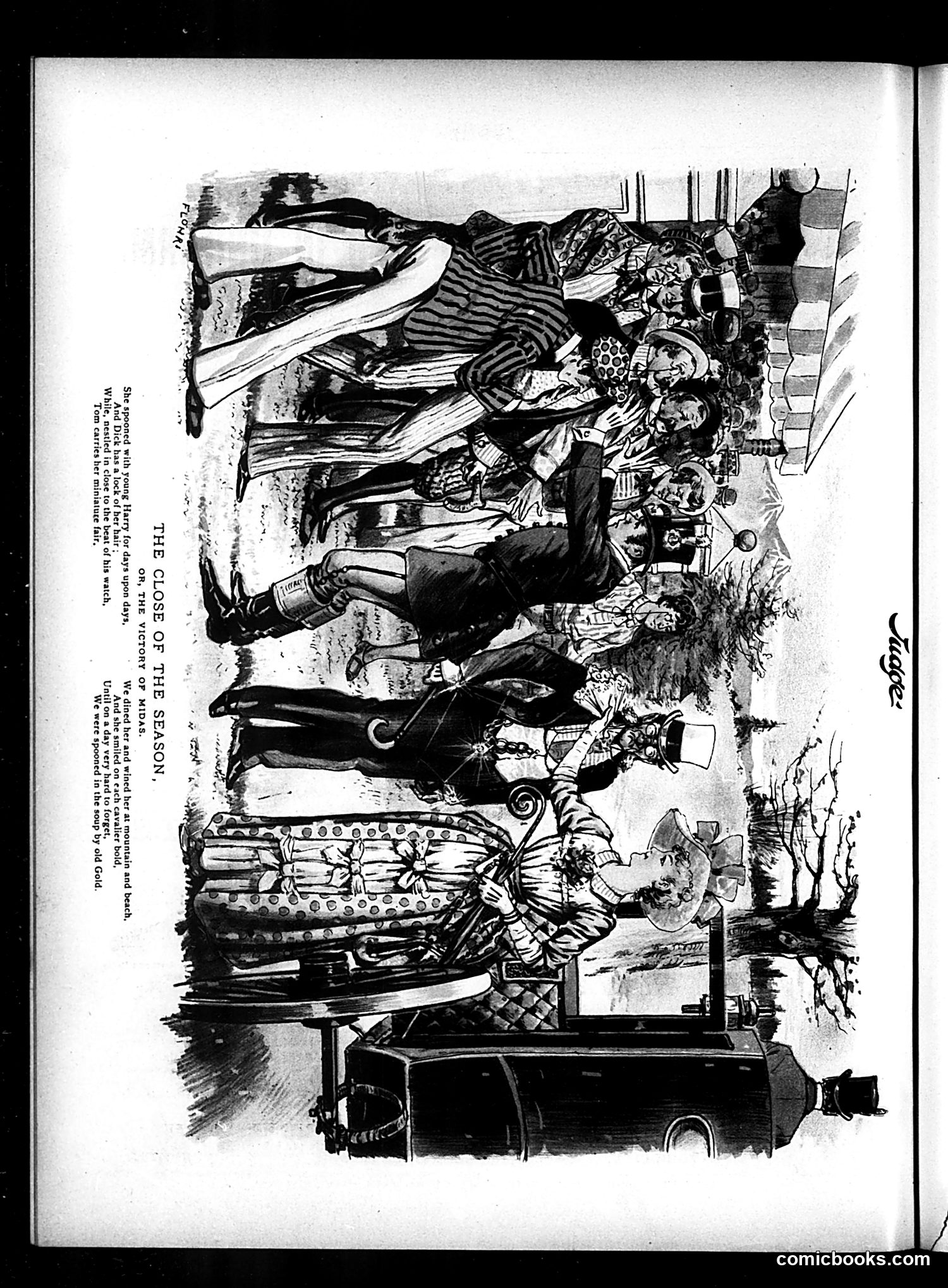
This cartoon satirizes wealthy high-society figures during the social season's end. The reference to "Midas" invokes the mythological king whose touch turned everything to gold—suggesting that money corrupts romance and authentic connection. The verse indicates a romantic narrative interrupted by financial reality: a couple enjoys the season's social circuit ("dined her and wined her and beached"), but their relationship is ultimately undermined by economic concerns ("spooned in the soup by old Gold"). The elaborate illustration depicts fashionable characters in period dress at what appears to be a seaside or resort setting, typical of Judge magazine's commentary on upper-class American society. The satire critiques how material wealth and social status ultimately dominate even personal relationships during the leisure season, reducing genuine human connection to economic transaction.