
Judge, 1889-09-14 · page 3 of 16
Judge — September 14, 1889 — page 3: what you’re looking at
What you’re looking at
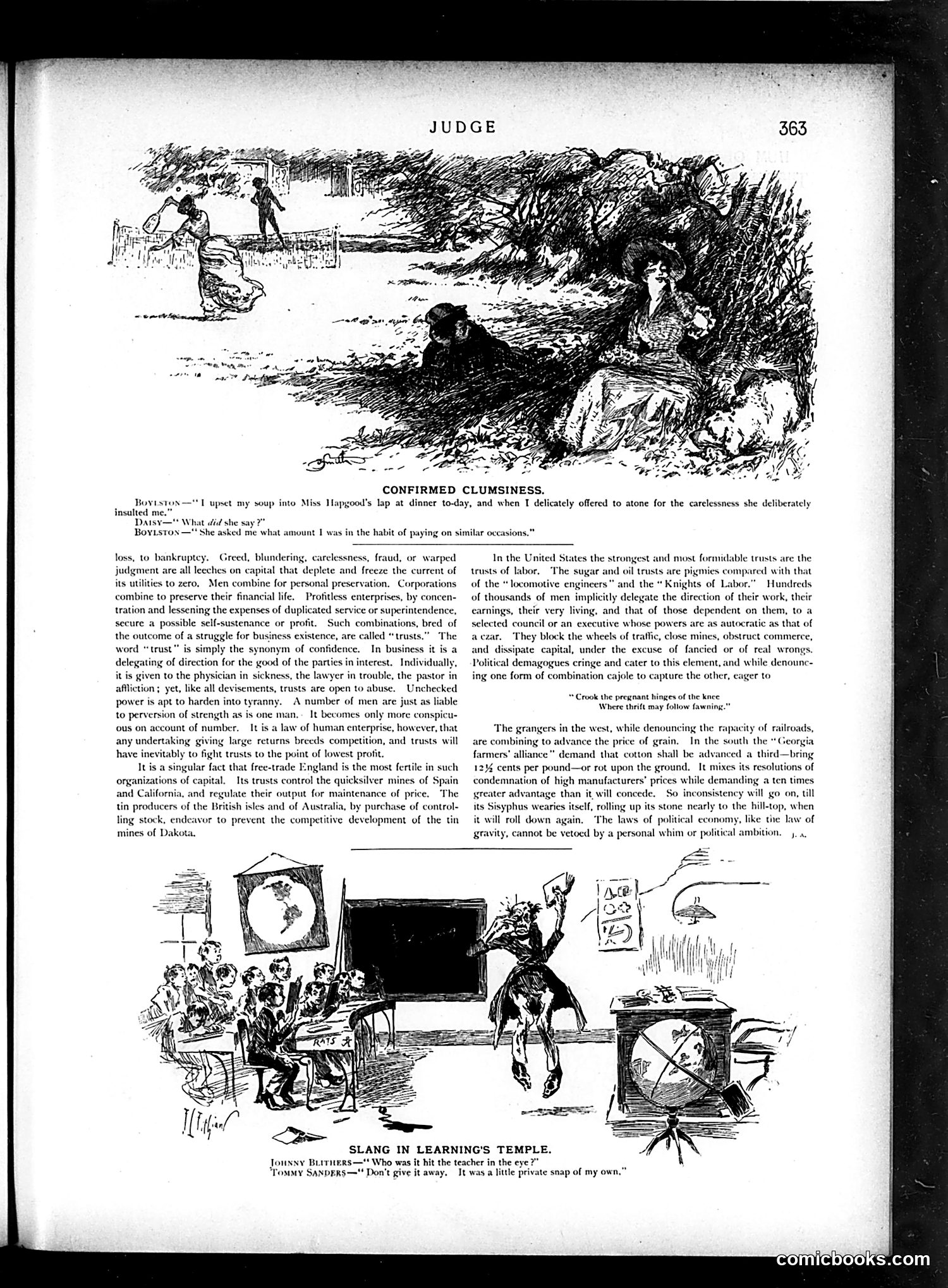
This page contains two separate satirical pieces: **"Confirmed Clumsiness"** (top): A brief comic dialogue where a woman intentionally spills soup on another's lap, then insults her by asking what payment she usually receives for such "accidents"—implying the victim is a servant or woman of low social standing. The joke turns on class assumptions and deliberate rudeness masked as clumsiness. **"Slang in Learning's Temple"** (bottom): A schoolyard joke where one boy asks another who hit their teacher in the eye. The response—"it was a little private snap of my own"—suggests the second boy struck the teacher himself but won't admit it publicly. The satire critiques schoolboy violence and lack of discipline. The long middle text essay discusses business trusts, labor unions, and economic monopolies—contemporary concerns in the Gilded Age. It argues trusts are both necessary and dangerous, prone to abuse when unchecked.
📄 Transcribed text from this page (OCR, searchable)
Machine-transcribed from the original scan — historical spelling and the odd misread are preserved.
CONFIRMED CLUMSINESS. Boytstes— insulted me. Daisy—"* Wh Boystox did she sa he asked “1 upset my soup into Miss Hapgood’s lap at dinner to-day, and when T delicately offered to atone for the carelessness she deliberately what amount I was in the habit of paying on similar occasions.” loss, to bankruptcy. Greed, blundering, carelessness, fraud, or warped judgment are all leeches on capital that deplete and freeze the current of its utilities to zero, Men combine for personal preservation. Corporations combine to preserve their financial life. Protitless enterprises, by concen- tration and lessening the expenses of duplicated service or superintendence, secure a possible self-sustenance or profit. Such combinations, bred of The In business it is a good of the parties in interest. Individually, in in sickness, the lawyer in trouble, the pastor in afliction ; yet, like all devisements, trusts are open to abuse. Unchecked power is apt to harden into tyranny. A number of men are just as to perversion of strength as is one man, It bec more conspicu- fous on account of number. It is a law of human enterprise, however, that any undertaking giving large returns breeds competition, and trusts will have in the outcome of a struggle for business existence, are called “ trust word “trust” is simply the synonym of delegating of direction for th it is given to the phys ontidence able mes only ably to fight trusts to the point of lowest profit. It is a singular fact that free-trade England is the most fertile in such orga ns of capital. Its trusts control the quicksilver mines of and California, and regulate their output for maintenance of price. The tin producers of the British isles and of Australia, by purchase of control- ling stock, endeavor to prevent the competitive development of the tin mines of Dakota, In th trusts of labor, of the “locomotive et tes the strongest and most formidable trusts are the yar and oil trusts are pigmies compared with that d the “ Knights of Labor.” Hundreds of thousands of men implicitly delegate the direction of their work, their carnings, their very living, and that of those dependent on them, to a selected council or an executive whose powers are as autocratic as that of acaar. The} and dissipate block the wheels of traffic, close mines, obstruct commerce, apital, under the excuse of fancied or of real wrongs. Political demagogues cringe and cater to this element, and while denounc- ing one form of combination cajole to capture the other, eager to ™ Crook the pregnant hinges of the knee Where thrift may follow fawning.” ngers in the west, while denouncing the rapacity of railroad re combining to advance the price of grain, In the south the “Georg alliance” demand that cotton shall be advanced a third—bring 12% cents per pound—or rot upon the ground, It mixes its resolutions of condemnation of high manufacturers’ prices while demanding a ten times greater advantage than it, will concede. will go on, till its Sisyphus wearies itself, rolling up to the hill-top, when it will roll down again, ‘The laws of political economy, like the law of So inconsistens SLANG IN LEARNING'S TEMPLE. Jounny BLtriers— Who was it hit the teacher in the eye ? MMY SANDERS—"' Don’t give it away, Tt was a little private snap of my own,”