
Judge, 1889-09-14 · page 2 of 16
Judge — September 14, 1889 — page 2: what you’re looking at
What you’re looking at
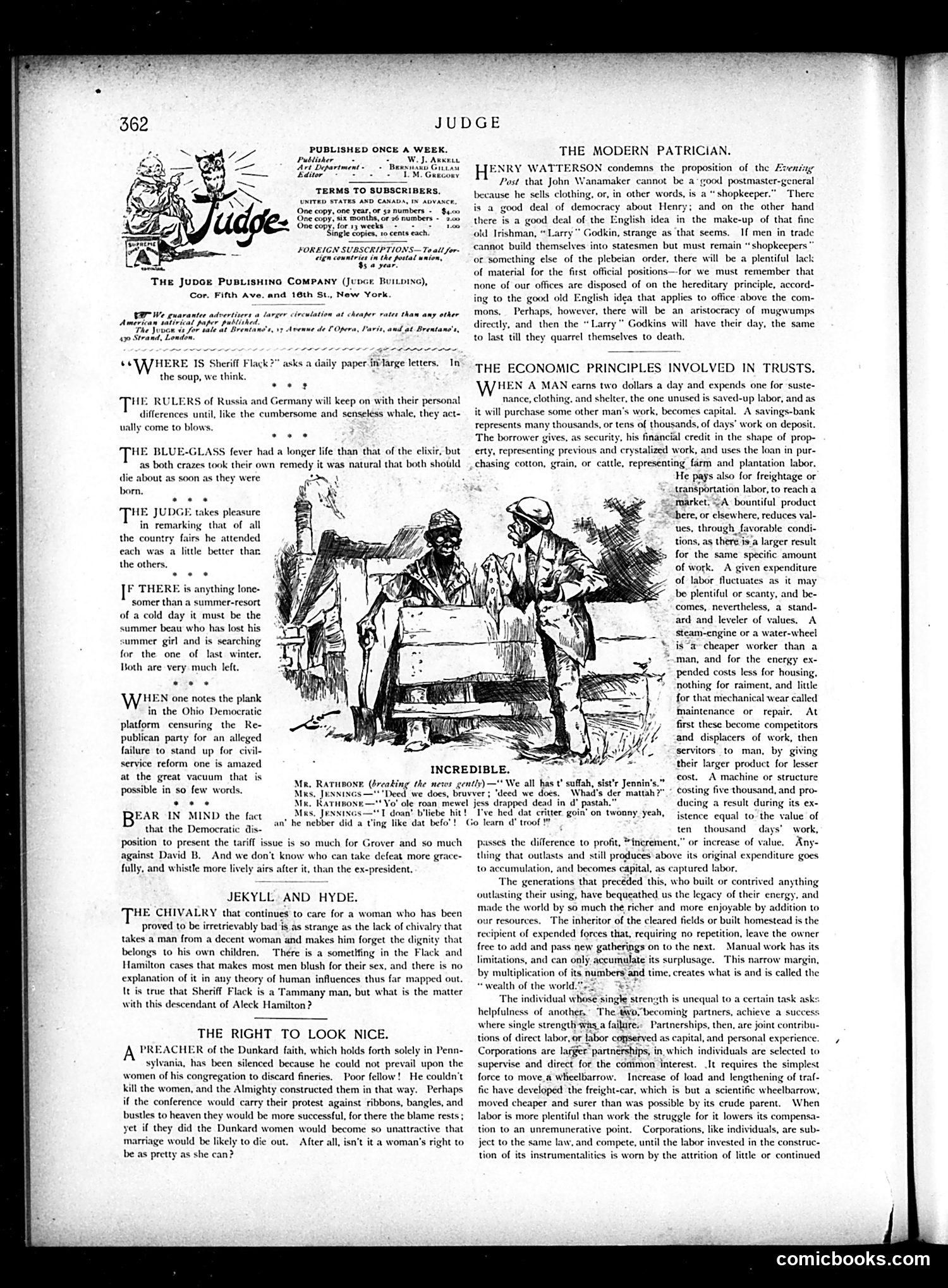
This page contains several brief satirical items rather than a unified cartoon. The key pieces include: **"Where is Sheriff Flack?"** — A short quip questioning a sheriff's whereabouts, likely a local political jab at an absent or ineffective official. **"The Modern Patrician"** — Henry Watterson condemns John Wanamaker's proposal for an Evening Post, criticizing Wanamaker's democratic pretensions while noting he's actually an old-money "patrician" who can't genuinely relate to common people. **"The Economic Principles Involved in Trusts"** — An illustrated article (with workers loading cargo) explaining how trusts and monopolies concentrate wealth and labor value, benefiting owners at workers' expense—typical Progressive-era economic critique. The page reflects early 20th-century American concerns about wealth inequality, monopolistic practices, and the gap between democratic ideals and plutocratic reality.
📄 Transcribed text from this page (OCR, searchable)
Machine-transcribed from the original scan — historical spelling and the odd misread are preserved.
PUBLISHED ONCE A WEEK. Publisher W. J. Awxrie Art Department Baxsinrio Editor 1M. Geecory TERMS TO SUBSCRIBERS, ne copy, one year, oF so numbers = $4.co oe Sopy; it onthe: cr x6 cumbers = "nn One cong for weet sees tas Single Copies 10 cents cach. FOREIGN SUBSCRIPTIONS — Teall for $3 Syeal THe Jupoe PuBLisHina ComPANy (Jupce Burtpinc), Cor, Fifth Ave. and 16th St., New York C-We guaranter advertivers American satirical paper published. The Juvon vs for sale at Brentano's, 17 Avenue de COpera, Paris, aud at Brentano's, 490 Strand, London. reer circulation at cheaper rates tham any other SOYVHERE IS Sheriff Flack the soup, we think. asks a daily paper in'Targe letters. In t HE RULERS of Russia and Germany will keep on with their personal differences until, like the cumbersome and senseless whale, they act- ually come to blows. HE BLUE-GLASS fever had a longer life than that of the elixir, but as both crazes took their own remedy it was natural that both should die about as soon as they were on born, JUDGE takes pleasure in remarking that of all the country fairs he attended each was a little better thar the others, H [F THERE is anything lone- somer than a summer-resort of a cold day it must be the summer beat who has lost his uummer girl and is searching for the one of last winter, Both are very much left. WHEN one notes the plank in the Ohio Demoera platform censuring the Re- publican party for an alleged failure to stand up for civil- service reform one is amazed at the great vacuum that i possible in so few words. BEAR SM Mrs, Jusincs — Me. Ratinone Mas, Jexntnos— an’ he nebber did a t'ing like dat befo' ! IN MIND the fact that the Democratic dis- position to present the tariff issue is so much for Grover and so much against David B. And we don’t know who can take defeat more gr: fully, and whistle more lively airs after it, than the ex-president. JEKYLL AND HYDE. THE CHIVALRY that continues to care for a woman who has been proved to be irretrievably bad is as strange as the lack of chivalry that takes a man from a decent woman and makes him forget the dignity that belongs to his own children. There is a sometlfing in the Flack and Hamilton cases that makes most men blush for their sex, and there is no explanation of it in any theory of human influences thus far mapped out. It is true that Sheriff Flack is a Tammany man, but what is the matter with this descendant of Aleck Hamilton ? THE RIGHT TO LOOK NICE. A PREACHER of the Dunkard faith, which holds forth solely in Penn- sylvania, has been silenced because he could not prevail upon the women of his congregation to discard fineries. Poor fellow! He couldn't kill the women, and the Almighty constructed them in that way. Perhaps if the conference would carry their protest against ribbons, bangles, and bustles to heaven they would be more successful, for there the blame rests; yet if they did the Dunkard women would become so unattractive that marriage would be likely to die out. After all, isn’t it a woman's right to be as pretty as she can? INCREDIBLE, p (breaking the news cent’) —" We all hast’ suffah, sist’r Jennin’s.” "Deed we does, bruvver ; ‘deed we does. “Yo! ole roan mewel jess drapped dea *T doan’ b'liebe hit! THE MODERN PATRICIAN. HENRY WATTERSON condemns the proposition of the Post that John Wanamaker cannot be a“ sood postma because he sells clothing, or, in other words, is a * shopkeeper. ood deal of democracy about Henry; and on the other hand there is a good deal of the English idea in the make-up of that fine old Irishman, “Larry” Godkin, strange as ‘that seems, If men in trade cannot build themselves into statesmen but must remain “shopkeepers " or something else of the plebeian order, there will be a plentiful: lack of material for the first official positions—for we must remember that none of our offices are disposed of on the hereditary principle, accord- ing to the good old English idea that applies to office above the com- mons, Perhaps, however, there will be an aristocracy of mugwumps directly, and then the “Larry” Godkins will have their day, the same to last till they quarrel themselves to death. THE ECONOMIC PRINCIPLES INVOLVED IN TRUSTS. HEN A MAN cars two dollars a day and expends one for suste- nance, clothing, and shelter, the one unused is saved-up labor, and as it will purchase some other man’s work, becomes capital. A savings-bank represents many thousands, or tens of thousands, of days’ work on deposit. ‘The borrower gives, as security, his financial credit in the shape of prop- erty, representing previous and crystalized work, and uses the loan in pur- chasing cotton, grain, or cattle, representing farm and plantation labor, He pays also for freightage or transportation labor, to reach a market: A bountiful product there, or elsewhere, reduces val- ues, through favorable condi- tions, as there is.a larger result for the same specific amount of work. A given expenditure of labor fluctuates as it may be plentiful or scanty, and be- comes, nevertheless, a stand- ard and leveler of values. A steam-engine or a water-wheel $a cheaper worker than a man, and for the energy ex- pended costs less for housir nothing for raiment, and little for that mechanical wear called maintenance or repair. At first these become competitors and displacers of work, then servitors to man, by giving their larger product for lesser cost. A machine or structure costing five thousand, and pro- ducing a result during its ex- istence equal to the value of thous: s’ work, the difference to profit, *increment,” or increase of value. Any- thing that outlasts and still produces above its original expenditure goes to accumulation, and becomes capital, as captured labor. ‘The generations that precéded this, who built or contrived anything outlasting their using, have bequeathed us the legacy of their energy, and made the world by so much the richer and more enjoyable by addition to ur resources. ‘The inheritor of the cleared fields or built homestead is the recipient of expended forces that, requiring no repetition, leave the owner free to add and pass new gatherings on to the next. Manual work has its and can only, accumulate its surplusage. This narrow margin, by multiplication of its numbers’ and time, creates what is and is called the wealth of the world."'y2 s ‘The individual whose single strength is unequal to a certain task asks helpfulness of another,” The tivo,"becominy partners, achieve a su where single strength was_a failure. Partnerships, then, are joint contribu tions of direct labor, or labor conserved as capital, and personal experience. Corporations are larger’ partnerships, in, which individuals are selected to supervise and direct for the contmon interest. It requires the simplest force to move. Wheelbarrow. Increase of load and lengthening of traf- fic have developed the freight-car, which is but a scientific wheelbarrow, moved cheaper and surer than was possible by its crude parent. When labor is more plentiful than work the struggle for it lowers its compensa- tion to an unremunerative point. Corporations, like individuals, are sub- ject to the same law, and compete, until the labor invested in the construc- tion of its instrumentalitics is worn by the attrition of little or continued Whad’s der’ mattah ? in d’ pastah.”” I've hed dat critter goin’ on twonny yeah, Go learn d troof ! ten pass comicbooks.com