
A complete issue · 16 pages · 1889
Judge — September 7, 1889
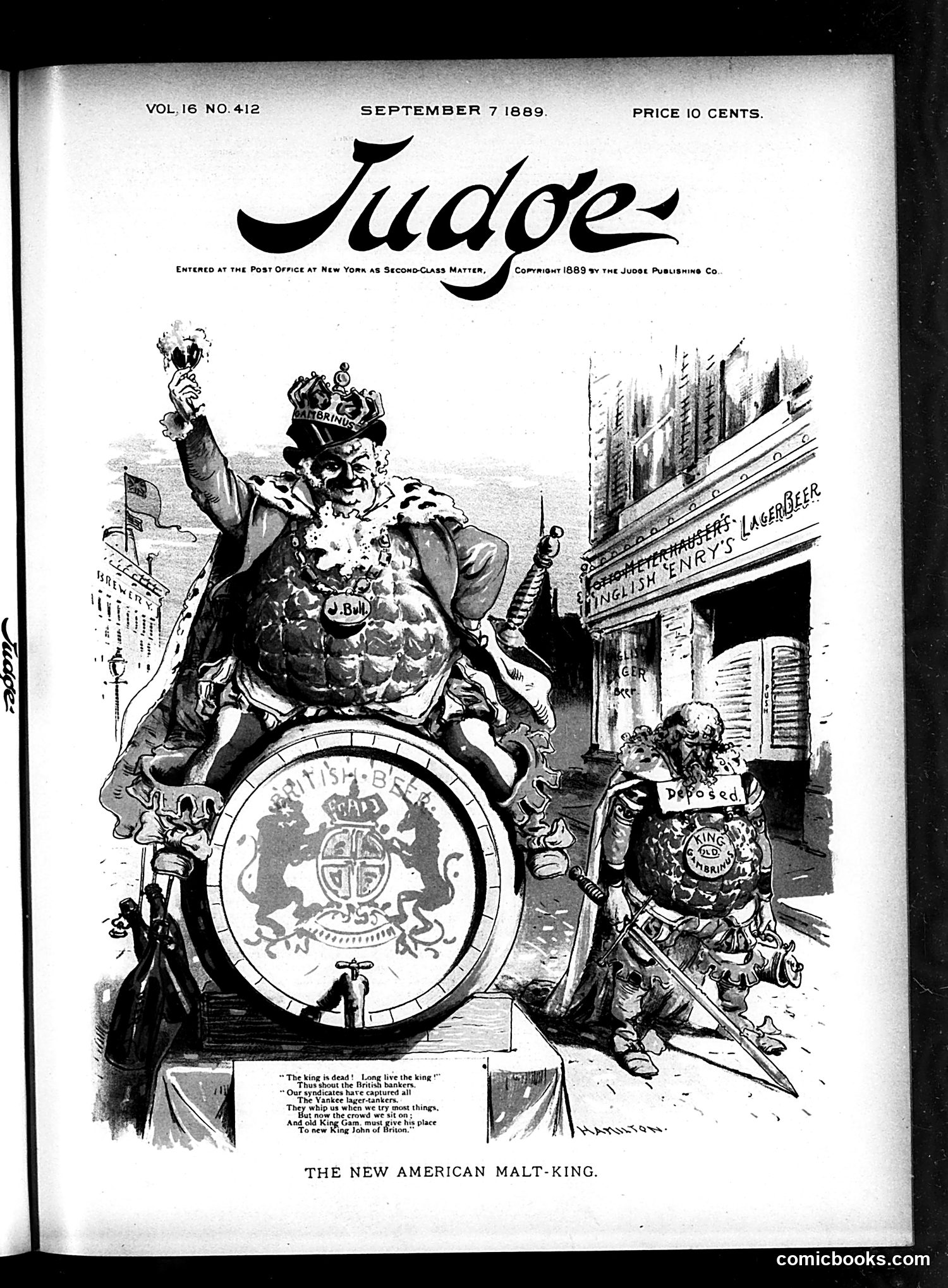
This September 1889 *Judge* cartoon satirizes the growing dominance of malt liquor and beer interests in American commerce and politics. The central figure—a grotesque, corpulent "Malt-King" wearing a crown and royal regalia—sits atop a barrel bearing the British coat of arms, suggesting foreign (specifically British) control of the American beer trade. The figure holds a scepter and raises a goblet triumphantly, while smaller caricatured figures (appearing to represent political or commercial rivals) bow or cower beneath. Signs reference English breweries like "Henry's Lager Beer," indicating concern about foreign brewery monopolies. The satirical point: American politics and commerce are being literally ruled by beer interests and foreign beer magnates, with the monarchy-like imagery suggesting these commercial powers have replaced legitimate government authority.
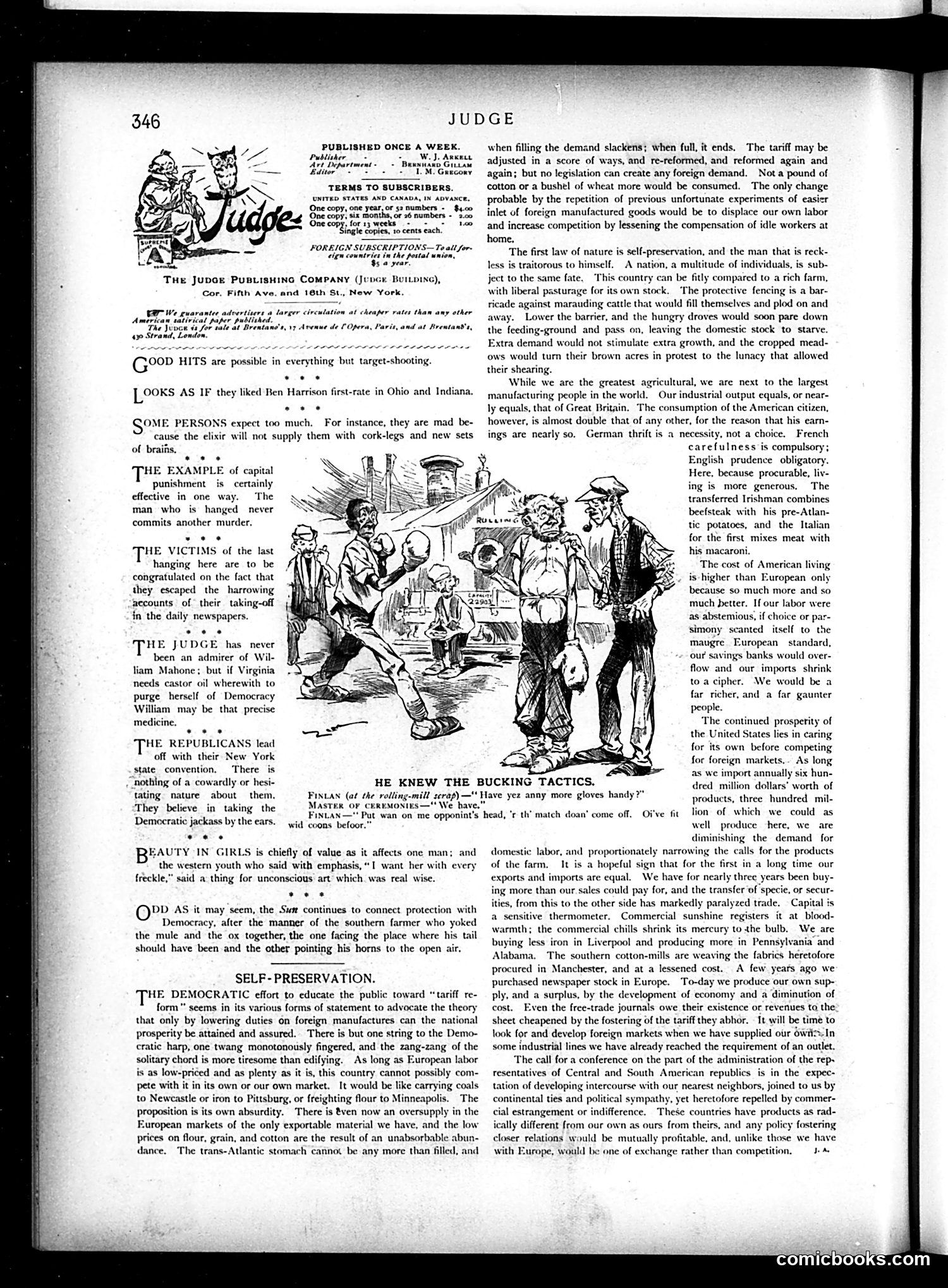
The central cartoon, titled "FINLAN THE HIKING TACTICS," depicts what appears to be a street altercation or arrest scene. The dialogue references "gloves" and "match down," suggesting a boxing or fighting context. The caption identifies someone named "Finlan" (possibly a political or public figure of the era). However, without clearer identification of the specific historical figure or incident referenced, the exact satirical point remains unclear. The cartoon appears to mock either a particular politician's handling of a confrontation or a broader social issue involving law enforcement and public behavior. The surrounding text discusses tariffs, labor, and economic policy—typical Judge Magazine concerns—but doesn't directly illuminate this cartoon's specific target or message. **Cannot determine precise satirical meaning without additional historical context.**
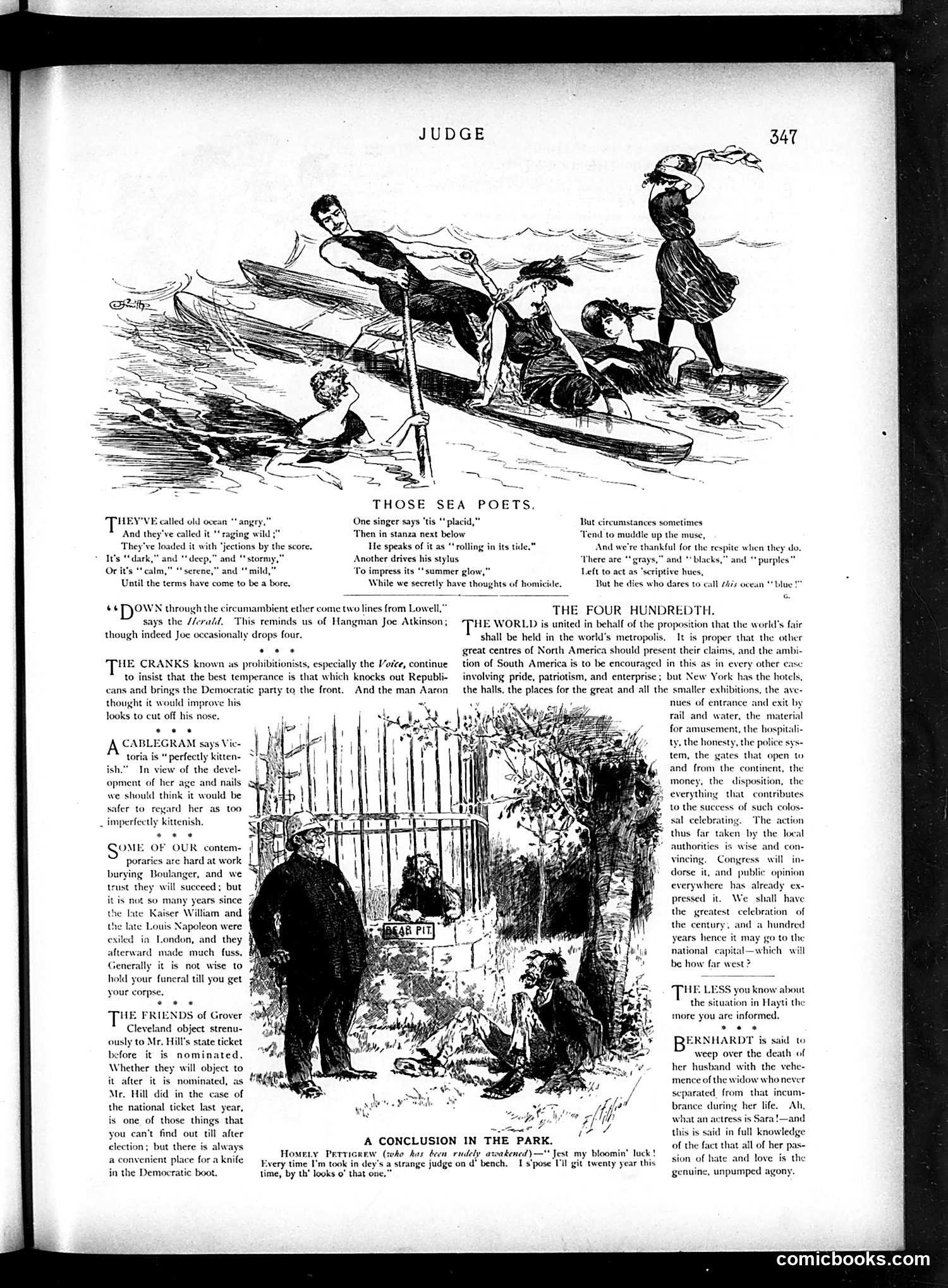
This page from Judge contains several satirical items targeting 1890s American politics and culture: **"Those Sea Poets"** mocks romantic poets for contradictory descriptions of the ocean—calling it both "placid" and "rolling," "calm" and "raging wild." The satire criticizes overwrought literary language that becomes tedious through repetition. **Political jabs** target: - Prohibitionists and the *Voice* magazine for prioritizing temperance over Republican electoral losses - Grover Cleveland's supporters objecting to David B. Hill's state ticket nomination - References to Boulanger (likely General Boulanger, a French political figure) and comparisons to exiled Louis Napoleon **"The Four Hundredth"** advocates New York hosting the world's fair, arguing it has superior infrastructure, hotels, and transportation compared to other North American cities. **"A Conclusion in the Park"** shows a working-class man on a bench discussing his legal troubles, likely satirizing urban poverty or the justice system. **Bernhardt reference** mocks actress Sarah Bernhardt's theatrical grief over her husband's death, suggesting her emotion is performative rather than genuine.
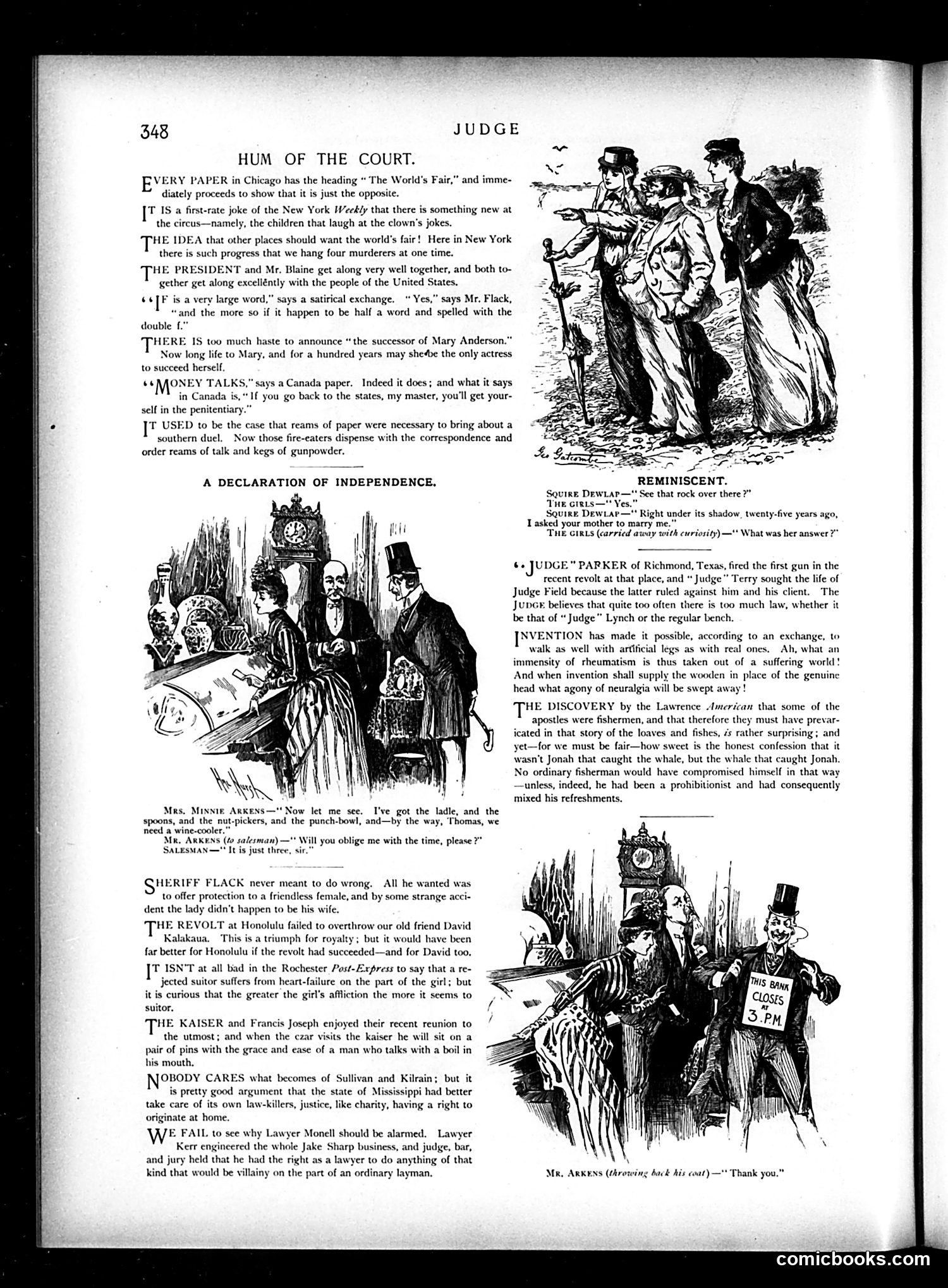
This page contains brief satirical comments on contemporary American politics and society, circa the 1890s (based on references to the World's Fair and figures like Blaine). **Key targets:** - **Chicago's World's Fair**: Mocked for claiming progress while the city has problems - **Mary Anderson**: An actress; the joke warns against premature succession announcements - **Judge Parker and Judge Terry**: Texas judges involved in violent disputes, satirizing vigilante "Judge Lynch" justice versus legal proceedings - **Sheriff Flack**: Appears to reference a real scandal involving protection of an improper relationship - **The Kaiser and Czar**: European political figures mocked for diplomatic posturing **The cartoons** show genteel Victorian scenes accompanying anecdotes—a couple reminiscing, a domestic servant interaction—where the humor derives from verbal wit and social observation rather than the illustrations themselves. The overall tone is cynical: mocking legal system failures, romantic hypocrisy, and political pretension through brief, barbed observations typical of 1890s American satirical journalism.
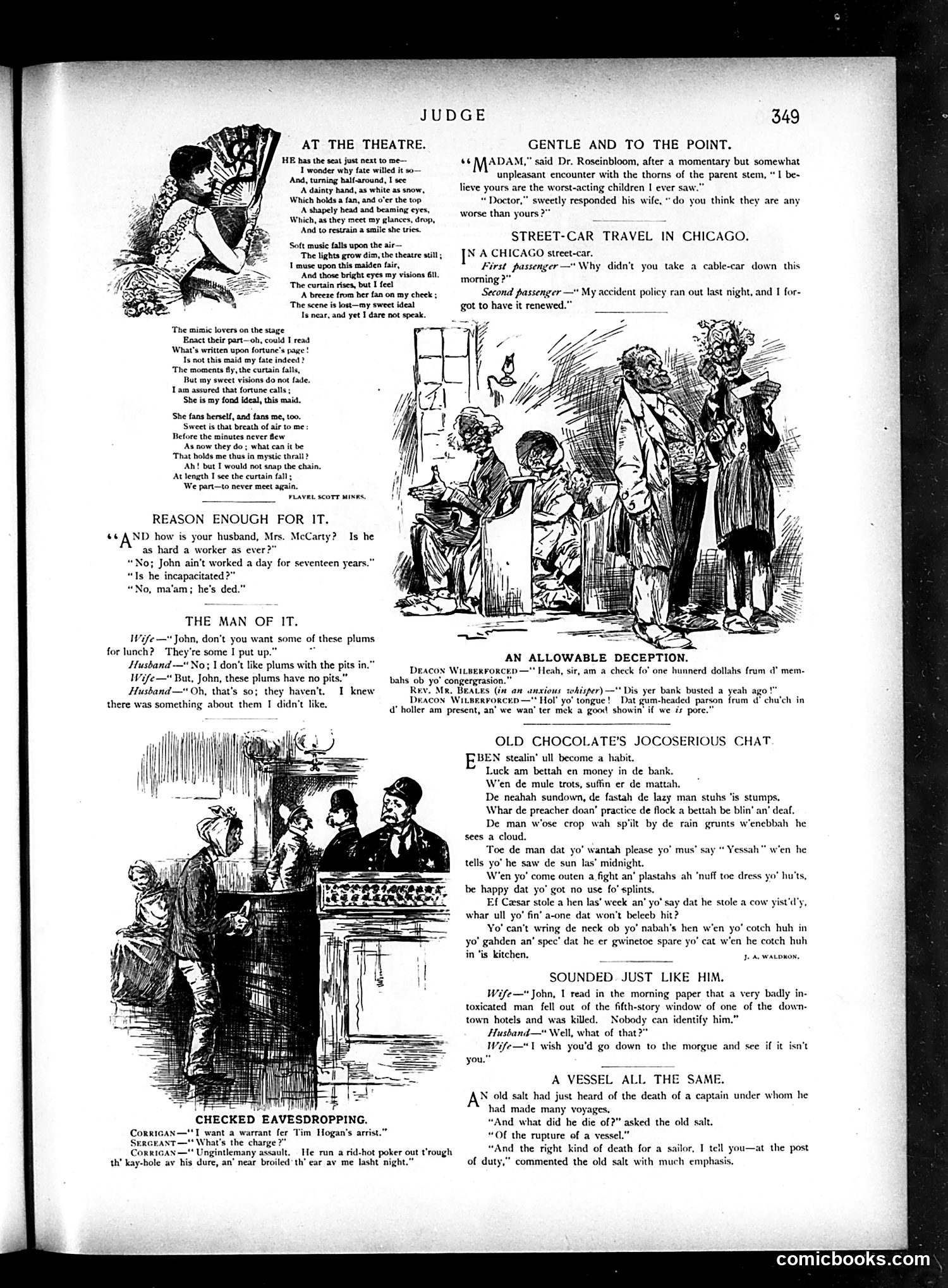
This page contains multiple satirical pieces typical of Judge's humor: **"At the Theatre"** is a romantic poem about a man entranced by an attractive woman seated nearby—a sentimental piece poking fun at theater-goers' distraction from the actual performance. **"Reason Enough for It"** jokes about a widow matter-of-factly stating her husband hasn't worked in seventeen years because he's dead—dark humor common to the era. **"Street-Car Travel in Chicago"** mocks safety-conscious passengers, with one explaining he won't use cable-cars because his accident insurance expired. **"Checked Eavesdropping"** depicts an Irish immigrant (indicated by dialect) seeking a warrant against someone who shoved a hot poker through his door's keyhole. **"Old Chocolate's Jocoserous Chat"** presents folk wisdom in exaggerated African American dialect—a common but offensive comedic trope of the period reflecting period racism. The illustrations use period engraving style to accompany these short humor pieces, typical of Judge's format.
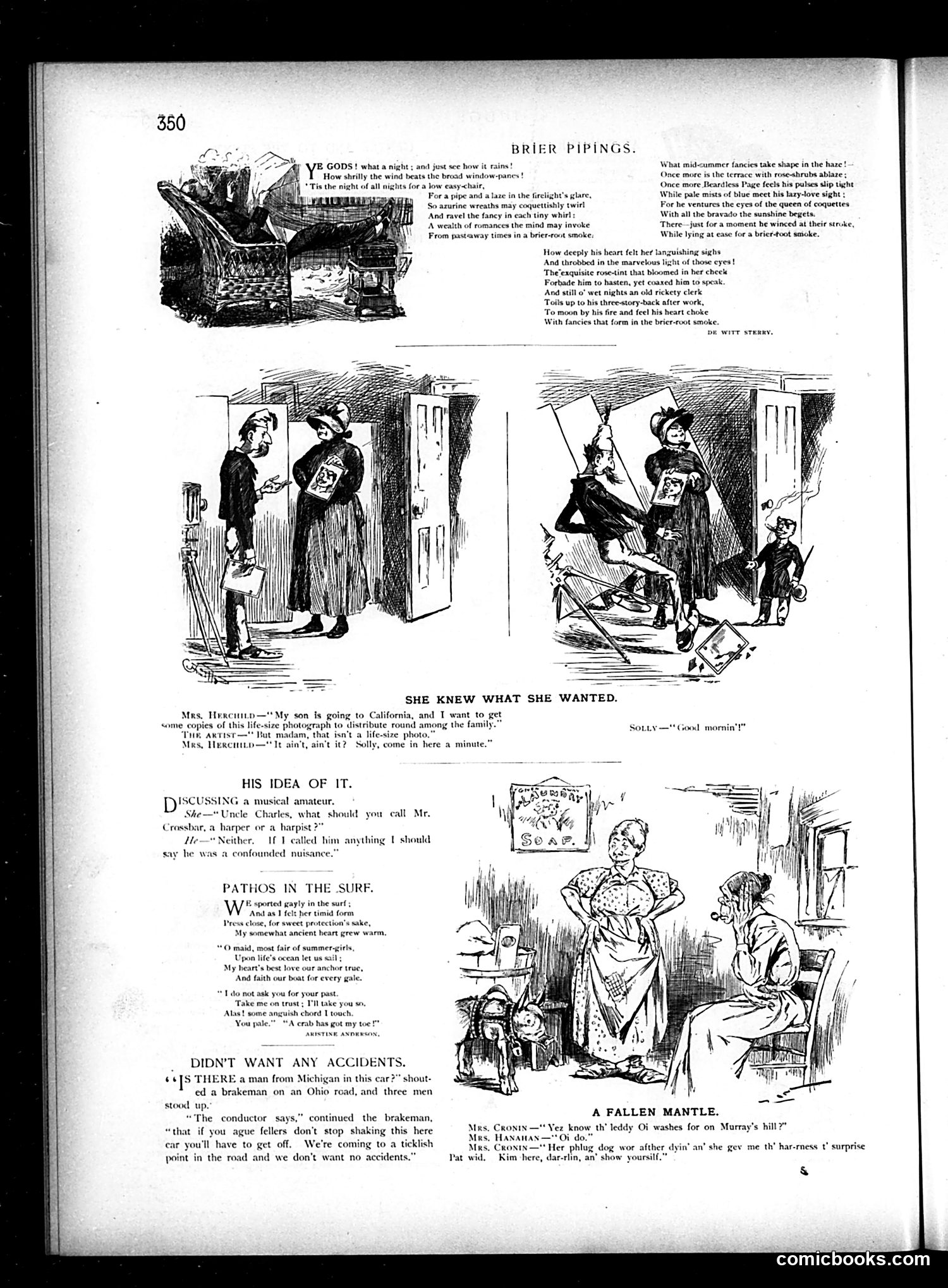
This page contains several brief humorous sketches typical of Judge's satirical format: **"She Knew What She Wanted"** mocks a woman's vanity—she wants life-size photographs of herself distributed to family, misunderstanding the artist's objection that the photo isn't actually life-sized (implying she's larger than she thinks). **"His Idea of It"** is a simple domestic joke: a woman asks whether Uncle Charles is a "harper or harpist"; her husband responds he'd call him a "confounded nuisance"—commentary on amateur musicians. **"Didn't Want Any Accidents"** satirizes regional dialect humor: a brakeman ejects three men from Michigan who are shaking the train car due to ague (fever chills), though the real concern is avoiding accidents at a dangerous point. **"A Fallen Mantle"** features working-class Irish dialect humor about a woman receiving her employer's dog's harness as a "surprise"—absurdist humor playing on miscommunication and class differences. The page emphasizes period-typical ethnic/class stereotyping and wordplay rather than political satire.
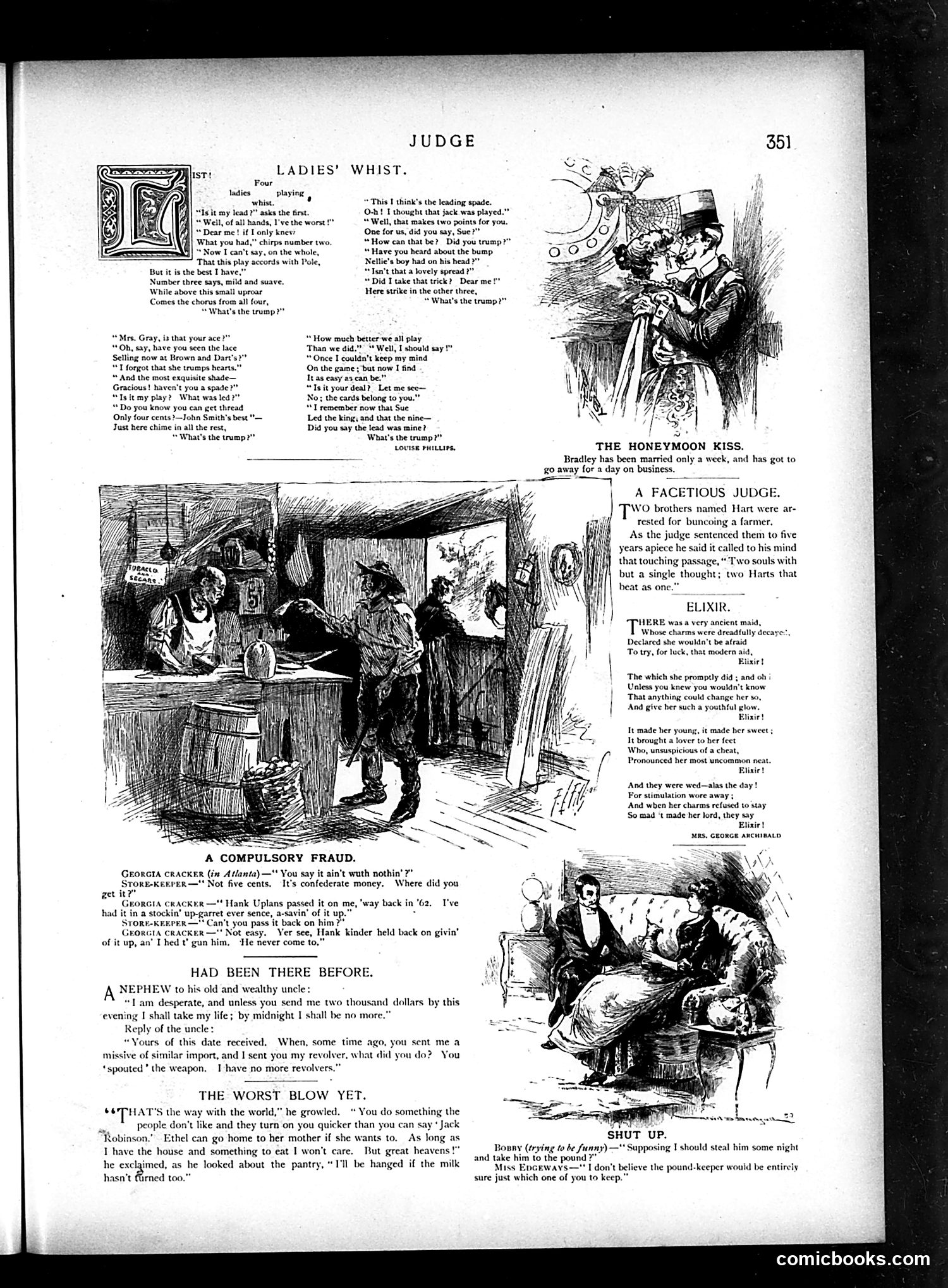
This page contains several satirical pieces typical of late 19th-century American humor: **"Ladies' Whist"** mocks women card players for constant distraction—they repeatedly ask "What's the trump?" while gossiping about shopping, children's injuries, and domestic matters. The satire targets women's supposed inability to focus on games or serious pursuits. **"The Honeymoon Kiss"** appears to be a brief humorous piece about a newlywed couple. **"A Facetious Judge"** presents a pun: a judge sentencing two brothers named Hart makes a wordplay on "two hearts that beat as one." **"Elixir"** is a cautionary poem about an aging woman using beauty treatments to attract a husband, who becomes angry when her "charms" fade—satirizing both cosmetic deception and male vanity. **"A Compulsory Fraud"** depicts a Georgia cracker trying to pass worthless Confederate money, suggesting post-Civil War economic hardship and regional stereotypes. The remaining pieces mock desperation and despair through dark humor.
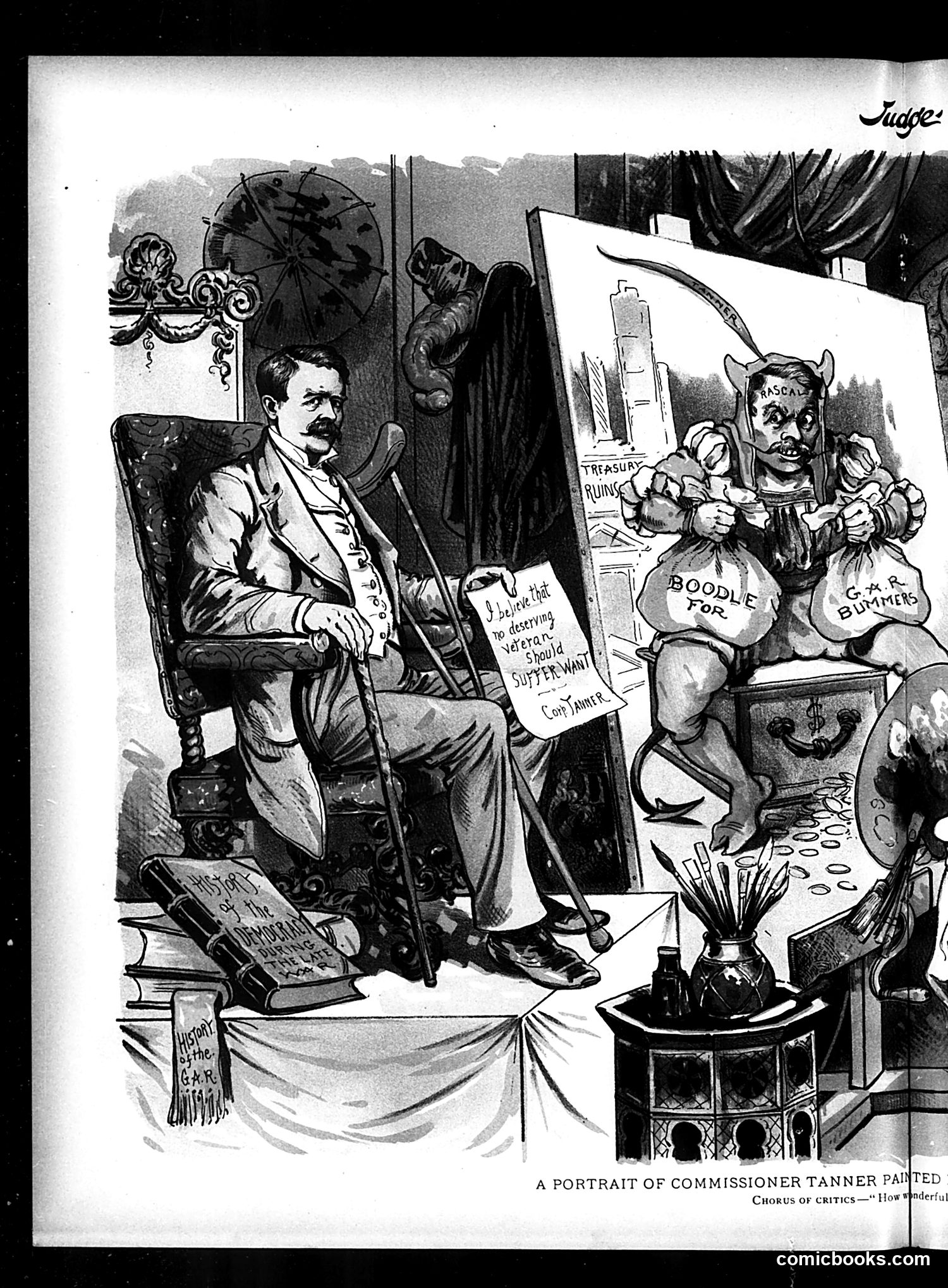
This is a political cartoon titled "A Portrait of Commissioner Tanner Painted" with a chorus of critics. The image shows a seated man (presumably Commissioner Tanner) on the left, while on the right, caricatured demonic or grotesque figures labeled "RASCAL," "BOODLE FOE," and "G—GUTTERS" emerge from or surround a painting, holding what appears to be a bag labeled "BOODLE" (slang for bribes/corrupt money). The cartoon satirizes Tanner by depicting him being painted by corrupt critics or political enemies who are literally conjuring up images of scandal and financial impropriety. The demons represent accusations of corruption and dishonest dealings. The satire suggests Tanner's reputation is being constructed through malicious portrayal rather than fact—the critics are quite literally painting him as corrupt.
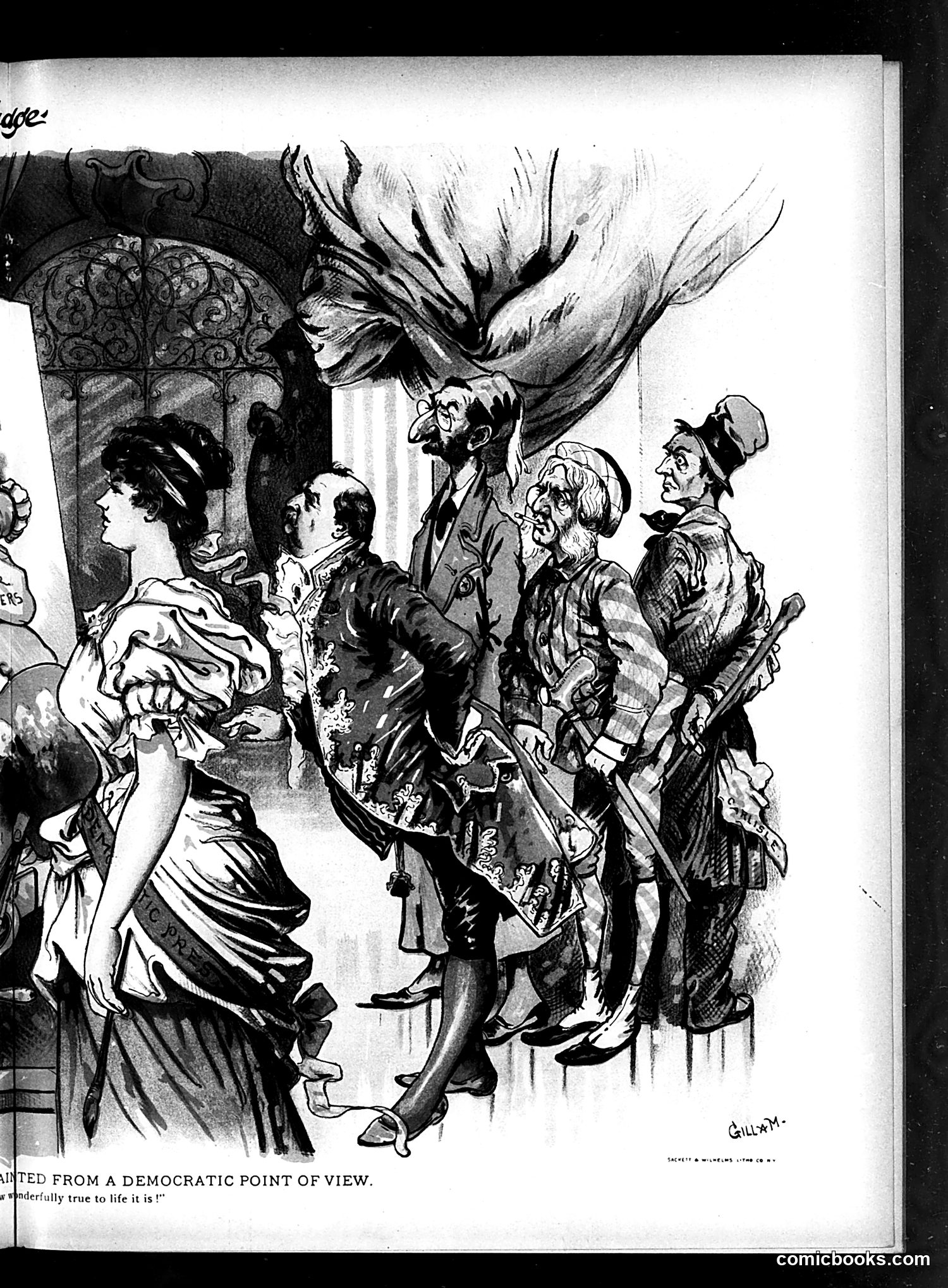
This Judge magazine cartoon satirizes Democratic Party politics from a Republican perspective. The caption "MINTED FROM A DEMOCRATIC POINT OF VIEW" and the phrase "wonderfully true to life it is!" suggest ironic commentary on Democratic policies or character. The scene depicts elegantly dressed military or political figures alongside a well-dressed woman, with exaggerated facial features typical of period caricature. The soldiers appear armed and somewhat disreputable, contrasting with refined surroundings (ornate architectural details visible). The exact historical context—which Democratic policies or figures are being mocked—cannot be definitively determined without additional page information or dating. The style suggests late 19th or early 20th century. The satire appears to criticize Democratic governance as producing inferior or unsuitable political/military leadership.
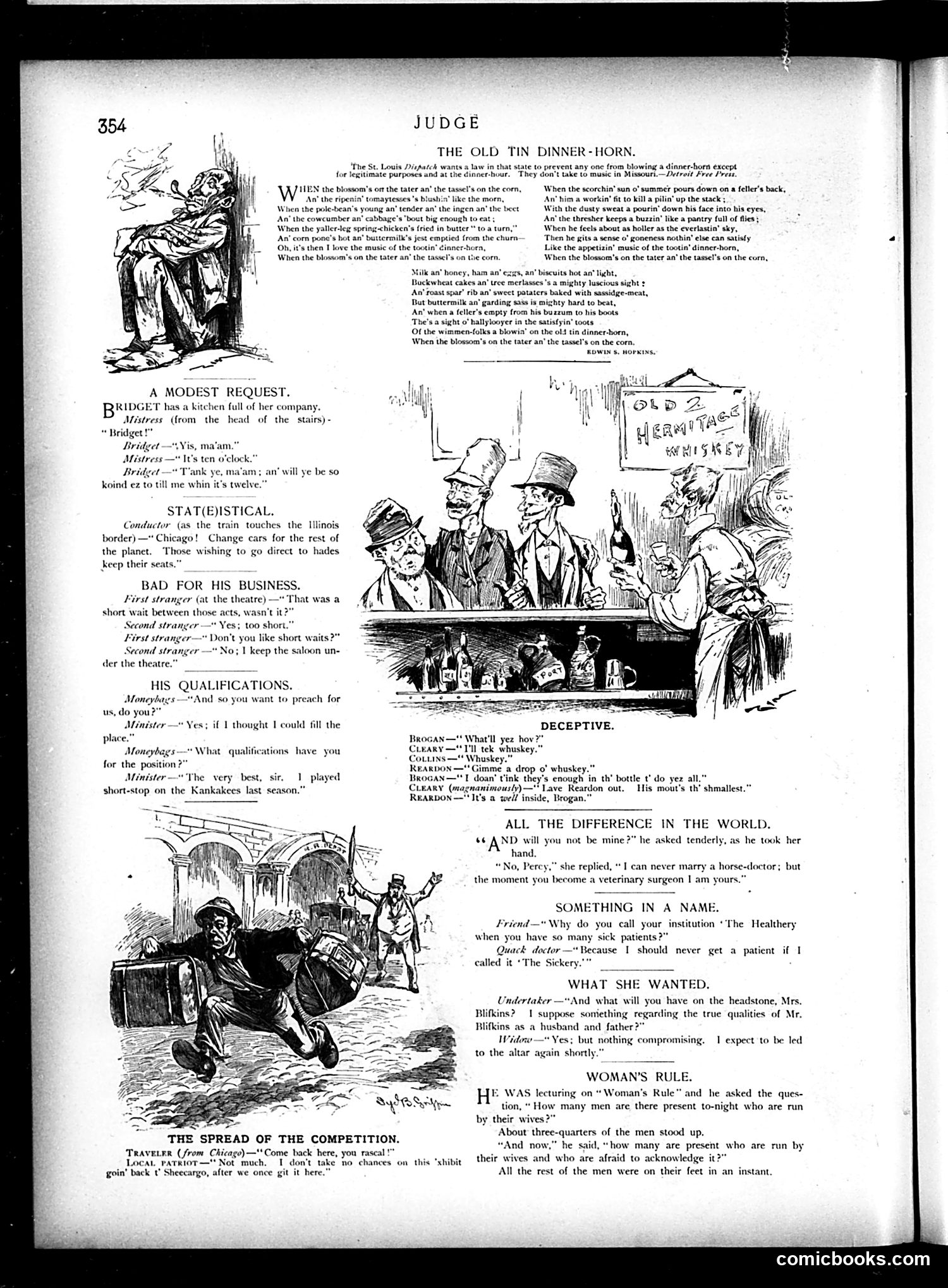
This page contains multiple humorous sketches satirizing American social life: **"The Old Tin Dinner-Horn"** (top): A nostalgic rural poem celebrating farm life and the dinner bell's call—likely mocking both rural sentimentality and urban readers' romanticization of country life. **"A Modest Request"**: A brief domestic joke where an Irish servant (Bridget) negotiates clock-watching with her mistress—poking fun at working-class Irish immigrants' bargaining tactics. **"Statistical"**: Dark humor about Chicago and damnation, reflecting anti-Chicago sentiment common in the era. **"His Qualifications"**: Mocks unqualified clergy, suggesting ministers were hired based on sports credentials rather than theological learning. **"Woman's Rule"**: The concluding sketch satirizes henpecked husbands by having three-quarters of men admit wives control them—reflecting period anxieties about women's growing social influence. The cartoons use ethnic stereotypes (Irish dialect) and class humor typical of *Judge*'s satirical approach to American society.
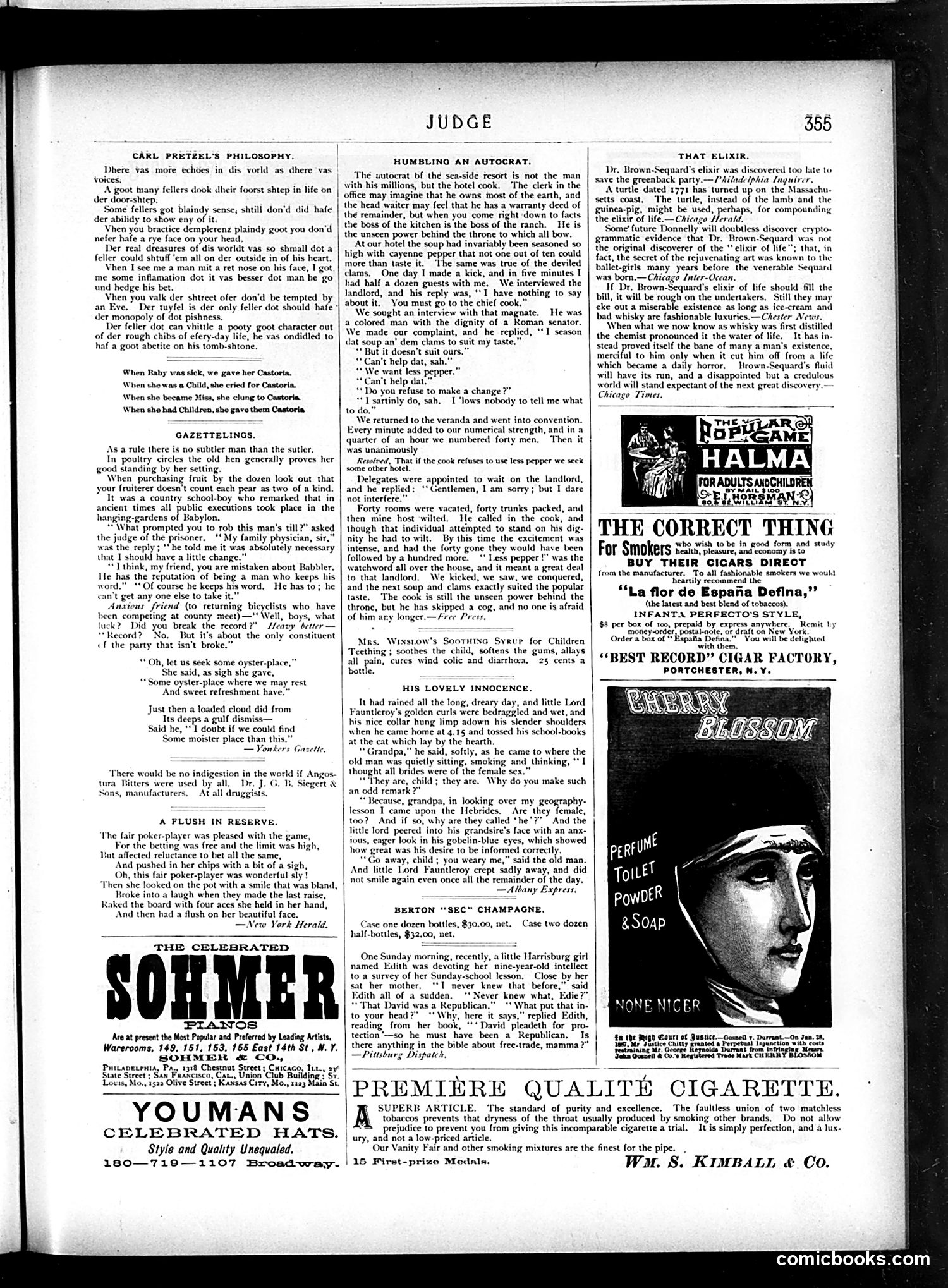
This page contains primarily **text content and advertisements** rather than political cartoons. The main notable feature is "Carl Pretzel's Philosophy"—a humorous column written in exaggerated German-immigrant dialect, presenting folksy aphorisms. Pretzel appears to be an established recurring character in Judge. The philosophy sections offer satirical observations on everyday life ("Some fellers got blaindy sense, shtili don'd did hafe der abilidy to show eny of it"), likely mocking both pretentious philosophy and immigrant speech patterns through comedic dialect. The "Gazettelings" section contains brief satirical jokes on social topics: bureaucratic absurdity, rural naïveté, and gender dynamics (notably, a female poker player's cunning). **Advertisements dominate the lower half**: piano manufacturers (Sohmer), hat sellers (Youmans), cigars, and patent medicines—typical for this era's magazines. No significant political cartoons or caricatures appear on this particular page.
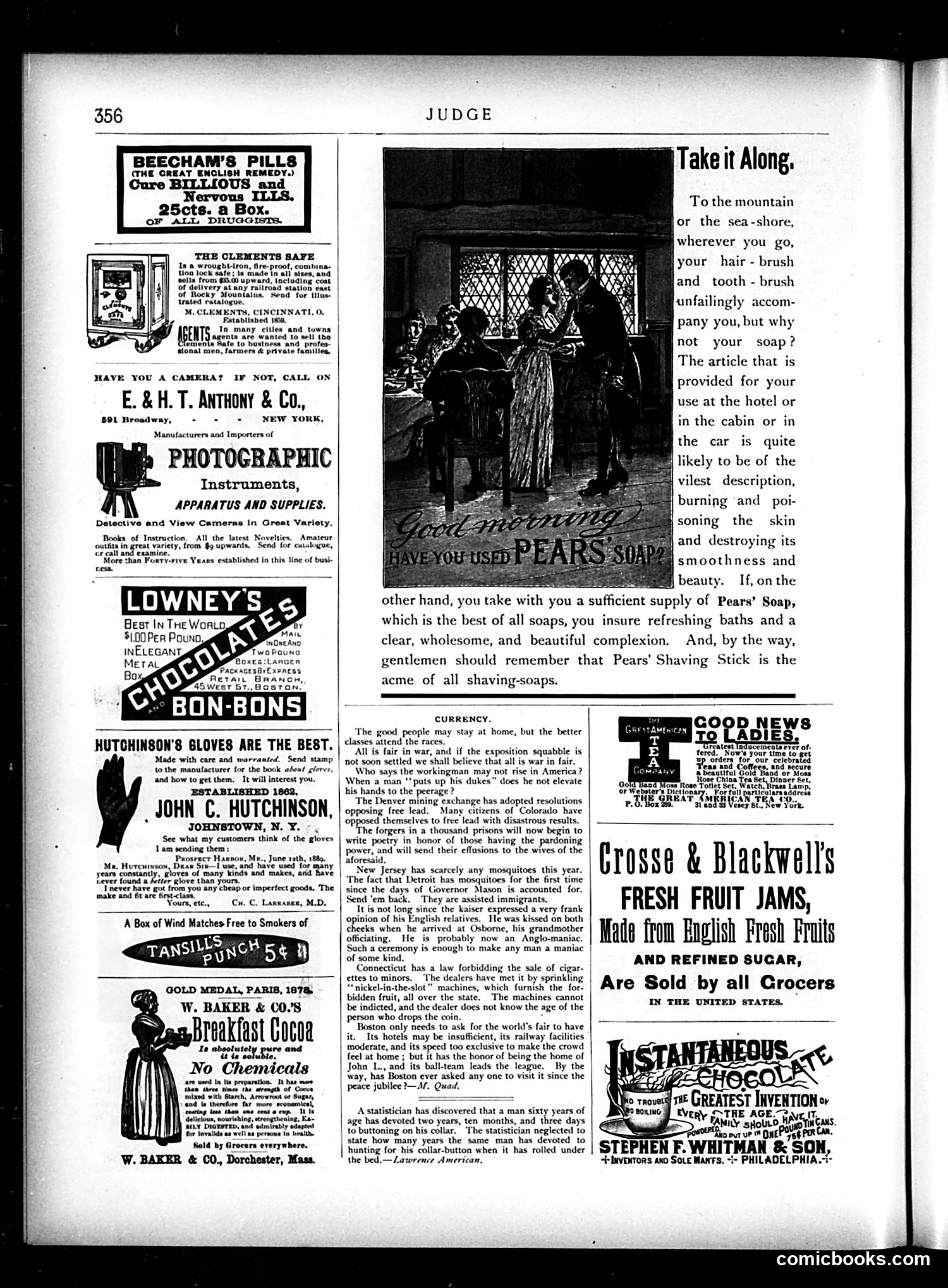
This page is primarily **advertisements and filler content**, not political satire. The layout includes product ads (Beecham's Pills, cameras, gloves, cocoa, soap) surrounding a brief editorial section titled "Currency." The "Currency" section contains **short, cynical social commentary** rather than detailed satire: - Mocking the wealthy attending races while common people stay home - Joking about labor disputes and worker aspirations - Punning on "free lead" (ammunition/metal) and Colorado labor violence - Satirizing prisoners writing sentimental poetry to curry favor with those with pardoning power - A local joke about mosquitoes in New Jersey and Detroit The central feature is a **Pears' Soap advertisement** with an illustration encouraging travelers to bring quality soap rather than rely on poor hotel amenities—presented as practical advice with gentle humor about travel conditions. There are **no identified political figures or caricatures**. This appears to be a typical late-19th-century magazine page mixing commercial advertising with brief topical humor and commentary.
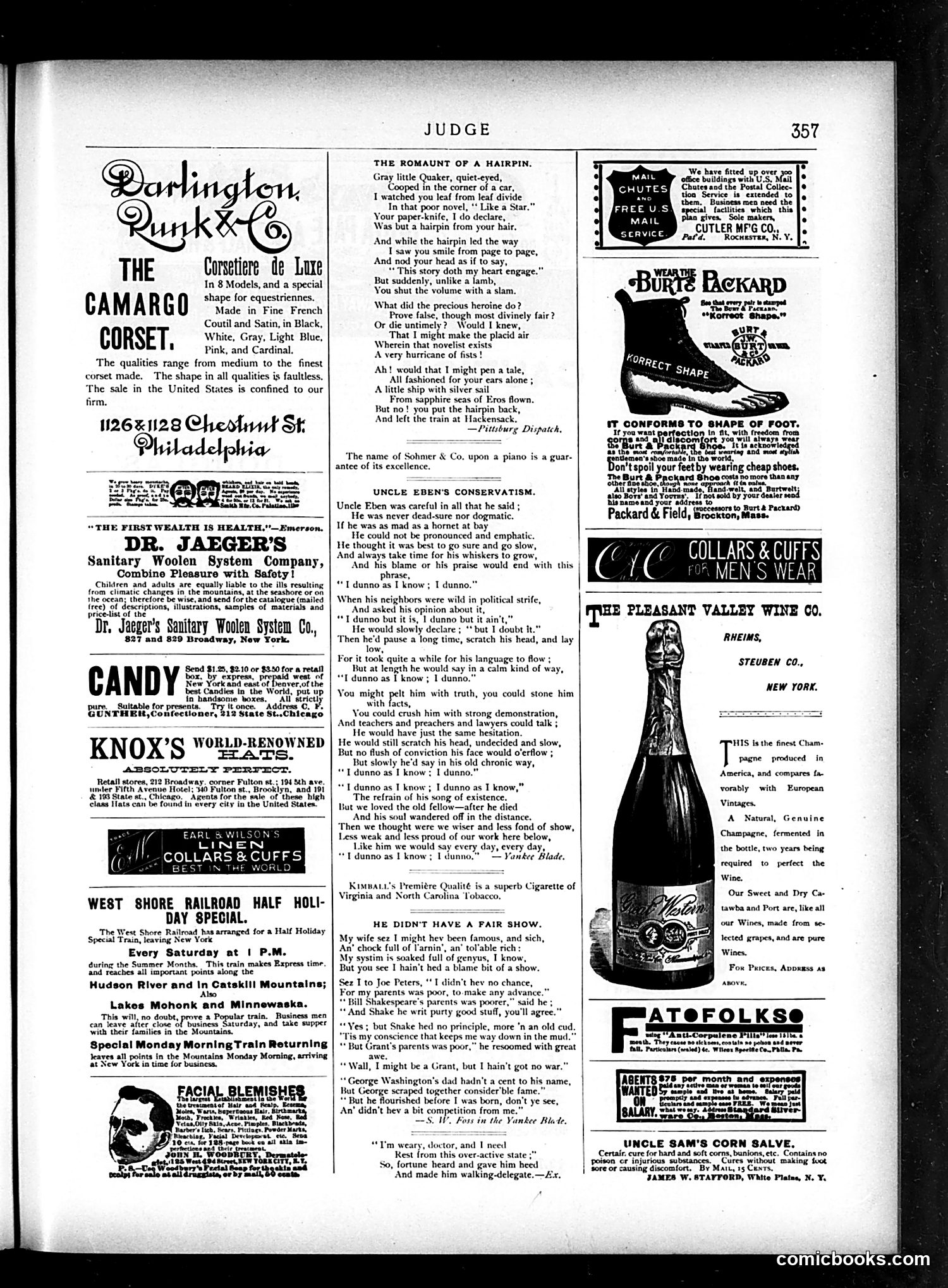
This page is primarily **advertisements** for Victorian-era consumer goods (corsets, hats, trains, patent medicines) interspersed with two **satirical poems**. "The Romaunt of a Hairpin" is a romantic comedy about a commuter observing a woman use a hairpin as a bookmark while reading a melodrama on a train. The joke is the narrator's frustrated curiosity—she abruptly closes the book at Hackensack station, leaving him forever wondering whether the heroine proved unfaithful or died. The satire gently mocks sentimental Victorian fiction and the absurdity of the narrator's obsession over a stranger's reading habits. "Uncle Eben's Conservatism" satirizes excessive caution and hedging. Uncle Eben is so perpetually non-committal—never "dead-sure," unable to express anger emphatically—that his extreme conservatism becomes ridiculous. The poem mocks people who refuse to take clear positions on anything. Both poems use humor to critique social pretension and human nature, typical of Judge's satirical approach.
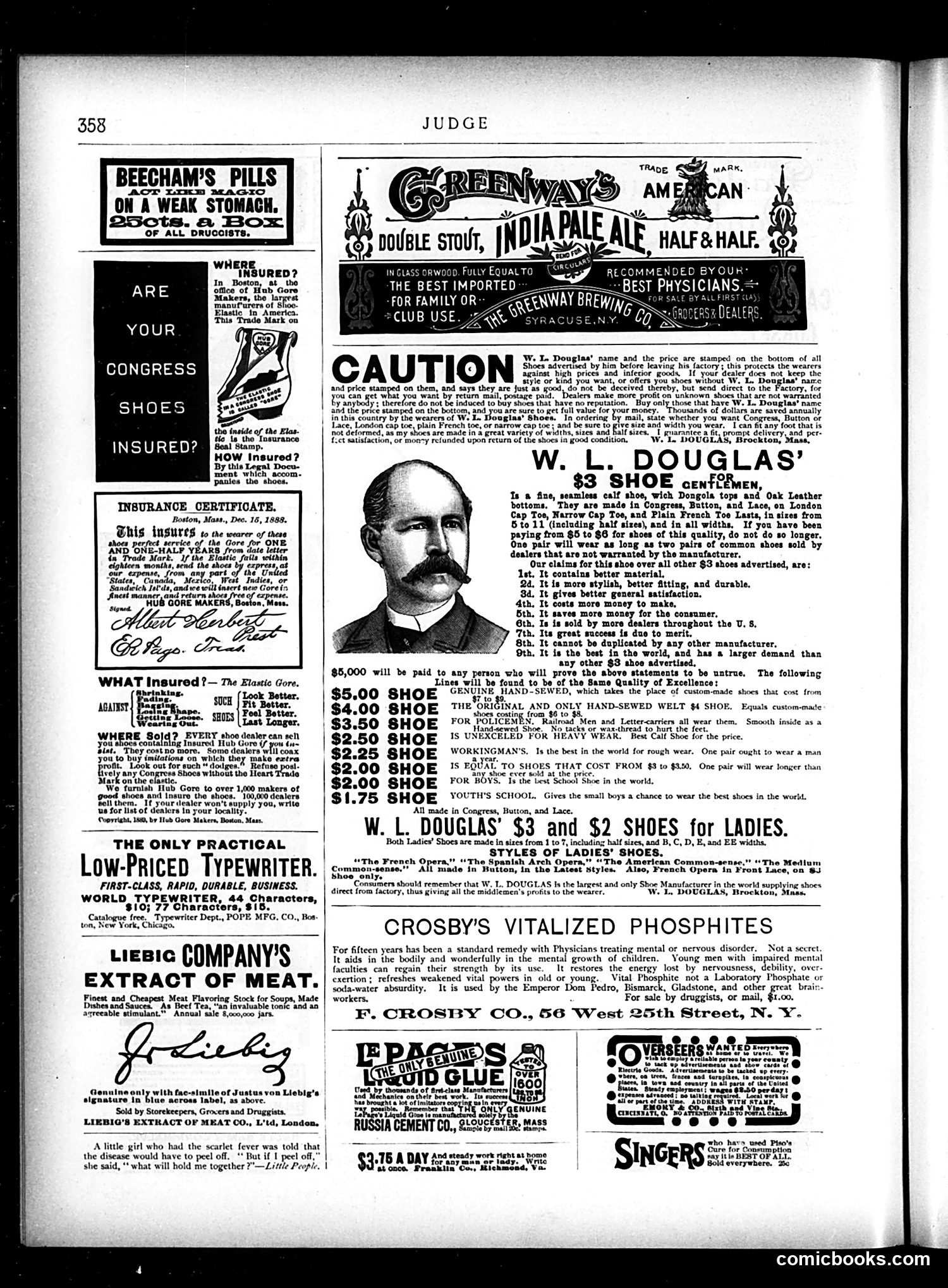
This page is primarily **advertising**, not political satire. It showcases late 19th-century consumer products typical of Judge magazine's revenue model. **Key advertisements include:** - **W.L. Douglas Shoes**: The dominant content features shoe manufacturer Douglas prominently, claiming his $3 shoe equals imported quality. He emphasizes his name stamped on soles as a guarantee against fraud and inferior goods—addressing consumer anxiety about counterfeit products. - **Hub Gore Makers**: Promotes elastic-sided shoes with an "insurance certificate" guaranteeing durability, a novelty marketing tactic. - **Beecham's Pills, Liebig's Extract of Meat, Crosby's Phosphites**: Standard patent medicines and tonics. The page reflects **Gilded Age consumer culture**: manufacturers competed fiercely on claims of quality and durability, used endorsements (physicians, dealers), and developed brand-protection strategies. The emphasis on "genuine" products and warnings against imitations suggests rampant counterfeiting was a real commercial problem for consumers to navigate.
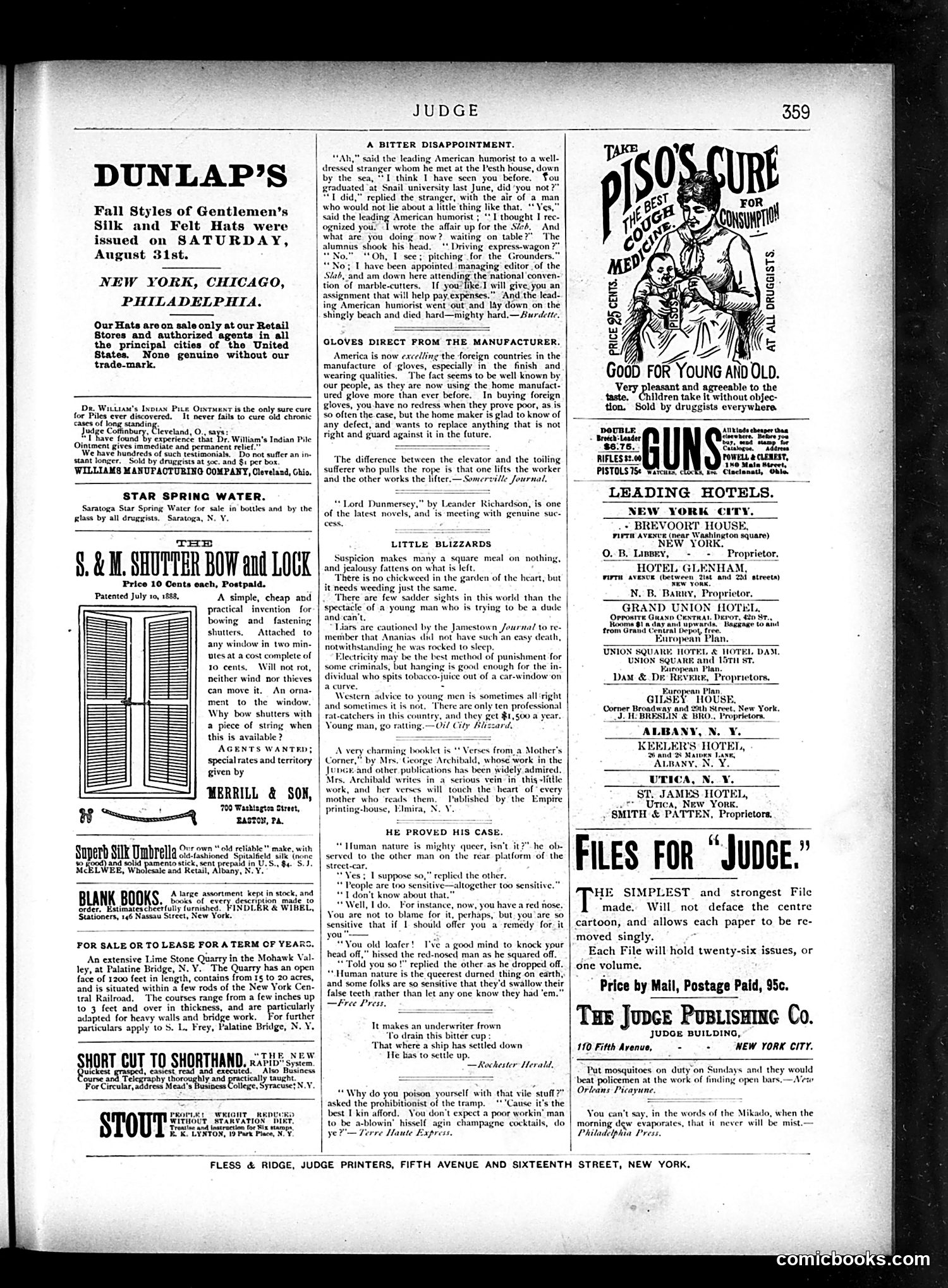
This is primarily an **advertising page** with one satirical piece. The main content is "A Bitter Disappointment," a short humorous story by Burdette (a known humorist of the era). **The Satire:** The joke mocks a self-important "leading American humorist" who patronizingly assumes a university graduate must be working menial jobs (waiting tables, driving wagons, pitching baseball). When the young man reveals he's actually been appointed managing editor of a major publication and is attending a professional convention, the humorist is so humiliated he dramatically "dies hard" on the beach. **The Point:** This satirizes the arrogance of established literary figures who underestimated younger talent, and the swift reversals of fortune in the competitive world of American journalism and publishing. The exaggerated ending ("died hard") is typical of Judge's comedic style. The rest of the page consists of period advertisements for hats, water, medical remedies, office equipment, and real estate—typical of 1880s magazines.
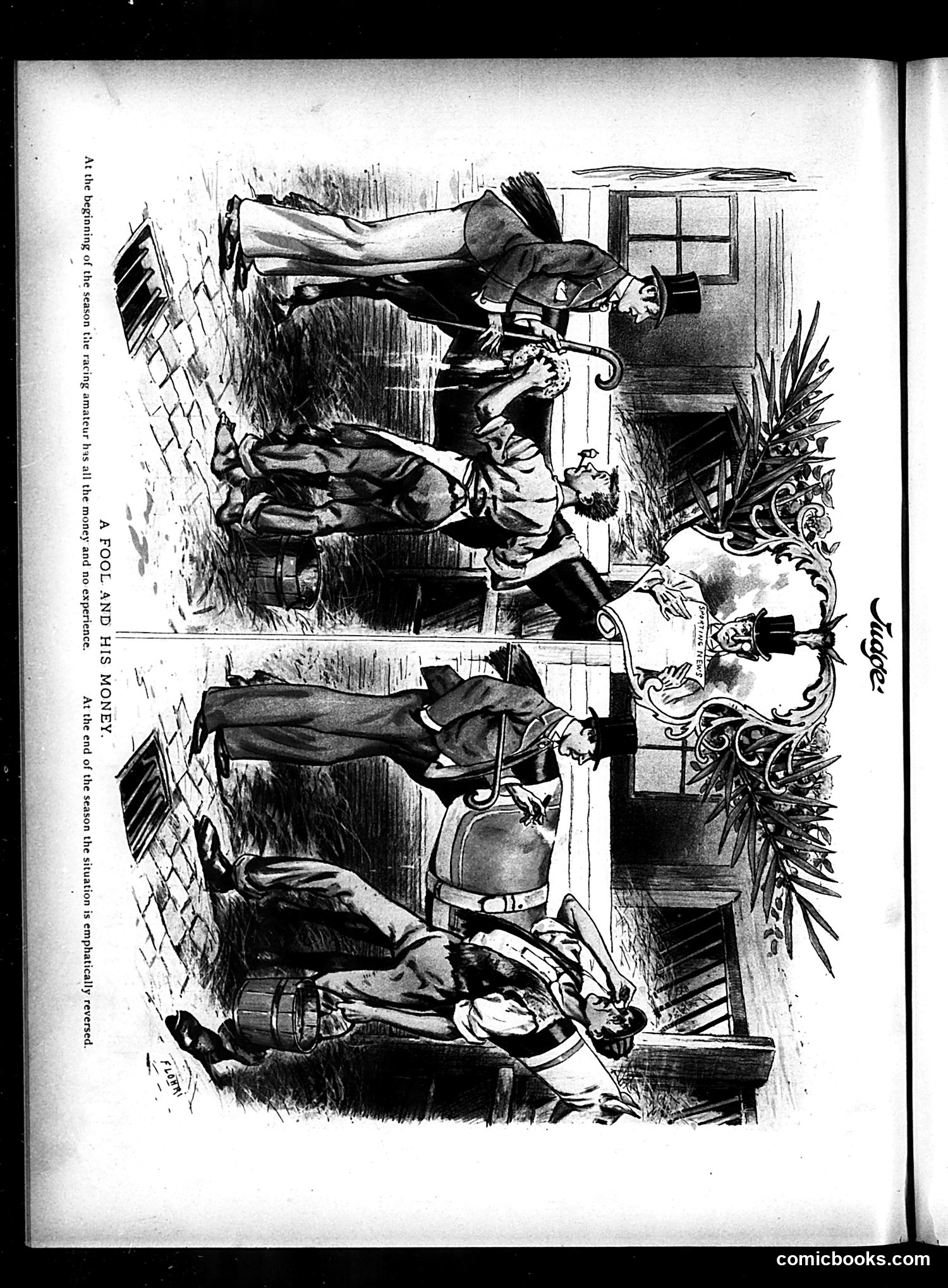
This cartoon illustrates the classic proverb about foolish spending through a racing-themed satire. The two panels show the reversal of fortune for an amateur horse-racing enthusiast across a single season. **Top panel**: A well-dressed gentleman arrives at the racetrack, apparently wealthy and confident but inexperienced. **Bottom panel**: The same man departs broke and bedraggled, having lost his fortune through betting. The caption explicitly states the moral: at season's start, the amateur has money but lacks experience; by season's end, he has gained bitter experience but lost all his money. This satirizes the hubris of wealthy amateurs who believe they can beat the odds at gambling, serving as a cautionary tale about the dangers of racing speculation and amateur betting.