
Judge, 1889-09-07 · page 2 of 16
Judge — September 7, 1889 — page 2: what you’re looking at
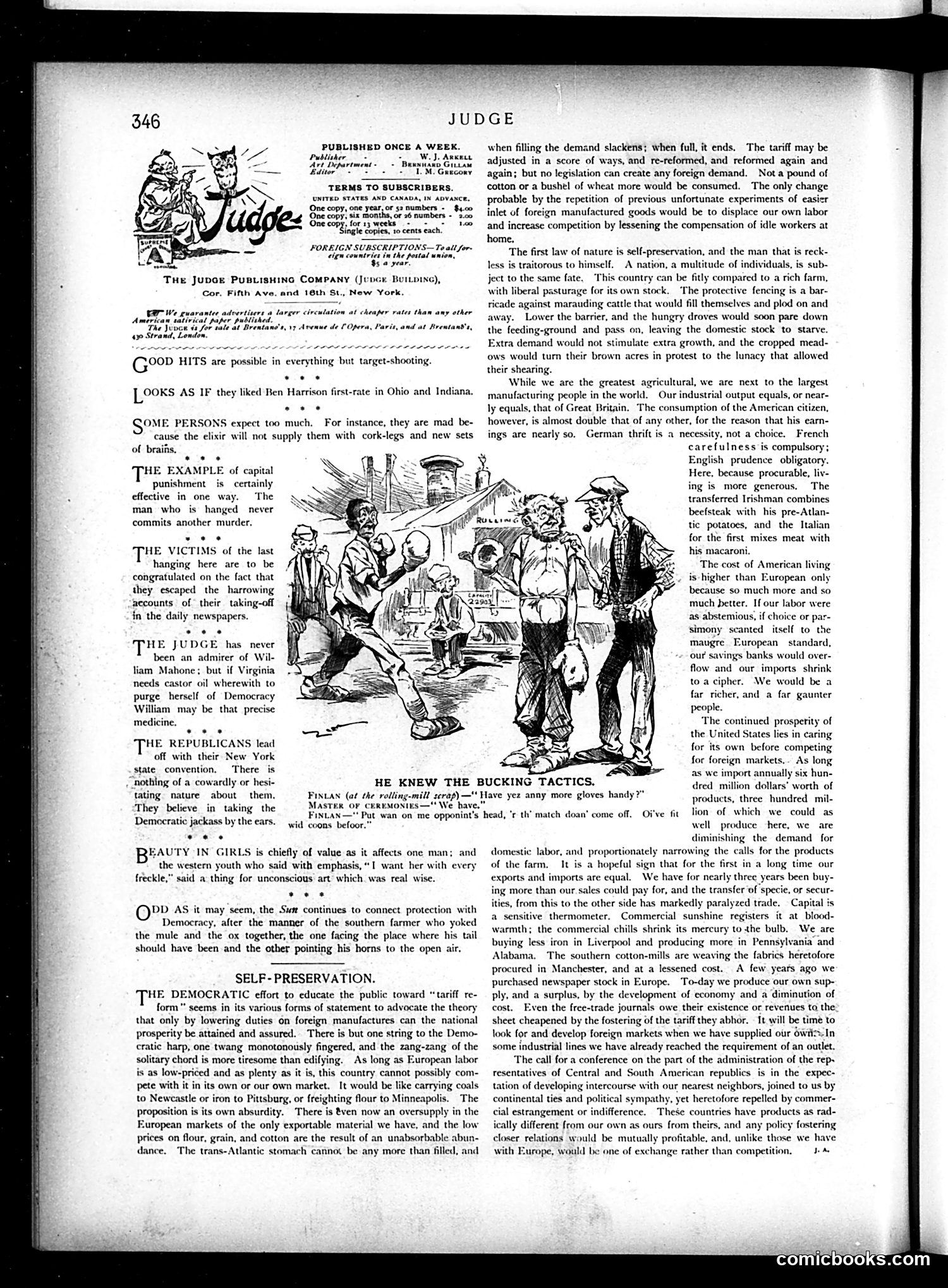
What you’re looking at
The central cartoon, titled "FINLAN THE HIKING TACTICS," depicts what appears to be a street altercation or arrest scene. The dialogue references "gloves" and "match down," suggesting a boxing or fighting context. The caption identifies someone named "Finlan" (possibly a political or public figure of the era). However, without clearer identification of the specific historical figure or incident referenced, the exact satirical point remains unclear. The cartoon appears to mock either a particular politician's handling of a confrontation or a broader social issue involving law enforcement and public behavior. The surrounding text discusses tariffs, labor, and economic policy—typical Judge Magazine concerns—but doesn't directly illuminate this cartoon's specific target or message. **Cannot determine precise satirical meaning without additional historical context.**
📄 Transcribed text from this page (OCR, searchable)
Machine-transcribed from the original scan — historical spelling and the odd misread are preserved.
JUDGE PUBLISHED ONCE A WEEK. Publisher Art Departme Eativor’ TERMS TO SUBSCRIBERS. UNITED STATES AND CANADA, IN ADVAN One copy, one year, or s2 numbers - $4.00 One copy, six months, or 26 numbers - "3.00 One cory for sy weeks = os tee ingle copies, 10 cents each, FOREIGN SUBSCRIPTION cign countries in the pottal $5 @ year. —To all for THe Jupor PuBLisHinGe ComPANy (Jupce Burtpixe), Cor, Fifth Ave. and 16th St, New York. EBT We guarantee advertisers a larger circulation at cheaper rates than any other Lal paper published a7 Arenue de COpera, Paris, and at Rrentand's, 4p Strand, Londom Looks AS IF they liked Ben Harrison first-rate in Ohio and Indiana. OME PERSONS expect too much. cause the elixir of brains, For instance, they are mad be- will not supply them with cork-legs and new sets HE EXAMPLE punishment is certainly effective in one w The man who is hanged never commits another murder. of capital S06 HE VICTIMS of the last hanging here are to be congratulated on the fact that they escaped the harrowing accounts of their taking-off in the daily newspapers. HE JUDGE has never been an admirer of W liam Mahone: but if Virginia needs castor oil wherewith to purge herself of Democracy William may be that precise medicine, THE. REPUBLICANS lead off with their New York state convention, There i nothing of a cowardly or hes tating nature about them. ‘They believe in taking the Democratic jackass by the ears. FINLAN (af the rolling-mill serap)— MASTER OF CEREMONIES—" We hat wid coons befoor.” wee BEAUTY IN GIRLS is chiefly of value as it affects one man; and the western youth who said with emphasis, “I want her with every freckle,” said a: thing for unconscious’ art’ which. was real v eee QPP AS it may seem, the Sum continues to connect protection with Democracy, after the manner of the southern farmer who yoked the mule and the ox together, the one facing the place where his tail should have been and the other pointing his horns to the open air, SELF- PRESERVATION. THE DEMOCRATIC effort to educate the public toward “tariff re- form" seems in its various forms of statement to advocate the theory that only by lowering duties on foreign manufactures can the national prosperity be attained and assured. ‘There is but one string to the Demo- cratic harp, one twang monotonously fingered, and the zang-zang of the solitary chord is more tiresome than edifying. As long as European labor is as low-priced and as plenty as it is, this country cannot possibly com- pete with it in its own or our own market. It would be like carrying coals to Newcastle or iron to Pittsburg, or freighting flour to Minneapolis. The proposition is its own absurdity. ‘There is tven now an oversupply in the European markets of the only exportable material we have, and the low prices on flour, grain, and cotton are the result of an unabsorbable abun- dance. ‘The trans-Atlantic stomach carinot be any more than filled, and HE KNEW THE BUCKING TACTICS. FiNLAN—'* Put wan on me opponint’s head, 'r th’ match doan’ come off. when filling the demand slackens; when full, it ends. The tariff may be adjusted in a score of ways, and re-reformed, and reformed again and again; but no legislation can create any foreign demand. Not a pound of cotton or a bushel of wheat more would be consumed. The only change probable by the repetition of previous unfortunate experiments of easier inlet of foreign manufactured goods would be to displace our own labor and increase competition by lessening the compensation of idle workers at home, The first law of nature is self-preservat less is traitorous to himself, A nation, a multitude of individuals, is sub- ject to the same fate, This country can be fitly compared to a rich farm, With liberal pasturage for its own stock. ‘The protective fencing is a bar- Ficade against marauding cattle that would fill themselves and plod on and away. Lower the barrier, and the hungry droves would soon pare down the feeding-ground and pass on, leaving the domestic stock to starve. Extra demand would not stim growth, and the cropped mead- ows would turn their brown acres in protest to the lunacy that allowed their shearing. While we are the greatest agricultural, we are next to the largest manufacturing people in the world. Our industrial output equals, or near- ly equals, that of Great Britain. The consumption of the American citizen, however, is almost double that of any other, for the reason that his earn- ings are nearly so. German thrift is a necessity, not a choice. French carefulness is compulsory; English prudence obligatory. Here, because procurable, liv- ing is more generous. The transferred Irishman combines beefsteak with his pre-Atlan- tic potatoes, and the Italian for the first mixes meat with his macaroni. The cost of American living is higher than European only because so much more and so much better. If our labor were as abstemious, if choice or par- simony scanted itself to the maugre European standard, our savings banks would over- flow and our imports. shrink to acipher. We would be a far richer, and a far gaunter people. yn, and the man that is reck- ‘The continued prosperity of the United States lies in caring for its own before competing for foreign markets... As long as we import annually six hun- dred million dollars’ worth of products, three hundred _mil- lion of which could as well here, we are diminishing the demand for domestic labor, and proportionately narrowing the calls for the products of the farm, It is a hopeful sign that for the first in a long time our exports and imports are equal. We have for nearly three years been buy- ing more than our sales could pay for, and the transfer of specie, or secur- ities, from this to the other side has markedly paralyzed trade. Capital is sitive thermometer. Commercial sunshine registers it at blood- mth; the commercial chills shrink its mercury to the bulb, We are buying less iron in Liverpool and producing more in Pennsylvania’ and Alabama, The southern cotton-mills are weaving the fabrics heretofore procured in Manchester, and at a lessened cost. A few years ago we purchased newspaper stock in Europe. To-day we produce our own sup- ply, and a surplus, by the development of economy and a diminution of cost. Even the free-trade journals owe their existence or revenues to the sheet cheapened by the fostering of the tariff they abhor. - It will be time to look for and develop foreign markets when we have supplied our dwiicsIn some industrial lines we have already reached the requirement of an outlet. ‘The call for a conference on the part of the administration of the rep resentatives of Central and South American republics is in the expec- tation of developing intercourse with our nearest neighbors, joined to us by continental ties and political sympathy, yet heretofore repelled by commer- cial estrangement or indifference. These countries have products as rad- ically different from our own as ours from theirs, and any policy fostering closer relations would be mutually profitable, and, unlike those we have with Europe, would be one of exchange rather than competition, lave yez anny more gloves handy?” we produce A