
Judge, 1889-09-07 · page 5 of 16
Judge — September 7, 1889 — page 5: what you’re looking at
What you’re looking at
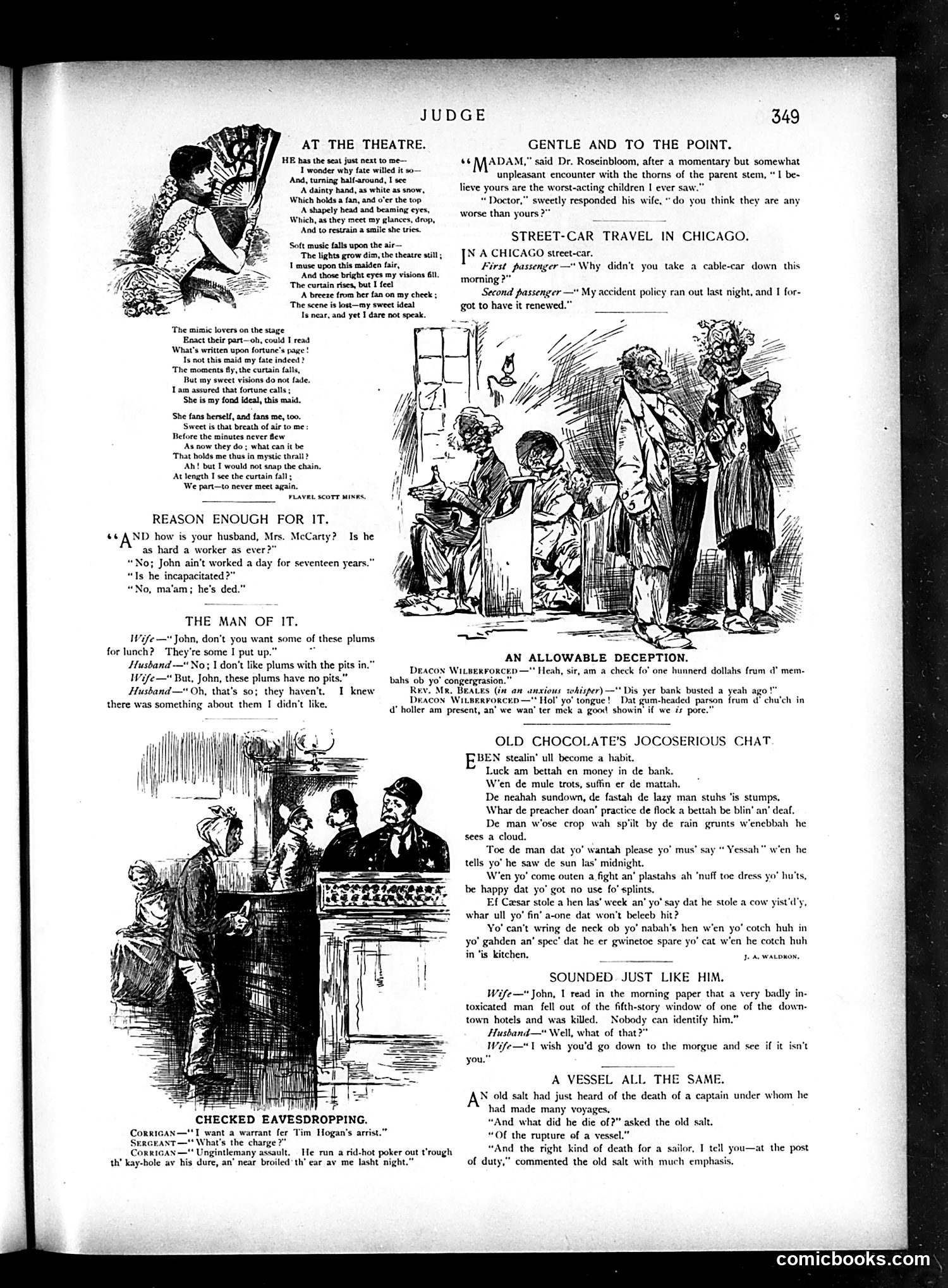
This page contains multiple satirical pieces typical of Judge's humor: **"At the Theatre"** is a romantic poem about a man entranced by an attractive woman seated nearby—a sentimental piece poking fun at theater-goers' distraction from the actual performance. **"Reason Enough for It"** jokes about a widow matter-of-factly stating her husband hasn't worked in seventeen years because he's dead—dark humor common to the era. **"Street-Car Travel in Chicago"** mocks safety-conscious passengers, with one explaining he won't use cable-cars because his accident insurance expired. **"Checked Eavesdropping"** depicts an Irish immigrant (indicated by dialect) seeking a warrant against someone who shoved a hot poker through his door's keyhole. **"Old Chocolate's Jocoserous Chat"** presents folk wisdom in exaggerated African American dialect—a common but offensive comedic trope of the period reflecting period racism. The illustrations use period engraving style to accompany these short humor pieces, typical of Judge's format.
📄 Transcribed text from this page (OCR, searchable)
Machine-transcribed from the original scan — historical spelling and the odd misread are preserved.
JUDGE AT THE THEATRE. HE has the seat just next to me— I wonder why fate willed it so— And, turning half-around, I see A dainty hand, as white as snow, Which holds a fan, and o'er the top A shapely head and beaming eyes, Which, as they meet my glances, drop, And to restrain a smile she tries. Soft music falls upon the air— The lights grow dim, the theatre still ; I muse upon this maiden fair, ‘And those bright eyes my visions 6il ‘The curtain rises, but I feel A breeze from her fan on my cheek ; The scene is lost—my sweet ideal Is near, and yet I dare not speak. ‘The mimic lovers on the stage Enact their part—oh, could I read ‘What's written upon fortune’s p Is not this maid my fate indees ‘The moments fly, the curtain falls, But my sweet visions do not fade. Tam assured that fortune calls ; She is my fond ideal, this maid. ‘She fans herself, and fans me, too. Sweet is that breath of air to me Before the minutes never flew As now they do; what can it be That holds me thus ia mystic thrall? ‘Ah! but I would not snap the chain, At length I see the curtain fall ; We part—to never meet again. TLAVEL SCOTT MINRS REASON ENOUGH FOR IT. #¢ AND how is your husband, Mi as hard a worker as ever? “No; John ain't worked a day for seventeen years.” “Is he incapacitated?” “No, ma‘am; he’s ded.” . McCarty? Is he THE MAN OF IT. Ife — John, don’t you want some of these plums for lunch? ‘They're some I put up.” a Husband —'No ; | don't like plums with the pi Wife—* But, John, these plums have no pit Husband —" Oh, that's $0; they haven't. there was something about them I didn’t like, IT knew ! ee CHECKED EAVESDROPPING. I want a warrant fer Tim Hogan's arrist.” * What's the charge 2" *Ungintlemany assault, He run a rid-hot poker out t'rough th’ kay-hole ay his dure, an’ near broiled’ th’ ear ay me lasht night.” Dracon Wi d' holler am present, an’ GENTLE AND TO THE POINT. id Dr. Roseinbloom, after a momentary but somewhat unpleasant encounter with the thorns of the parent stem, “I be- lieve yours are the worst-acting children I ever saw.” “Doctor,” sweetly responded his wife, “do you think they are any ‘worse than yours 2” STREET-CAR TRAVEL IN CHICAGO. IX A CHICAGO street-car. First passenger —" Why didn’t you take a cable-car down this morning ?” Second passenger got to have it renewed.’ “ My accident policy ran out last night, and I for- AN ALLOWABLE DECEPTION. Deacon Witberrorcep—"' Heah, sir, am a check fo’ one hunnerd dollahs frum d’ mem- bahs ob yo" congergrasion. Rev. Mr. BEALE ES (in an anxious whisper) —"' Dis yer bank busted a yeah ago!" FORCED —"* Hol’ yo" tongue! Dat gum-headed parson frum d° chu'ch in xe wan’ ter mek a good showin’ if we és pore.” OLD CHOCOLATE’S JOCOSERIOUS CHAT EBEN stealin’ ull become a habit. Luck am bettah en money in de bank. W'en de mule trots, suffin er de mattah, De neahah sundown, de fastah de lazy man stuhs ‘is stumps, Whar de preacher doan’ practice de flock a bettah be blin’ an’ deaf. De man w'ose crop wah spiilt by de rain grunts wenebbah he sees a cloud. Toe de man dat yo’ wantah please yo’ mus’ say “ Yessah” w’en he tells yo" he saw de sun las’ midnight. Wren yo" come outen a fight an’ plastahs ah ‘nuff toe dress yo" hu'ts, be happy dat yo" got no use fo" splint Ef Cassar stole a hen las’ week an’ yo" say dat he stole a cow yist'd’y, whar ull yo’ fin’ a-one dat won't beleeb hit? Yo! can’t wring de neck ob yo’ nabah’s hen w’en yo" cotch huh in yo’ gahden an’ spec’ dat he er gwinetoe spare yo’ cat wen he cotch huh in ‘is kitchen. Je A WALDKON, SOUNDED JUST LIKE HIM. Wife—"Jobn, 1 read in the morning paper that a very badly in- toxicated man fell out of the fifth-story window of one of the down. town hotels and was killed. Nobody can identify him. Husband—* Well, what of that?” Wife—*1 wish you'd go down to the morgue and see if it isn't you.” A VESSEL ALL THE SAME. AX ld salt had just heard of the death of a captain under whom he had made many voyages. “And what did he die of?” asked the old salt. “Of the rupture of a vessel.” “And the right kind of death for a sailor, 1 tel of duty,” commented the old salt with much emphasis. —at the post comicbooks.com