
A complete issue · 16 pages · 1889
Judge — August 24, 1889
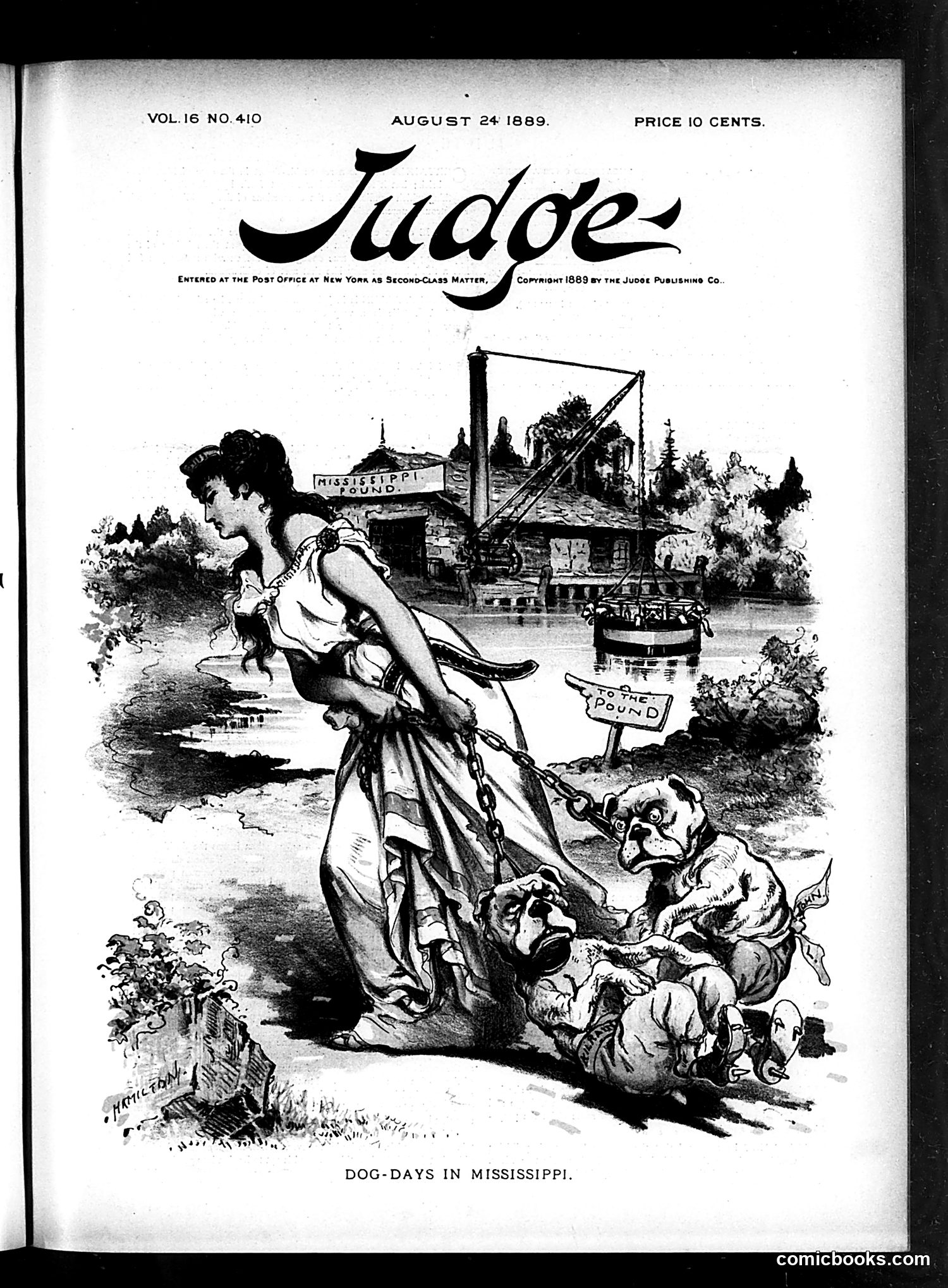
This Judge magazine cover from August 24, 1889, uses allegorical satire about the American South. A classical female figure (representing Justice or Liberty) stands amid the Mississippi River landscape, wielding a whip or rod to control several dog-headed figures at her feet. The "dog-days" reference—typically meaning the hottest summer period—becomes a pun: these are literal "dogs" (caricatured figures) representing Southern political or social problems. The sign reading "50 POUND" suggests these figures are being penned or controlled like animals. The satirical point appears critical of conditions in Mississippi during Reconstruction's aftermath, likely mocking Southern governance or racial violence. The cartoon implies these problems require firm discipline—personified by the dominant female figure.
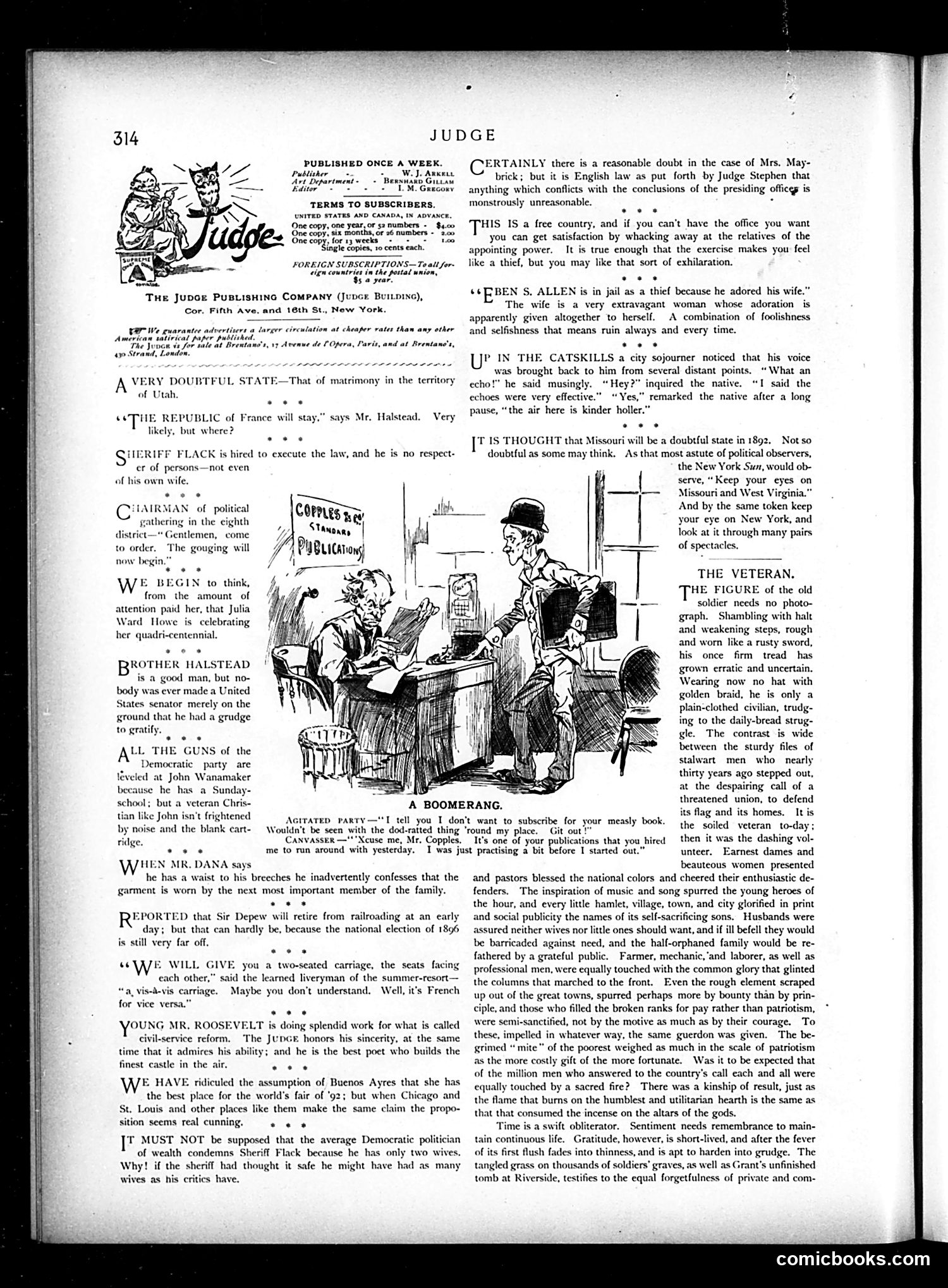
The central cartoon depicts two figures at a desk labeled "Coffees & Co. Publishing" - apparently a magazine publisher's office. One man (seated) complains to another about an unwanted subscription, saying he doesn't want their "messy book" and refuses to be a subscriber. He mentions practicing "a bit before I started out," suggesting incompetence or trial-and-error approach. The cartoon's title, "A Boomerang," indicates the satire: the publisher's own publication has backfired. The joke appears to criticize either *Judge* magazine itself or a competitor's editorial practices - possibly mocking poor business practices, bad writing, or unsuccessful publishing ventures that return to harm their creators. The casual dismissal of the subscription reinforces the publication's apparent lack of quality or appeal.
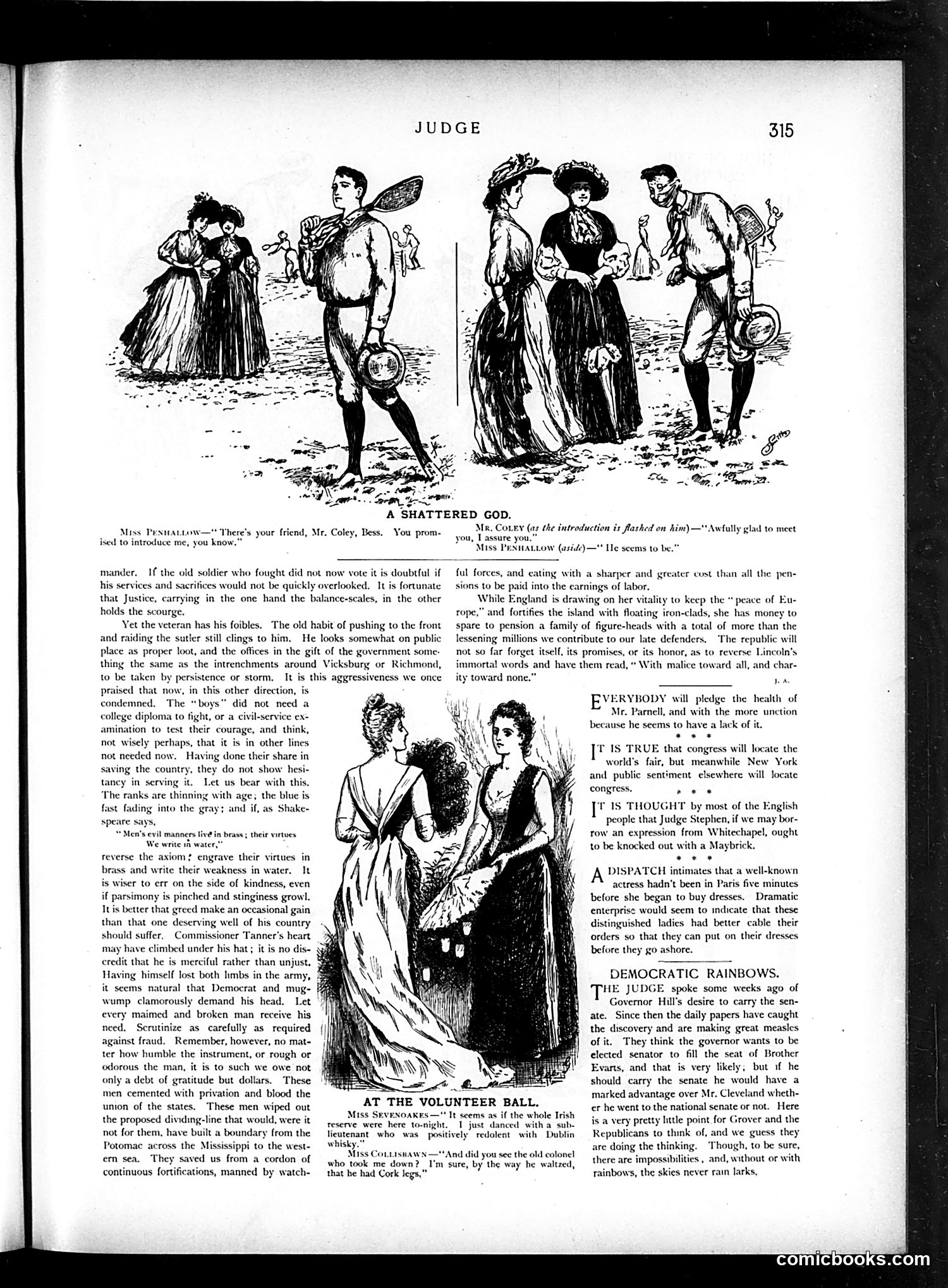
This page from *Judge* magazine contains multiple satirical pieces from the late 19th century. **"A Shattered God"** (top cartoon) appears to mock the introduction of a friend named Mr. Coley at a beach social gathering—the "god" reference suggests ironic disappointment with the introduction. **"At the Volunteer Ball"** features Irish military personnel at a social event. The jokes center on stereotypical Irish traits—one soldier is "redolent with Dublin whisky," another has "Cork legs" (slang for a wooden prosthetic leg). This reflects period anti-Irish prejudice common in American satire. The longer editorial text discusses Civil War veterans, particularly Commissioner Tanner (a disabled veteran), defending their pensions against political opponents who question the expenditure. It argues veterans deserve support regardless of their current political affiliations. **"Democratic Rainbows"** references Governor Hill's potential candidacy for Senate and discussions about electoral positioning—specific 1880s-90s political maneuvering now largely obscure. The page reflects typical *Judge* content: social snobbery, ethnic stereotyping, and partisan political commentary.
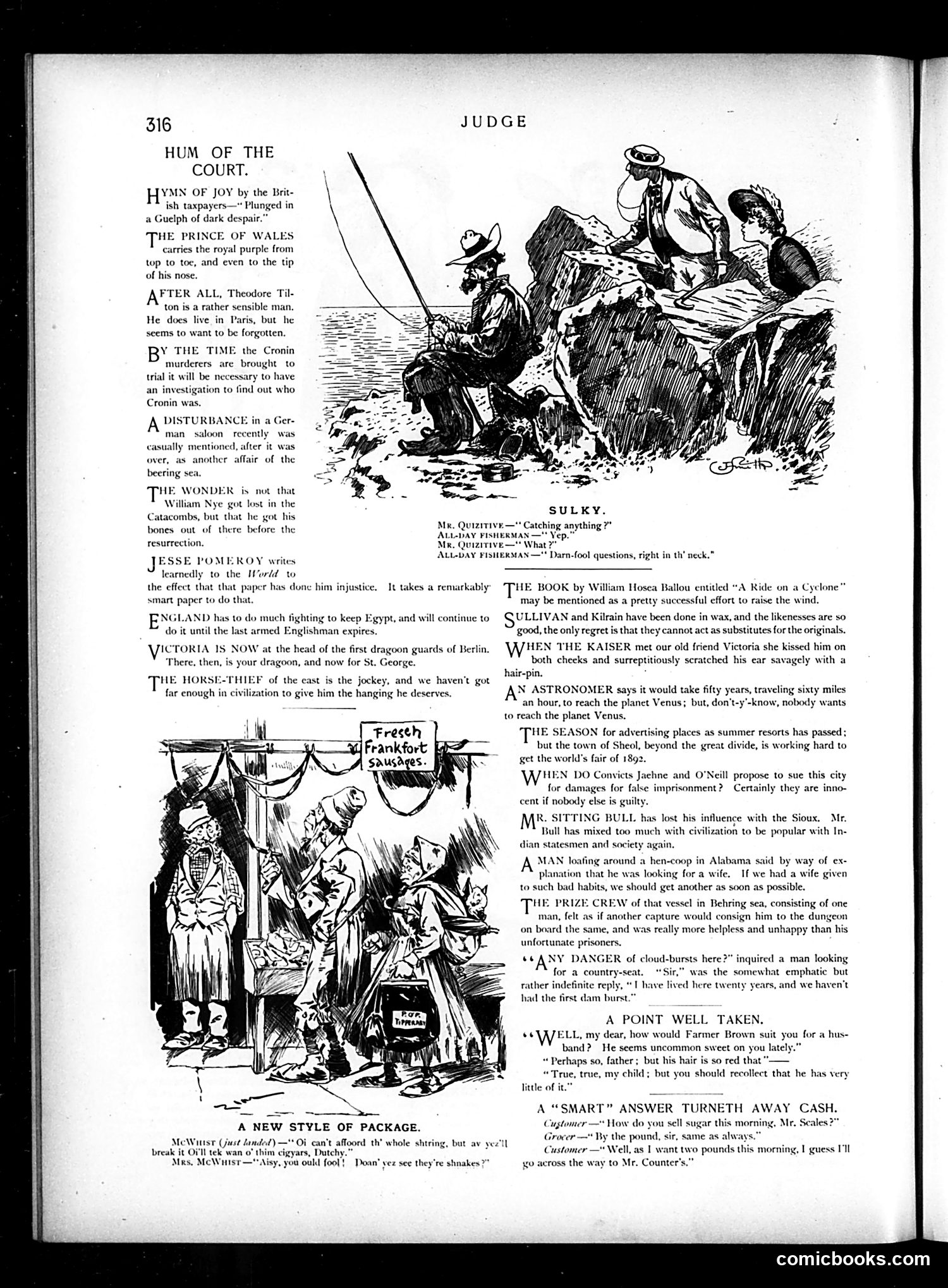
This page mixes brief satirical commentary on contemporary figures with cartoon humor. Key references include: **Political/Social Jabs:** - Prince of Wales: mocked for his extravagance ("purple from top to toe") - Theodore Tilton: referenced as a scandal figure living in Paris - Dr. Cronin murder case: suggests the investigation will reveal little - William Nye: appears to be a public figure who got lost in Paris catacombs - British Egypt policy: criticized as endless military commitment - Victoria and the Kaiser: hints at diplomatic relations **Cartoons illustrate everyday humor:** - "Sulky" fishing scene with clichéd questions - "A New Style of Package" showing a butcher shop scene with wordplay about package wrapping The page's tone is characteristic of Judge's blend of political commentary, celebrity gossip, and gentle domestic humor—satire accessible to educated Victorian readers but now requiring historical context for modern audiences unfamiliar with these figures and events.
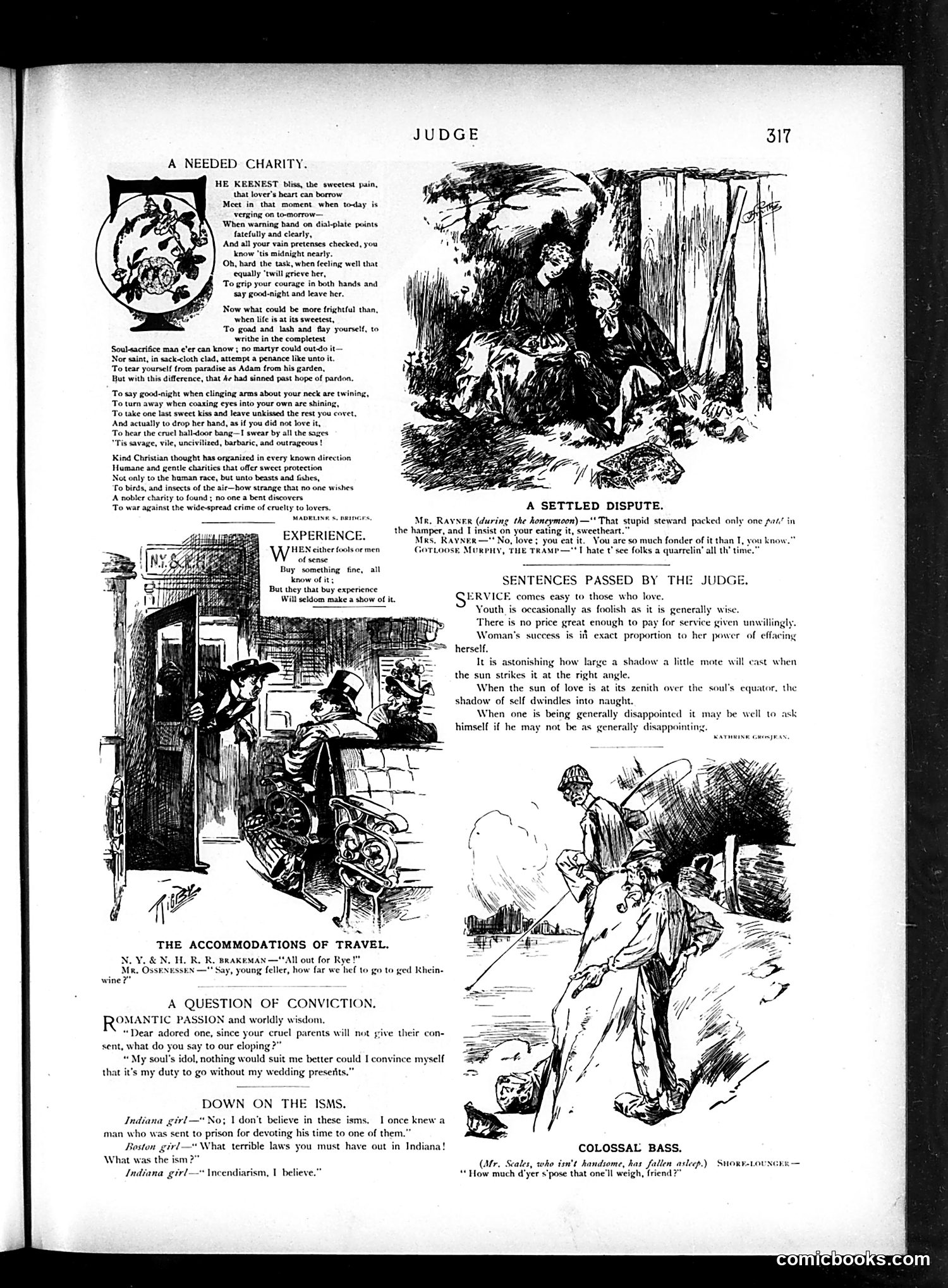
This page from *Judge* satirizes romance and social conventions through several sketches: **"A Needed Charity"** mocks the restraint required of Victorian suitors who must leave their sweethearts at midnight. The poem argues that forcing lovers to part is cruel and suggests society should establish a "charity" to protect them from this "crime"—a humorous inversion treating romantic self-denial as barbaric. **"A Settled Dispute"** shows newlyweds bickering over food while a tramp observes their quarrel, finding their petty argument absurd. The joke critiques how quickly honeymoon bliss deteriorates into mundane domestic squabbles. **Other sketches** include jokes about railway travel, elopement vs. wedding gifts, and regional attitudes toward political "isms" (appearing to reference anarchism/radicalism). The page primarily satirizes courtship rituals, marital discord, and social pretension rather than specific political figures, offering gentle mockery of American middle-class life and romance.
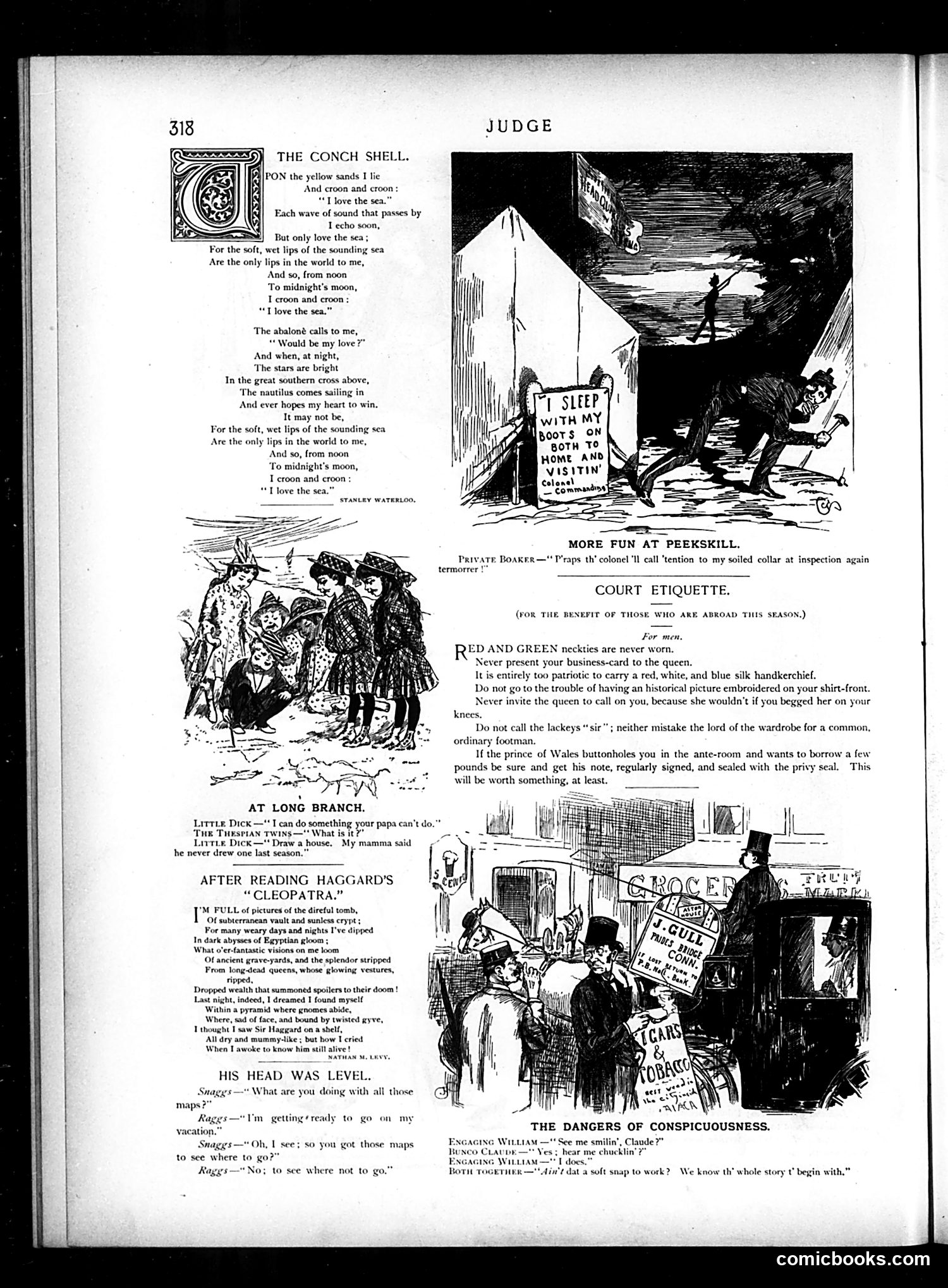
This page contains multiple satirical pieces typical of late-19th-century Judge magazine: **"The Conch Shell"** (poem): A romantic parody about someone emotionally fixated on the sea, rejected by other suitors (abalone, nautilus). The satire mocks sentimental Victorian poetry. **"Court Etiquette"**: Humorous advice for Americans visiting British royalty abroad, gently ridiculing both American patriotic excess (red-white-blue handkerchiefs, business cards to the queen) and American social anxiety about proper decorum. The joke about the Prince of Wales borrowing money with a signed note suggests skepticism about aristocratic credibility. **"More Fun at Peekskill"**: A soldier's joke about repeated inspection failures—mild military satire. **"At Long Branch"** and other brief jokes: Light domestic humor about children and drawing ability. **"After Reading Haggard's Cleopatra"**: Parody of overwrought literary responses to H. Rider Haggard's popular adventure novel, mocking readers who get lost in melodramatic Egyptian tomb imagery. The page is primarily entertainment and light social satire rather than hard political commentary.
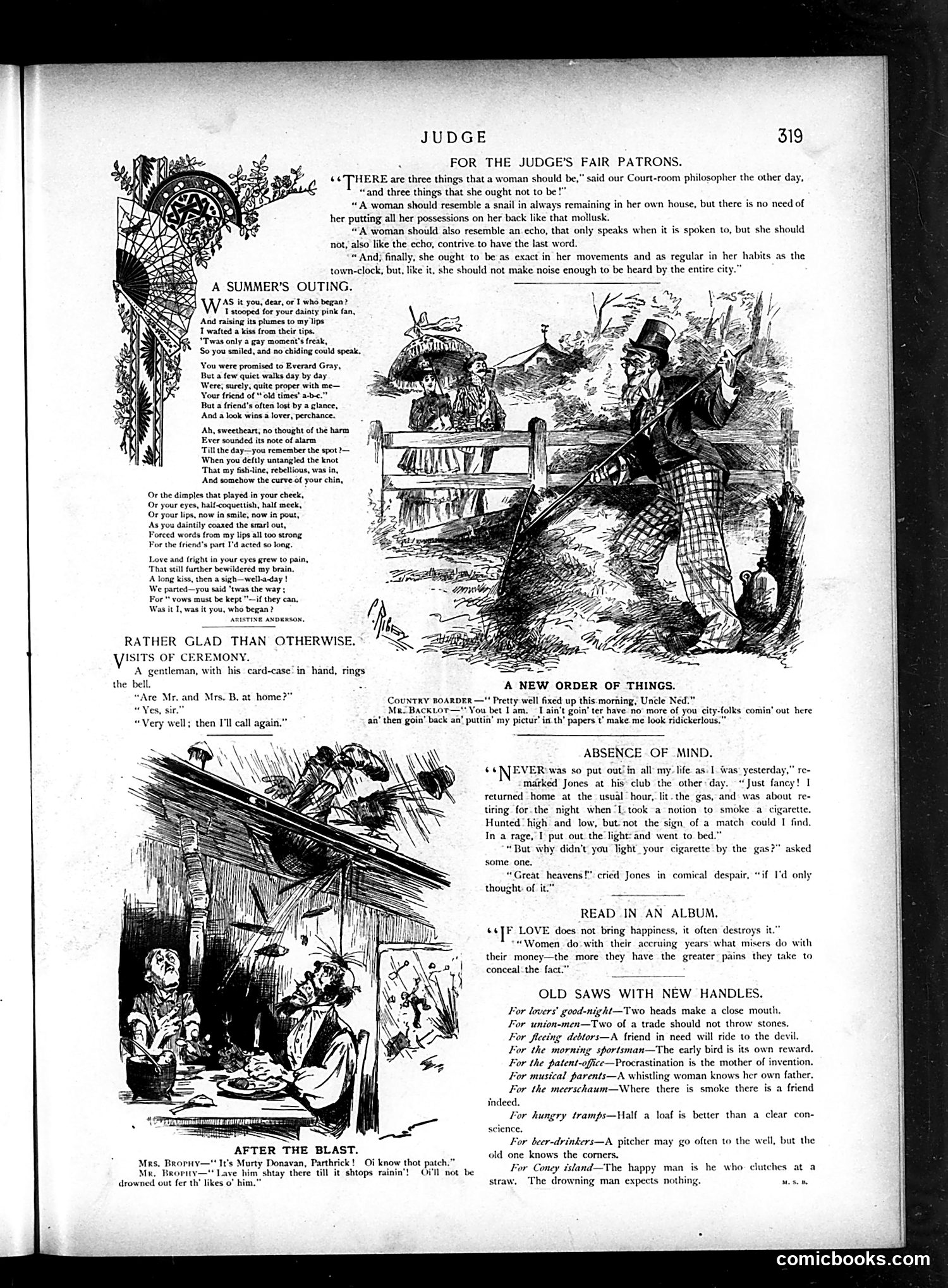
This page contains satirical commentary typical of late 19th-century American humor: **"For the Judge's Fair Patrons"** presents mock advice about ideal womanhood—she should stay home (like a snail), speak only when spoken to (like an echo), and be as regular as a clock but quiet. This satirizes Victorian gender expectations by reducing them to absurd animal comparisons. **"A Summer's Outing"** is a sentimental poem about a man breaking his platonic friendship vow by kissing an engaged woman during an innocent fishing outing, played for romantic drama. **The cartoons** illustrate various social situations: a formal gentleman caller making visits (upper right), rural folks mocking city visitors who publicize them (center), and scenes of domestic life. **"Old Saws with New Handles"** repurposes common proverbs with new applications—humor derived from unexpected contexts rather than topical references. The page overall reflects Judge's blend of sentimental romance, gentle social satire, and wordplay rather than sharp political commentary.
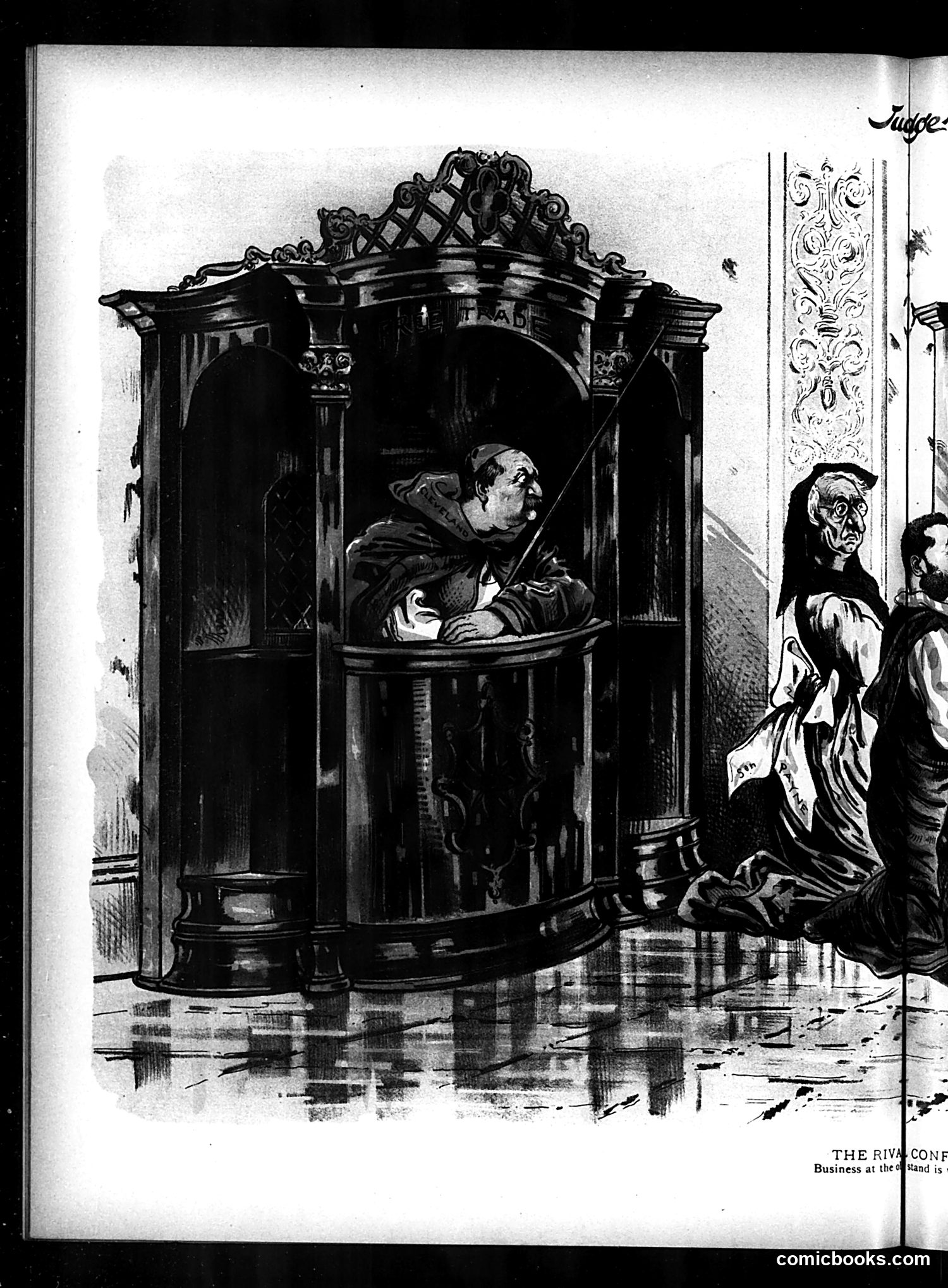
This appears to be a satirical cartoon from *Judge* magazine depicting a confessional booth. A priest is shown inside the ornate wooden structure, while figures (appearing to include women with exaggerated features) wait outside. The title references "Business at the stand," suggesting commentary on the Catholic confessional practice. The satire likely critiques either the frequency of confessions, the nature of sins being confessed, or broader anti-Catholic sentiment common in 19th-century American satire. The caricatured figures and the emphasis on "business" suggest mockery of confession as a commercial or repetitive ecclesiastical practice. However, without a clear date or additional context from the magazine's OCR text (which appears corrupted), the specific political or social target remains somewhat unclear.
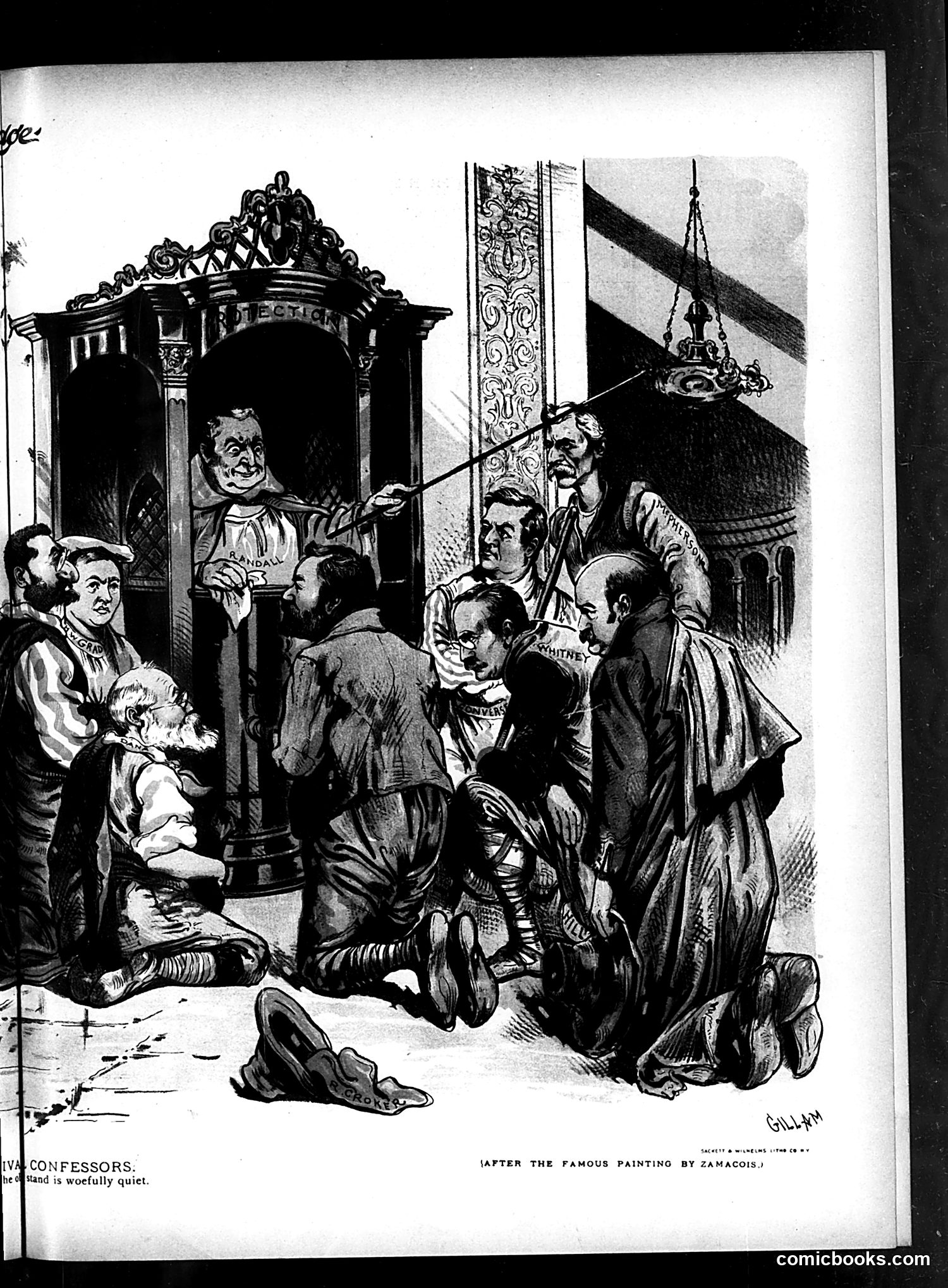
This satirical cartoon depicts a religious confession scene, likely from the 19th century based on the style. A priest sits in an ornate confessional booth while multiple penitents kneel before him, some appearing distressed or contrite. The caption "stand is woefully quiet" suggests the satirical point: despite numerous people supposedly coming to confess sins, there's an ironic silence or lack of genuine confession happening. The cartoon likely critiques either religious hypocrisy (people pretending piety while lacking sincere contrition) or satirizes the confession practice itself as ineffectual. The exaggerated facial expressions and crowded composition emphasize the absurdity. The artwork is credited as "after the famous painting by Zamacois," indicating it parodies a known religious artwork for comedic effect.
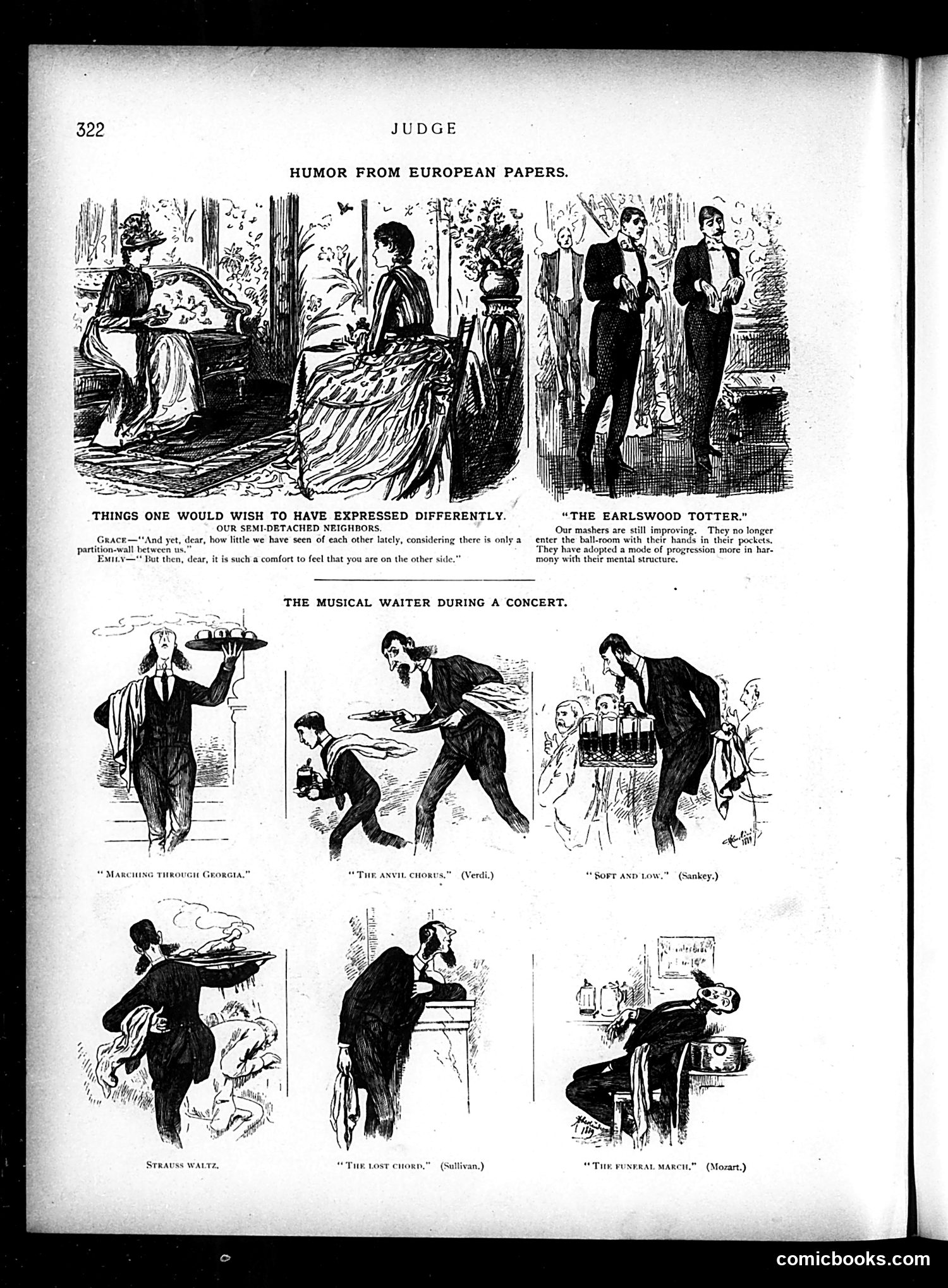
This page contains three separate humor pieces from European satirical papers: 1. **"Things One Would Wish to Have Expressed Differently"**: A couple in adjacent homes laments seeing little of each other despite sharing only a partition wall. The joke is the wife's dark comfort that at least they're separated—suggesting marital discord. 2. **"The Earlswood Totter"**: Mocks fashionable young men ("mashers") who've stopped slouching with hands in pockets, now walking in an affected, pretentious manner that supposedly reflects their shallow intellect. 3. **"The Musical Waiter During a Concert"**: Six comic illustrations showing a waiter's exaggerated physical reactions while serving during different musical pieces—he "marches" during "Marching Through Georgia," contorts during "The Anvil Chorus," bows low for soft passages, etc. The satire mocks both overly-dramatic musical interpretation and waiters' oblivious disruptions during performances. All three target Victorian social pretension and awkward manners.
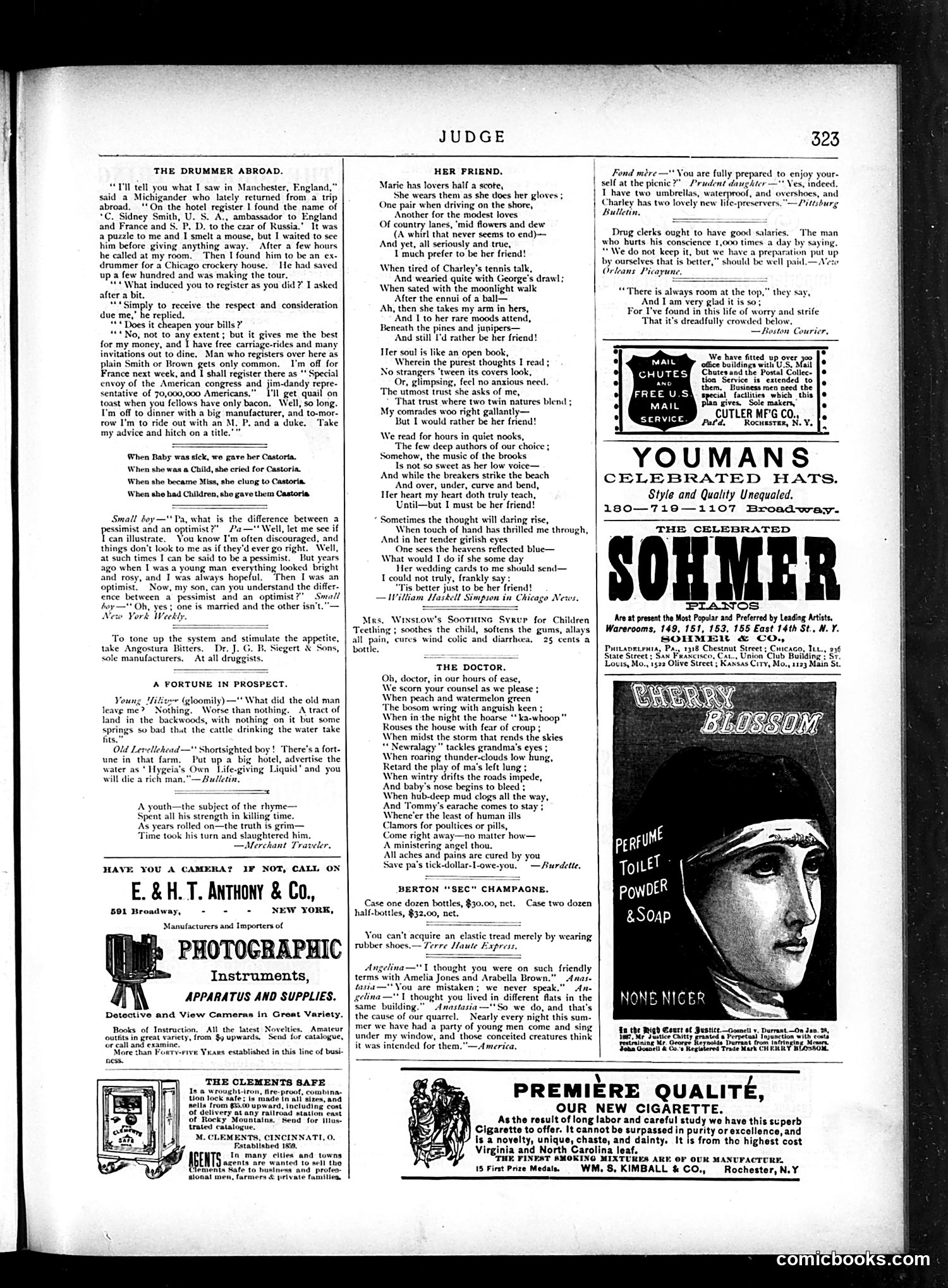
This page is primarily **advertising and light humor** rather than political satire. The main cartoon, "THE DRUMMER ABROAD," mocks American salesmen (drummers) who inflate their social status while traveling. A Michigan businessman registers at an English hotel as "Sidney Smith, U.S.A., ambassador to England and France and special representative to the czar of Russia"—purely invented titles. His scheme works: he receives better treatment, free carriage rides, and dinner invitations. The joke satirizes both American pretension and the gullibility of foreigners who assume anyone with an official-sounding title must be important. The satire targets **American braggadocio and class-consciousness**—the idea that a common salesman must fabricate credentials to receive basic respect. It's gentle mockery of Gilded Age social climbing and the perceived American tendency toward self-aggrandizement. The rest of the page contains unrelated humorous anecdotes and period advertisements (cameras, champagne, medicine).
This page is primarily **advertising** with minimal editorial content. The dominant features are commercial advertisements for dry goods, foods, patent medicines, and clothing—typical of late-19th/early-20th century magazines. The one substantial editorial piece is a sentimental poem, "The Grapevine Swing" by Samuel M. Peck, depicting nostalgic memories of childhood on a Southern plantation. The poem romanticizes antebellum life with imagery of swinging from vines, mocking-birds, and carefree youth—reflecting the Lost Cause mythology popular in that era. A brief anecdote about a Boston businessman losing $10,000 in bonds illustrates careless financial management. The page contains **no political cartoons or satirical content**—it's essentially a commercial-heavy issue typical of Judge's revenue model, with poetry and light humor filling space around paid advertisements.
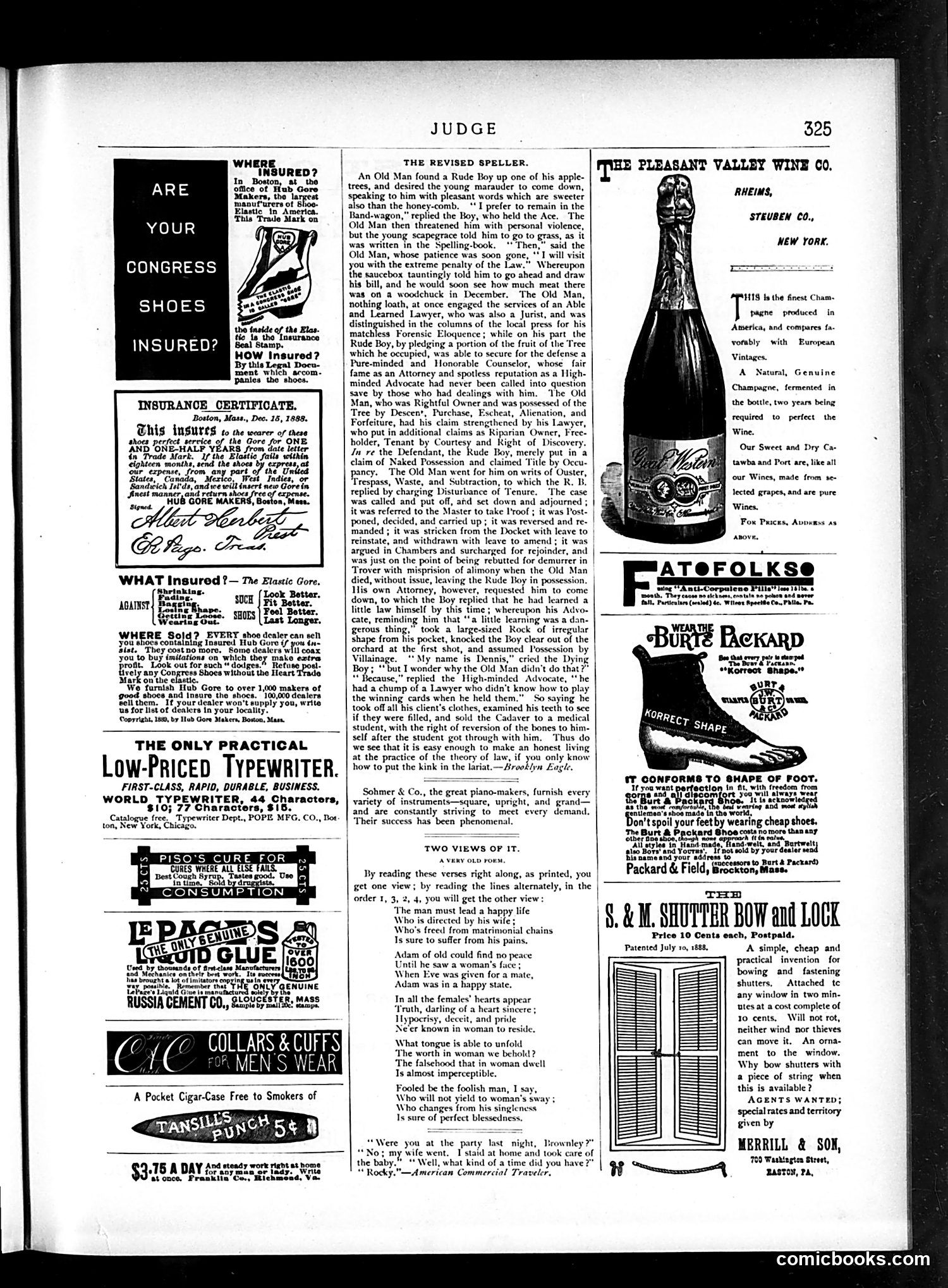
This page is primarily **advertising**, dominated by commercial products (insurance, typewriters, shoes, wine). The main satirical content is "The Revised Speller," a story satirizing excessive legal complexity. The narrative concerns an old man trying to remove a boy from an apple tree. What should be simple becomes absurdly complicated when lawyers get involved. The boy makes trivial claims ("Naked Possession," "Title by Occupancy") while the old man's lawyer multiplies baseless claims (Riparian Owner, Freeholder, etc.). The case gets repeatedly delayed, adjourned, reversed, and remanded—never resolved. **The satire targets**: the legal profession's tendency to unnecessarily complicate straightforward disputes, accumulate fees through endless procedural delays, and obscure simple facts under mountains of technical jargon. It's social criticism dressed as humorous fable—suggesting American law had become more about lawyers' profit than justice.
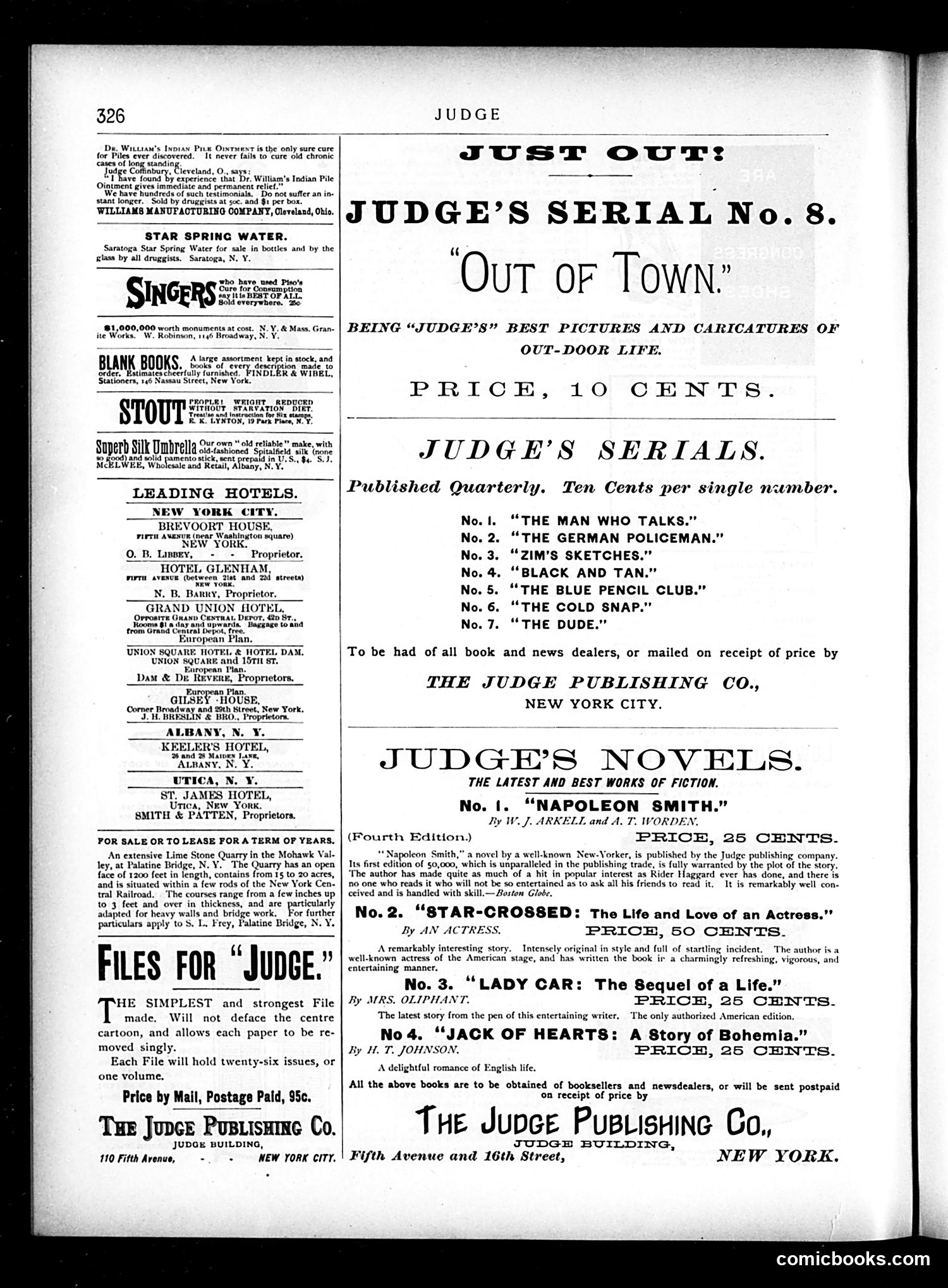
This is primarily an **advertising and promotion page** from Judge magazine, not a satirical cartoon page. The page announces **Judge's Serial No. 8**, titled "Out of Town," featuring humorous pictures and caricatures about outdoor life (priced 10 cents). It also advertises Judge's ongoing serial publications—seven titles including "The Man Who Talks," "The German Policeman," and "The Dude"—suggesting these were recurring satirical character sketches targeting recognizable American social types. Below that, the page promotes **Judge's Novels**, fiction works by contemporary authors. "Napoleon Smith" by W.J. Arkell claims 50,000 copies in circulation; "Star-Crossed" purports to be written by an actual actress about theatrical life. The remainder consists of period **commercial advertisements** for patent medicines, hotels, office supplies, and real estate—typical magazine filler of the era. Without seeing the actual cartoons referenced, the specific satirical targets remain unclear, though the titles suggest humor aimed at recognizable social archetypes.
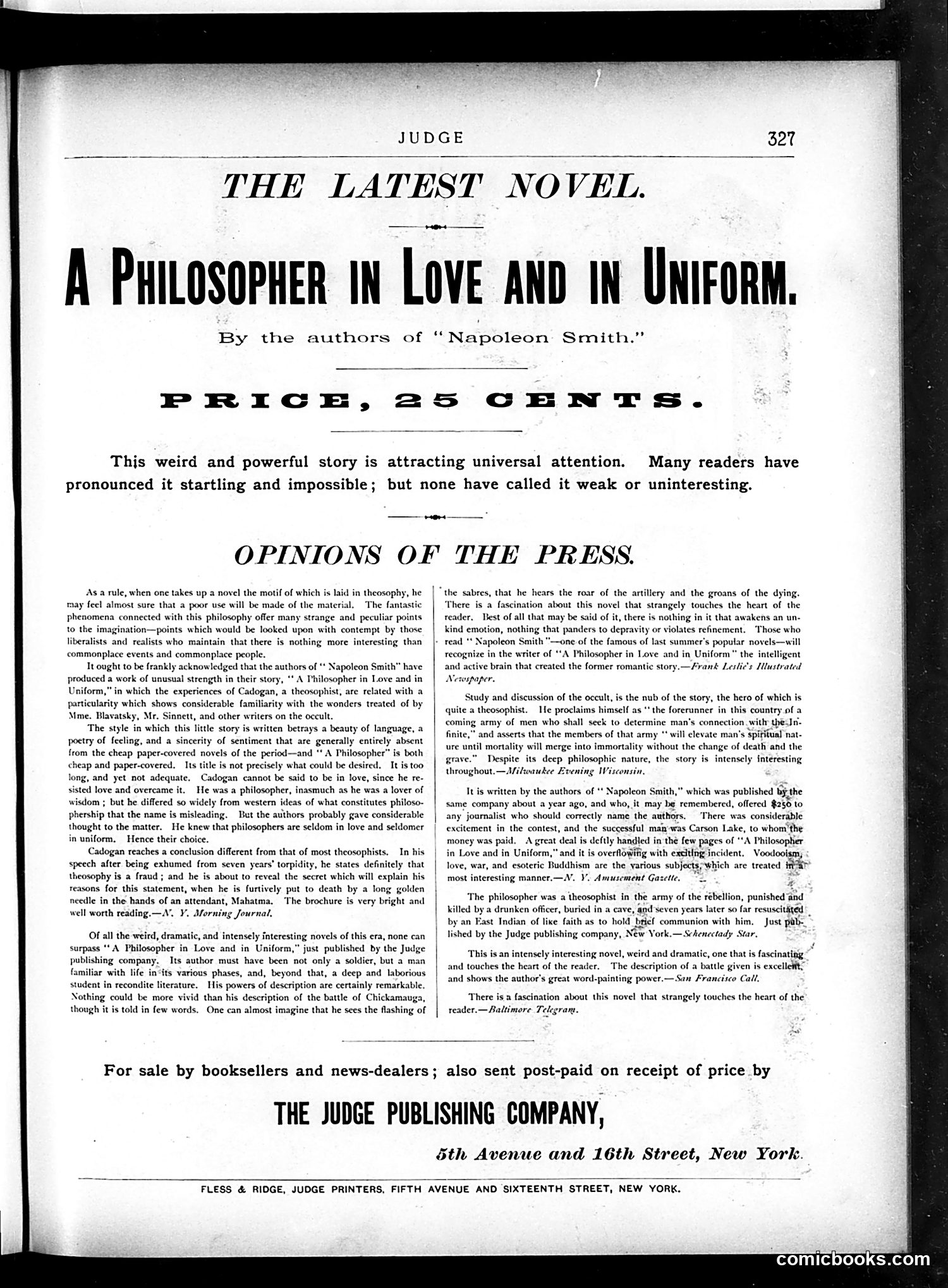
This is a **title page and advertisement**, not a cartoon. It promotes a novel called *A Philosopher in Love and in Uniform* by the authors of *Napoleon Smith*. The page includes glowing press reviews praising the book as "weird," "dramatic," and "intensely interesting." Key details: the protagonist is Cadogan, a theosophist who experiences supernatural phenomena; he survives seven years of suspended animation but is mysteriously killed by a "long golden needle" wielded by a character named Mahatma; the novel includes a vivid battle scene from Chickamauga (an American Civil War battle). The reviews suggest the novel blends philosophy (theosophy was a popular spiritualist movement in the late 19th century) with romance and military drama. The advertisements emphasize the book's "unusual strength" and literary quality despite its cheap paper cover and 25-cent price. This reflects period taste for supernatural fiction and theosophy's cultural prominence around the 1880s-1890s.
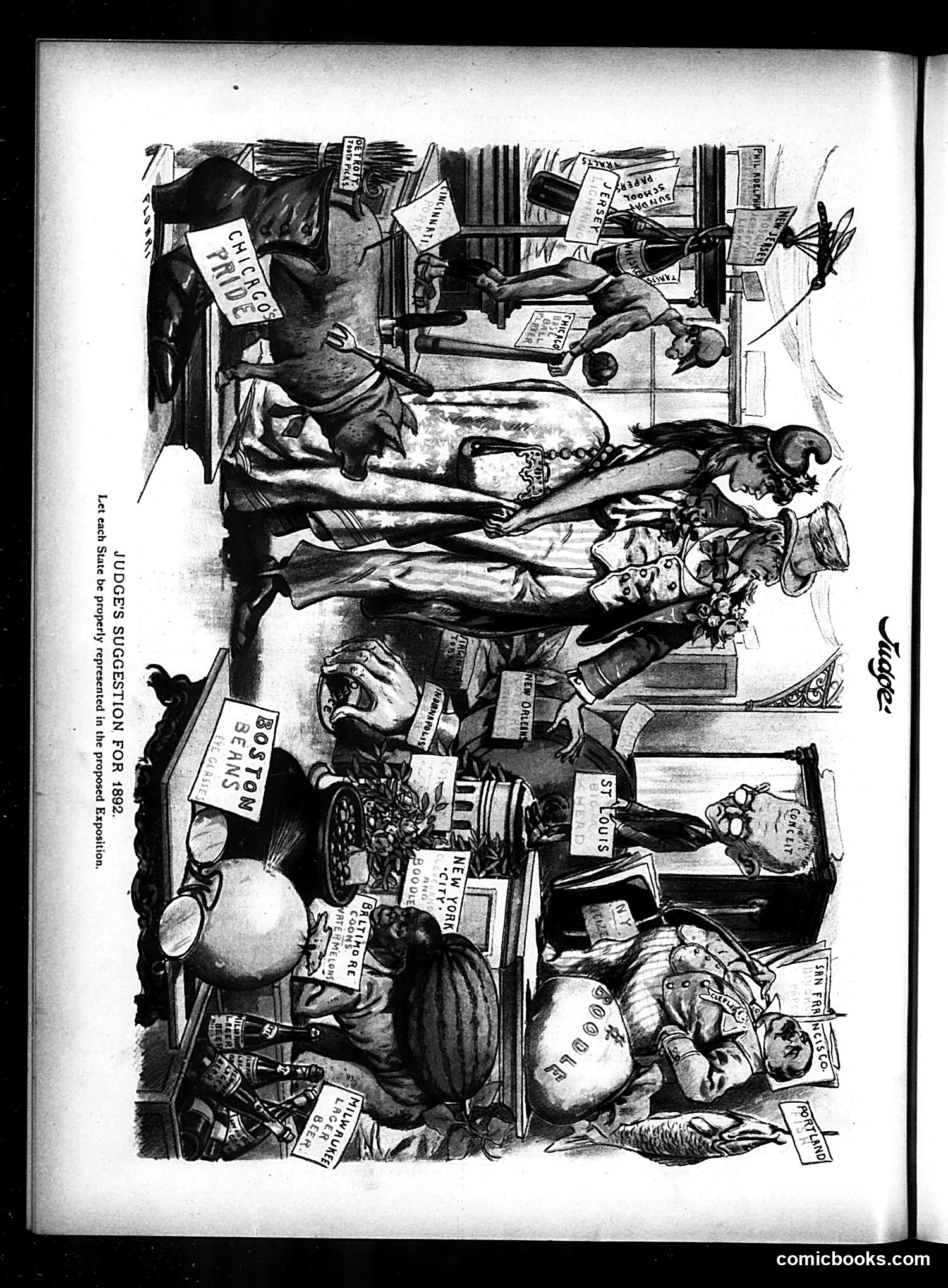
This political cartoon satirizes plans for a proposed 1892 exposition (likely the World's Columbian Exposition in Chicago). The image shows various figures labeled with different U.S. states, each depicted with characteristic products, stereotypes, or symbols meant to represent their regional identity. The cartoon's satirical point appears to be about authentic state representation at the exposition—suggesting each state should display what it's genuinely known for rather than presenting idealized versions of itself. The crowded composition with multiple figures and labeled boxes creates a humorous commentary on regional pride and how states might want to be perceived versus their actual character. The satire mocks both state vanity and the exposition's goal of showcasing American achievement.