
Judge, 1889-08-24 · page 15 of 16
Judge — August 24, 1889 — page 15: what you’re looking at
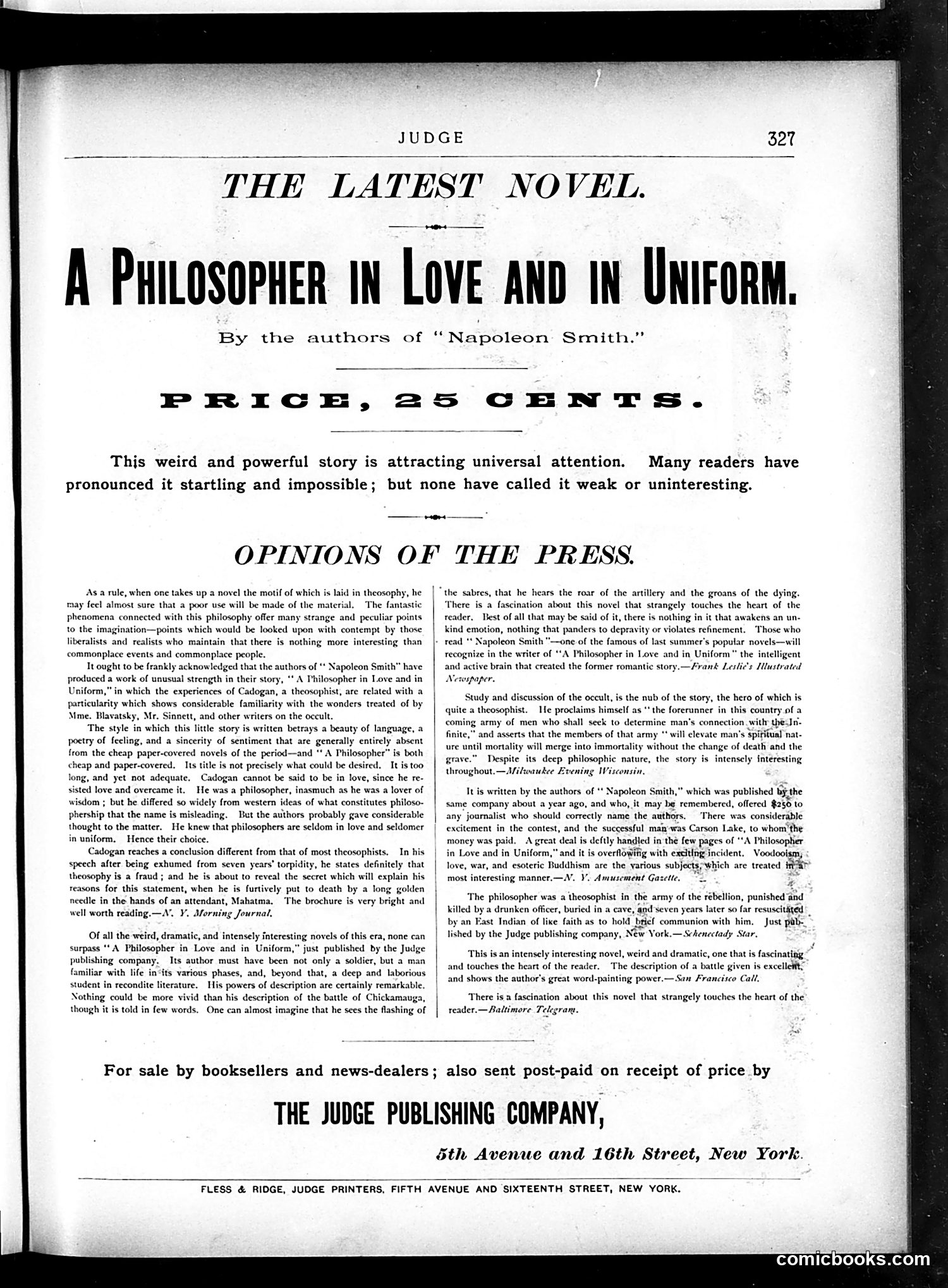
What you’re looking at
This is a **title page and advertisement**, not a cartoon. It promotes a novel called *A Philosopher in Love and in Uniform* by the authors of *Napoleon Smith*. The page includes glowing press reviews praising the book as "weird," "dramatic," and "intensely interesting." Key details: the protagonist is Cadogan, a theosophist who experiences supernatural phenomena; he survives seven years of suspended animation but is mysteriously killed by a "long golden needle" wielded by a character named Mahatma; the novel includes a vivid battle scene from Chickamauga (an American Civil War battle). The reviews suggest the novel blends philosophy (theosophy was a popular spiritualist movement in the late 19th century) with romance and military drama. The advertisements emphasize the book's "unusual strength" and literary quality despite its cheap paper cover and 25-cent price. This reflects period taste for supernatural fiction and theosophy's cultural prominence around the 1880s-1890s.
📄 Transcribed text from this page (OCR, searchable)
Machine-transcribed from the original scan — historical spelling and the odd misread are preserved.
“THE LATEST NOVEL. 4 A PHILOSOPHER IN LOVE AND IN UNIFORM. By the authors of Napoleon Smith.” This weird and powerful story is pronounced it startling and impossible ; attracting universal attention. Many readers but none have called it weak or uninteresting. OPINIONS OF THE PRESS. As a rule, when one takes up a novel the motif of which is laid in theosophy, he may feel almost sure that a poor use will be made of the material, ‘The fanta phenomena connected with this philosophy offer many strange and peculiar points to the imagination—points which would be looked upon with contempt by those liberalists and realists who maintain that there is nothing more interesting than commonplace events and commonplace people. It ought to be frankly acknowledged that the authors of Napoleon Smith” have produced a work of unusual strength in their stor “* A Philosopher in Love and in Uniform,” in which the experiences of Cadogan, a theosophist, are related with a particularity which shows considerable familiarity with the wonders treated of by Mme, Blavatsky, Mr. Sinnett, and other writers on the occult. The style in which this little story is written betrays a beauty of language, a poetry of feeling, and a sincerity of sentiment that are generally entirely absent from the cheap paper-covered novels of the period—and ‘' A Philosopher” is both cheap and paper-covered. Its title is not precisely what could be desired. It is too long, and yet not adequate. Cadogan cannot be said to be in love, since he re- sisted love and overcame it. He was a philosopher, inasmuch as he was a lover of wisdom ; but he differed so widely from western ideas of what constitutes philoso phership that the name is misleading. But the authors probably gave considerable thought to the matter. He knew that philosophers are seldom in love and seldomer in uniform, Hence their choice. Cadogan reaches a conclusion different from that of most theosophists. In his speech after being exhumed from seven years’ torpidity, he states definitely that theosophy is a fraud; and he is about to reveal the secret which will explain his asons for this statement, when he is furtively put to death by a long golden needle in the hands of an attendant, Mahatma. The brochure is very bright and well worth reading. —\’. Y, Morning Journal, Of all the weird, dramatic, and intensely interesting novels of this era, none can surpass ‘A Philosopher in Love and in Uniform,” just published by the Judge publishing company. Its author must have been not only a soldier, but a man familiar with life in“its various phases, and, beyond that, a deep and laborious student in recondite literature. His powers of description are certainly remarkable, Nothing could be more vivid than his description of the battle of Chickamaug though it is told in few words. One can almost imagine that he sees the flashing of For sale by booksellers and news-dealers ; “the sabres, that he hears the roar of the artillery and the groans of the dying. ‘There is a fascination about this novel that strangely touches the heart of the reader, est of all that may be said of it, there is nothing in it that awakens an un- kind emotion, nothing that panders to depravity or violates refinement, ‘Those who read ‘ Napoleon Smith "one of the famous of last summer's popular novels—will recognize in the writer of ‘A Philosopher in Love and in Uniform” the intelligent and active brain that created the former romantic story.—Frank Leslie's Mlustrated spaper. Study and discussion of the occult, is the nub of the story, the hero of which is quite a theosophist. Ie proclaims himself as “the forerunner in this country of a army of men who shall seek to determine man’s connection with thesIn- and asserts that the members of that army ‘* will elevate man’s Spiritual nat- mortality will merge into immortality without the change of death and the Despite its deep philosophic nature, the story is intensely interesting throughout.—Aitwaukee Evening Wisconsin, grave. It is written by the authors of “* Napoleon Smith," which was published by. the same company about a year ago, and who, it may be remembered, offered $256 to any journalist who should correctly name the authors. There was considerable excitement in the contest, and the successful man-was Carson Lake, to whom'the money was paid, A great deal is deftly handled in thé few pages of ‘*A Philosopher in Love and in Uniform,” and it is overflowing with exciting incident, Voodooism, love, war, and esoteric Buddhism are the yarious subjects; which are treated ita” most interesting manner.—A’. V. Amusement Gazette. ; ‘The philosopher was a theosophist in the army of the rebellion, punished ™and killed by a drunken officer, buried in a cave, gnd'seven years later so far resuscitited by an East Indian of like faith as to hold brie communion with him. Just pab=” lished by the Judge publishing company, New York.—Schenectady Star, This is an intensely interesting novel, weird and dramatic, one that is fascinating and touches the heart of the reader. The description of a battle given is excelledit, and shows the author's great word-painting power.—San Francisco Call, ‘There is a fascination about this novel that strangely touches the heart of the reader.—Raltimore Telegrant. also sent post-paid on receipt of price by THE JUDGE PUBLISHING COMPANY, Sth Avenue and 16th Street, New York. FLESS & RIDGE, JUDGE PRINTERS, FIFTH AVENUE AND SIXTEENTH STREET, NEW YORK. comicbooks.com