
Judge, 1889-08-24 · page 5 of 16
Judge — August 24, 1889 — page 5: what you’re looking at
What you’re looking at
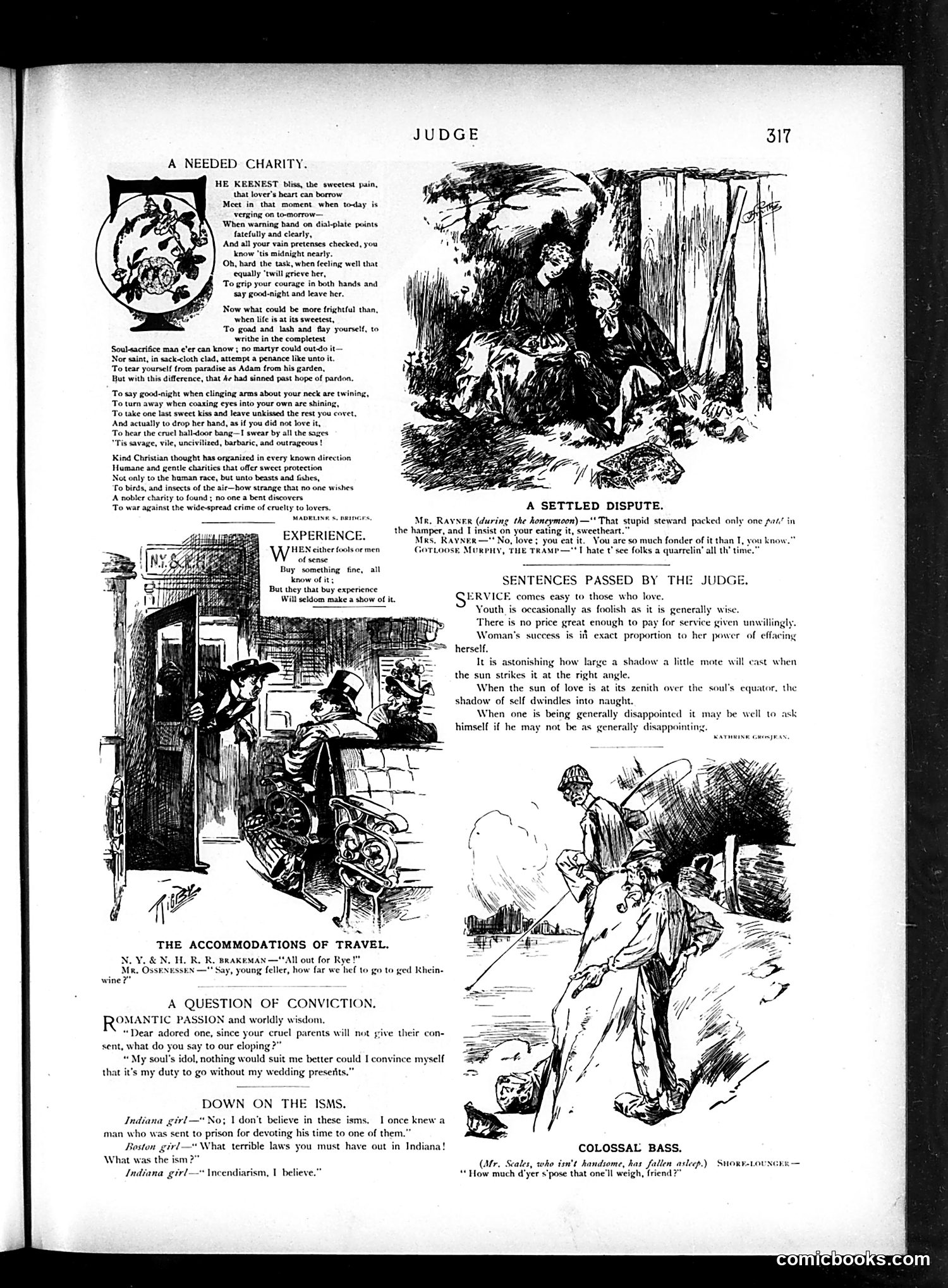
This page from *Judge* satirizes romance and social conventions through several sketches: **"A Needed Charity"** mocks the restraint required of Victorian suitors who must leave their sweethearts at midnight. The poem argues that forcing lovers to part is cruel and suggests society should establish a "charity" to protect them from this "crime"—a humorous inversion treating romantic self-denial as barbaric. **"A Settled Dispute"** shows newlyweds bickering over food while a tramp observes their quarrel, finding their petty argument absurd. The joke critiques how quickly honeymoon bliss deteriorates into mundane domestic squabbles. **Other sketches** include jokes about railway travel, elopement vs. wedding gifts, and regional attitudes toward political "isms" (appearing to reference anarchism/radicalism). The page primarily satirizes courtship rituals, marital discord, and social pretension rather than specific political figures, offering gentle mockery of American middle-class life and romance.
📄 Transcribed text from this page (OCR, searchable)
Machine-transcribed from the original scan — historical spelling and the odd misread are preserved.
A NEEDED CHARITY. HE KEENEST bliss, the sweetest pain, that lover's heart can borrow Meet in that moment when today is ‘verging on to-morrow— ‘When warning hand on dial-plate points fatefully and clearly, ‘And all your vain pretenses checked, you know ‘tis midnight nearly. Oh, hard the task, when feeling well that equally ‘twill grieve her, To grip your courage in both hands and say good-night and leave her. Now what could be more frightful than, ‘when life is at its sweetest, ‘To goad and lash and flay yourself, to writhe in the completest Soul-sacrifice man e'er can know ; no martyr could outdo it— Nor saint, in sack-cloth clad, attempt a penance like unto it, To tear yourself from paradise as Adam from his garden, Hut with this difference, that 4e had sinned past hope of pardon. To say good-night when clinging arms about your neck are twining, To turn away when coaxing eyes into your own are shining, To take one last sweet kiss and leave unkissed the rest you covet, And actually to drop her hand, as if you did not love it, To hear the cruel hall-door bang—T swear by all the sages “Tis savage, vile, uncivilized, barbaric, and outrageous ! Kind Christian thought has organized in every known direction Humane and gentle charities that offer sweet protection ‘Not only to the haman race, but unto beasts and fishes, To birds, and insects of the air—how strange that no one wishes A nobler charity to found ; no one a bent discovers To war against the wide-spread crime of cruelty to lovers. EXPERIENCI HEN either fools or men of sense Buy something fine, all know of it; But they that buy experience Will seldom make a show of it. THE ACCOMMODATIONS OF TRAVEL. Y.& N. H.R. R. BRakeMan—"All out for RB: Mr. OSSENESSEN ‘Say, young feller, how far we hef to go to ged Khein- wine?” A QUESTION OF CONVICTION, ROMANTIC PASSION and worldly wisdom, Dear adored one, since your cruel parents will not give their con- sent, what do you say to our eloping ? My soul's idol, nothing would suit me better could I convince myself that it’s my duty to go without my wedding preseitts.”” DOWN ON THE ISMS. Indiana girl—" No; 1 don't believe in these isms, I once knew a man who was sent to prison for devoting his time to one of them.” Boston girl—* What terrible laws you must have out in Indiana! What was the ism Indiana girl—* \ncendiarism, | believe.” A SETTLED DISPUTE. Mr. RAYNER (during the honeymoon) —" That stupid steward packed only one pat! hamper, and [ insist ‘ ks. RAYNER —* WoTLoos| on your eating it, sweetheart.” i You are so much fonder of it than T Thate t’ see folks a quarrelin’ all th’ time you eal 0, 10 a know, Mogrny, THe TRAMP— 3 SENTENCES PASSED BY THE ERVICE comes easy to those who love. Youth is occasionally as foolish as it is generally wise. There is no price great enough to pay for service given unwillingly. Woman's success is if exact proportion to her power of effacing herself. It is astonishing how large a shadow a little mote will the sun strikes it at the right angle. When the sun of love is at its zenith over the soul’s equator, the shadow of self dwindles into naught. When one is being generally disappointed it may be well to ask himself if he may JUDGE, st when not be as generally disappointing. COLOSSAL BASS. (Mr. Scales, who isn't handsome, has fallen a’ ep.) SMORK-LOUNGER — “How much d'yer s'pose that one'll weigh, friend ?