
A complete issue · 16 pages · 1889
Judge — May 11, 1889
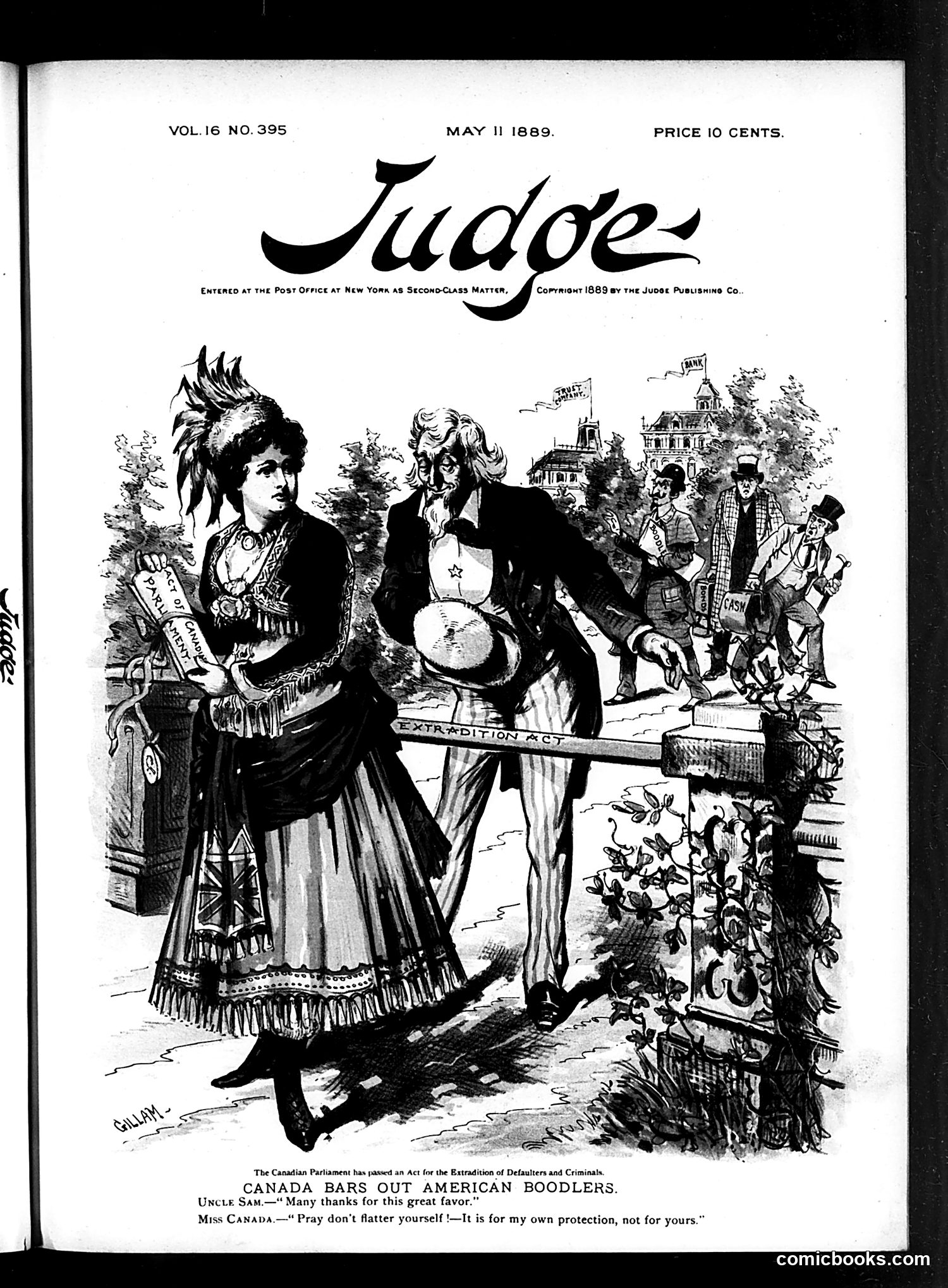
This political cartoon satirizes Canada's passage of an extradition act targeting American criminals. The personified figures represent Uncle Sam (left, labeled) and Miss Canada (center, holding a sword labeled "Extradition Act"). Canada is depicted as protecting herself from American wrongdoers. The caption quotes Uncle Sam thanking Canada for this "favor," while Miss Canada responds skeptically: "Pray don't flatter yourself—it is for my own protection, not for yours." The implication is that America exports criminals to Canada, necessitating Canadian legal protection. The background shows various disreputable figures, likely representing the "American boodlers" (corrupt politicians/swindlers) referenced in the headline. The cartoon mocks America's crime problem and suggests Canada views the extradition treaty as self-defense rather than cooperation.
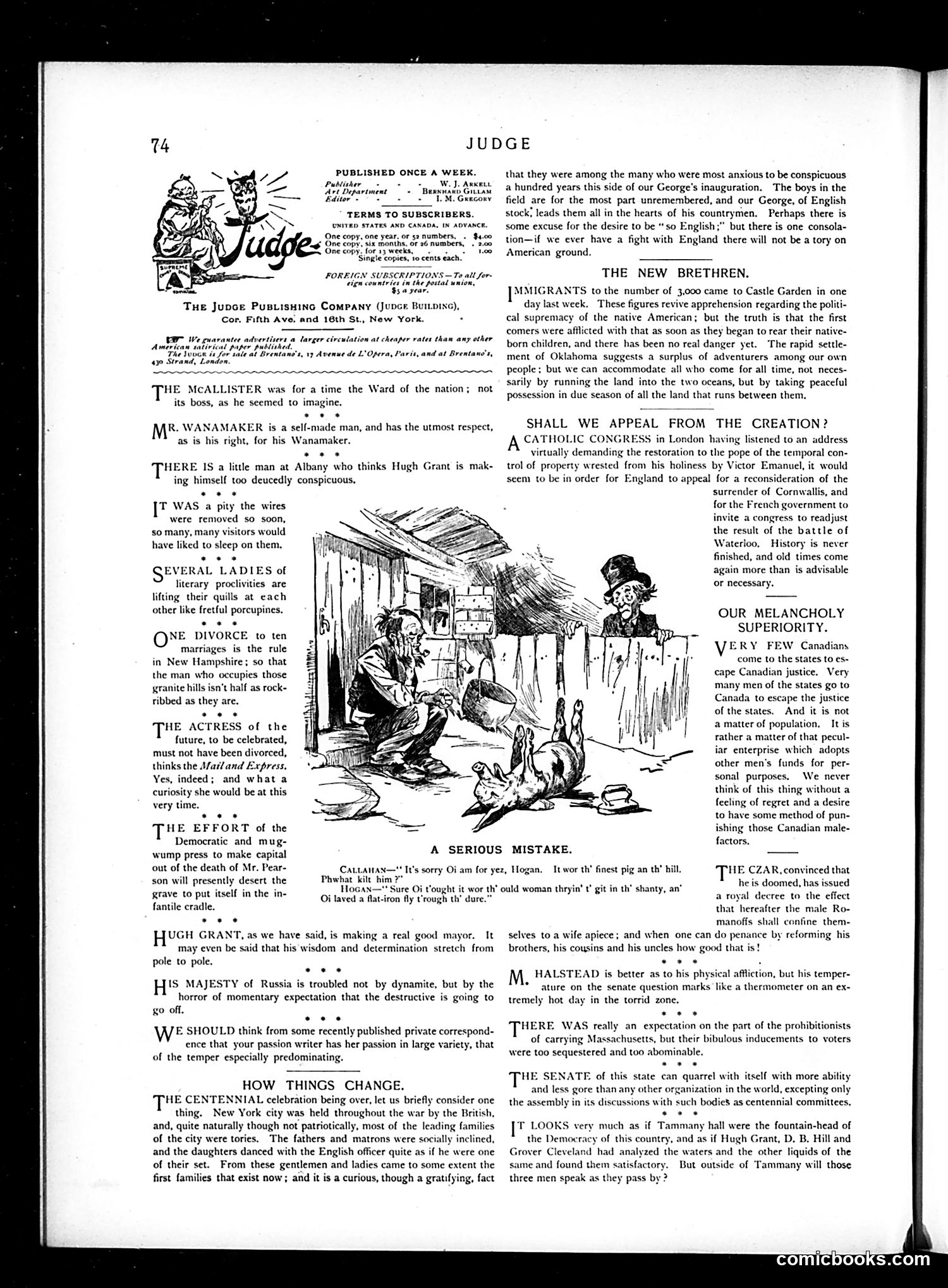
This page contains editorial commentary rather than a political cartoon. The main illustrated item is titled "A Serious Mistake," depicting a rural scene where a man (Callahan) apologizes to Hogan about a pig incident, with the caption suggesting confusion between "finest pig" and "old woman." The text discusses several topics: immigration to Castle Garden (3,000 arrivals), Canadian justice systems, Russian and Czarist politics, and Hugh Grant as New York mayor. There are brief satirical jabs at Democratic newspapers, the Senate, and references to Tammany Hall politics. The page lacks a clear unified political cartoon. Instead, it offers scattered commentary on late 19th-century American politics, immigration, and urban governance—typical of Judge's format mixing humor with topical editorial content.
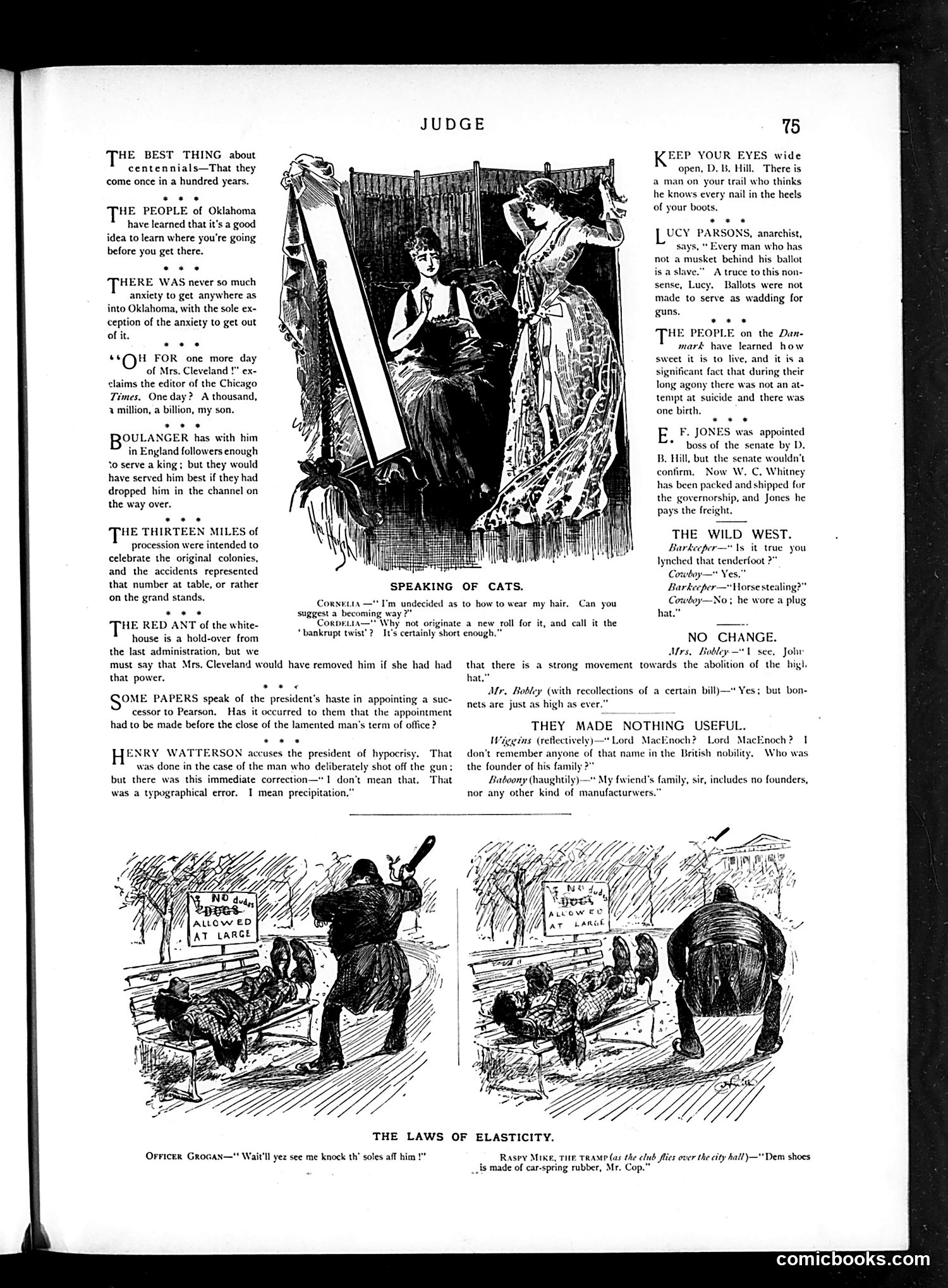
This page from *Judge* contains multiple brief satirical pieces targeting American politics and society of the 1880s-90s era. **Main topics include:** - **Oklahoma Territory**: Mocking the land rush and settlers' mixed feelings about relocation - **Cleveland administration**: References to President Cleveland's staff appointments and decisions (the "red ant" joke, E.F. Jones's appointment disputes with D.B. Hill) - **Social issues**: Lucy Parsons (a real anarchist activist) is ridiculed for advocating armed rebellion; fashion critiques about high hats - **The Boulanger reference**: Likely General Boulanger, a French political figure - **Two cartoon panels** ("The Laws of Elasticity") depict a police officer beating a vagrant with a club made of "car-spring rubber"—the joke being the absurd elasticity allows no actual harm The humor is typical *Judge* style: sharp political jabs, puns, and commentary on contemporary figures and events most readers recognized immediately. Modern readers need historical knowledge of these officials and incidents to fully appreciate the satire.
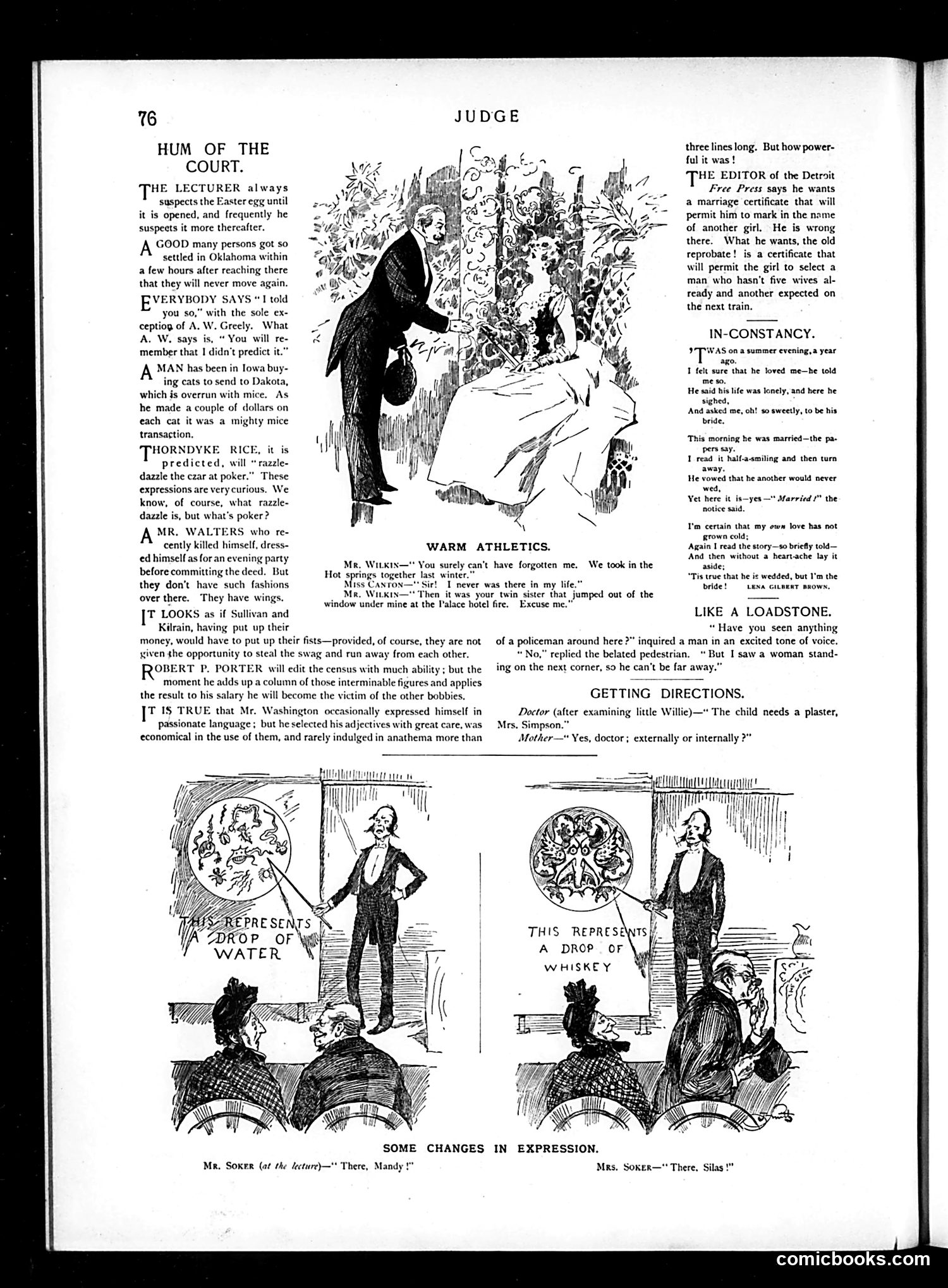
This page contains brief humorous observations ("Hum of the Court") and several satirical cartoons typical of 1880s American humor. **Main Content:** The page mixes short jokes about current events and personalities with illustrated gags. Notable references include: - A jab at the Detroit Free Press editor seeking a "marriage certificate" to court another woman—satirizing infidelity - A poem titled "In-Constancy" about a woman whose lover married another, yet she claims to be "the bride" (unclear/ambiguous meaning) - A "Warm Athletics" dialogue between acquaintances awkwardly reuniting at hot springs - Two comparison cartoons showing how a lecturer's expression changes when pointing to "a drop of water" versus "a drop of whiskey"—mocking temperance advocates' theatrical moralizing **Context:** This reflects late 19th-century preoccupations: infidelity scandals, women's romantic betrayals, and the temperance movement. The humor relies on wordplay and mild social criticism rather than political satire.
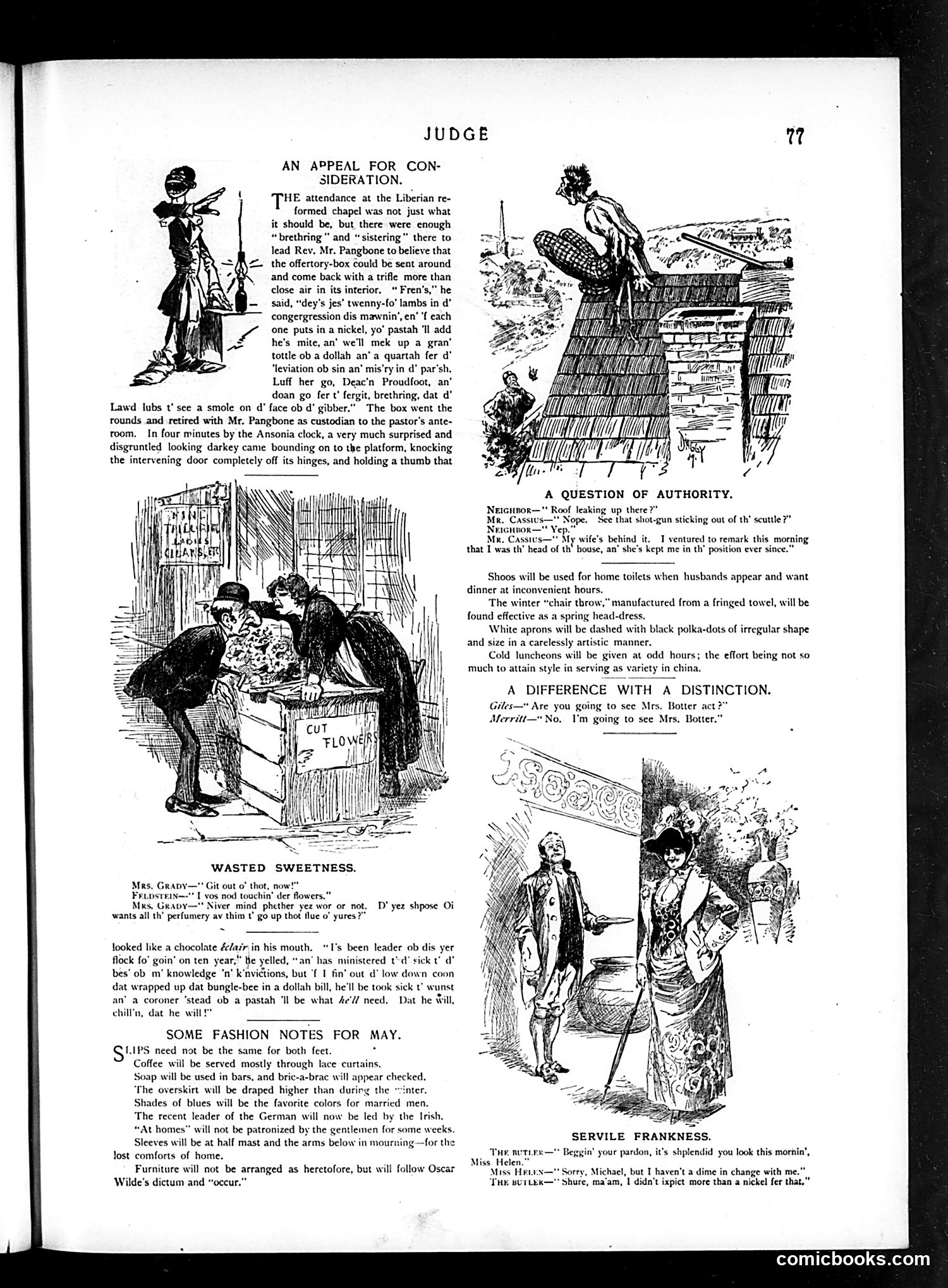
This page contains multiple satirical pieces mocking race, gender dynamics, and social pretense typical of late 19th-century American humor. **"An Appeal for Consideration"** depicts a Black minister at a "Liberian reformed chapel" using dialect to solicit donations, with the punchline that the collection box returns nearly empty—satirizing both religious fundraising and racial stereotypes. **"A Question of Authority"** jokes about a wife controlling her husband through domestic intimidation (threatening with a shotgun), inverting traditional male household authority. **"Wasted Sweetness"** shows an Irish immigrant complaining that cut flowers waste perfume up the chimney—mocking working-class frugality and Irish accents. **"Some Fashion Notes for May"** appears to be satirical fashion predictions with absurd or ironic suggestions. **"A Difference with a Distinction"** plays on attending a theatrical performance versus attending the actress herself—likely a double entendre about social versus romantic interest. **"Servile Frankness"** depicts an Irish butler's overly honest compliment about the author's appearance, mocking servant class presumption. The humor relies heavily on ethnic stereotypes, class mockery, and gender role reversals common to period satire.
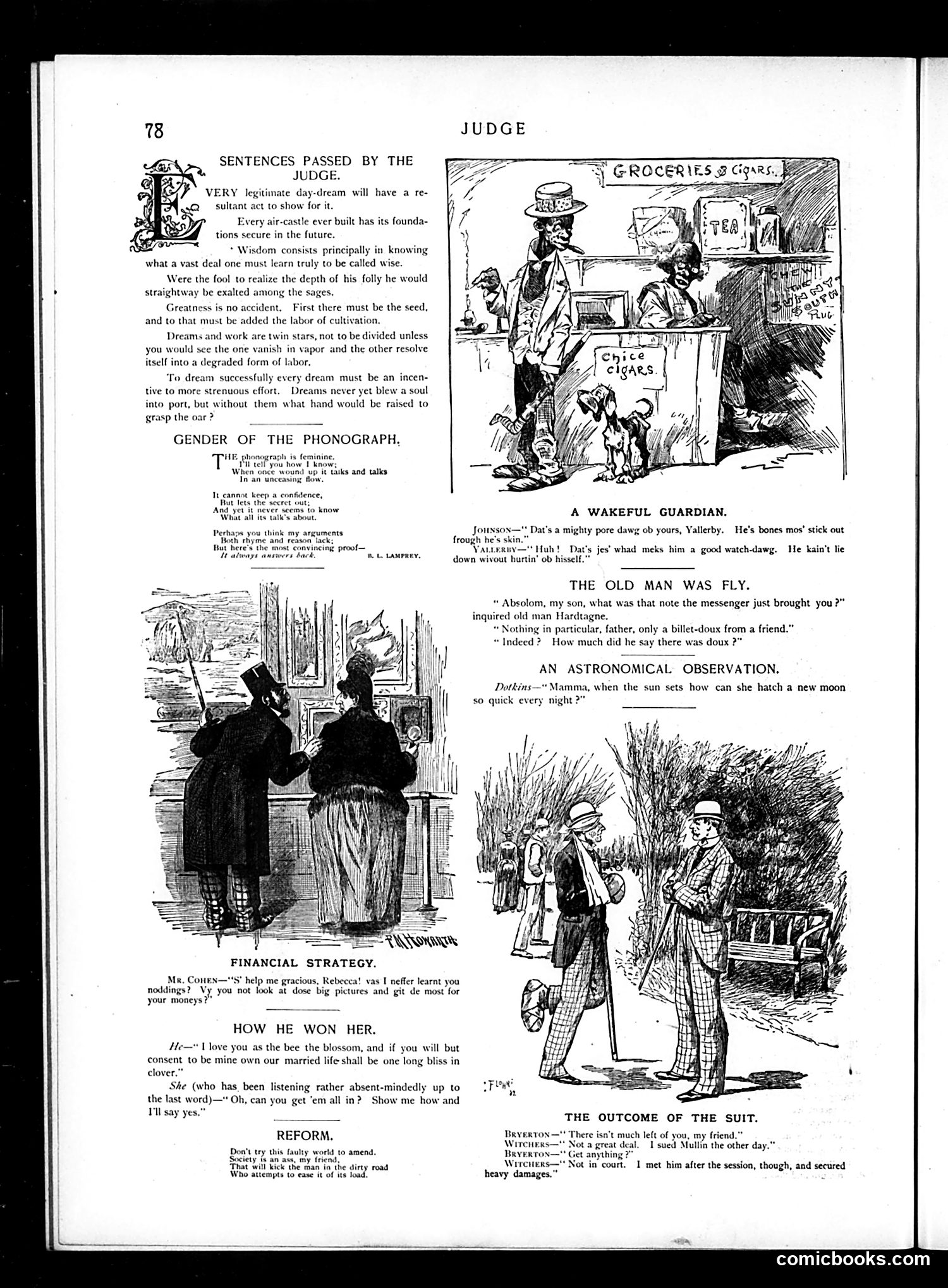
This page from *Judge* contains several satirical vignettes typical of late 19th-century American humor: **"A Wakeful Guardian"** mocks racial dialect humor common to the era, depicting two Black men discussing a poorly-fed watchdog—the joke being the dog's condition makes it useless as a guard. **"The Old Man Was Fly"** plays on a pun: a young man receives a love letter ("billet-doux"), and his father asks how much money ("doux") was enclosed, misunderstanding the term. **"An Astronomical Observation"** presents a child's innocent confusion about celestial mechanics—how the sun "hatches" a new moon nightly. **"The Outcome of the Suit"** depicts two men after a legal battle; one suffered injuries but won "heavy damages" (compensation), a commentary on litigation outcomes. The page also includes philosophical musings on dreams, ambition, and effort—typical *Judge* editorial content. The scattered jokes target linguistic confusion, racial stereotypes, and legal system absurdities.
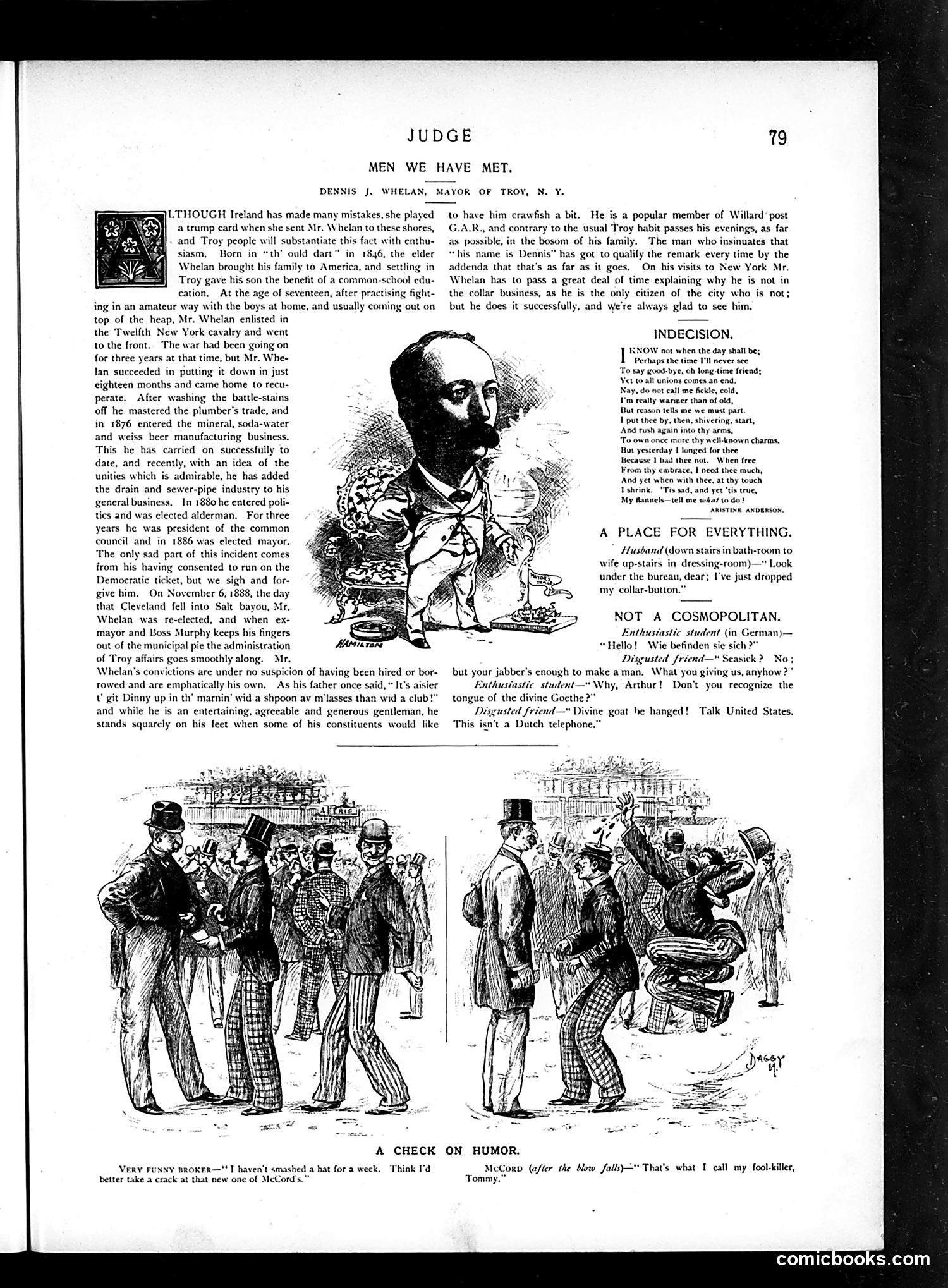
This page profiles Dennis J. Whelan, mayor of Troy, New York. The biographical sketch—a Judge feature celebrating notable public figures—credits Whelan with Irish immigrant success: arriving in 1846, he built a plumbing and beverage business before entering politics and becoming mayor in 1886 and re-elected in 1888. The satire is gentle. Judge gently mocks Whelan for running on the Democratic ticket (Judge was Republican-leaning) and notes he must repeatedly explain why he's not in the "collar business"—likely a jab at his modest origins or appearance. The page also contains three humorous short items: "Indecision" (romantic ambivalence toward flannel), "A Place for Everything" (domestic comedy), and "Not a Cosmopolitan" (mockery of a student pretentiously speaking German). These represent typical Judge filler content mixing mild political and social satire with domestic humor.
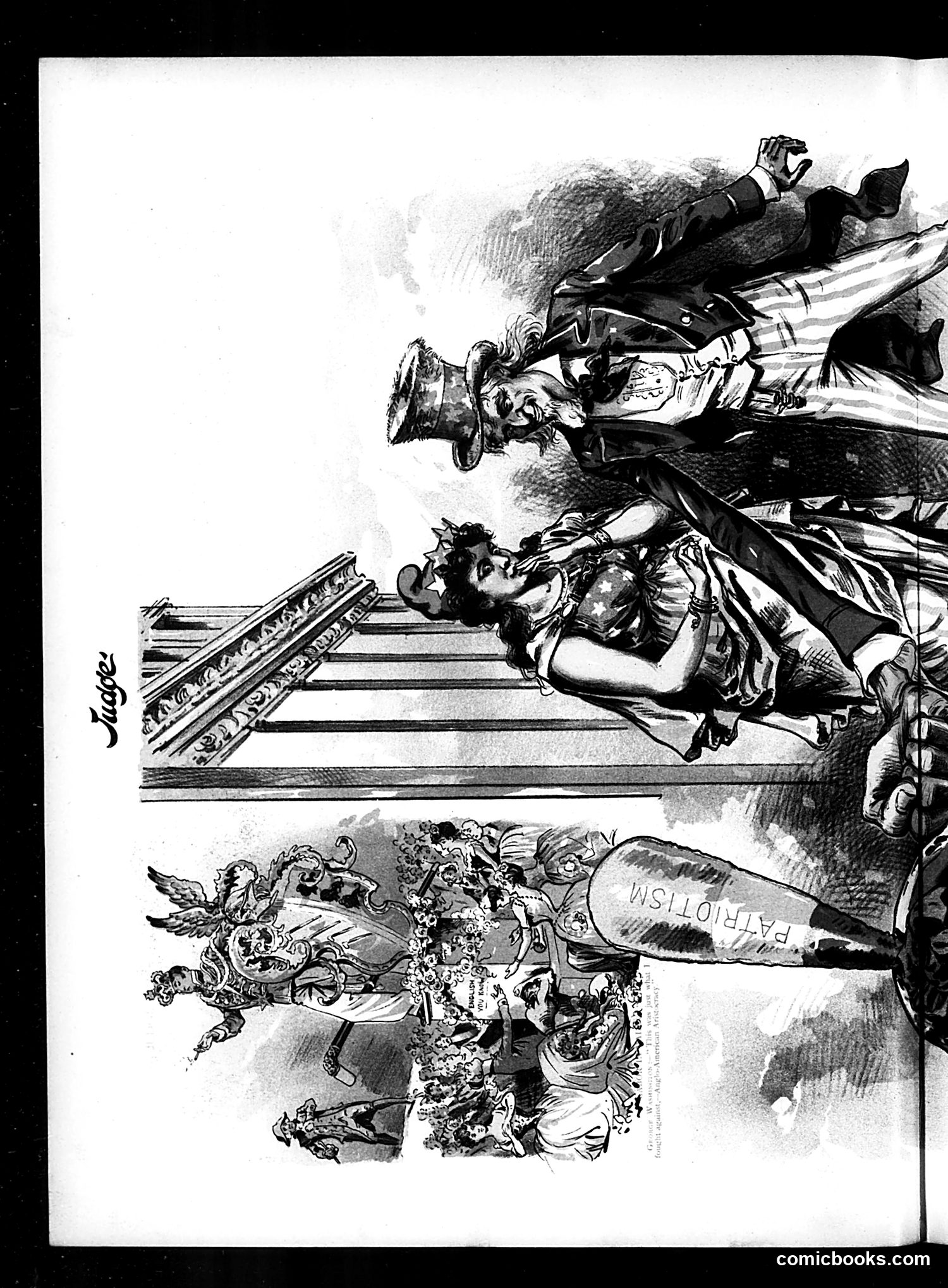
This page appears to be rotated 90 degrees. When properly oriented, it shows two satirical illustrations typical of Judge magazine's political commentary. The upper cartoon depicts elegantly dressed figures on what appears to be a formal architectural setting with decorative molding—suggesting high society or government contexts. The lower illustration features elaborate allegorical figures and cherubs surrounding a central bottle labeled "PROHIBITION," indicating this satirizes America's Prohibition era (1920-1933). The ornate, classical styling of the composition mocks the grandiose treatment given to temperance advocacy. Without clearer text identification of specific figures, I cannot definitively name the individuals caricatured. However, the juxtaposition suggests Judge is critiquing both social pretension and the Prohibition movement—likely arguing these policies were pursued by self-righteous elites disconnected from ordinary people's lives.
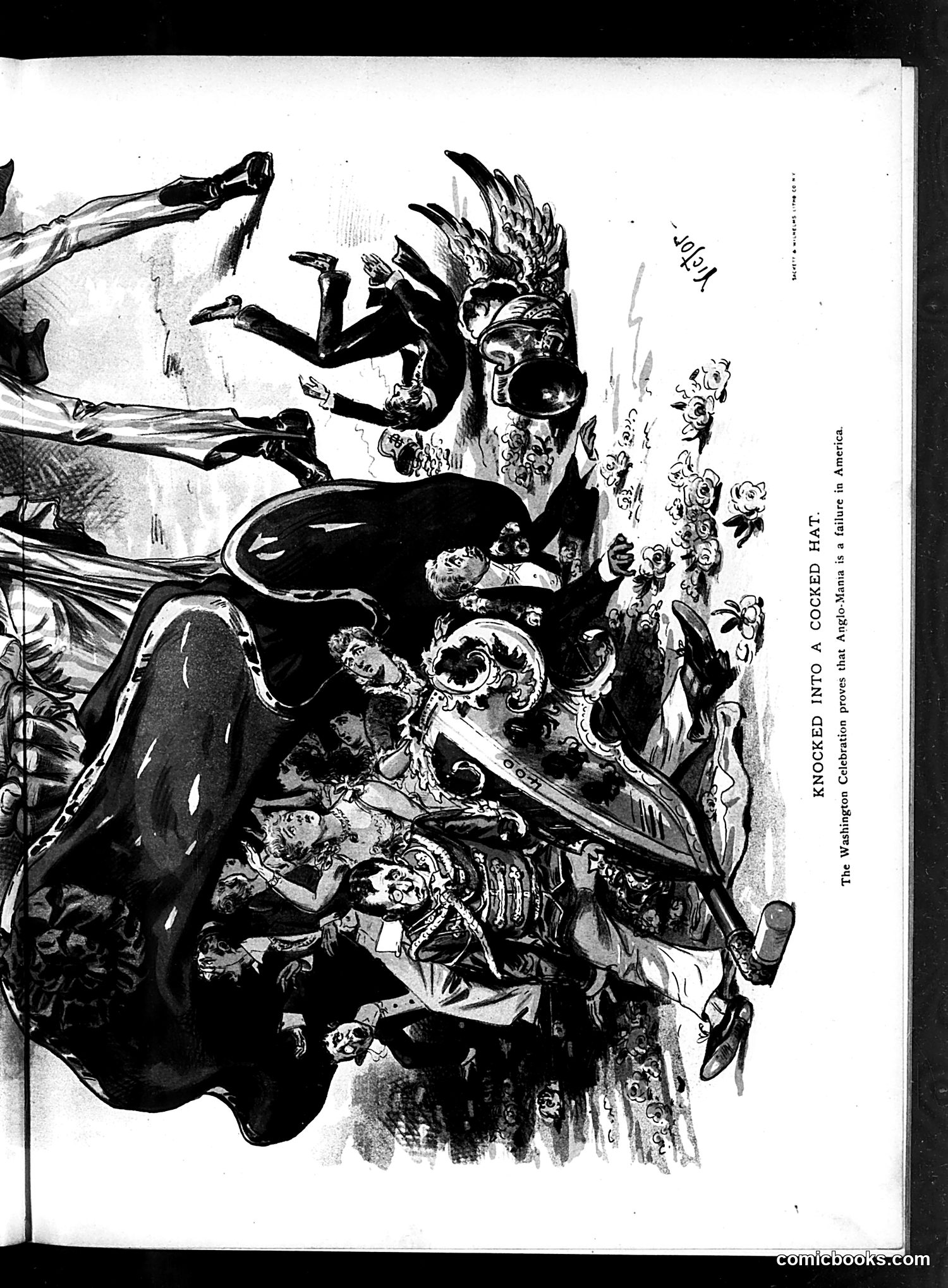
This political cartoon satirizes American enthusiasm for British culture and customs. The image depicts a chaotic scene where figures representing Anglo-American affectation are literally knocked down or thrown into disarray—"knocked into a cocked hat" being a period phrase meaning humiliated or defeated. The caption claims that a "Washington Celebration" proves "Anglo-Mania is a failure in America," suggesting the cartoon mocks Americans who slavishly imitate British manners and fashion. The central figures appear to be elaborately dressed in exaggerated British-influenced attire, now tumbling in undignified positions. This reflects late-19th-century American anxieties about cultural identity—whether the young nation should embrace or reject British influence. The satire argues that such pretentious imitation is ridiculous and fundamentally un-American.
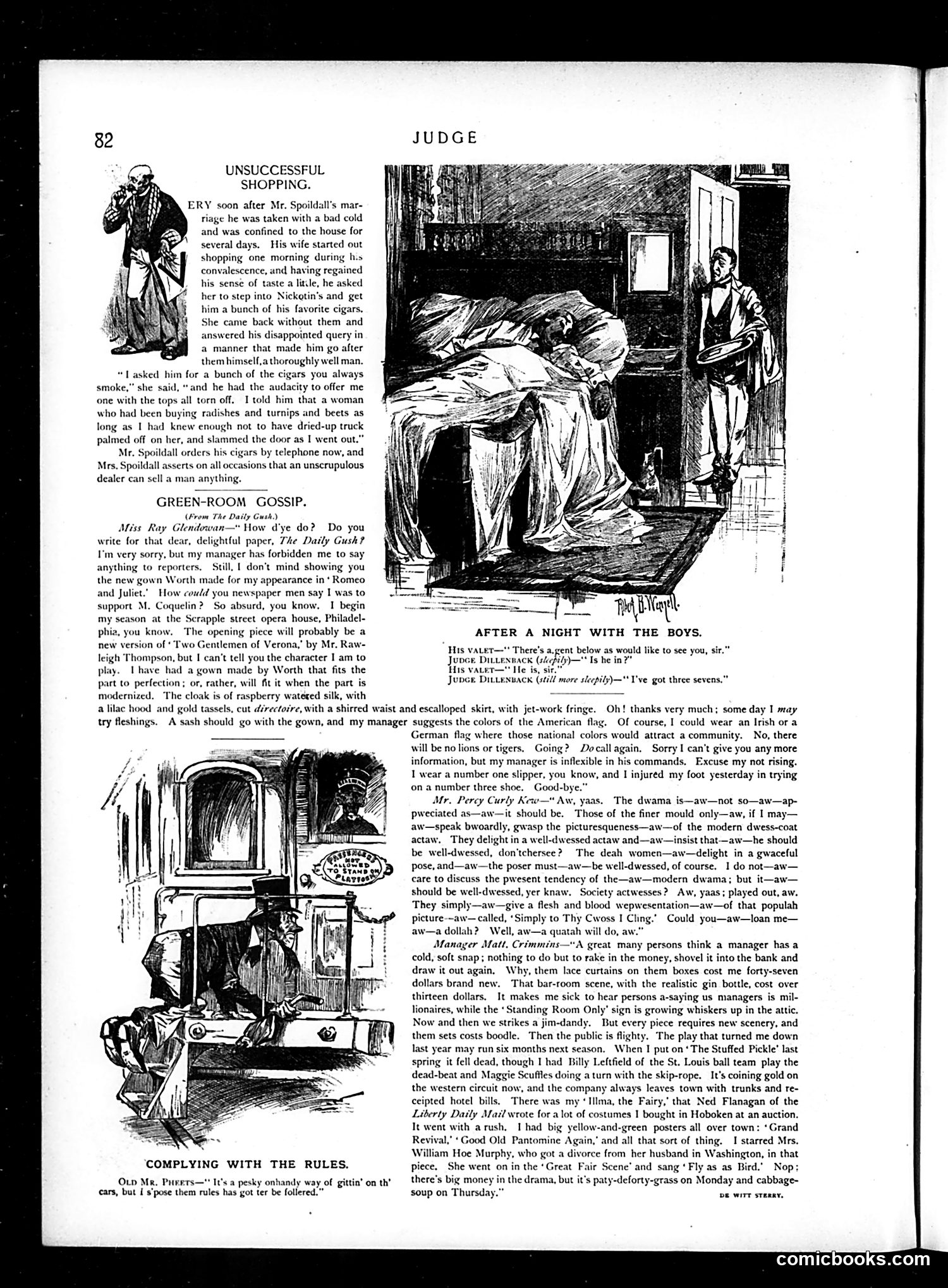
This page contains three distinct satirical pieces: **"Unsuccessful Shopping"** mocks a newlywed wife who applies her grocery-shopping standards to buying cigars, rejecting damaged merchandise with such authority that her husband must purchase his own cigars thereafter. The joke satirizes women's emerging consumer confidence and domestic authority. **"Green-Room Gossip"** parodies theatrical pretension through affected actresses and actors—Miss Ray Glendowan brazenly name-drops Worth designer gowns while claiming confidentiality, and Mr. Percy Curly Kew speaks in exaggerated theatrical affectation while hitting up the interviewer for money. This mocks theatrical vanity and self-importance. **"After a Night with the Boys"** shows a judge so drunk from carousing that he's gambling (holding three sevens) and barely coherent when receiving a visitor. The humor targets judicial dignity compromised by excessive drinking—a common Vice-era concern about professional men's character. Each piece uses visual caricature paired with dialogue to expose social hypocrisy and character flaws.
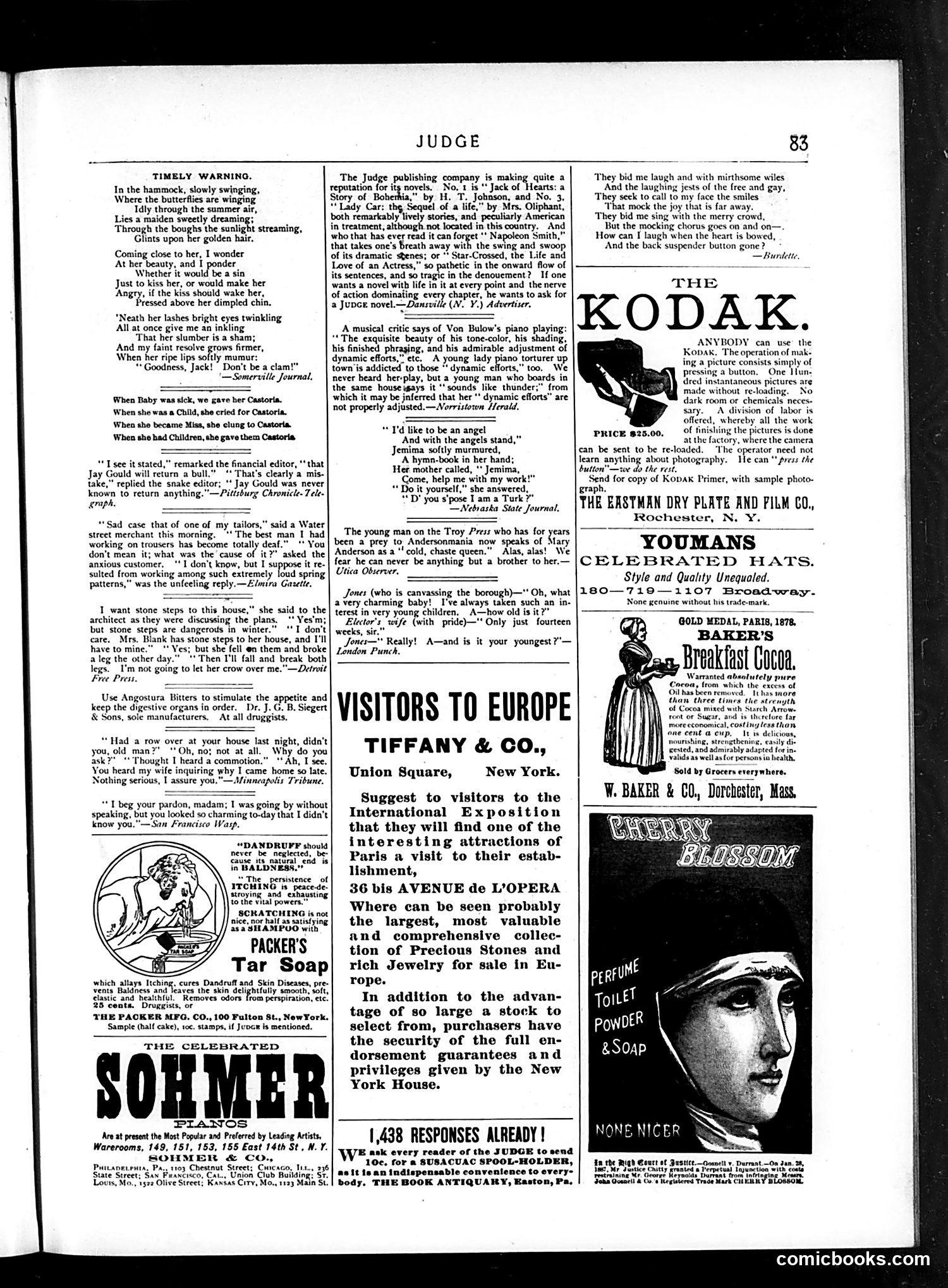
This page is primarily **advertising and miscellaneous content** rather than a political cartoon. The main elements include: **Poetry & Humor**: "Timely Warning" is a flirtatious poem about a man contemplating kissing a sleeping woman in a hammock—a lighthearted romantic scenario typical of the era. Short jokes follow, including quips about Jay Gould (the wealthy industrialist) and marital discord. **Advertisements**: The bulk of the page features period product ads: Castoria (a children's medicine), Packer's Tar Soap (for dandruff/baldness), Baker's Breakfast Cocoa, Sohmer Pianos, and Judge Publishing's own novels. **Notable Ad**: A Tiffany & Co. advertisement for European tourists recommends the Paris Opera's Avenue de l'Opéra for jewelry shopping. **Social Context**: The content reflects late-19th-century American middle-class concerns: health remedies (hair loss, digestion), conspicuous consumption (fine pianos, jewelry), and sentimental romance. There's no discernible political satire on this particular page.
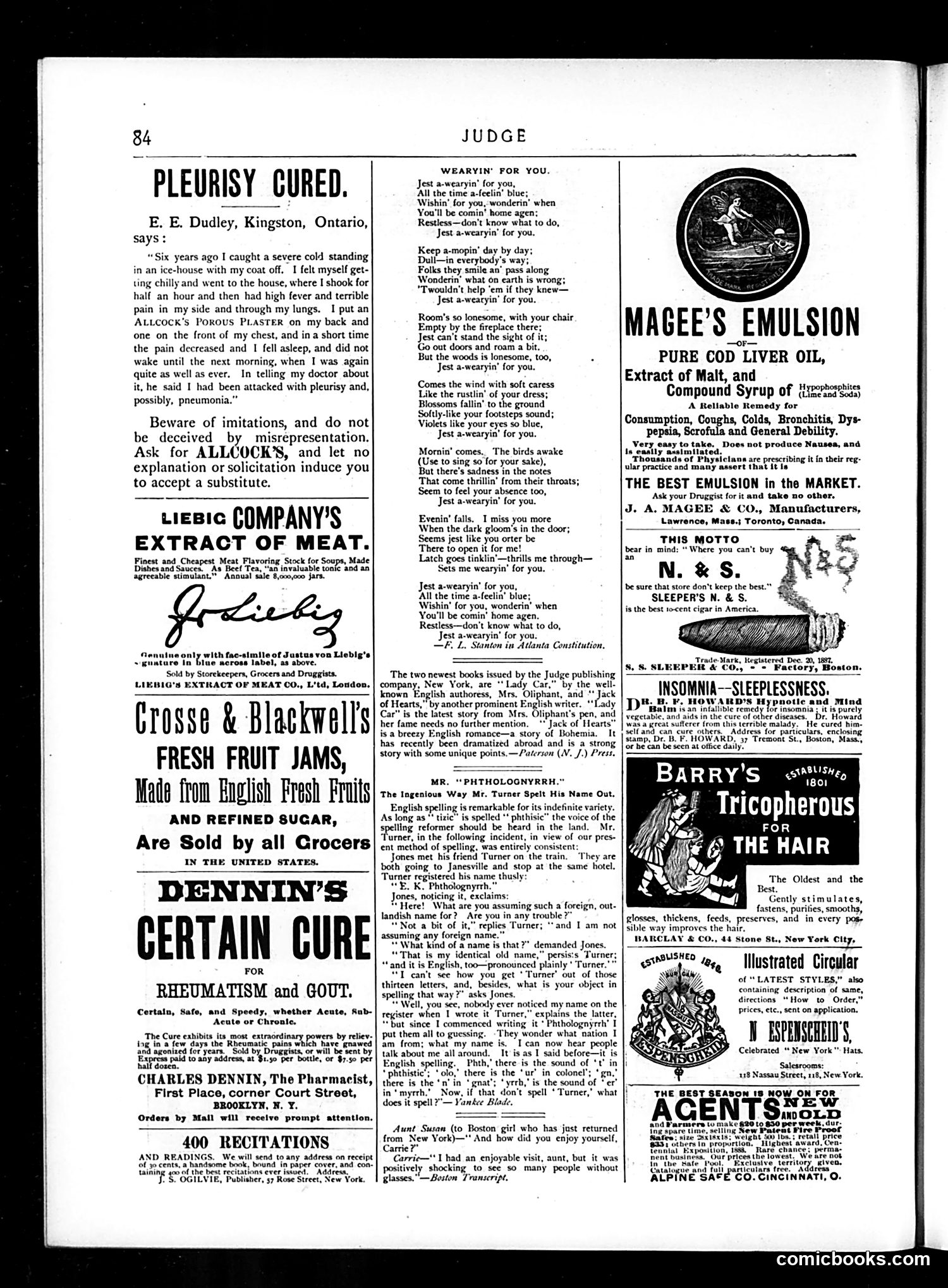
This is primarily an **advertising page** with minimal editorial content. The main elements are: **Layout**: The page is dominated by patent medicine and consumer product advertisements (Allcock's Porous Plasters, Liebig's Extract of Meat, Crosse & Blackwell's jams, Dennin's rheumatism cure)—typical of late 19th-century magazines. **Editorial Content**: A sentimental poem titled "Wearyin' for You" (attributed to F. L. Stanton) fills the upper right. It's a nostalgic love song about missing someone, employing romanticized rural imagery ("violets like your eyes"). **Book Notice**: Brief mention of new Judge Publishing releases including "Lady Car" and "Jack of Hearts." **Cultural Context**: The advertisements reflect period concerns (rheumatism, pleurisy) and the era's enthusiasm for patent remedies. The poem's sentimentality is typical of late Victorian popular literature. **No significant satire or political commentary** appears on this page—it functions primarily as a revenue-generating advertising vehicle typical of the era.
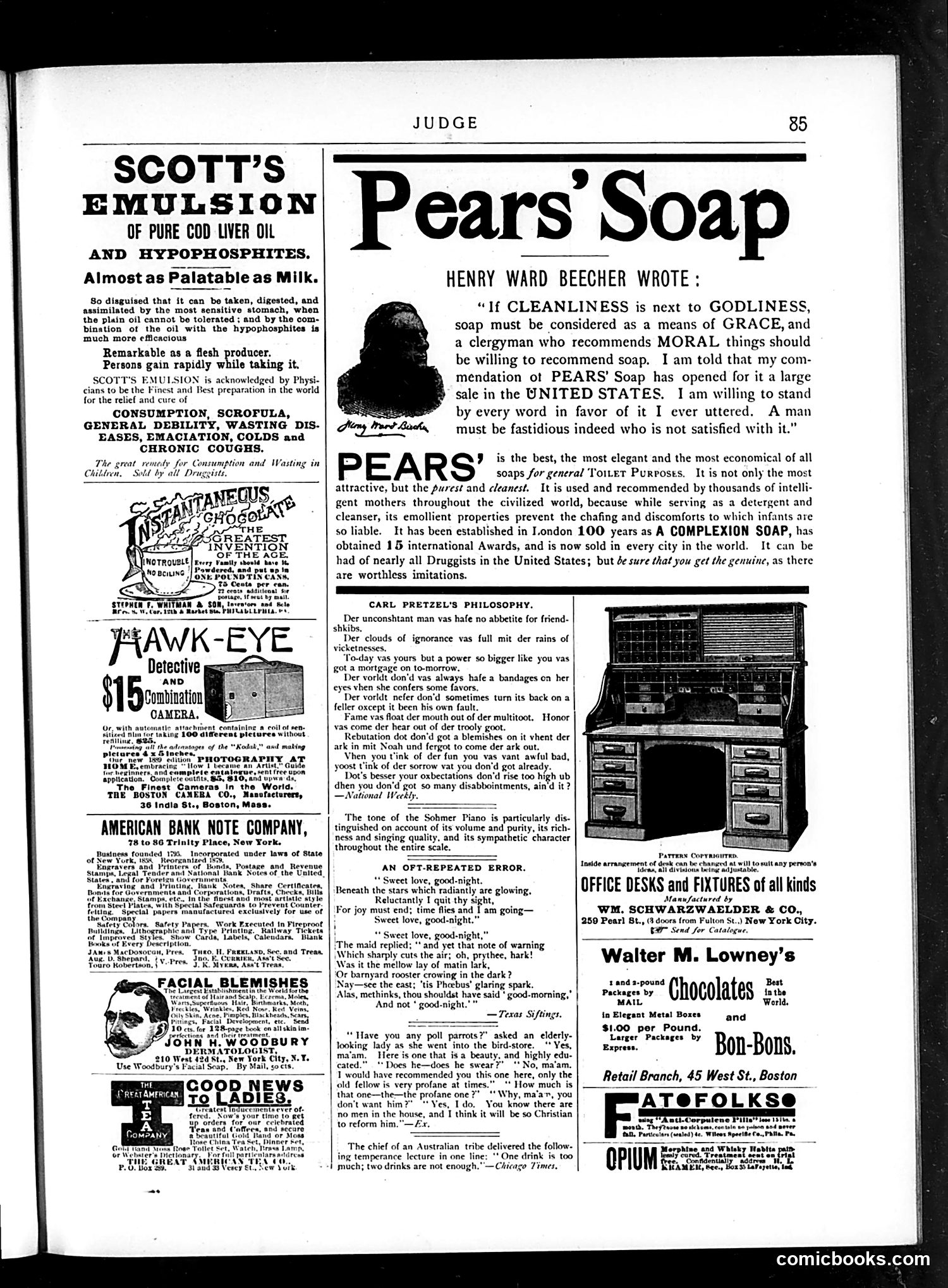
This is primarily an **advertising page** rather than satirical content. The dominant feature is a large Pears' Soap advertisement that quotes religious leader Henry Ward Beecher endorsing the product, cleverly linking cleanliness to godliness and morality. The page contains several **product advertisements** typical of late-19th-century magazines: Scott's Emulsion (a cod liver oil health tonic), cameras, banking services, facial soap, chocolates, and patent medicines. The only clear **satirical content** is a brief joke column in the center about a woman buying a parrot, playing on dialectal speech patterns and the bird's profanity—typical light humor of the era. The **social context** reflects late-Victorian advertising's use of religious authority and moral language to sell consumer goods, alongside the period's faith in patent medicines and tonics for treating consumption and other ailments.
This page is primarily **advertising**, not editorial cartoon content. It features period product advertisements for Franco-American soups, railroads (West Shore Railroad, Wabash Railway), Dr. Jaeger's wool clothing system, and other goods typical of the 1890s. The only substantive non-advertising content is a poem titled **"A Vice-Versa List,"** which satirizes modern urban annoyances. It catalogs things people complain are always missing when needed—umbrellas during rain, home trains after fishing trips, baseballs hit by careless players, comfort in cheap apartments—versus things nobody wants (annoying people like seed vendors, tramps, anarchists). The satire is gentle social commentary on everyday frustrations of the era, not political. It reflects the magazine's humor formula: relatable complaints about urban life and human nature rather than sharp political satire. The poem's self-aware opening admits they're simply listing universal irritations everyone recognizes.
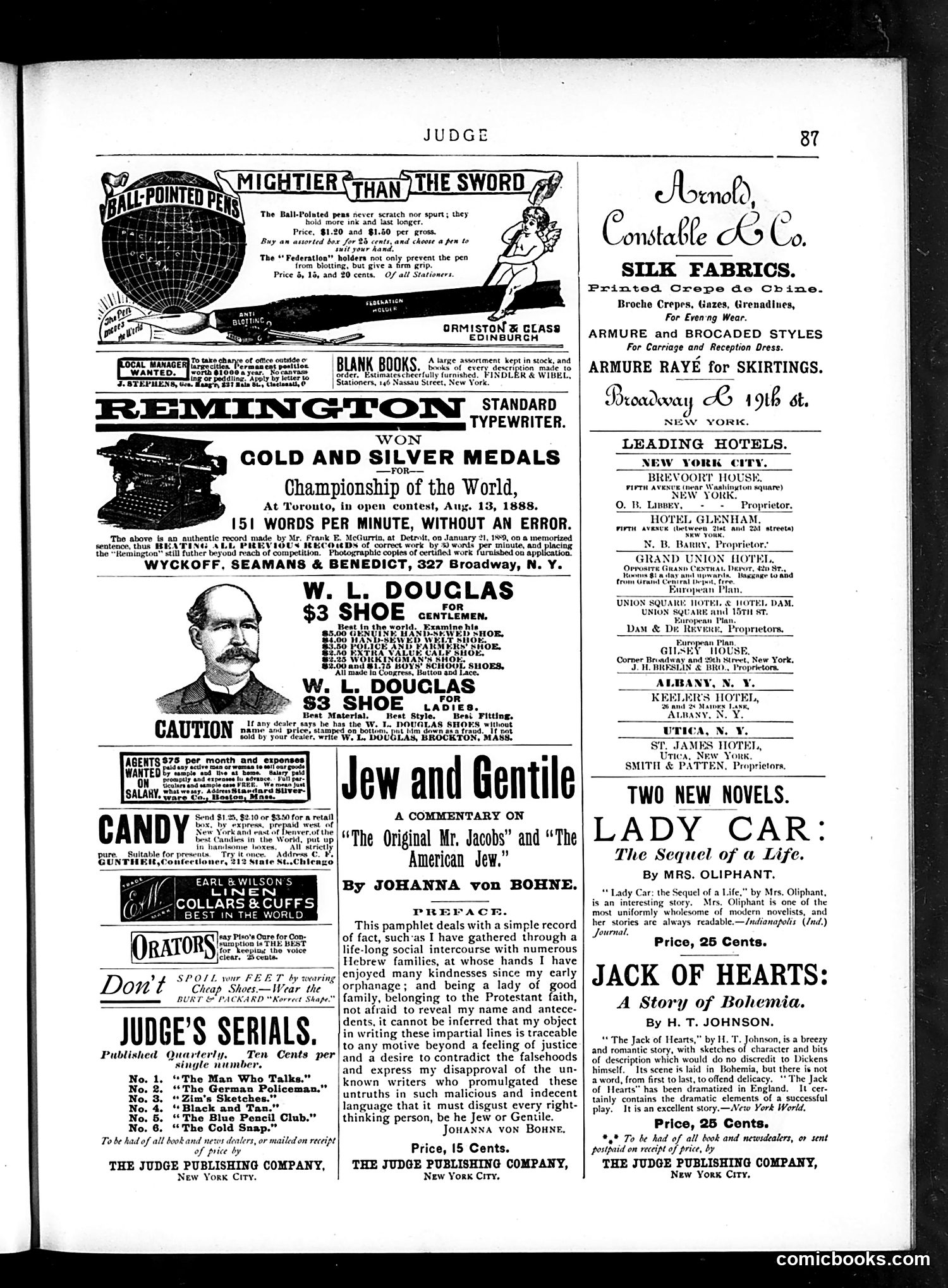
This is primarily an **advertising page** from Judge magazine (late 1880s), with one notable exception: a book advertisement for *"Jew and Gentile: A Commentary on 'The Original Mr. Jacobs' and 'The American Jew'"* by Johanna von Bohne. The book's preface reveals its purpose: to defend Jewish people against "untruths" and "malicious and indecent language" circulating in contemporary writing. The author—identifying herself as a Protestant woman of good family—positions herself as a credible witness to Jewish virtue based on personal relationships with Hebrew families. **Historical context**: This reflects late-19th-century antisemitic stereotyping and defamatory literature. The book appears to be a **counter-narrative response**—unusual for its era—arguing against prejudicial characterizations of Jewish Americans. The remaining advertisements (typewriters, shoes, silk fabrics, hotels, novels) are typical commercial content. The page shows Judge functioning as both satirical commentary and advertising vehicle.
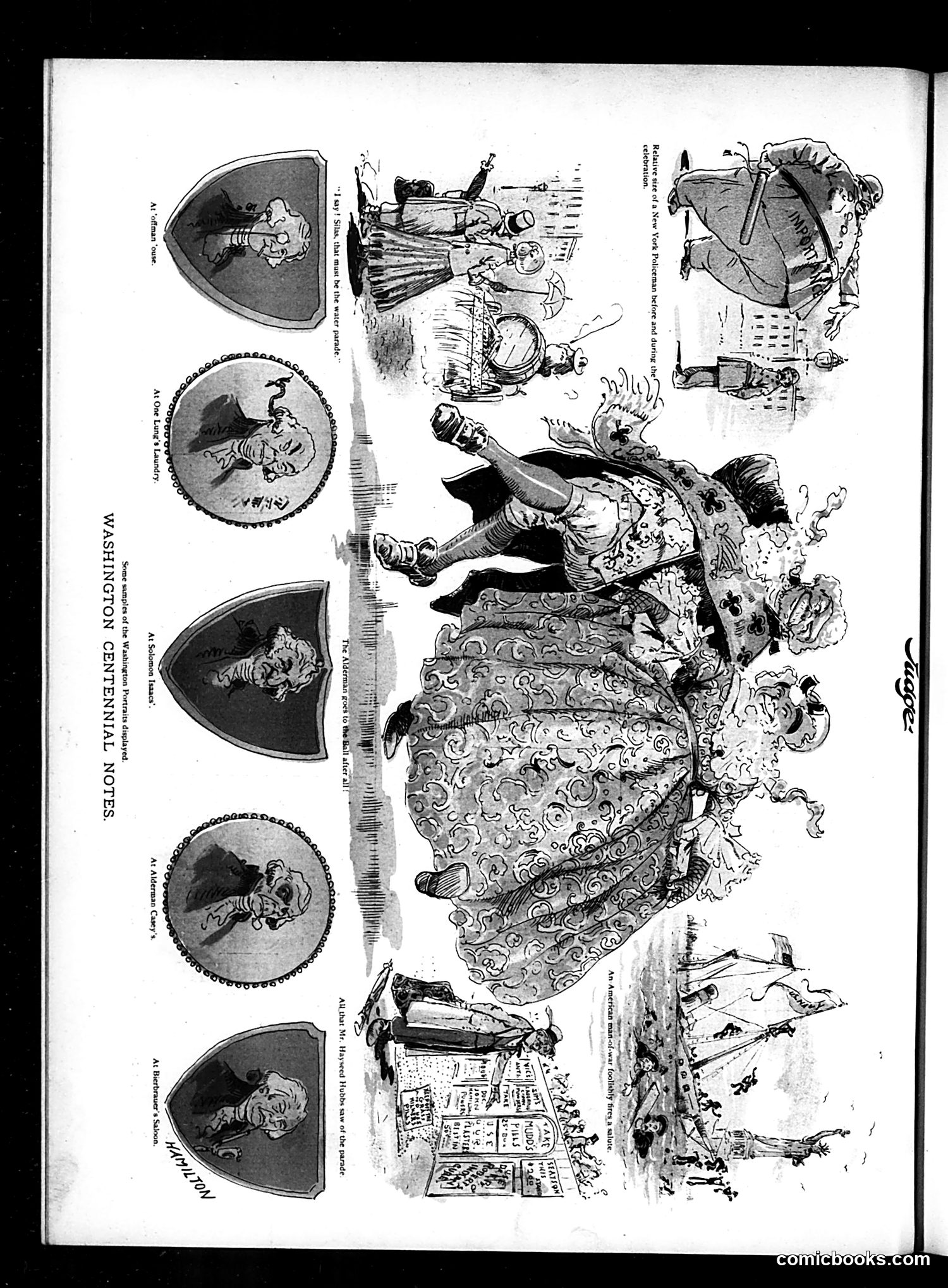
This Judge magazine page satirizes New York's celebration of George Washington's centennial (likely 1889). The main cartoon shows a policeman dramatically expanding in size—a visual gag suggesting officers became "inflated" with importance during the festivities. The circular vignettes on the left appear to be portraits displayed during centennial celebrations at two locations: Solomon Isaacs' and Alderman Casey's establishments. The text references "Washington Portraits displayed," implying these venues showcased commemorative imagery. The large central figure depicts someone (possibly a political figure or celebrant) in elaborate dress, suggesting the ostentatious nature of the celebrations. The satire likely mocks how ordinary civic figures gained outsized prominence, how merchants capitalized on the centennial with commercialized "Washington" merchandise, or how the celebration itself became excessive and self-aggrandizing rather than genuinely commemorative.