
A complete issue · 20 pages · 1889
Judge — March 16, 1889
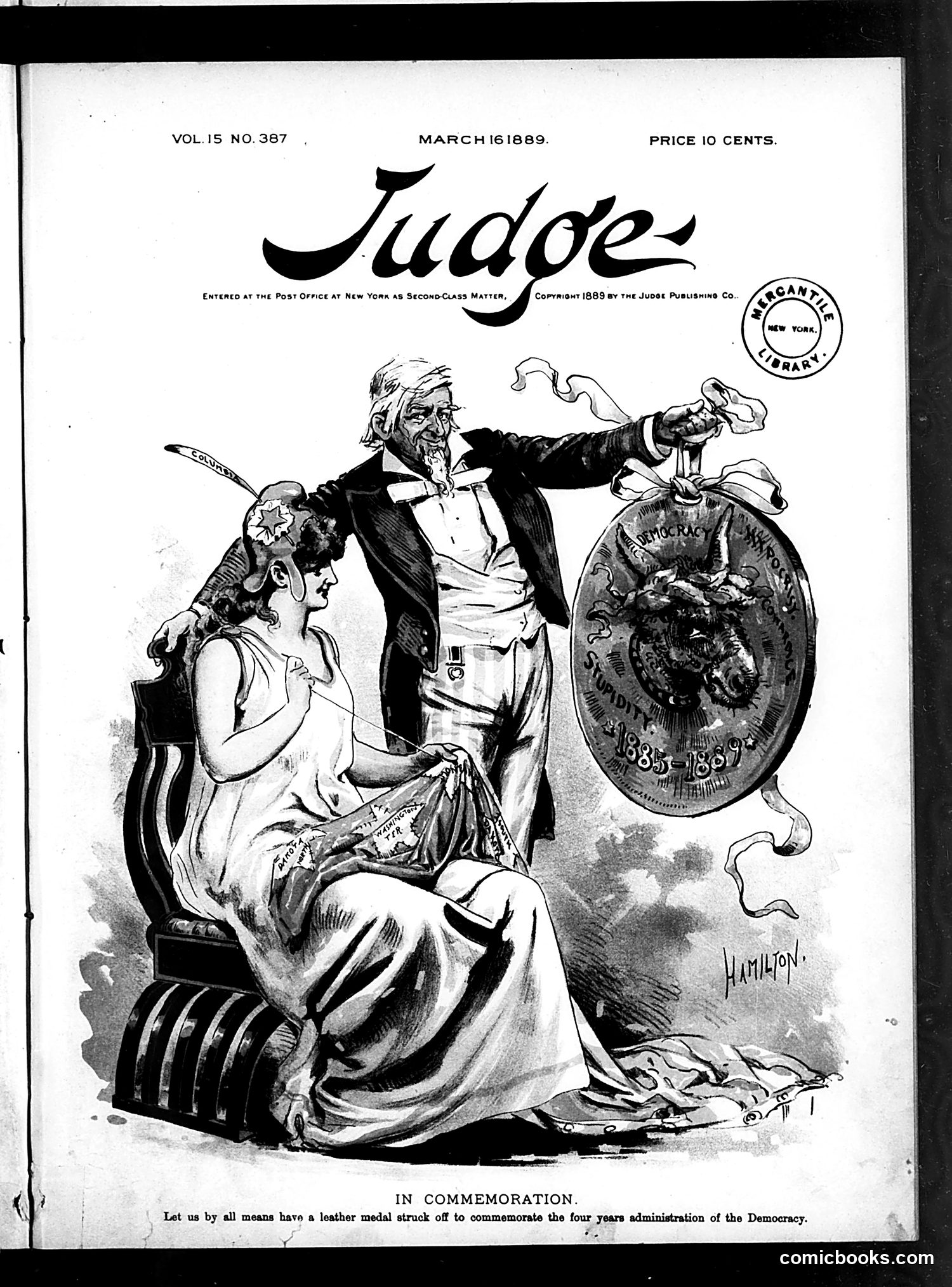
This satirical cartoon commemorates the conclusion of President Grover Cleveland's first Democratic administration (1885-1889). The elderly male figure, likely representing Cleveland or a Democratic leader, presents a medal inscribed "Democracy" to a seated female figure representing the nation or Democratic Party. The caption's sarcastic tone—suggesting a "leather medal" commemorates "four years administration of the Democracy"—mocks the Democratic record as unworthy of genuine honor. The medal itself appears tarnished or damaged, reinforcing the critique. The cartoon's biting humor suggests Judge's Republican editors viewed Cleveland's presidency as failed or damaging to the nation, warranting only mockery rather than respect as his term ended.
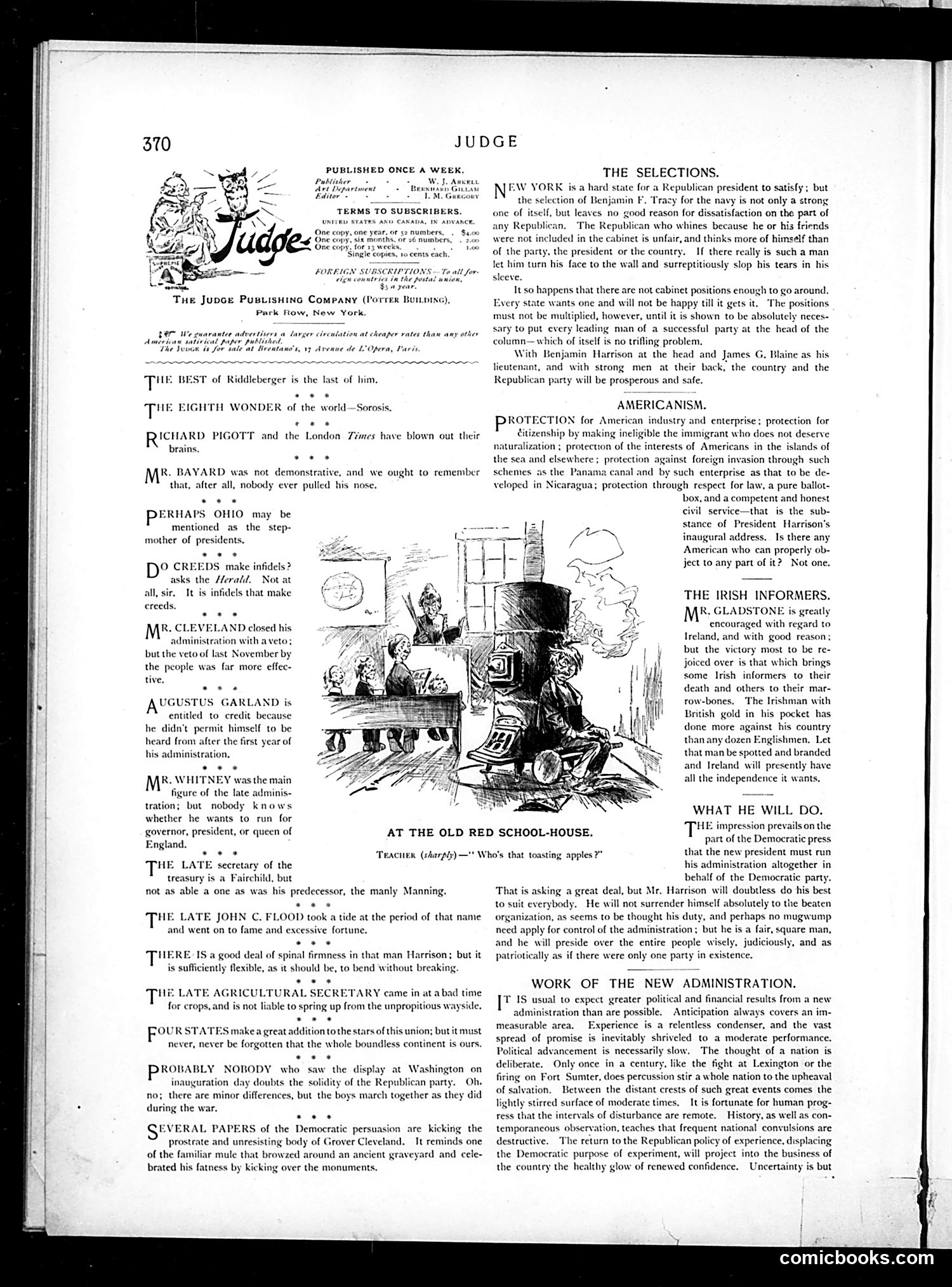
This page contains political commentary and satirical snippets rather than a single cohesive cartoon. The main illustrated piece, "At the Old Red School-House," depicts a teacher asking a student "Who's that toasting apples?" — likely a visual gag about children's knowledge or current events (the specific reference is unclear without more context). The text sections critique various political figures of the Harrison administration era, including references to Benjamin Harrison, James Blaine, and others. The commentary focuses on Republican Party politics, cabinet selections, and protectionist trade policies ("Americanism" section). The overall tone mocks both Republican administration decisions and Democratic responses, using brief satirical observations typical of Judge's editorial style during this period.
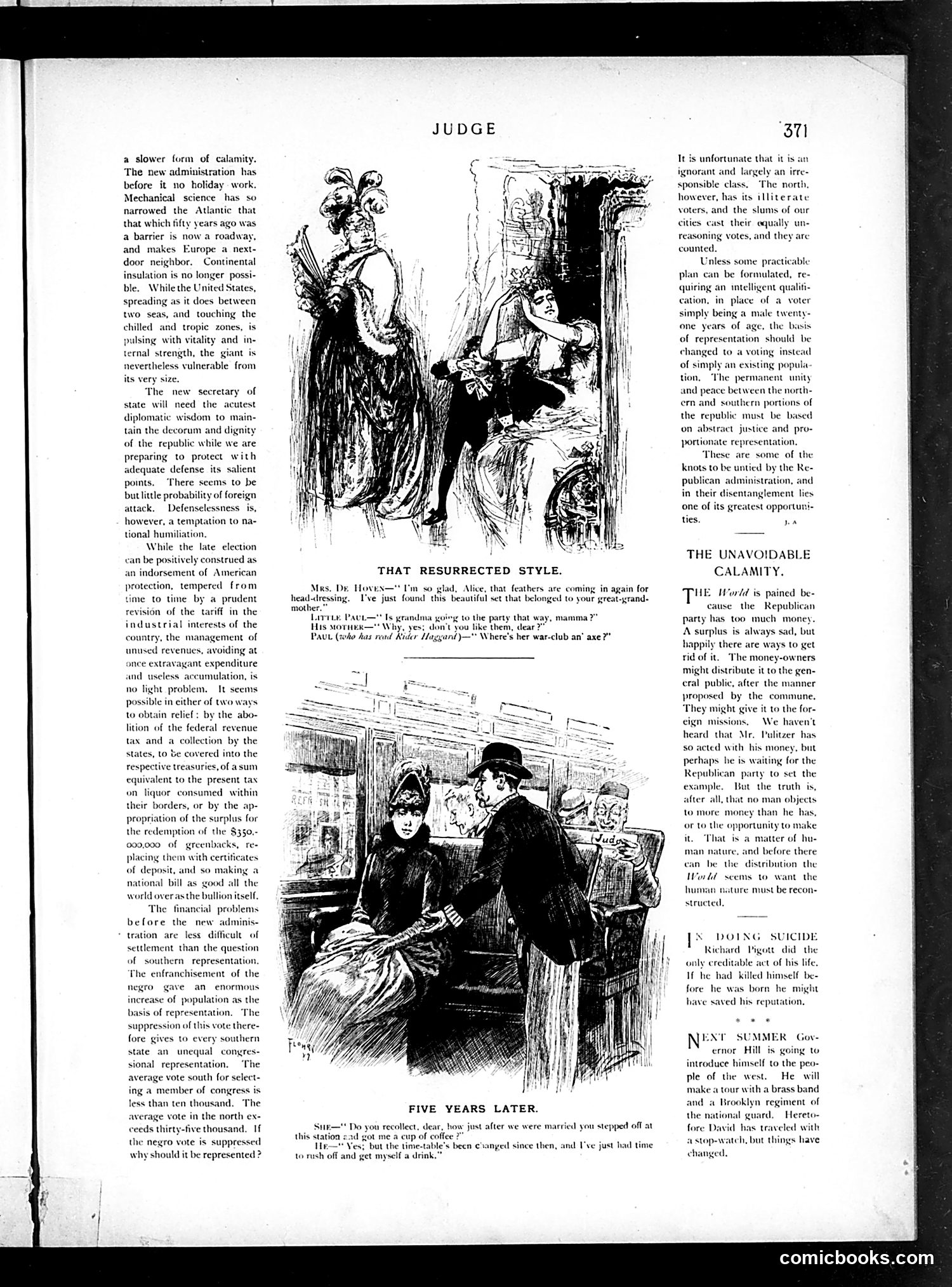
This page contains political commentary on the new Republican administration (likely 1889, following Harrison's election). **Main Editorial Content:** The left column discusses governance challenges: protecting America's now-vulnerable borders (due to improved Atlantic steamship technology), managing federal surplus revenue, and addressing the core political crisis—Southern Congressional representation. **The Representation Crisis:** The text argues that Black voters, newly enfranchised after Reconstruction, were being systematically suppressed in the South. Yet those states counted Black populations for Congressional apportionment while denying them votes, giving Southern states disproportionate representation. The satire's point: this is fundamentally unjust—either count all voters or don't count suppressed populations. **Cartoon Illustrations:** Two domestic scenes mock "resurrected style"—women reviving outdated fashions (feathered hats), with crude references to primitive ancestors. The "Five Years Later" cartoon depicts marital discord, likely satirizing how quickly new things become old. **Overall Message:** A serious Republican publication grappling with post-Reconstruction governance failures while using lighter social satire as counterpoint.
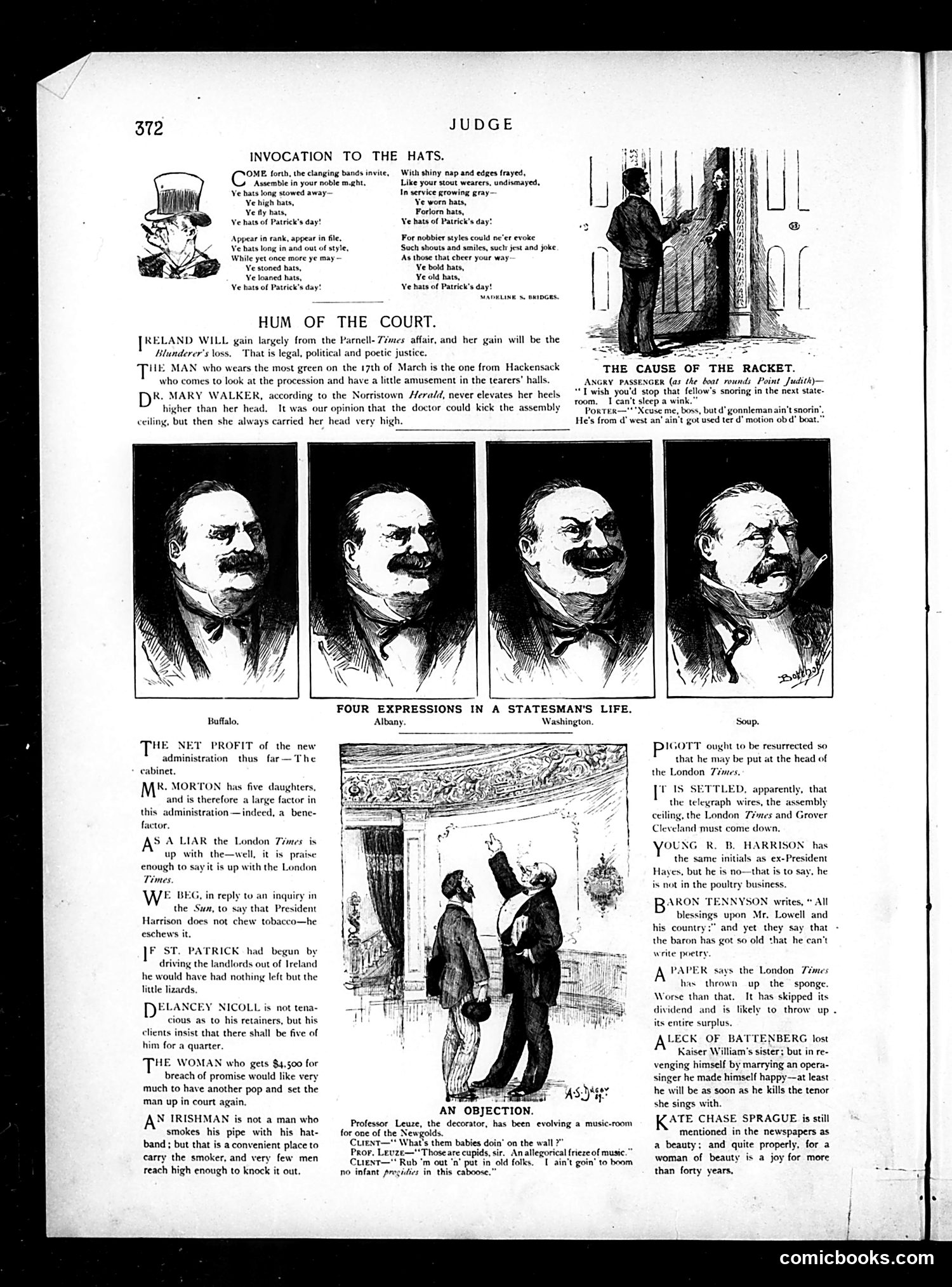
This page from Judge blends political humor with social commentary typical of late-19th-century American satire. **"Invocation to the Hats"** celebrates St. Patrick's Day (March 17th), mocking Irish-American parade traditions with references to worn, old hats—suggesting both the working-class participants and their threadbare dignity. **The court humor section** takes shots at contemporary figures: the Parnell-Times affair (Irish political scandal), Dr. Mary Walker (women's rights activist known for unconventional dress), and President Harrison's administration. The jokes are gossip-based—Morton having five daughters, references to politicians' personal habits. **"Four Expressions in a Statesman's Life"** shows facial expressions labeled Buffalo, Albany, Washington, and Soap—likely tracking a politician's changing demeanor through career stages (appears to reference a specific contemporary figure, unclear who). The remaining items mock Irish stereotypes, legal absurdities, and press scandals with the acerbic tone Judge maintained for educated, politically-aware readers.
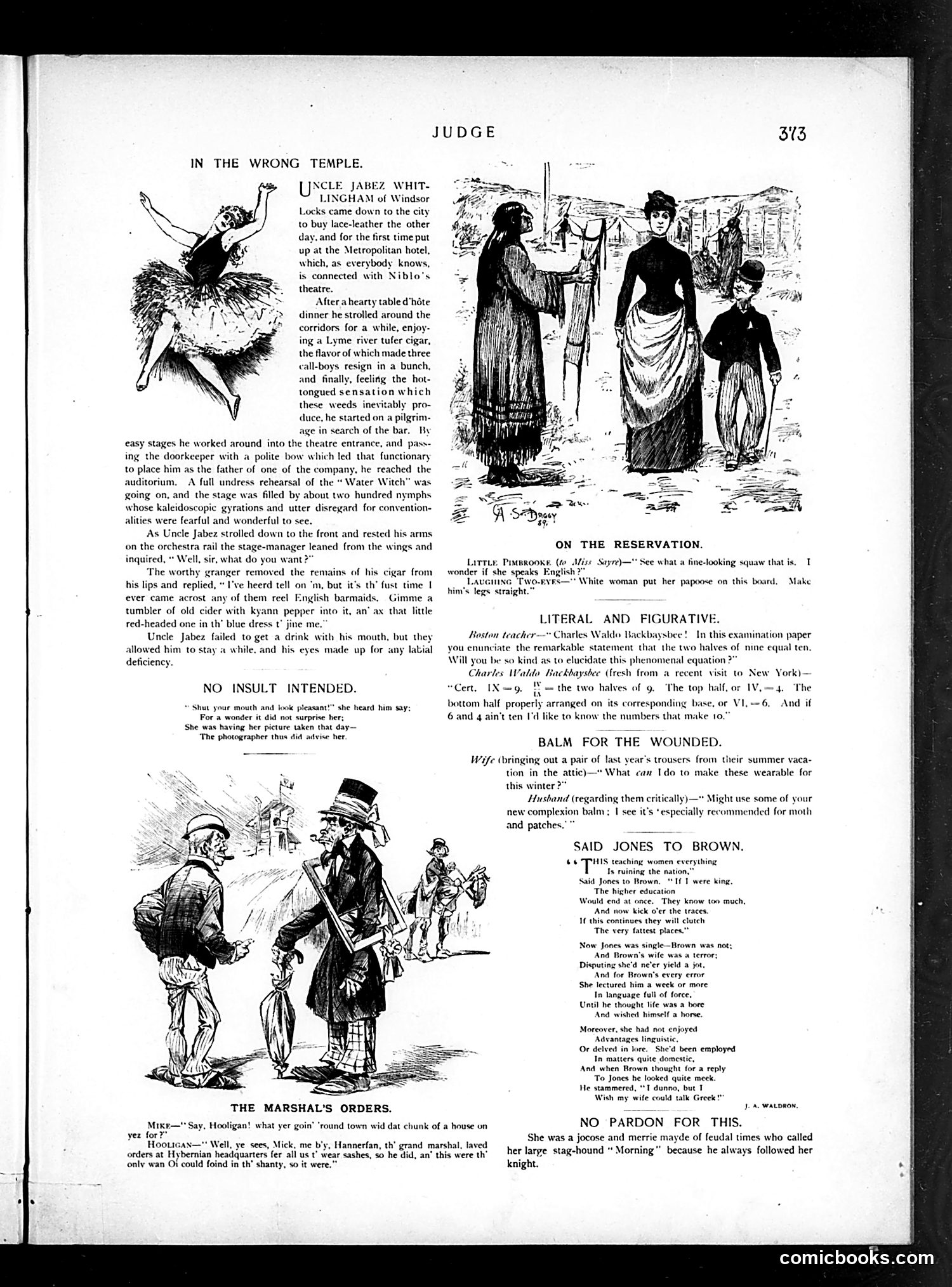
This page contains several humorous sketches satirizing late-19th-century American life: **"In the Wrong Temple"**: A rural visitor mistakes Niblo's Theatre for a bar, watching a stage rehearsal of "The Water Witch" (a real theatrical production) featuring scantily-clad chorus nymphs. The joke ridicules both the man's naïveté and implicitly critiques theatrical spectacle as morally questionable. **"The Marshal's Orders"**: Irish immigrant characters discuss wearing decorative sashes ordered by a parade marshal, using heavy dialect humor typical of the era's ethnic caricature. **"On the Reservation"**: A condescending conversation about Native American women, reflecting period attitudes toward Indigenous peoples as exotic subjects. **"Said Jones to Brown"**: A poem mocking women's education, arguing it makes women rebellious—undercut by showing Jones's wife actually dominates their relationship, suggesting education isn't the real problem. The sketches employ period stereotypes (rural hicks, Irish immigrants, Native Americans) and target women's advancement, representing conservative social anxieties of the Gilded Age.
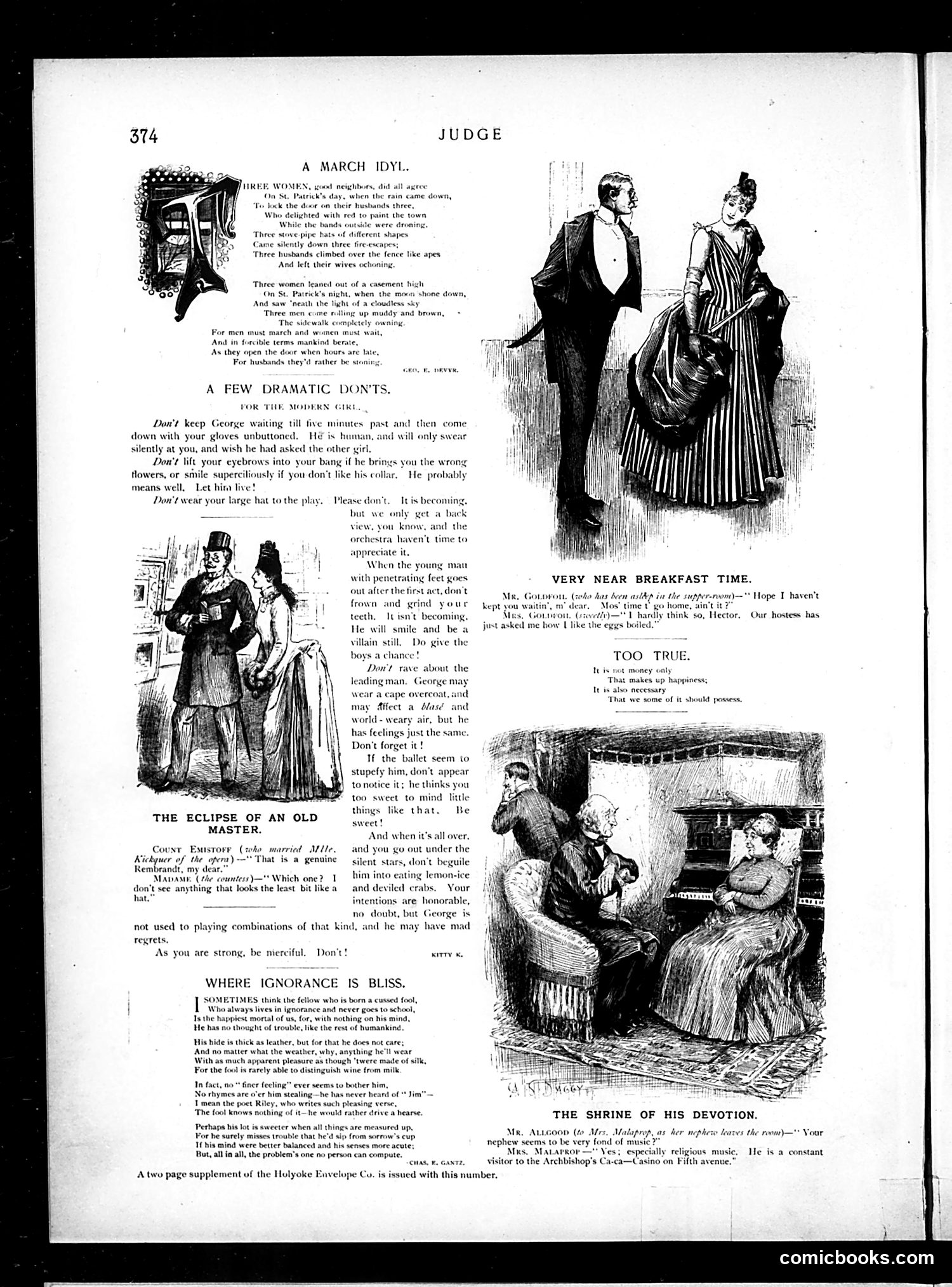
This page contains satirical commentary on early 20th-century social customs and gender relations: **"A March Idyl"** mocks husbands sneaking away to participate in parades/marches while wives wait at home, suggesting marital discord over domestic vs. public duties. **"A Few Dramatic Don'ts for the Modern Girl"** offers tongue-in-cheek advice to young women dating, cautioning against lateness, expensive hats at theaters (blocking views), and excessive displays of emotion. The satire targets both female behavior and male expectations—portraying men as fragile egos requiring constant flattery. **"The Eclipse of an Old Master"** depicts a count and countess discussing art; the countess's confused response ("Which one?") suggests women's supposed ignorance of fine art, satirizing both actual gender educational gaps and pretentious cultural posturing. **"Where Ignorance is Bliss"** celebrates foolish contentment—the man oblivious to weather, poetry, and social refinement is paradoxically happier than the educated. **"The Shrine of His Devotion"** shows a man devoted to church attendance, likely satirizing performative religiosity. The overall tone mocks courtship conventions, domestic hierarchies, and gender stereotypes of the era.
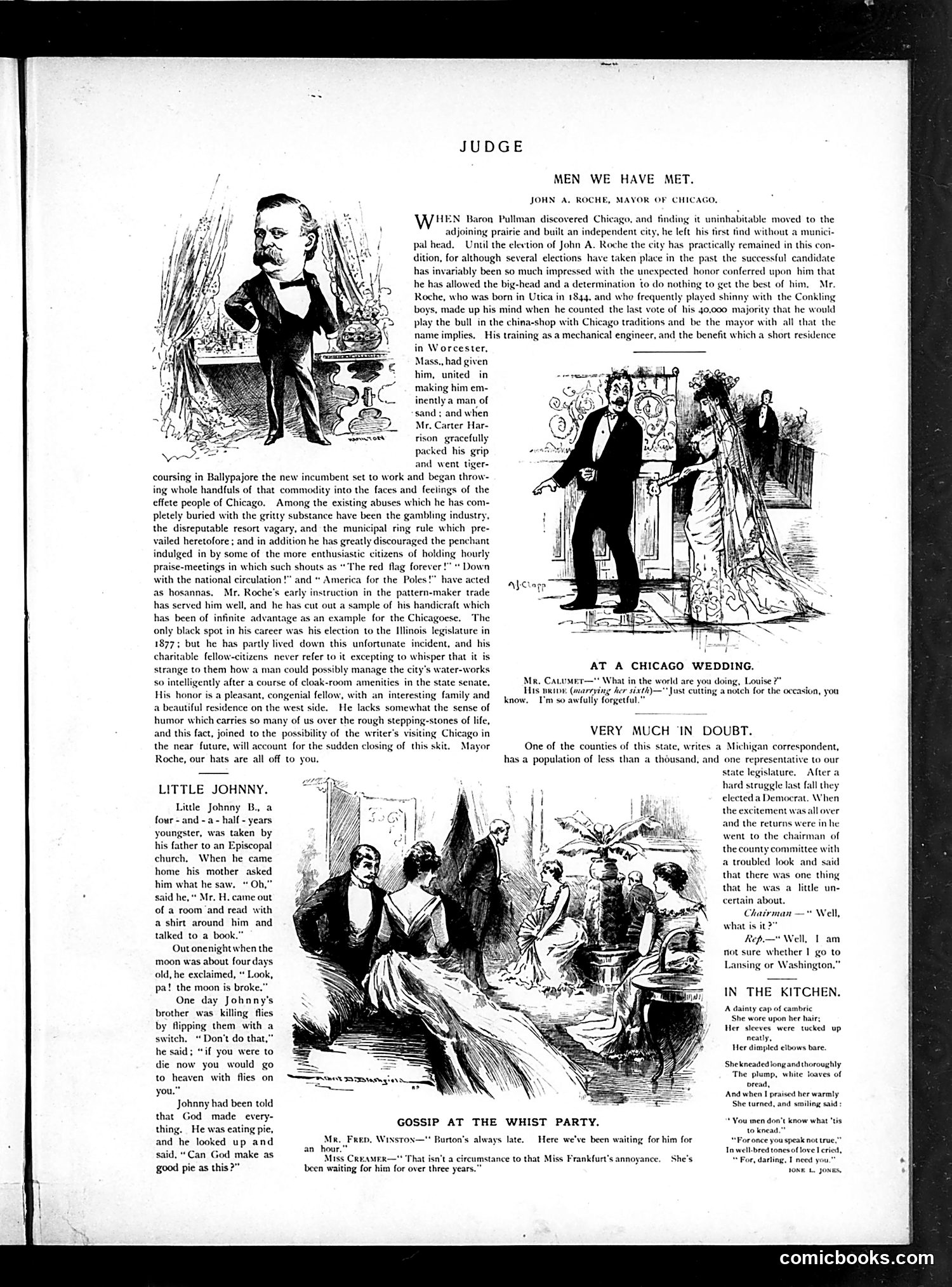
This page from *Judge* features a biographical profile of **John A. Roche, Mayor of Chicago**, presented as satirical praise. The text mockingly celebrates Roche as a reformer who cleaned up Chicago's vices—gambling, disreputable resorts, and political corruption—describing him as a man of "sand" (grit) who disrupted established traditions like a "bull in a china-shop." The satire targets Roche's prior service in the Illinois legislature, which the writer dismissively attributes to "cloak-room amenities" (political dealings), questioning how someone with such experience could competently manage city water-works. The page also includes lighter comedic sketches: a wedding scene joke, "Little Johnny" anecdotes, and gossip vignettes. These appear to be standard magazine filler content typical of *Judge*. The overall tone suggests ambivalent regard—acknowledging Roche's actual reforms while questioning his political competence and character.
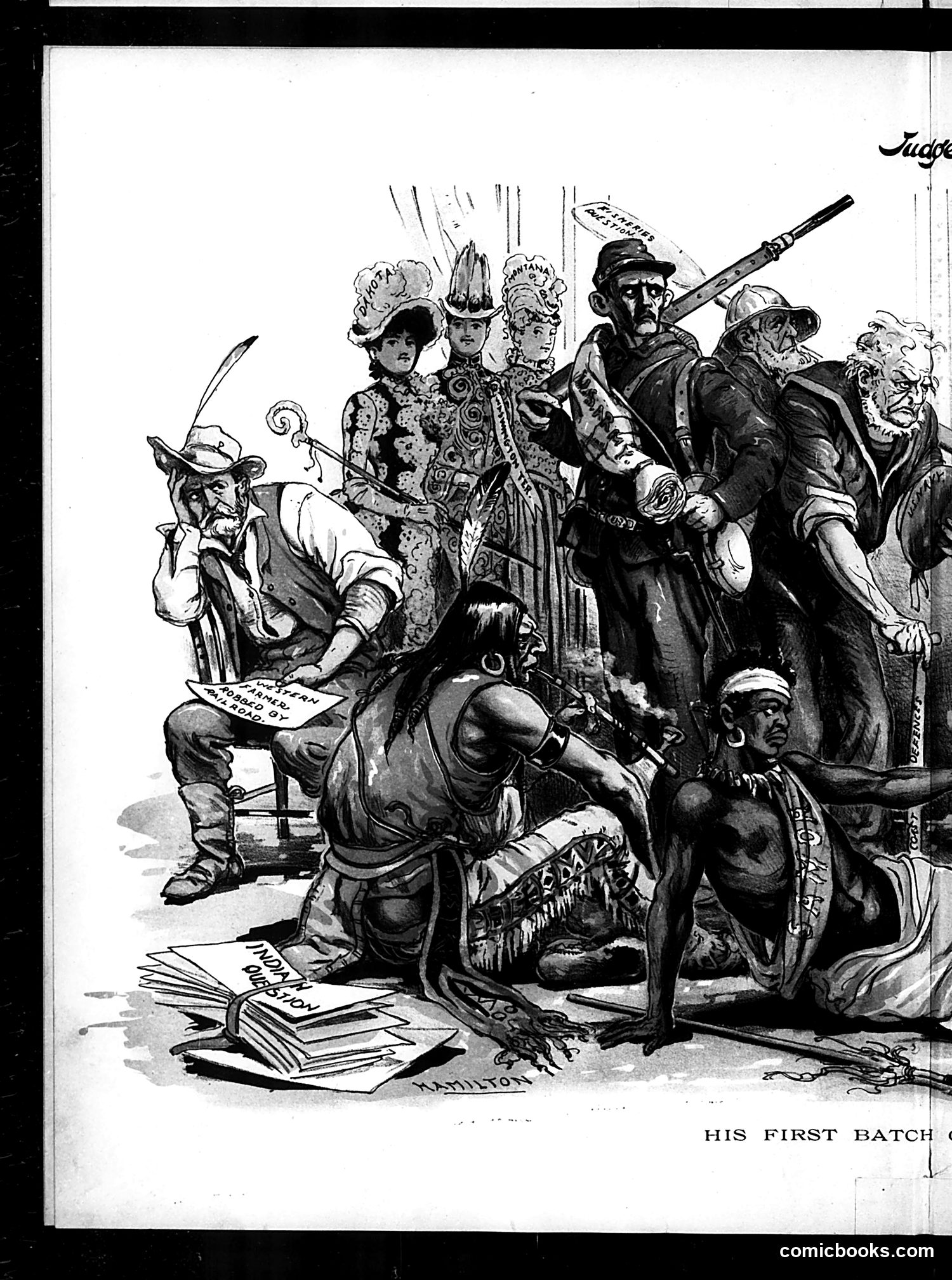
This Judge magazine cartoon satirizes immigration and naturalization. The central figure appears to be an authority (likely a government official or judge) overseeing a diverse group of immigrants - depicted through exaggerated ethnic caricatures including figures in traditional dress and what appear to be stereotypical racial features. The title "His First Batch" suggests this official is processing or "producing" newly naturalized citizens. Stacks of documents (likely naturalization papers) are visible on the ground. The cartoon's satire likely critiques either: 1. The ease/corruption of the naturalization process, or 2. Concerns about the quality or assimilation of new immigrants The varied appearance of the figures emphasizes the diversity of immigrant groups, possibly mocking fears about rapid, uncontrolled immigration during this period. The exaggerated caricatures reflect the racist visual conventions typical of late 19th/early 20th-century American satire.
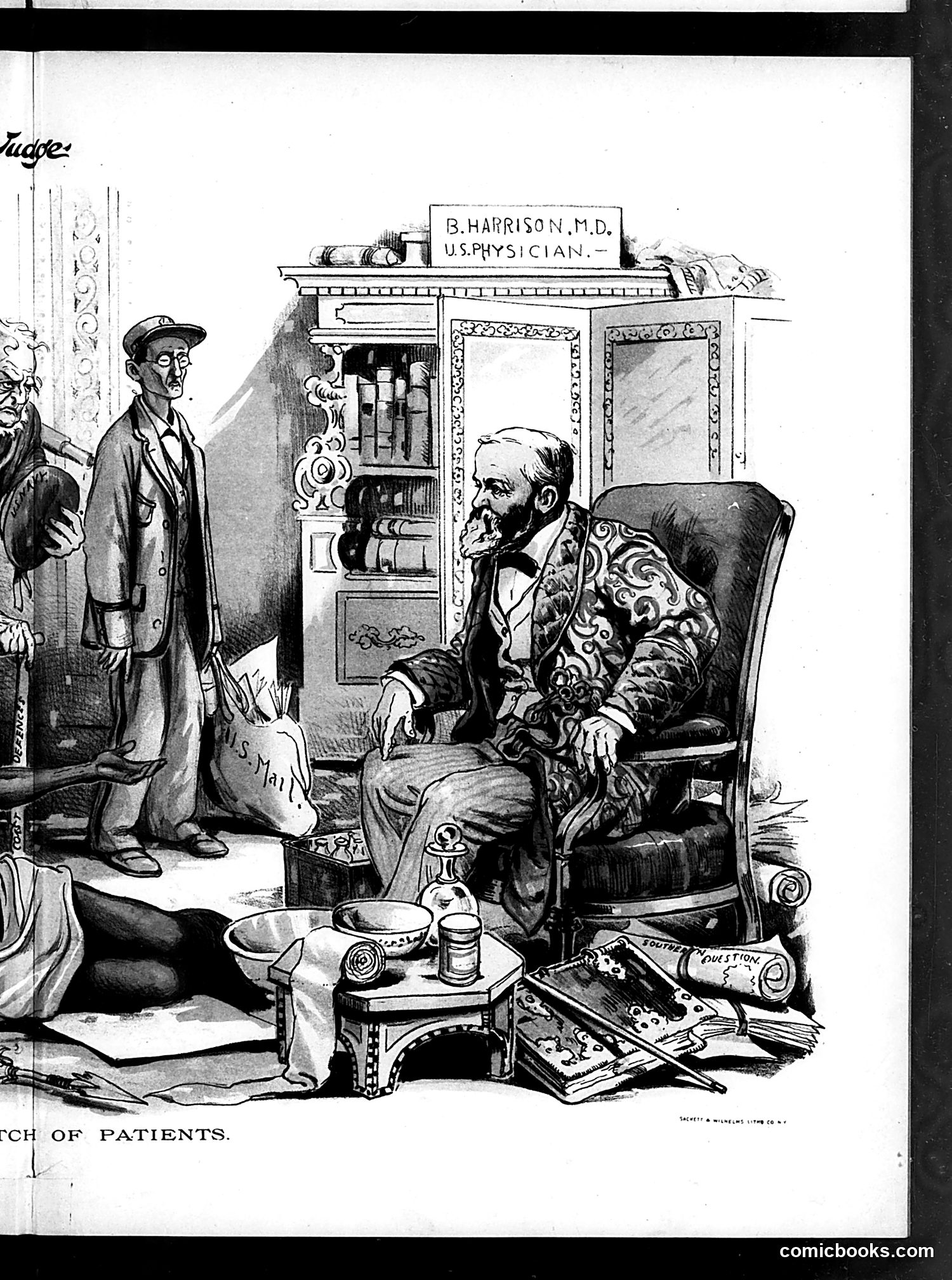
This Judge cartoon satirizes Dr. B. Harrison, a U.S. physician, showing his office crowded with patients. The sign reading "a batch of patients" (partially visible at bottom) suggests the doctor treats large numbers of people. The sketch depicts a well-dressed physician in his ornate office, with medical bottles visible on shelves behind him. A well-to-do gentleman sits prominently in a decorative chair, while other patients wait. The satire likely mocks either Harrison's popularity/commercial success as a doctor, or critiques the commodification of medicine—treating patients as a "batch" rather than individuals. The elaborate office furnishings and formal dress suggest mockery of pretentious medical practice or quackery marketed to wealthy clients. Without additional context about which Dr. Harrison this references, the specific target remains unclear.
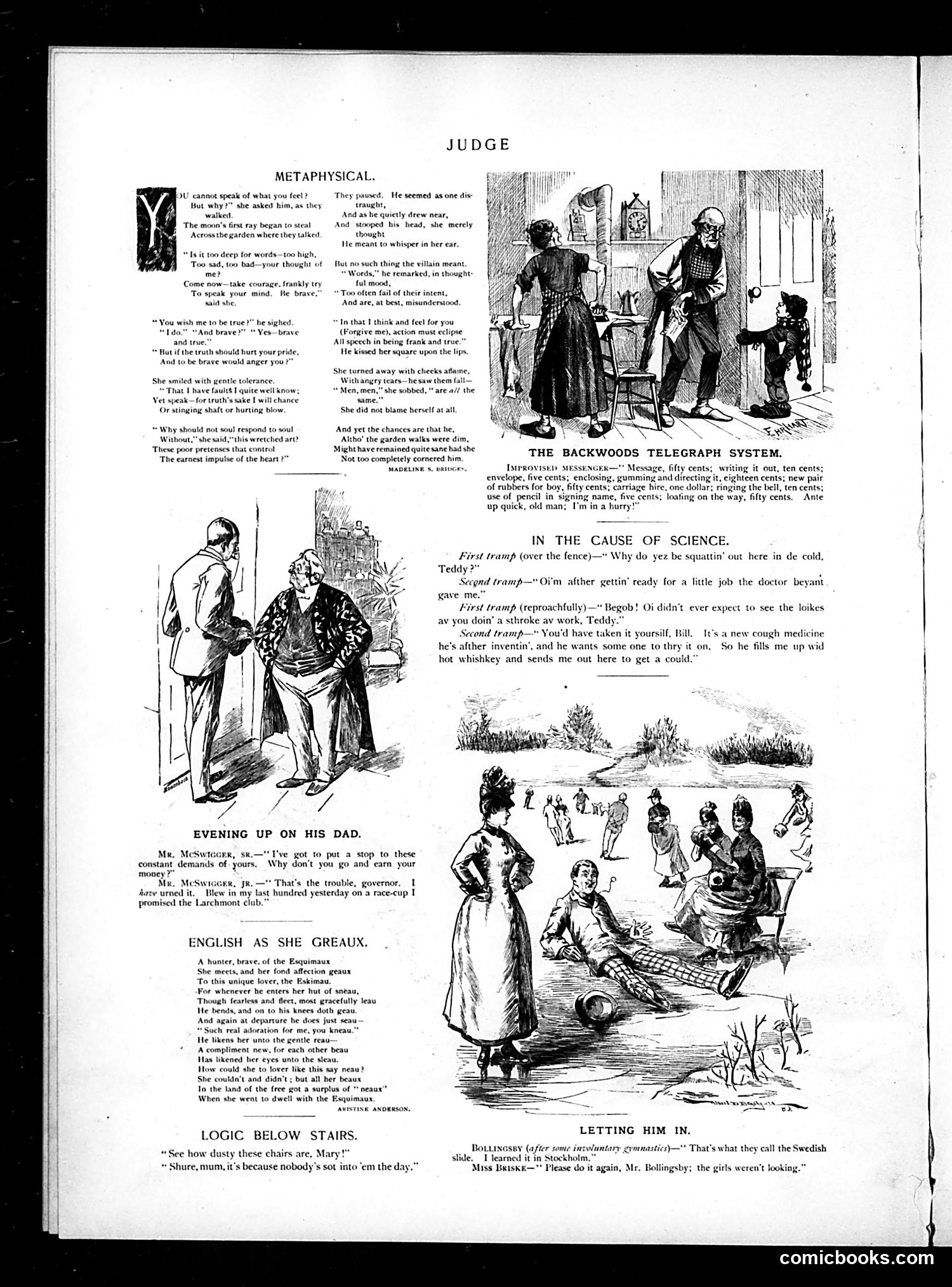
This page contains several satirical pieces typical of early Judge magazine humor: **"Metaphysical"** depicts a romantic couple debating whether words can adequately express emotion—a mockery of overwrought Victorian sentimentality about love and communication. **"Evening Up on His Dad"** satirizes wealthy idleness: a son demands money from his father, claiming he's "earned" it by gambling away funds at a horse race. **"English as She Greaux"** parodies tortured rhyming and dialect humor, playing on "Esquimaux" (Inuit peoples) with forced French-sounding word endings for comedic effect—reflecting period attitudes toward both linguistic pretension and Indigenous peoples. **"In the Cause of Science"** mocks medical experimentation on the poor, with tramps coerced into testing untested "cough medicine" for payment. **"The Backwoods Telegraph System"** satirizes rural communication costs with absurdly itemized messenger fees. Minor pieces mock class dynamics ("Logic Below Stairs"), social climbing ("Letting Him In"), and romantic deception. The humor relies on period stereotypes, exaggerated dialect, and class-based comedy typical of 1890s-1900s American satire.
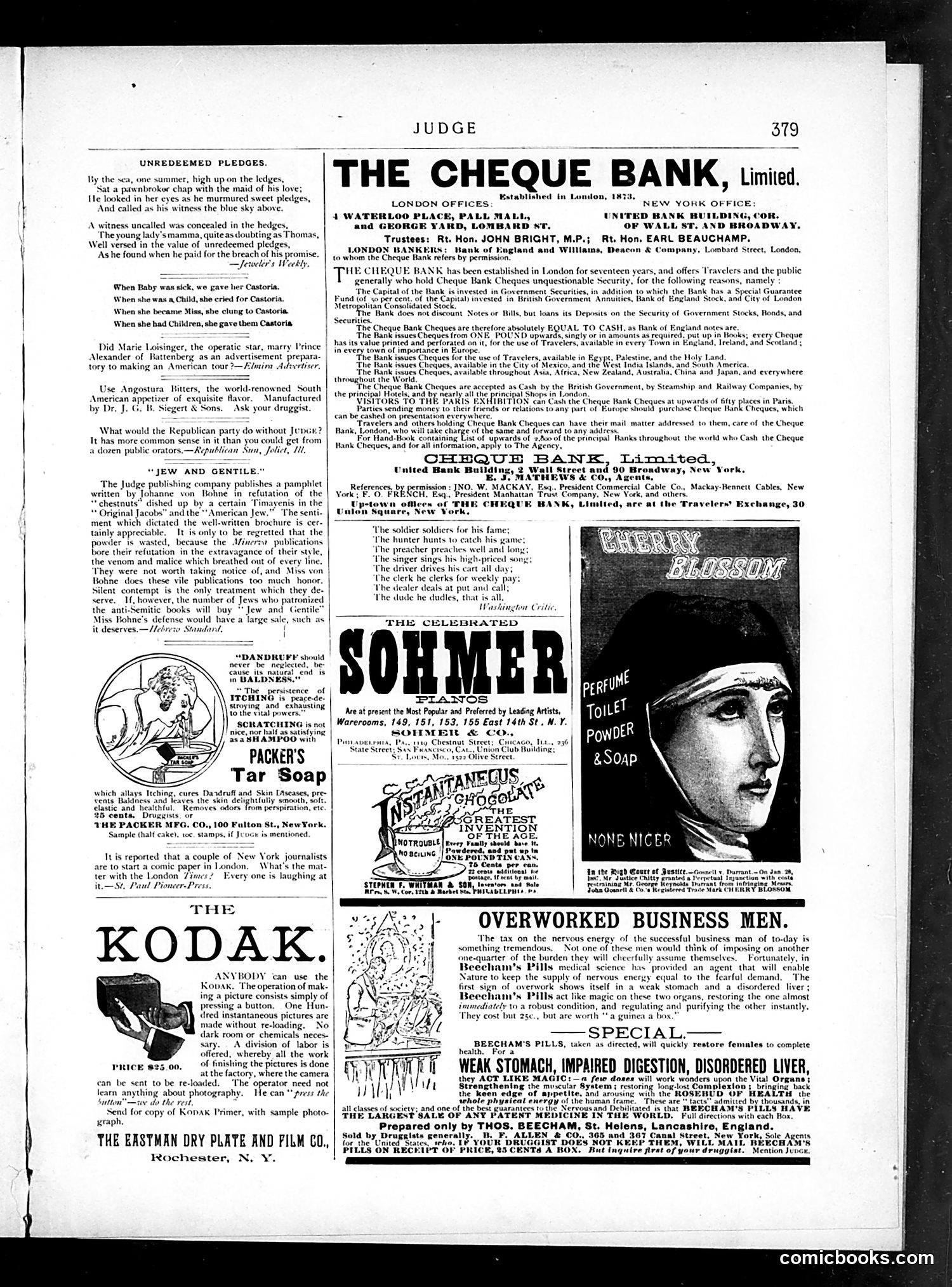
This page is primarily **advertising and business content** rather than political satire. The dominant feature is a lengthy advertisement for the Cheque Bank, Limited, established in London in 1832, detailing their traveler's cheques and banking services across Europe, Asia, Africa, and America. The page includes minor satirical poems and advertisements: - "Unredeemed Pledges," a sentimental poem about a pawnbroker's broken promises to a woman - A brief jab at Republican politicians' "common sense" - Advertisements for Castoria (children's medicine), Packer's Tar Soap, Kodak cameras, Sohmer perfume/toiletries, and Beecham's Pills (digestive remedy) The only clear political reference is a dismissive quip suggesting Alexander of Hattenberg planned an American tour for self-promotion—though context for who this refers to is not visible on this page. Overall, this appears to be a standard late-19th-century magazine page mixing light humor with commercial advertisements.
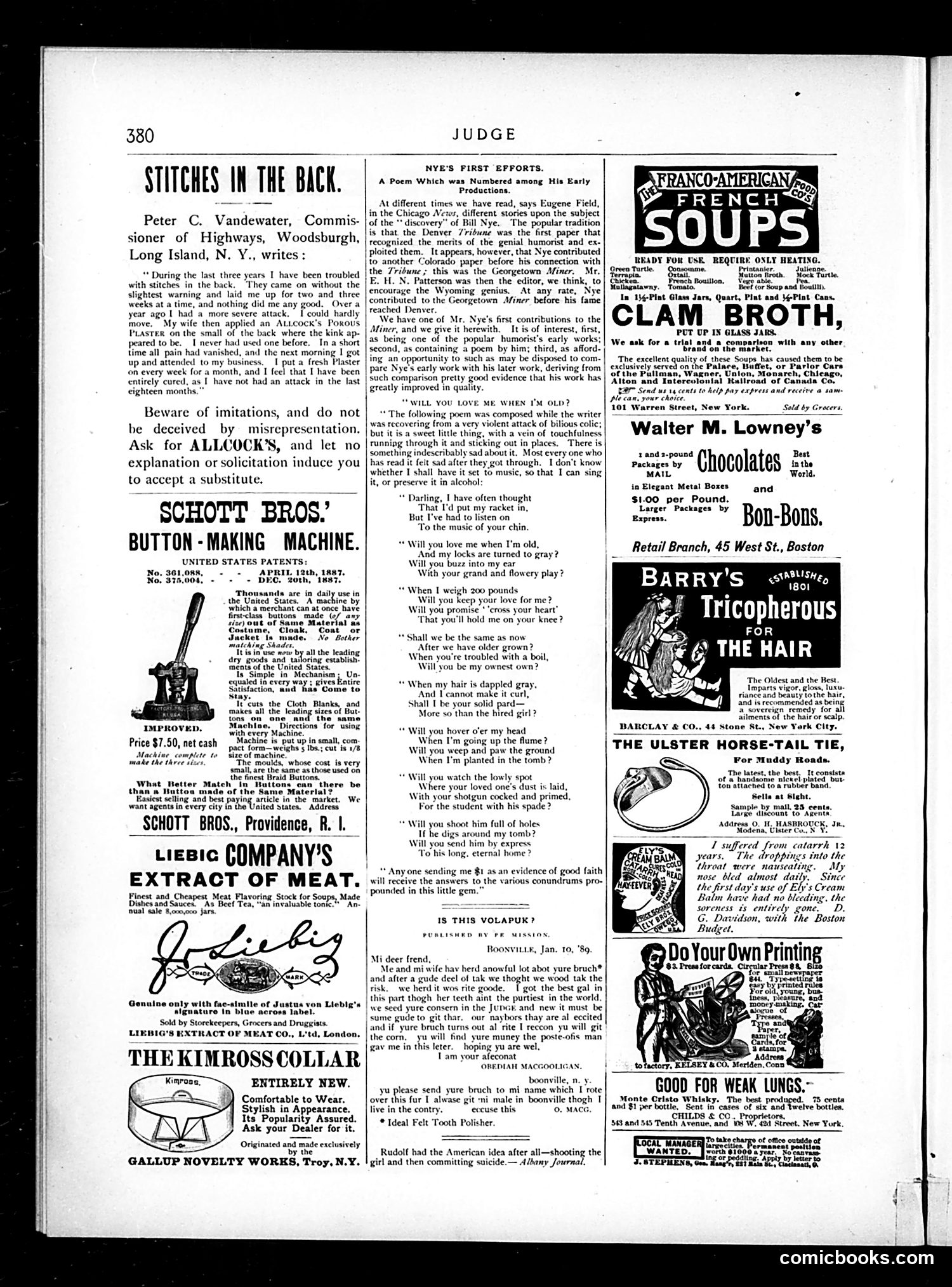
This page celebrates Bill Nye, a popular American humorist of the late 1800s. The article explains that Nye's early career began at the *Georgetown Miner* (a Colorado newspaper) before he became famous at the Denver *Tribune*, contrary to popular belief. The piece reproduces one of Nye's earliest contributions—a humorous poem titled "Will You Love Me When I'm Old?" The poem uses comedic exaggeration, asking whether a sweetheart will remain loyal as the speaker ages, grays, loses teeth, and faces other indignities. It's lighthearted verse designed to amuse readers. The article's interest lies in allowing readers to compare Nye's early work with his later, more celebrated writing—implying his talent developed and matured over time. This was educational content for *Judge's* readers interested in how one of the era's most famous comic writers began his career. The surrounding advertisements are typical period commercial matter unrelated to the editorial content.
This page is primarily **advertising**, not political satire. It contains numerous period product advertisements (Scott's Emulsion cod liver oil, West Shore Railroad, insomnia remedies, candy, hats, facial treatments). The only editorial content is a brief humorous anecdote titled "SENATOR BLACKBURN REFUSES A GOOD OFFER." It describes Senator Blackburn traveling through Indian Territory and encountering a Native American cowman who requests whiskey. The senator shares his flask of "Old Crow" whiskey, and the cowman drinks it all. The "joke" appears to be a light ethnic stereotype about Native Americans and alcohol—the anecdote suggests the cowman greedily consumed the senator's entire bottle. The humor is gentle rather than vicious, playing on naive expectations rather than vicious caricature. Without seeing the conclusion or identifying the specific senator referenced, the full satirical point remains somewhat unclear, though it likely mocks either Blackburn's gullibility or period attitudes toward Native Americans.
This page is primarily **advertising**, not editorial or satirical content. The top features a small product advertisement for the "Ball-Pointed Pen" by Ormiston & Glass (Edinburgh), promoting its durability compared to standard pens. The bulk of the page contains commercial advertisements typical of late 19th/early 20th-century magazines: W.L. Douglas shoes, fountain pens, Soden Mineral Pastilles (a patent medicine claiming to treat throat and lung ailments), hotels, and banking services. One ad promoting Soden pastilles makes now-dubious medical claims about preventing diphtheria and treating whooping cough. A small "CAUTION" notice warns against counterfeit W.L. Douglas shoes, instructing buyers to verify the maker's stamp. The right column lists "Leading Hotels" in New York City and a business index. **No political satire or social commentary is evident.** This appears to be a standard advertising-heavy magazine page, with product claims and hotel listings that reflect period commercial practices rather than Judge's typical satirical editorial mission.
This is primarily an **advertising page** for Judge Publishing Company's books and serials, not a political cartoon page. The main content advertises four novels (including "Napoleon Smith" and "Star-Crossed: The Life and Love of an Actress"), Judge's serial publications, and notably a controversial pamphlet titled **"Jew and Gentile"** by Johanna von Bohne. The pamphlet's preface is striking: the author—identifying herself as a Protestant woman of "good family"—claims to defend Jewish people against "malicious and indecent" language while simultaneously promoting a comparative analysis of Jewish versus Christian character. This appears to be 19th-century **philo-semitic propaganda** that paradoxically perpetuates ethnic stereotyping while claiming fairness. The illustrated "Natural Gas" advertisement in the top right corner is unrelated satirical content. The page reflects Judge's late-1880s editorial interests: fiction marketing and ethno-religious commentary dressed in respectability rhetoric.
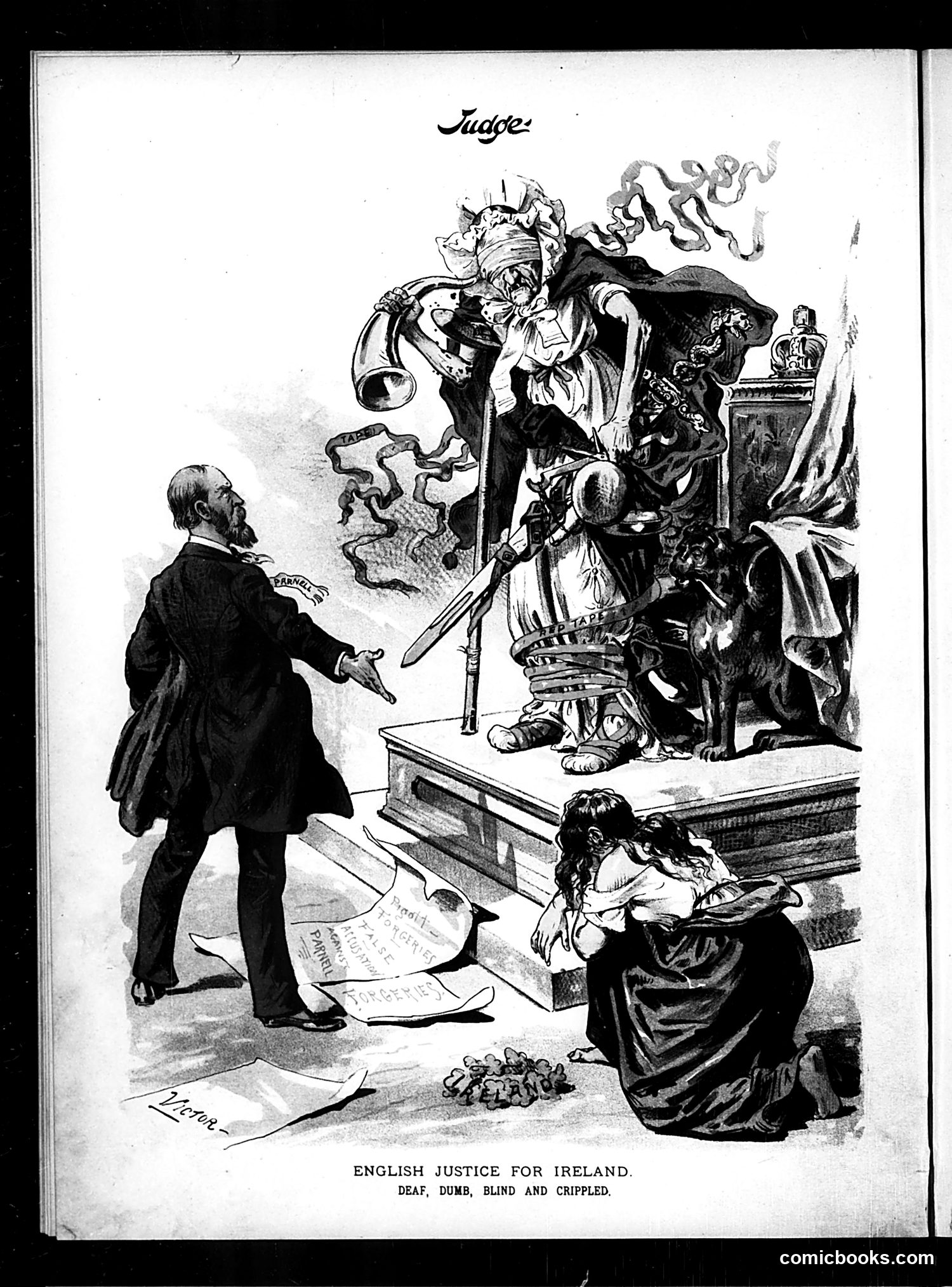
This satirical cartoon critiques English justice system treatment of Ireland. A well-dressed man (likely representing an English judge or official) stands before an elaborate judicial apparatus populated by figures wearing blindfolds, ear coverings, and depicting disability—symbolizing that English justice is deliberately deaf, dumb, blind, and crippled when applied to Irish matters. The scattered papers at the bottom suggest legal documents or cases being ignored. The ornate bench and crown imagery emphasize the authority claiming to dispense justice while being incapable or unwilling to do so fairly. The cartoon's message: England's judicial system willfully ignores Irish grievances and applies justice selectively or incompetently to Ireland. This reflects late-19th/early-20th-century Irish grievances about discriminatory British legal treatment during the independence movement era.
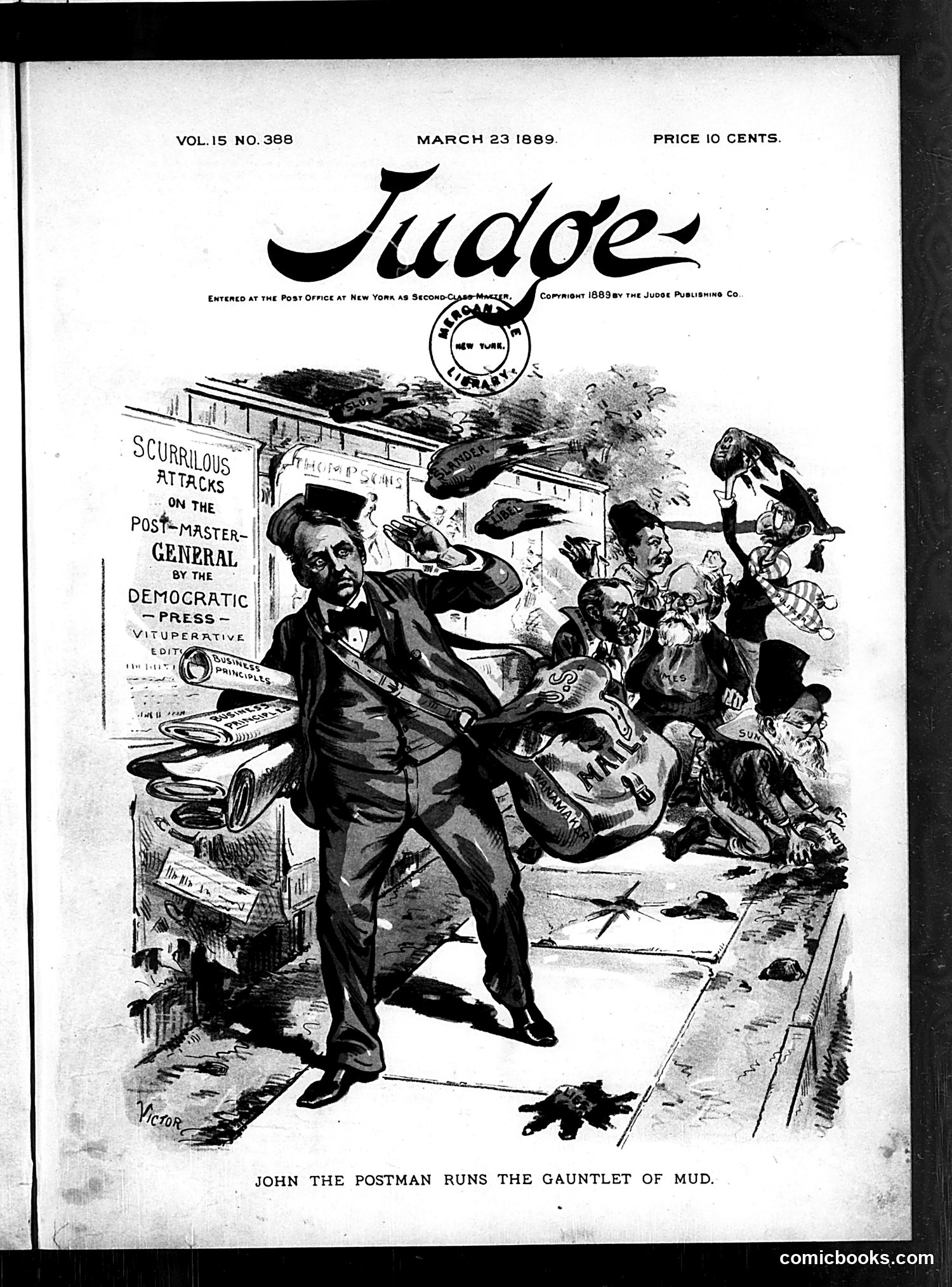
This 1889 Judge cartoon satirizes attacks on Postmaster General John Wanamaker by the Democratic press. The central figure (likely Wanamaker, identifiable as "John the Postman") stands dignified while hostile figures—representing Democratic newspapers and editors—hurl mud and insults at him. The sign references "vituperative" (abusive) editorial principles of the Democratic press. The "gauntlet of mud" is a metaphor for relentless character attacks through journalism. Judge, a Republican publication, defends the Republican Postmaster General against what it portrays as unfair Democratic media assault. The cartoon criticizes partisan press tactics rather than addressing specific policy disputes, presenting Wanamaker as a dignified figure enduring baseless attacks from bitter political opponents.
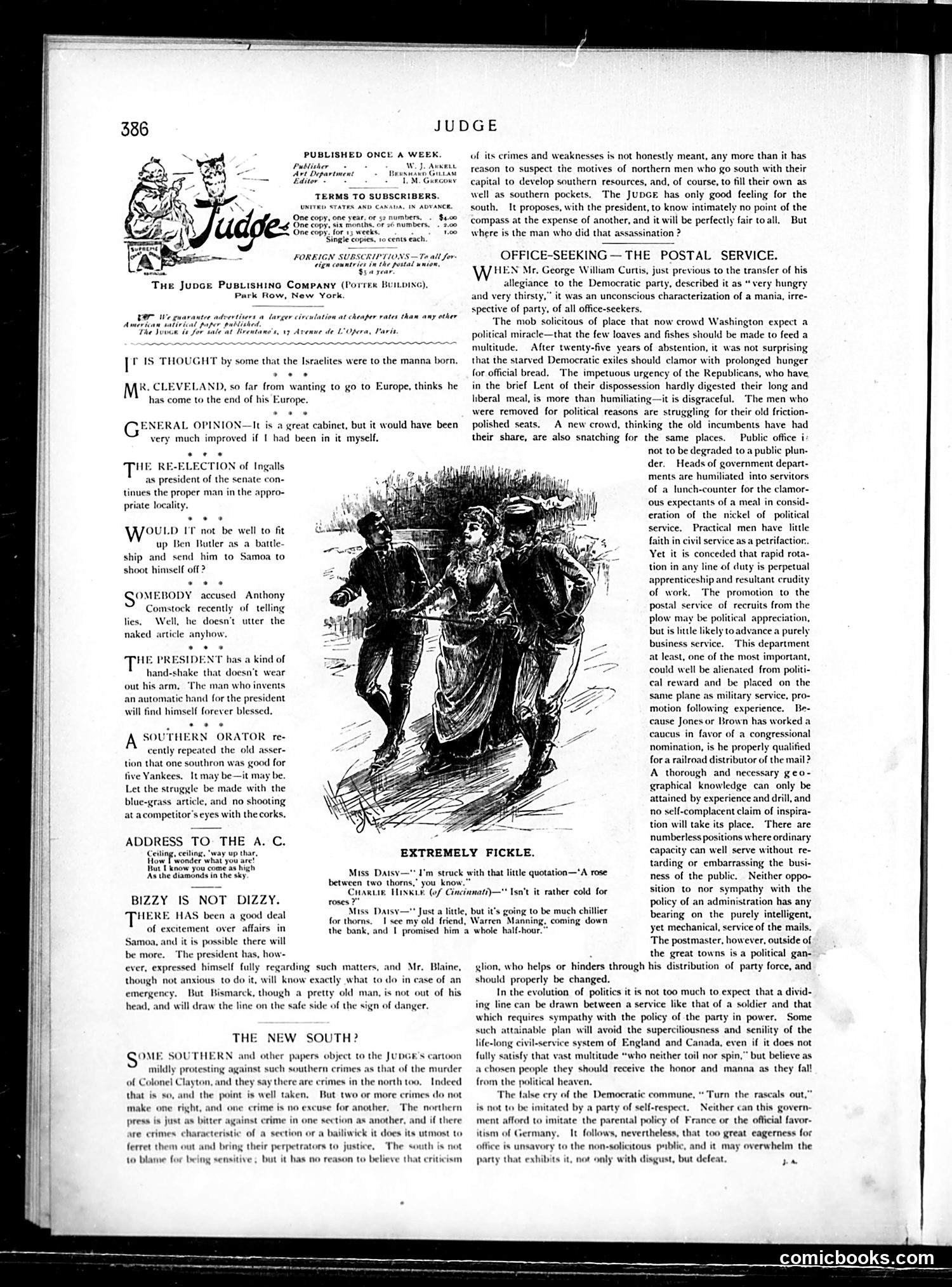
This page contains brief political commentary and a romantic cartoon joke titled "Extremely Fickle." **The Cartoon**: A young woman (Miss Daisy) and a man (Charlie Hinkle) discuss a quotation about roses and thorns. She claims to be "struck" by the poetic sentiment, but immediately abandons Charlie when she spots another suitor (Warren Manning) arriving, promising him her "whole half-hour" instead. The joke satirizes female inconstancy in romance—a common theme in period humor. **Political Commentary**: The longer editorial discusses Southern sensitivity to Northern criticism of regional crimes (likely lynching and violence). Judge defends its criticism as well-intentioned and parallel to Northern press scrutiny of Northern crimes, arguing both regions should accept honest critique without suspicion of ulterior motives. The page also contains brief satirical jabs at President Cleveland, Senator Ingalls, and General Ben Butler, typical of Judge's regular commentary.
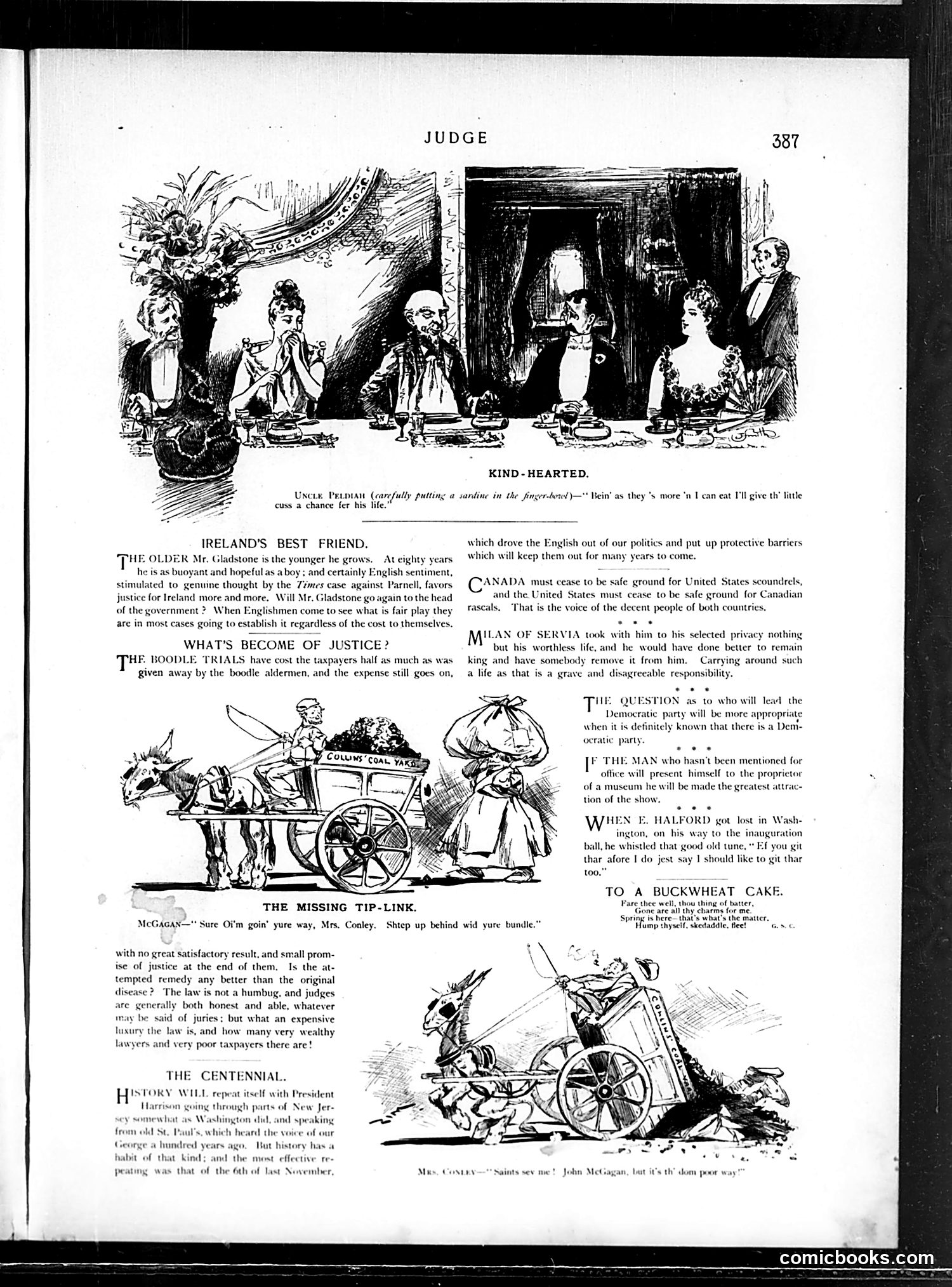
This page from *Judge* magazine contains several brief political satires and commentary pieces, circa 1889-1892 (based on references to Harrison's presidency and the Centennial). **Main cartoons:** 1. **"Kind-Hearted"**: A wealthy man puts a sardine in a finger bowl—a joke about aristocratic pretense and throwing scraps to the poor. 2. **"Ireland's Best Friend"**: Praises William Gladstone (the aging British Liberal leader) for supporting Irish causes and justice, contrasting his consistency with English attitudes shifting toward fairness. 3. **"The Missing Tip-Link"**: An Irish immigrant offers a ride—satirizing working-class corruption or penny-ante theft versus wealthy "boodle" corruption. **Text commentary** addresses: expensive justice systems costing taxpayers as much as the corruption they prosecute; protective trade barriers against British influence; and Democratic Party weakness. The humor relies on period political figures (Gladstone, Parnell, Harrison) and contemporary debates over Irish independence, government corruption, and trade policy—topics largely forgotten today.
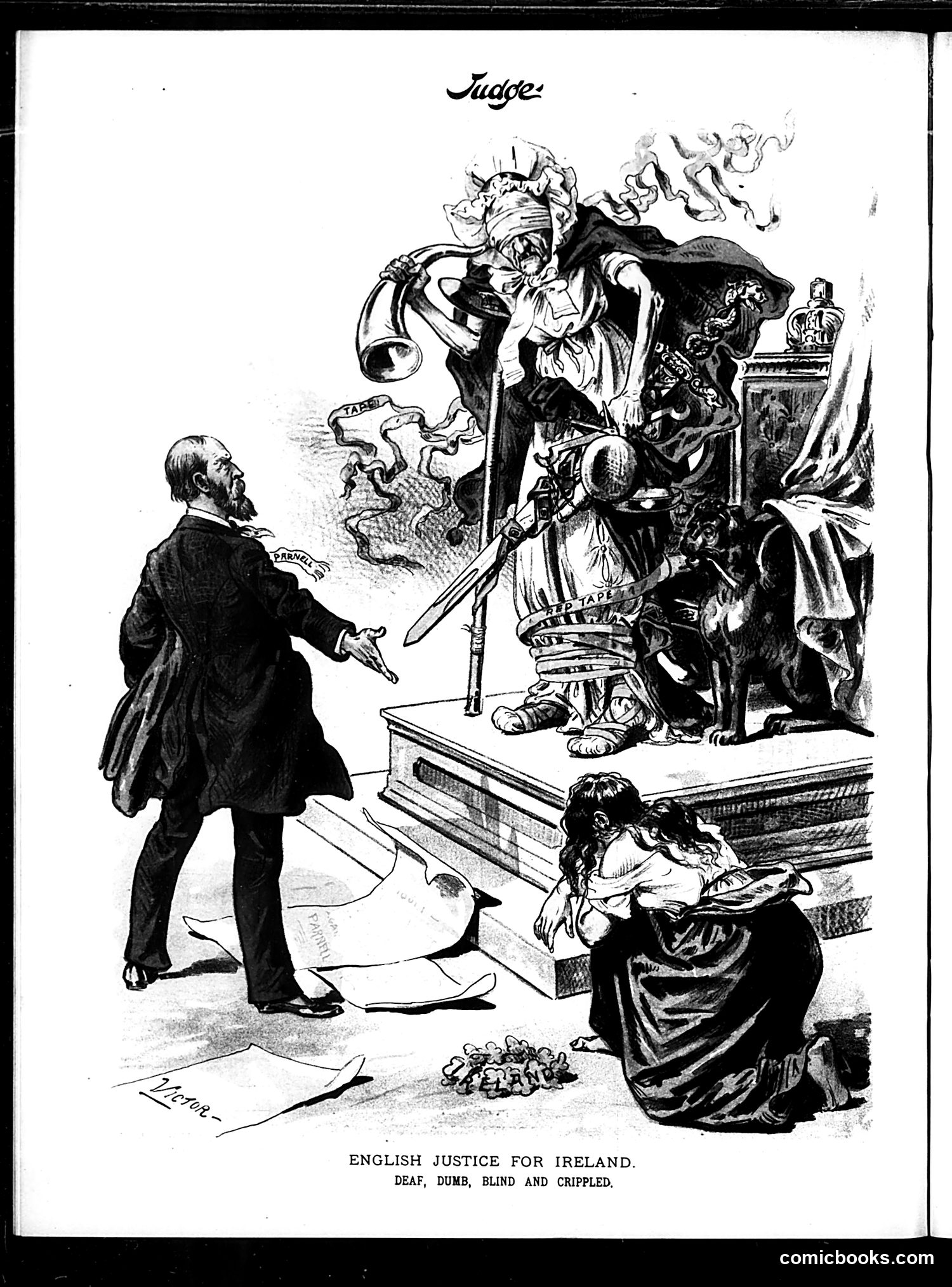
This cartoon critiques British justice toward Ireland. The central figure labeled "Judge" appears as a grotesque, blindfolded deity—representing the personification of justice—positioned on a bench or throne. A well-dressed man (likely a British official or politician) gestures toward the bench from below, while a woman kneels grieving in the foreground with scattered papers. The caption—"English Justice for Ireland: Deaf, Dumb, Blind and Crippled"—uses these disabilities as metaphors: the judge cannot hear Ireland's pleas, cannot speak for justice, cannot see the suffering, and lacks the capacity to act fairly. The imagery suggests that British judicial systems are fundamentally incapable of delivering impartial justice to Ireland, presenting Irish grievances as systematically ignored by a broken legal apparatus.