
Judge, 1889-03-16 · page 2 of 20
Judge — March 16, 1889 — page 2: what you’re looking at
What you’re looking at
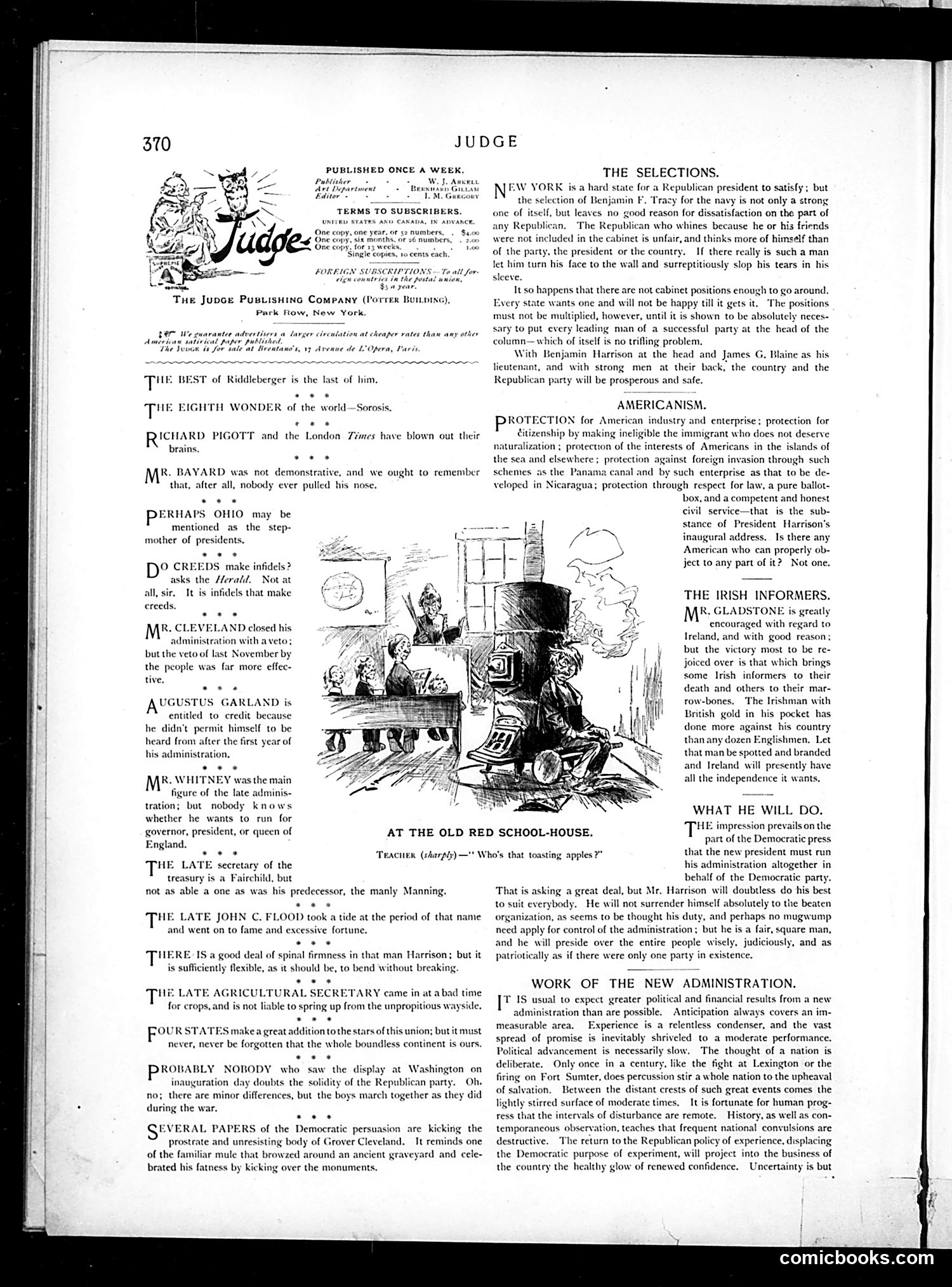
This page contains political commentary and satirical snippets rather than a single cohesive cartoon. The main illustrated piece, "At the Old Red School-House," depicts a teacher asking a student "Who's that toasting apples?" — likely a visual gag about children's knowledge or current events (the specific reference is unclear without more context). The text sections critique various political figures of the Harrison administration era, including references to Benjamin Harrison, James Blaine, and others. The commentary focuses on Republican Party politics, cabinet selections, and protectionist trade policies ("Americanism" section). The overall tone mocks both Republican administration decisions and Democratic responses, using brief satirical observations typical of Judge's editorial style during this period.
📄 Transcribed text from this page (OCR, searchable)
Machine-transcribed from the original scan — historical spelling and the odd misread are preserved.
JUDGE PUBLISHED ONCE A WEEK. WJ. Anceas Crete c FOREIGN SUBSCRIPTIONS — To alt fo Park Row, New York. ser we American satiri The Sows arantee advertisers a larger ci i paper published. fs for tale at Brentano's, ulation at cheaper rates than any other Avenue de L’Opera, i THE Eicn tee ICHARD PIGOTT and the London 7imes have blown out their brains. T of Riddleberger is the last of him, H WOND! of the world —Sorosis, and we ought to remember that, after all, nobody ever pulled his nose. PERHAPS OHIO. may be mentioned as the step- mother of presidents. 0 CREEDS make infidels? asks the Herald. Not at all, sir, It is infidels that make creeds. R, CLEVELAND closed his admi : but the veto of last November by the people was far more effec- tive, istration with av UGUSTUS GARLAND is entitled to credit because he didn't permit himself to be heard from after the first year of his administrati R, WHITNEY was the main figure of the late adminis- tration; but nobody knows whether he wants to run for governor, president, or queen of England. HE LATE secretary of the treasury is a Fairchild, but not as able a one as was his predecessor, the manly Manning. HE LATE JOHN C. FLOOD took a tide at the period of that name and went on to fame and excessive fortune. f spinal firmness in that man Harrison; but it s it should be, to bend without breaking. HERE. IS a good des is sufficiently flexible, HE LATE AGRICULTURAL SECRETARY came in at a bad time for crops, and is not liable to spring up from the unpropitious wayside. ‘OUR STATES makea great addition to the stars of this union; but it must never, never be forgotten that the whole boundless continent is ours. ROBABLY NOBODY who saw the display at Washington on inauguration day doubts the solidity of the Republican party, Oh. no; there are minor differences, but the boys march together as they did during the war. SEVERAL PAPERS of the Democratic persuasion are kicking the prostrate and unresisting body of Grover Cleveland. It reminds one of the familiar mule that browzed around an ancient graveyard and cele- brated his fatness by kicking over the monuments. AT THE OLD RED SCHOOL-HOUSE. TeacueR (sharply) —"* Who's that toasting apples?" THE SELECTIONS. N EW YORK isa hard state for a Republican president to satisfy ; but the selection of Benjamin F. Tracy for the navy is not only a strong one of itself, but leaves no good reason for dissatisfaction on the part of any Republican, The Republican who whines because he or his friends were not included in the cabinet is unfair, and thinks more of himself than of the party, the president or the country. If there really is such a man let him turn his face to the wall and surreptitiously slop his tears in his sleeve. It so happens that there are not cabinet positions enough to go around. Every state wants one and will not be happy till it gets it, ‘The positions must not be multiplied, however, until it is shown to be absolutely neces- sary to put every leading man of a successful party at the head of the column— which of itself is no trifling problem, With Benjamin Harrison at the head and James G, Blaine as his lieutenant, and with strong men at their back, the country and the Republican party will be prosperous and safe, AMERICANISM. ROTECTION for American industry and enterprise; protection for Citizenship by making ineligible the immigrant who does not deserve naturalization ; protection of the interests of Americans in the islands of the sea and elsewhere; protection against foreign invasion through such schemes as the Panama and by such enterprise as that to be de- veloped in Nicaragua; protection through respect for law, a pure ballot- box, and a competent and honest civil service—that is the sub- stance of President Harrison's inaugural address. Is there any American who can properly ob- ject to any part of it? Not one. THE IRISH INFORMERS. R, GLADSTONE is greatly encouraged with regard to Ireland, and with good reason; but the victory most to be re- joiced over is that which brings some Irish informers to their death and others to their mar- row-bones. The Irishman with British gold in his pocket has done more against his country than any dozen Englishmen, Let that man be spotted and branded and Ireland will presently have all the independence it wants, WHAT HE WILL DO. HE impression prevailson the part of the Democratic press that the new president must run his administration altogether in behalf of the Democratic party. That is asking a great deal, but Mr. Harrison will doubtless do his best to suit everybody. He will not surrender himself absolutely to the beaten ion, as seems to be thought his duty, and perhaps no mugwump nced apply for control of the administration ; but he is a fair, square man, and he will preside over the entire people wisely, judiciously, and as patriotically as if there were only one party in existence. orga WORK OF THE NEW ADMINISTRATION. T IS usual to expect greater political and finan: administration than are possible, Anticipation al measurable area. Experience is a relentless condenser, and the vast spread of promise is inevitably shriveled to a moderate performance. Political advancement is necessarily slow. The thought of a nation is deliberate. Only once in a century, like the fight at Lexington or the firing on Fort Sumter, does percussion stir a whole nation to the upheaval of salvation. Between the distant crests of such great events comes the lightly stirred surface of moderate times. It is fortunate for human prog- ress that the intervals of disturbance are remote. History, as well as con- temporancous observation, teaches that frequent national convulsions are destructive. The return to the Republican policy of experience, displ the Democratic purpose of experiment, will project into the business of the country the healthy glow of renewed confidence. results from a new ‘ays covers an im- comicbooks.com