
Judge, 1889-03-16 · page 18 of 20
Judge — March 16, 1889 — page 18: what you’re looking at
What you’re looking at
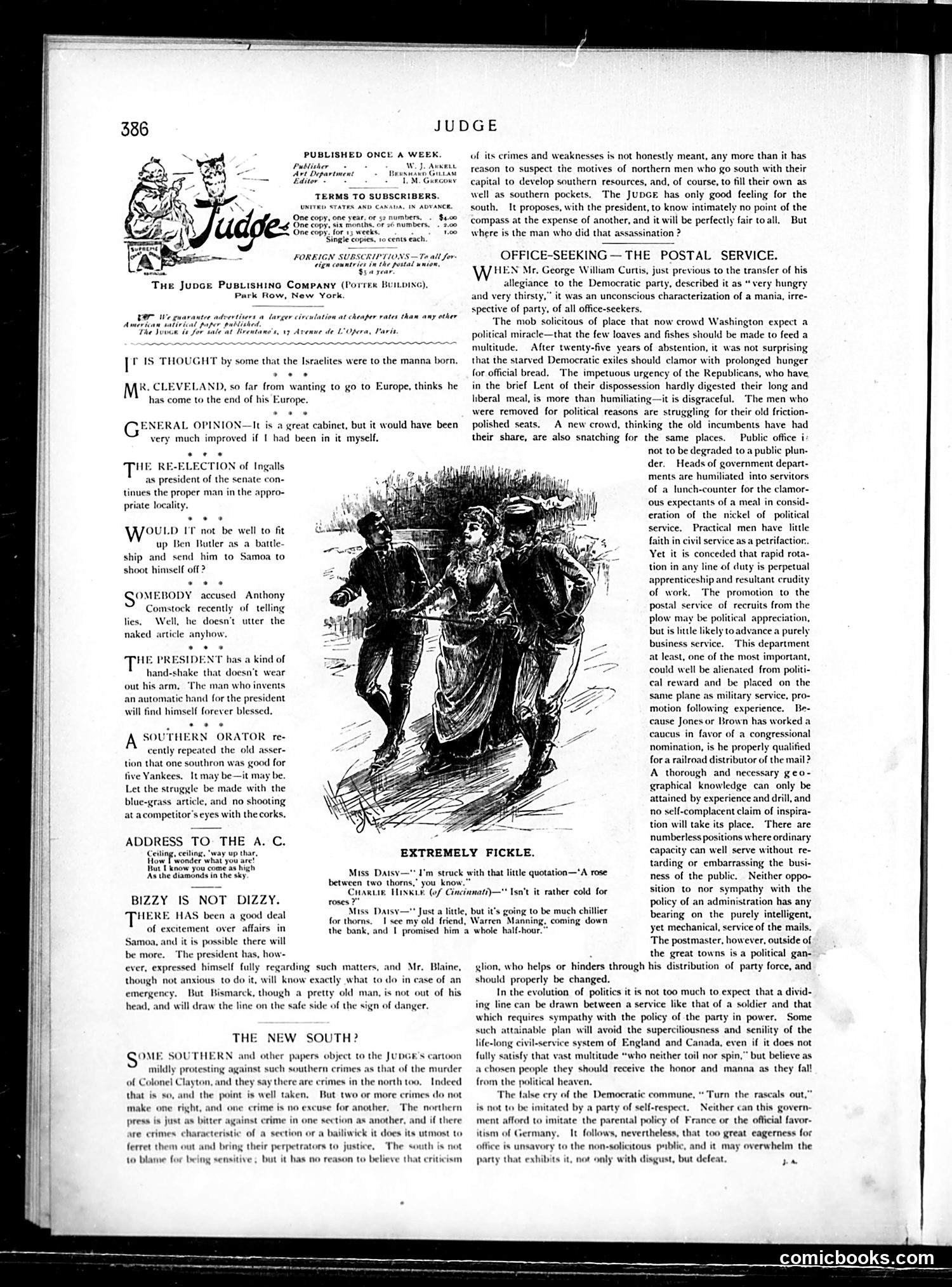
This page contains brief political commentary and a romantic cartoon joke titled "Extremely Fickle." **The Cartoon**: A young woman (Miss Daisy) and a man (Charlie Hinkle) discuss a quotation about roses and thorns. She claims to be "struck" by the poetic sentiment, but immediately abandons Charlie when she spots another suitor (Warren Manning) arriving, promising him her "whole half-hour" instead. The joke satirizes female inconstancy in romance—a common theme in period humor. **Political Commentary**: The longer editorial discusses Southern sensitivity to Northern criticism of regional crimes (likely lynching and violence). Judge defends its criticism as well-intentioned and parallel to Northern press scrutiny of Northern crimes, arguing both regions should accept honest critique without suspicion of ulterior motives. The page also contains brief satirical jabs at President Cleveland, Senator Ingalls, and General Ben Butler, typical of Judge's regular commentary.
📄 Transcribed text from this page (OCR, searchable)
Machine-transcribed from the original scan — historical spelling and the odd misread are preserved.
PUBLISHED ONCE A WEE! Publisher ++ Ww.) Art Departme! + Brenna Editar Te TERMS TO SUBSCRIBERS. UNITRU STATES AND CANAUA, IN ADVANCE. One cop one year, of sz numbers, . $4.00 six months, of 26 numbers, 3.00 ‘One copy: for 13 weeks. reo ‘Single copies. cents each, “RIPTIONS To all for- ‘ign countries in the postal wmion, $s year Tue Jupce Pusisnino Company (Vorrek Buitpinc), Park Row, New York. BRT W's guarantee advertivers a larger circulation at cheaper rates than any other American satirical paper published. The Juin ts for tale at Bren 4 tp Avenue de L°Opera, Paris if f IS THOUGHT by some that the Israelites were to the manna born, R. CLEVELAND, so far from wanting to go to Europe, thinks he has come to the end of his Europe. GENERAL OPINION—It is a great cabinet, but it would have been very much improved if | had been in it myself. HE RE-E ION of Ingalls as president of the senate con- tinues the proper man in the appro priate locality. OULD IT not be well to fit up Ben Butler as a battle. ship and send him to Samoa to shoot himself off ? OMEBODY accused Anthony Comstock recently of telling lies, Well, he doesn’t utter the naked article anyhow. HE PRESIDENT has a kind of hand-shake that doesn’t wear out his arm, The man who invents an automatic hand for the president find himself forever blessed. SOUTHERN ORATOR re- cently repeated the old asser- tion that one southron was good for five Yankees. It may be—it may be Let the struggle be made with the blue-grass article, and no shooting at acompetitor’s eyes with the corks, ADDRESS TO: THE A. C. Ceiling, ceiling, ‘way up thar, How f wonder what you are! iT know you come as high As the diamonds in the sky 7 between two thorns,” you know Cc BIZZY IS NOT DIZZY. roses ? HERE HAS been a good deal of excitement over affairs in Samoa, and it is possible there will be more. The president has, how= ever, expressed himself fully regarding such matters, and Mr. Blaine, though not anxious to do it, will know exactly what to do in case of an emergency. y. But Bismarck, though a pretty old man, is not out of his head, and will draw the line on the safe side of the sign of danger. THE NEW SOUTH? OME SOUTHERN and other papers object to the JUDGE'S cartoon mildly protesting a of the murder of Colonel Clayton, and they say there are crimes in the north too, Indeed 1 the point is well taken, But two or more cri nake one right The northern press is just as bitter against crime in on Nas another, and if there wick it does its utmost to nd bring their perpetrators to justice, The s inst such southern crimes as tha that iss es do not nd one crime is no excuse for another, sect are crimes characteristic of a section or ab ferret them out ith is not to blame for being sensitive; but it has no reason to believe that criticism EXTREMELY FICKLE. Miss Daisy—"* I'm struck with that little quotation—"A rose ARLIE HINKLE (of Cincinnati)—"* Isn't it rather cold for Miss Datsy—"" Just a little, but for thorns. I see my old friend, Warren Manning, coming down the bank, and 1 promised him a whole half-hour.” JUDGE of its crimes and weaknesses is not honestly meant, any more than it has reason to suspect the motives of northern men who go south with their capital to develop southern resources, and, of course, to fill their own as well as southern pockets, The JUDGE has only good feeling for the south. It proposes, with the president, to know intimately no point of the compass at the expense of another, and it will be perfectly fair toall, But where is the man who did that assassination ? OFFICE-SEEKING — THE POSTAL SERVICE. HEN Mr. George William Curtis, just previous to the transfer of his allegiance to the Democratic party, described it as “ very hungry and very thirsty,” it was an unconscious characterization of a mani spective of party, of all office-seekers. The mob solicitous of place that now crowd Washington expect a political miracle—that the few loaves and fishes should be made to feed a multitude. After twenty-five years of abstention, it was not surprising that the starved Democratic exiles should clamor with prolonged hunger for official bread. The impetuous urgency of the Republicans, who have in the brief Lent of their dispossession hardly digested their long and liberal meal, is more than humiliating—it is disgraceful. The men who were removed for political reasons are struggling for their old friction- polished seats. A new crowd, thinking the old incumbents have had their share, are also snatching for the same places. Public office i not to be degraded to a public plun- der. Heads of government depart- ments are humiliated into servitors of a lunch-counter for the clamor- ous expectants of a meal in consid- eration of the nickel of political service. Practical men have little faith in civil service as a petrifact Yet it is conceded that rapid rota- tion in any line of duty is perpetual apprenticeship and resultant crudity of work. The promotion to the postal service of recruits from the plow may be political appreci but is little likely toadvance a purely business service. This department at least, one of the most important, could well be alienated from politi- cal reward and be placed on the same plane as military service, pro- motion following experience. Be- cause Jones or Brown has worked a caucus in favor of a congressional nomination, is he properly qualitied for a railroad distributor of the mail? A thorough and necessary geo- graphical knowledge can only be attained by experience and drill, and no self-complacent claim of inspira- tion will take its place. There are numberless positions where ordinary capacity can well serve without re- tarding or embarrassing the busi- ness of the public. Neither oppo- sition to nor sympathy with the policy of an administration has any bearing on the purely intelligent, yet mechanical, service of the mails. ‘The postmaster, however, outside of the great towns is a political gan- glion, who helps or hinders through his distribution of party force, and should properly be changed. In the evolution of politics it is not too much to expect that a divid- ing line can be drawn between a service like that of a soldier and that which requires sympathy with the policy of the party in power, Some such attainable plan will avoid the superciliousness and senility of the life-long civil-service system of England and Canada, even if it does not fully satisfy that vast multitude “who neither toil nor spin,” but believe as a chosen people they should receive the honor and manna as they fal! from the politic: The false ery of the Democratic commune, is not to be imitated by a party of self-respect. Neither can this govern- ment afford to imitate the parental policy of France or the official favor- itism « rmany. It follows, nevertheless, that too great eagerness for office is unsavory to the non-so irre- 's going to be much chillier al heaven, Turn the rascals out,” tous public, and it may overwhelm the ty that exhibits it, not only with disgust, but defeat, fe comicbooks.com Vie ev’ -