
A complete issue · 16 pages · 1889
Judge — February 9, 1889
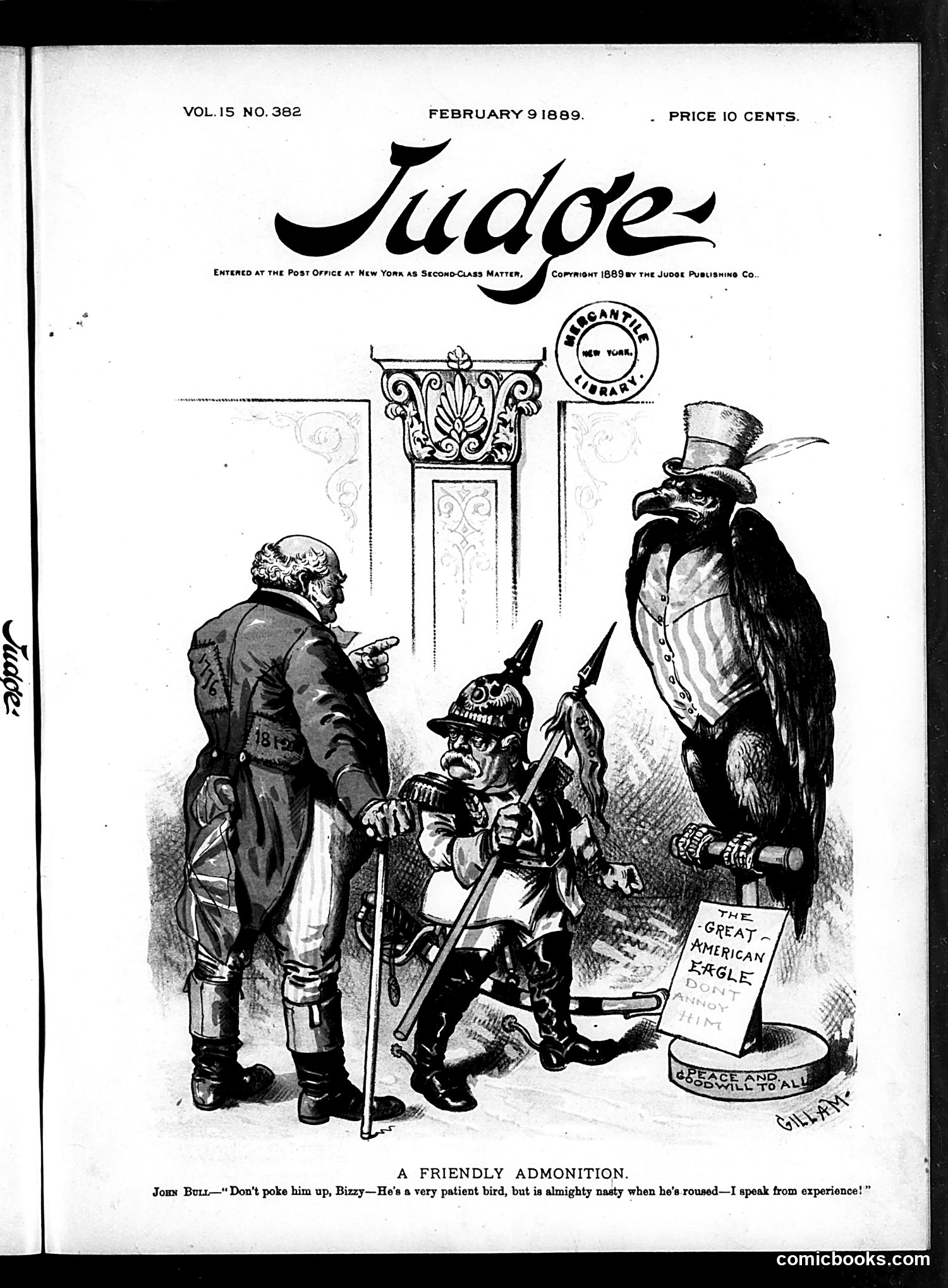
This political cartoon titled "A Friendly Admonition" features three figures: John Bell (left, in 1812 military dress), a small caricatured figure in the center wearing a spiked Prussian helmet, and on the right, a figure representing "The Great American Eagle" in formal dress. The central figure appears to be a caricature of a German or Prussian leader, likely referencing contemporary tensions with Germany. Bell warns against "poking him up"—suggesting the small militaristic figure is volatile and dangerous when provoked. The eagle represents American interests. The satire warns against unnecessary confrontation with aggressive foreign powers, using the eagle's patriotic message ("Peace and Good Will to All") to advocate restraint in international relations rather than military escalation.
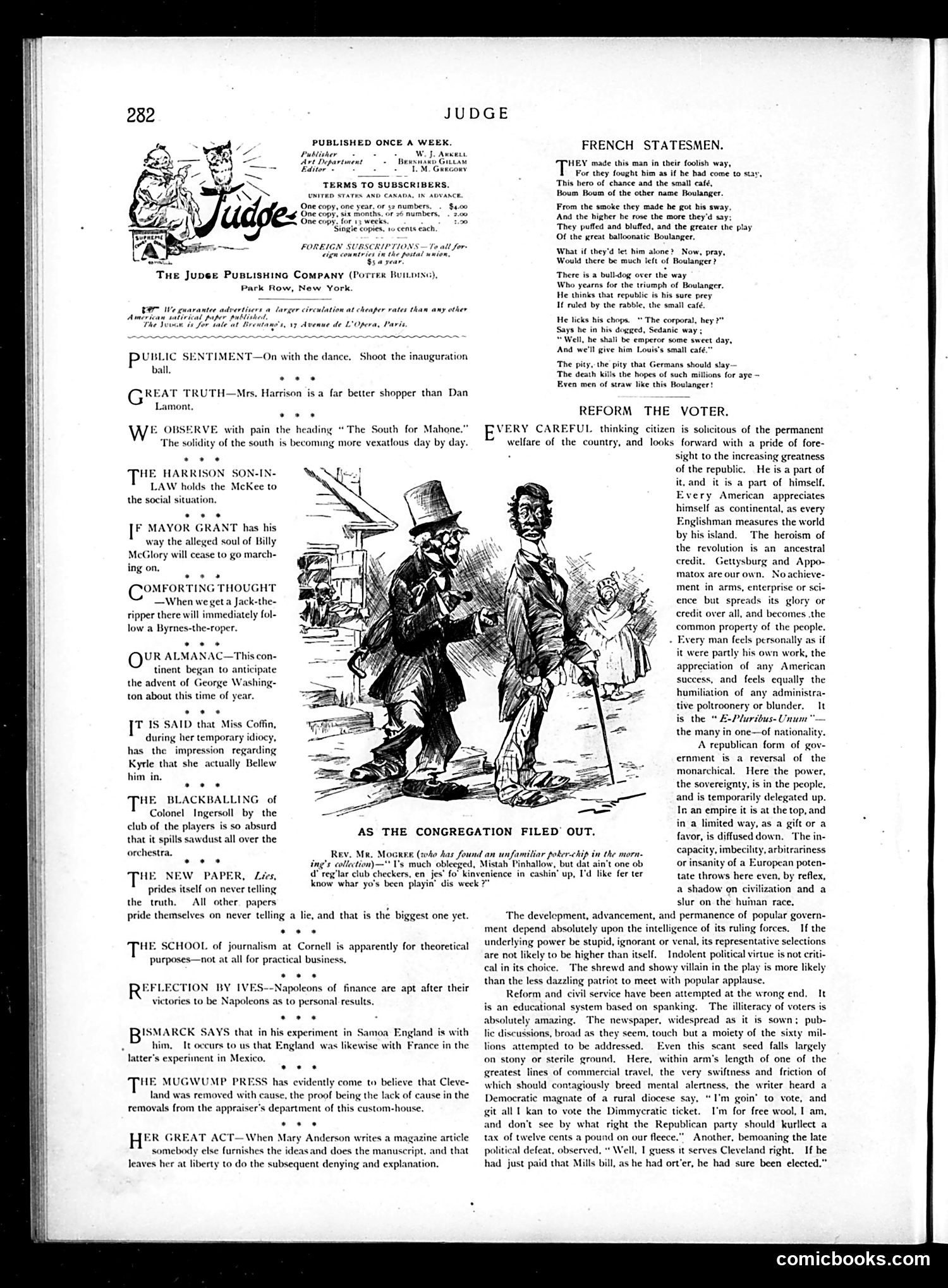
This cartoon satirizes political hypocrisy during the Gilded Age. The central figure appears to be a corrupt politician or clergyman (based on the title's religious reference) receiving praise from followers as they exit. The accompanying text credits "Rev. Mr. Moore" with commenting on familiar "poker-ship in the morn," suggesting a minister who engages in gambling or vice while maintaining respectability. The satire targets the disconnect between public moral personas and private behavior—a common *Judge* magazine theme. The "congregation filing out" implies that respectable society accepts or overlooks the misconduct of authority figures. The cartoon critiques both the hypocrisy of leaders and the willingness of the public to ignore their moral failings in exchange for social position or influence.
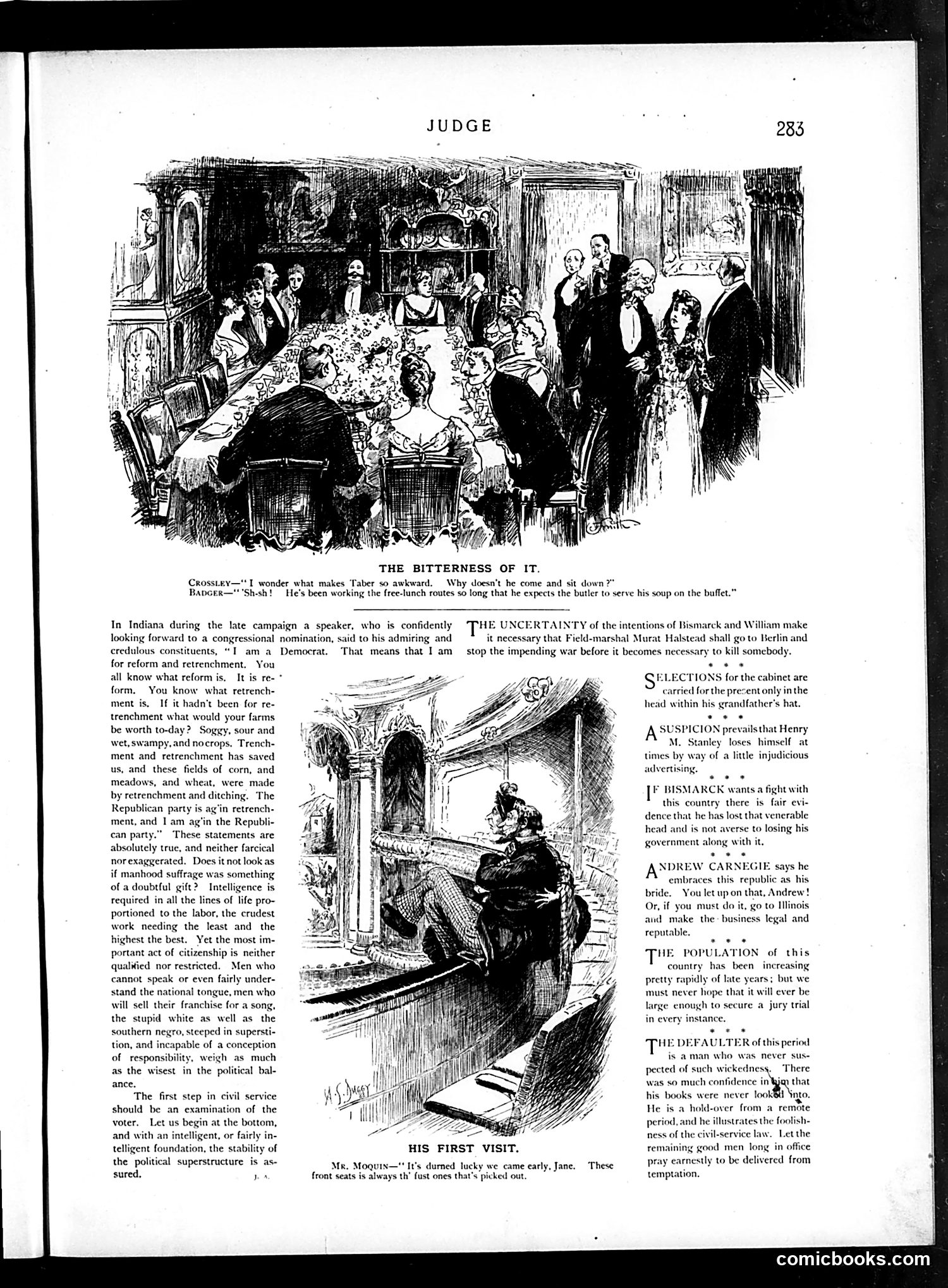
This page contains political satire from the late 19th century, likely the 1880s-90s based on references to Bismarck, William (Kaiser Wilhelm), and civil service reform debates. **Top cartoon** mocks a dinner guest (Taber) who is awkwardly standing. The joke: he's become so accustomed to "free-lunch routes" (cheap establishments offering complimentary meals) that he expects buffet-style service rather than formal table dining—satirizing either political corruption or working-class pretension. **Lower cartoon** ("His First Visit") shows a couple arriving early to secure front-row seats, with the husband noting these seats are always taken first—a gentle social observation about theater attendance habits. **Editorial commentary** criticizes voter qualification standards, arguing universal male suffrage allows uneducated and unqualified voters (including immigrants and formerly enslaved people) equal political power as the wise. It advocates literacy/intelligence testing for voters—a racist, classist position common in Gilded Age publications. References to Bismarck, Stanley (explorer), and civil service reform place this during heated debates over government appointments and international tensions.
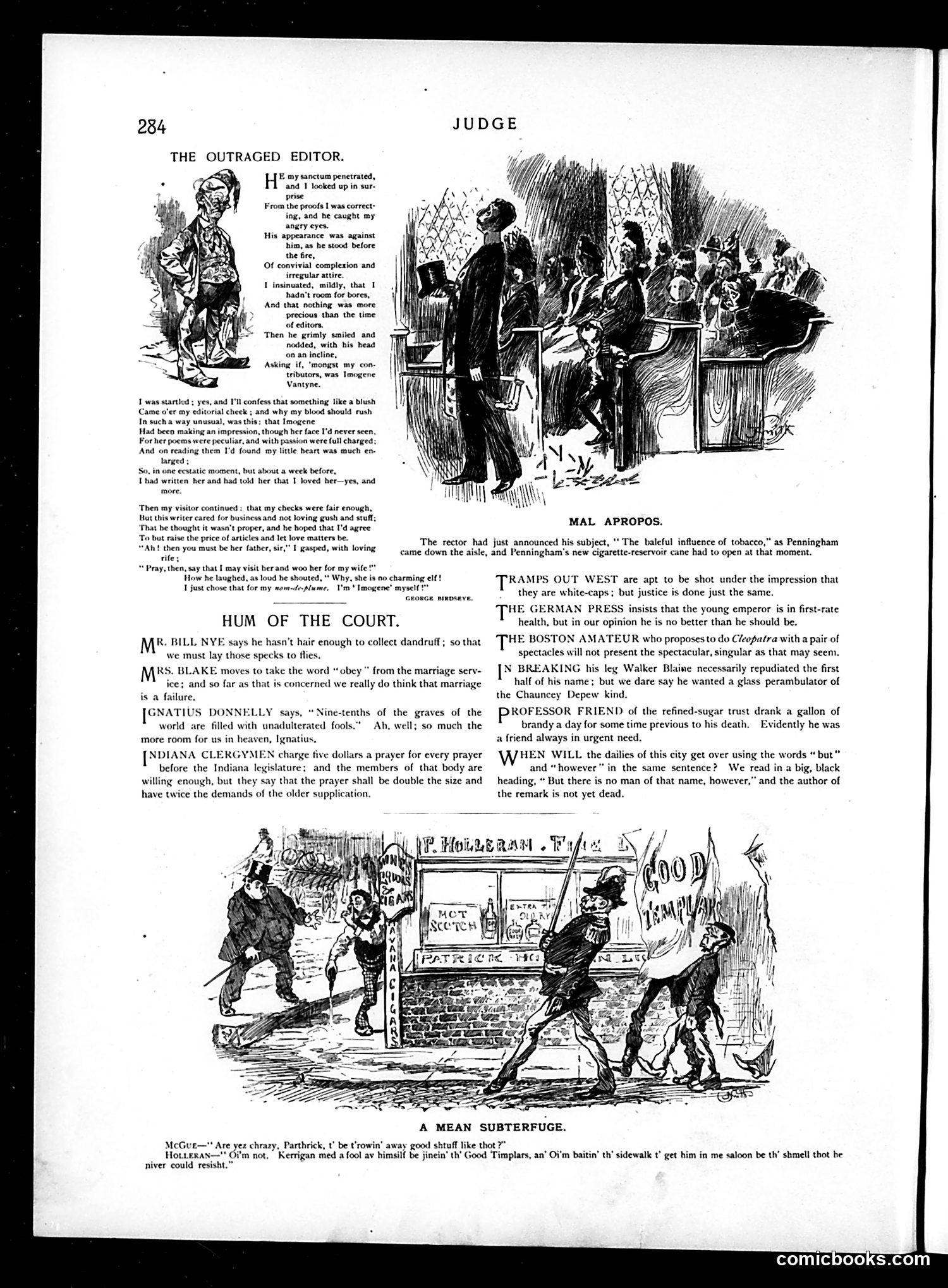
The main narrative poem describes an editor who has fallen in love with a poet named "Imogene Vantyne" based on her passionate submissions—only to discover the visitor is actually a man using that pseudonym to increase payment for articles. The joke satirizes editors' sentimentality and the deception possible in anonymous publishing. The page's other brief satirical items mock contemporary figures and trends: Bill Nye's baldness, marriage-vow reforms, clergy salary disputes, and German emperor health reports. "Mal Apropos" depicts the ironic timing of a rector announcing tobacco's evils just as a parishioner's cigarette case opens nearby—coincidental bad luck rather than intentional mockery. "A Mean Subterfuge" shows working-class Irish characters discussing alcoholism as a social problem, using dialect humor common to period satire. These items represent typical Judge content: topical jabs at politicians, social hypocrisy, and everyday absurdities, relying on recognizable figures and contemporary knowledge now largely lost.
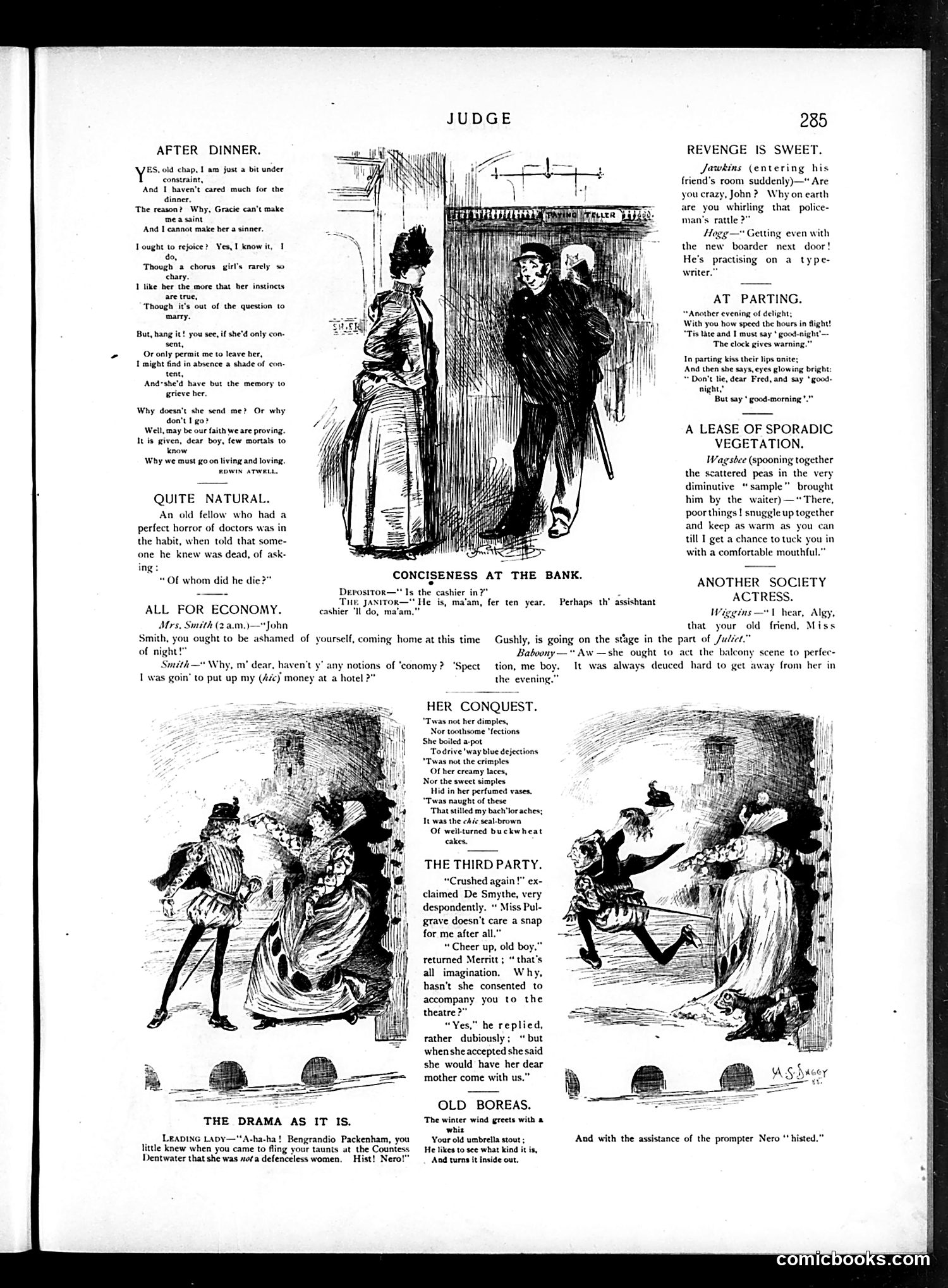
This page contains multiple humorous vignettes typical of late-19th-century American satire. The cartoons mock everyday social situations and gender relations: **"After Dinner"** depicts a man lamenting his romantic entanglement with a chorus girl—respectable enough to marry but unwilling to leave, creating mutual unhappiness. **"All for Economy"** jokes about a wife complaining her husband spent money at a hotel rather than at home—satirizing anxieties about male behavior and domestic economy. **"Conciseness at the Bank"** presents the old joke format of a depositor's simple question misunderstood as asking about the cashier's employment duration. **"Her Conquest"** humorously reveals a woman won a man through cooking (buckwheat cakes) rather than beauty—inverting romantic idealization. **"The Third Party"** mocks a suitor's disappointment when his date insists her mother accompany them to the theatre—a commentary on chaperone culture and courtship constraints. The satirical thrust targets romantic misunderstandings, domestic tensions, and social conventions of the era, presented through genteel humor aimed at middle-class readers.
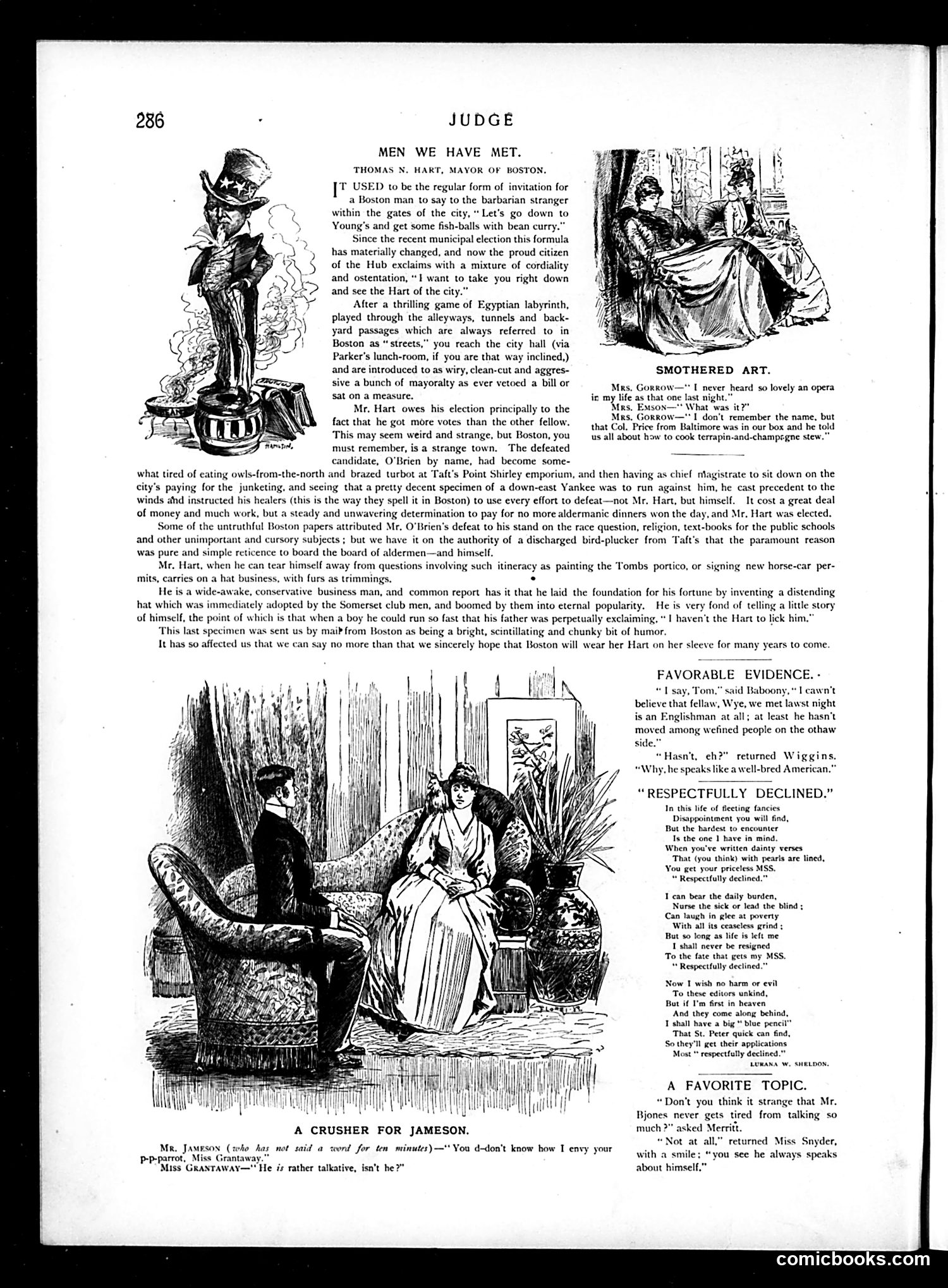
This page features a profile of **Thomas N. Hart, newly elected Mayor of Boston**, written as satirical social commentary. The piece mocks Boston's provincial pride while praising Hart as a practical businessman who defeated incumbent O'Brien. The satire works through irony: Hart won not on policy grounds (race, religion, schools) but because O'Brien grew tired of mandatory aldermanic dinners and deliberately sabotaged his own campaign. Judge presents Hart as competent but humorous—a hat manufacturer fond of terrible puns ("I haven't the Hart to lick him"). The accompanying cartoons address separate topics: **"Smothered Art"** jokes about a woman boring guests with obscure opera details, and **"A Crusher for Jameson"** depicts a social putdown (text unclear but involves boasting). The section **"Respectfully Declined"** prints a humorous rejection letter from a magazine editor. The overall tone is lighthearted political ribbing rather than serious criticism, typical of Judge's genteel satire aimed at urban, educated readers.
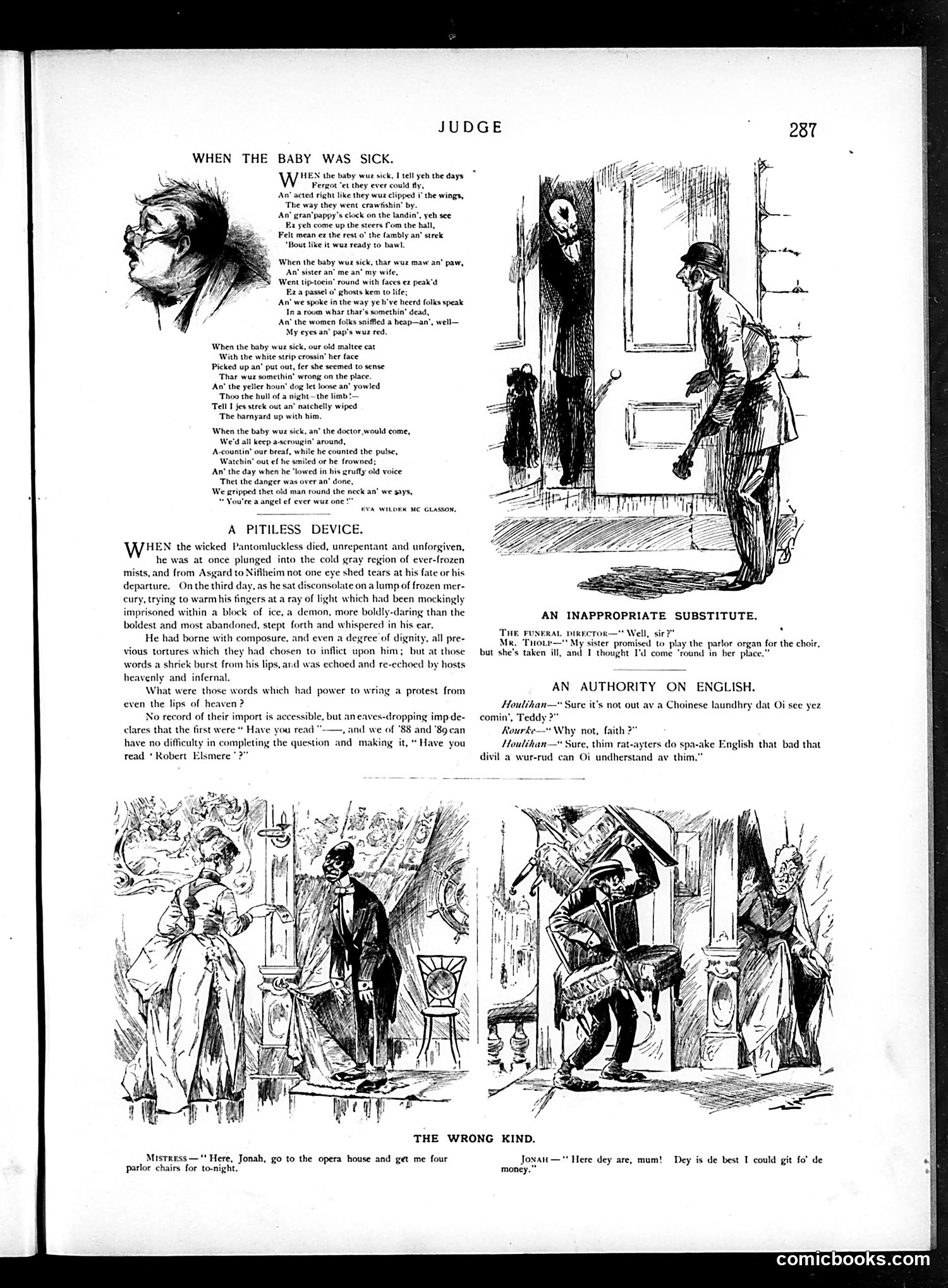
This page contains multiple satirical pieces typical of Judge's humor: **"When the Baby Was Sick"** (top): A sentimental poem about family concern during childhood illness, contrasting emotional vulnerability with the narrator's rural dialect. The accompanying sketch shows a concerned household gathered around a sick child—likely mocking the Victorian sentimentality of such domestic scenes. **"A Pitiless Device"** (middle): A darkly comic fantasy about a wicked man tormented in the afterlife. His ultimate punishment is being asked "Have you read *Robert Elsmere*?"—referencing an 1888 religious novel by Mrs. Humphry Ward that sparked contemporary debate. The joke suggests the book was so tedious it constitutes infernal torture. **"An Inappropriate Substitute"** and **"An Authority on English"** (right): Brief joke sketches mocking social awkwardness and ethnic dialect humor (featuring Irish characters "Houlihan" and "Rourke"). **"The Wrong Kind"** (bottom): A mistress sends her servant Jonah to fetch opera chairs; he returns with actual chairs instead of orchestra seating—a pun on class and linguistic misunderstanding. The page exemplifies Judge's mix of sentimental verse, literary satire, and working-class humor.
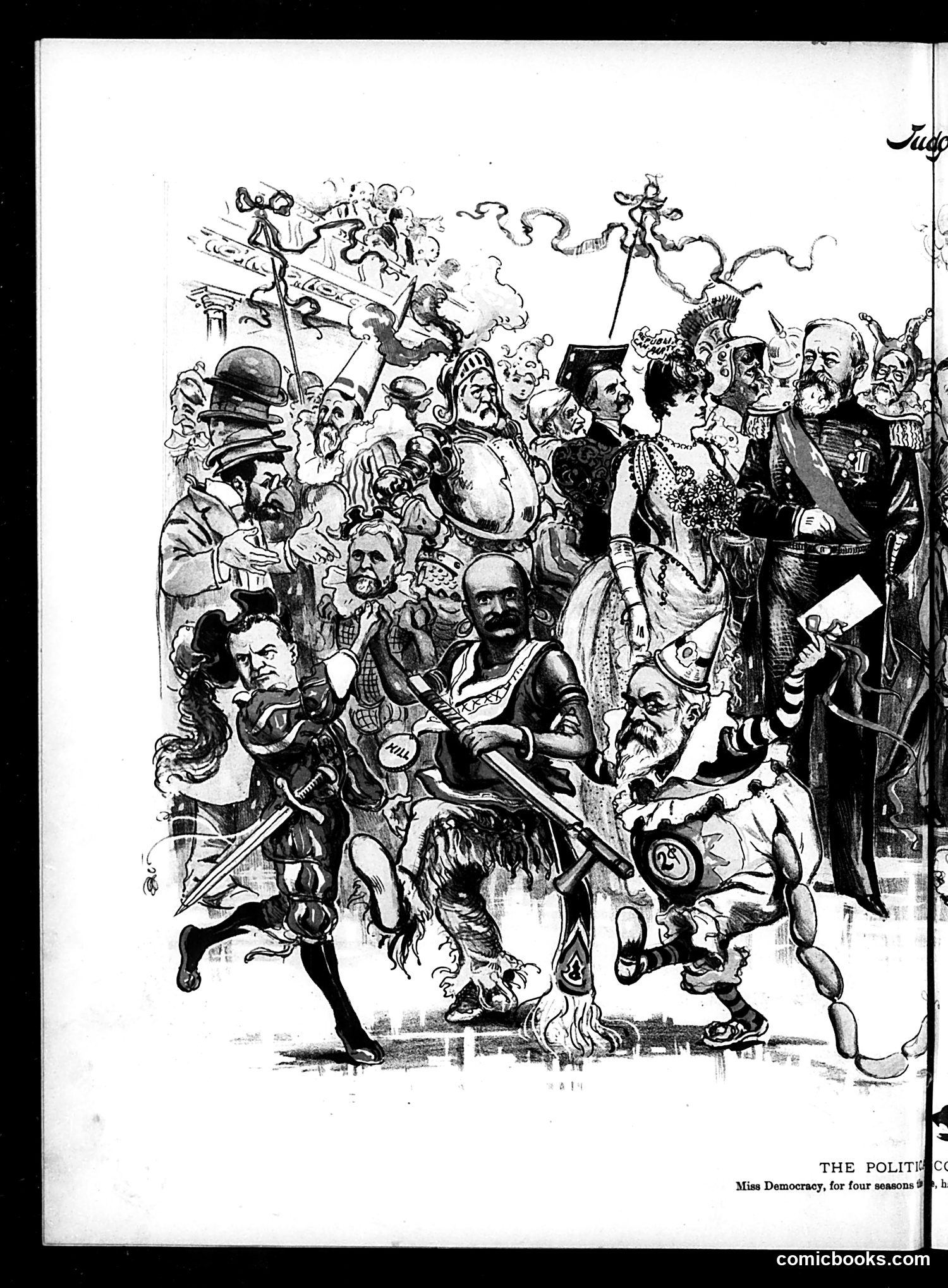
This is a satirical political cartoon from *Judge* magazine titled "THE POLITI[CAL]..." (text cut off). The caption references "Miss Democracy, for four seasons" (partially visible). The image depicts a chaotic crowd of political and military figures surrounding a central female allegorical figure representing Democracy. The composition is densely packed with caricatured faces showing various expressions—some menacing, others absurd. Military uniforms, ornate decorations, and ceremonial regalia are prominent. The satire appears to criticize how Democracy is besieged, manipulated, or endangered by political and military establishment figures. The crowding and aggressive poses suggest these power-brokers threaten or exploit democratic principles. The "four seasons" reference likely indicates a specific political cycle, though without a complete date or caption, the exact historical moment remains unclear.
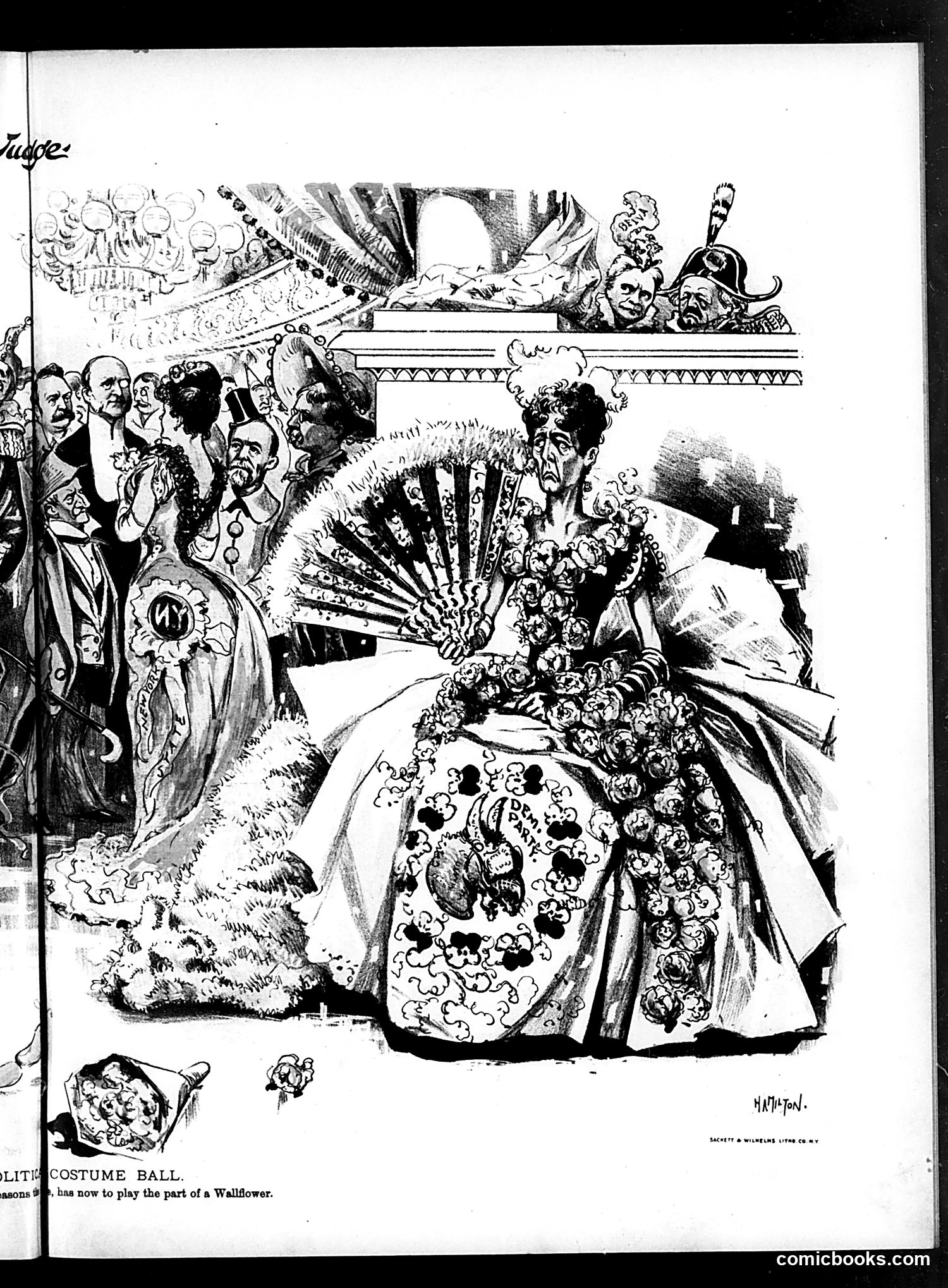
This satirical cartoon depicts a lavish costume ball where a central female figure—apparently representing a prominent woman or political figure (the caption suggests she must "play the part of a Wallflower")—is surrounded by admirers and elaborate pageantry. The ornate costume, fan, and decorative elements suggest wealth and social prominence. The satire appears to mock either a specific society woman's social pretensions or, more likely, a female political figure forced into a diminished social role despite her prominence. The "wallflower" reference suggests ironic commentary on someone of importance being sidelined or overlooked, despite their elaborate presentation. The crowd of onlookers and ornamental details emphasize the artificial nature of high society spectacle. Without knowing the specific date and context, the exact target remains unclear, though the piece satirizes social hierarchies and women's constrained roles in public life.
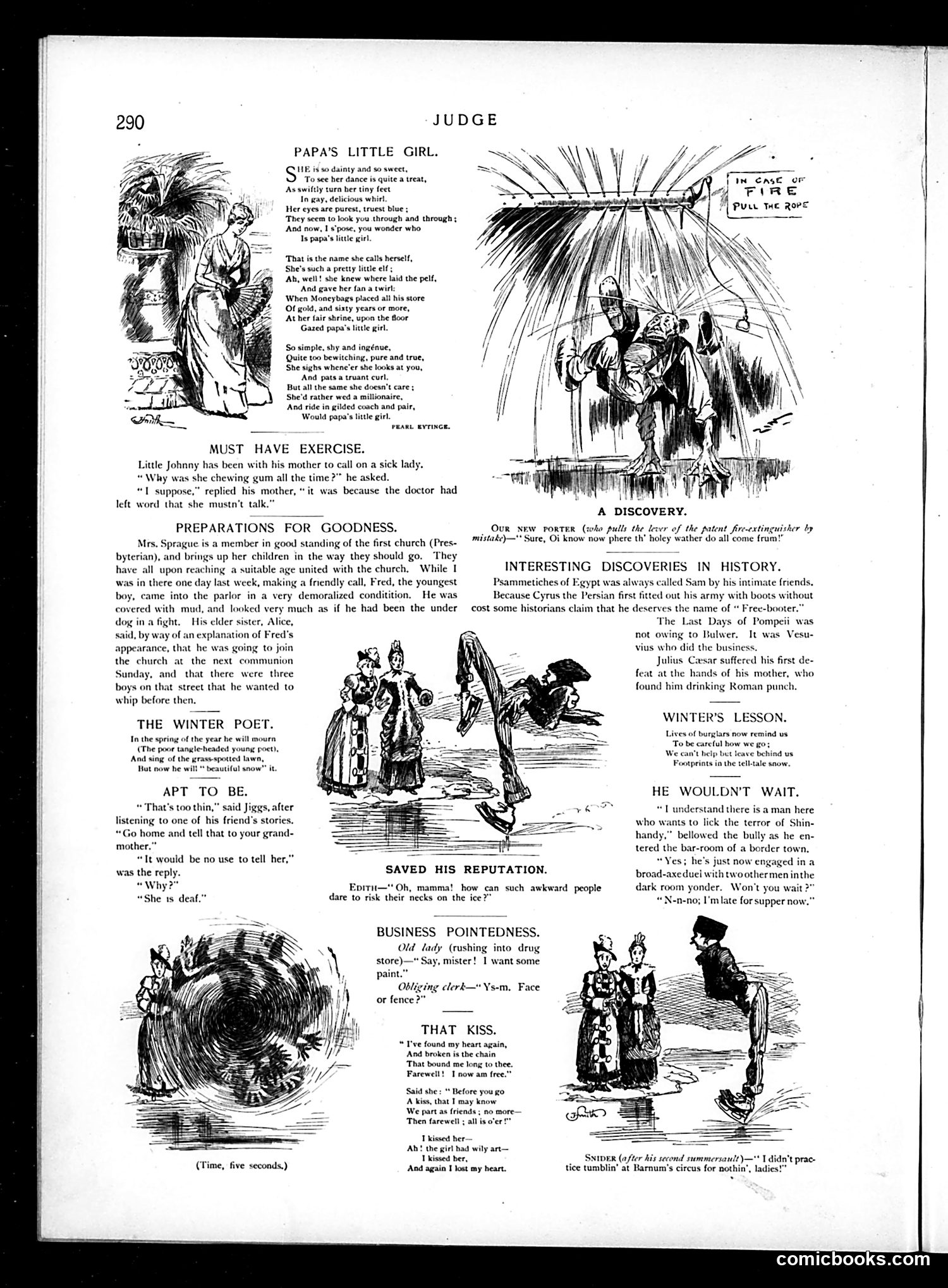
This page contains multiple satirical pieces typical of late 19th-century American humor: **"Papa's Little Girl"** (poem with illustration): Satirizes gold-digging young women who marry wealthy older men. The "simple, shy" girl is revealed as calculating—she'd "rather wed a millionaire" than genuinely love her elderly suitor ("Moneybags"). The satire targets both feminine deception and the transactional nature of wealthy marriages. **"Must Have Exercise"**: A brief joke mocking hypocritical propriety—a sick lady is forced to remain silent by doctor's orders, presented as if enforcing good behavior rather than medical necessity. **"Preparations for Goodness"**: Satirizes religious hypocrisy. A boy preparing to join the Presbyterian church wants to "whip" neighborhood children beforehand—suggesting his piety is performative rather than genuine moral improvement. **Various shorter pieces** mock historical revisionism ("Interesting Discoveries"), weather complaints, social awkwardness, and frontier masculinity. The overall tone reflects Judge's characteristic mockery of American pretension, particularly regarding wealth, morality, and social respectability.
This page reports on the arrest of Luzon J. Finch, a manufacturer accused of mass-producing counterfeit Carter's Little Liver Pills—a popular patent medicine of the era. **The Fraud:** Finch illegally copied the trademarked pills and sold inferior versions at ten cents versus the genuine product's twenty-five cents, with over 100 druggists knowingly distributing the fakes. He even customized labels with retailers' names to increase authenticity. **The Context:** Patent medicines were largely unregulated in this period, making them targets for counterfeiting. Carter's Little Liver Pills were a real, heavily-advertised product—their company had invested over $1 million in promotion. The case illustrates how trademark counterfeiting and consumer fraud were genuine legal concerns even in the 19th century. **The Satire:** Judge presents this as sensational news rather than mockery—exposing public deception by legitimate manufacturers' competitors was genuinely newsworthy to contemporary readers concerned about health product authenticity.
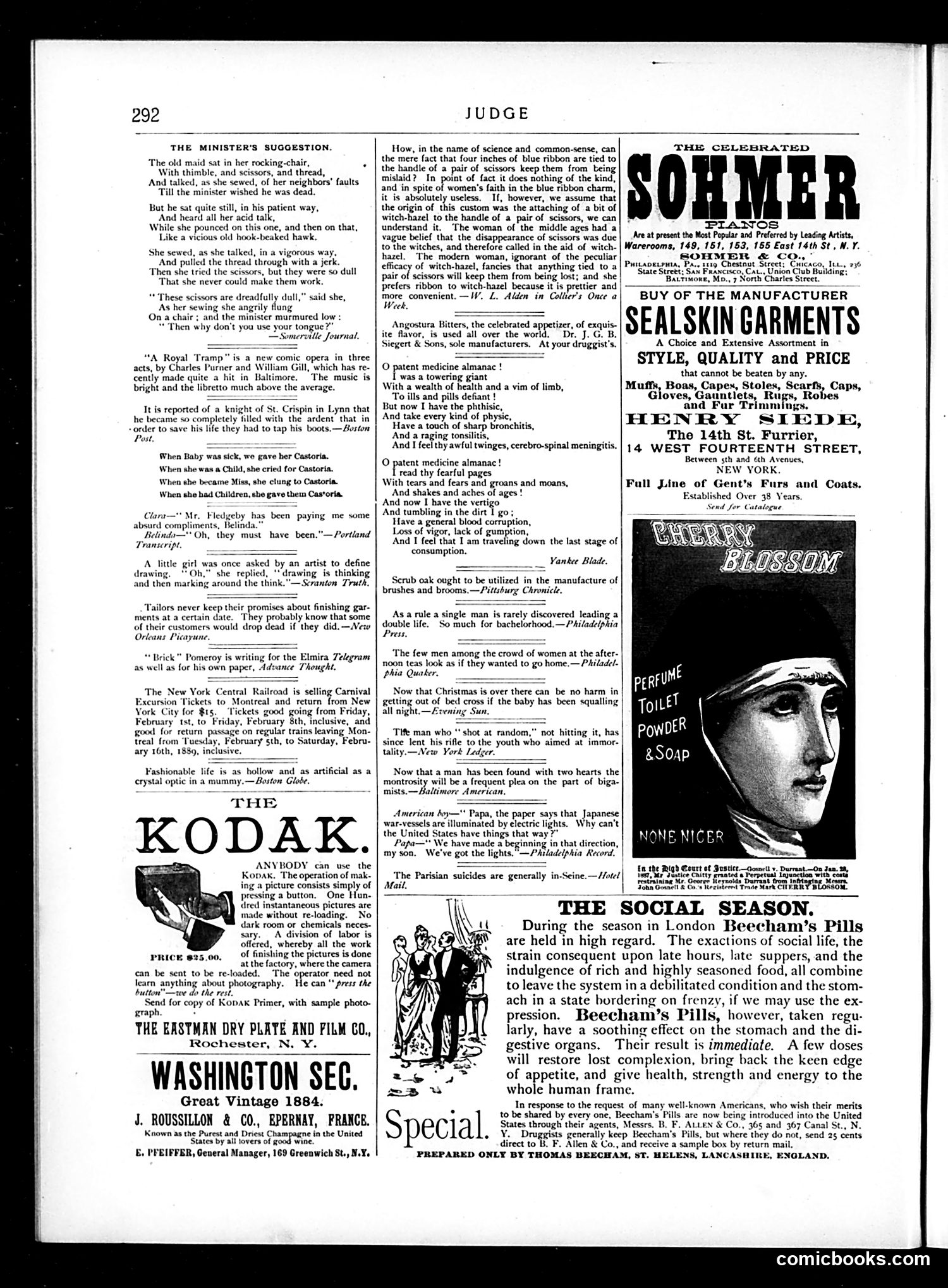
This page is primarily **advertising and miscellaneous content** rather than political satire. The main elements are: **"The Minister's Suggestion"** (top): A humorous poem mocking a gossipy old maid who criticizes her neighbors while sewing. A minister, tired of her harsh judgments, suggests she use her tongue instead of dull scissors—implying her tongue (for gossip) works far better than her tools. It's gentle social satire about female chattiness and cattiness, a common Victorian trope. The remainder is **commercial advertising**: Kodak cameras, Beecham's Pills (digestive remedy), Henry Siede's sealskin garments, perfume/soap, and champagne. There's also commentary on various minor social topics (scissors, suicides, Christmas propriety). The page reflects Judge's typical format: mixing light satirical verse with period advertisements, targeting middle-class readers with gentle humor about domestic life and consumer products.
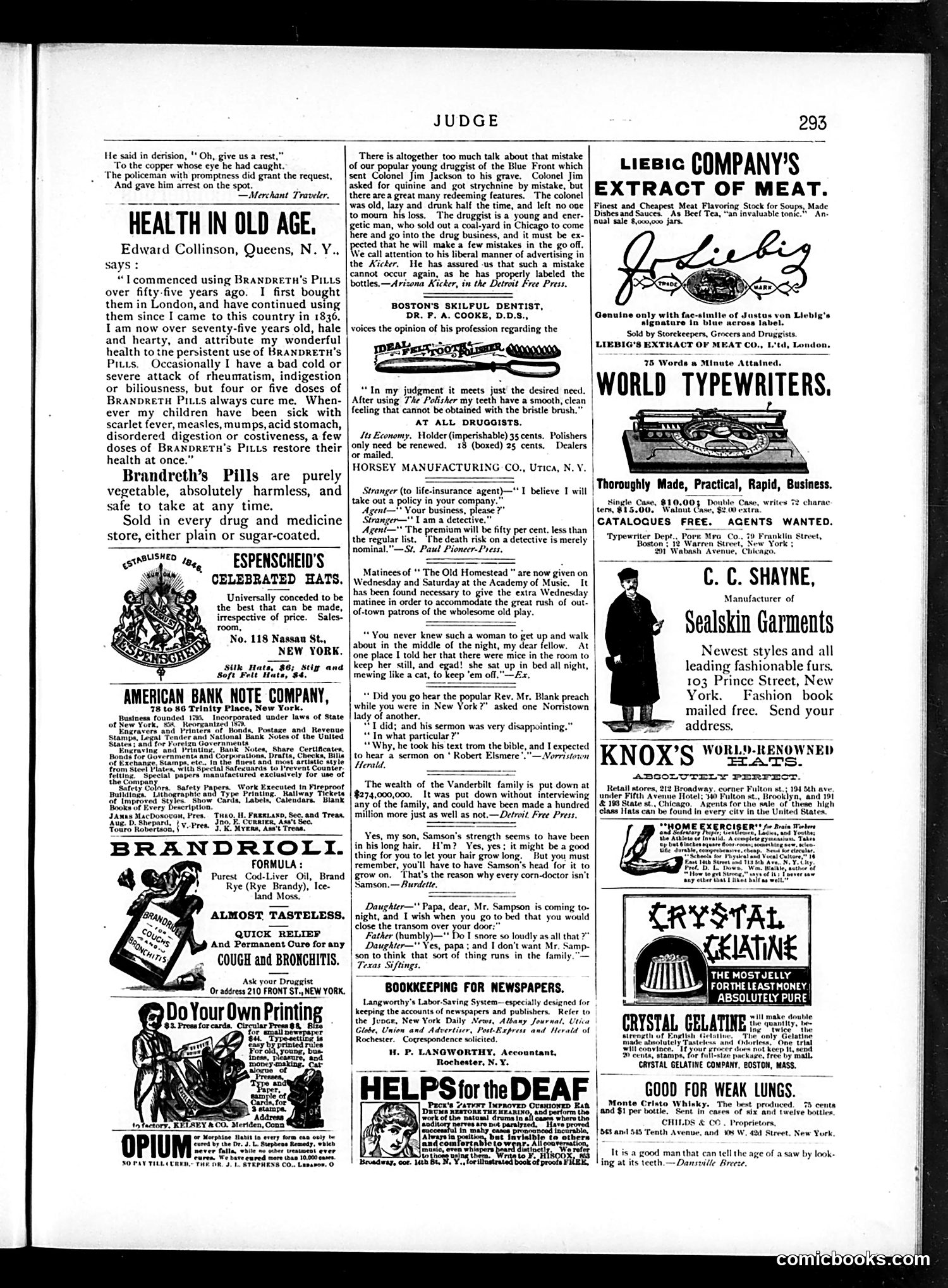
This page is primarily **advertising**, typical of Judge magazine's revenue model. The small editorial content includes: **Main Editorial Item**: A brief anecdote about a druggist who fatally gave Colonel Jim Jackson strychnine instead of quinine. The joke satirizes how the community excuses the error because the colonel was "old, lazy and drunk half the time." It's dark humor about death caused by incompetence, while praising the druggist's advertising efforts—a commentary on how commercial success and marketing can overshadow actual harm. **Supporting Joke**: A life-insurance agent offers reduced premiums to a detective, since detectives have higher mortality risk. **The Advertisements**: These dominate—including Brandreth's Pills (a patent medicine), typewriters, hats, sealskin garments, and dental products. The testimonials (like Edward Collinson's 75-year endorsement of Brandreth's Pills) exemplify era-typical medical advertising making unsubstantiated health claims. **Historical Context**: This reflects the unregulated patent medicine era before FDA oversight, where dangerous products were sold freely and Judge's pages were largely funded by such advertisements.
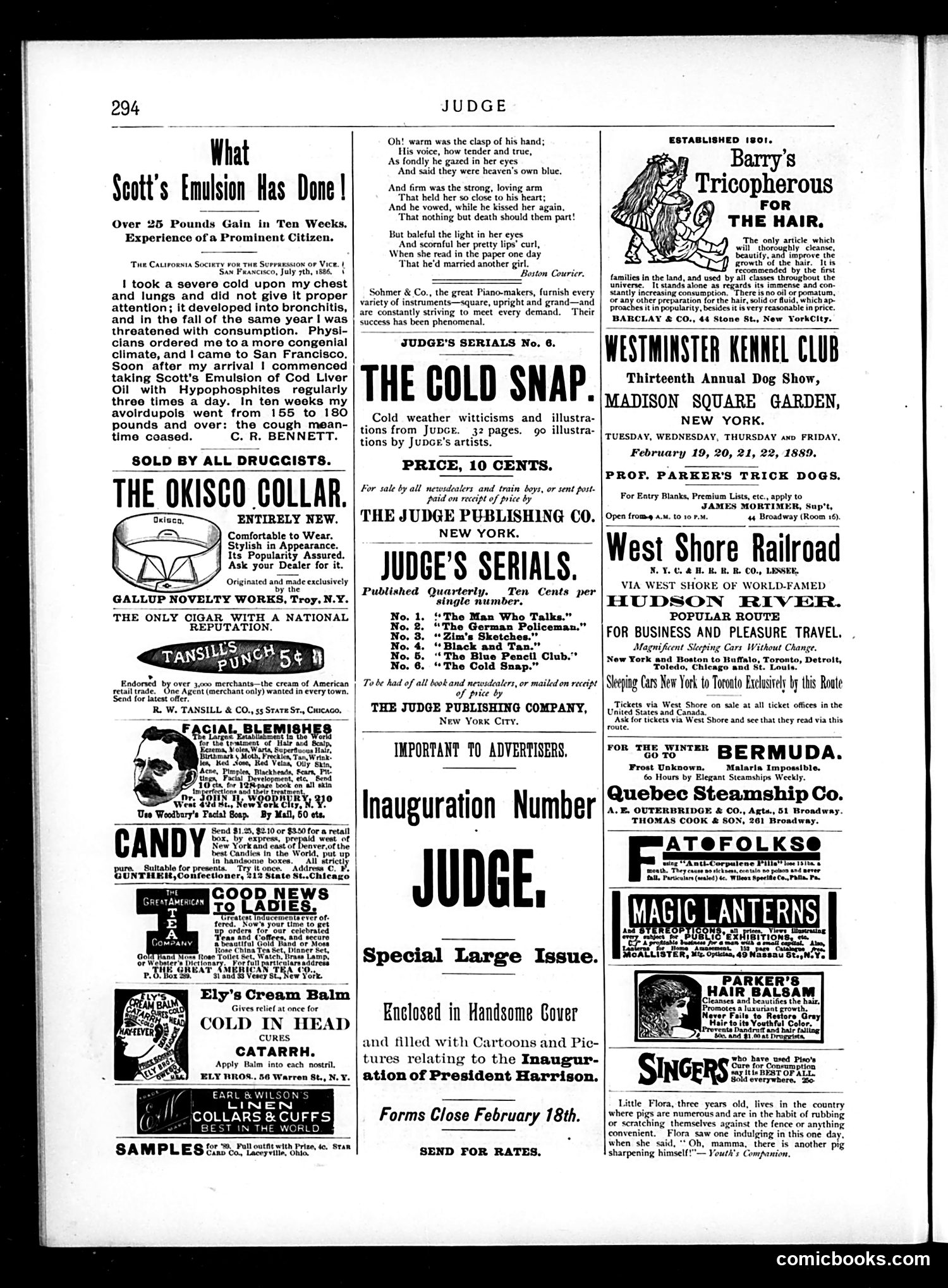
This is primarily a **advertisements and announcements page** from Judge magazine's inauguration issue, likely February 1889 (Harrison's inauguration). The one **narrative element** is a brief poem about romantic betrayal: a man professes eternal love to a woman, swearing "nothing but death should them part," but she discovers via newspaper that he's married another woman. The satire mocks the contrast between sentimental romantic declarations and the reality of male infidelity—a common theme in period humor. The page is otherwise dominated by **period advertisements**: Scott's Emulsion (cod liver oil tonic), the Okisco collar, Tansill cigars, facial creams, candy, cold remedies, pianos, and dog show announcements. These ads reflect late-Victorian consumer culture and health products (many likely containing questionable ingredients by modern standards). The layout and dense advertising suggest this is a commercial magazine issue designed for revenue, with the Harrison inauguration as a special "large issue" drawing advertisers.
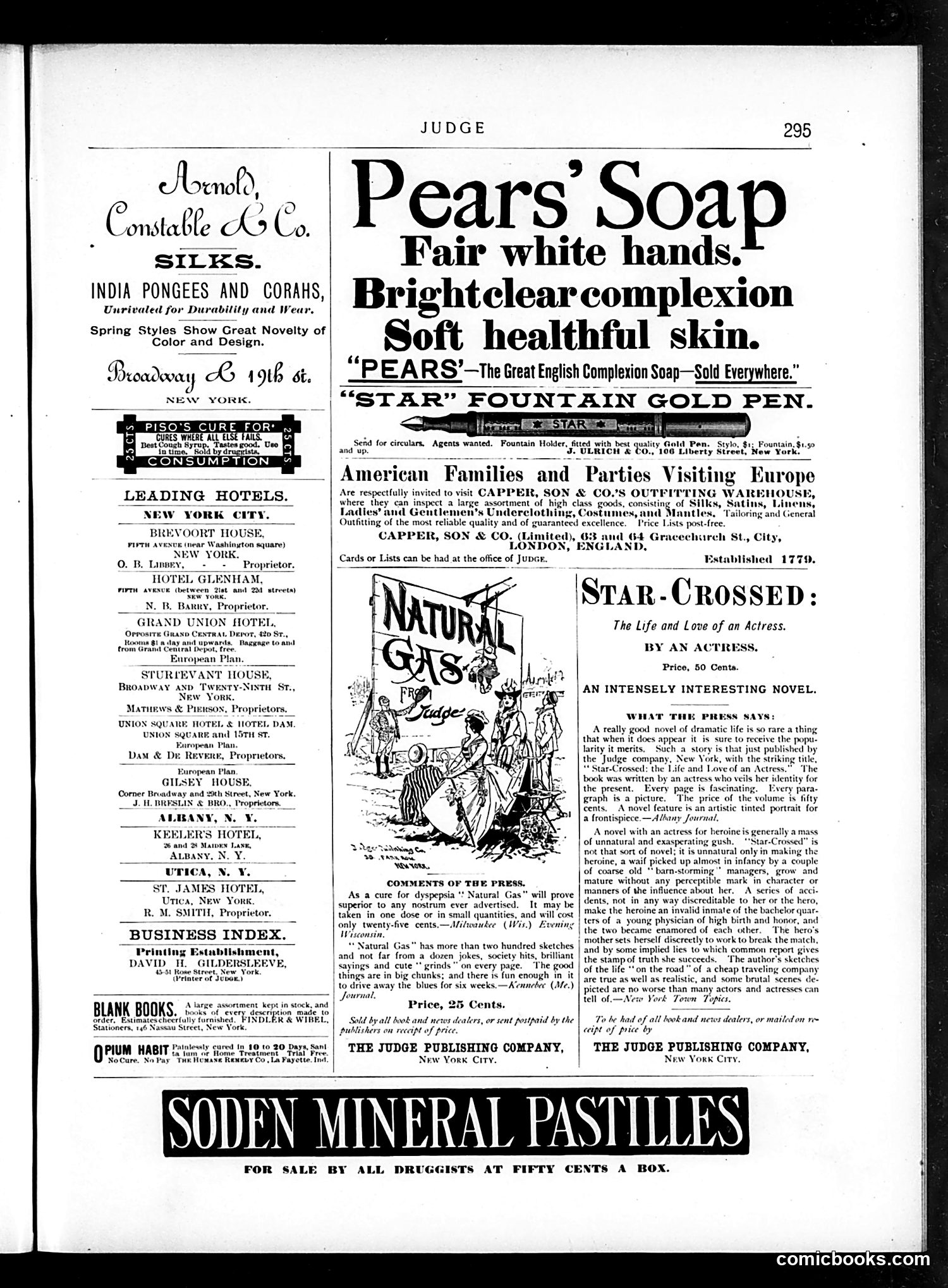
This page is primarily **advertising and promotional content** rather than editorial satire. The dominant feature is a large advertisement for "Pears' Soap," promoting "fair white hands," "bright clear complexion," and "soft healthful skin"—typical period beauty claims. The page also advertises luxury hotels in New York City, silk goods, and notably a novel titled "Star-Crossed: The Life and Love of an Actress" published by Judge Publishing Company. Press excerpts praise the book as offering dramatic entertainment with "fun enough to drive away the blues for six weeks." There is **no clear political cartoon** visible on this page. The "Natural Gas" reference in the press comments appears to be a humorous review comparing a publication to a cure-all nostrum, but this is subtle wordplay rather than satirical commentary. The page reflects **Gilded Age consumer culture**—targeting affluent readers with luxury goods, upscale hotels, and leisure entertainment—rather than engaging in social or political critique.
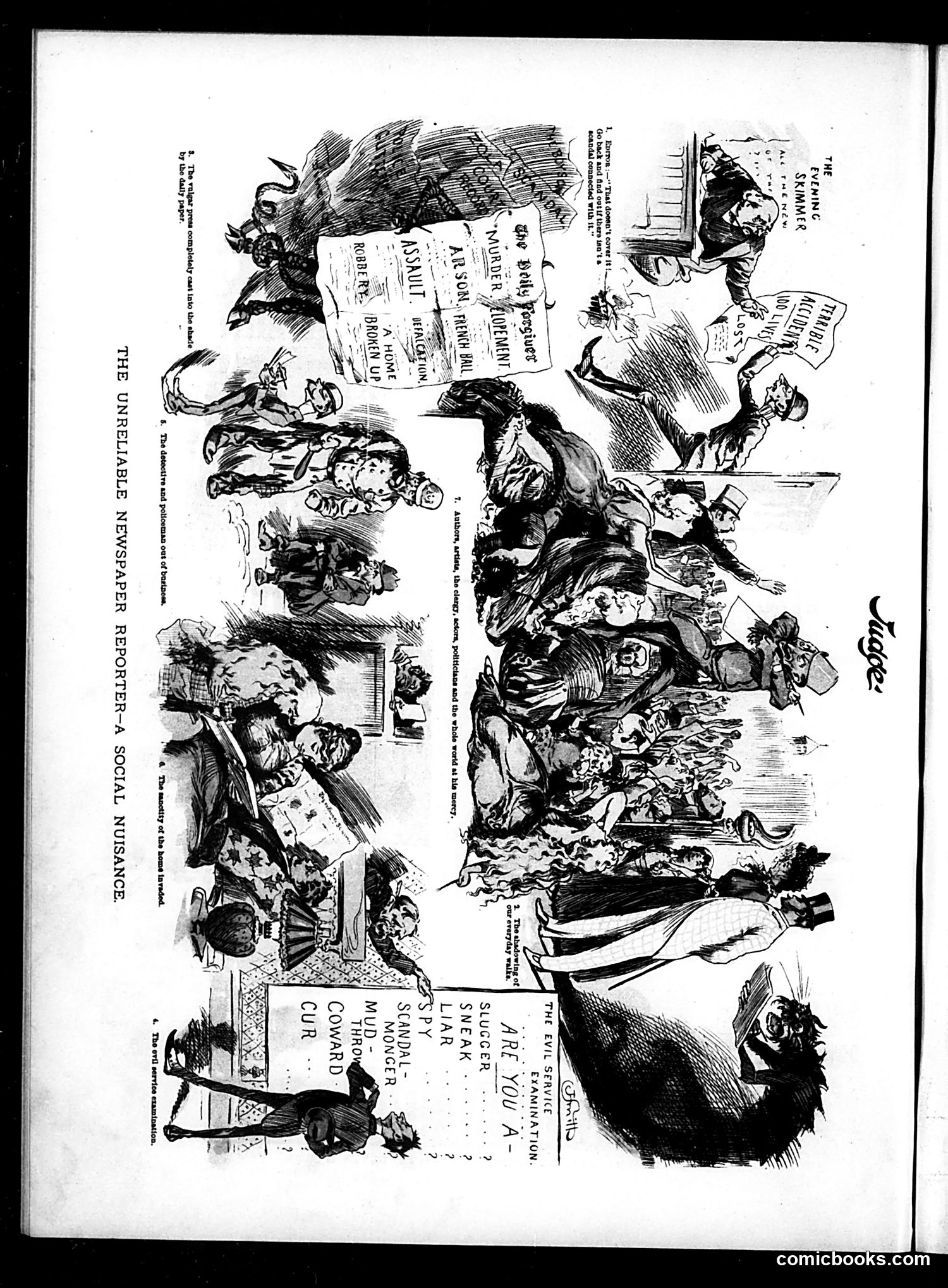
This Judge magazine cartoon satirizes newspaper reporters as social menaces. The central figure is a caricatured reporter depicted as a disheveled, disreputable character labeled with various vices: "slugger," "sneak," "liar," and "spy." The surrounding vignettes illustrate alleged harms reporters cause: invading homes, displacing respectable journalism ("vulgar press"), putting detectives and police out of work through sensationalism, and compromising domestic privacy. The cartoon presents reporters as predatory figures who prioritize scandal over truth. This reflects late 19th/early 20th-century anxieties about the emerging "yellow journalism" movement—newspapers that prioritized sensational stories over accuracy to boost circulation. The satire defends institutional authority (police, legitimate press, family privacy) against what it portrays as irresponsible tabloid sensationalism.