
Judge, 1889-02-09 · page 2 of 16
Judge — February 9, 1889 — page 2: what you’re looking at
What you’re looking at
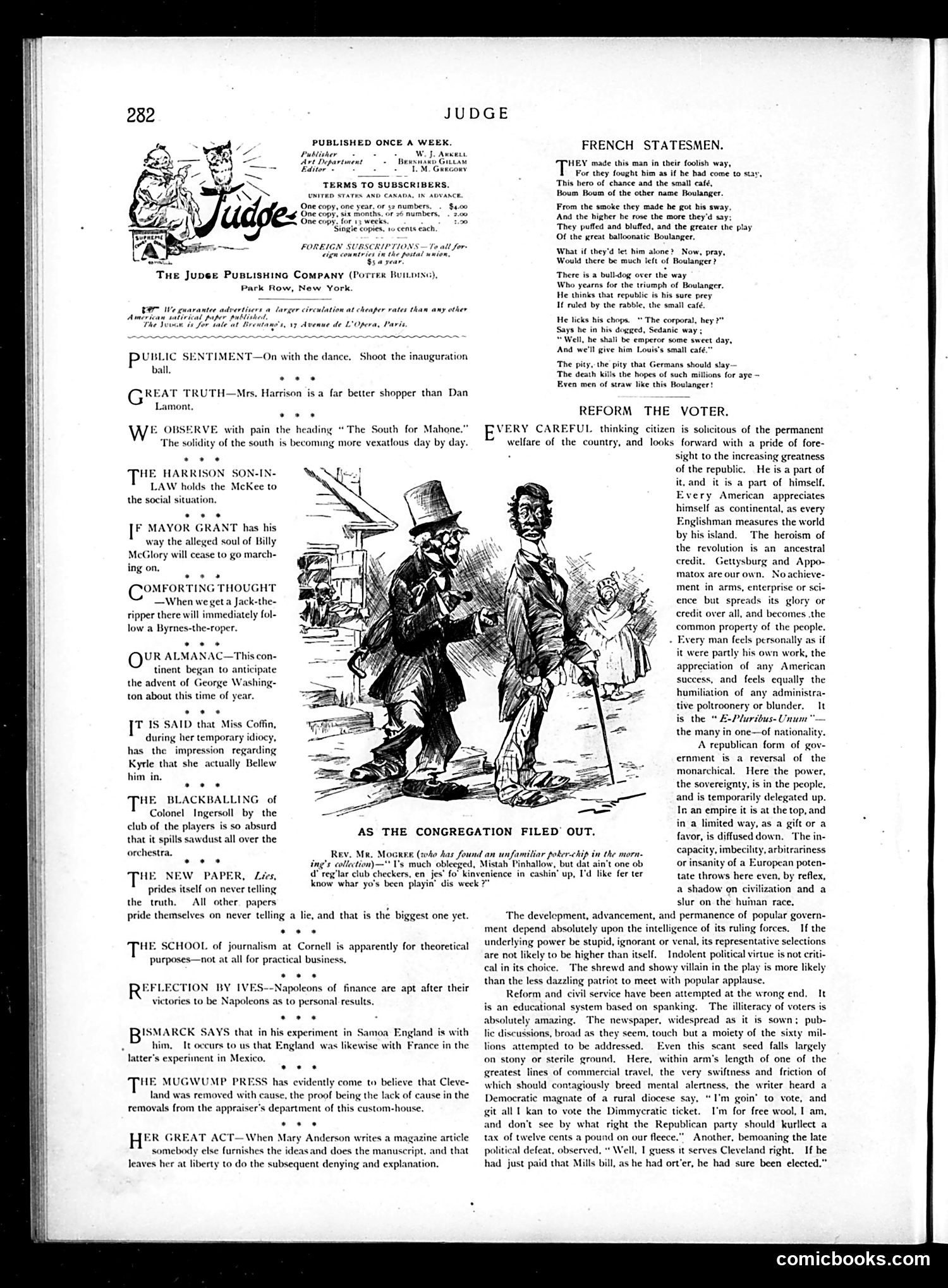
This cartoon satirizes political hypocrisy during the Gilded Age. The central figure appears to be a corrupt politician or clergyman (based on the title's religious reference) receiving praise from followers as they exit. The accompanying text credits "Rev. Mr. Moore" with commenting on familiar "poker-ship in the morn," suggesting a minister who engages in gambling or vice while maintaining respectability. The satire targets the disconnect between public moral personas and private behavior—a common *Judge* magazine theme. The "congregation filing out" implies that respectable society accepts or overlooks the misconduct of authority figures. The cartoon critiques both the hypocrisy of leaders and the willingness of the public to ignore their moral failings in exchange for social position or influence.
📄 Transcribed text from this page (OCR, searchable)
Machine-transcribed from the original scan — historical spelling and the odd misread are preserved.
JUDGE PUBLISHED ONCE A WEEK. Publisher + ++ WJ Awwenn Art Department Brnsn LAM Eaiter LM. Grecory TERMS TO SUBSCRIBERS. ‘One copy, one year. or sz numbers. . $4.00 ‘One copy 200 One copy. 2 ‘Single copies, to cents each, FOREIGN SUBSCRIPTIONS i for. en comntrigg (nthe postal non, sa year Tue Jupee Pustisnina Company (Pores Bunpisc), Park Row, New York B97 We guarantee advertisers American sativical paper publishes The Jour & leat Lrentano's, 17 Avenue de L'Opera, Paris larger cirentation at cheaper rates than any other Pustic SENTIMENT—On with the dance. Shoot th ball. auguration, GREAT TRUTH—Mrs. Harrison is a far better shopper than Dan nont, eee OBSERVE. with pain the heading “The South for Mahone. ‘The solidity of the south is becoming more vexatlous day by day. HE HARRISON SON-IN- LAW holds the McKee to the social situation. F MAYOR GRANT has his way the alleged soul of Billy McGlory will cease to go march- ing on, OMFORTING THOUGHT —When we get a Jack-the- ripper there will immediately fol- low a Byrnes-the-rope UR ALMANAC—This con- tinent began to anticipate the advent of George Washing- ton about this time of year. T IS SAID that Miss Coffin, during her temporary idiocy, has the impression regarding Kyrle that she actually Bellew him in, HE BLACKBALLING of Colonel Ingersoll. by the club of the players is so absurd that it spills sawdust all over the orchestra. Rev. Mr. Moc eee W PAPER, Lies, s itself on never telling the truth. All. other papers pride themselves on never telling a lie, and that is the biggest one yet. know whar yo's been playin’ dis eee THE SCHOOL of journalism at Cornell is apparently for theoretical purposes—not at all for practical business, see CTION BY IVES--Napoleons of finance are apt after their victories to be Napoleons as to personal results. ISMARCK SAYS that in his experiment in Samoa England is with him, It occurs to us that England was likewise with France in the latter's experiment in Mexico. eee HE MUGWUMP PRESS has evidently come to believe that Cleve- land was removed with cause, the proof being the lack of cause in the removals from the appraiser's department of this custom-house. ZR GREAT ACT—When Mary Anderson writes a magazine article somebody else furnishes the ideasand does the manuscript, and that leaves her at liberty to do the subsequent denying and explanation. AS THE CONGREGATION FILED OUT. 4 (who has found an unfamiliar poker-chip in the morn- ing’s collection)—"' \'s much obleeged, Mistah Pinhallow, but dat ain't one ob a’ reg’lar club checkers, en jes’ fo kinvenience in cashin’ up, I'd like fer ter week 7" FRENCH STATESMEN. HEY made this man in their foolish way, For they fought him as if he had come to stay, This hero of chance and the small café, Boum Boum of the other name Boulanger. From the smoke they made he got his sway, And the higher he rose the more they'd say: ‘They puffed and bluffed, and the greater the play Of the great balloonatic Boulanger, What if they'd tet him alone? Now, pray, Would there be much left of Boulanger? There is a bulldog over the way Who yearns for the triumph of Boulanger. He thinks that republic is his sure prey If ruled by the rabble, the small café. He licks his chops. “The corporal, hey 2” Says he in his dogged, Sedanic way ; “Well, he shall be emperor some sweet day, And we'll give him Louis's small café.’ The pity. the pity that Germans should slay— The death kills the hopes of such millions for aye ~ Even men of straw like this Boulanger! REFORM THE VOTER. EVERY CAREFUL thinking citizen is solictous of the permanent welfare of the country, and looks forward with a pride of fore- sight to the increasing greatness of the republic. He is a part of it, and it is a part of himself. Every American appreciates himself as continental, as every Englishman measures the world by his island. ‘The heroism of the revolution is an ancestral credit. Gettysburg and Appo- matox are our own. Noachieve- ment in arms, enterprise or sci- ence but spreads its glory or credit over all, and becomes .the common property of the people. Every man feels personally as if it were partly his own work, the appreciation of any American success, and feels equally the humiliation of any administra- tive poltroonery or blunder. It is the “ E-Pluribus- Unum” the many in one—of nationality. A republican form of gov- ernment is a reversal of the monarchical. Here the power, the sovereignty, is in the people, and is temporarily delegated up. In an empire it is at the top, and in a limited way, as a gift or a favor, is diffused down. ‘The in- capacity, imbecility, arbitrariness or insanity of a European poten- tate throws here even, by reflex, a shadow on civilization and a slur on the huinan race. The development, advancement, and permanence of popular govern- ment depend absolutely upon the intelligence of its ruling forces. If the underlying power be stupid, ignorant or venal, its representative selections are not likely to be higher than itself, Indolent political virtue is not criti- cal in its choice. The shrewd and showy villain in the play is more likely than the less dazzling patriot to meet with popular applause. Reform and civil service have been attempted at the wrong end. It is an educational system based on spanking. The illiteracy of voters is absolutely amazing. The newspaper, widespread as it is sown; pub- lic discussions, broad as they seem, touch but a moiety of the sixty mil- lions attempted to be addressed. Even this scant seed falls largely on stony or sterile ground. Here, within arm's length of one of the greatest lines of commercial travel, the very swiftness and friction of which should contagiously breed mental alertness, the writer heard a Democratic magnate of a rural diocese say, “I’m goin’ to vote, and git all I kan to vote the Dimmycratic ticket. I'm for free wool, I am, and don’t see by what right the Republican party should kurllect a tax of twelve cents a pound on our fleece.” Another, bemoaning the late political defeat, observed, “* Well, I guess it serves Cleveland right. If he had just paid that Mills bill, as he had ort’er, he had sure been elected.” comicbooks.com