
Judge, 1889-02-09 · page 11 of 16
Judge — February 9, 1889 — page 11: what you’re looking at
What you’re looking at
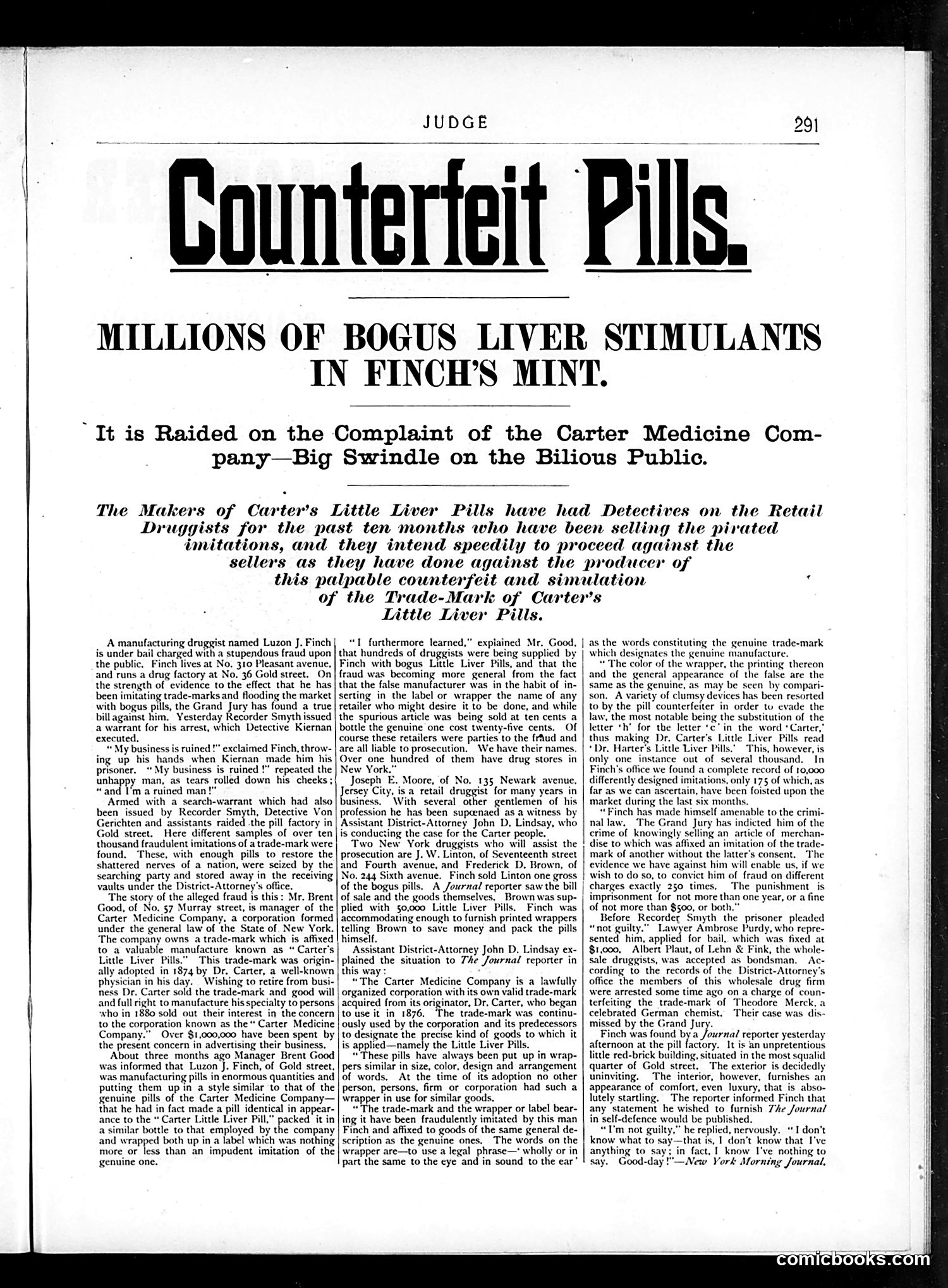
This page reports on the arrest of Luzon J. Finch, a manufacturer accused of mass-producing counterfeit Carter's Little Liver Pills—a popular patent medicine of the era. **The Fraud:** Finch illegally copied the trademarked pills and sold inferior versions at ten cents versus the genuine product's twenty-five cents, with over 100 druggists knowingly distributing the fakes. He even customized labels with retailers' names to increase authenticity. **The Context:** Patent medicines were largely unregulated in this period, making them targets for counterfeiting. Carter's Little Liver Pills were a real, heavily-advertised product—their company had invested over $1 million in promotion. The case illustrates how trademark counterfeiting and consumer fraud were genuine legal concerns even in the 19th century. **The Satire:** Judge presents this as sensational news rather than mockery—exposing public deception by legitimate manufacturers' competitors was genuinely newsworthy to contemporary readers concerned about health product authenticity.
📄 Transcribed text from this page (OCR, searchable)
Machine-transcribed from the original scan — historical spelling and the odd misread are preserved.
JUDGE Counterteit Pills MILLIONS OF BOGUS LIVER STIMULANTS IN FINCH’S MINT. “It is Raided on the Complaint of the Carter Medicine Com- pany—Big Swindle on the Bilious Public. The Makers of Carter Little Liver Pills have had Detectives on the Retail Druggists for the past ten months who have been selling the pirated imitations, and they intend speedily to proceed against the sellers as they have done against the producer of this palpable counterfeit and simulation . of the Trade-Mark of Carter’s A manufacturing druggist named Luzon J. Finch | is under bail charged with a stupendous fraud upon the public, Finch lives at No. 310 Pleasant avenue, and runs a drug factory at No. 36 Gold street. On the strength of evidence to the effect that he has been imitating trade-marks and flooding the market with bogus pills, the Grand Jury has found a true bill against him.’ Yesterday Recorder Smyth issued a warrant for his arrest, which Detective Kiernan executed. * My business is ruined !" exclaimed Finch, throw- ing up his hands when Kiernan made him his prisoner. “* My business is ruined !” repeated the unhappy man, as tears rolled down his checks “and I'm a ruined man!" Armed with a search-warrant which had also been issued by Recorder Smyth, Detective Von Little Liver Pills. “1 furthermore learned, that hundreds of druggists were being supplied by Finch with bogus Little Liver Pills, and that the fraud was becoming more general from the fact that the false manufacturer was in the habit of in- serting in the label or wrapper the name of any retailer who might desire it to be done, and while the spurious article was being sold at ten cents a bottle the genuine one cost twenty-five cents. Of course these retailers were parties to the frhud and are all liable to prosecution, We have their names. Over one hundred of them have drug stores in New York.” Moore, of No. 135 Newark avenue. Jersey City, is a retail druggist for many years in business. With several other gentlemen of his profession he has been supanaed as a witness by Gerichten and assistants raided the pill factory in | Assistant District-Attorney John D. Lindsay, who Gold street. Here different samples of over ten thousand fraudulent imitations of a trade-mark were found. These, with enough pills to restore the shattered nerves of a nation, were seized by the searching party and stored away in the receiving vaults under the District-Attorney’s office. The story of the alleged fraud is this: Mr. Brent Good, of No. 57 Murray street, is manager of the Carter Medicine Company, a corporation formed under the general law of the State of New York. The company owns a trade-mark which is affixed to a valuable manufacture known as “ Carter's Little Liver Pills.” This trade-mark was origin- ally adopted in 1874 by Dr. Carter, a well-known physician in his day. Wishing to retire from busi- ness Dr. Carter sold the trade-mark and good will and full right to manufacture his specialty to persons who in 1880 sold out their interest in the concern to the corporation known as the“ Carter Medicine Company.” Over $1,000,000 have been spent by the present concern in advertising their business. About three months ago Manager Brent Good was informed that Luzon J. Finch, of Gold street, was manufacturing pills in enormous quantities and putting them up in a style similar to that of the genuine pills of the Carter Medicine Company— that he had in fact made a pill identical in appear- ance to the “ Carter Little Liver Pill,” packed it in a similar bottle to that employed by the company and wrapped both up in a label which was nothing more or less than an impudent imitation of the is conducting the case for the Carter people. Two New York druggists who will assist the prosecution are J. W. Linton, of Seventeenth street and Fourth avenue, and Frederick D. Brown, of No. 244 Sixth avenue. Finch sold Linton one gross of the bogus pills. A Journal reporter saw the bill plied with 50,000 Little Liver Pills, Finch was accommodating enough to furnish printed wrappers telling Brown to save money and pack the pills himself. Assistant District-Attorney John D. Lindsay ex- plained the situation to The Journal reporter in this way: “The Carter Medicine Company is a lawfully | organized corporation with its own valid trade-mark acquired from its originator, Dr. Carter, who began touse it in 1876, The trade-mark was continu- ously used by the corporation and its predecessors to designate the precise kind of goods to which it is applied—namely the Little Liver Pills. “These pills have always been put up in wrap- pers similar in size, color, design and arrangement of words. At the time of its adoption no other person, persons, firm or corporation had such a wrapper in use for similar goods. “The trade-mark and the wrapper or label bear- ing it have been fraudulently imitated by this man Finch and affixed to goods of the same general de- scription as the genuine ones. The words on the genuine one, wrapper are—to use a legal phrase— wholly or in part the same to the eye and in sound to the ear’ of sale and the goods themselves. Brown was sup- | ” explained Mr. Good, | as the words constituting the genuine trade-mark whieh designates the genuine manufacture. The color of the wrapper, the printing thereon and the general appearance’ of the false are the same as the genuine, as may be seen by compari- son, A variety of clumsy devices has been resorted to by the pill counterfeiter in order to evade the law, the most notable being the substitution of the letter ‘h’ for tbe letter * the word *Carter,” thus maki e Liver Pills read . however, is only one instance out of several thousand. ‘In Finch’s office we found a complete record of 10,000 ifferently designed imitations, only 175 of which, as far as we can ascertain, have been foisted upon the market during the last six months. inch has made himself amenable to the crimi- nal law. The Grand Jury has indicted him of the crime of knowingly selling an article of merchan- dise to which was affixed an imitation of the tra mark of another without the latter's consent. evidence we have against him will enable us, if we wish to do so, to convict him of fraud on different charges exactly 250 times. ‘The punishment is imprisonment for not more than one year, or a fine of not more than $500, or both. Before Recorder Smyth the prisoner pleaded “not guilty.” Lawyer Ambrose Purdy, who repre- sented him, applied for bail, which Was fixed at $1,000, Albert Plaut, of Lehn & Fink, the whole- sale druggists, was accepted as bondsman. Ac- cording to the records of the District-Attorney’s office the members of this wholesale drug firm were arrested some time ago on a charge of coun- terfeiting the trade-mark of Theodore Merc celebrated German chemist. ‘Their case was dis- missed by the Grand Jury. Finch was found by/a Journal réporter yesterday afternoon at the pill factory. It is an unpretentious little red-brick building, situated in the most squalid quarter of Gold street. The exterior is decidedly uninviting. ‘The interior, however, furnishes an appearance of comfort, even luxury, that is abso- lutely startling. ‘The reporter informed Finch that any statement he wished to furnish 7ue Journal in self-defence would be published. “I'm not guilty,” he replied, nervously. “I dot know what to say—that is, I don’t know that 1‘ i in fact, | know I've nothing to New York Morning Journal,