
A complete issue · 20 pages · 1888
Judge — July 21, 1888
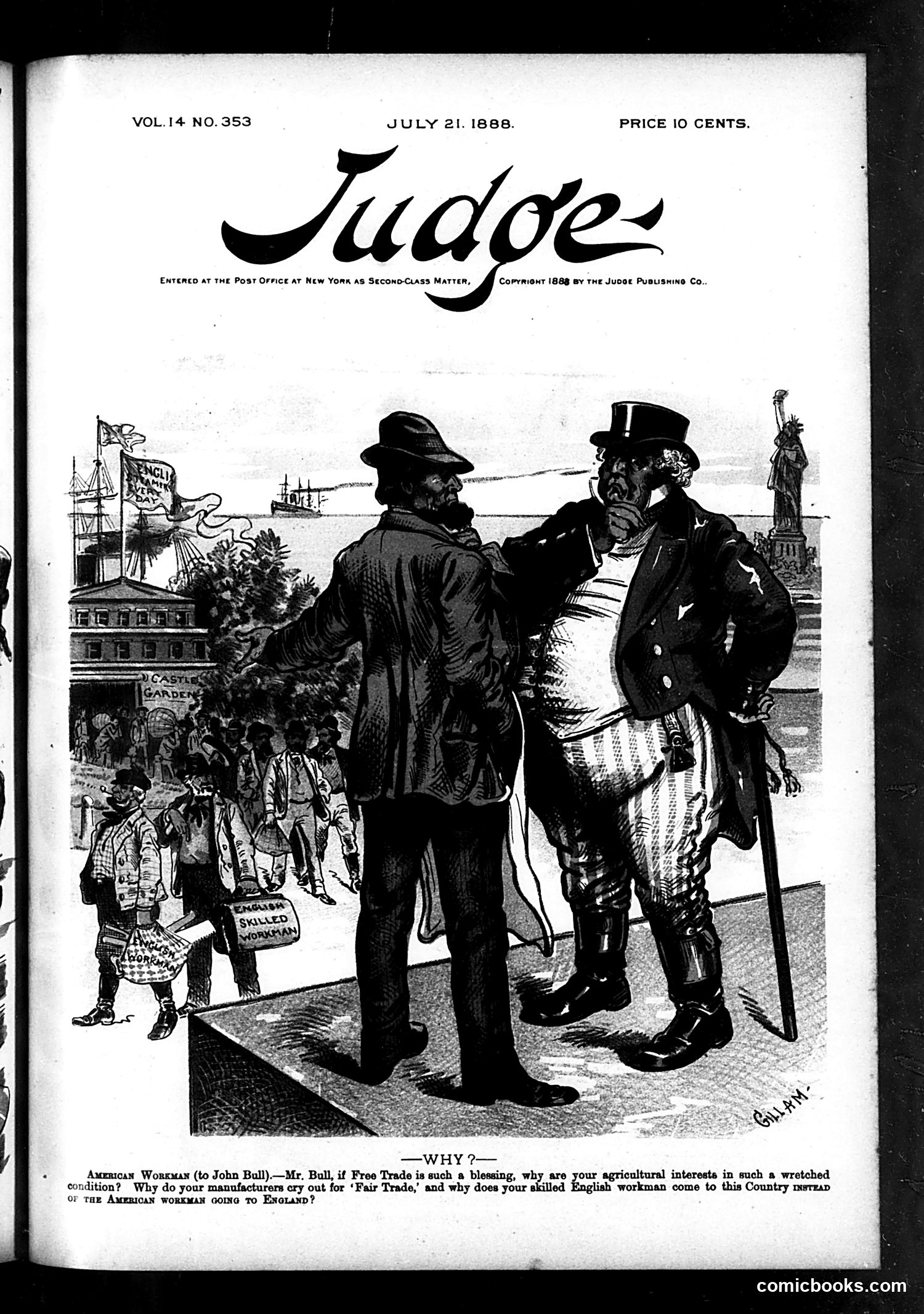
This political cartoon titled "WHY?" satirizes protectionist trade policy debates of the 1880s. The central figures appear to be British and American politicians or businessmen discussing trade relations, with the American figure (left) confronting another figure about contradictions in U.S. policy. The caption questions why American agricultural and manufacturing interests claim to support "Fair Trade" while their actual policies contradict this stance. The smaller figures in the background, labeled with references to tariffs and trade, suggest working-class concerns about these debates. The cartoon criticizes what it views as hypocrisy: American business interests advocating protectionist tariffs while rhetorically supporting free trade principles. This reflects 1880s debates over U.S. trade policy and agricultural protection that would culminate in the McKinley Tariff of 1890.
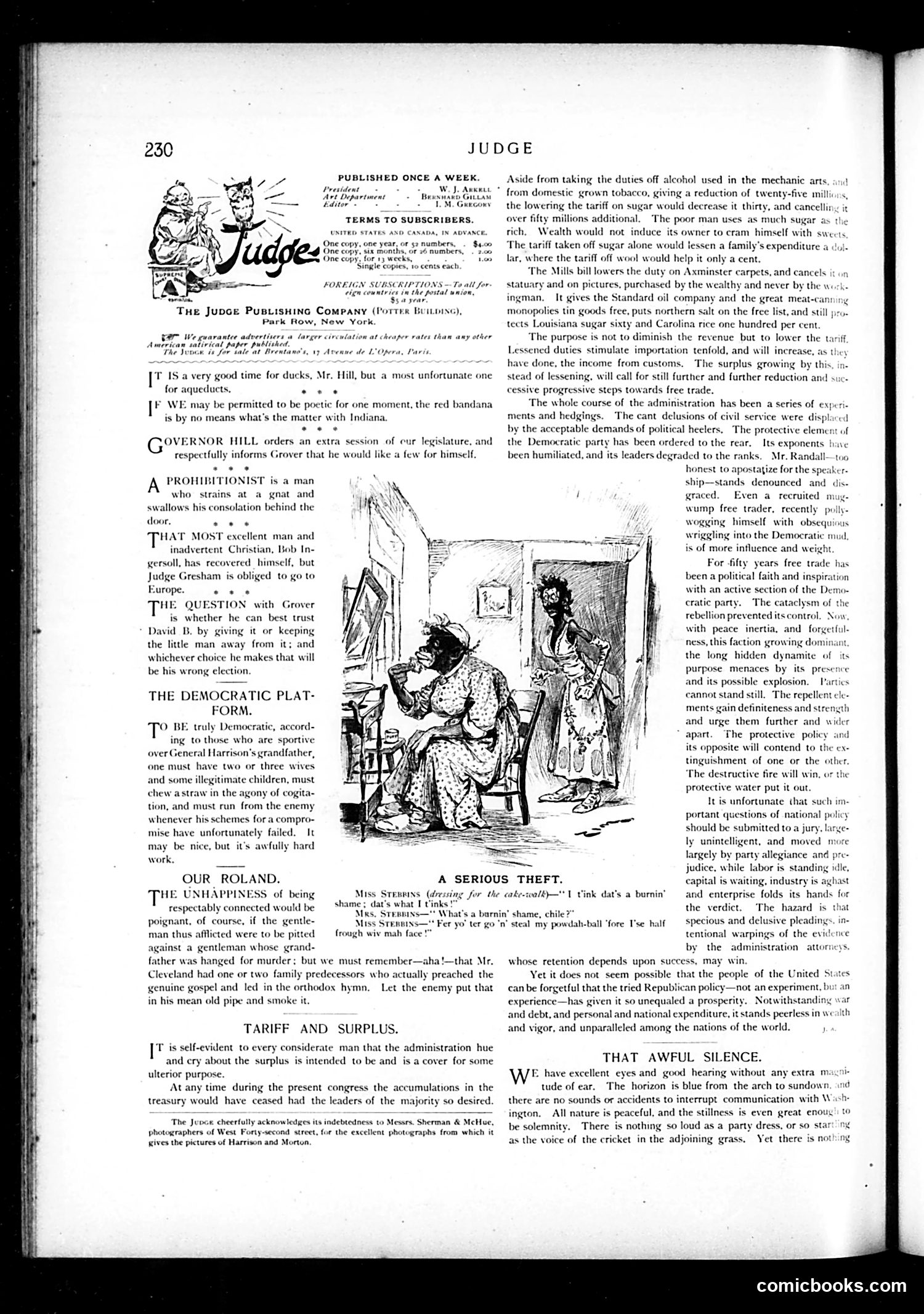
This cartoon satirizes the Democratic Party's internal conflict over tariff policy. The scene depicts a theft, with the caption suggesting someone stole a "barn's-worth" of Democratic Party principles. The satire targets the apparent contradiction between the party's stated positions and its actions. The text references how Democrats historically championed free trade, but the "protective element of the Democratic party has been ordered to the rear" — meaning protectionist Democrats gained influence, abandoning traditional party doctrine. The "theft" metaphor suggests Democrats stole from their own platform by shifting toward protectionism. This reflects late 19th/early 20th-century Republican criticism of Democratic inconsistency on trade policy, a major political fault line of the era. The joke: the party lost its ideological integrity.
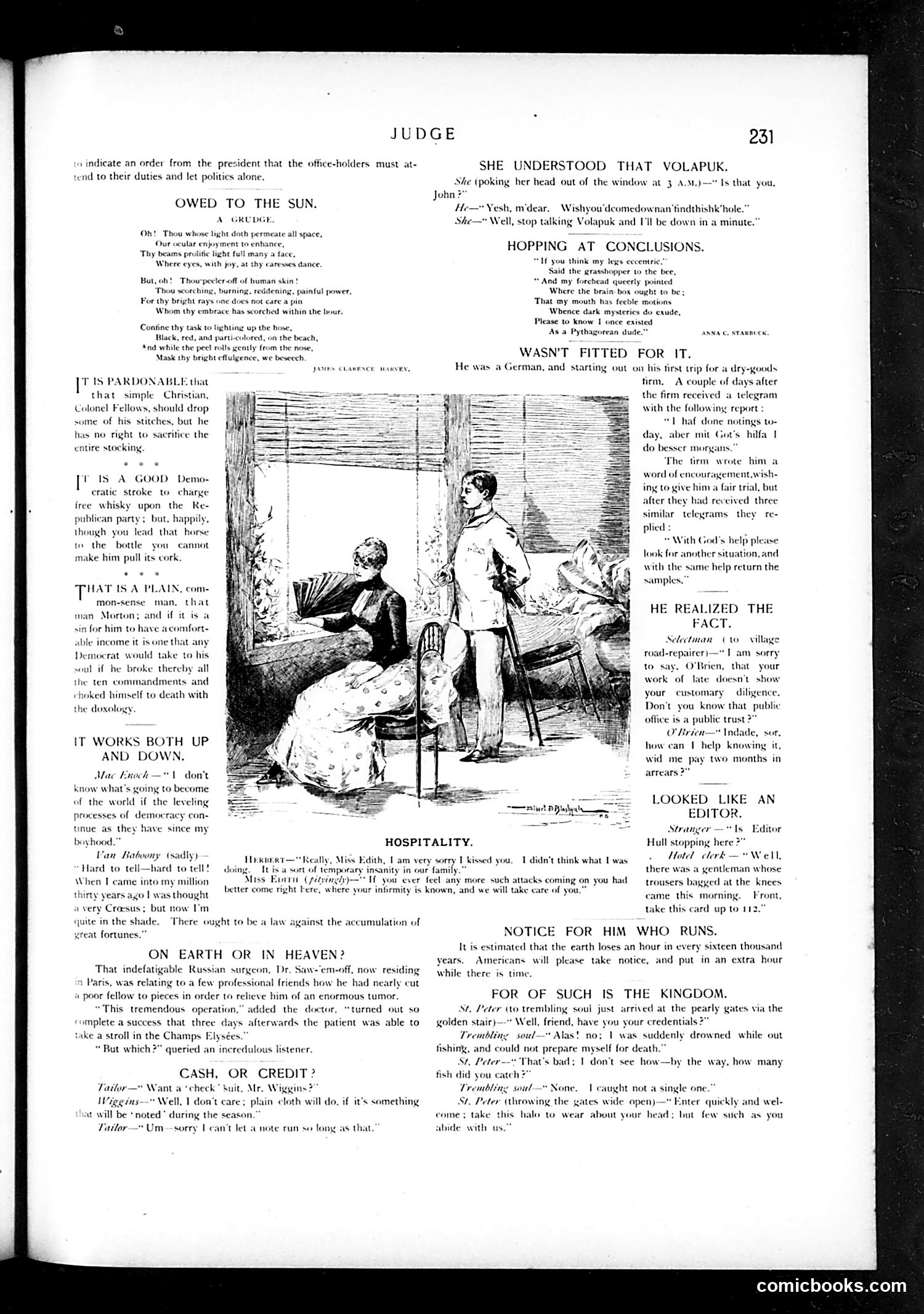
This page contains multiple brief satirical pieces typical of Judge's humor. The central cartoon depicts **"Hospitality,"** showing a well-dressed man (likely representing a business owner or employer) speaking with another man about family "insanity." The joke satirizes how people politely conceal uncomfortable family problems while maintaining social pretense. The surrounding text pieces mock various targets: a German immigrant's broken English working for a dry-goods firm; Volapük (an invented universal language that was briefly fashionable in the 1880s), used here to ridicule pretentious linguistic fads; and grasshoppers claiming past-life reincarnation as a Pythagorean. The poems at top mock sunburns and peeling skin—common summer complaints for the era's readers. These pieces reflect Judge's blend of social observation, immigrant humor, and wordplay typical of Gilded Age American satire, targeting affectation, incompetence, and contemporary crazes.
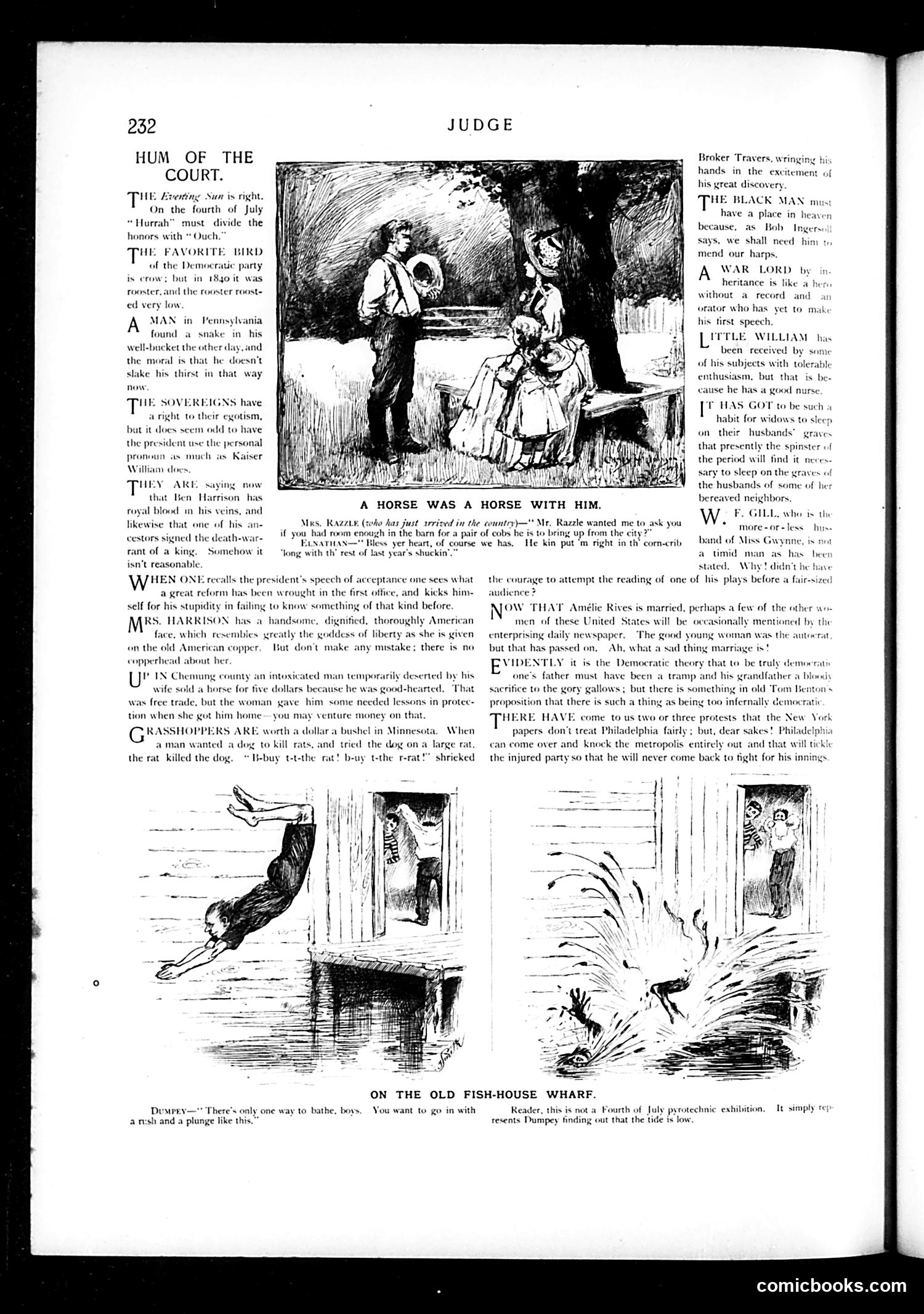
This page from **Judge** magazine contains political and social satire typical of the 1880s-90s era. Key references include: **"Hum of the Court"** contains brief satirical comments on current events: mocking **Ben Harrison's** claims to royal ancestry; poking fun at **Kaiser William**'s autocratic manner; and joking about recent social topics (widows sleeping on graves, protective tariffs). **"A Horse Was a Horse With Him"** depicts a rural character accepting farm animals without understanding their value—satirizing rural simplicity or the agrarian economy. **"On the Old Fish-House Wharf"** shows working-class life with slapstick humor about bathing in public waters. The overall tone reflects Judge's Republican-leaning editorial stance and preoccupation with class distinctions, political figures of the Harrison administration era, and urban/rural contrasts. The satire assumes readers' familiarity with contemporary political debates and public figures now largely forgotten.
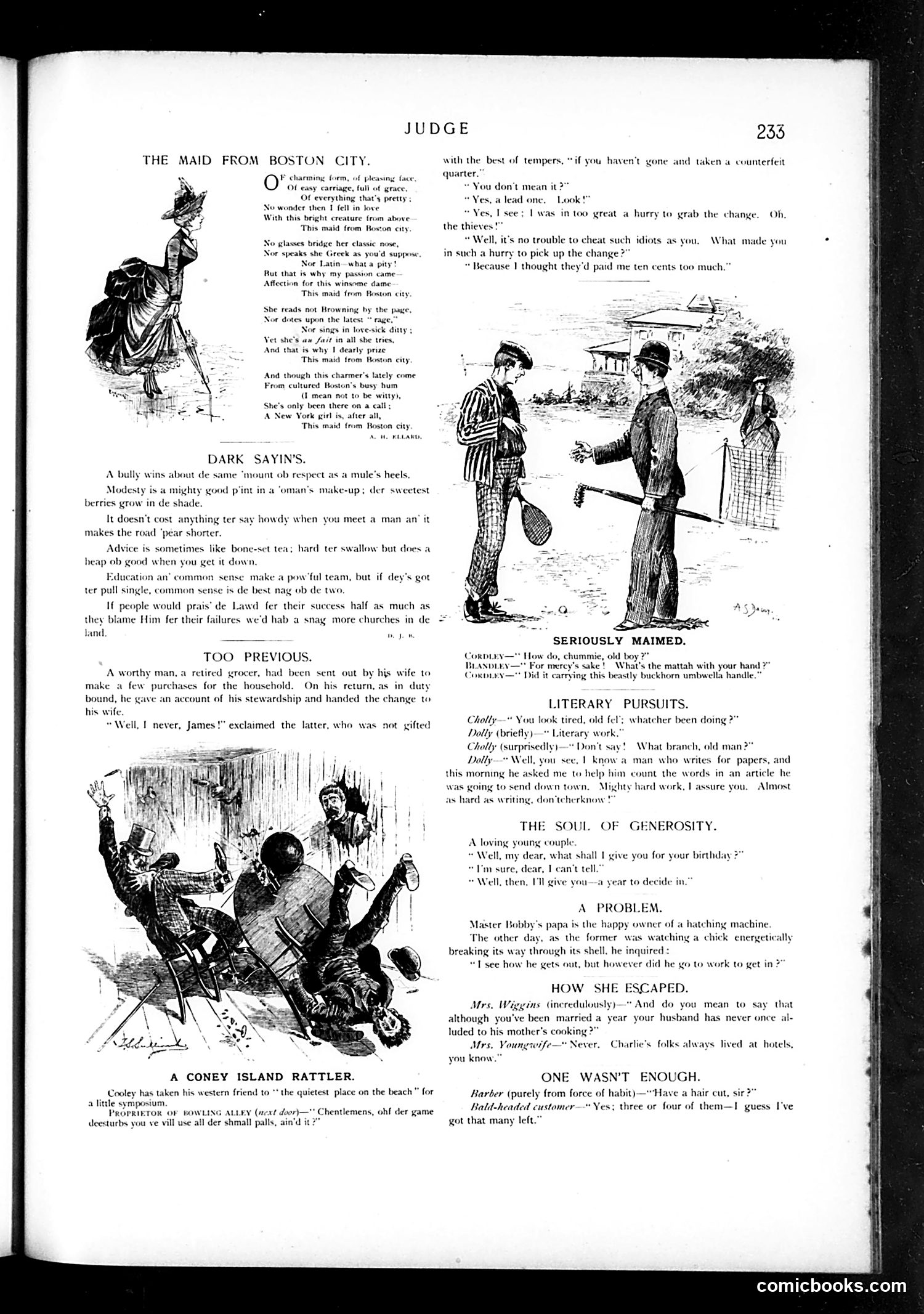
This page contains several brief satirical pieces typical of Judge's humor: **"The Maid from Boston City"** is a poem gently mocking the pretension of Boston's cultural reputation. The joke: a supposedly refined Boston woman is actually just a New York girl visiting on vacation—deflating Boston's intellectual superiority. **"Dark Sayings"** presents folk wisdom in dialect, likely minstrel-show style, offering homespun advice about human nature. **"Too Previous"** satirizes a wife's quick suspicion of her husband over a counterfeit quarter—she jumps to accusations of dishonesty. **"Coney Island Rattler"** jokes about noise complaints at a bowling alley, using ethnic dialect humor common to the era. The remaining pieces employ light domestic humor: complaints about umbrellas, literary pretension, gift-giving indecision, and a wife never mentioning her husband's mother's cooking. The cartoons feature period-appropriate illustrations. Overall, this reflects late 19th/early 20th-century American magazine humor emphasizing social observation, class commentary, and domestic comedy.
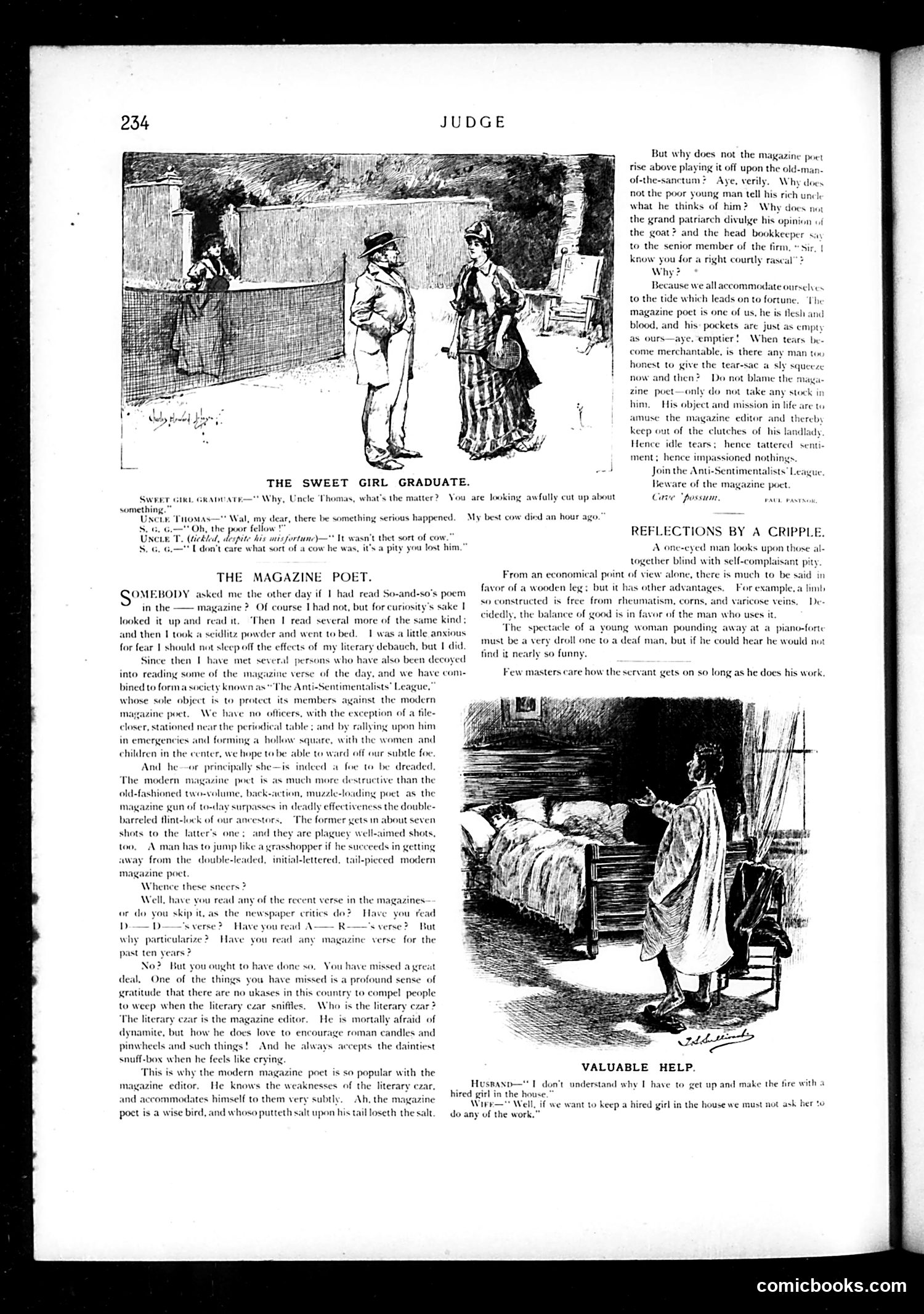
**"The Sweet Girl Graduate"** depicts an uncle confronting a young woman about a serious matter. The joke appears to concern her romantic disappointment—she's lost a suitor ("poor fellow"), and the uncle sarcastically asks if the man was worthless, concluding "it's a pity you lost him." This mocks the era's emphasis on women's marriage prospects as life's primary concern. **"The Magazine Poet"** is a longer satirical essay attacking modern magazine poets as pandering, shallow, and financially desperate. The author ridicules their ability to manipulate magazine editors through emotional manipulation and weak sentimentality. The satire suggests these poets deliberately suppress honest criticism of the wealthy and powerful to maintain editorial favor and income. The piece mocks both the poets' shameless opportunism and editors' willingness to publish mediocre verse that flatters readers' emotions rather than challenging them intellectually.
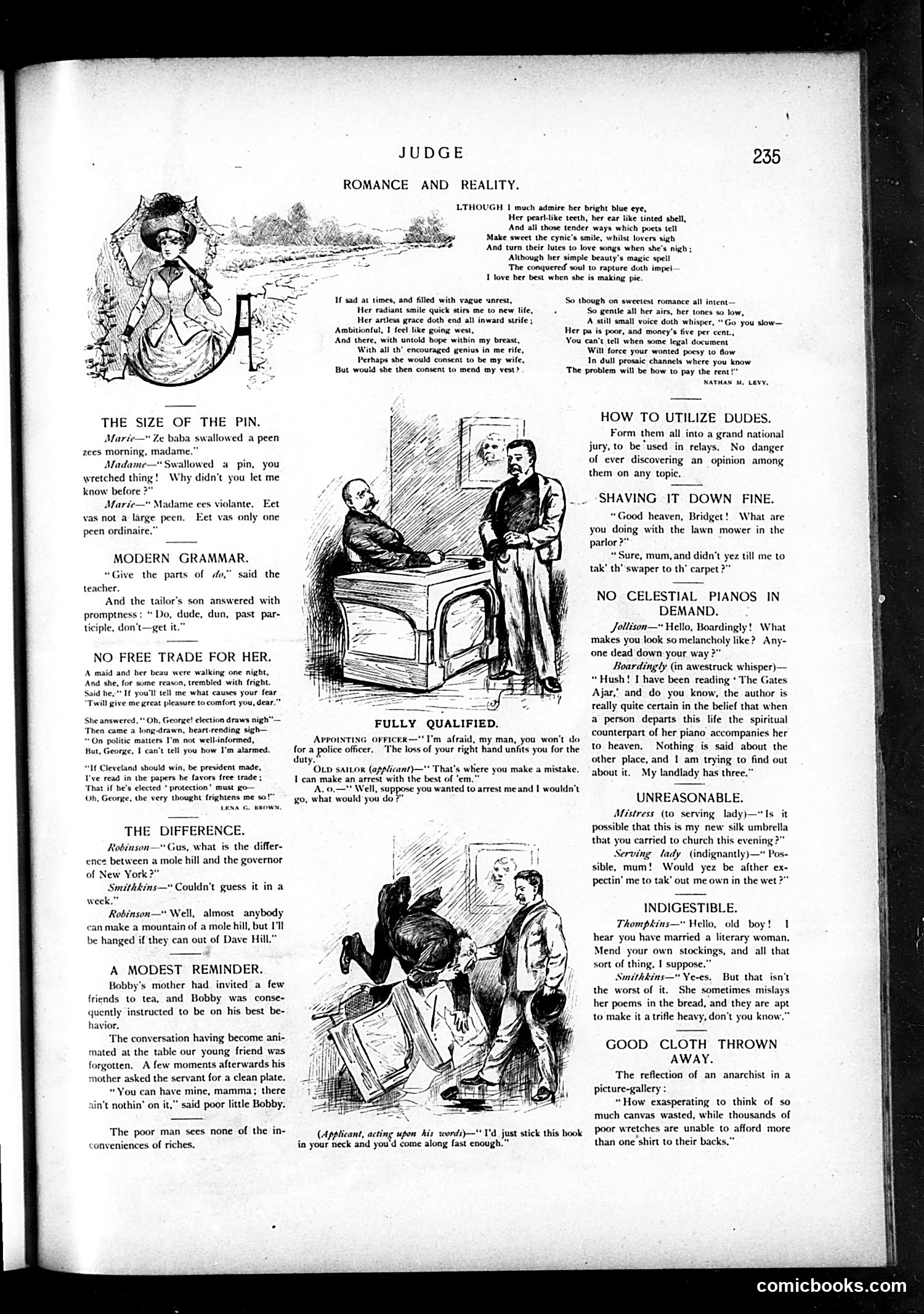
This page from *Judge* contains multiple brief satirical pieces typical of the magazine's format: **"Romance and Reality"** (top): A poem mocking the gap between romantic idealization of women and practical reality. The speaker admires his beloved's beauty and grace but ultimately values her most for domestic utility—making pie and mending his vest. The final stanza adds economic realism: her father's modest means and financial pressure undercut romantic sentiment. **Various short humor pieces** follow, including jokes about: - A servant swallowing a pin (class humor) - Grammar instruction mishaps - Political anxiety about Cleveland and free trade (likely 1880s-90s election) - Social commentary on wealth disparities **"Fully Qualified"** depicts a disabled naval applicant for police work who solves the problem of arrest resistance by literally hooking suspects with his prosthetic hand—absurdist humor about disability and bureaucracy. The cartoons show working-class figures (servants, applicants, children) in situations exposing the gap between social expectations and practical reality—*Judge*'s consistent satirical mode.
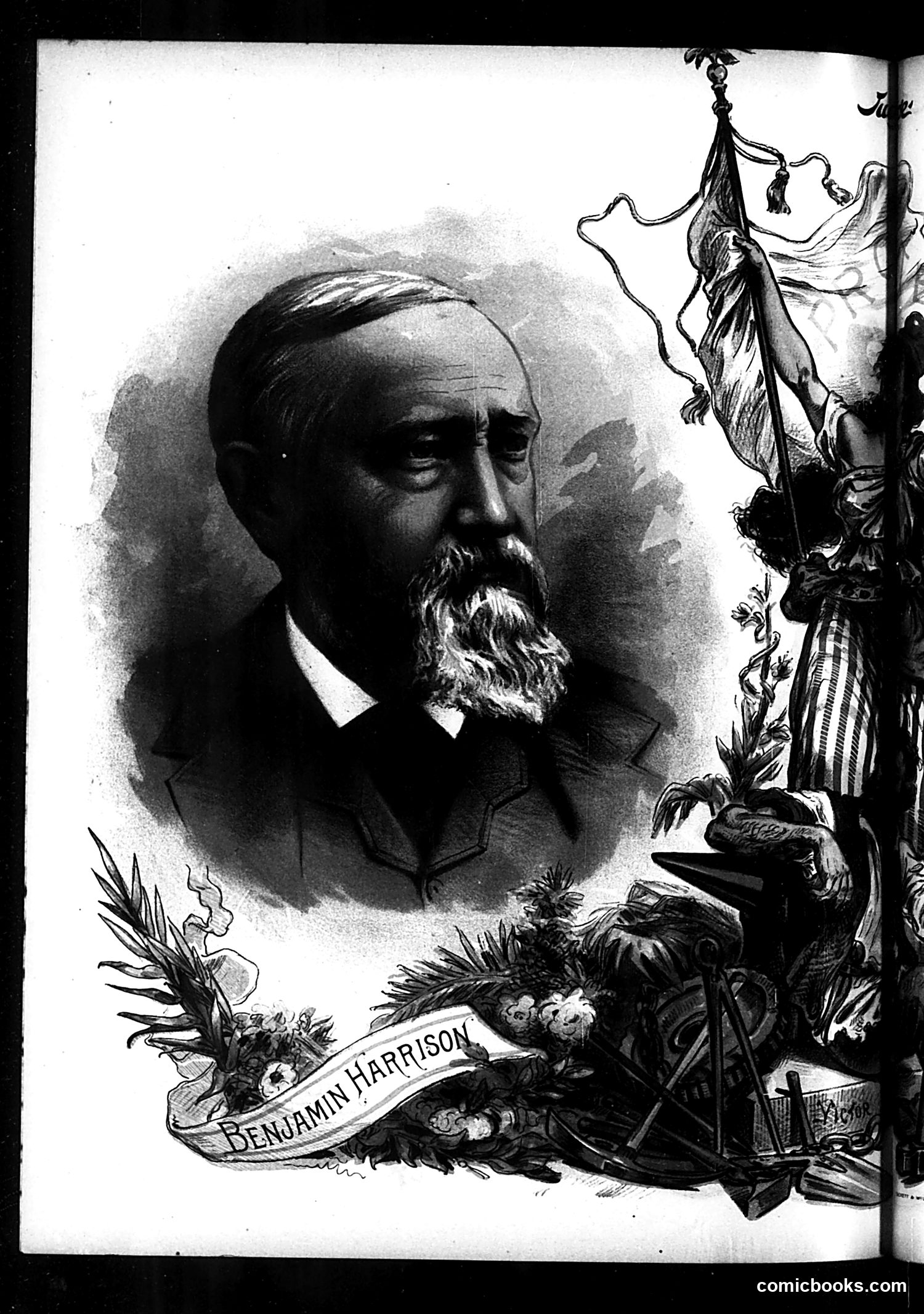
This is a commemorative engraving of **Benjamin Harrison**, identified by the banner label at the bottom. The portrait shows a bearded man in formal 19th-century attire, rendered in the serious style typical of political engravings from *Judge* magazine. The decorative border surrounding Harrison includes classical allegorical elements—flags, military emblems, agricultural symbols, and what appears to be Lady Liberty or similar patriotic iconography. This ornamental framing was standard for honoring political figures in the period. Without additional context or satirical text visible on this page, this appears to be a straightforward commemorative portrait rather than satirical commentary. *Judge* regularly featured such tribute engravings alongside its satirical content.
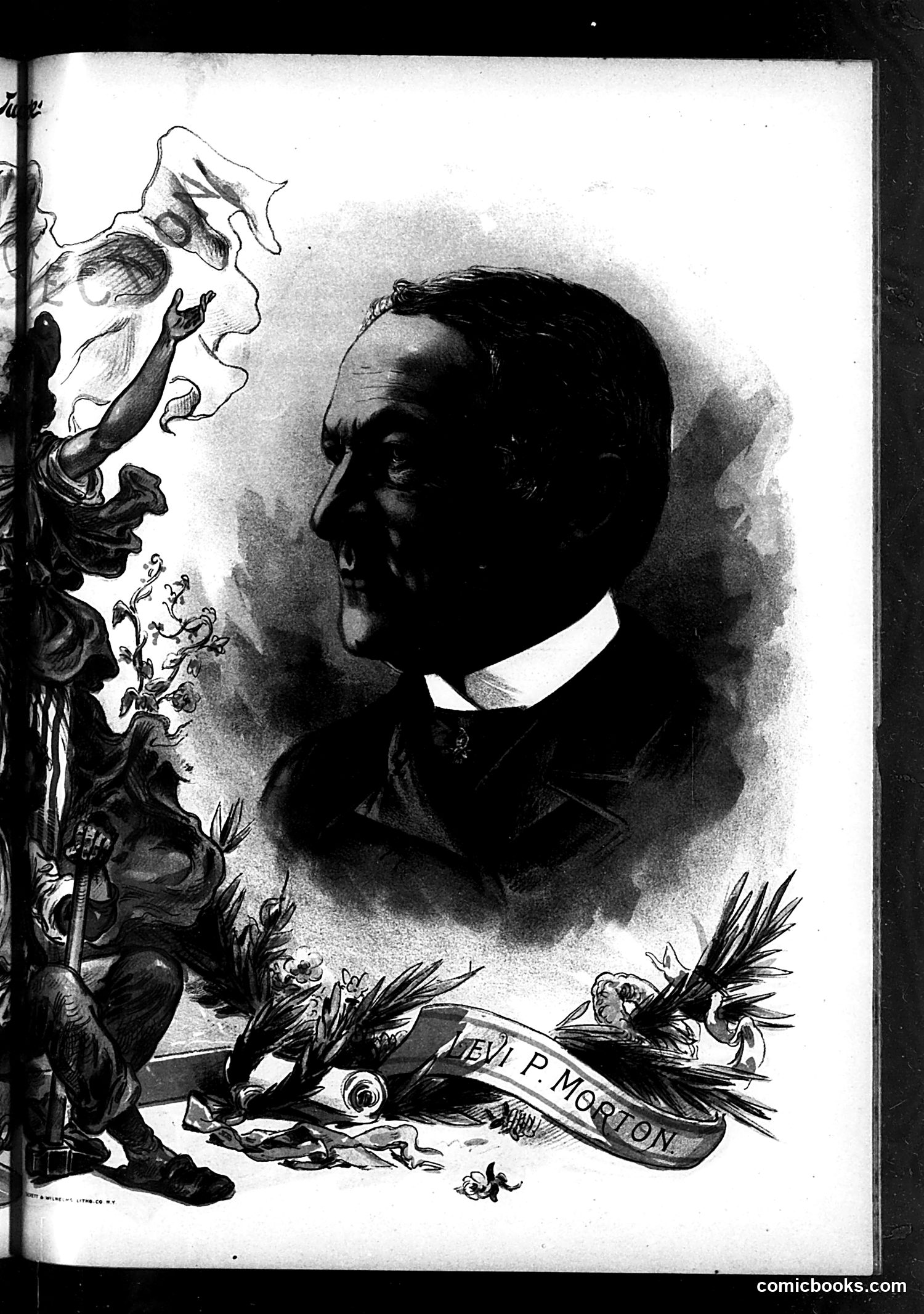
This appears to be a commemorative or biographical portrait from *Judge* magazine featuring **Levi P. Morton**, whose name is visible on a ribbon at the bottom of the image. The elaborate decorative border includes classical imagery—masks, vegetation, and ornamental elements—suggesting this is either a tribute or significant biographical feature rather than satirical commentary. Morton was a prominent late 19th-century political figure who served as Vice President under Benjamin Harrison (1889-1893) and later as Governor of New York. The formal presentation style and classical ornamentation indicate this is likely a respectful portrait rather than satirical cartoon, possibly marking a political appointment, death, or commemorative occasion. The exact context requires additional publication date information.
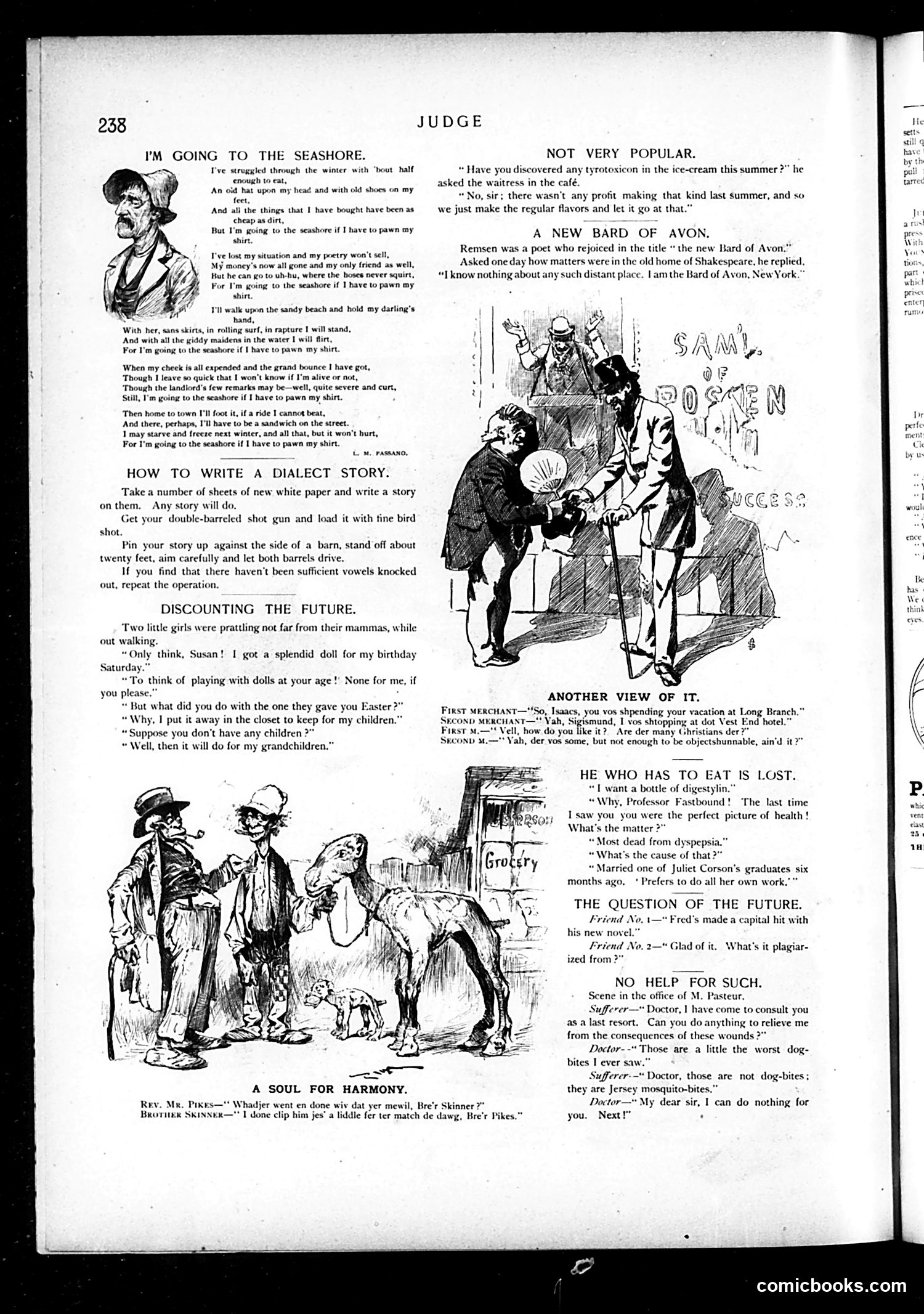
This page from *Judge* magazine contains several satirical humor pieces typical of late 19th-century American comedy: **"I'm Going to the Seashore"** mocks working-class desperation for vacation, with a narrator willing to pawn possessions to afford a beach trip he cannot afford. **"A New Bard of Avon"** satirizes a poet named Remsen who claims to be "the Bard of Avon, New York"—ridiculing pretentious American literary figures who appropriate classical European culture. **"How to Write a Dialect Story"** parodies contemporary literary trends using exaggerated dialect writing (common in period literature), suggesting one creates authenticity by randomly removing vowels—mocking both the technique and authors who overused it. The remaining pieces target contemporary concerns: ice cream safety (food contamination fears), Jewish merchants' vacation habits ("Another View"), and digestive problems from wives' cooking. The cartoons use caricature and crude stereotypes common to the era. Overall, the page satirizes American social climbing, literary pretension, and emerging consumer culture anxieties.
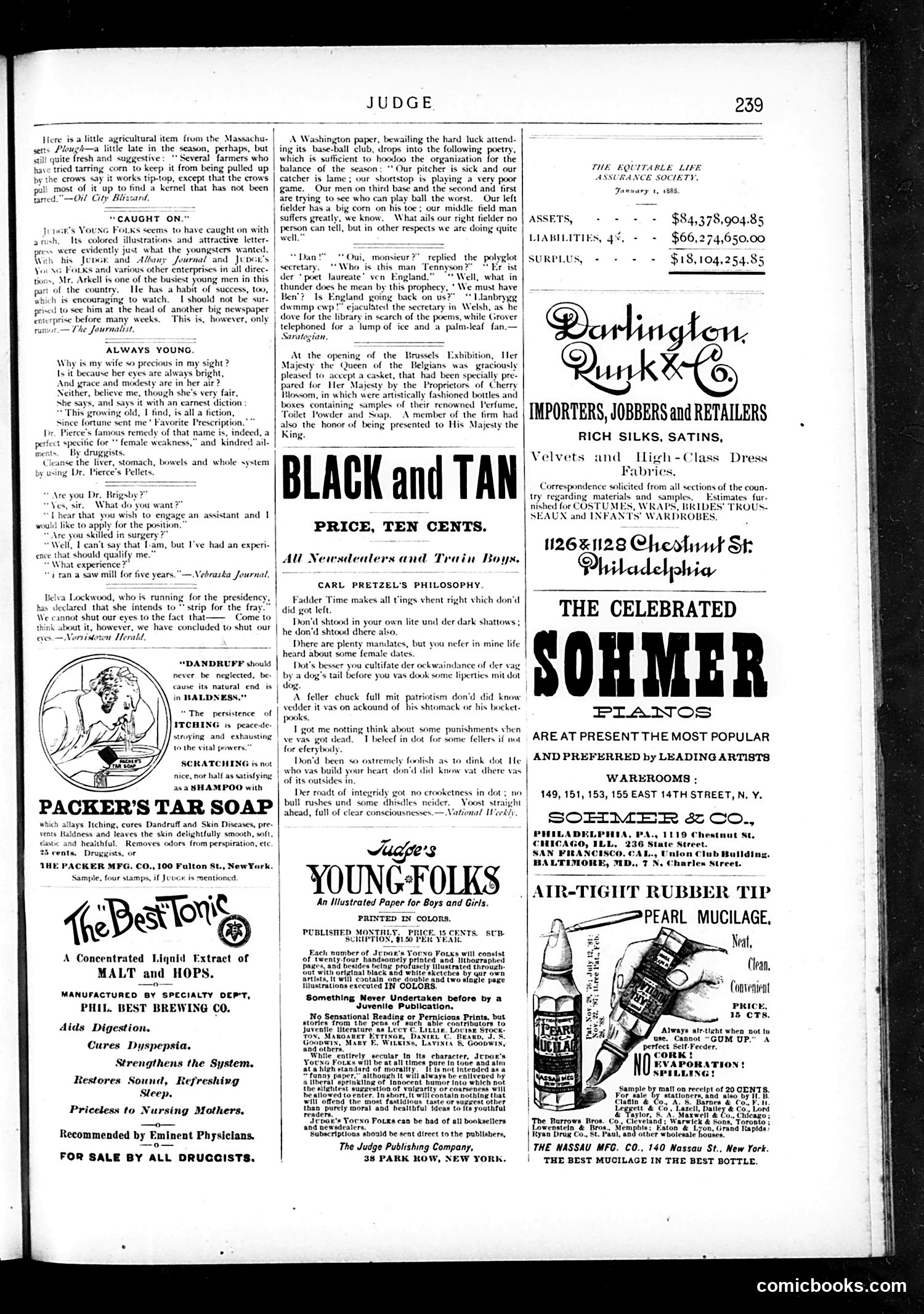
This page is predominantly **advertising**, with only minor satirical content. The main items of note: **"Caught On"** brief mentions Judge's Young Folks publication gaining popularity with colored illustrations and attractive lettering for youngsters—praise for publisher Richard Arkell's success. **"Always Young"** is a short humorous poem about why the speaker's wife seems perpetually youthful—the punchline being she credits Dr. Pierce's "Favorite Prescription," a patent medicine advertised elsewhere on the page. **A brief joke** about a job applicant claiming five years' experience running a saw mill when asked about surgical experience—absurdist humor playing on the disconnect between qualifications and the position sought. **"Dandruff" section** is primarily promotional copy for Packer's Tar Soap, warning against baldness. The page is otherwise filled with advertisements for various patent medicines, publications (including *Judge's Young Folks*), pianos, and silks. The satirical content is minimal and light, focused on domestic humor and wordplay rather than political commentary.
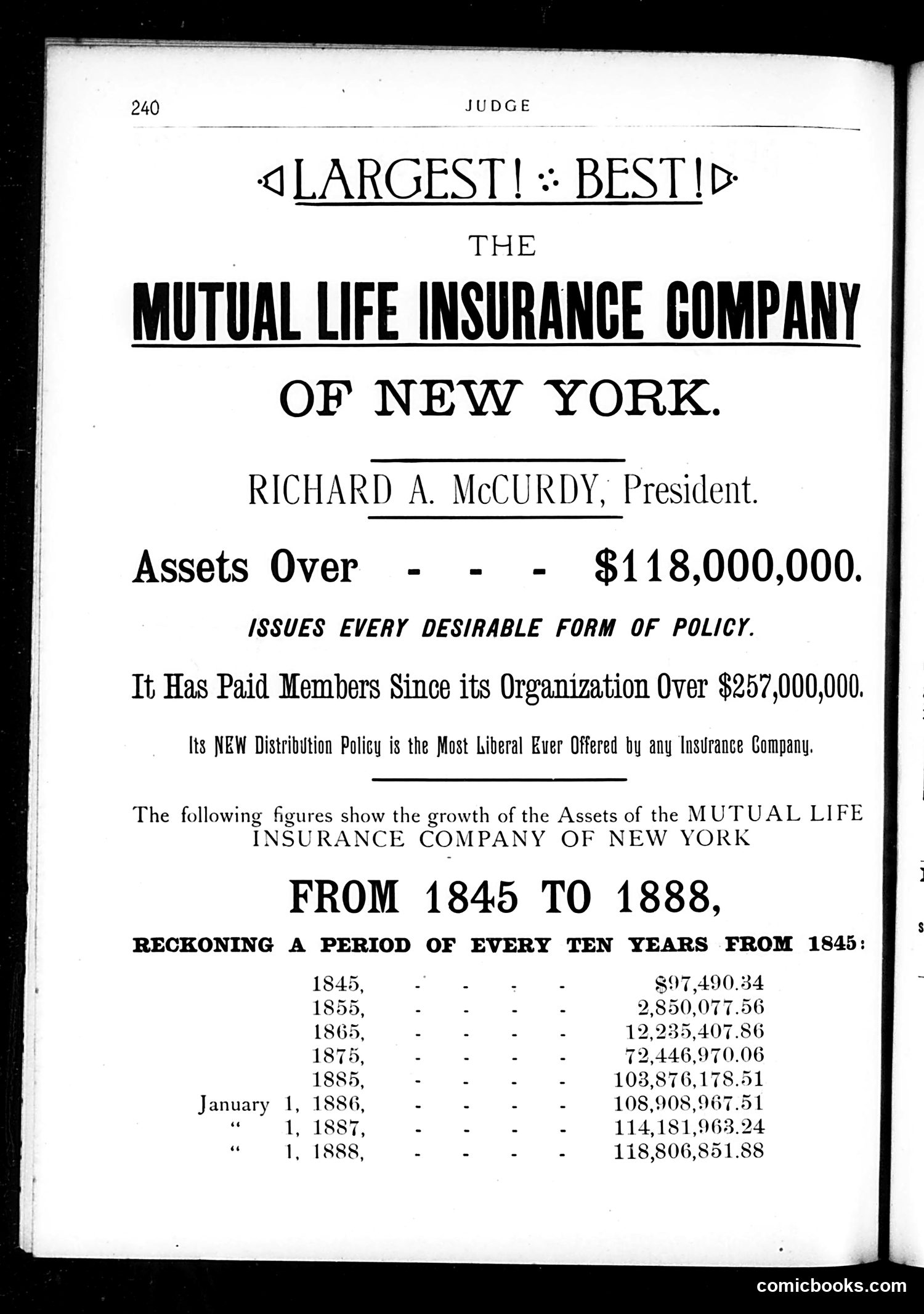
This page is **not a cartoon or satire** — it's a straightforward advertisement for the Mutual Life Insurance Company of New York, published in *Judge* magazine around 1888. The ad promotes the company's financial strength and growth, highlighting President Richard A. McCurdy's leadership. It emphasizes the company's massive assets ($118 million), substantial payouts to members ($257 million since founding), and shows dramatic asset growth over 43 years (from ~$97,000 in 1845 to ~$118 million by 1888). The superlative language ("LARGEST! BEST!") and claims about its "Most Liberal" distribution policy were typical advertising rhetoric of the Gilded Age, when insurance companies were rapidly expanding and competing aggressively. There is no visible political commentary or satire here — this appears to be paid advertising space within the satirical magazine.
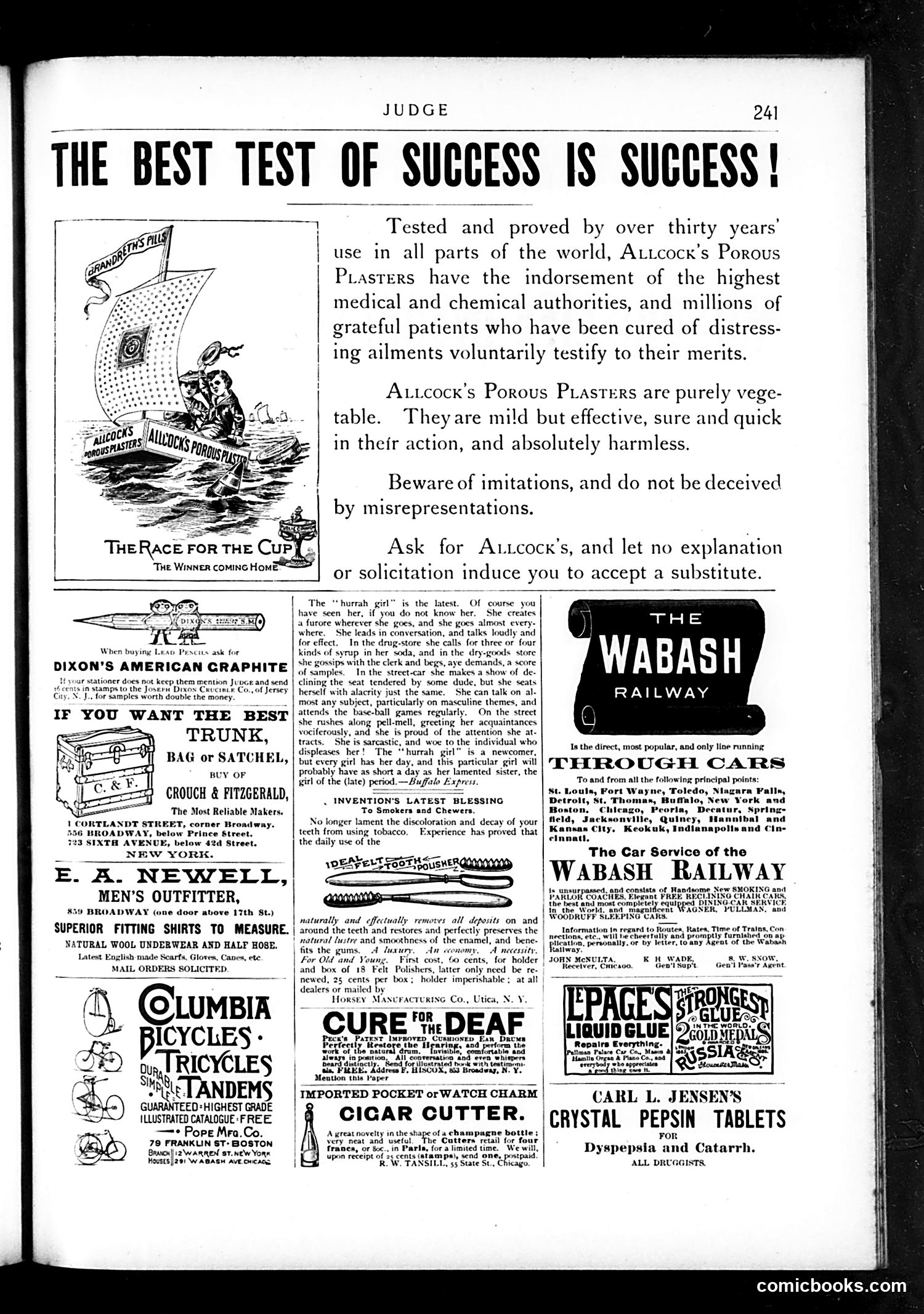
This page is primarily **advertising, not editorial content or political satire**. Judge magazine here functions as a vehicle for classified ads and product promotions rather than satirical cartooning. The only illustrated element with potential social commentary is a small sidebar titled "The latest" (mentioning a "hurrah girl"), which appears to be a brief, tongue-in-cheek description of contemporary young female behavior—specifically a type of attention-seeking woman who talks loudly, frequents public spaces, and flirts. This represents mild social satire about changing women's behavior and emerging "modern girl" stereotypes of the era. The remaining content consists entirely of advertisements for products (Allcock's Porous Plasters, Columbia Bicycles, the Wabash Railway, various men's outfitters) and services. No political figures or events are referenced.
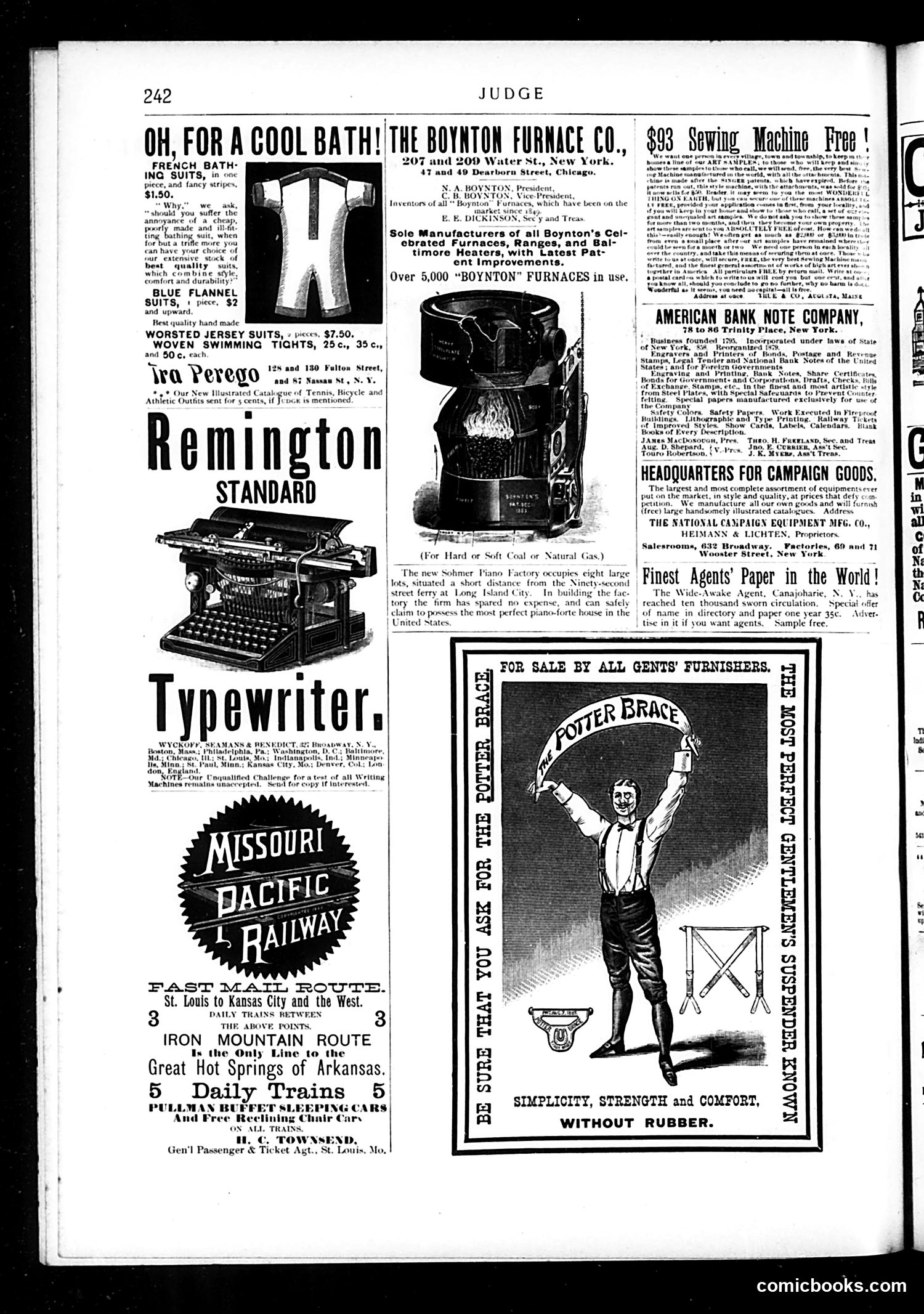
This page is primarily **advertising**, not political satire. It contains commercial advertisements for various products and services typical of the era: - **Clothing ads** (swimming suits, jerseys) - **The Remington Typewriter** (prominent left side) — a major office technology of the time - **The Boynton Furnace Company** — heating systems for homes - **American Bank Note Company** — currency and security printing - **Potter Brace** (bottom right) — a medical support garment marketed for "simplicity, strength and comfort, without rubber" - **Missouri Pacific Railway** — promoting routes to Kansas City and Hot Springs, Arkansas - **Campaign equipment supplies** and other miscellaneous vendors The Potter Brace ad features a cheerful man demonstrating the product's effectiveness. There is no identifiable political cartoon or satire on this page—it's a standard advertising section from an American magazine of this period, likely from the 1880s-1890s based on product types and design.
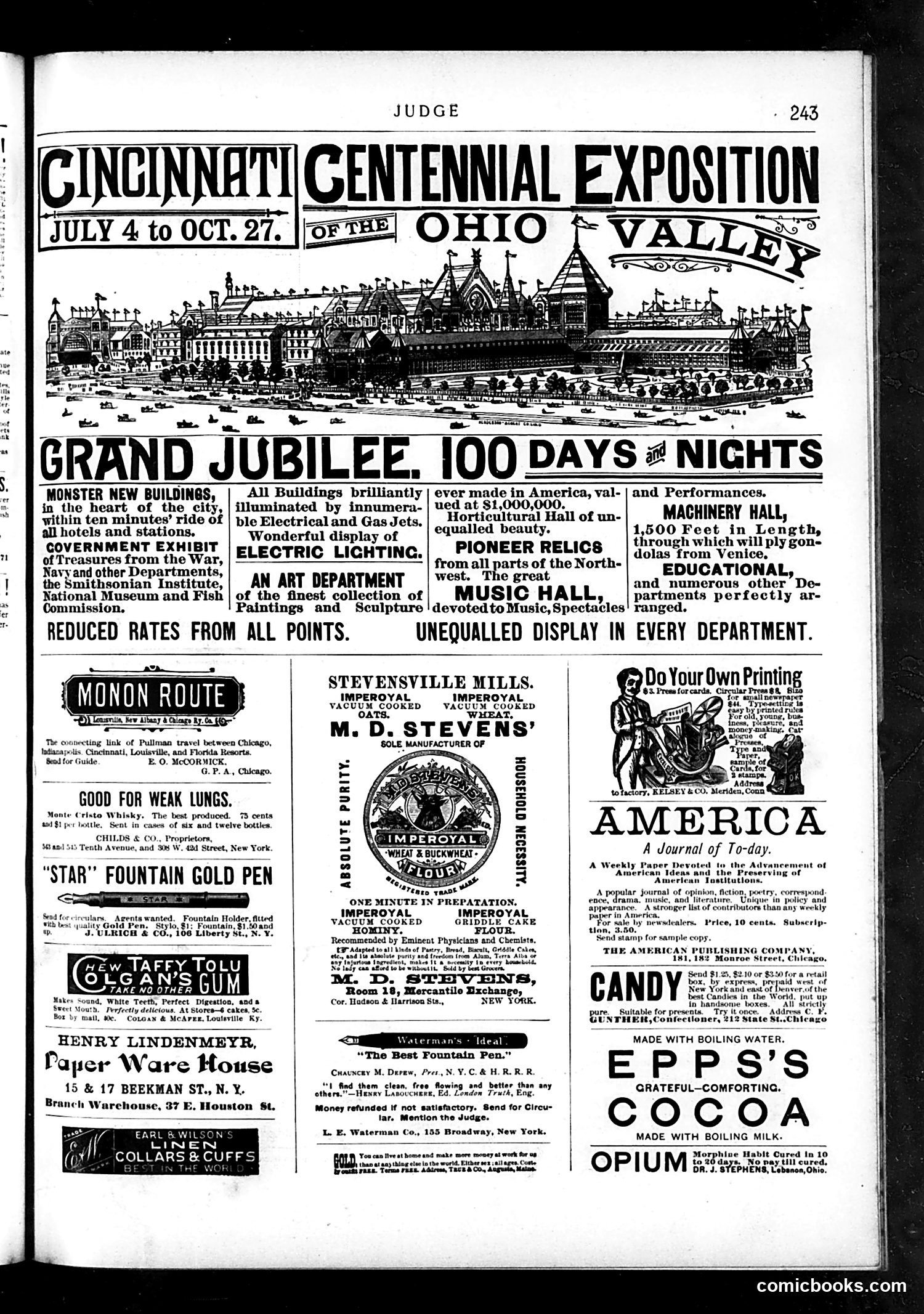
This is primarily an **advertising page**, not a political cartoon. It announces Cincinnati's 1888 Centennial Exposition (July 4–October 27), celebrating 100 years of the Ohio Valley's settlement. The large header features an illustrated exposition grounds with elaborate buildings, electric lighting, and gondolas—promoting technological modernity and civic pride. Key attractions advertised include government exhibits, art collections valued at $1 million, machinery displays, and educational departments. The page is dominated by commercial ads for contemporary products: patent medicines (whisky for "weak lungs," opium for morphine addiction), fountain pens, breakfast foods, and collars. These reflect late-19th-century consumer culture and advertising practices. **No identifiable political figures or satire appear here.** This is a straightforward promotional document showcasing American industrial progress and commercial enterprise during the Gilded Age.
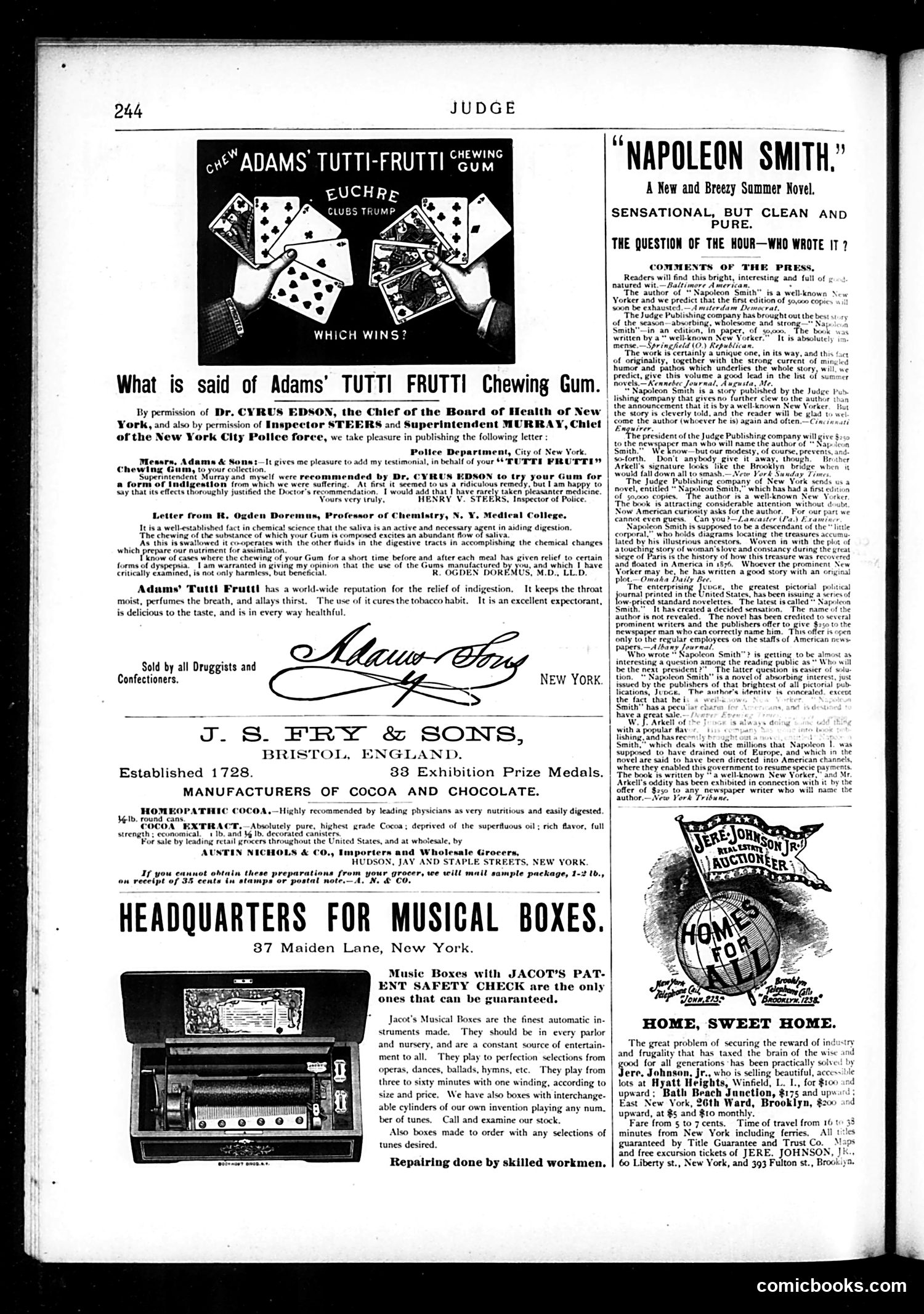
This page is primarily **advertising**, not political satire. The main content showcases endorsements for Adams' Tutti Frutti chewing gum. The left side features testimonial letters from real New York officials—Inspector Henry V. Steers and Professor B. Ogden Doremus of the Medical College—claiming the gum aids digestion by stimulating saliva production. This represents Victorian-era patent medicine marketing, where products made broad health claims without FDA oversight. The small card game illustration at top ("Euchre—Which Wins?") appears to be a decorative frame for the product, not satirical commentary. The remaining advertisements promote cocoa, chocolate, and musical boxes—typical period marketplace content. The page lacks the political or social satire Judge magazine was known for; it's essentially a classified advertising section using testimonials from authority figures (doctors, police officials) to build credibility for dubious health claims—standard practice in this era before modern consumer protection laws.
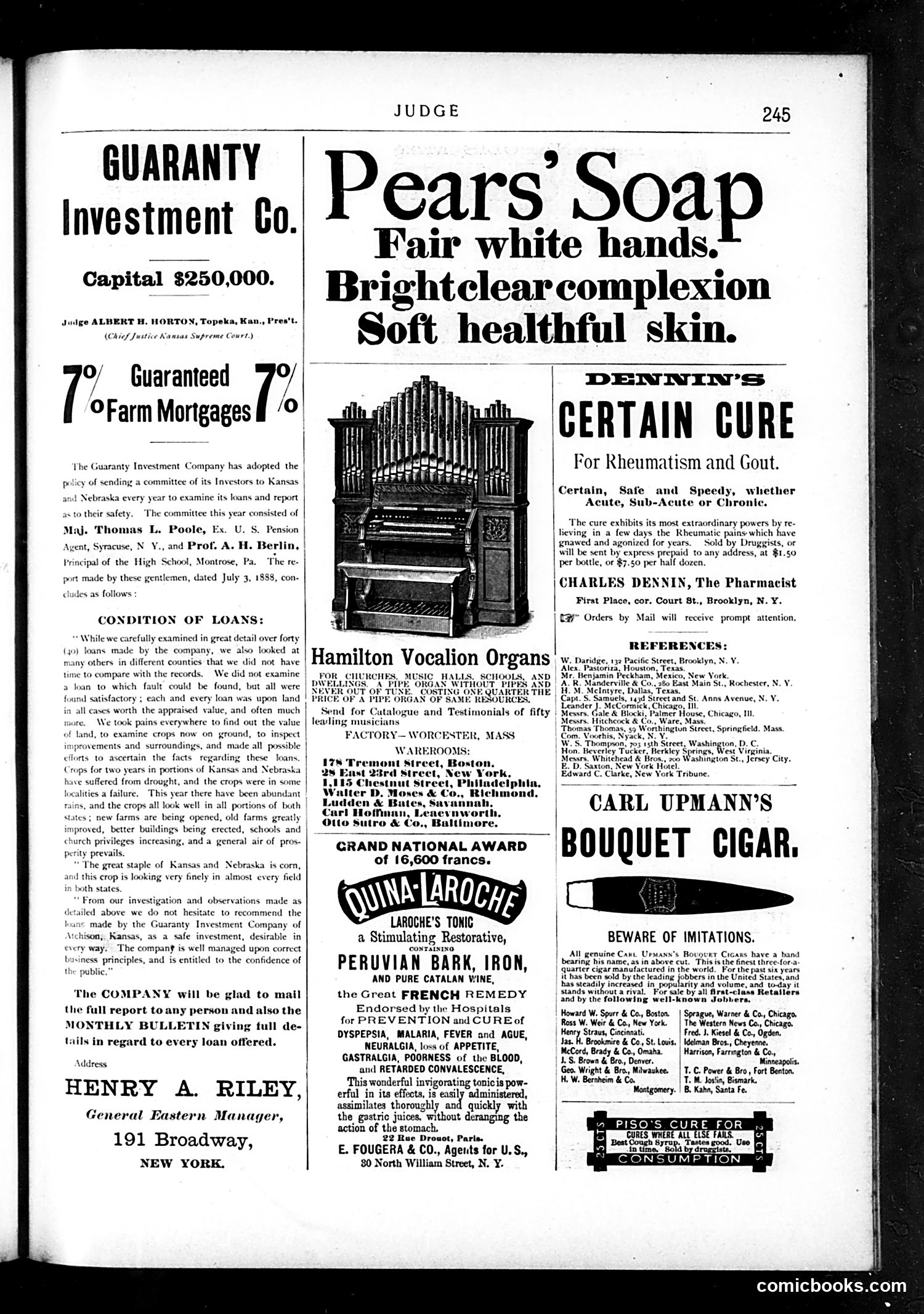
This page is **primarily advertising**, not satirical editorial content. It contains investment promotions, patent medicine ads, and product endorsements typical of late-19th-century Judge magazine. The main advertisement touts the Guaranty Investment Company's farm mortgages (7% guaranteed returns). Notably, it references Judge Albert H. Horton of Kansas as president, with testimonials from verified investors. This appears designed to legitimize the investment scheme through judicial authority. The remaining ads promote period products with claims that appear absurd today: Pears' Soap promises "fair white hands" and "bright clear complexion"; Dennin's nostrum claims to cure rheumatism in "a few days"; Laroche's tonic (containing iron and wine) treats dyspepsia and malaria. All tout medical benefits by modern standards clearly exaggerated or false. These ads reflect late-1800s marketing practices before FDA regulations—products made unverified health claims freely, and prestigious names lent credibility to dubious investments and medicines alike.
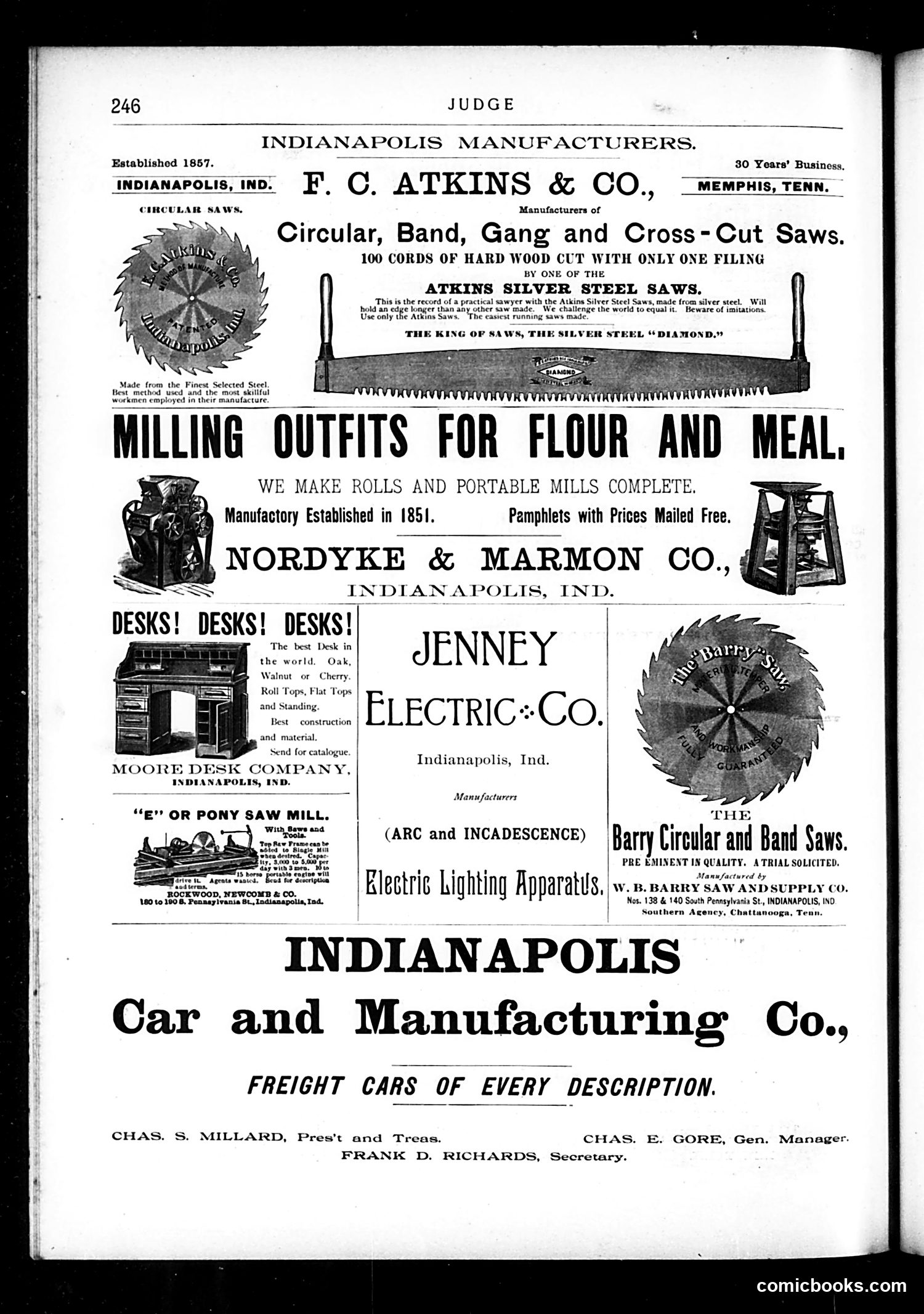
This page is **not a political cartoon or satire**—it is an **advertising section** from Judge magazine, page 246. The content comprises commercial advertisements for Indianapolis-area manufacturers from approximately the late 19th century. The ads feature industrial equipment: F.C. Atkins & Co. sells circular saws (claiming superiority through durability); Nordyke & Marmon manufactures milling equipment; Moore Desk Company promotes office furniture; Jenney Electric Co. advertises electric lighting apparatus; W.B. Barry Saw and Supply Co. markets circular and band saws; and Indianapolis Car and Manufacturing Co. manufactures freight cars. These are straightforward product advertisements with no satirical intent or political messaging—typical "booster" advertising celebrating Indianapolis industrial manufacturing. The page reflects the city's prominence as a manufacturing hub in this era.
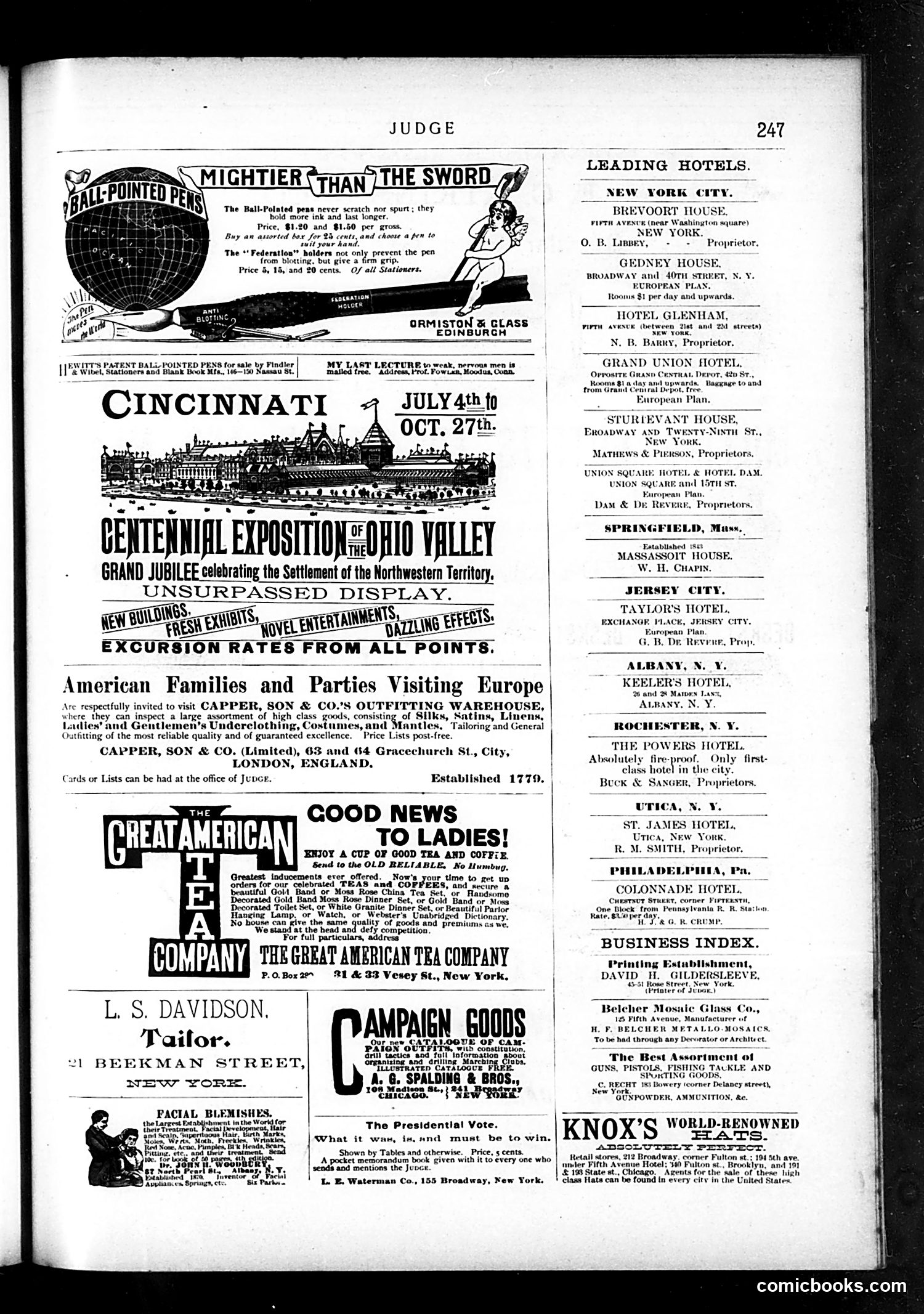
This page is primarily **advertising and announcements**, not satirical content. It's from Judge magazine's business directory section. The one substantive item is "The Presidential Vote" advertisement—a small box promoting a pocket memorandum book about presidential election voting data, priced at 5 cents. This appears to be non-partisan reference material for tracking electoral records. The remainder consists of hotel advertisements (New York, Jersey City, Philadelphia, Rochester, Albany, Utica), business directory listings (printing, glassware, ammunition), and product ads (ball-point pens, tea and coffee promotions, tailoring services, hats). The page reflects **late 19th-century American commerce**—note the focus on travel accommodations (likely for wealthy families visiting Europe or attending expositions) and consumer goods like the novel "ball-pointed pens" being promoted. There is no identifiable political cartoon or satirical commentary on this particular page.
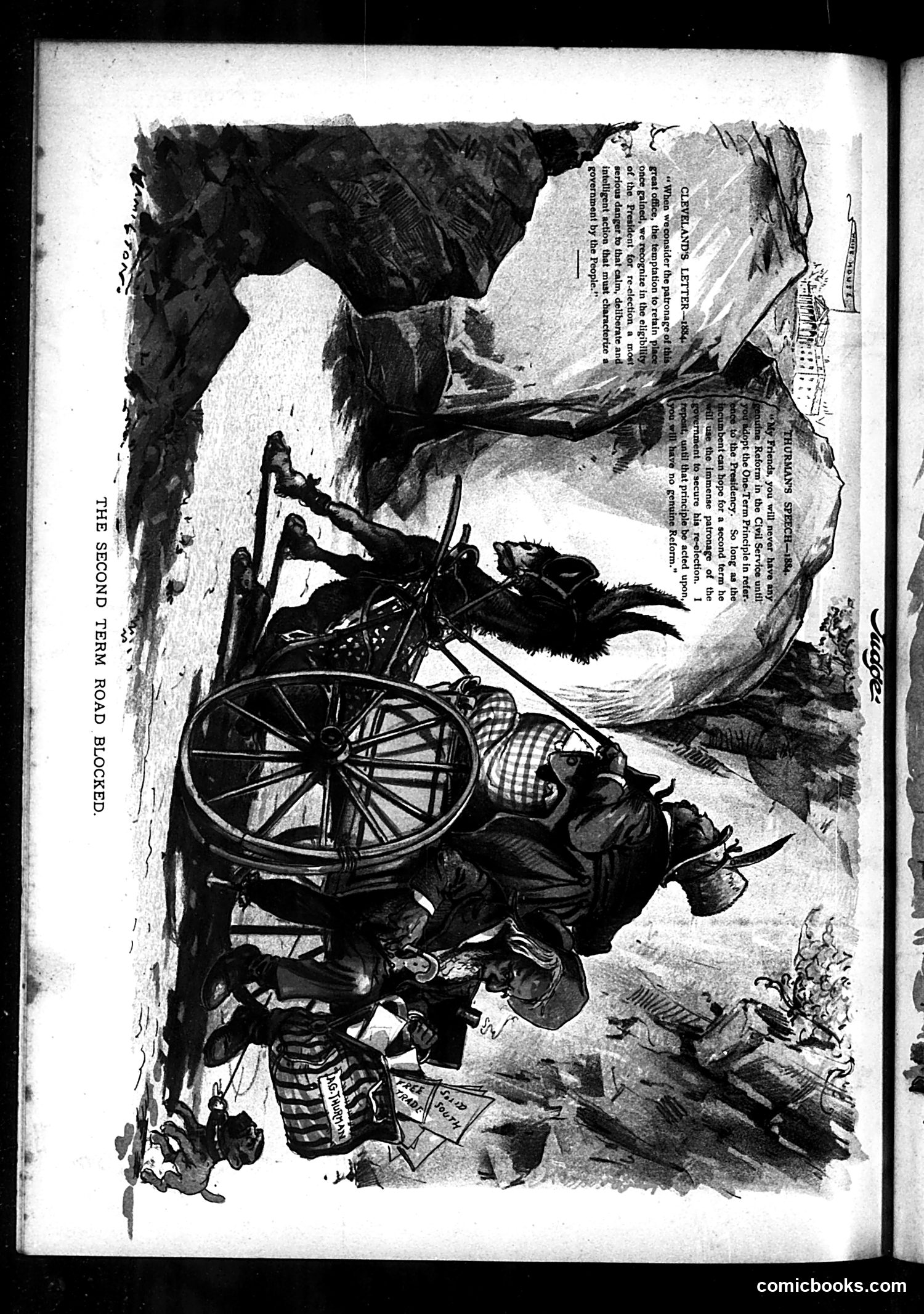
This political cartoon satirizes concerns about presidential patronage and re-election politics. The image shows a figure (likely representing a president seeking a second term) on a bicycle encountering a massive roadblock or barrier. The satire critiques how incumbent presidents allegedly abuse "the immense patronage of the Government" to secure re-election through political favors rather than merit. The bicycle represents the president's political momentum being halted by reform-minded obstacles. The text suggests that genuine reform is impossible "so long as the President can hope for a second term"—implying that desire for re-election corrupts governance and enables abuse of governmental power for political gain. This reflects late-19th-century *Judge* magazine's focus on civil service reform and anti-corruption sentiment.