
Judge, 1888-07-21 · page 10 of 20
Judge — July 21, 1888 — page 10: what you’re looking at
What you’re looking at
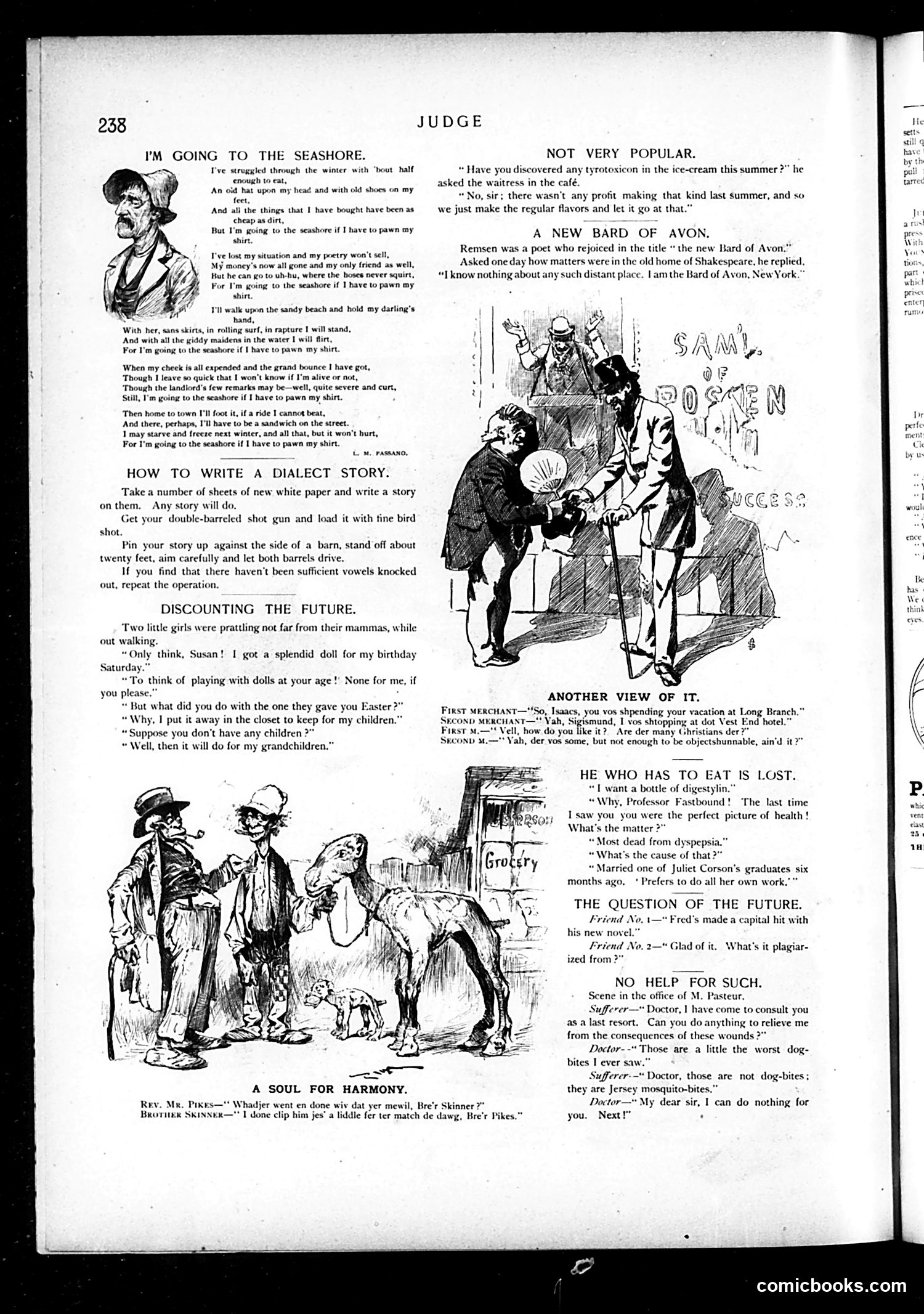
This page from *Judge* magazine contains several satirical humor pieces typical of late 19th-century American comedy: **"I'm Going to the Seashore"** mocks working-class desperation for vacation, with a narrator willing to pawn possessions to afford a beach trip he cannot afford. **"A New Bard of Avon"** satirizes a poet named Remsen who claims to be "the Bard of Avon, New York"—ridiculing pretentious American literary figures who appropriate classical European culture. **"How to Write a Dialect Story"** parodies contemporary literary trends using exaggerated dialect writing (common in period literature), suggesting one creates authenticity by randomly removing vowels—mocking both the technique and authors who overused it. The remaining pieces target contemporary concerns: ice cream safety (food contamination fears), Jewish merchants' vacation habits ("Another View"), and digestive problems from wives' cooking. The cartoons use caricature and crude stereotypes common to the era. Overall, the page satirizes American social climbing, literary pretension, and emerging consumer culture anxieties.
📄 Transcribed text from this page (OCR, searchable)
Machine-transcribed from the original scan — historical spelling and the odd misread are preserved.
JUDGE ’M GOING TO THE SEASHORE. NOT VERY POPULAR. Tre struggled through the winter with “bout half ™ Have you discovered any tyrotoxicon in the ice-cream this summer 2” he An cig bat upes ary head and whh old'ahoes on my” . aiked the waitress in the café. Hai “No, sir; there wasn’t any profit making that kind last summer, and so ‘And all the things that I have bought have been as we just make the regular flavors and let it go at that.” cheap as dirt, But Hm going tothe seashore it have to pawn my A NEW BARD OF AVON. pial te 8 oh dole ts 8 Bod Remsen was a poet who rejoiced in the title “ the new Bard of Avon: My inoeay can al pene aid ey tale Iend ea well Asked one day how matters were in the old home of Shakespeare, he replied, But he can go to ub-hu, where the hoses never squirt, “I know nothing about any such distant place. am the Bard of Avon, NewYork.” For I'm going to the seashore if I have to pawn my % T'll walk upon the sandy beach and hold my darling’s ASS hand, With her, sans skirts, in rolling surf, in rapture I will stand, ‘And with all the giddy maidens in the water I will firt, ; e AA i \A y For I'm going to the seashore if I haye to pawn my shirt. W\\ Ip ys When my cheek is all expended and the grand bounce I have got, ‘Though I leave so quick that I won't know if I'm alive or not, ‘Though the landlord's few remarks may be—well, quite severe and curt, Still, I'm going to the seashore if I have to pawn my shirt. Then home to town I'll foot it, ifa ride T cannot beat, And there, perhaps, I'll have to be a sandwich on the street. T may starve and freeze next winter, and all that, but it won't hurt, For I'm going to the seashore if I have to pawn my shirt. LM. PASRANO. HOW TO WRITE A DIALECT STORY. Take a number of sheets of new white paper and write a story on them. Any story will do. Get your double-barreled shot gun and load it with fine bird shot. Pin your story up against the side of a barn, stand off about twenty feet, aim carefully and let both barrels drive. If you find that there haven't been sufficient vowels knocked out, repeat the operation. DISCOUNTING THE FUTURE. Two little girls were prattling not far from their mammas, while out walking. “Only think, Susan! I got a splendid doll for my birthday Saturday.” ‘ ‘ Sel ANOTHER VIEW OF IT. ut what did yoo do: with.the\one they gave, you Easter FIRST MERCHANT—"'So, Isaacs, you vos shpending your vacation at Long Branch.” “Why, I put it away in the closet to keep for my children.” Skcon Yah, Sigismund, 1 vos shopping at dot Vest End hotel.” i * Suppose you don’t have any children 2” First st.—'* Vell, how do you like it? “Are der many Ghristians der?” ‘ : i SkcoND st.—"" Yah, der vos some, . gh to be objec ain'd it?” Well, then it will do for my grandchildren,’ COND St ‘ah, der vos some, but not enough to be objectshunnable, ain'd it HE WHO HAS TO IS LOST. “Why, Professor Fastbound! The last time I saw you you were the perfect picture of health ! What's the matter * Most dead from dyspepsia.” “ What's the cause of that ?” “ Married one of Juliet Corson’s graduates six months ago.‘ Prefers to do all her own work. THE QUESTION OF THE FUTURE. Friend No. 1—" Fred's made a capital hit with his new novel.” Friend No. 2—" Glad of it. What's it plagiar- ized from >” NO HELP FOR SUCH. Scene in the office of M. Pasteur. Sufferer—" Doctor, | have come to consult you asa last resort, Can you do anything to relieve me from the consequences of these wounds >" Doctor--" Those are a little the worst dog- bites I ever saw Sufferer-—" Doctor, those are not dog-bites; A SOUL FOR HARMONY. they are Jersey mosquito-bites.’ Rey. Mr. Pixes—" Whadjer went en done wiv dat yer mewil, Bre’r Skinner ?* Doctor—“ My dear sir, | can do nothing for Byoriiex SkINNER—" I done clip him jes’ a liddle fer ter match de dawg, Bre'r Pikes.” you. Next!” . comicbooks.com