
Judge, 1888-07-21 · page 2 of 20
Judge — July 21, 1888 — page 2: what you’re looking at
What you’re looking at
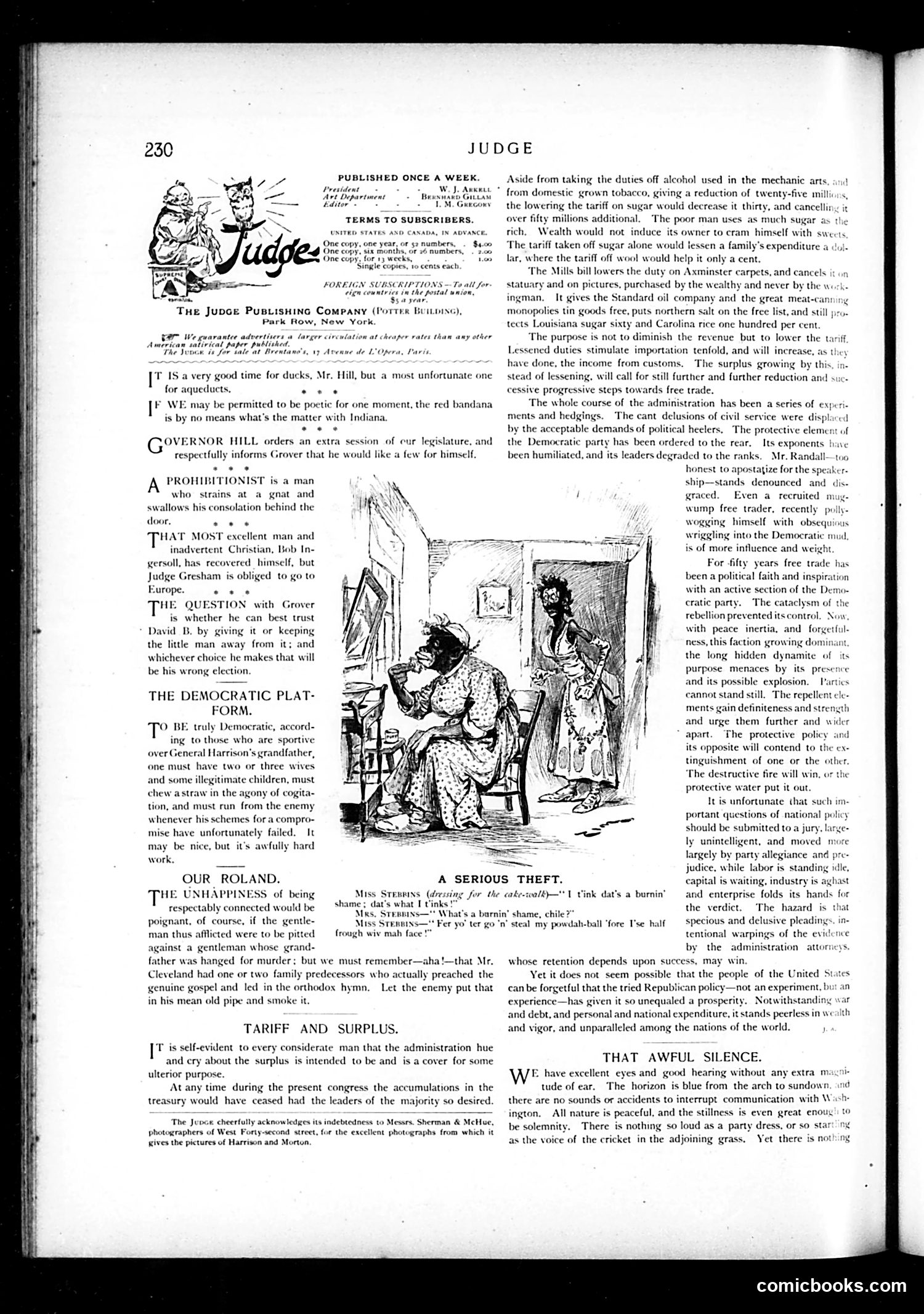
This cartoon satirizes the Democratic Party's internal conflict over tariff policy. The scene depicts a theft, with the caption suggesting someone stole a "barn's-worth" of Democratic Party principles. The satire targets the apparent contradiction between the party's stated positions and its actions. The text references how Democrats historically championed free trade, but the "protective element of the Democratic party has been ordered to the rear" — meaning protectionist Democrats gained influence, abandoning traditional party doctrine. The "theft" metaphor suggests Democrats stole from their own platform by shifting toward protectionism. This reflects late 19th/early 20th-century Republican criticism of Democratic inconsistency on trade policy, a major political fault line of the era. The joke: the party lost its ideological integrity.
📄 Transcribed text from this page (OCR, searchable)
Machine-transcribed from the original scan — historical spelling and the odd misread are preserved.
JUDGE PUBLISHED ONCE A WEEK. President W. J. Anne Art Department Brexnand Gian dite’. 1M. Gecony TERMS TO SUBSCRIBERS. One copy, one year, of 52 numbers, . $4.00 ‘One copy, six months, of 26 numbers, 3.00 One copy, for 13 weeks, hoo ‘Single copies, to cents each FOREIGN SUBSCRIPTIONS ~To all for eign countriet in the postal wnion, $5.4 year Tue Jupce Pustisnina Company (Porter Buitine), Park Row, New York TT We guarantee advert) American sativical paper pub The Sov ger circulation at cheaper rates than any is for sale ty Avenue de Li ‘T IS a very good time for ducks, Mr. Hill, but a most unfortunate one for aqueducts, ae oe F WE may be permitted to be poetic for one moment, the red bandana is by no means what's the matter with Indian OVERNOR HILL orders an extra session of respectfully informs Grover that he would like PROHIBITIONIST is a man who strains at a gnat and swallows his consolation behind the ar legislature, and few for himself. door. a: % HAT MOST excellent. man and inadvertent Christian, Bob In- xersoll, has recovered himself, but Judge Gresham is obliged to go to Europe. eee HE QUESTION with Grover is whether he can best trust David B. by giving it or keeping the little man away from it; and whichever choice he makes that will be his wrong THE DEMOCRATIC PLAT- FORM. TO BE truly Democratic, accord- ing to those who are sportive over General Harrison's grandfather, one must have two or three wives and some illegitimate children, must chew a straw in the agony of cogita- tion, and must run from the enemy whenever his schemes fora mise have unfortunately failed. It may be nice, but it’s awfully hard work. mpro- OUR ROLAND. HE UNHAPPINESS of being respectably connected would be poignant, of course, if the gentle- man thus afflicted were to be pitted against a gentleman whose grand- father was hanged for murder: but we must remember—aha!—that Mr. Cleveland had one or two family predecessors who actually preached the genuine gospel and led in the orthodox hymn, Let the enemy put that in his mean old pipe and smoke it, shame ; dat’s what [ t'inks Mxs. STEREINS—"* W frough wiv mah face TARIFF AND SURPLUS. T is self-evident to every considerate man that the administration hue and cry about the surplus is intended to be and is a cover for some ulterior purpose. Atany time during the present congress the accumulations in the treasury would have ceased had the leaders of the majority so desired. The Juvce cheerfully acknowledges its indebtedness to Messrs. Sherman & McHue, photographers of West Forty-second street, for the excellent photographs from which it ives the pictures of Harrison and Morton A SERIOUS THEFT. Miss SteRRins (dressing for the cake-walk)—* | Vink dat’s a burnin’ at's a barnin’ shame, chile?” Miss Stenstns—* Fer yo" ter go ‘n’ steal my powdah-ball “fore I'se half Aside from taking the duties off alcohol used in the mechanic arts from domestic grown tobacco, giving a reduction of twenty-five mil the lowering the tariff on sugar would decrease it th over fifty millions additional. rich, Wealth would not induce its owner to cram himself with sweet ‘The tariff taken off sugar alone would lessen a family's lar, where the tariff off wool would help it only a cent. ‘The Mills bill lowers the duty on Axminster carpets, and cancels i: statuary and on pictures, purchased by the wealthy and never by the w: ingman. It gives the Standard oil company and the gr monopolies tin goods free, puts northern salt on the fre tects Louisian y, and cancelli ‘The poor man uses as much sugar as expenditure a dole and still prow sugar sixty and Carolina rice one hundred per cent The purpose is not to diminish the revenue but to lower the tariff Lessened duties stimulate importation tenfold, and will increase, as they have done, the income from customs. The surplus growing by this, in- stead of lessening, will call for still further and further reduction and suc- cessive progressive steps towards free trade. The whole course of the administration has been a series of ¢ ments and hedgings. The cant delusions of civil service were displaced by the acceptable demands of political heclers. The protective element of the Democratic party has been ordered to the rear. been humiliated, and its leaders degraded to the ranks. Its exponents have Mr. Randall—too honest to apostatize for the spe ship—stands denounced and graced. Even a recruited wump free trader, recently polly. wogging himself with obsequious wriggling into the Democratic mud. is of more influence and weight For fifty years free trade has been a political faith and inspiratic with an active section of the Demo- cratic party. The cataclysm of the rebellion prevented its control, Now with peace inertia, and for ness, this faction growing dominant the long hidden dynamite of its purpose menaces by its presence and its possible explosion. mug- Parties cannot stand still. The repellent ele- ments gain definiteness and strength and urge them further and wider apart. The protective policy its opposite will contend to the ex- tinguishment of one or the other. ‘The destructive fire will win, or the protective water put it out. It is unfortunate that such ix portant questions of national policy should be submitted to a jury. la ly unintelligent, and moved more largely by party allegiance and pre- judice, while labor is standing idle, capital is waiting, industry is aghast and enterprise folds its hands for the verdict. The hazard is that specious and delusive pleadings. in- tentional warpings of the evidence by the administration ato whose retention depends upon success, may win. Yet it does not seem possible that the people of the United States canbe forgetful that the tried Republican policy—not an experiment. | experience—has given it so unequaled a prosperity, Notwithstanding and debt, and personal and national expenditure, it stands peerless in we and vigor, and unparalleled among the nations of the world. j THAT AWFUL SILENCE. E have excellent eyes and good hearing without any extra m tude of ear. The horizon is blue from the arch to sundown. there are no sounds or accidents to interrupt communication with Wash- All nature is peaceful, and the stillness is even great enot There is nothing so loud as a party dress, or so star! Yet there is not ington. be solemnity. as the voice of the cricket in the adjoining grass. comicbooks.com