
A complete issue · 16 pages · 1887
Judge — January 8, 1887
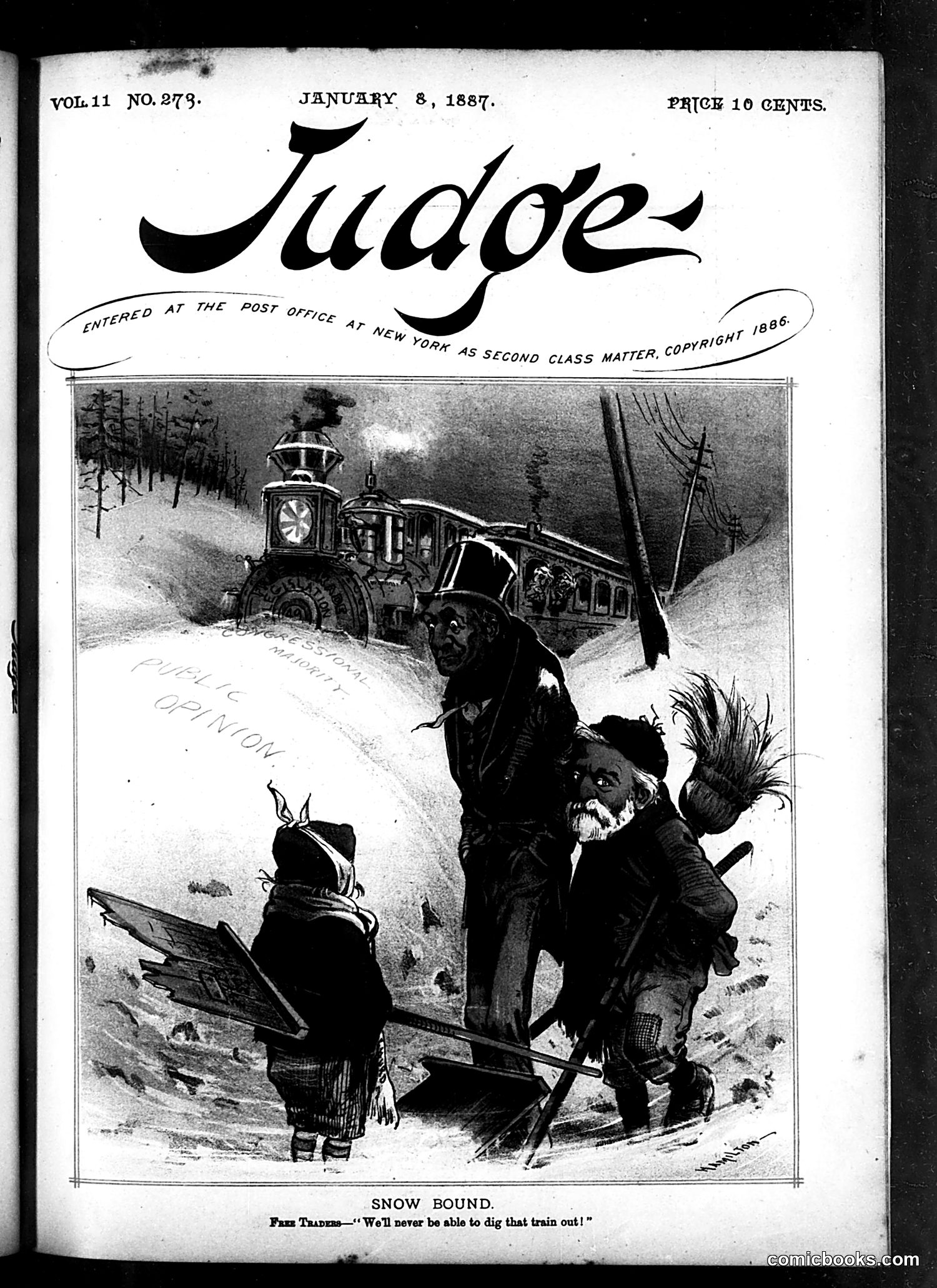
This cartoon depicts two caricatured figures (appearing to be political or public figures of the era, though specific identities are unclear from the image alone) struggling in heavy snow alongside railroad tracks. A steam locomotive is visible in the background, trapped or stopped by snow drifts. The caption reads: "We'll never be able to dig that train out!" The satire appears to target the failure of railroad operations or management during winter weather—a common complaint in 1880s America. The exaggerated, struggling figures suggest incompetence or desperation in facing the crisis. The cartoon likely mocks either specific railroad company executives or broader government/political figures responsible for transportation infrastructure, using the snow-bound train as a metaphor for their inability to handle challenges.
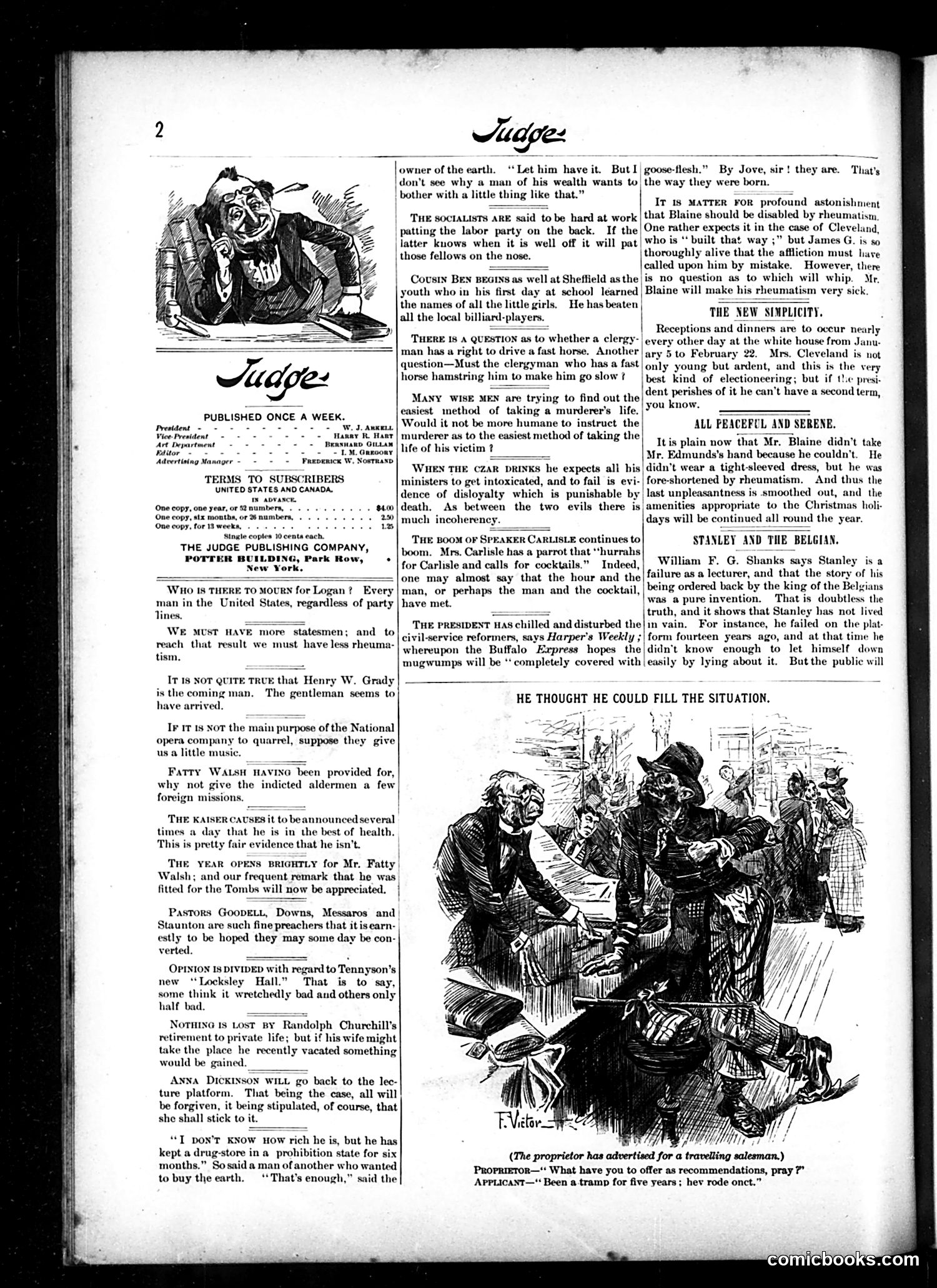
This page contains political commentary and satirical editorial pieces rather than a single focused cartoon. The main illustrated piece, "He Thought He Could Fill the Situation," depicts a proprietor interviewing an applicant for a traveling salesman position. The applicant claims five years' experience as "a tramp," apparently misrepresenting vagrant experience as sales experience—a joke about incompetent or dishonest job applicants. The editorial text addresses various contemporary issues including clergy authority, laborers' rights, presidential administration, and religious figures. References to "the Kaiser" and Buffalo military matters suggest World War I-era content. The commentary is general political and social satire typical of Judge magazine's format, rather than targeting specific identifiable individuals in the illustrations.
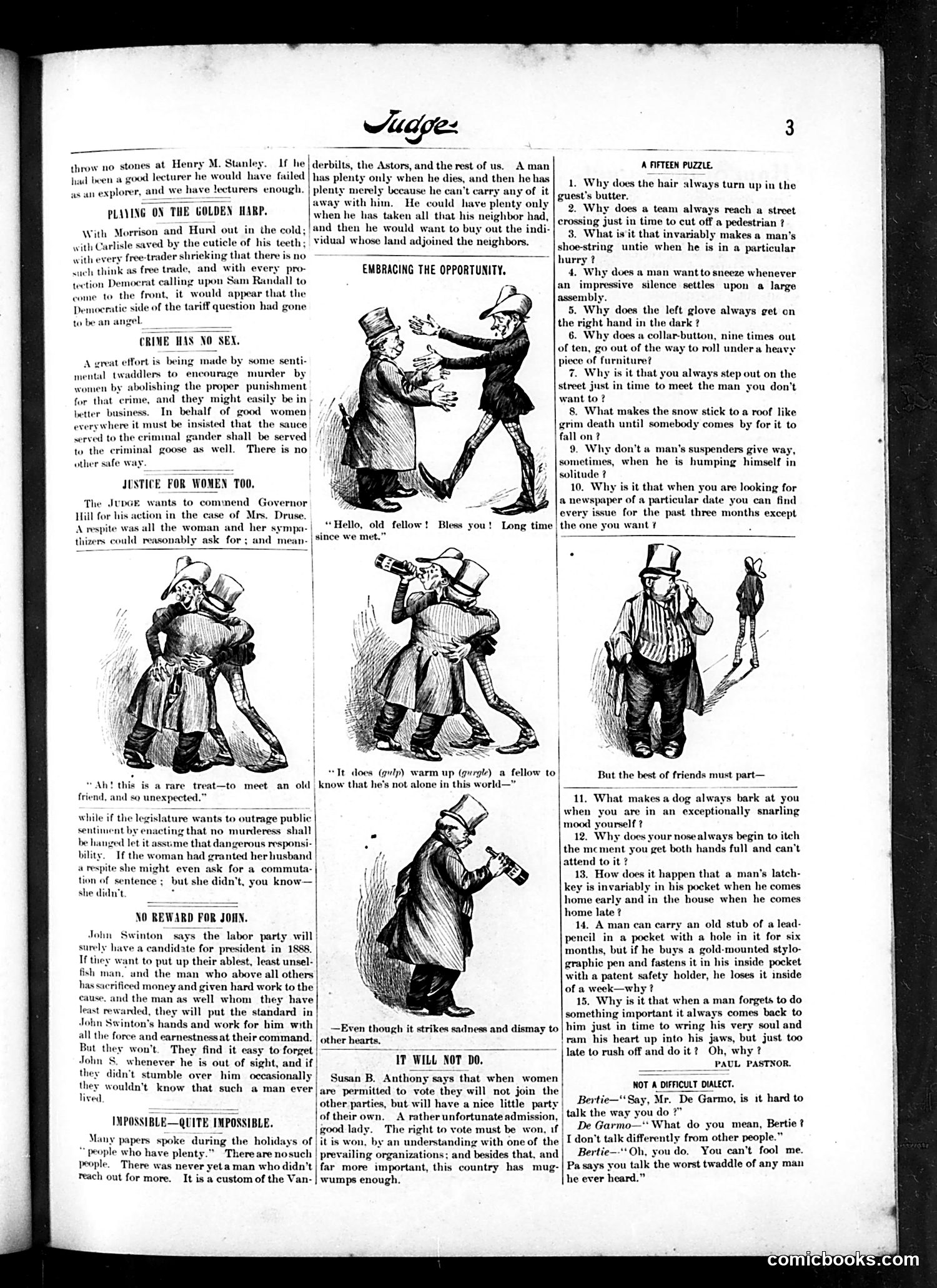
This page contains multiple short political and social commentaries typical of Judge's satirical format. **"Playing on the Golden Harp"** and **"Crime Has No Sex"** critique Democratic Party disarray over tariffs and argue women murderers deserve equal punishment to men—rejecting sentimental calls for leniency. **"Justice for Women Too"** praises Governor Hill's actions in the Mrs. Druse case, supporting capital punishment for female murderers while mocking female activists who sought commutation. **"No Reward for John"** likely references labor movement leadership (unclear which "John"), praising a forgotten labor advocate. **"Embracing the Opportunity"** depicts two men greeting; the caption suggests hypocrisy or unexpected alliance. **"It Will Not Do"** mocks Susan B. Anthony's claim that women voters won't form independent political parties, calling this "unfortunate admission"—Judge opposes women's suffrage as destabilizing. The page reflects *Judge's* conservative editorial stance: opposing labor movements, women's rights, and tariff reform while defending traditional legal punishment and existing power structures.
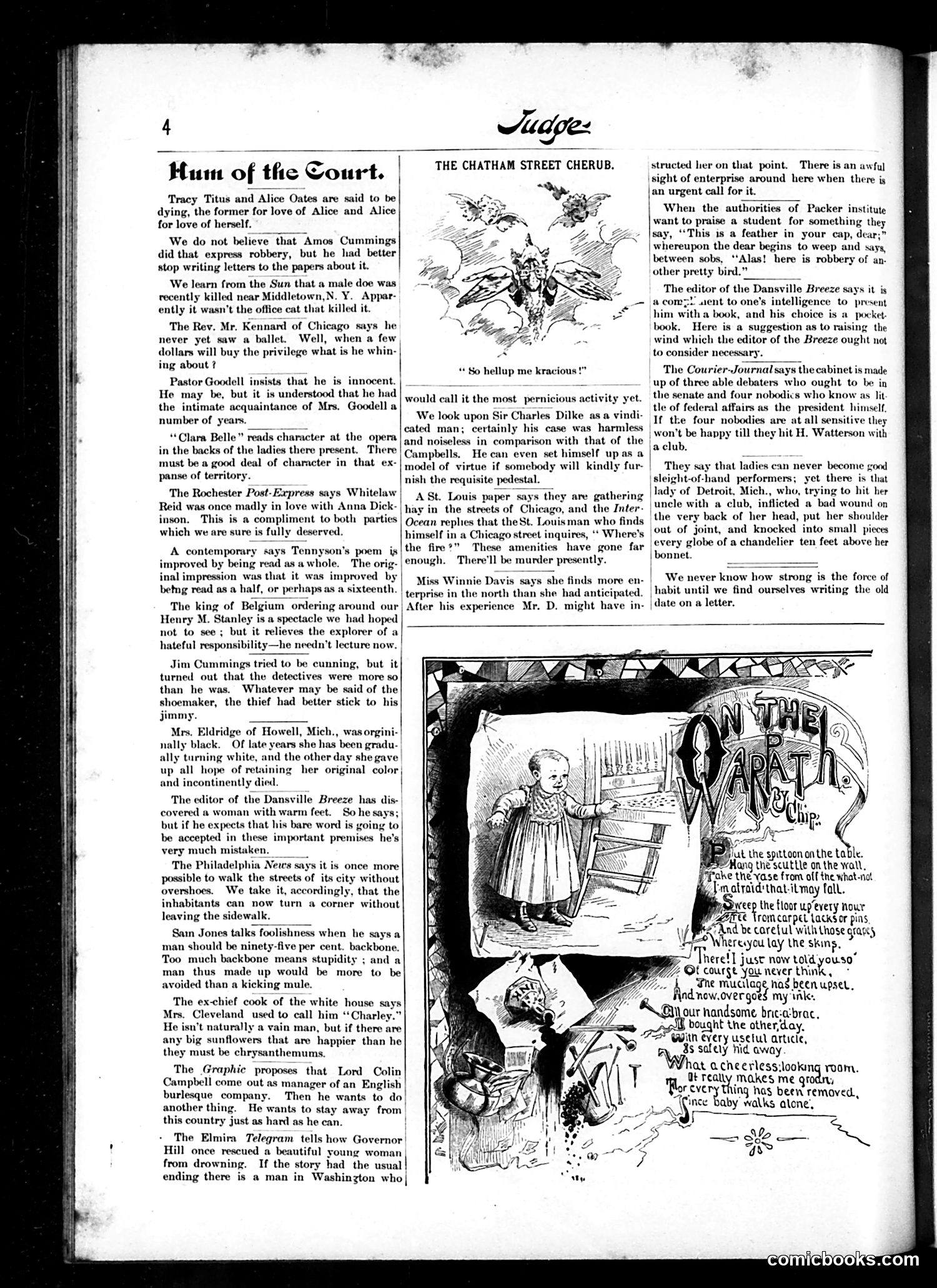
This is a satirical column of brief gossip items and social commentary typical of Judge magazine's "Mum of the Court" feature. The jokes mock various public figures and pretensions: **Key references:** - **Whitelaw Reid** and **Anna Dickinson**: A backhanded "compliment" to both parties about a rumored past romance - **Henry M. Stanley** serving the King of Belgium: Satirizes the explorer's loss of independence and prestige - **Sir Charles Dilke**: Vindicated from scandal, now mocked for self-righteousness - **Mrs. Cleveland**: The First Lady's informality with White House staff, presented as risible vanity The cartoon titled "The Attic" depicts a young woman in an empty room with verse about its cheerlessness and sparse furnishings—likely commentary on poverty or domestic disappointment. Overall, this represents Judge's typical format: snobby, gossipy commentary on celebrities, politicians, and social figures, mixing mild social critique with class-conscious mockery.
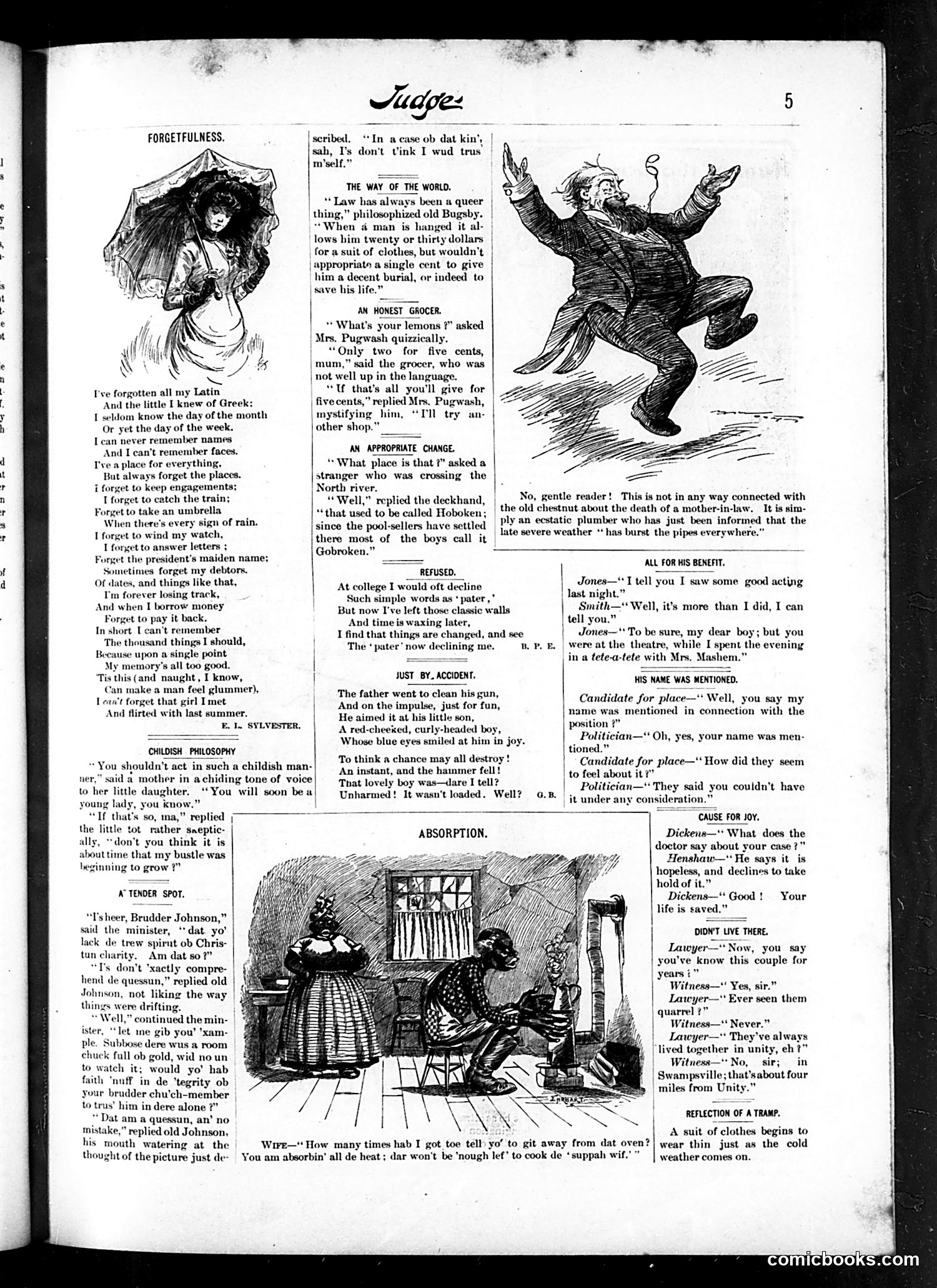
This page contains multiple short humorous pieces typical of the satirical magazine's format. **Main Content:** The largest item, "Forgetfulness," is a comic poem about selective memory—a man forgets everything except one crucial detail: a girl he flirted with last summer. The satire mocks human nature's contradictions. **Social Satire Pieces:** Several brief dialogues mock contemporary society: a grocer misunderstanding English, a neighborhood renamed from "Hoboken" to "Gobroken" (suggesting moral decline), and a college man who once rejected Latin but now desperately needs it. **"Just by Accident"** darkly jokes about a father accidentally aiming a loaded gun at his son—only it wasn't loaded, exploiting relief for humor. **Political Humor:** The "Candidate for Place" exchange satirizes political patronage: despite name-dropping, the candidate won't get the position "under any consideration"—mocking how political connections don't guarantee success. The illustrations include caricatured figures in period dress, typical of Judge's visual style. Overall, the page reflects late 19th/early 20th-century American social commentary through humor.
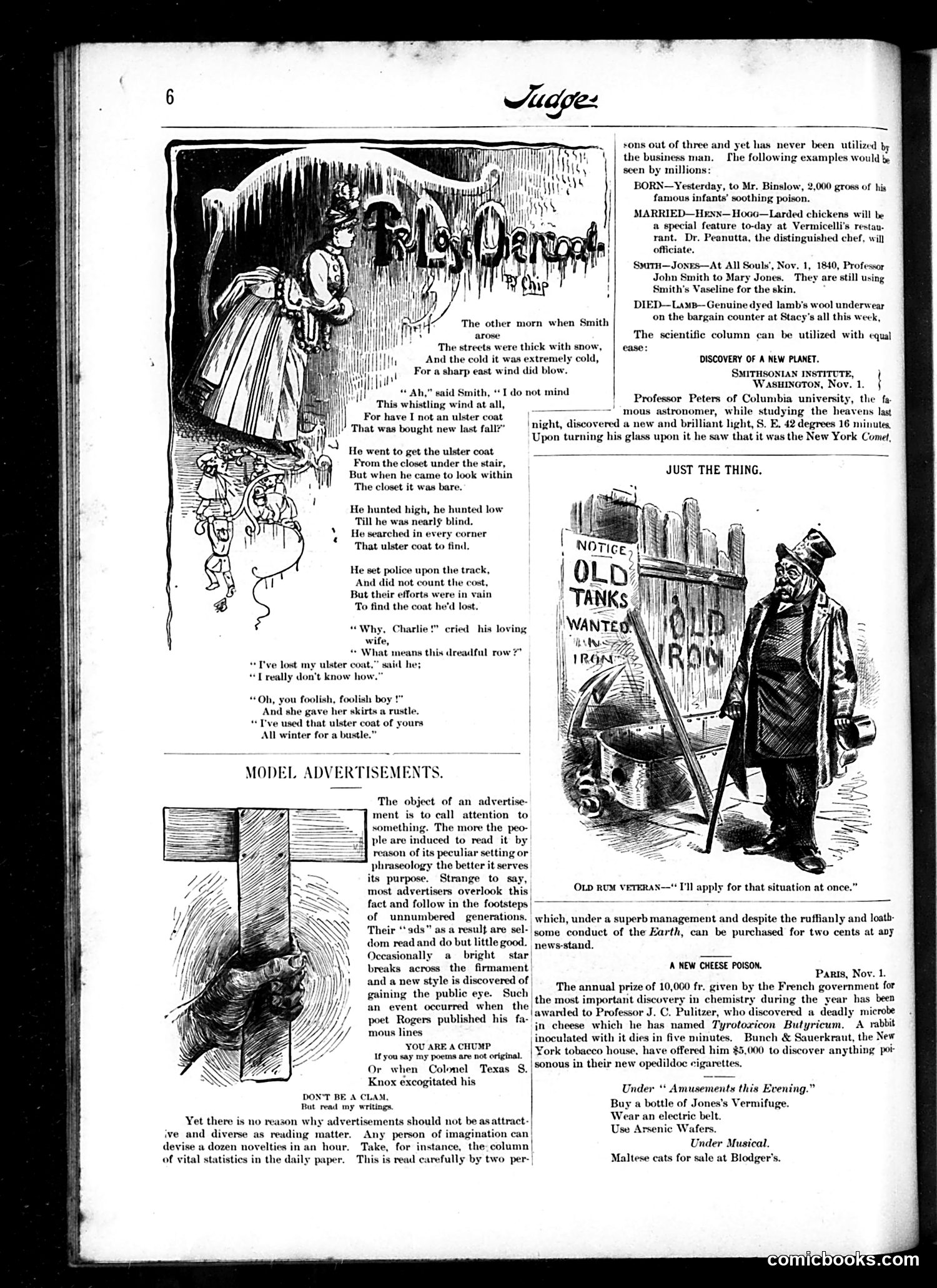
This page contains a humorous poem about a man named Smith who loses his winter coat (an "ulster coat"—a type of overcoat). The punchline: his wife confesses she's been using it all winter as a **bustle**—the framework women wore under skirts to create the fashionable silhouette of the era. The satire mocks both Smith's obliviousness and the absurdity of contemporary women's fashion that required stealing a man's outerwear to achieve the desired shape. The lower section titled "Model Advertisements" satirizes newspaper advertising conventions. Judge criticizes how advertisers fail to be creative, then offers mock examples showing how to embed ads into birth/marriage/death announcements and scientific reporting—absurdist suggestions that would make ads both intrusive and ridiculous. The cartoon "Old Rum Veteran" shows a destitute man seeing a notice for "Old Tanks Wanted—Old Iron" and misinterpreting it as a job opportunity, confusing literal tank containers with his own alcoholic state. These are typical Judge satirical pieces targeting fashion excess, advertising mediocrity, and urban social comedy.
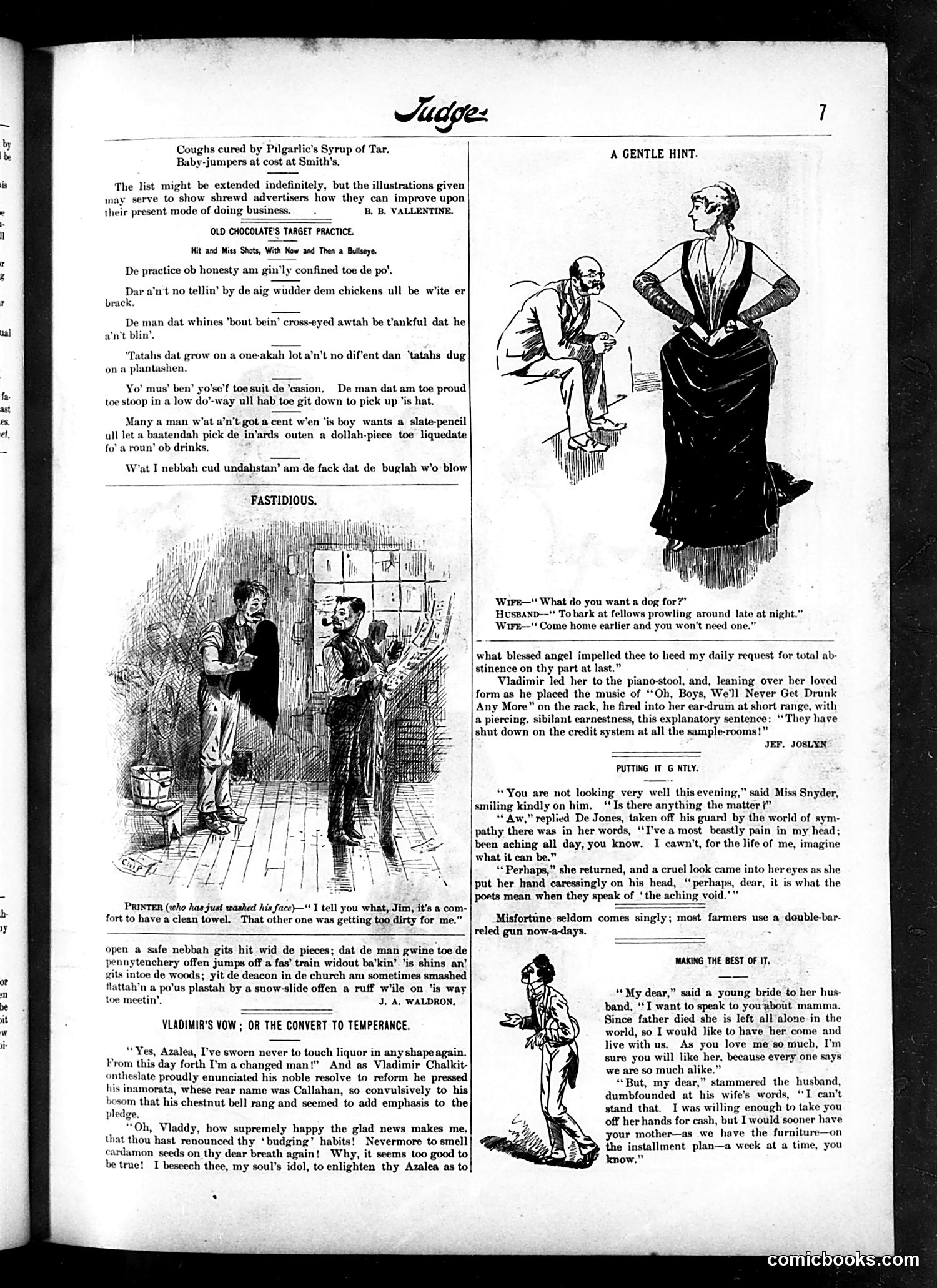
This page contains several satirical pieces typical of Judge's style: **"Old Chocolate's Target Practice"** uses racist dialect (appearing to mock African American speech) to present supposedly philosophical observations—a common but deeply offensive Judge format of the era. **"Fastidious"** shows a printer rejecting a dirty towel, a simple workplace humor piece. **"Vladimir's Vow"** satirizes temperance pledges as insincere. Vladimir swears off alcohol to impress his girlfriend Azalea, but the real reason emerges: the local bars have stopped extending credit. The joke mocks both temperance advocates and the shallow motivations behind reform promises. **"A Gentle Hint"** offers marital advice: a wife suggests her husband wouldn't need a guard dog against late-night prowlers if he came home earlier—implying infidelity. **"Putting It Gently"** and **"Making the Best of It"** are brief romantic/domestic humor pieces. The page demonstrates Judge's focus on middle-class social commentary, marital conflict, and ethnic caricature—typical of Gilded Age American humor magazines.
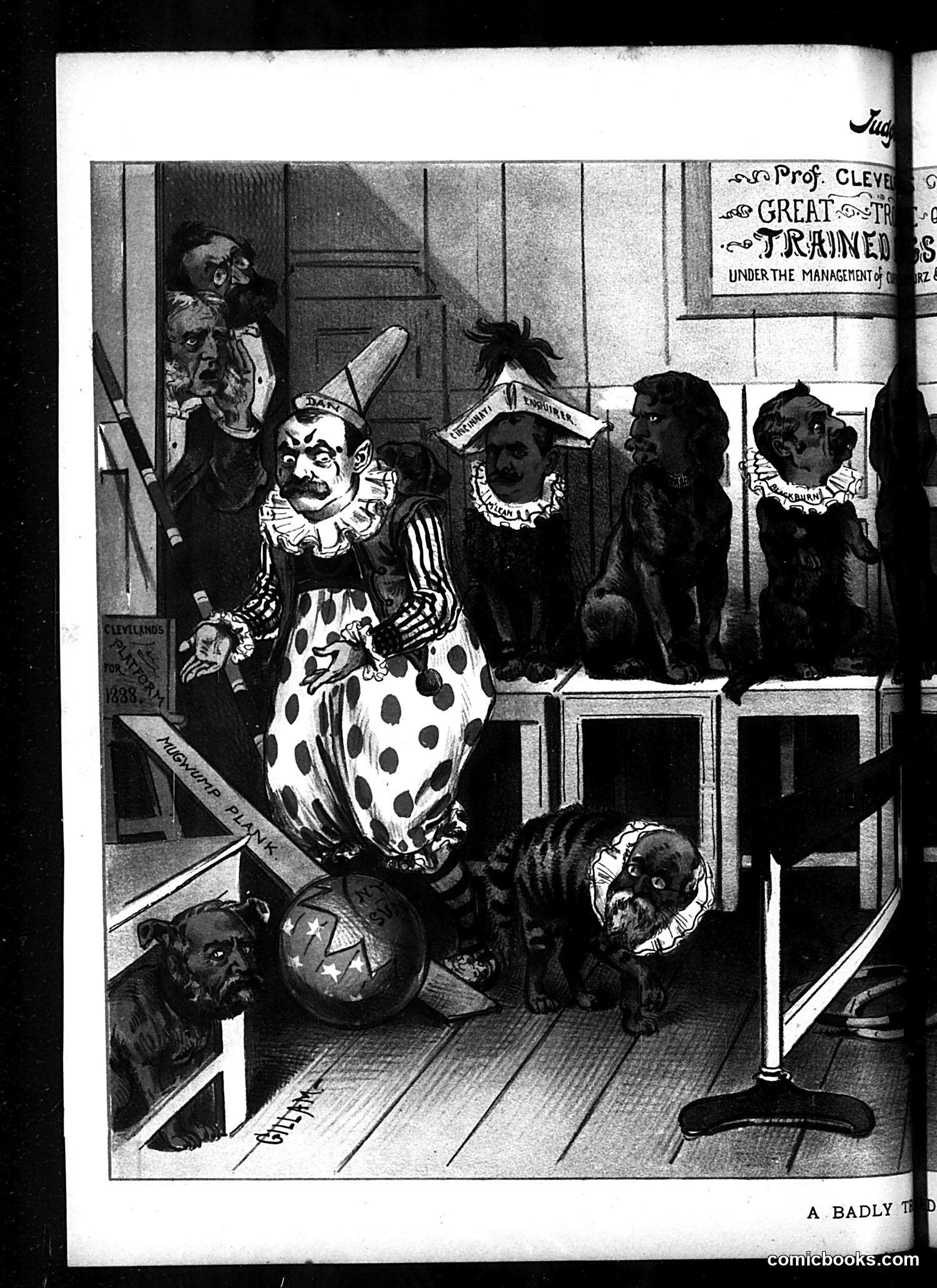
This Judge magazine illustration depicts a circus or vaudeville scene featuring a clown trainer with trained dogs wearing clown collars and hats. The sign references "Prof. Clever" and "Great Trained" performers "Under the Management of" someone (name partially obscured). The cartoon appears to satirize political leadership or management through the metaphor of animal training—suggesting that the figures being "managed" are being treated like performing animals rather than independent actors. The dogs in clown costumes represent those being controlled or manipulated. Without clearer identification of the specific manager's name or clearer historical context visible on this page fragment, I cannot definitively identify which political figure or event this targets, though the setup clearly mocks authoritarian management style.
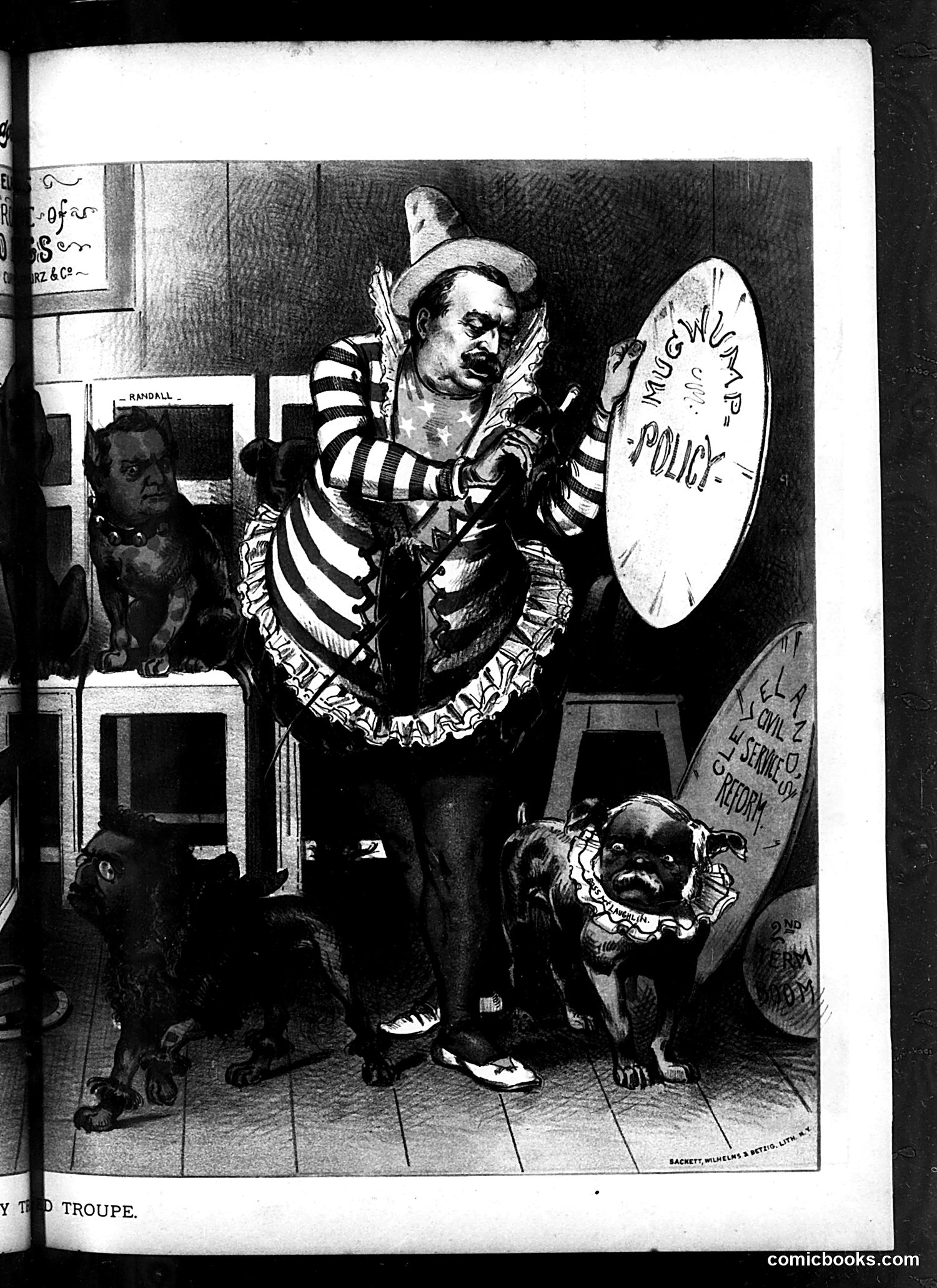
This satirical illustration depicts a mugging scene. A man in a striped suit and hat—appearing to be a circus performer or entertainer—is being robbed by two menacing dogs while holding a police shield labeled "MUGGINS POLICE." The cartoon is a visual pun on the word "mugging," which has a dual meaning: both literal robbery and the theatrical facial expressions performers make. The performer's costume (striped suit, ruffled collar) suggests a circus clown or vaudeville act, while the aggressive dogs and police shield create the robbery scenario. The satire likely mocks either law enforcement's ineffectiveness at preventing street crime, or possibly comments on theatrical "mugging" as a form of performance being "robbed" of legitimacy. The exact political context remains unclear without the full article text.
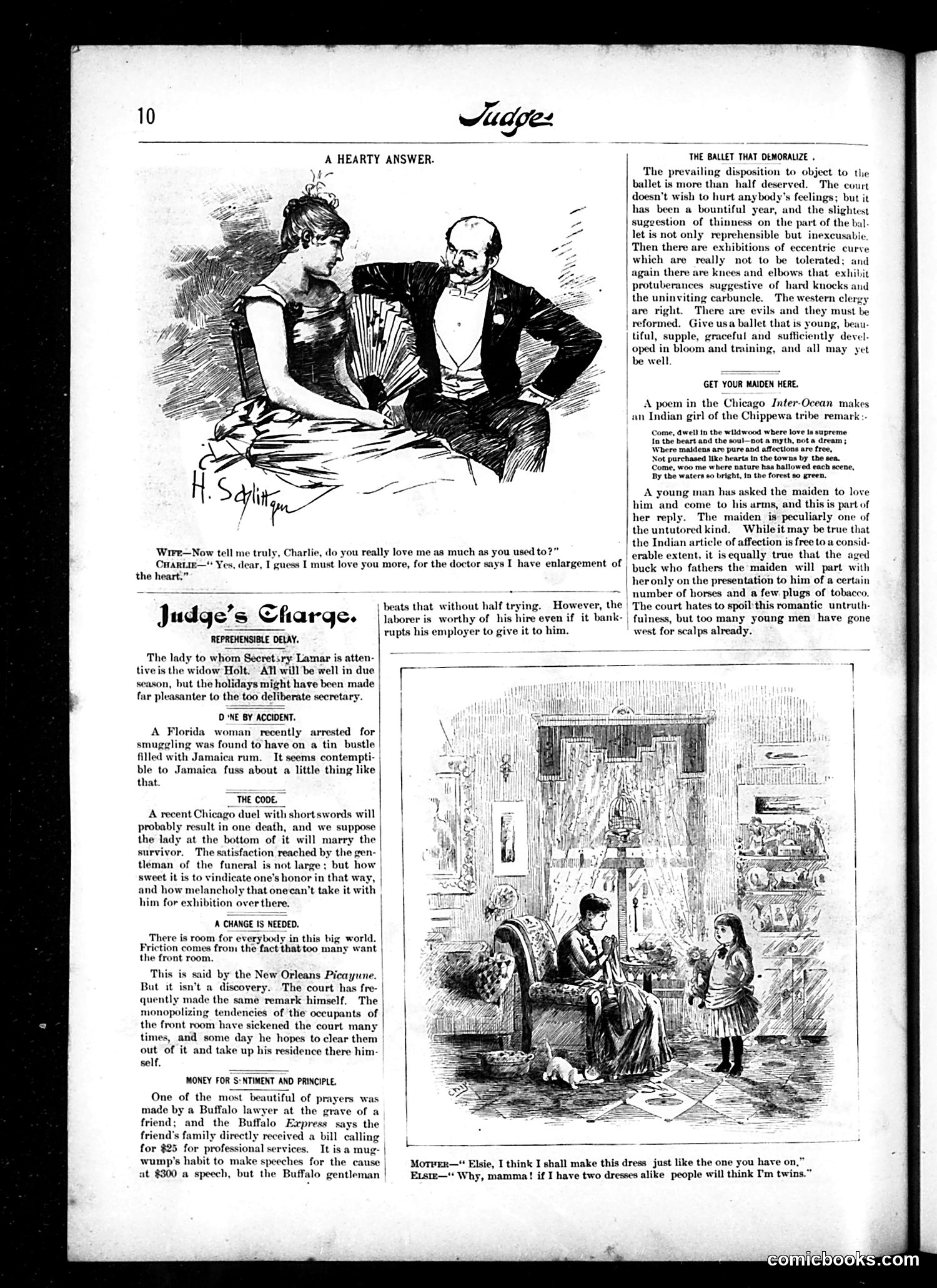
**"A Hearty Answer"** (top cartoon): Shows a man telling his wife he loves her more now because "the doctor says I have enlargement of the heart." The satire mocks both sentimental excuses for marital affection and the tendency to medicalize emotion—he's claiming a heart condition proves love rather than demonstrating genuine feeling. **"The Ballet That Demoralizes"**: Judge's editorial column criticizes ballet dancers for being insufficiently curvaceous or developed ("thinness," lack of "bloom"). The accompanying reference to a Chicago poem about an innocent Chippewa maiden is satirized for its romantic fantasy—Judge notes that real Indian fathers demand horses and tobacco for their daughters, mocking the poem's idealized portrayal of "free" indigenous love. **"Judge's Charge"** and surrounding items: Brief satirical commentary on social issues including delayed courtship, smuggling, honor duels, and a lawyer billing a grieving family for funeral oration services—all critiquing contemporary hypocrisy and poor manners among the respectable classes.
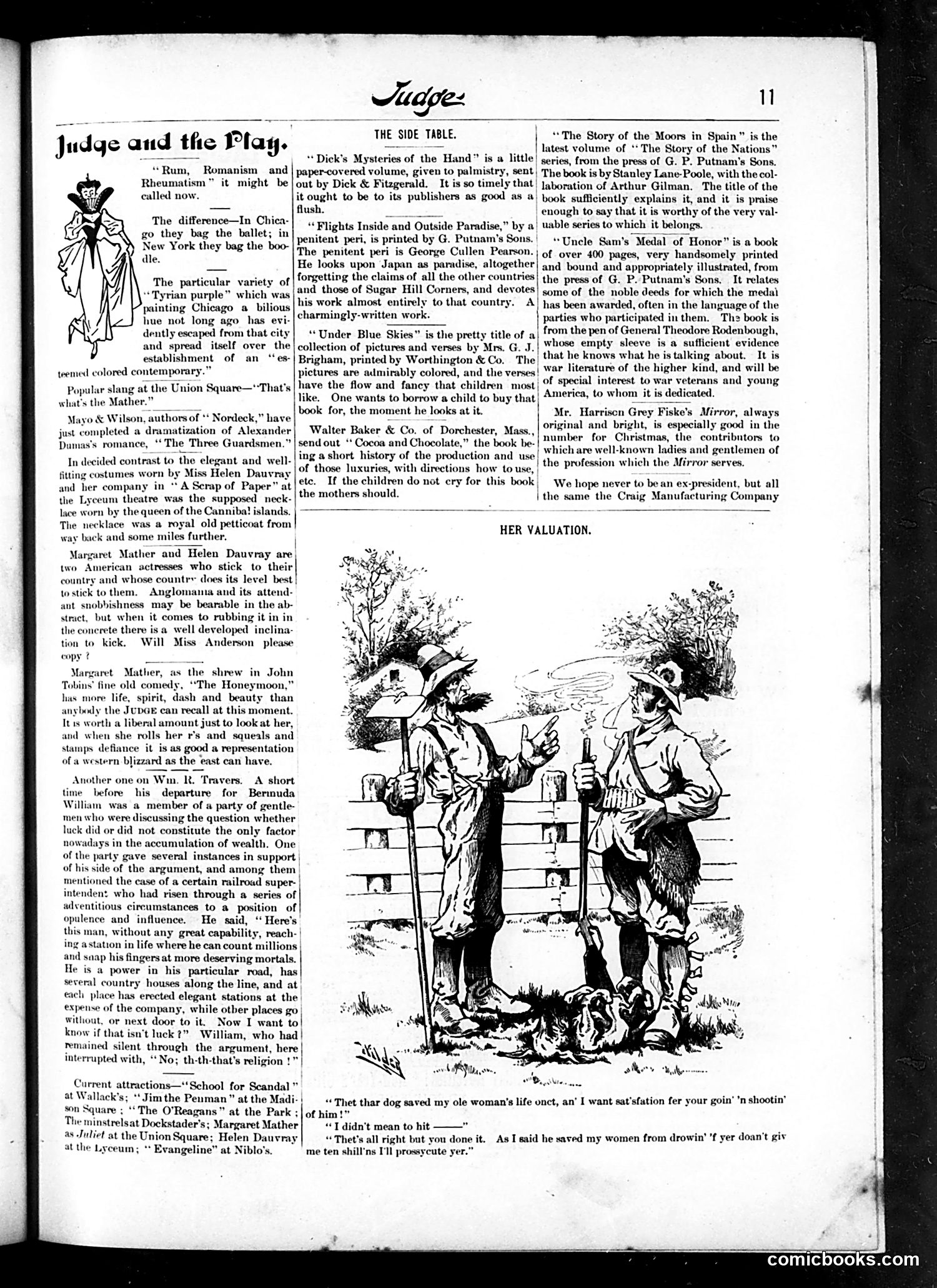
The cartoon depicts a man and woman at what appears to be a valuation or appraisal scene, with the man gesturing toward stacked items (likely household goods or furnishings). The caption reveals the satirical point: the woman's husband is claiming he "saved my ole woman's life" and demands compensation—specifically, he wants the woman not prosecuted for shooting him. The woman's response indicates she actually *did* shoot him ("That's all right but you done it"), and she's negotiating: if he saved women from drowning, she won't prosecute for attempted murder. This appears to be dark, satirical humor about domestic violence and marital discord, suggesting a couple engaged in a perverse transaction where the husband's claimed heroism is being weighed against the wife's apparent violence toward him. The joke relies on the absurdity of treating violence and rescue as negotiable offenses—typical of Judge magazine's acerbic social commentary on American life.
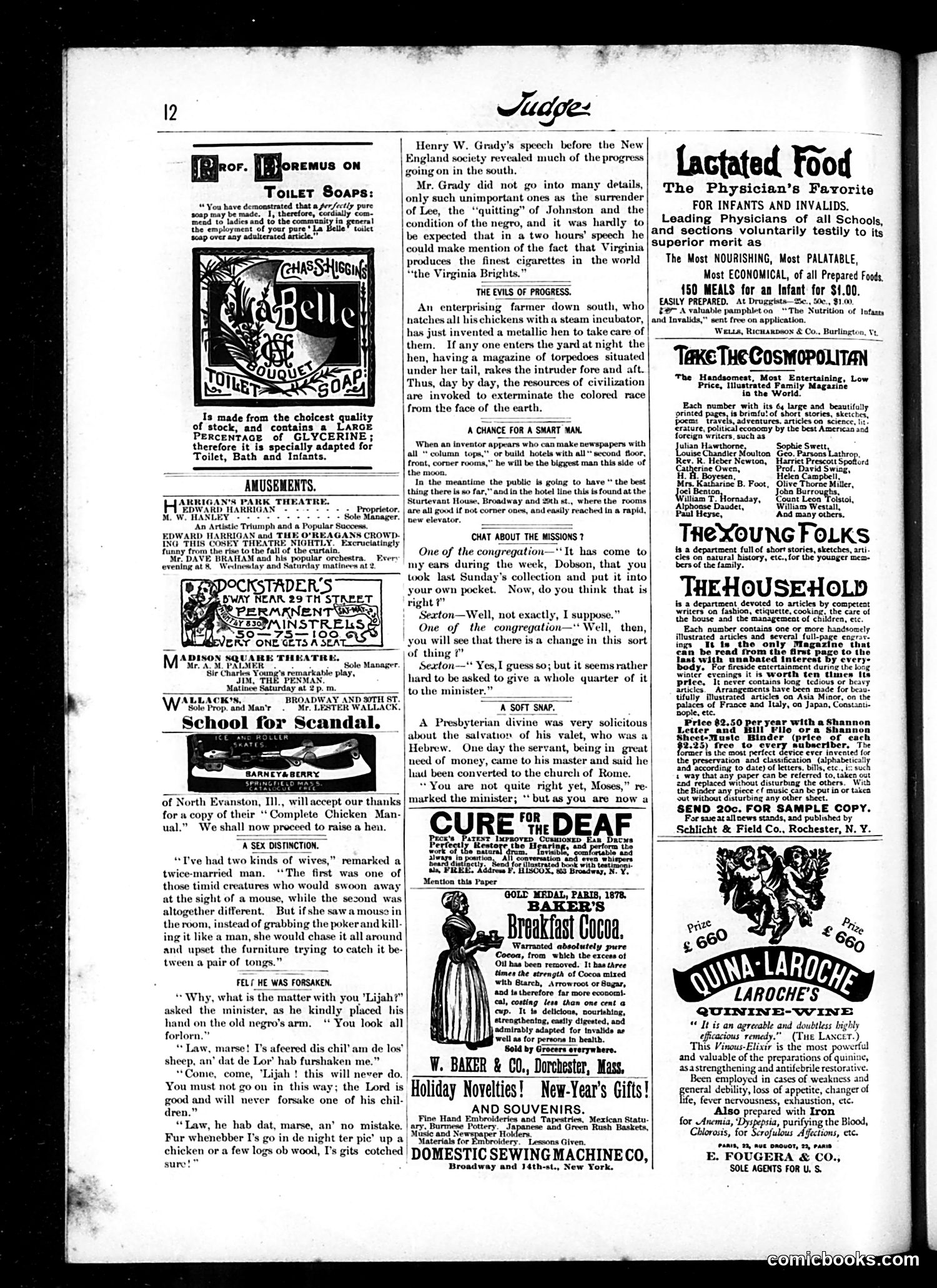
This page from *Judge* magazine contains several satirical pieces and advertisements typical of the era. The main cartoon, "Brief Bemusing on Toilet Soaps," features a endorsement quote praising pure soap—likely satirizing how manufacturers claimed product purity while competitors used adulterants. The accompanying illustration shows the "Belle" soap brand emphasizing its glycerin content. Other humor pieces include: - **"Sex Distinction"**: A joke contrasting a timid first wife who faints at mice versus a second wife who chases them with furniture-destroying vigor—poking fun at gender stereotypes. - **"He Was Forsaken"**: A dialect-heavy joke featuring a Black minister's assistant expressing despair, using period-typical racial caricature humor. - **"Chat About the Missions"**: A church collection-plate theft joke where a sexton admits pocketing donations. The page is largely advertising for entertainment venues, soaps, cocoa, and patent medicines—reflecting *Judge*'s function as both satirical commentary and commercial vehicle for the era's products and entertainments.
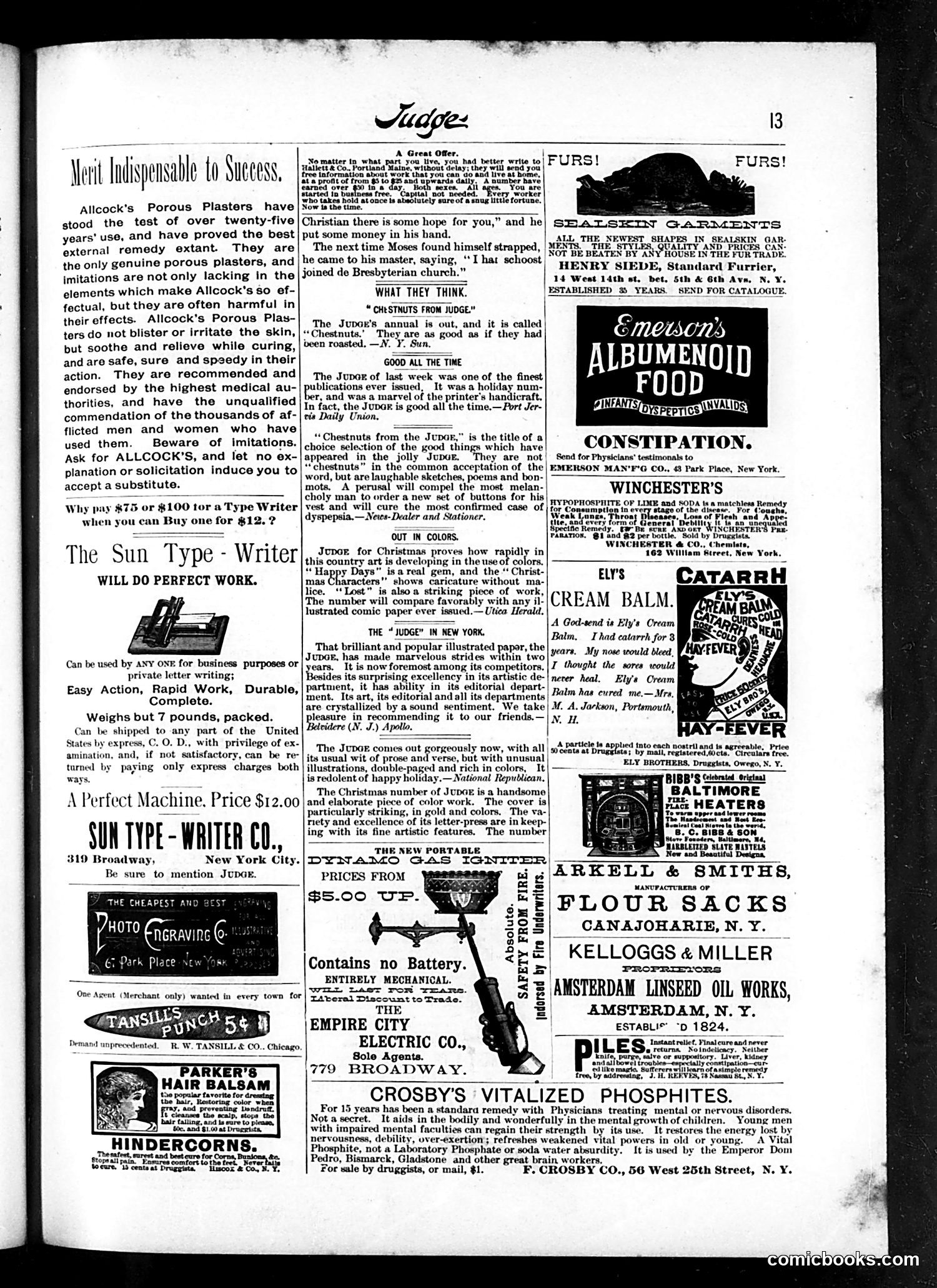
This is primarily an **advertising page** from Judge magazine, with minimal editorial content. The page showcases various patent medicines, office equipment, and commercial products typical of late 19th-century American marketing. The small editorial content includes self-promotional testimonials praising Judge's quality and artistic merit, plus a brief anecdote about "Moses" (likely a stereotyped character) joining the Presbyterian church to obtain financial assistance from his master—a joke playing on themes of opportunistic religious conversion. The advertisements reflect era-specific consumer concerns: Allcock's Porous Plasters (medical remedy), Sun Type-Writer ($12 alternative to expensive models), Ely's Cream Balm (hay fever cure), and various patent medicines. These ads target middle-class readers seeking affordable health and productivity solutions. The page serves primarily as revenue through advertising rather than satirical content, representing Judge's dual function as both humor publication and commercial vehicle.
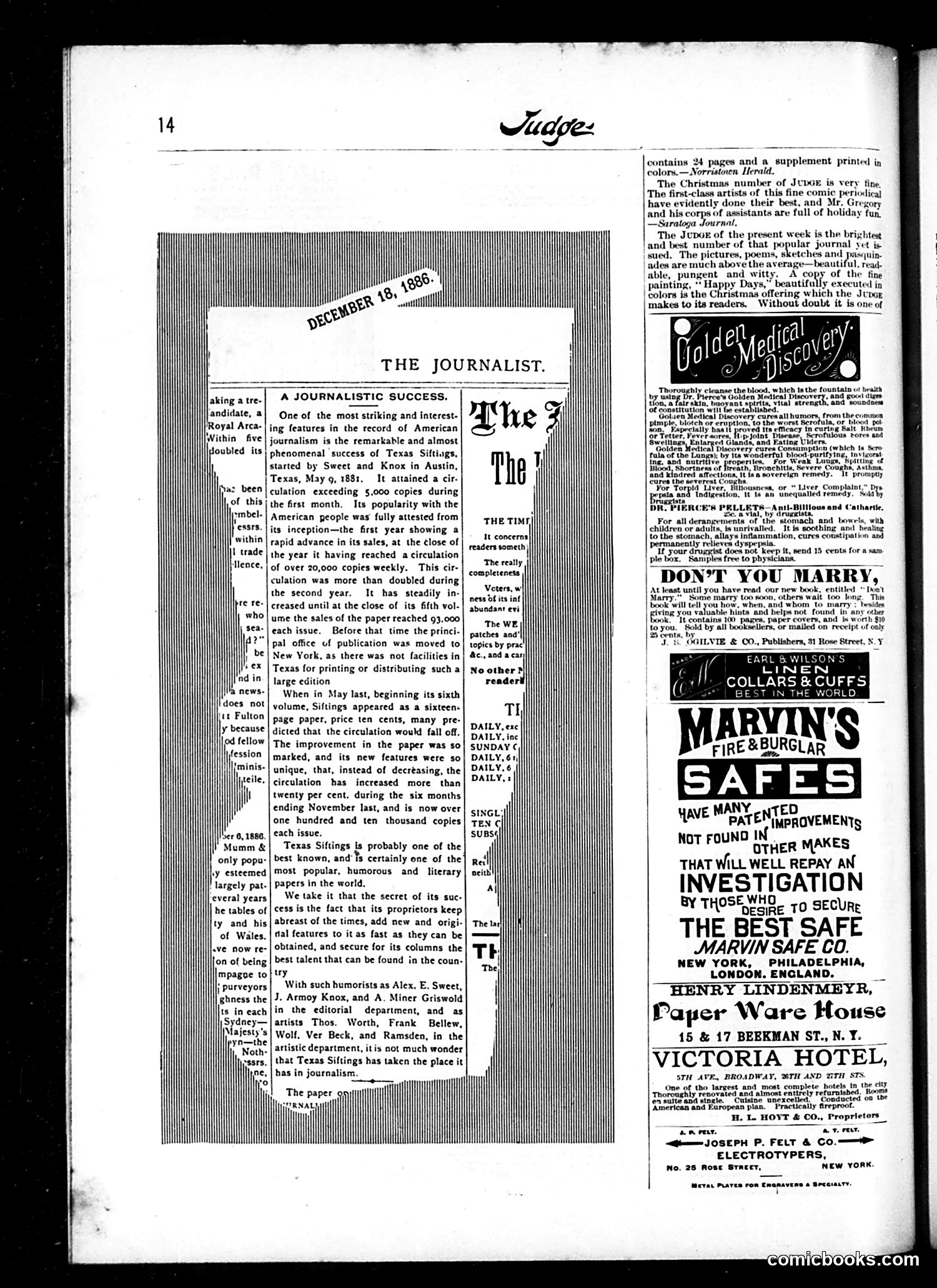
This page is primarily **editorial content praising Texas Siftings**, a rival humorous newspaper that launched in Austin in 1881. The article celebrates Siftings' rapid growth from 5,000 weekly copies to over 110,000 within five years—an extraordinary success attributed to keeping current with reader interests and employing top comic talent like Alex E. Sweet and artist Thomas Worth. The right column contains **advertisements** for patent medicines (Dr. Pierce's Golden Medical Discovery), safes, collars, and hotels—typical Judge content. **For modern readers**: This reveals Judge's competitive journalism landscape and its frank celebration of competitors' success. The tone suggests mutual professional respect despite being rivals. The emphasis on circulation numbers reflects how 1880s publishers measured success, while the named humorists and artists show Judge's awareness of audience-drawing talent. The page contains **no political satire**—it's primarily a trade-focused article and ads typical of period magazine content.
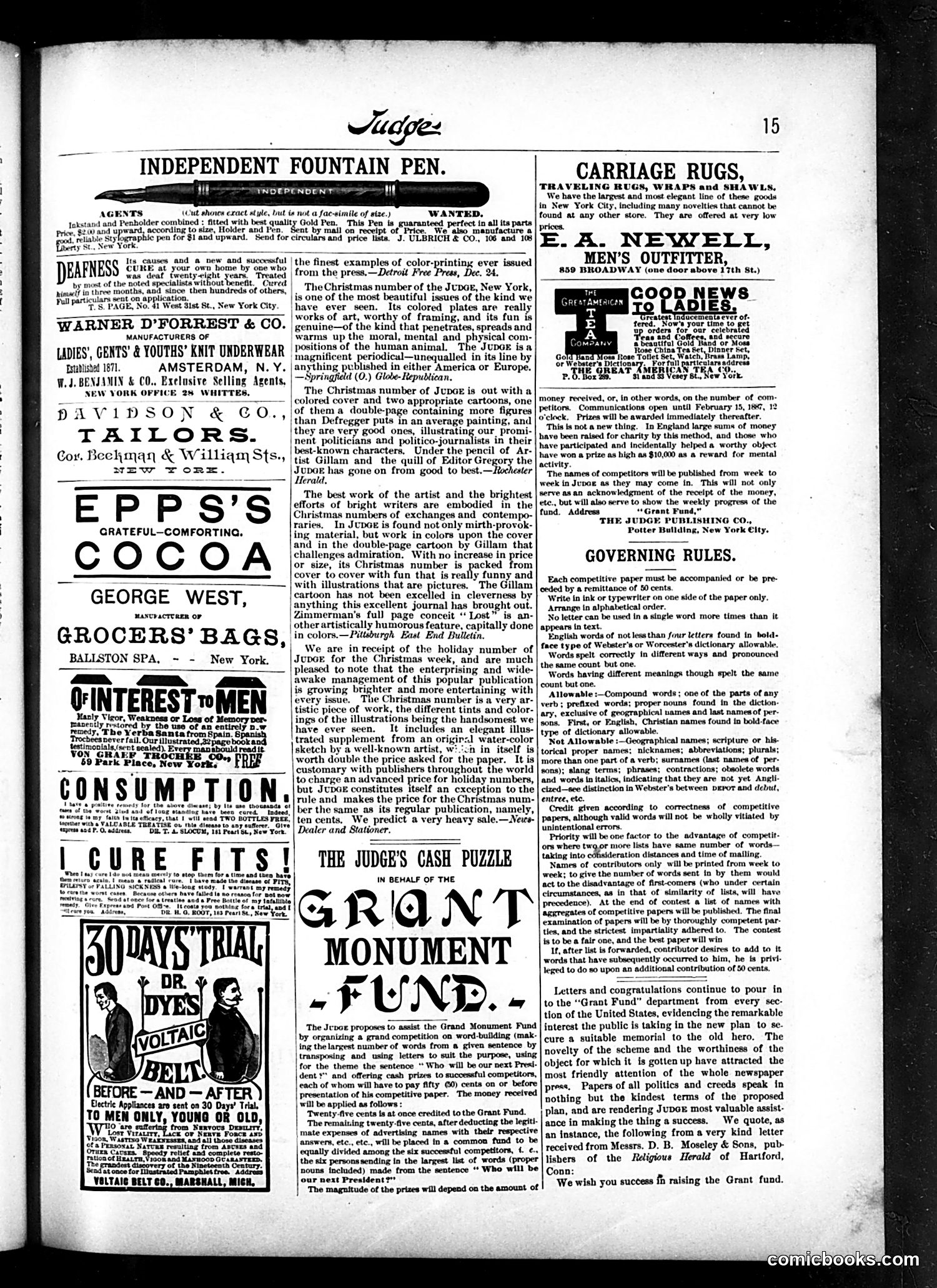
This page is primarily **advertisements and promotional material** for Judge magazine's Christmas issue, not a political cartoon page. The bulk of the content consists of: 1. **Testimonial reviews** praising Judge's Christmas number for its color printing quality and artistic cartoons by artist Gillam 2. **Commercial advertisements** for diverse products: fountain pens, deafness cures, knit underwear, tailoring services, cocoa, groceries, patent medicines (including dubious "vigor" treatments and consumption cures) 3. **A reference** to an upcoming "Judge's Cash Puzzle" contest benefiting the Grand Monument Fund The single substantive political/editorial content is mention of Gillam's double-page cartoon featuring "prominent politicians and politico-journalists in their best-known characters"—but that cartoon itself isn't visible on this page. The reviews emphasize Judge's reputation for intelligent satire combined with artistic merit and humor aimed at middle-class readers.
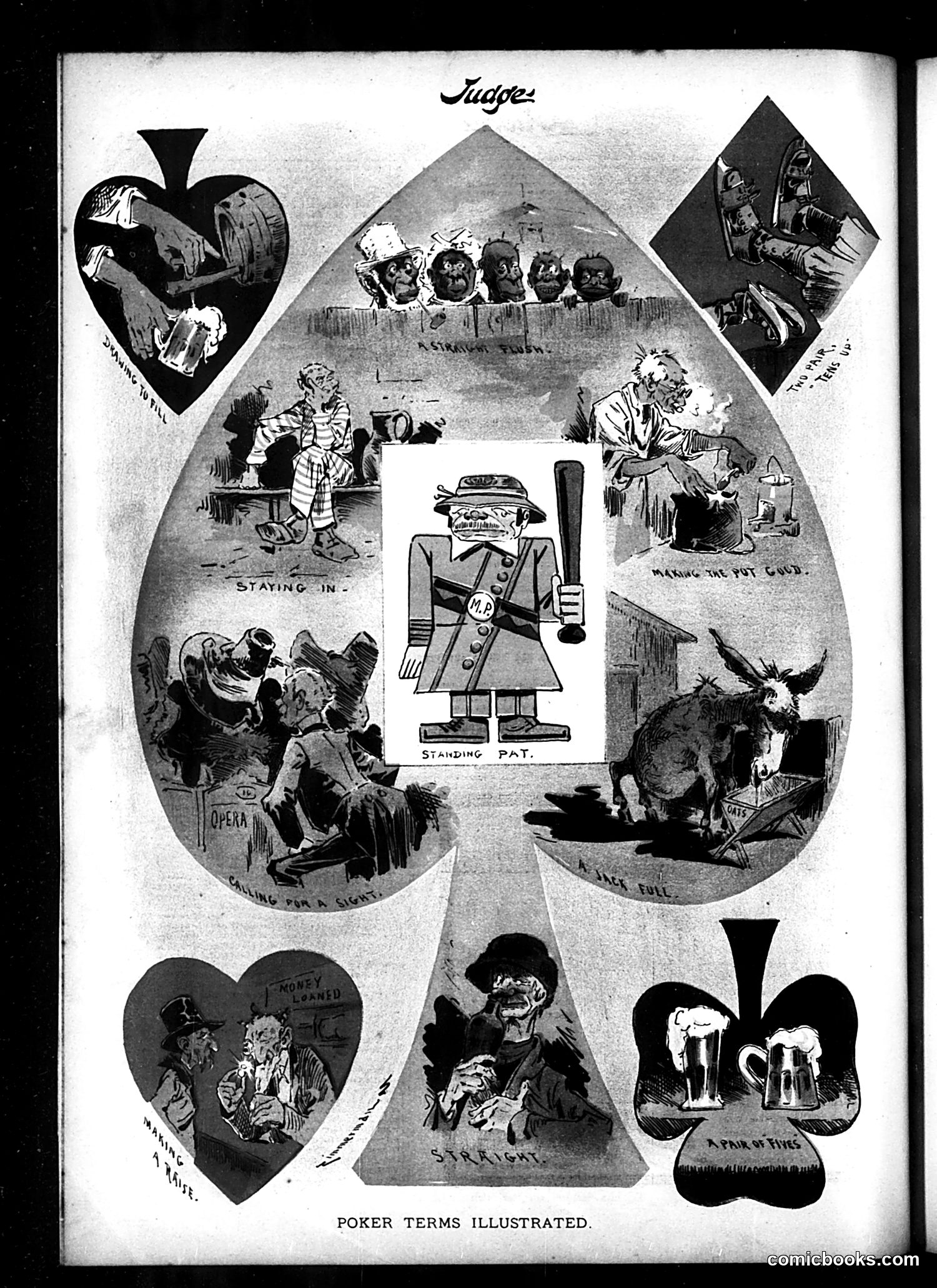
This page from *Judge* uses playing-card suit symbols (hearts, diamonds, clubs, spades) to organize satirical vignettes illustrating poker terminology through social commentary. The central figure labeled "Standing Pat" depicts a character marked "M.P." (Member of Parliament), holding a baseball bat—likely a British political figure refusing to budge on policy. The surrounding scenes illustrate poker terms: "Staying In," "Calling for a Sight," "Making the Pot Good," and others, each showing exaggerated social situations involving caricatured figures in various states of conflict or desperation. The cartoons appear to satirize both poker gambling culture and political stubbornness, using poker metaphors to mock contemporary political figures and social behaviors. The crude caricatures and rough conditions depicted suggest criticism of lower-class gambling and its social consequences.