
A complete issue · 27 pages · 1886
Judge — December 25, 1886
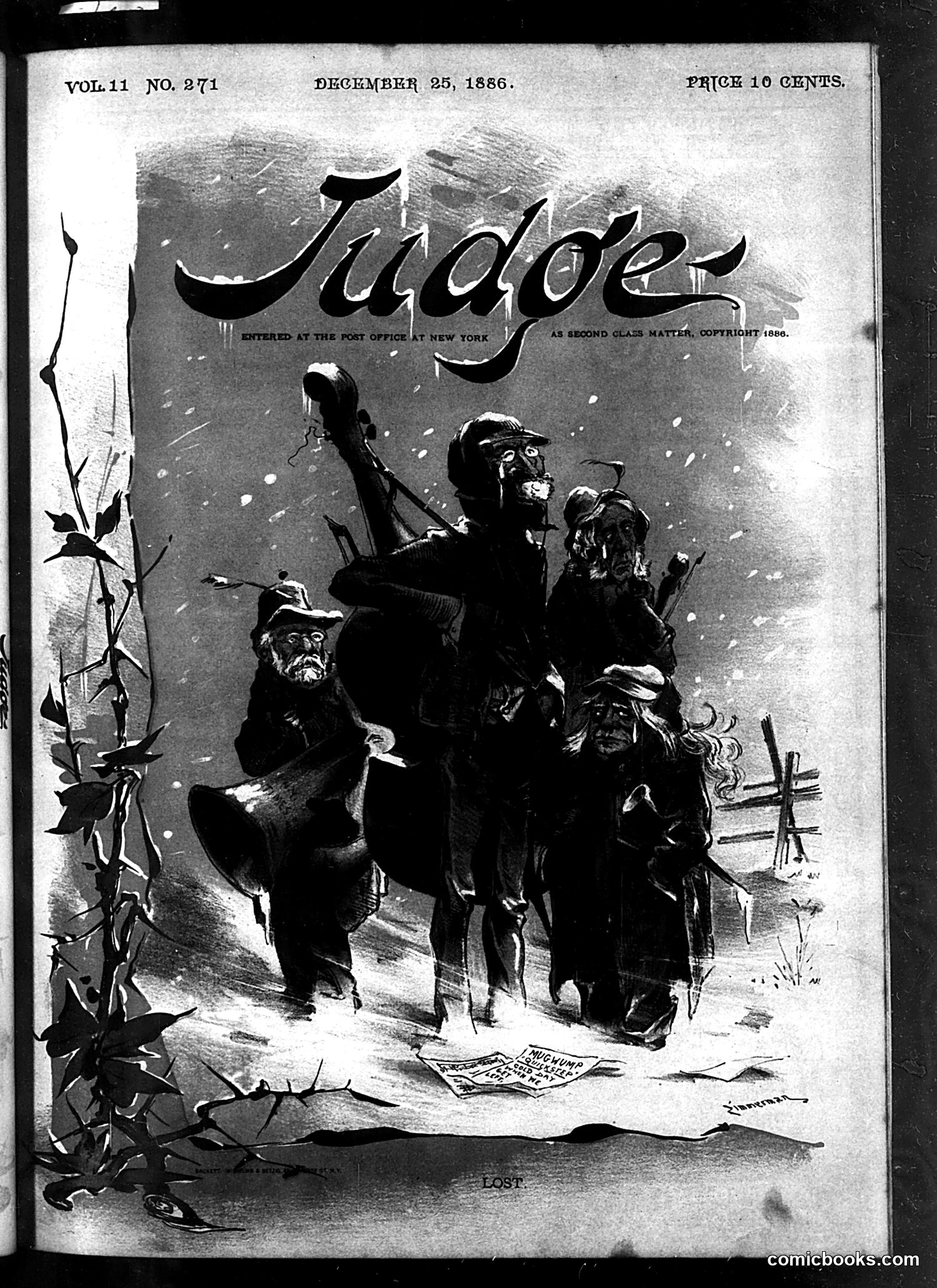
This satirical cartoon titled "Lost" depicts anthropomorphized animals—appearing to be apes or monkeys—in winter clothing searching or wandering in snow. The figures seem distressed or lost, with one holding what appears to be a newspaper or document. The specific political or social reference is unclear from the image alone. However, given the 1886 date and the imagery of "lost" figures, this likely comments on contemporary political confusion, failed policies, or displaced persons—possibly referencing labor unrest, immigration issues, or political uncertainty of the Gilded Age period. Without clearer text identifying the specific figures or event, the precise satirical target remains uncertain. The anthropomorphic animal style was common in Judge for depicting social or political groups critically.
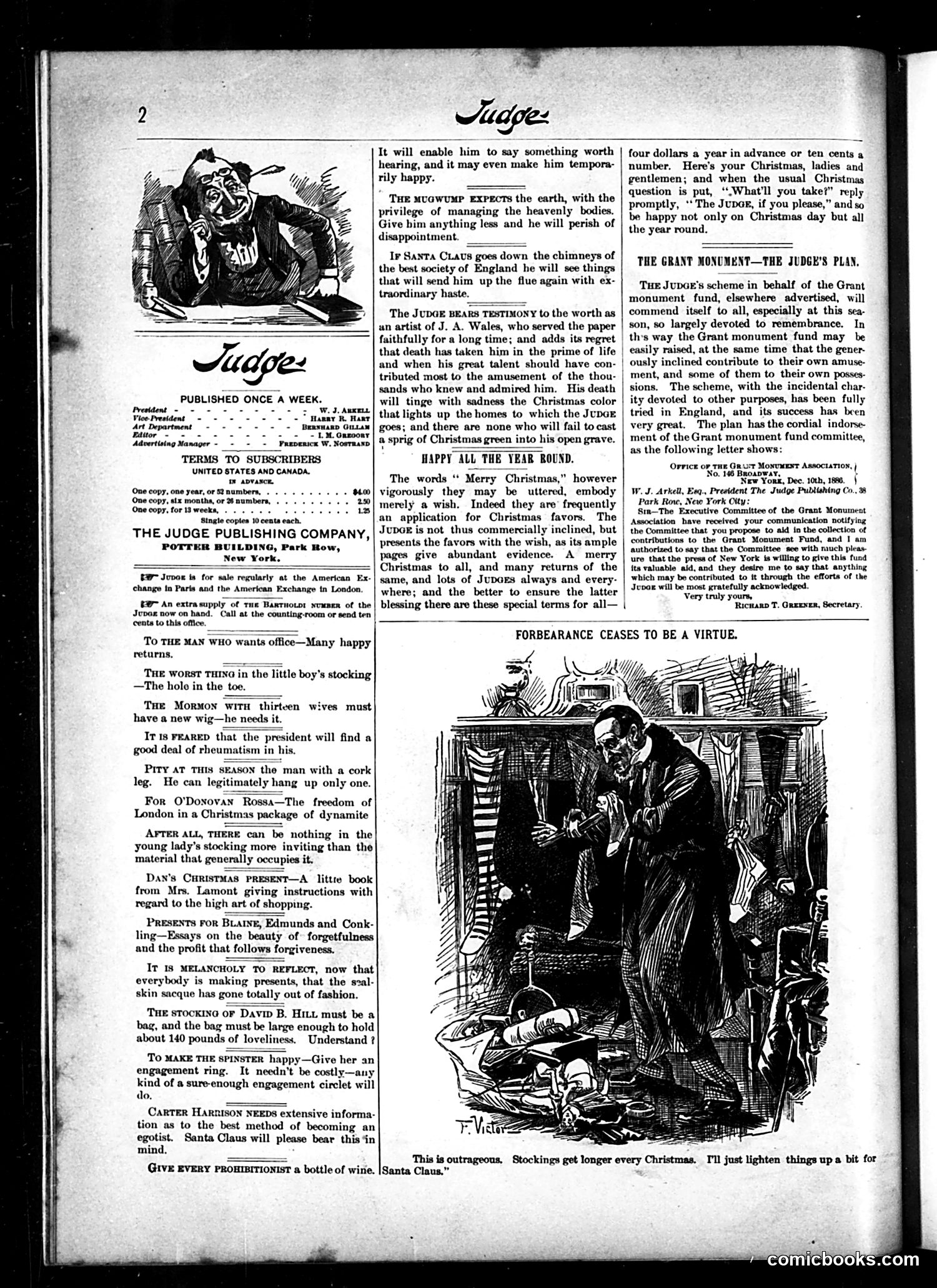
This page contains satirical commentary and a cartoon titled "Forbearance Ceases to Be a Virtue." The main illustration depicts what appears to be a domestic scene where someone is examining a child's Christmas stocking with concern—the caption reads: "This is outrageous. Stockings get longer every Christmas. I'll just lighten things up a bit for..." The joke critiques the escalating expense and size of Christmas gifts, particularly children's stockings, as consumerism grows. The frustrated figure represents parents struggling with ever-increasing holiday spending expectations. The left column contains brief satirical quips about contemporary society—including references to Mormon polygamy, presidential politics, and general social absurdities typical of Judge's humor style. The page also advertises "The Grant Monument" fundraising scheme and publication details for Judge Publishing Company.
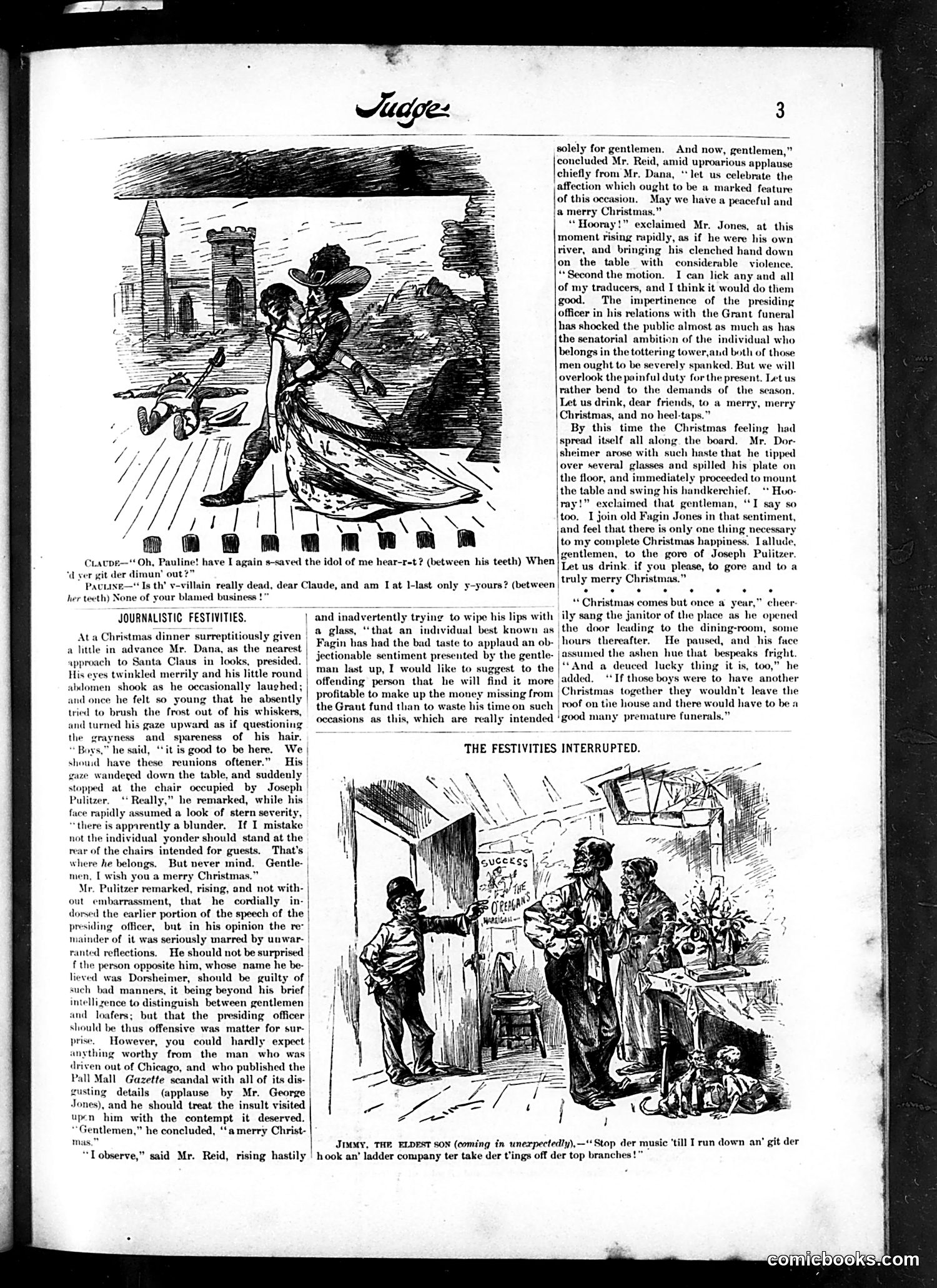
This page satirizes prominent **newspaper editors and journalists** of the Gilded Age engaged in a bitter Christmas dinner. The main figures appear to be: - **Mr. Dana** (presiding): Likely Charles Dana of the New York Sun - **Joseph Pulitzer**: Referenced as an outsider who doesn't belong at the "gentlemen's" gathering - **Mr. Reid**: Another newspaper proprietor - **Mr. Jones**: Appears to be George Jones, associated with exposing scandals - **Mr. Dorsheimer**: Another figure in the dispute The satire mocks the **intense professional rivalries and personal animosities** between competing newspaper publishers. Despite toasting "Christmas feeling" and brotherhood, these editors immediately begin insulting each other—attacking Pulitzer's background, referencing scandals (the "Mail Gazette scandal"), and even fantasizing about violence ("the gore of Joseph Pulitzer"). The cartoon illustrations show their heated arguments. The humor lies in the **hypocrisy**: they pledge peace and goodwill while seething with contempt, revealing journalism's cutthroat competitive culture beneath polite society's veneer.
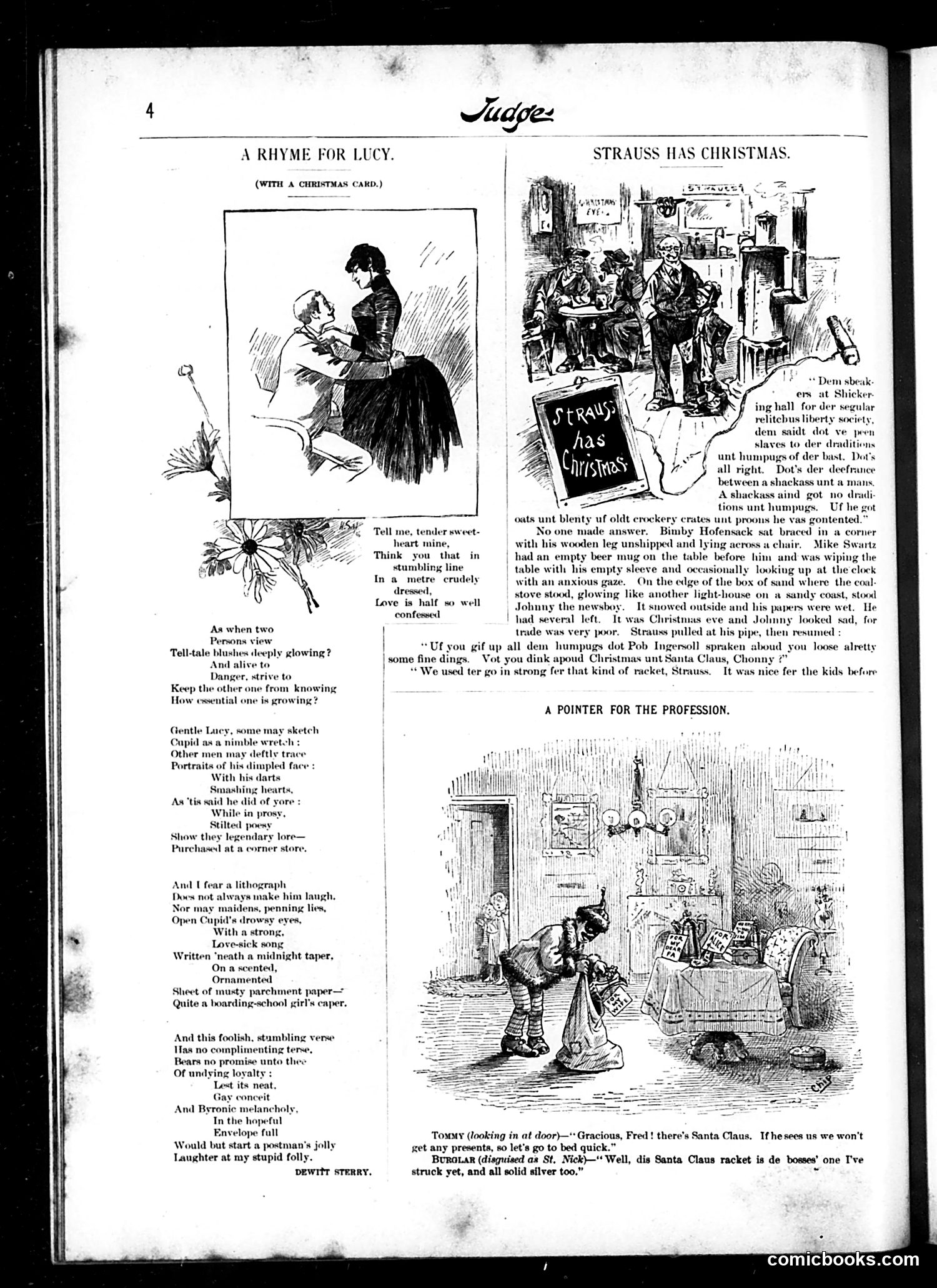
This page contains three separate satirical pieces typical of late 19th-century American humor: **"A Rhyme for Lucy"** (left): A sentimental Christmas poem mocking romantic verse conventions—the author (DeWitt Sterry) deliberately writes awkwardly to parody overwrought love poetry and flowery greeting-card sentimentality. **"Strauss Has Christmas"** (top right): A narrative sketch about poor German immigrants on Christmas Eve. Strauss (likely a working-class character, given the German dialect) discusses with Johnny, a newsboy, whether to abandon religious belief following Robert Ingersoll's atheist arguments. The story depicts working-class poverty and immigrant skepticism toward traditional Christmas values—socially relevant commentary on immigration and secularism. **"A Pointer for the Profession"** (bottom right): A cartoon mocking burglars disguised as Santa Claus, stealing silver. This jokes about crime exploiting holiday traditions—a practical "tip" for thieves that simultaneously critiques holiday commercialism and urban crime concerns of the era. The overall tone reflects Judge's satirical approach to contemporary social issues: sentimentality, religious doubt, poverty, and urban criminality.
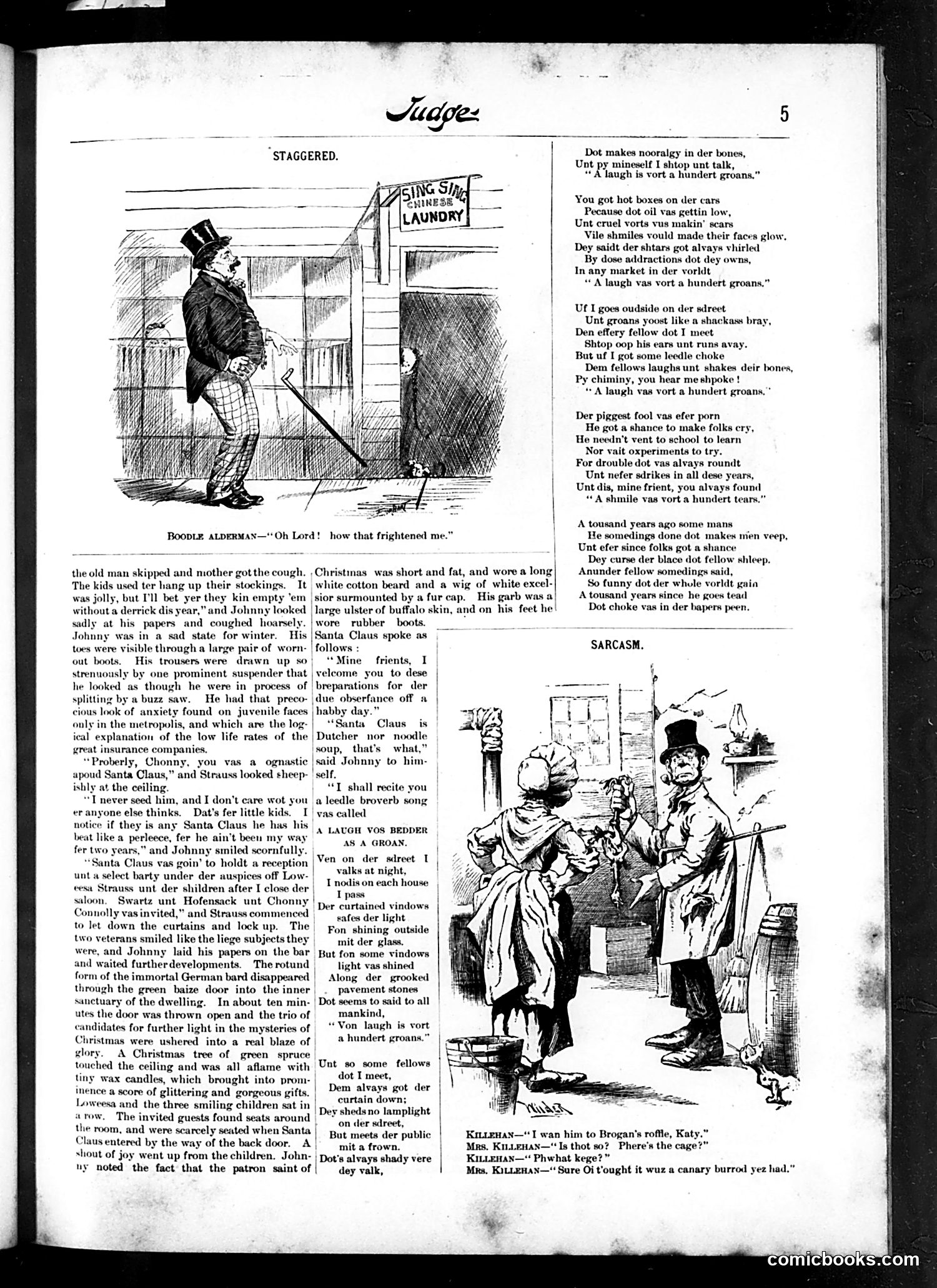
This page satirizes poverty and economic hardship among working-class immigrants during what appears to be the late 19th century. The main cartoon, "Staggered," depicts a young newsboy named Johnny in desperate circumstances—worn boots, tattered clothes held by a single suspender, coughing from illness. He's cynical about Santa Claus, having received nothing for two years. The satire centers on a German immigrant saloon-keeper (Strauss) who stages a Christmas party for poor children, attempting to restore their hope and joy. The poem that follows, "A Laugh Was Better As a Groan," reinforces the message that laughter and kindness are more valuable than material goods, even for the desperately poor. The heavy German dialect and caricatured immigrant speech patterns reflect period attitudes toward German immigrants, while the overall narrative advocates for human compassion toward the impoverished—a progressive message for Judge's satirical approach to social issues.
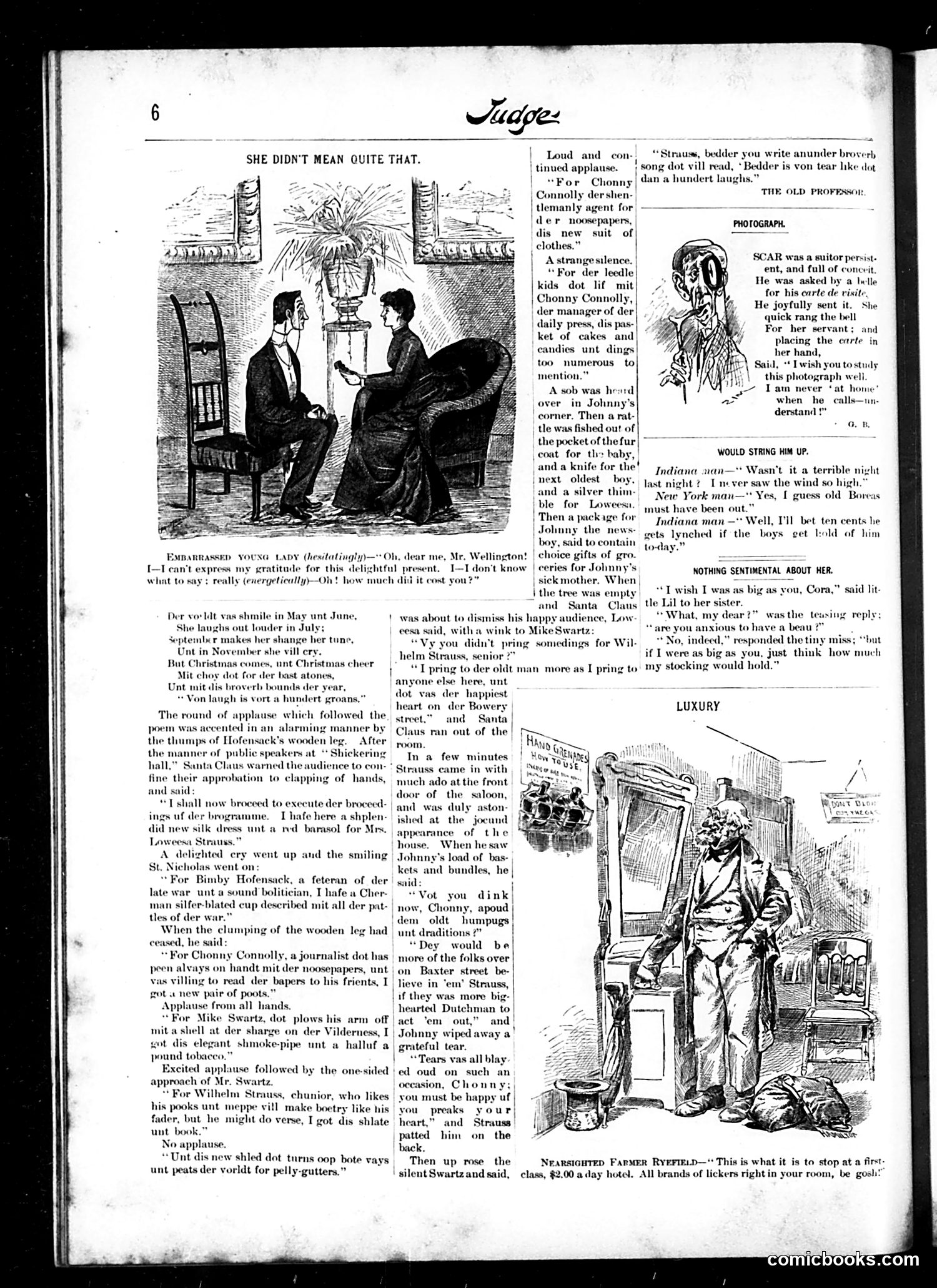
This page from Judge magazine contains multiple satirical pieces satirizing German-American characters and dialect humor popular in late 19th-century American comedy. **Main cartoon "She Didn't Mean Quite That"**: A young woman receives a gift from a suitor named Mr. Wellington. Her embarrassed response to his question about cost—"Oh! how much did it cost you?"—is misinterpreted as greedy rather than polite surprise, creating the humor through misunderstanding. **"The Old Professor" and related sketches**: These feature German-American characters (identifiable by phonetic dialect spelling: "vos," "dot," "der") recounting Christmas charity. A character named Chonny Connolly distributes gifts to poor families, praised in exaggerated German-accented English. The humor relies on ethnic stereotyping and sentimental working-class narratives. **"Scar" and "Nothing Sentimental About Her"**: Brief romantic vignettes depicting courtship and sibling rivalry, using conventional period sentiment. The page primarily uses ethnic humor and dialect comedy now considered offensive stereotyping.
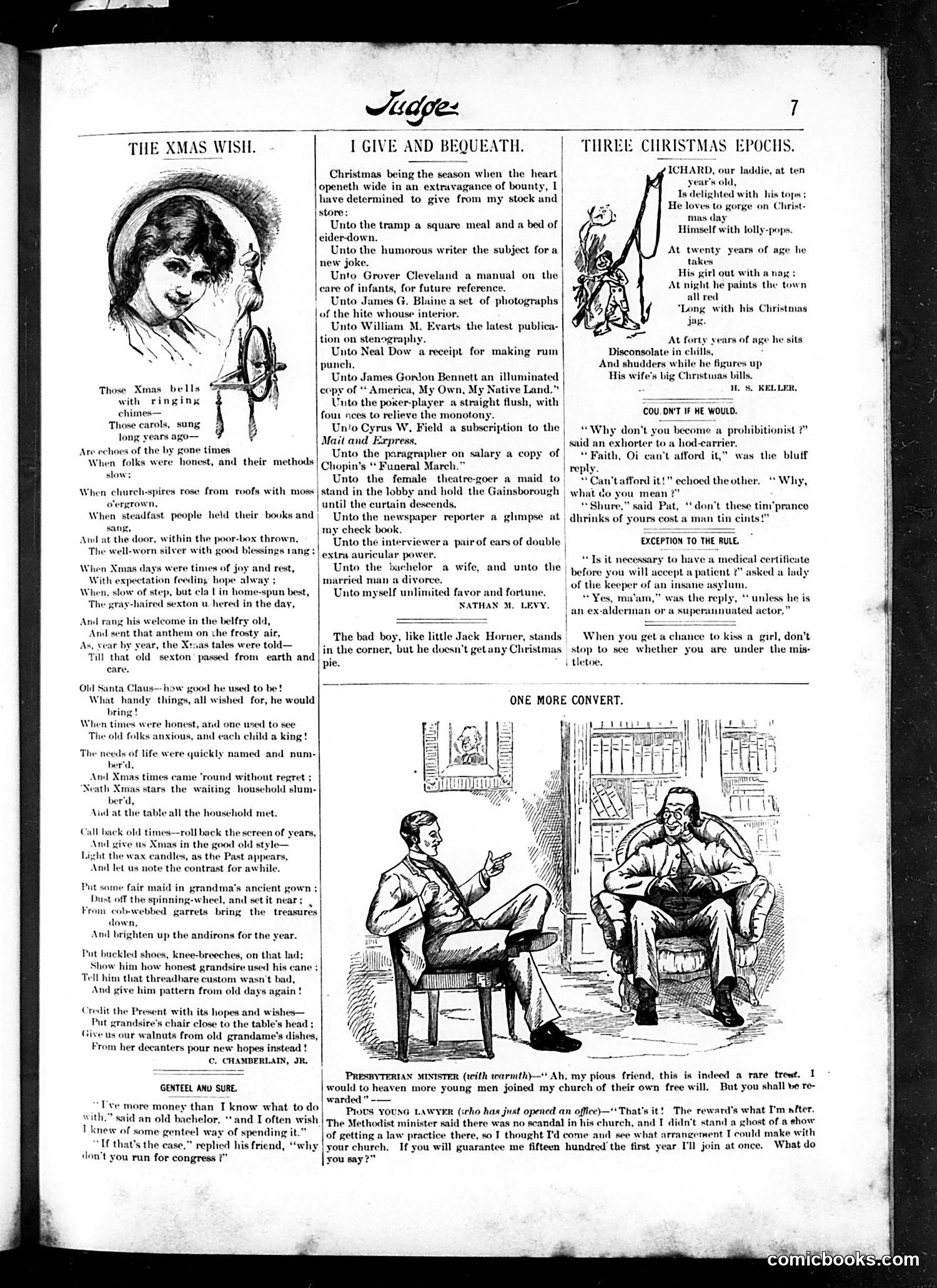
This page contains Christmas-themed satirical content from what appears to be the late 19th century (references to Cleveland, Blaine, and Evarts suggest the 1880s). **"The Xmas Wish"** (left column) is a nostalgic poem lamenting the loss of honest, simpler times. It contrasts past Christmases—with their genuine charity, church attendance, and modest values—with the present's materialism and decline in virtue. **"I Give and Bequeath"** (center) is a mock-gift list satirizing prominent figures of the era: Grover Cleveland receives a manual on infant care; James G. Blaine gets photographs of the White House interior; Neal Dow (a prohibitionist) receives a rum-punch recipe. The humor lies in giving each person something ironically opposite to their public persona or interests. **"Three Christmas Epochs"** (right) humorously traces a man's life through Christmas celebrations: as a boy enjoying toys, at twenty pursuing women, at forty reckoning with accumulated debts and responsibilities. **"One More Convert"** (bottom) depicts a conversation where an exhorter urges a laborer to become a prohibitionist, but the man replies he cannot afford temperance drinks—a joke about working-class economics and the gap between moral exhortation and practical reality.
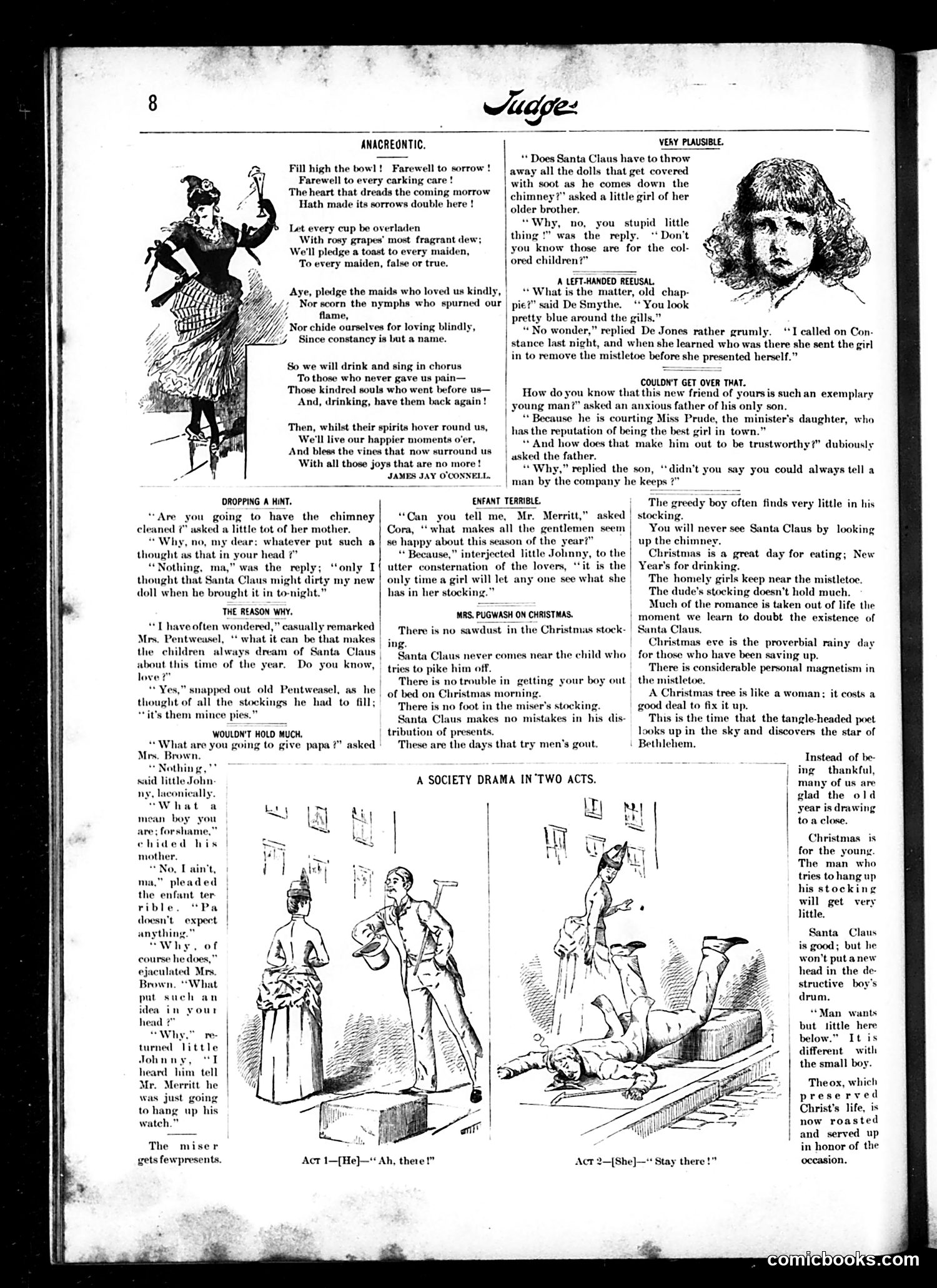
This page from *Judge* (a satirical weekly) contains multiple short humorous pieces mocking Victorian-era social pretensions and holiday customs, primarily centered on Christmas and courtship. The content includes satirical commentary on: - **Santa Claus racism**: A cruel joke about dolls covered in soot being "for the colored children"—reflecting the racist attitudes of the era. - **Courtship hypocrisy**: Multiple pieces lampoon young men's moral character and women's strategic use of mistletoe etiquette to control romantic situations. - **Class anxiety**: References to servants, mistletoe removal, and the "miser's stocking" mock both wealthy and poor pretensions. - **Children's bluntness**: "Enfant Terrible" jokes where children expose adult hypocrisy—a girl mentioning stockings as opportunities to see underwear, for instance. - **A two-act society drama** (illustrated): Shows a physical farce where a man and woman apparently quarrel over something (unclear from this image alone). The overall tone is cynical about Christmas commercialism, romantic dishonesty, and social climbing.
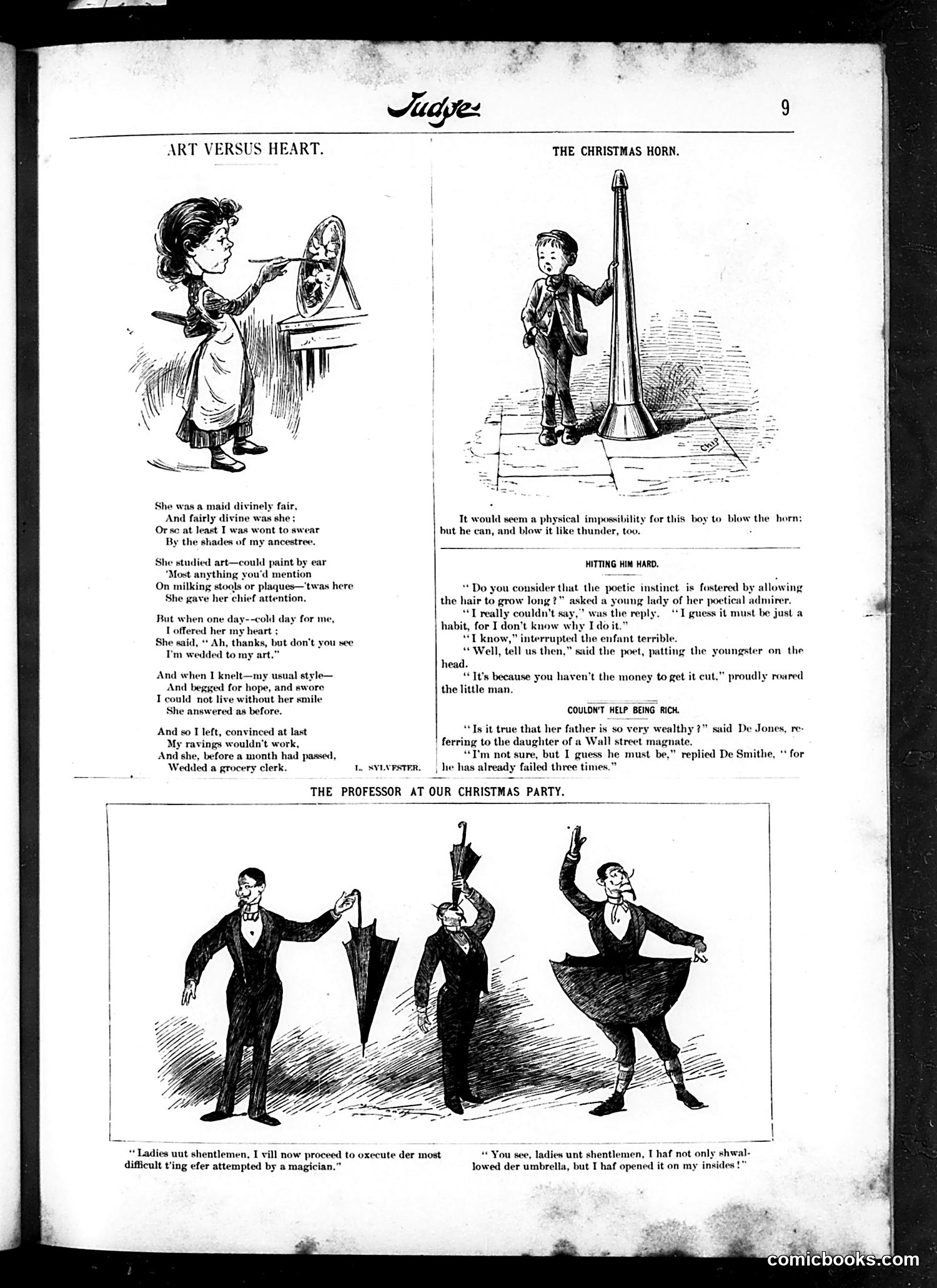
This page contains four separate humorous pieces typical of late-19th/early-20th-century American satire: **"Art Versus Heart"**: A poem mocking the pretensions of an artistically ambitious woman who rejects a suitor's marriage proposal by claiming devotion to her art, only to marry a grocer's clerk shortly after—satirizing false artistic pretenses and romantic hypocrisy. **"The Christmas Horn"**: A visual joke about a boy impossibly playing a large horn despite his small size. **"Hitting Him Hard"**: A joke where a precocious child embarrasses a vain poet by bluntly stating he grows his hair long because he can't afford haircuts—mocking bohemian affectation and pretentious poverty. **"Couldn't Help Being Rich"** and **"The Professor at Christmas Party"**: Brief jokes about wealthy financiers' repeated bankruptcies and a performer's magician act, likely featuring ethnic dialect humor (the "Professor" appears to use German-accented English). All content reflects Judge's focus on social satire, vanity, and class commentary through situational humor.
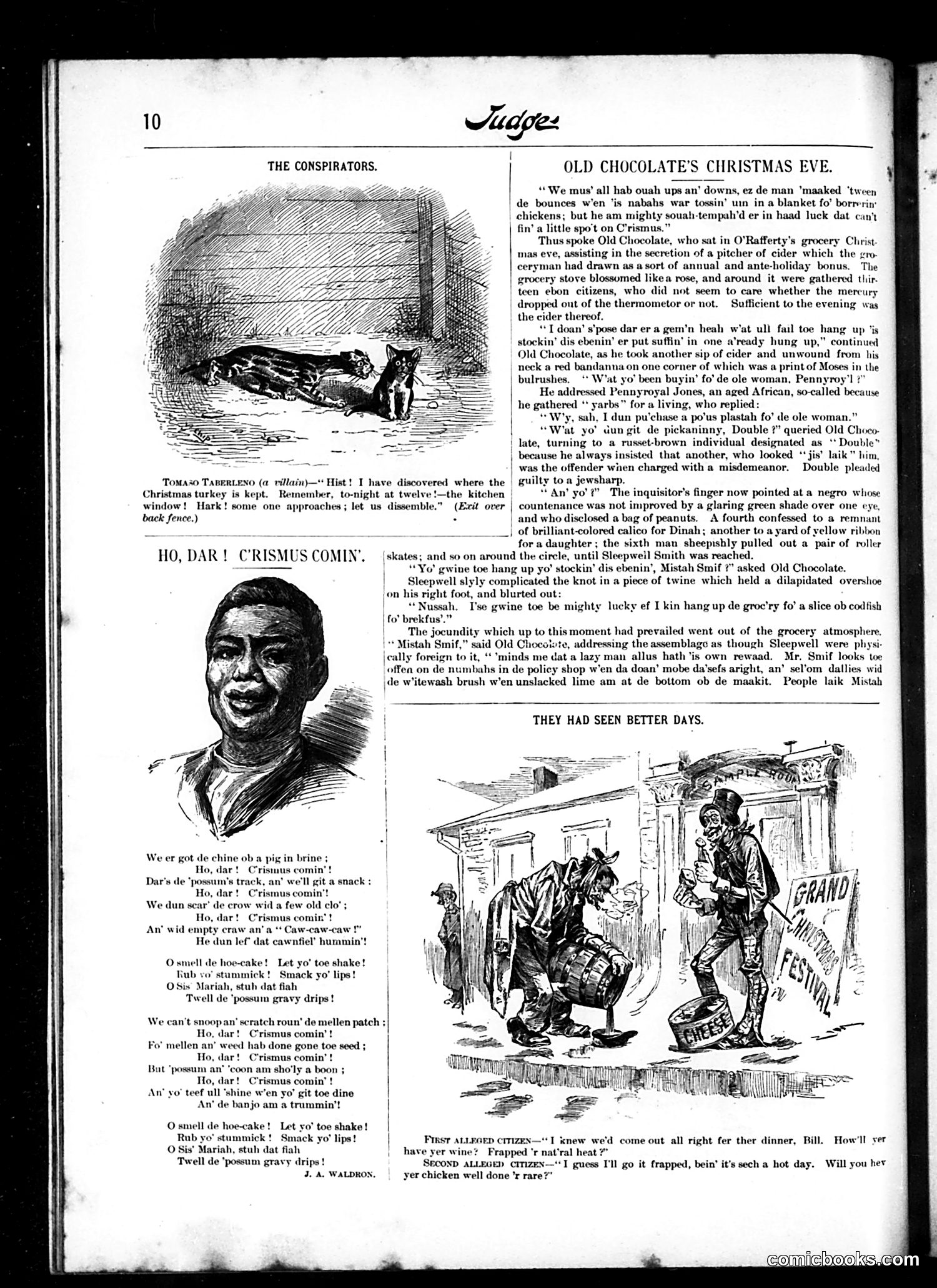
This page contains two satirical pieces stereotyping African Americans in late 19th-century Judge magazine. **"The Conspirators"** depicts an elaborate theft plot involving named Black characters stealing a Christmas turkey from a grocery store—a joke playing on racist stereotypes about Black criminality and dishonesty. **"Old Chocolate's Christmas Eve"** shows a gathering of Black men in O'Rafferty's grocery store discussing modest Christmas purchases (peanuts, calico, roller skates). The humor derives from minstrelsy-style dialect and the contrast between their poverty and holiday aspirations. The accompanying poem celebrates stereotypical "Negro" foods (possum, hoe-cakes) in exaggerated dialect. Both pieces use heavily exaggerated phonetic spelling to represent African American speech as comical and subhuman. The satire reflects Judge's editorial stance: ridiculing Black Americans' economic struggles and cultural practices as inherently laughable rather than sympathetic. This represents the deeply racist visual and textual humor normalized in late 19th-century American satirical publications.
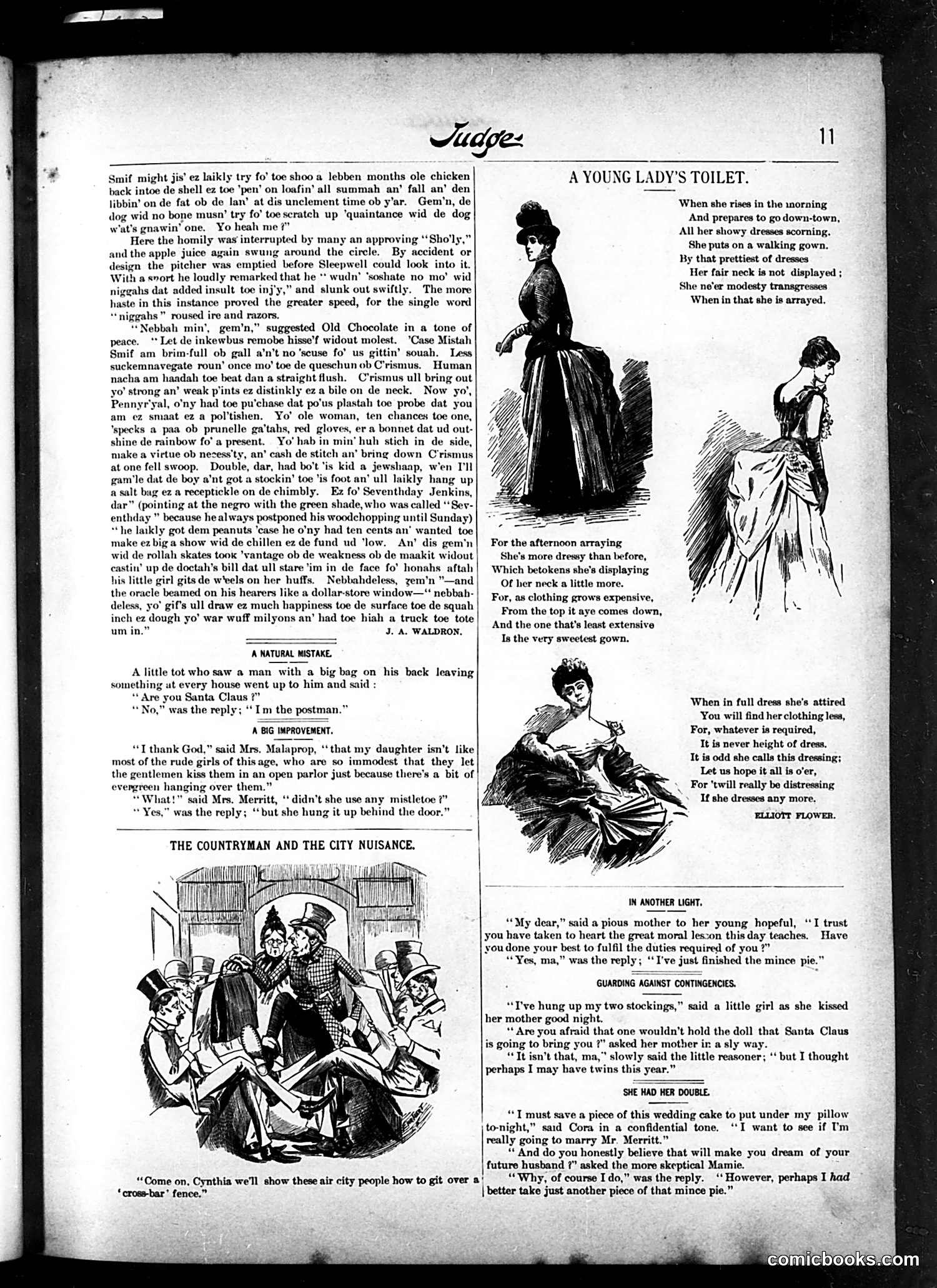
This page from *Judge* contains several satirical pieces typical of late 19th-century American humor: **Main content**: A lengthy dialect monologue by "Old Chocolate," an African American character, offering folk wisdom about Christmas gifts. The piece uses heavy racial dialect and stereotypes common to the era—this was considered "humor" at the time but reflects deeply racist attitudes. **Side cartoons and brief jokes** mock various social types: a child mistaking a postman for Santa Claus; a woman praising her daughter's modesty while admitting she hung mistletoe *behind* a door to avoid being kissed in the parlor (the joke being the contradiction); and a countryman threatening to show city people how to jump a fence. **"A Young Lady's Toilet"**: A poem (with accompanying illustrations) satirizing female fashion and vanity—women supposedly dressing modestly for morning walks but more elaborately for afternoon outings. The page reflects period attitudes about race, gender, and class through crude stereotyping and gendered expectations now recognized as offensive.
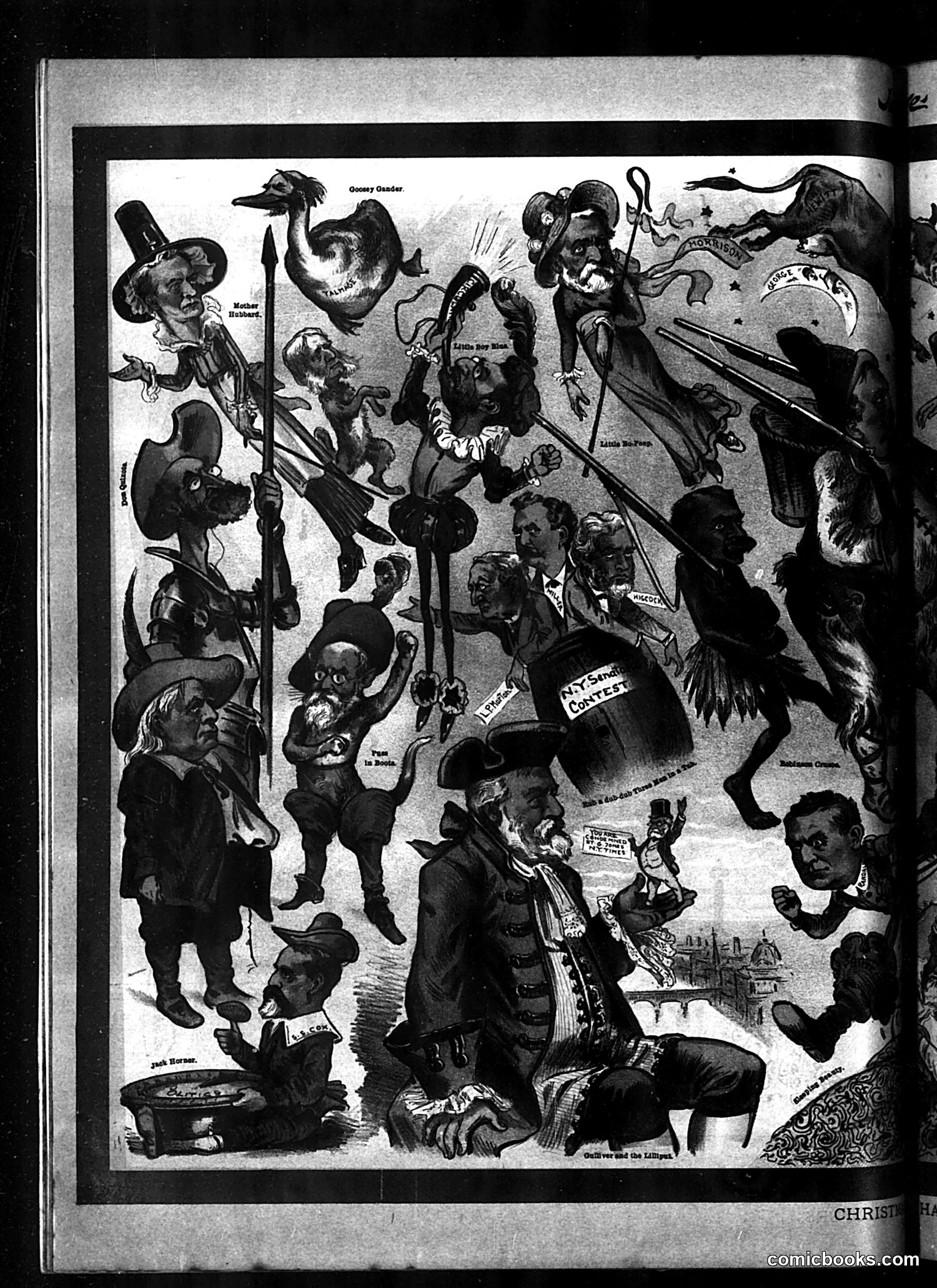
This appears to be a satirical cartoon featuring caricatured figures engaged in various political machinations. The image shows multiple grotesque characters in period dress (likely late 19th or early 20th century) depicted as animals or demons alongside human figures in formal attire. Labels visible include references to political positions and what appear to be commentary on corruption or political scheming. The cartoon uses the common satirical technique of depicting politicians or public figures as animals or monsters to suggest moral degeneracy. However, the OCR text is largely illegible, preventing precise identification of the specific figures, events, or political controversies being lampooned. Without clearer text or additional context, the exact satirical targets remain unclear to a modern reader.
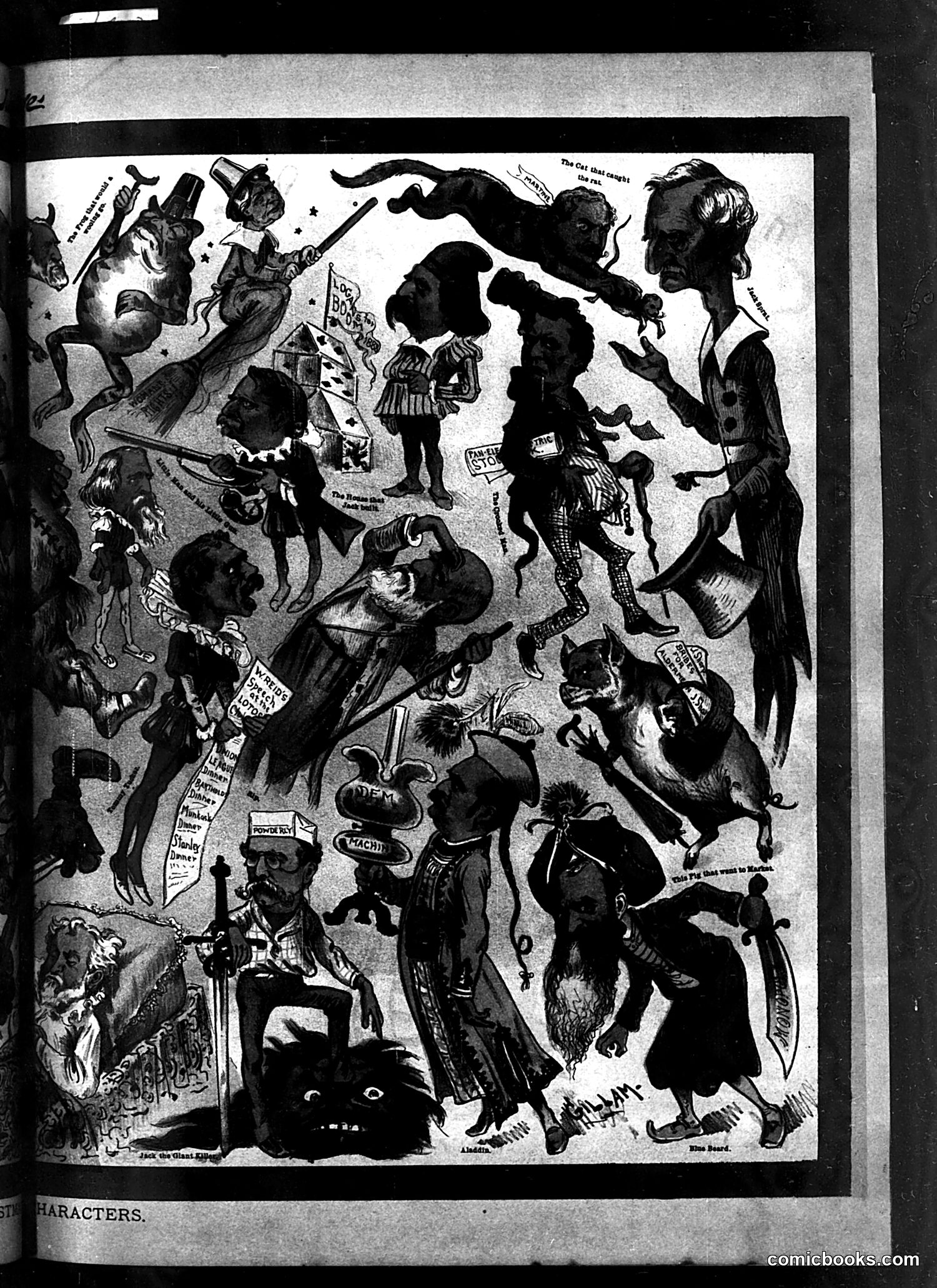
This appears to be a satirical illustration titled "CHARACTERS" depicting various figures in a chaotic, fantastical scene. The style suggests late 19th or early 20th-century American political satire. The image shows numerous caricatured figures—some appearing ape-like or demonic, others in formal dress or costumes—engaged in seemingly absurd activities. Several visible labels reference politicians or public figures, though specific text is difficult to read clearly in this reproduction. The composition suggests commentary on contemporary political figures or social types, likely mocking their behavior or influence. The grotesque, exaggerated caricatures are typical of Judge magazine's approach to political criticism through visual hyperbole. Without clearer text visibility, I cannot identify specific individuals or pinpoint the exact political events referenced, though the dense, carnival-like arrangement suggests commentary on multiple public figures or scandals simultaneously.
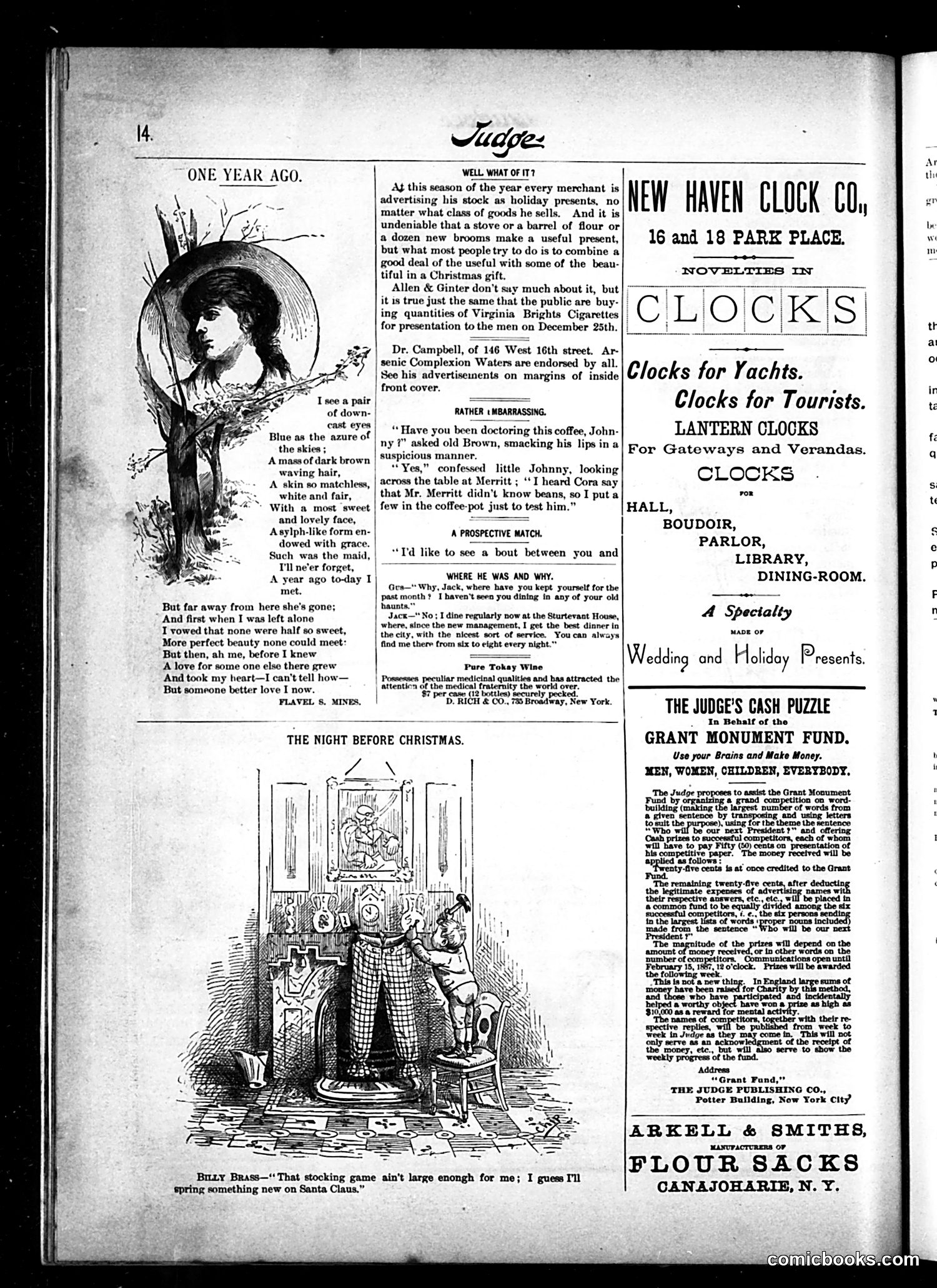
This Judge magazine page contains several short humorous pieces and advertisements, primarily aimed at holiday gift-giving. **Main Content:** The page features a romantic poem titled "One Year Ago" about lost love, alongside domestic humor pieces—one about a child doctoring his father's coffee with beans to "test" Mr. Merritt (who supposedly "doesn't know beans"), and another about a man who dines nightly at the Sturtevant House restaurant. **"The Night Before Christmas" Illustration:** Shows a child preparing an oversized stocking, joking he'll "spring something new on Santa Claus"—a visual pun suggesting physical tricks rather than gift surprises. **Advertisements dominate the right side,** promoting New Haven Clock Company (with specialized clocks for yachts and tourists), cigarettes for Christmas gifts, and a "Judge's Cash Puzzle" promoting the Grant Monument Fund—a fundraising competition readers could enter. The page is typical holiday-season Judge content: light sentiment mixed with gentle domestic satire and commercial promotion, aimed at middle-class readers seeking gift ideas and entertainment.
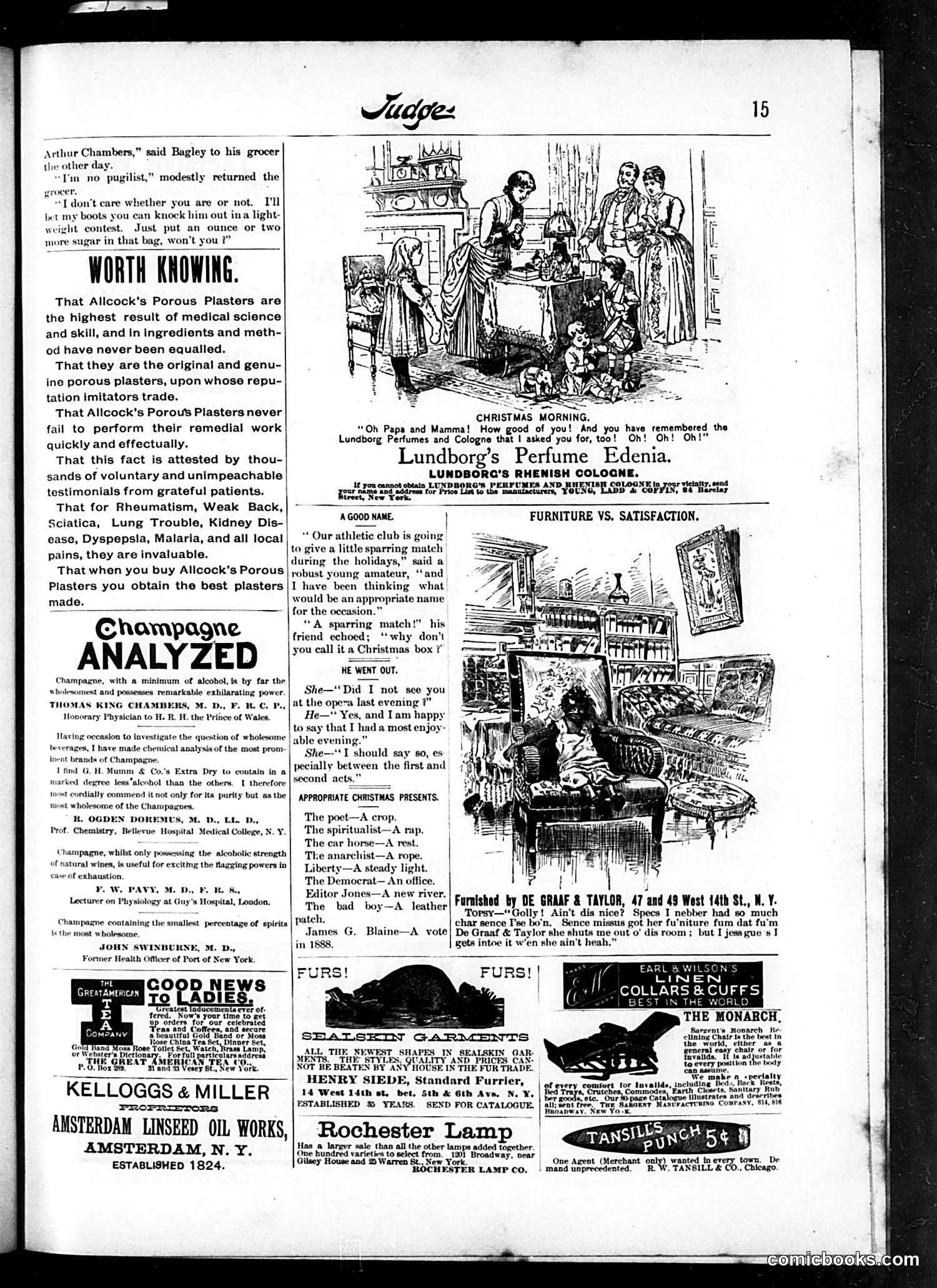
This page is primarily **advertisements and filler content** rather than political satire. The main cartoon depicts a domestic scene labeled "Christmas Morning," showing a family exchanging gifts, advertising Lundborg's Perfume. Below are several brief joke items with mild social commentary: - A grocer joke about adding sugar to bags (commerce/cheating) - "A Good Name" joke: calling a boxing match a "Christmas box" (wordplay) - "Appropriate Christmas Presents" list offering satirical gift suggestions—notably "The anarchist—A rope" (referencing contemporary anarchist concerns) and "The Democrat—An office" (partisan jab at Democrats seeking government positions) - "He Went Out" depicts a woman criticizing her husband's opera attendance The page is dominated by medical/product endorsements (Allcock's Porous Plasters, Champagne analysis by doctors, linseed oil, furniture company, fur garments, and lamps). These pseudo-scientific testimonials from physicians represent typical late-19th-century advertising tactics before modern FDA regulations. The anarchist reference suggests publication during heightened anxieties about anarchism, likely the 1880s-1890s period.
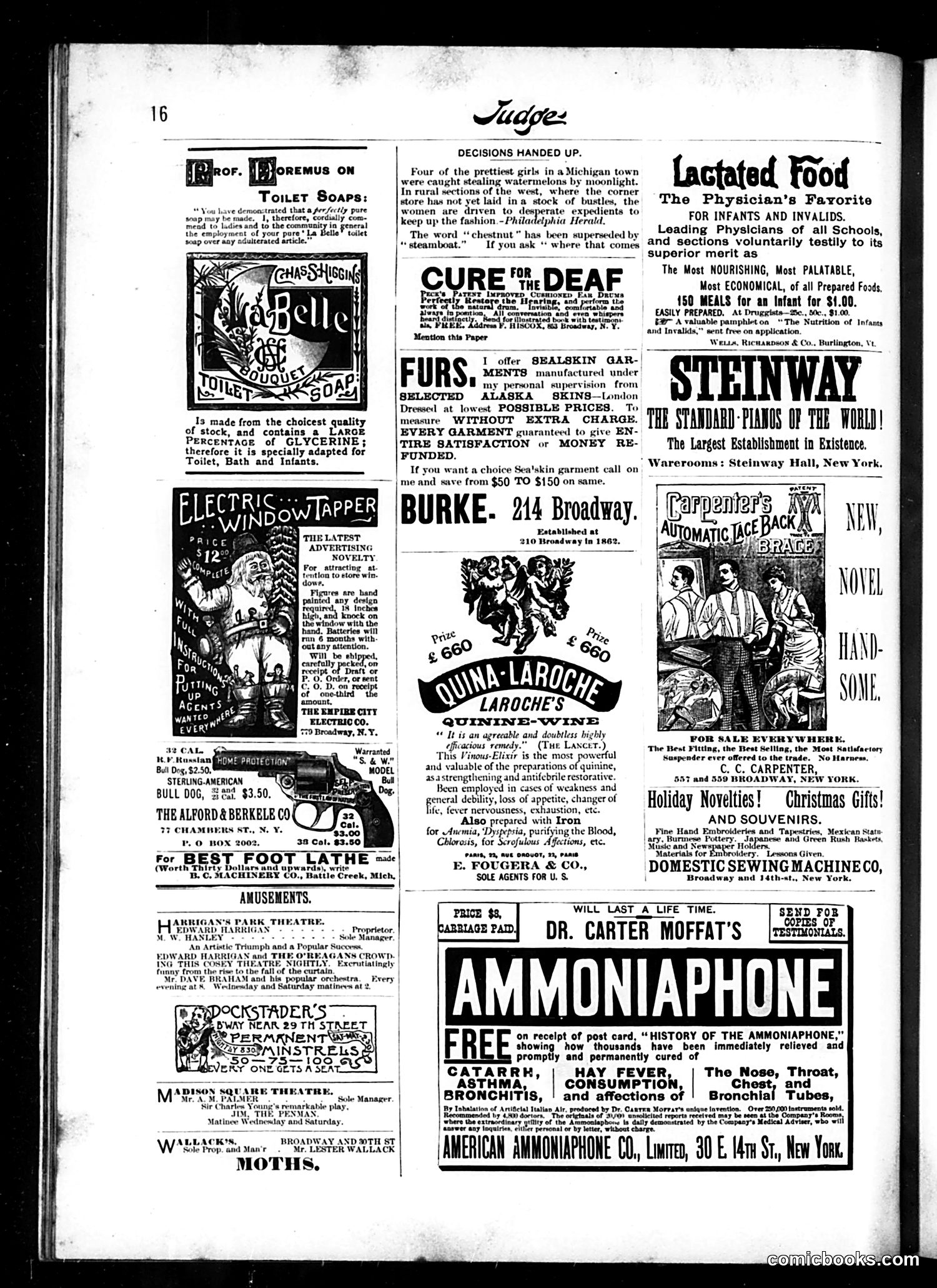
This page is primarily **advertisements and theater listings**, not political satire. Judge magazine's satirical content appears minimal here. The only identifiable editorial content is a brief "Decisions Handed Up" section referencing a Michigan news story about girls caught stealing watermelons, contrasting rural frontier fashion norms with urban expectations—a mild social observation rather than pointed satire. The rest is commercial advertising: patent medicines (Ammoniophone for catarrh, Quinine-Wine tonics), consumer goods (Steinway pianos, sealskin garments, sewing machines), and theatrical announcements. These ads reflect late 19th-century American commerce and reveal period attitudes—notably the promotion of questionable medical "cures" and the prominence of patent medicine advertising, practices that would later become heavily regulated. This appears to be a typical Judge page where advertising revenue dominated the publication's business model.
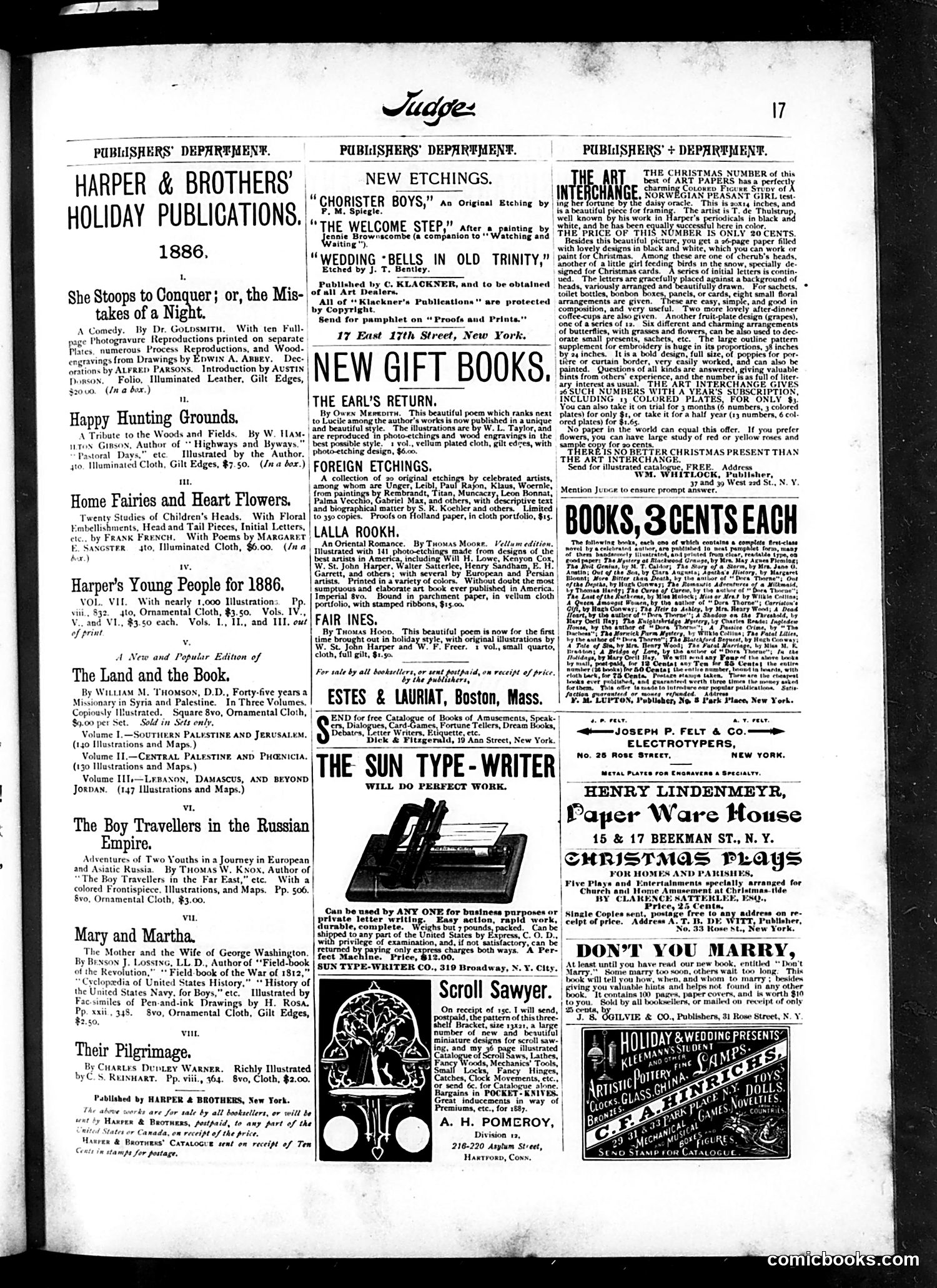
This page is primarily **publishers' advertisements** rather than satirical content. It showcases Harper & Brothers' 1886 holiday book offerings and announcements from other publishers. The visible advertisements include: - **Harper & Brothers' books**: editions of classics like *She Stoops to Conquer*, travel narratives (*Boy Travellers in the Russian Empire*), and illustrated gift volumes - **Art etchings** by C. Klackner featuring romantic scenes ("The Welcome Step," "Wedding Bells in Old Trinity") - **Gift books** with illustrations and poems - **Commercial products**: typewriters, paper goods, printing services No significant political cartoons or satire appear on this page. The "Judge" branding indicates this is from the satirical magazine, but page 17 functions as a commercial directory rather than editorial content—typical for 19th-century magazines that relied heavily on advertising revenue. Modern readers would find this a straightforward catalog of Victorian-era holiday merchandise and publishing announcements.
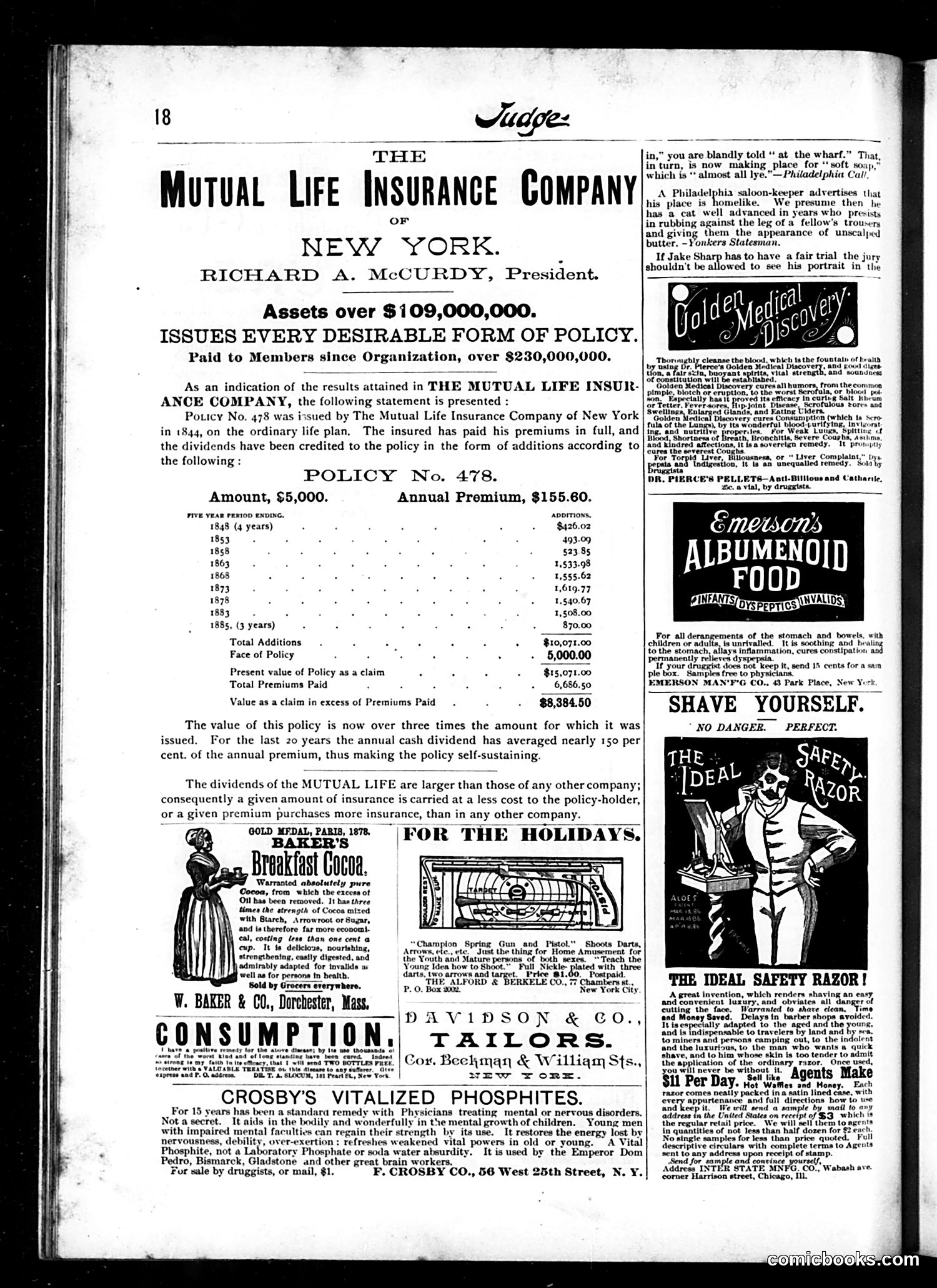
This page is primarily **advertising and corporate promotion**, not satire. It features: **Main Content:** A full-page advertisement for the Mutual Life Insurance Company of New York, headed by President Richard A. McCurdy. The ad showcases Policy No. 478, issued in 1844, demonstrating how dividends accumulated over 41 years made the policy "self-sustaining"—a key selling point. The policy's value tripled the original $5,000 amount. **Surrounding Advertisements:** The page includes typical period ads for health products (Dr. Pierce's Golden Medical Discovery, Emerson's Albumenoid Food), W. Baker & Co. Breakfast Cocoa, and safety razors. **Minor Satirical Content:** Small sidebars reference Jake Sharp (a controversial figure requiring fair trial) and a Philadelphia saloonkeeper claiming his bar is "homelike." The page reflects **late 19th-century American advertising and insurance marketing**, emphasizing dividend returns and financial security—concerns central to the era's growing middle class.
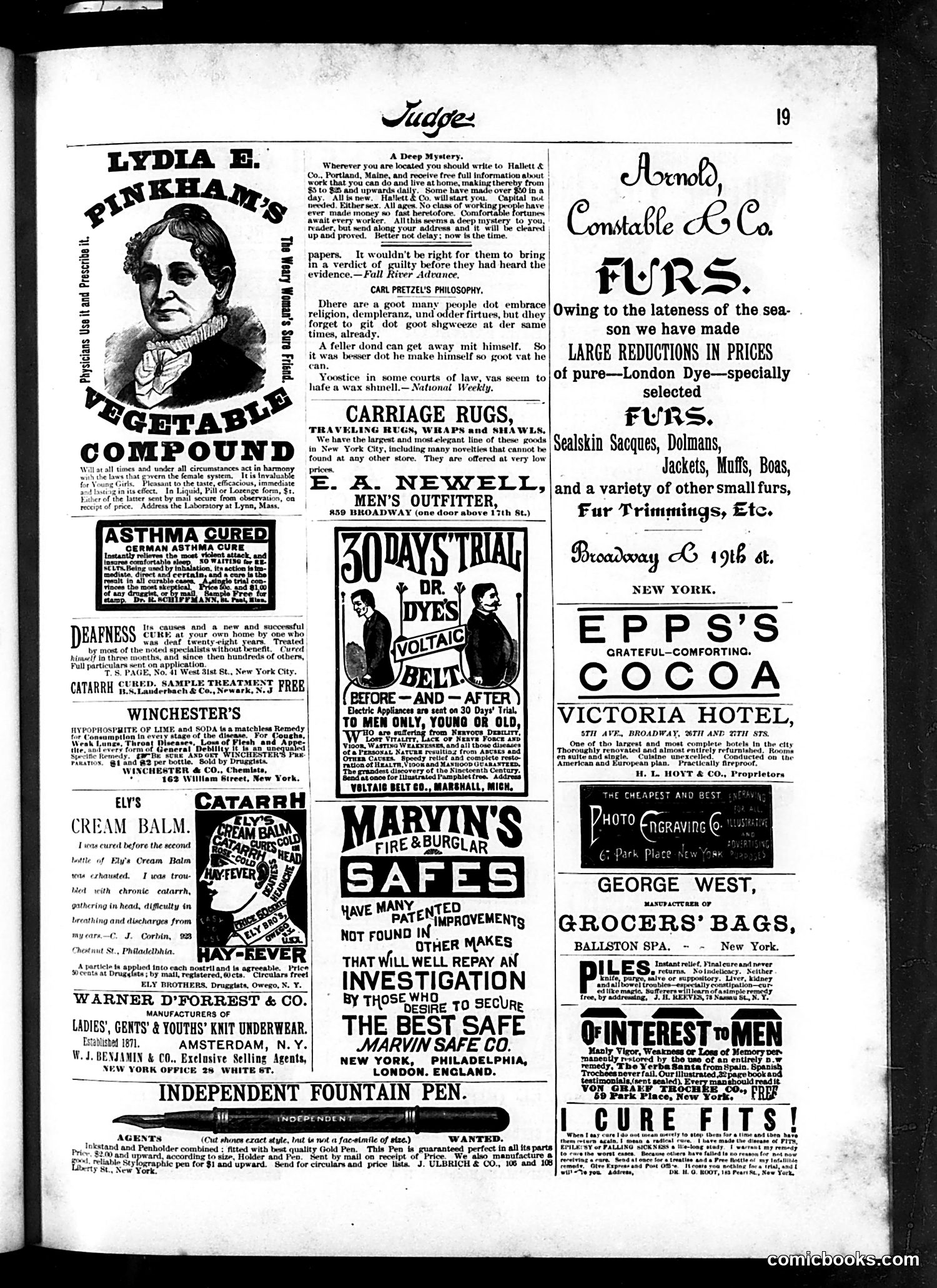
This page is almost entirely **advertisements** with minimal editorial content. The notable exceptions are: **"Carl Pretzel's Philosophy"** — a short ethnic humor column featuring a German-accented character offering folksy observations. "Carl Pretzel" was a recurring Judge feature using stereotypical German-immigrant dialect for comedy (typical of 1910s publications). **The main cartoons/images** are advertisement illustrations, not political satire: - Lydia E. Pinkham's Compound (patent medicine for "female system") - Medical cure advertisements (asthma, deafness, catarrh) - Marvin Fire & Burglar Safes - Various clothing and product vendors **For modern readers:** This reflects how 19th/early 20th-century magazines financed themselves through patent medicine ads (now recognized as often fraudulent). The "Carl Pretzel" dialect humor, while intended as entertainment, exemplifies the casual ethnic stereotyping common to the era. The page documents how advertising and editorial content were thoroughly intermixed.
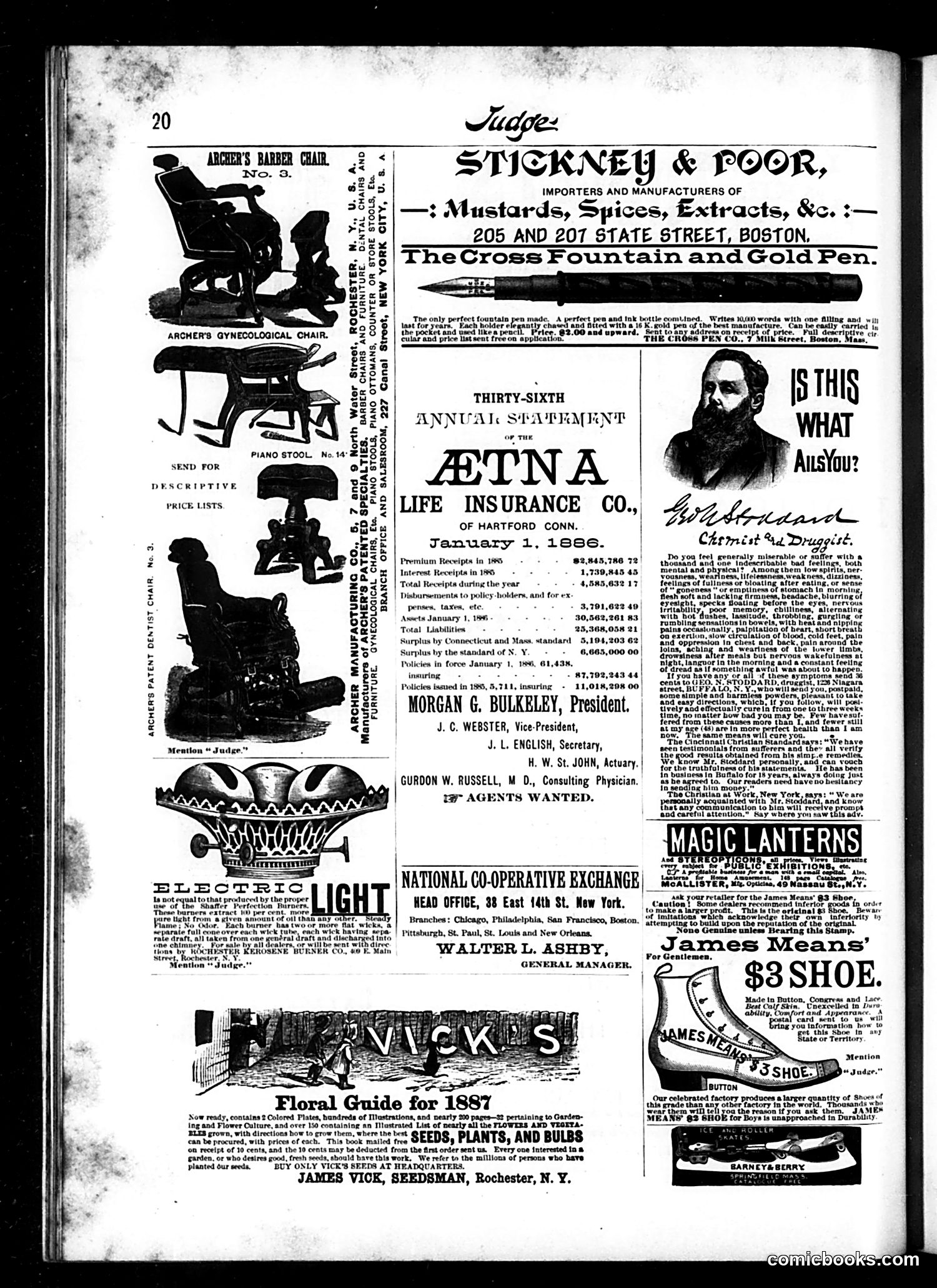
This page is primarily **advertisements** with minimal satirical content. The dominant feature is the thirty-sixth annual statement from the Aetna Life Insurance Company of Hartford, Connecticut, displaying financial data and officers. The only apparent satirical element is a small portrait labeled "IS THIS WHAT AILS YOU?" showing a bearded man identified as a "Chemist & Druggist." The accompanying text lists digestive complaints (bloating, heartburn, weakness)—common ailments that patent medicines claimed to cure. This appears to mock the era's widespread medical quackery and dubious remedies. The remaining content consists of genuine period advertisements: barber chairs, fountain pens, shoes, seeds, magic lanterns, and dental furniture. These ads reflect late-19th-century commercial products but contain no political or social satire. The page exemplifies Judge's business model: mixing light satire with paid advertising to fund the publication.
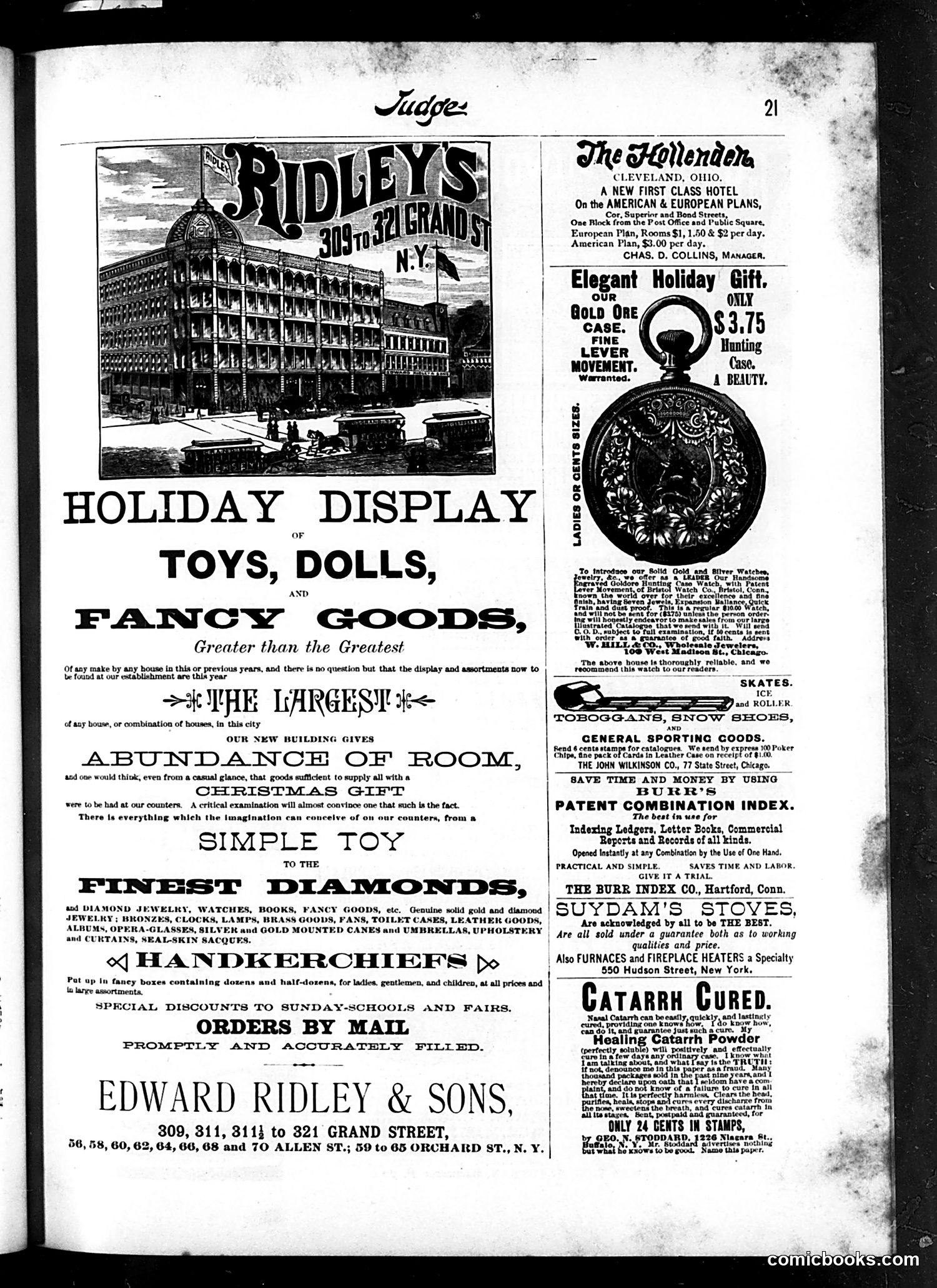
This is primarily an **advertising page** rather than a satirical cartoon or editorial content. The page consists almost entirely of commercial advertisements from the late 19th century, with no visible political cartoons or satirical illustrations requiring historical explanation. The main advertiser is **Edward Ridley & Sons**, a New York department store advertising their holiday toy and goods display. Other ads promote hotels, sporting goods, office supplies, stoves, and patent medicines—typical commercial fare of the era. The only illustrated element is the **building engraving** at top showing Ridley's storefront on Grand Street, a standard architectural advertisement meant to convey the store's size and legitimacy to potential customers. This reflects Judge's business model: revenue came largely from advertisers, so many pages were dedicated to paid promotions rather than satirical content.
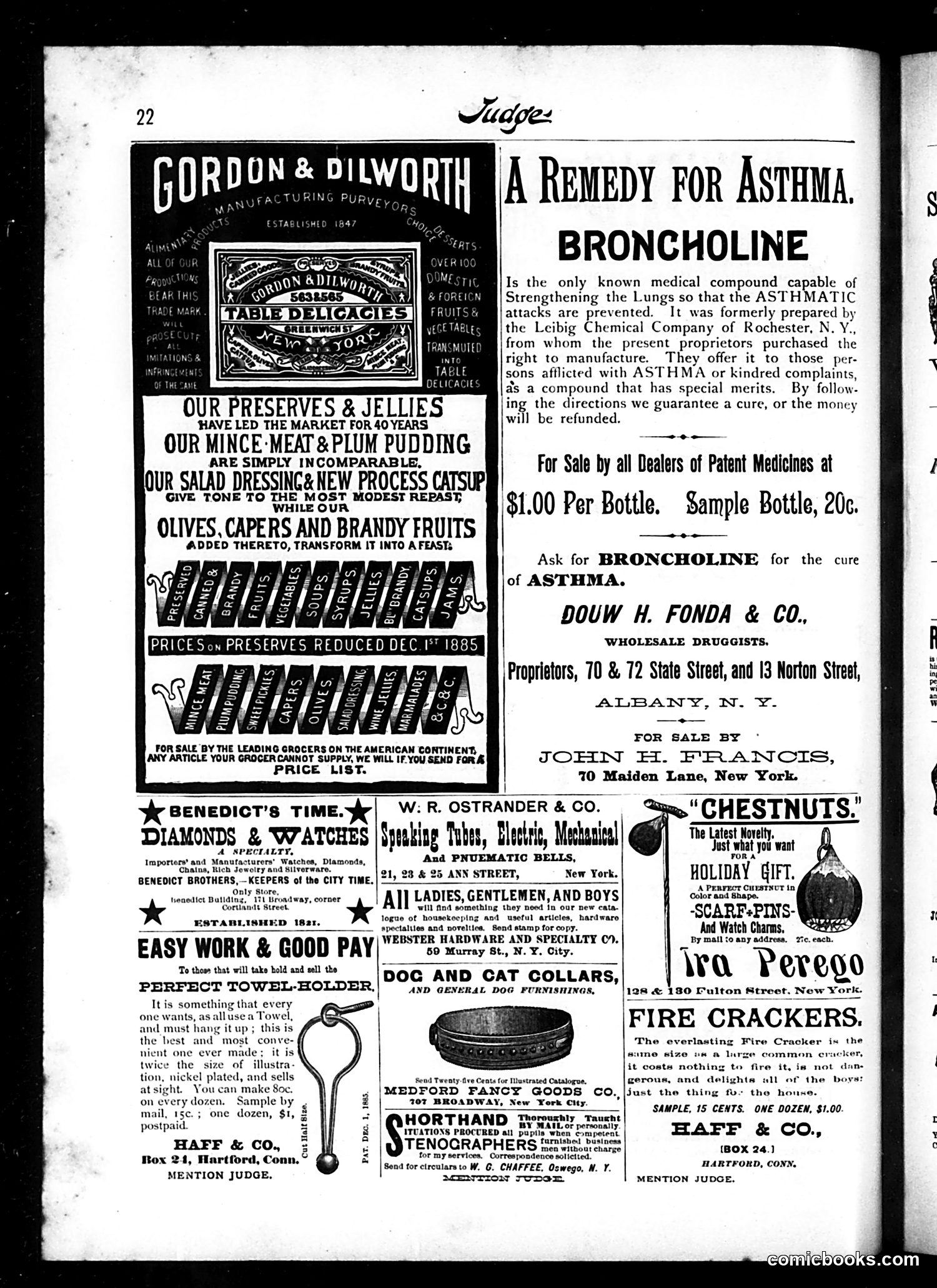
This is primarily an **advertising page** with no political cartoons or satire. It consists entirely of commercial advertisements typical of late 19th-century magazines. Notable ads include: - **Gordon & Dilworth** food products (preserves, puddings, condiments) - **Broncholine**, a patent medicine claiming to cure asthma—representative of the era's dubious medical remedies before FDA regulation - **Benedict's jewelry** store - Various household products (towel holders, dog collars, fire crackers, scarf pins) - **Shorthand instruction** services The **Broncholine ad** is historically significant: it exemplifies the widespread false health claims of the 1880s. The guarantee ("cure or money refunded") suggests the product was ineffective. For modern readers, this page documents how American commerce operated before consumer protection laws—unregulated patent medicines, exaggerated product claims, and mail-order schemes were standard advertising practice. No satirical content is present on this page.
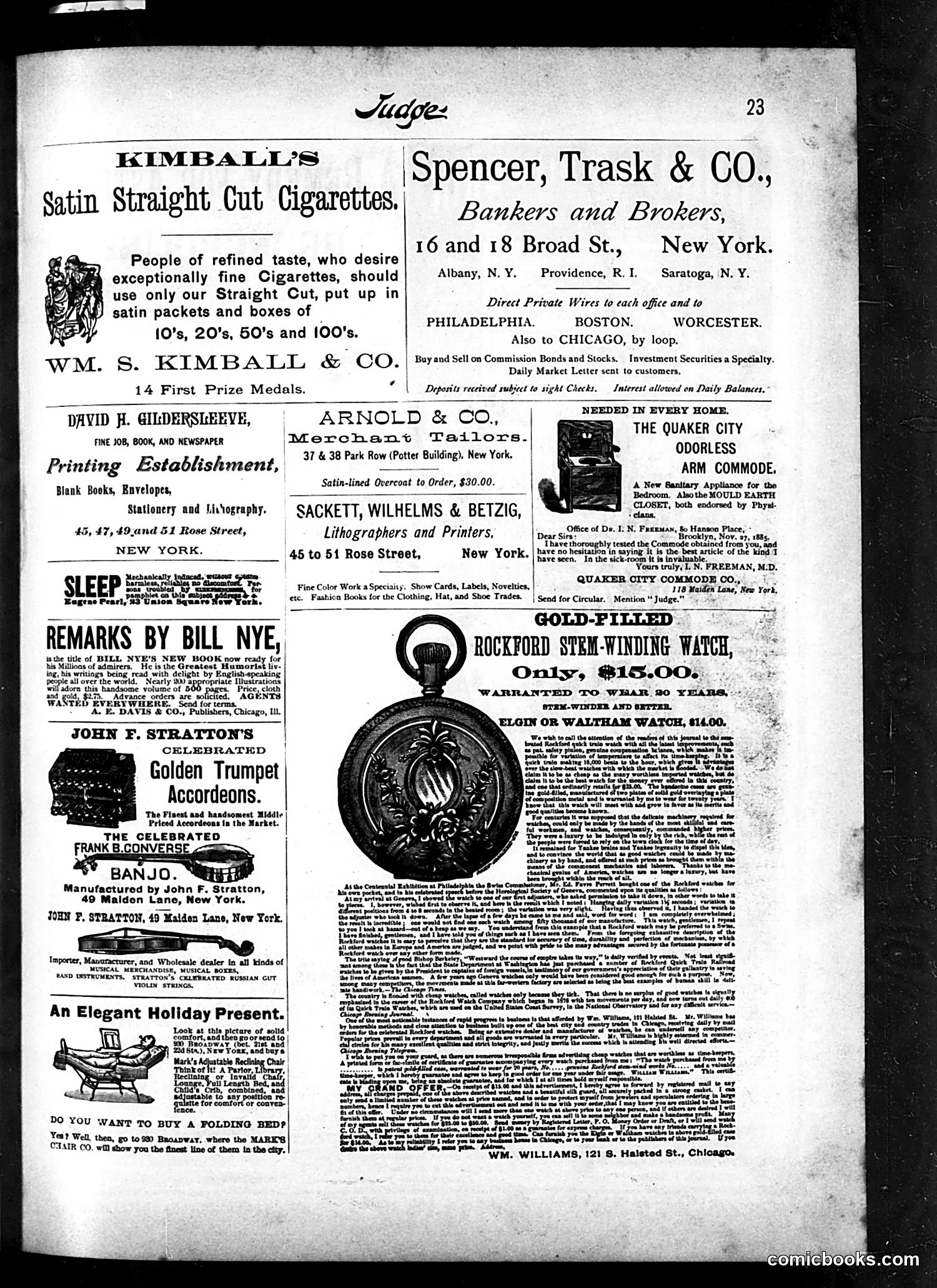
This is primarily an **advertising page** from Judge magazine, not a satirical cartoon page. The page contains dozens of commercial advertisements for late 19th-century products and services: cigarettes, banking services, merchant tailoring, printing establishments, lithography, sanitary bathroom fixtures, musical instruments (accordions, banjos), folding beds, and pocket watches. The only non-advertising content is "Remarks by Bill Nye," promoting a new humor book by the popular American humorist Bill Nye, describing him as "the Greatest Humorist living." This serves as an advertisement for the publication rather than satirical commentary. The page reflects Judge's business model: a satirical magazine that funded itself through paid advertisements. There is **no political satire or social commentary visible** on this particular page—it's simply a revenue-generating collection of period advertisements targeting middle and upper-class readers.
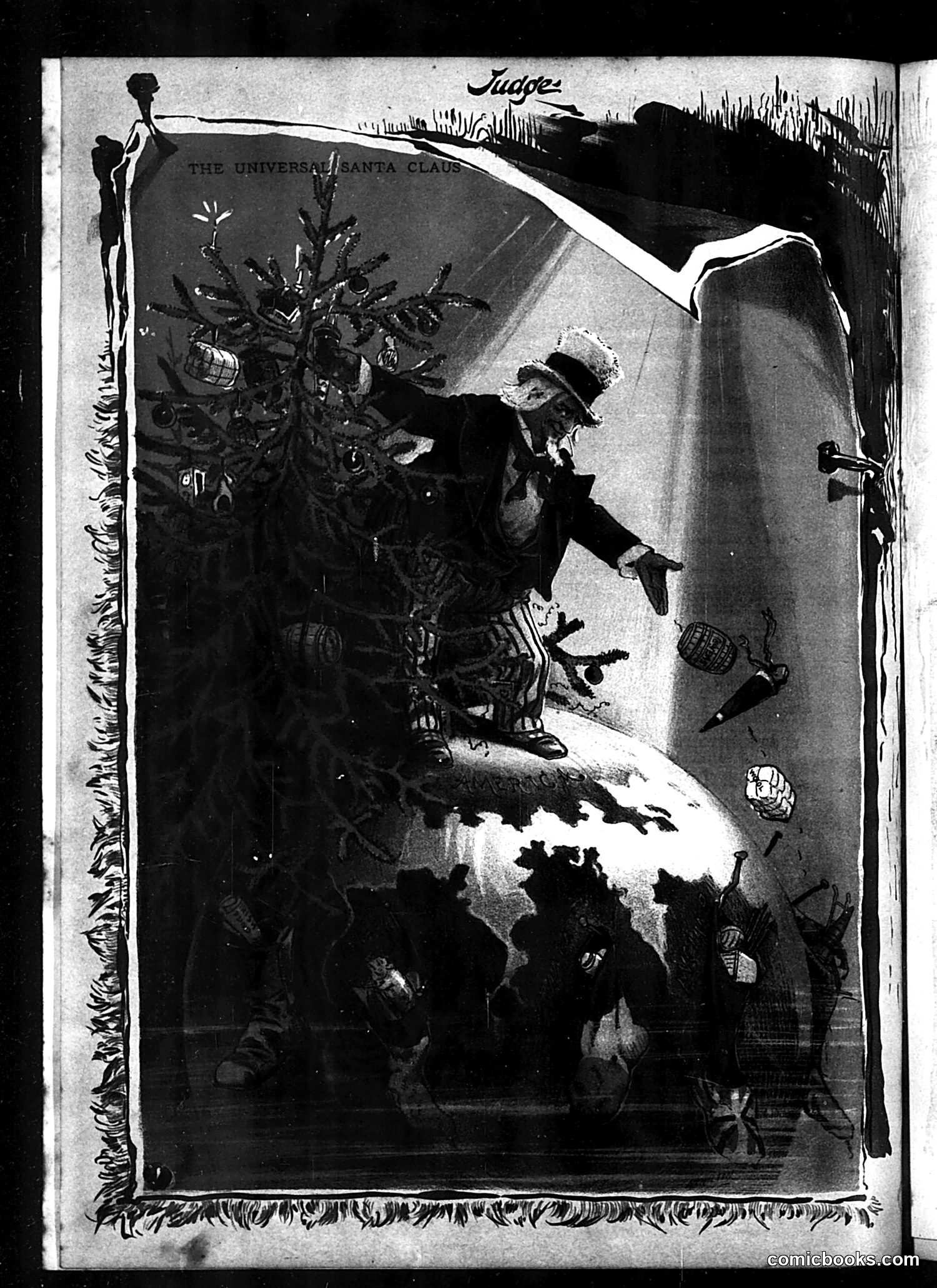
This political cartoon depicts Santa Claus as a universal figure distributing gifts to children of various nations and backgrounds gathered around a decorated Christmas tree. The composition suggests Santa's role as a symbol of goodwill and generosity transcending national and cultural boundaries. The satirical point appears to be commentary on commercialism or American cultural influence spreading globally through holiday consumerism. Alternatively, it may celebrate international goodwill during the Christmas season, positioning Santa as a unifying figure above political divisions. The ornate decorative border and magazine's satirical nature suggest the cartoonist is making a pointed observation—whether celebratory or critical—about how Christmas and American consumer culture were becoming increasingly "universal" or globally dominant. The specific historical context remains unclear without publication date information.
I can see this is a page from *Judge* magazine, but the image quality is too degraded for me to read the OCR text clearly or discern specific cartoon details with confidence. The page appears mostly blank or very faintly printed, with what might be a landscape sketch or illustration in the upper portion, but I cannot make out figures, captions, or satirical content clearly enough to explain the cartoon's meaning to a modern reader. To properly identify the political/social references, caricatures, and satire involved, I would need either a higher-resolution image or clearer text. I cannot responsibly assert specific identities or meanings without being able to read the details.
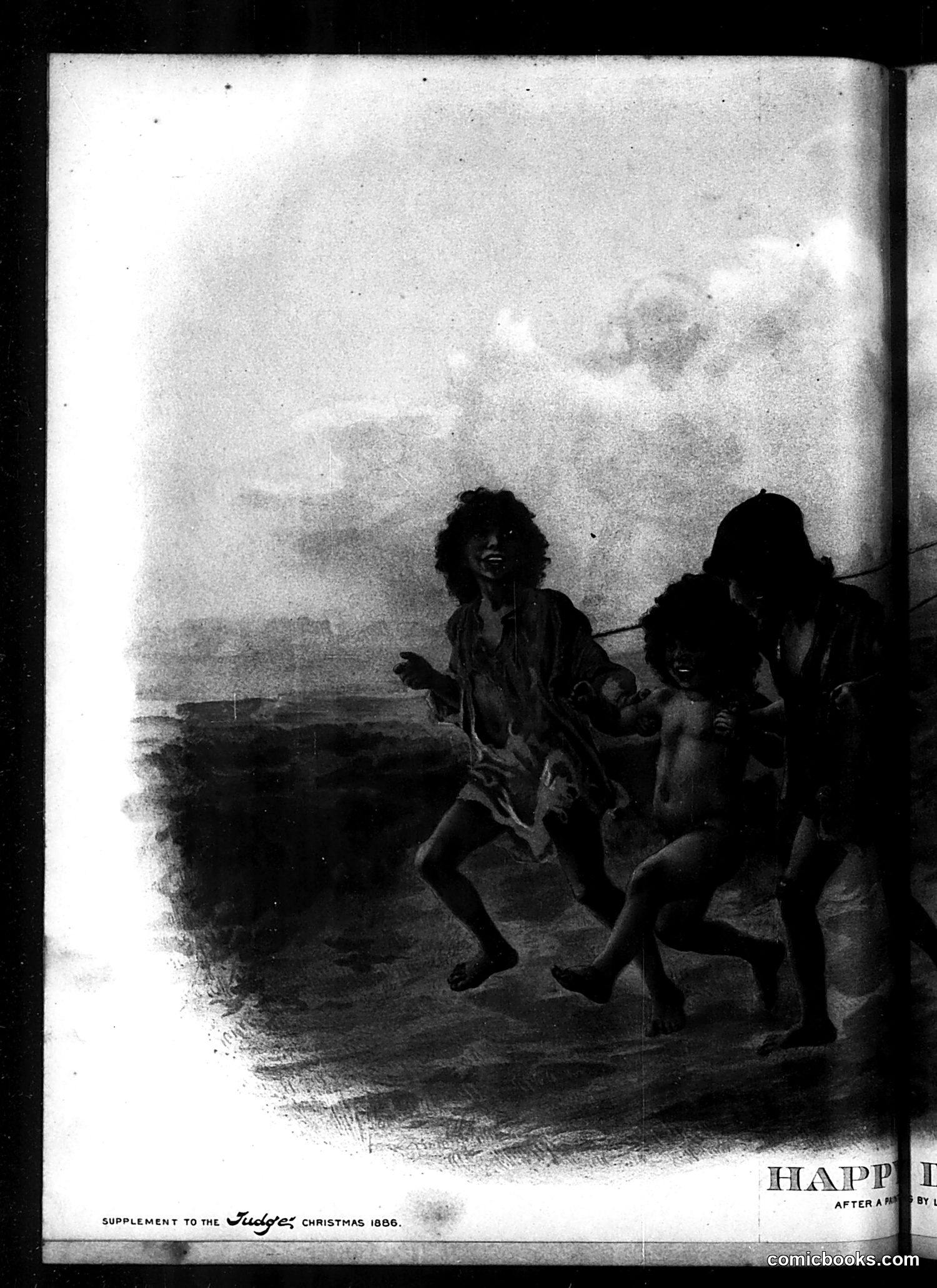
This appears to be a supplement to Judge's Christmas 1886 issue. The visible image shows silhouetted figures on what seems to be a beach or shoreline against a cloudy sky. The partial text at bottom right reads "HAPP..." and "AFTER A..." suggesting a caption that's cut off. Without the complete caption or title, I cannot definitively identify the specific political or social satire intended. The silhouette style and beach setting suggest this may depict a holiday or leisure scene, possibly with satirical commentary on contemporary society or politics. The grainy quality and age of the reproduction make details difficult to discern. To properly explain this cartoon's meaning, the full caption and any surrounding context would be necessary.
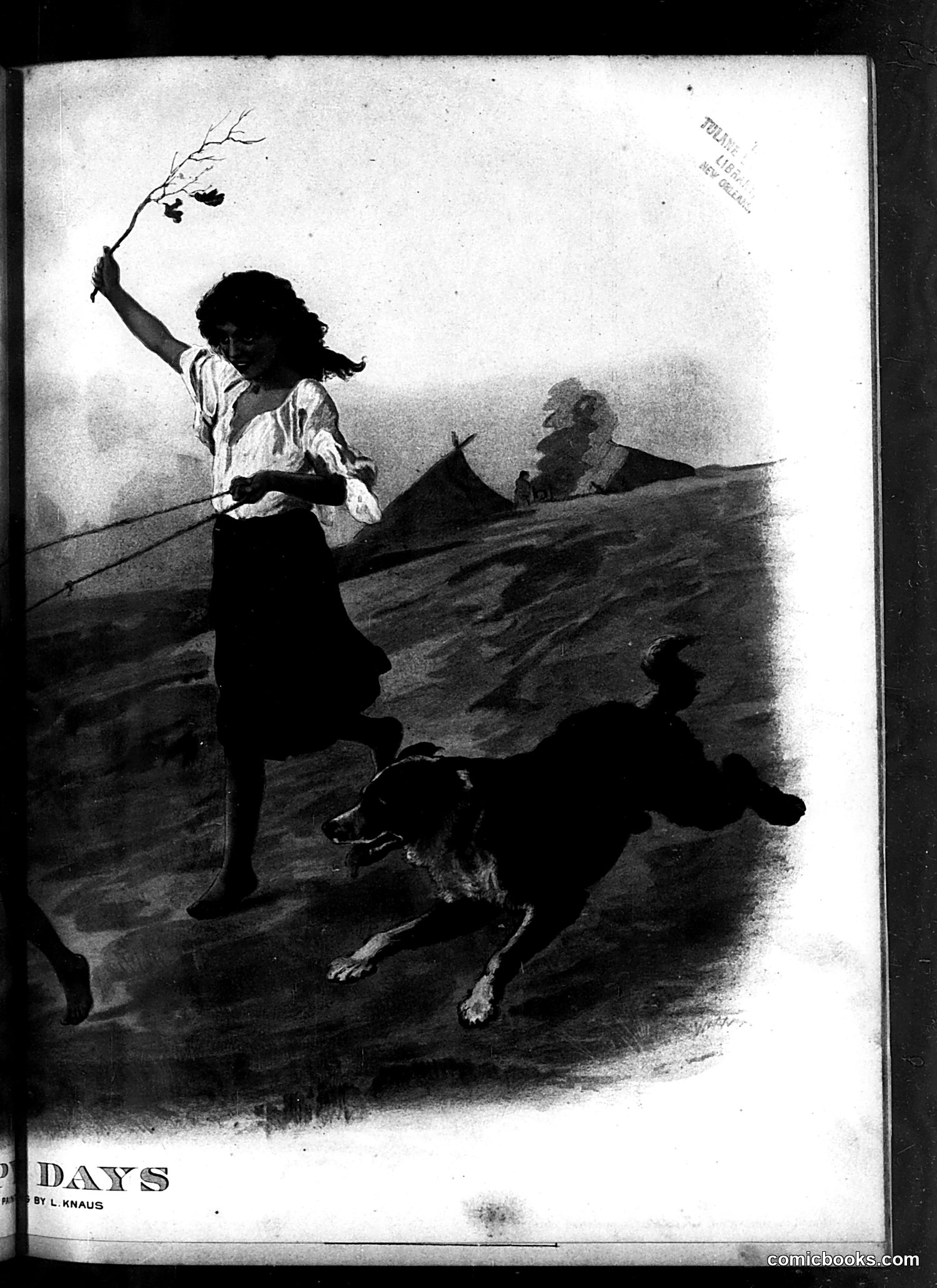
This appears to be an illustration titled "DAYS" by L. Knaus (visible at bottom). The image depicts a scene with a woman in period dress holding a bare branch aloft, a dog in the foreground, and two figures in the background on what looks like barren terrain. Without clearer text or caption visible on the page, the specific satirical point is unclear. The bare branch and desolate landscape could suggest hardship or difficult times, possibly referencing economic or social conditions of the era in which this Judge magazine appeared. The woman's dramatic pose suggests she represents something symbolic—perhaps hope, protest, or personification of an abstract concept—but the precise meaning and any political references require additional context about the publication date and accompanying text that isn't fully legible here.