
Judge, 1886-12-25 · page 3 of 27
Judge — December 25, 1886 — page 3: what you’re looking at
What you’re looking at
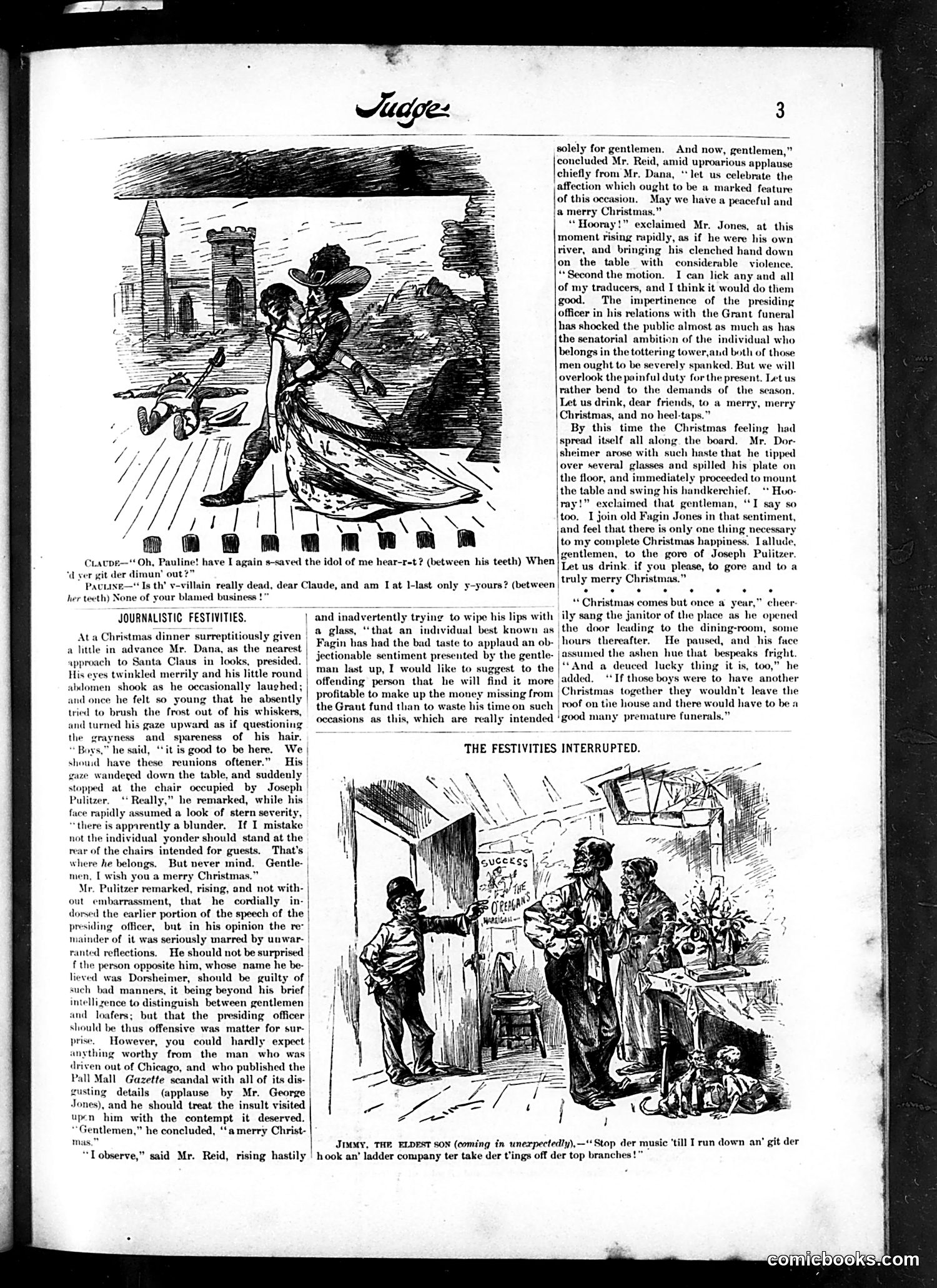
This page satirizes prominent **newspaper editors and journalists** of the Gilded Age engaged in a bitter Christmas dinner. The main figures appear to be: - **Mr. Dana** (presiding): Likely Charles Dana of the New York Sun - **Joseph Pulitzer**: Referenced as an outsider who doesn't belong at the "gentlemen's" gathering - **Mr. Reid**: Another newspaper proprietor - **Mr. Jones**: Appears to be George Jones, associated with exposing scandals - **Mr. Dorsheimer**: Another figure in the dispute The satire mocks the **intense professional rivalries and personal animosities** between competing newspaper publishers. Despite toasting "Christmas feeling" and brotherhood, these editors immediately begin insulting each other—attacking Pulitzer's background, referencing scandals (the "Mail Gazette scandal"), and even fantasizing about violence ("the gore of Joseph Pulitzer"). The cartoon illustrations show their heated arguments. The humor lies in the **hypocrisy**: they pledge peace and goodwill while seething with contempt, revealing journalism's cutthroat competitive culture beneath polite society's veneer.
📄 Transcribed text from this page (OCR, searchable)
Machine-transcribed from the original scan — historical spelling and the odd misread are preserved.
Mm A her teeth) None of your blamed business !" ‘JOURNALISTIC FESTIVITIES. a Christmas dinner surreptitiously given alittle in advance Mr. Dana, as the nearest | approach to His eyes twinkled merrily abdomen shook as he occasionally laughed; and once he felt so young that he absently tried to brush the frost out of his whiskers, and turned his gaze upward as if questioning the grayness and spareness of his hair. * Boys,” he said, ‘it is good to be here. We id have these reunions oftener.” His gaze wandered down the table, and suddenly ned at the chair occupied by Joseph Pulitzer.“ Really,” he remarked, while his face rapidly assumed a look of stern severity, here is apparently a blunder. If I mistake not the individual yonder should stand at the rar of the chairs intended for guests. That's where he belongs. But never mind. Gentle- men, Ewish you a merry Christmas.” ! Mr. Pulitzer re ‘ked, rising, and not with- | out embarrassment, that he cordially in- | dorsed the earlier portion of the speech of the | presiding officer, but in his opinion the re- mainder of it was seriously marred by unwar- ranted reflections. He should not be surprised f the person opposite him, whose name he be- lieved was Dorsheimer, should be guilty of | such bad manners, it being beyond his brief intellizence to distinguish between gentlemen and loafers; but that the presiding officer should be thus offensive was matter for sur- prise, However, you could hardly expect | anything worthy from the man who was driven out of Chicago, and who published the Mall Gazette scandal with all of its dis- | gusting details (applause by Mr. George | Jones), and he should treat the insult visited upen him with the contempt it deserved. “Gentlemen,” he concluded, ‘a merry Christ- m 3 solely for gentlemen. And now, gentlemen,” concluded Mr. Reid, amid uproarious applause chiefly from Mr, Dana, “let us celebrate the affection which ought to be a marked feature of this occasion, May we have a peaceful and |a merry Christmas.” “Hooray!” exclaimed Mr. Jones, at this moment rising rapidly, as if he were his own river, and bringing his clenched hand down on the table with considerable violence. “Second the motion. I can lick any and all of my traducers, and I think it would do them good. The impertinence of the presiding officer in his relations with the Grant funeral has shocked the public almost as much as has the senatorial ambition of the individual who belongs in the tottering tower,and both of those men ought to be severely spanked. But we will overlook the poinful duty for the present. Let us rather bend to the demands of the season. Let us drink, dear friends, to a merry, merry Christmas, and no heel-taps.” By this time the Christmas feeling had spread itself all along the board. Mr. Dor- |sheimer arose with such haste that he tipped over several glasses and spilled his plate on the floor, and immediately proceeded to mount the table and swing his handkerchief. ‘* Huo- ray!” exclaimed that gentleman, “I say so too. I join old Fagin Jones in that sentiment, jand feel that there is only one thing necessary to my complete Christmas happiness. I allude, gentlemen, to the gore of Joseph Pulitzer, Let us drink. if you please, to gore and to a truly merry Christmas.” “Christmas comes but once a year,” cheer | and inadvertently trying to wipe his lips with ily sang the janitor of the place as he opened a glass, “that an individual best known as the door leading to the dining-room, some Fagin has had the bad taste to applaud an ob- hours thereafter. He paused, and his face jectionable sentiment presented by the gentle- | assumed the ashen hue that bespeaks fright. man last up, I would like to suggest to the |‘‘And a deuced lucky thing it is, too,” he offending person that he will find it more ‘added. ‘If those boys were to. have another profitable to make up the money missing from |Christmas together they wouldn't leave the the Grant fund than to waste his time on such |Tof on the house and there would have to be a occasions as this, which are really intended ‘good many premature funerals.” THE FESTIVITIES INTERRUPTED. JIMMY, THE ELDEST SON (coming in unexpected!y),—“Stop der music 'till I run down an’ git der “Lobserve,” said Mr. Reid, rising hastily | hook an’ ladder company ter take der t'ings off der top branches!”