
A complete issue · 16 pages · 1886
Judge — July 31, 1886
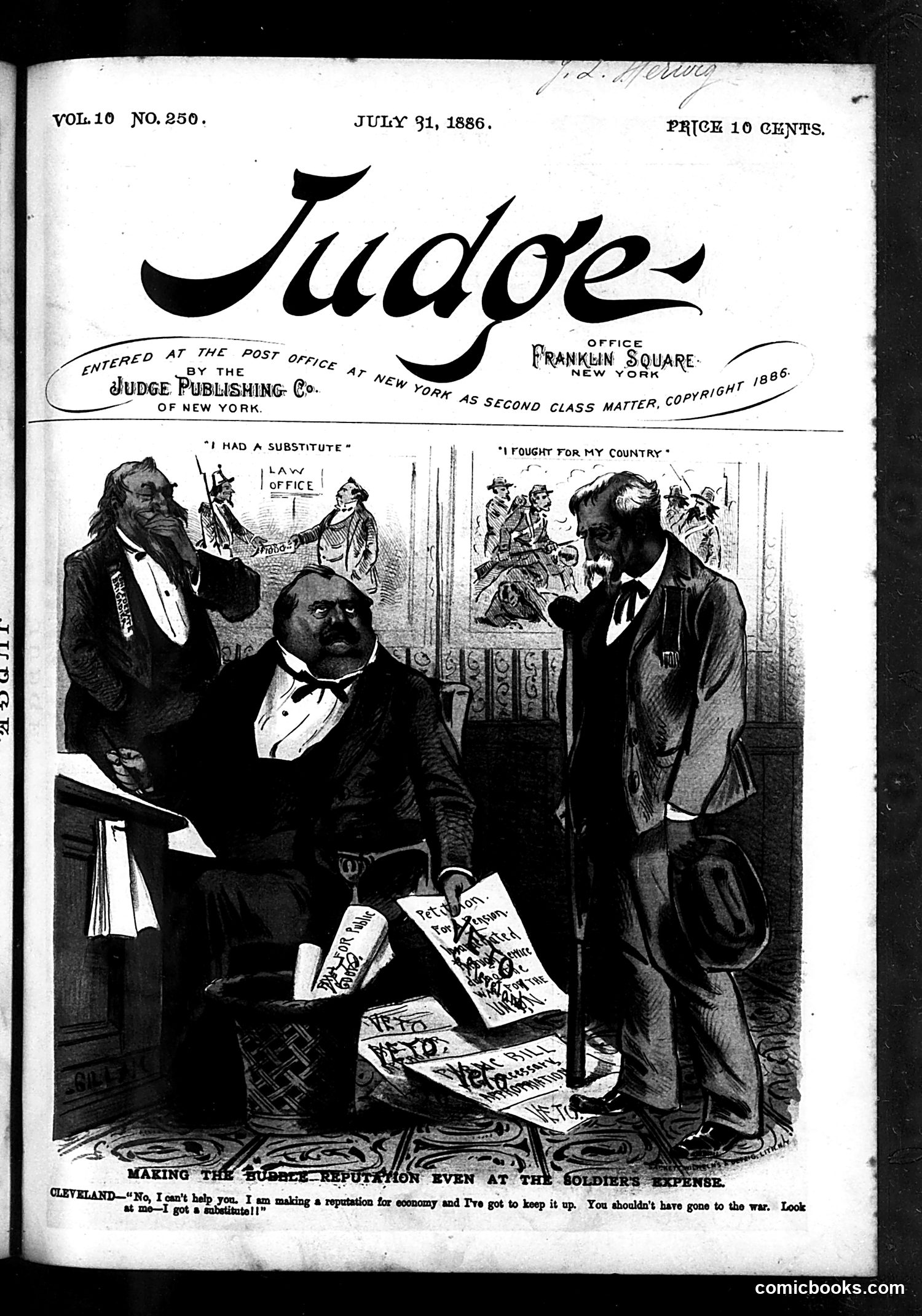
This political cartoon satirizes President Grover Cleveland's handling of Civil War veterans' pensions. The central seated figure appears to be Cleveland, surrounded by three men confronting him about his economical stance. The dialogue bubbles reveal the satire: the left figure claims "I had a substitute" (avoiding military service), while the right states "I fought for my country." Cleveland's response—visible in the caption—dismisses their claims, saying he cannot maintain reputation while supporting pensions, and that soldiers "shouldn't have gone to war." The cartoon criticizes Cleveland for penny-pinching on veteran benefits while accepting excuses from those who avoided service. The scattered pension documents at his feet emphasize the administration's indifference to soldier welfare—a politically unpopular position that damaged his support among veterans.
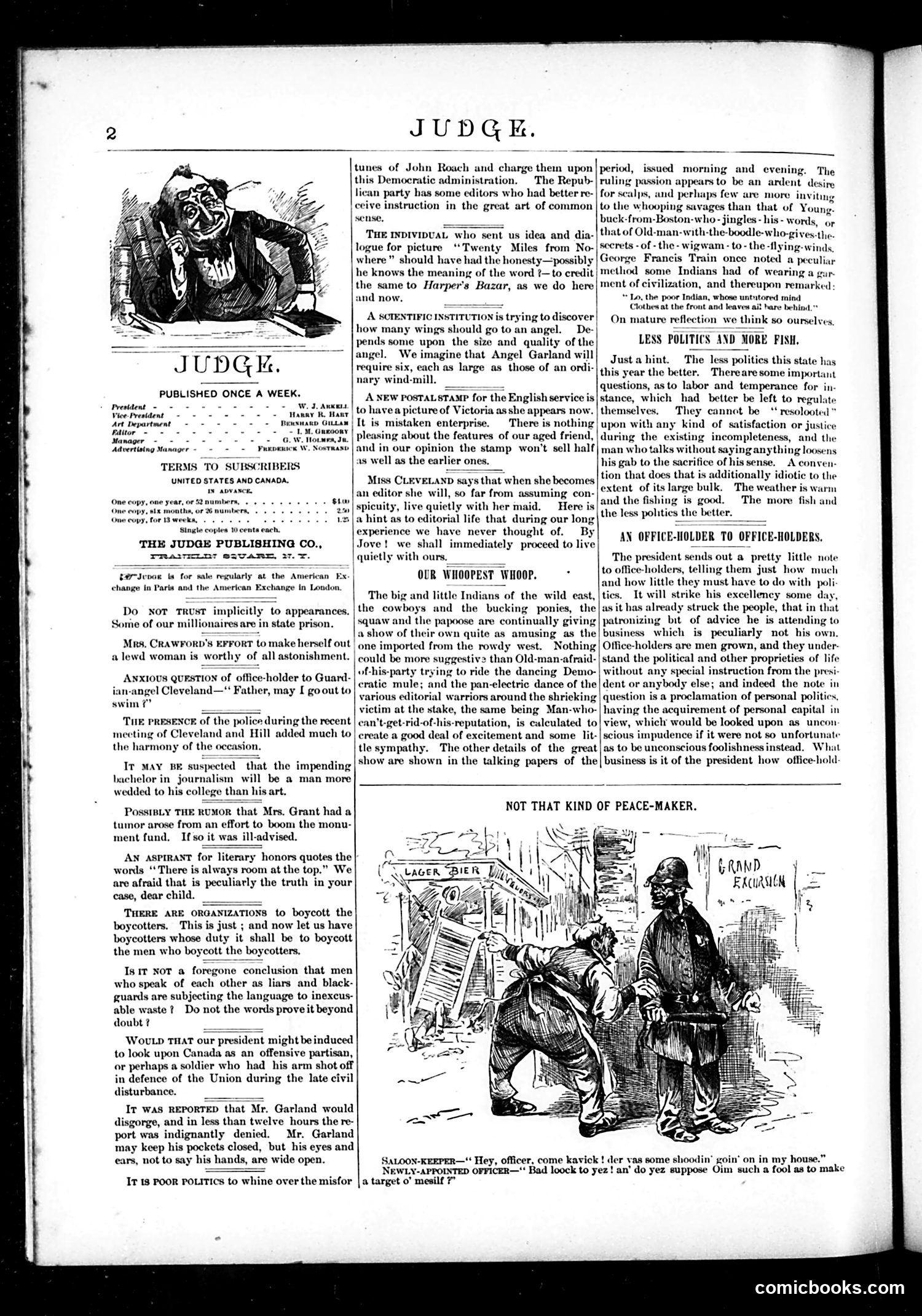
This cartoon satirizes a newly-appointed police officer attempting to break up a saloon brawl. The caption reads: "Saloon-keeper—'Hey, officer, come quick! der vas some shootin' goin' on in my house.' Newly-appointed Officer—'Had luck to yes! an' do yes suppose thin such a fool as to make a target of myself?'" The joke targets the incompetence or cowardice of inexperienced police appointments. The officer refuses to intervene in the violent dispute, defeating the purpose of law enforcement. The German accent of the saloon-keeper suggests immigrant working-class urban settings where such establishments and violence were common. The satire mocks inadequate policing and the challenges of maintaining public order in cities during this era.
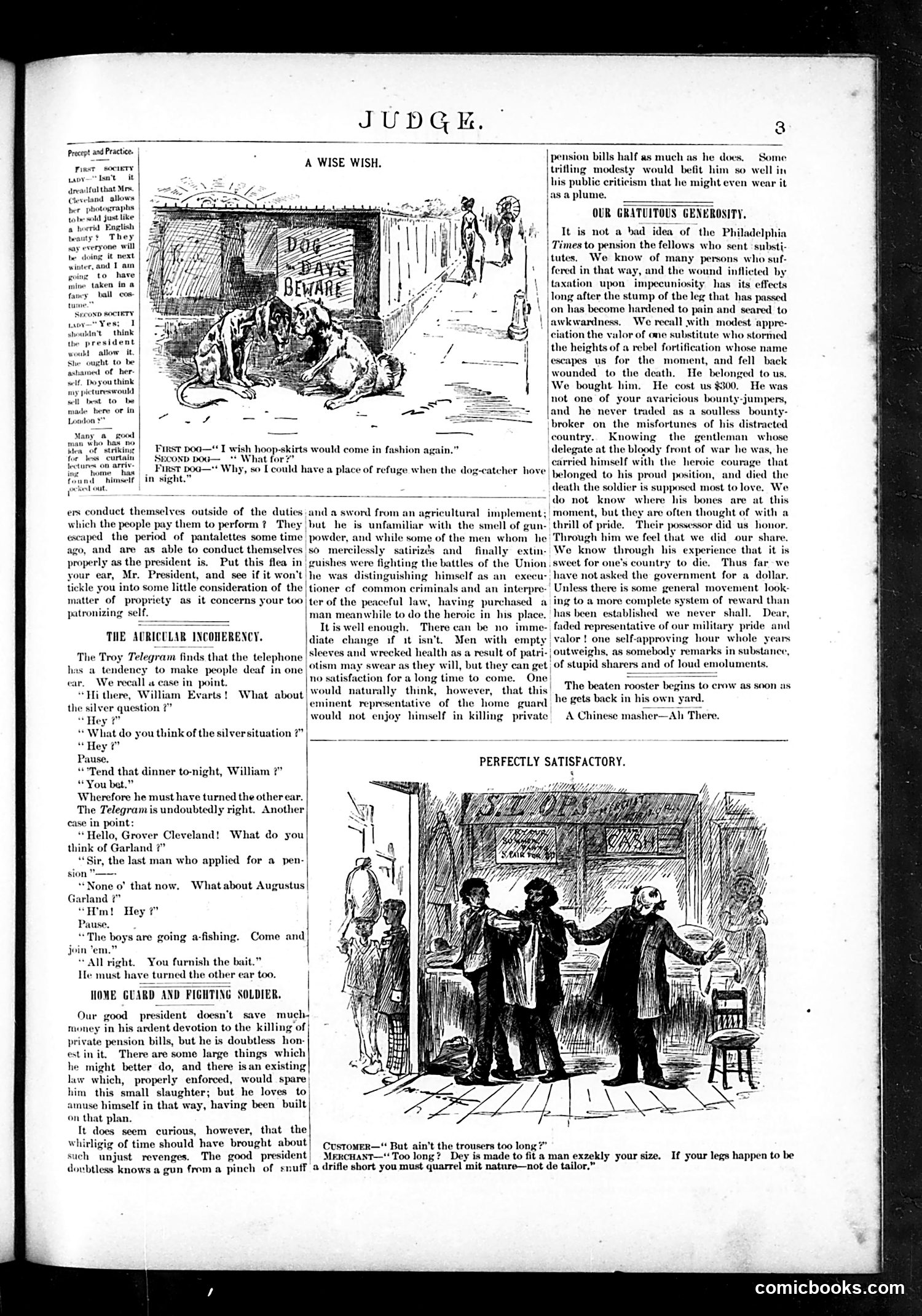
This page satirizes President Cleveland's pension vetoes and military hypocrisy. **"A Wise Wish"** depicts two dogs discussing fashion—a light joke about hoop skirts. **"The Auricular Incongruency"** mocks Cleveland's supposed selective hearing, using dialogue about the "silver situation" and Postmaster General Garland (whom Cleveland fired). The implication: Cleveland conveniently "doesn't hear" criticism. **"Home Guard and Fighting Soldier"** is the main political attack. It criticizes Cleveland for killing Civil War pension bills while he himself hired a substitute to avoid military service. The article contrasts Cleveland's peacetime executions as judge with his criticism of actual soldiers. It sarcastically praises pension fraud, noting that at least a substitute soldier "belonged to us" and cost $300—mocking those who bought their way out while denying pensions to wounded veterans. The satire argues Cleveland is hypocritical: he avoided war sacrifice yet mercilessly denies aid to those who suffered fighting.
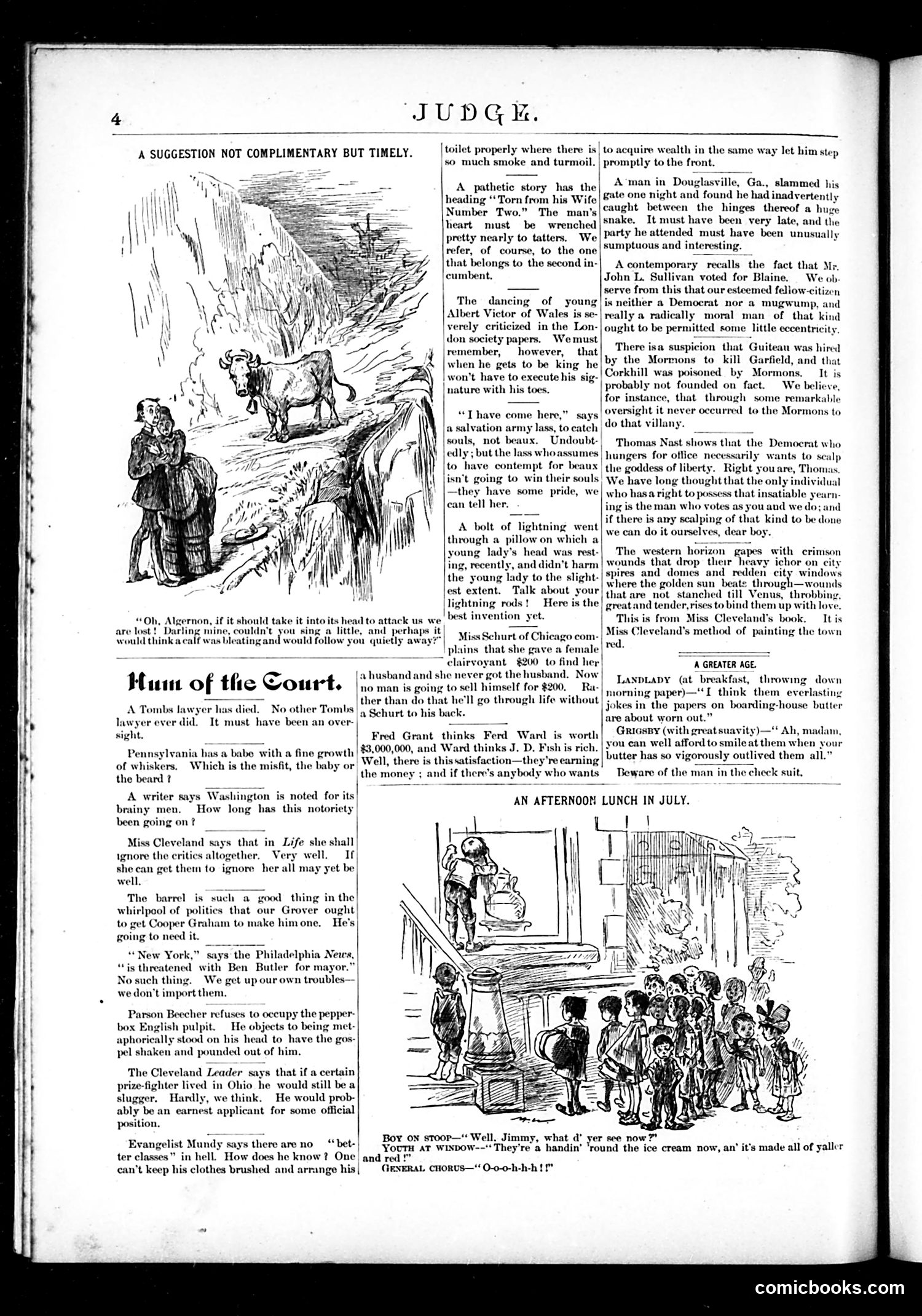
This page from *Judge* magazine contains several short satirical items mocking contemporary 1880s political and social figures: **"Hum of the Court"** collects brief jabs: at a Tombs lawyer's death (apparently unremarkable), Washington's supposed intellectual reputation, Miss Cleveland's ignoring critics, President Cleveland's political vulnerabilities ("barrel" reference suggests he needs protection), and Ben Butler's potential mayoral run in New York. **Other items** mock Prince Albert Victor of Wales's dancing, a Salvation Army woman's sanctimoniousness about rejecting "beaux," and various wealthy figures (Fred Grant, J.D. Fish) acquiring money. One piece satirizes a man who accidentally trapped a snake in his gate at night—implying he was returning late from an excessive party. **"An Afternoon Lunch in July"** (bottom illustration) depicts children buying ice cream, likely satirizing urban working-class life. The satire targets political figures, aristocratic pretension, and moral hypocrisy typical of *Judge*'s style—lightweight mockery of newsworthy personalities rather than serious political commentary.
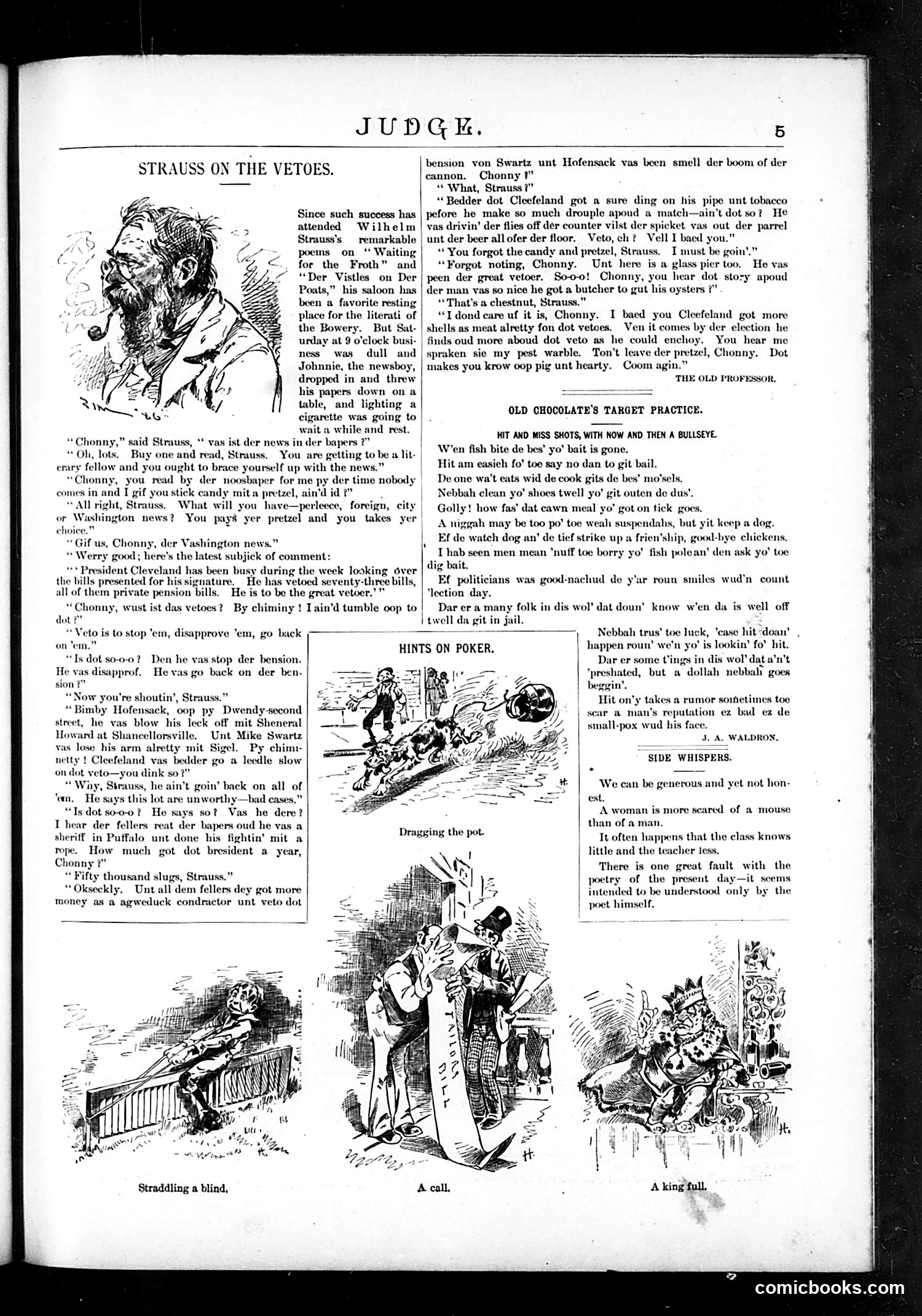
This page satirizes President Cleveland's extensive use of the veto power. The main dialogue features a Bowery saloon-keeper named Strauss (depicted with a German-immigrant accent) questioning a newsboy about Cleveland's vetoes of legislation, particularly pension bills for Civil War veterans. The satire's point: Cleveland has become overly aggressive in rejecting bills, especially those providing pensions to soldiers like those Strauss knew who lost limbs in battles (Chancellorsville, with generals Howard and Sigel). Strauss ironically notes that if Cleveland hadn't been a sheriff in Buffalo dodging conflict himself, he might be more sympathetic to veterans' needs. The lower sections contain unrelated humorous content ("Old Chocolate's Target Practice" and poker hints), typical of Judge's miscellaneous format.
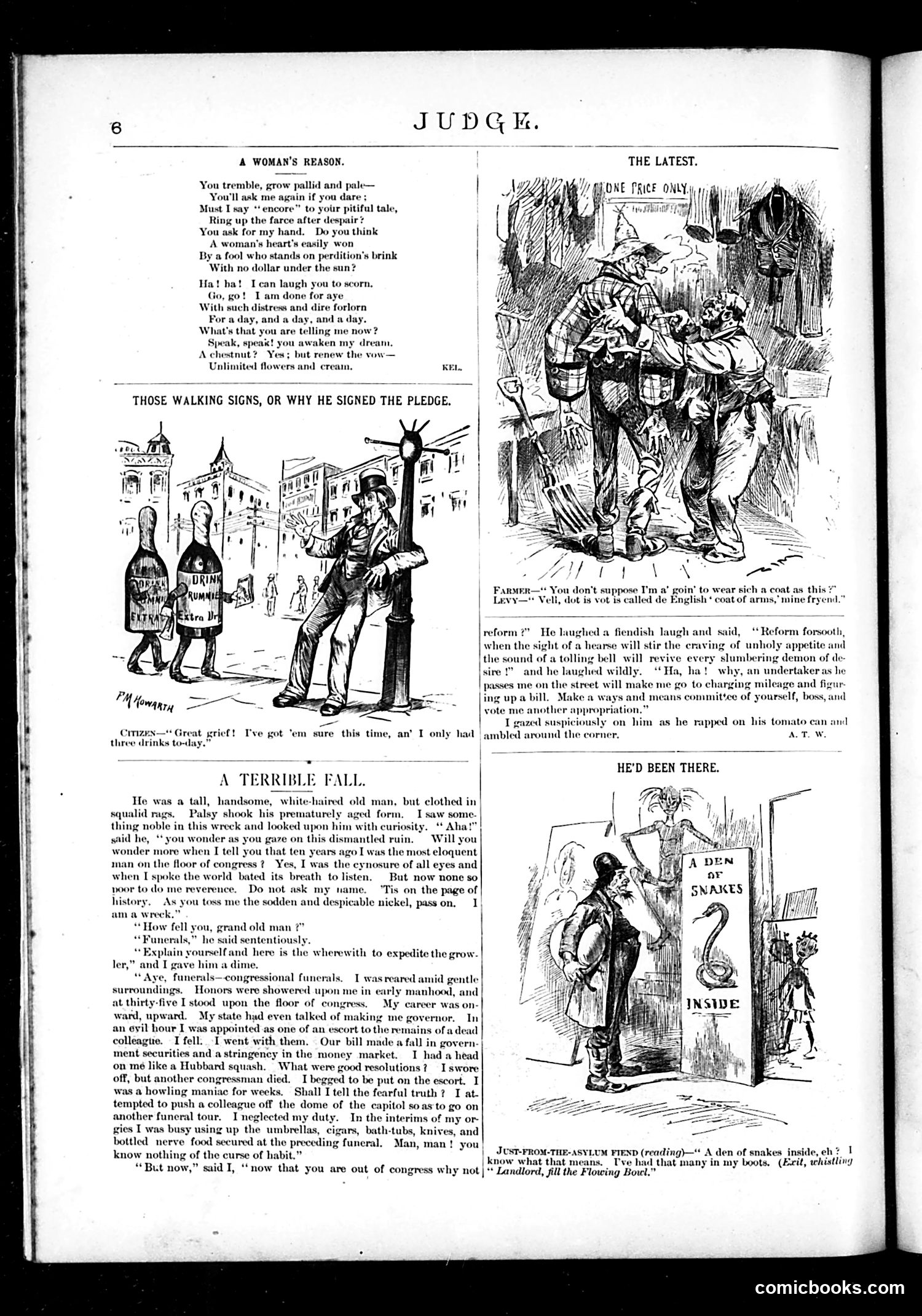
This page contains three distinct pieces of satirical content: **"A Woman's Reason"** (poem, left): A woman rejects a suitor's marriage proposal, mocking his poverty and emotional appeals. The satire targets romantic melodrama and financial insecurity as grounds for rejecting marriage. **"Those Walking Signs, or Why He Signed the Pledge"** (cartoon, bottom left): Two bottles personified as men stand before city buildings. The caption suggests someone took a temperance pledge. This satirizes public temperance movements and the performative nature of abstinence pledges—making a "walking sign" of one's commitment. **"A Terrible Fall"** (narrative, center): A once-eloquent congressman has become a destitute beggar. His downfall stems from attending colleague funerals—he became addicted to the social prominence funerals provided, neglecting duties and embezzling supplies. The satire mocks congressional corruption, the performative nature of funeral attendance, and politicians' inability to resist habit and excess, even after leaving office. **"He'd Been There"** (cartoon, right): Appears to reference a snake den—likely satirizing a den or disreputable establishment. The page collectively satirizes political corruption, addiction, and social hypocrisy in Gilded Age America.
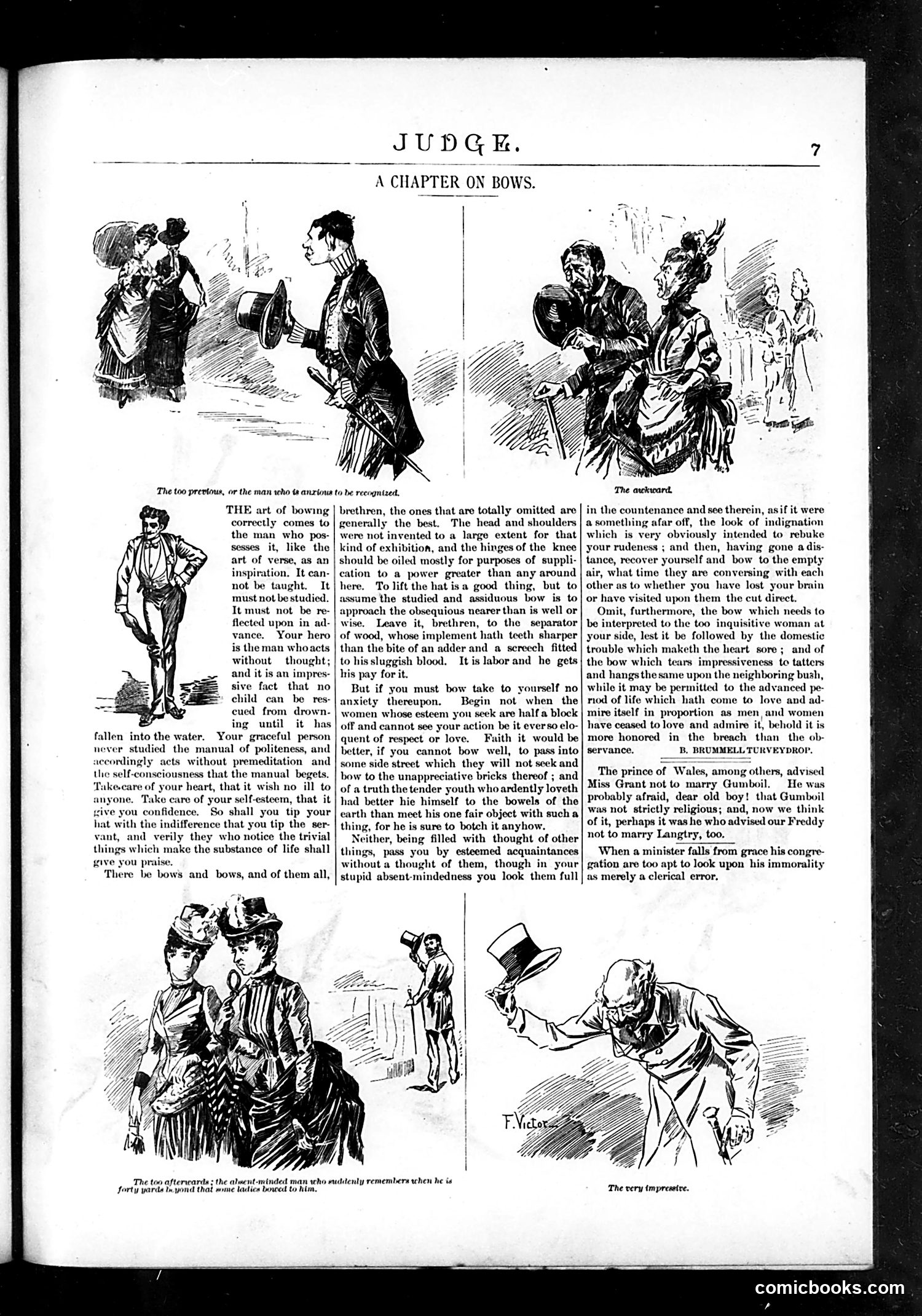
This page satirizes Victorian etiquette obsession through pseudo-serious advice on the social art of bowing. The illustrations depict various bow scenarios: the overeager man bowing from too far away, the awkward bow, the absent-minded man who forgets to acknowledge acquaintances then bows to empty air, and "the very impatient" man. The humor targets two things: (1) the absurd rigidity of upper-class social codes that demand studied perfection in trivial gestures, and (2) the pretense that such behavior requires "inspiration" rather than simple human decency. The mock-serious author ("B. Brummell Turveydrop") uses inflated language to deflate the subject—comparing proper bowing to rescuing drowning children. A footnote references the Prince of Wales advising Miss Grant against marrying "Gumboil," likely satirizing real aristocratic gossip about contemporary relationships, though specific figures remain unclear.
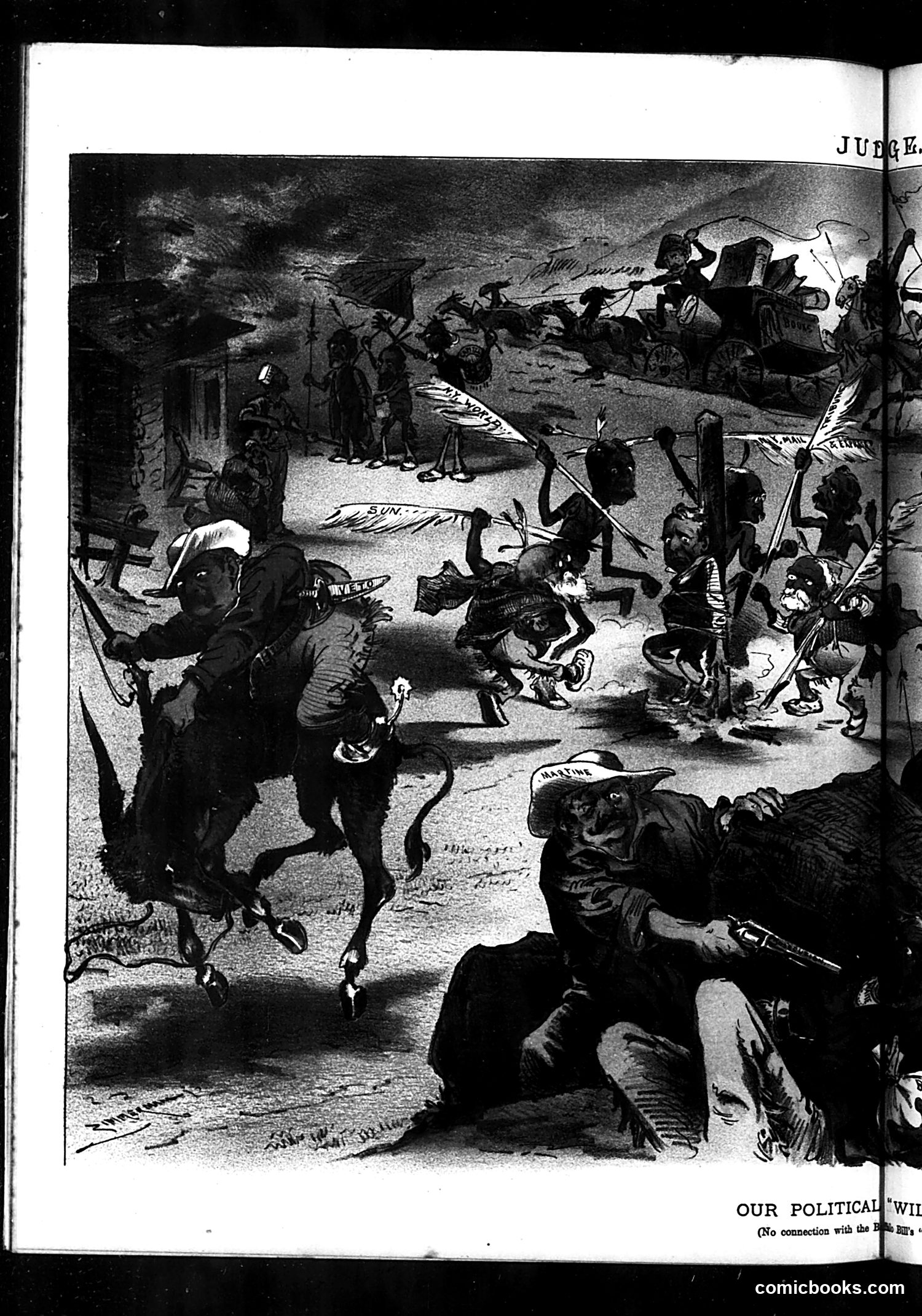
This appears to be a satirical political cartoon from *Judge* magazine depicting a chaotic street scene. The image shows multiple figures engaged in what seems to be violent confrontation or civil unrest—figures wielding crosses and other implements, with bodies on the ground and wagons in the background. The caption reads "OUR POLITICAL" with incomplete text below mentioning "No connection with the..." (text cut off). Without the complete caption and publication date visible, the specific political event being satirized is unclear. However, the imagery suggests commentary on American political violence, possibly referencing religious extremism, electoral conflict, or social upheaval. The style and presentation indicate this is Gilded Age or Progressive Era satire, likely critiquing contemporary political brutality or corruption through dark humor.
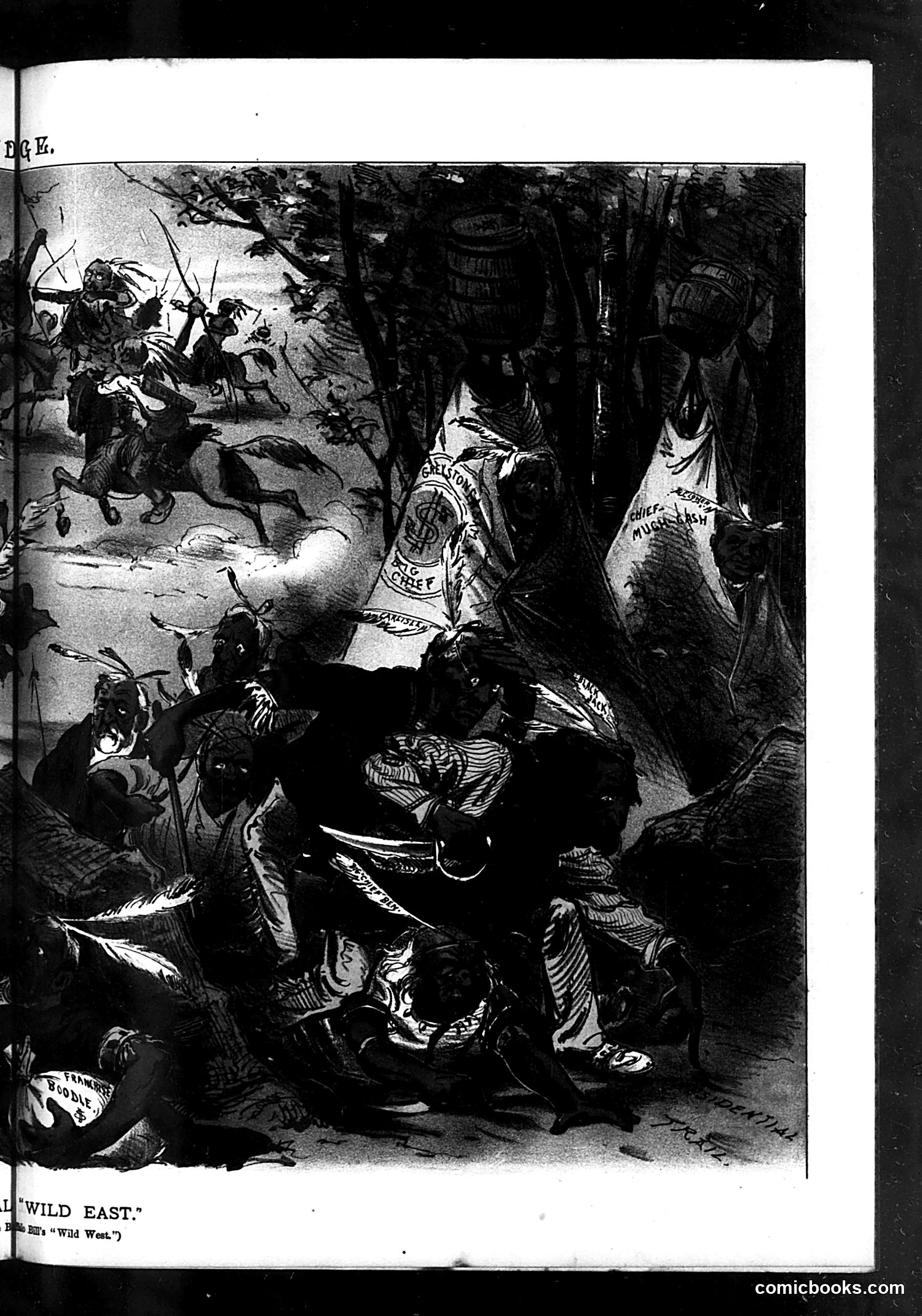
This political cartoon parodies the American "Wild West" by reimagining it as the "Wild East," likely referencing Eastern European or Russian instability of the early 20th century. The image shows armed, chaotic figures in what appears to be lawless violence—mirroring the romanticized frontier chaos of American Wild West mythology. The satire suggests that Eastern regions (possibly Russia during its revolutionary period, or the Balkans) are experiencing comparable lawlessness and violence to America's frontier era. By inverting the "Wild West" concept geographically, Judge magazine implies that the "civilized" East is actually descending into barbaric disorder—a commentary on political instability, ethnic conflict, or revolutionary upheaval in that region during this period.
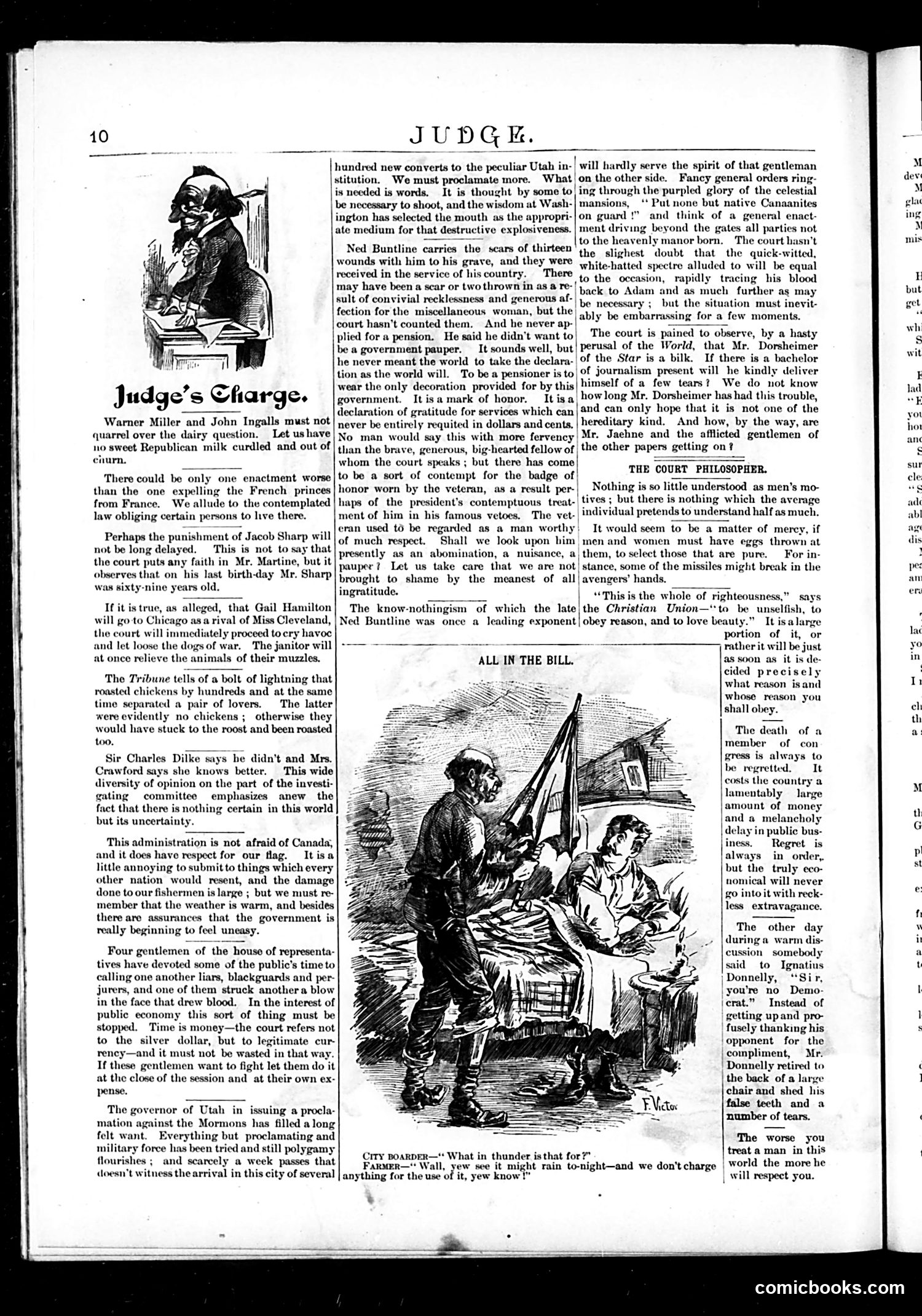
This page from **Judge** magazine (a 19th-century American satirical weekly) contains multiple brief political commentaries under the heading "Judge's Charge." The items mock various contemporary figures and issues: - **Warner Miller and John Ingalls**: Republican politicians apparently quarreling over dairy policy - **Jacob Sharp**: A political figure awaiting legal punishment; the satire suggests his advanced age (69) may result in natural death before sentencing - **Gail Hamilton vs. Miss Cleveland**: A rivalry between two women, one potentially going to Chicago - **Sir Charles Dilke and Mrs. Crawford**: References a real 1880s British scandal involving alleged adultery - **U.S.-Canada relations**: Criticizes the administration's weak response to Canadian aggression - **Congressional behavior**: Satirizes House members calling each other liars and physically fighting - **Mormon polygamy in Utah**: Criticizes the governor's proclamations as insufficient; advocates actual enforcement action The accompanying illustration ("All in the Bill") depicts poverty or homelessness, likely commenting on economic policy. The tone is characteristic of Judge's irreverent, witty critique of American political incompetence and moral failings.
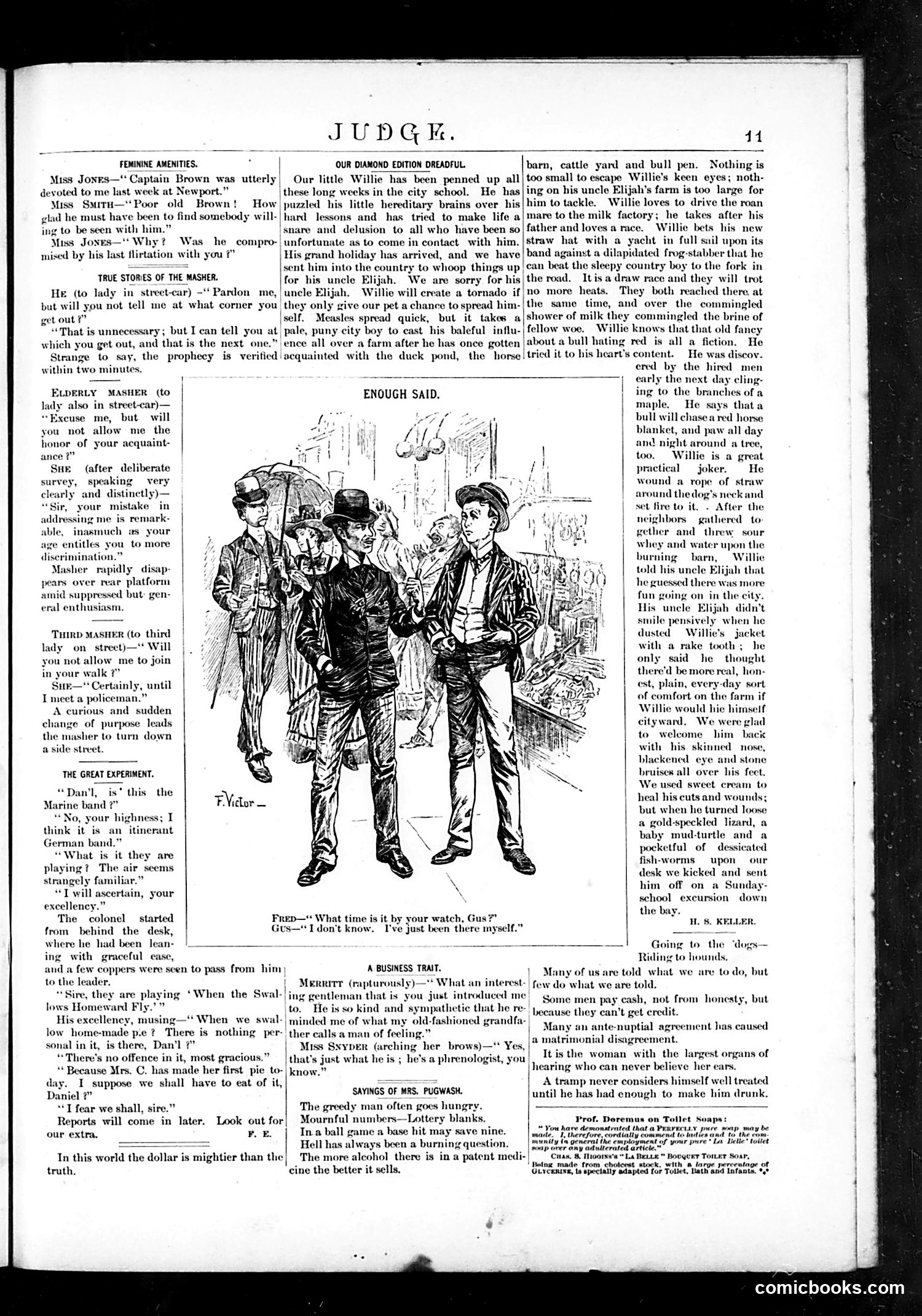
This Judge magazine page contains three main satirical pieces: **"Feminine Amenities"** mocks women's social gossip, specifically their casual cruelty toward eligible bachelors. The humor targets how women weaponize social embarrassment—being "seen with" someone can damage a man's reputation. **"True Stories of the Masher"** satirizes street harassment. A "masher" (a period term for a man who aggressively pursues women in public) is twice rebuffed by women who use clever comebacks. The joke is that women have developed defensive witticisms against unsolicited advances. **"Our Diamond Edition Dreadful"** parodies overly sentimental children's literature. It describes a mischievous city boy visiting his uncle's farm, causing various disasters—setting fires, tormenting animals—presented in melodramatic language mocking the earnest moral tales popular in children's magazines of the era. The central cartoon shows men discussing time, illustrating the "Dreadful" narrative about Willie's chaotic visit.
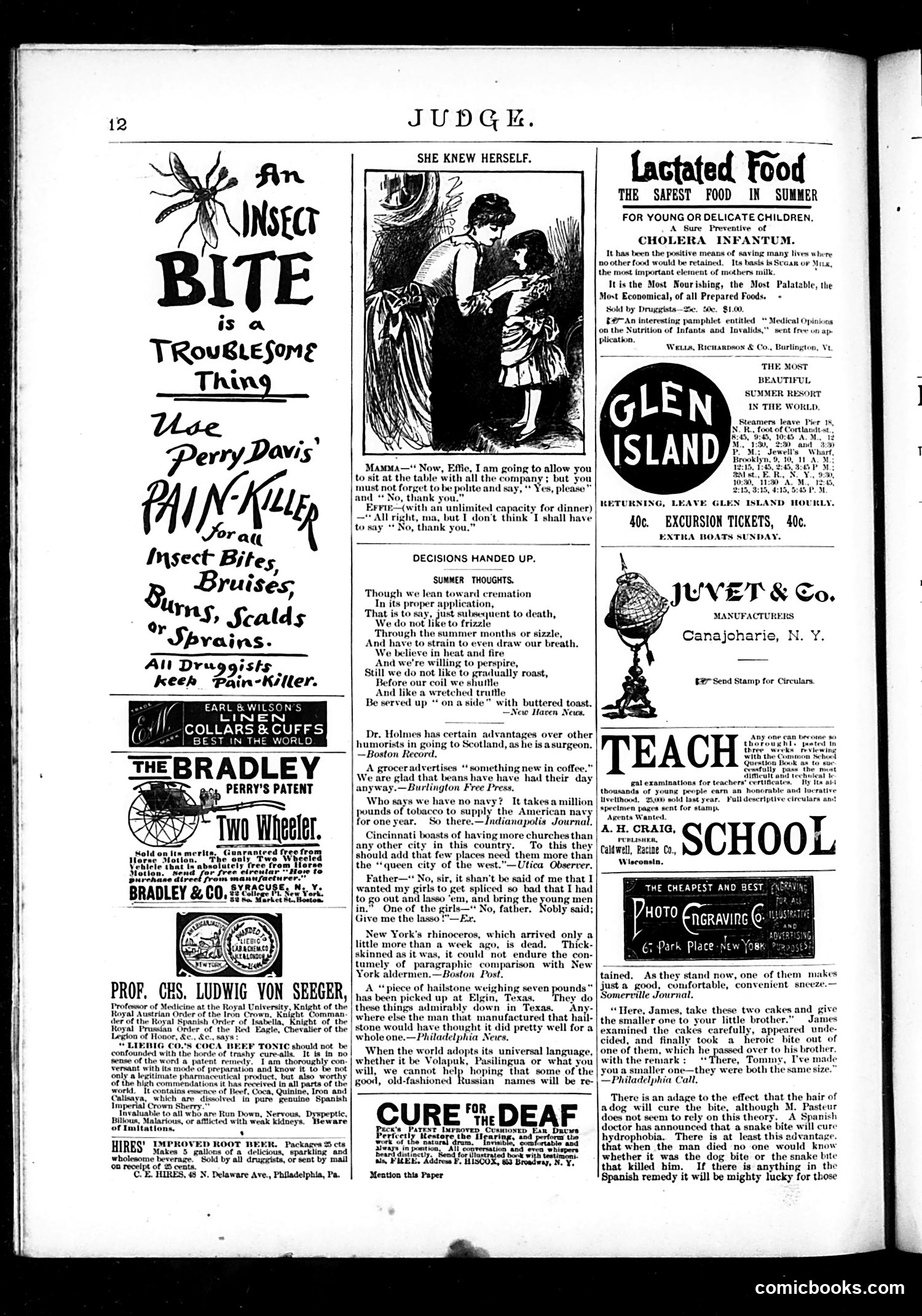
This is primarily an **advertising-heavy page** from Judge magazine, with minimal political satire. The main content includes period product advertisements typical of the 1880s-90s: Perry Davis' Pain-Killer (a patent medicine), Lactated Food (infant formula to prevent cholera infantum—then a serious childhood threat), and root beer. The only comic elements are brief: **"She Knew Herself"** — A domestic humor cartoon where a mother instructs her daughter Effie on table manners, and Effie responds she has "unlimited capacity for dinner," suggesting childish gluttony. **"Summer Thoughts"** — Humorous verse about Americans' reluctance toward cremation during hot months, preferring not to be "roasted" or served "on a side with buttered toast"—dark humor about cremation alternatives. The page also includes miscellaneous short jokes mocking topics like New York's navy, Cincinnati's churches, and a rhinoceros at the zoo. These are light, topical observations rather than serious satire. The overall effect is entertainment through advertising and genteel humor typical of the period.
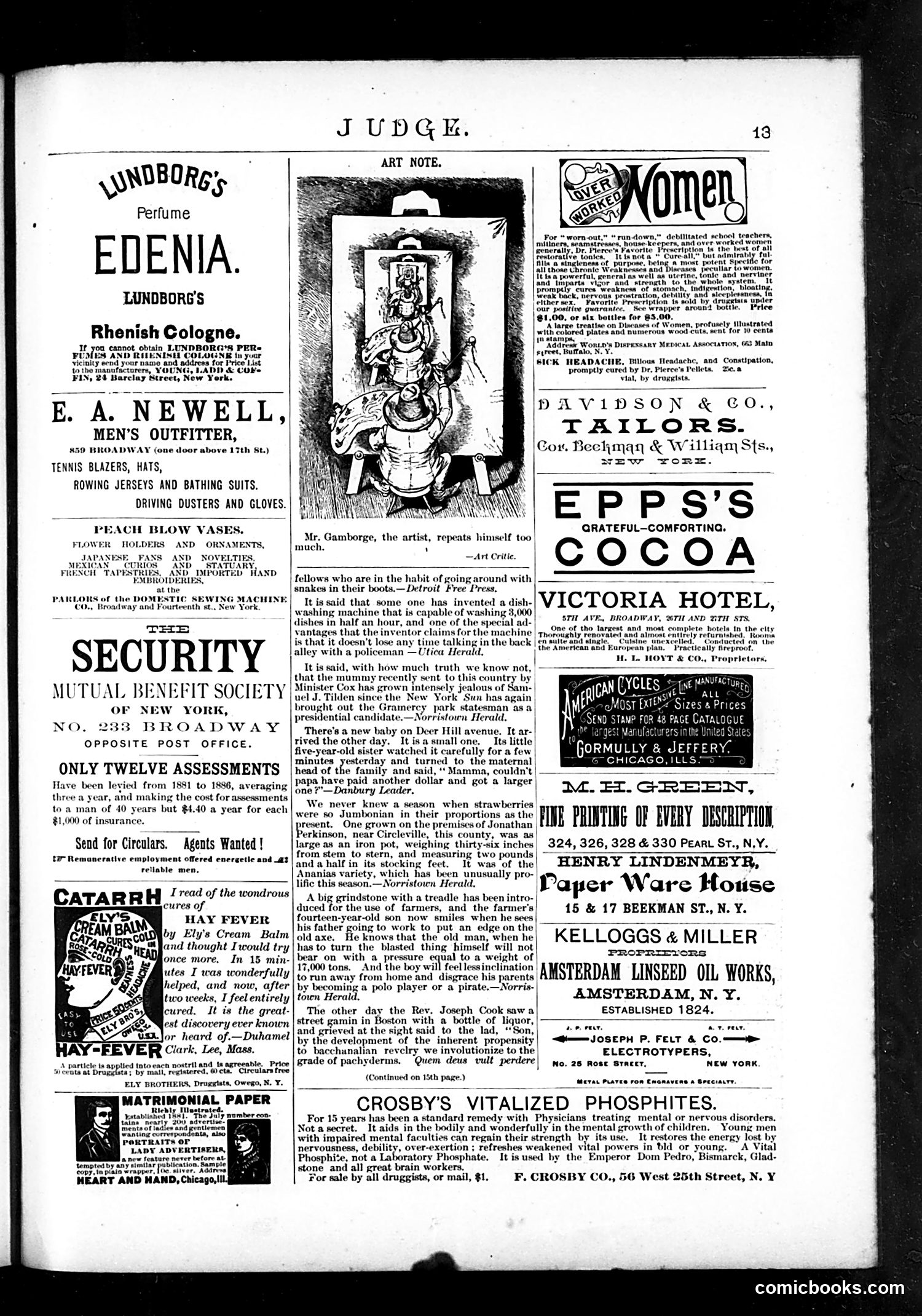
This page is primarily **advertising with scattered humorous anecdotes** rather than political cartoons. The visible artwork shows a decorative illustration of classical figures around a perfume bottle (for Lundborg's Edenia cologne). The text consists of brief comedic vignettes parodying contemporary society: - An art critic's complaint that Mr. Gamborge "repeats himself too much" — satirizing pretentious art criticism - Jokes about a dishwashing machine that "doesn't lose time talking in the back alley with a policeman" — mocking idle workers - A comment on a mummy supposedly "growing intensely jealous" of Samuel Tilden since newspaper coverage resumed — political satire on Tilden's presidential ambitions - Humorous exaggeration about oversized strawberries and a heavy grindstone designed to discourage boys from running away These anecdotes reflect **late-1880s middle-class American life**, targeting pretension, labor issues, and political figures. The humor relies on absurdity and ironic understatement typical of Victorian-era satire. The page is dominated by period advertisements for perfume, clothing, medical products, and business services.
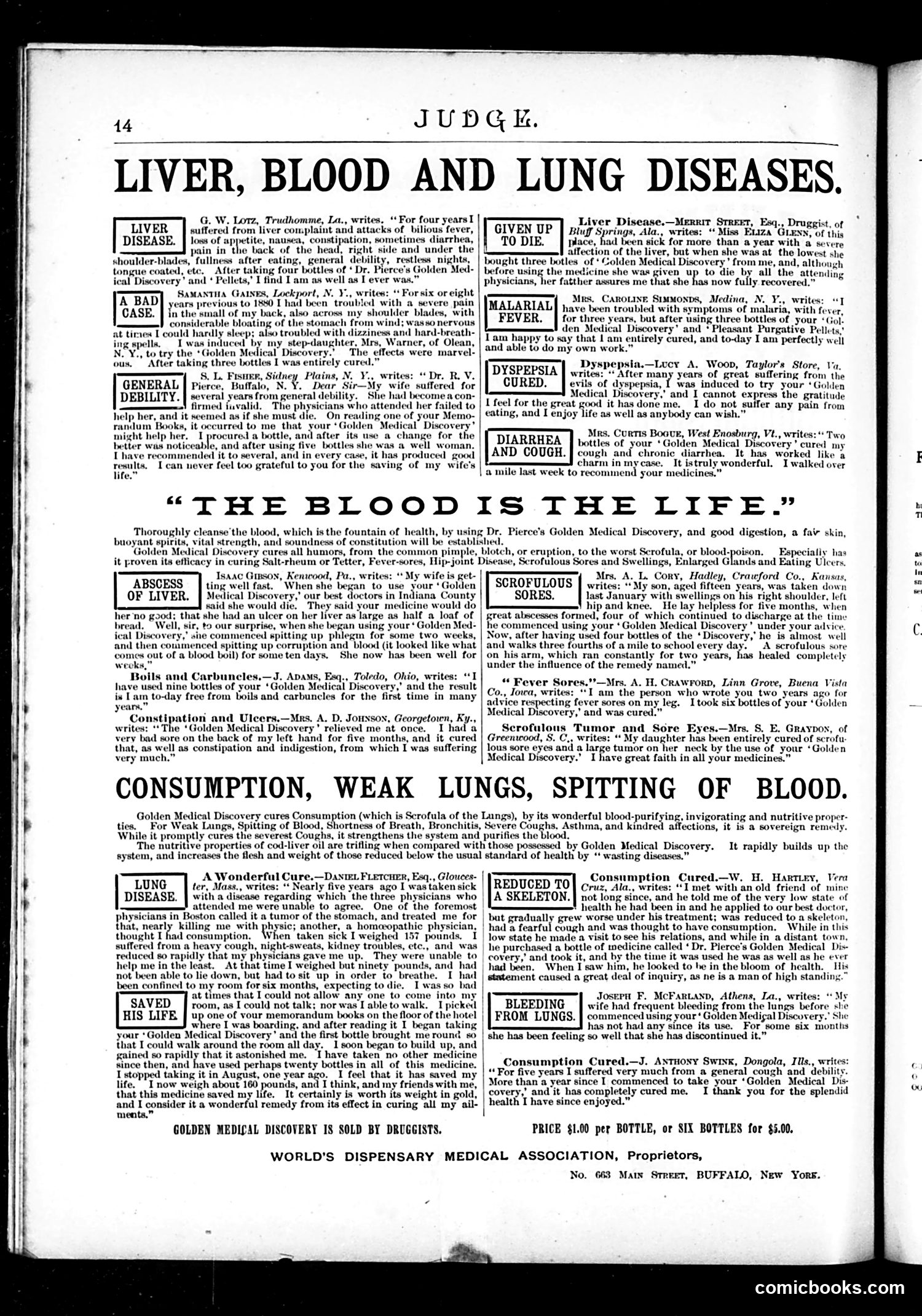
This is **not a political cartoon page** but rather a **patent medicine advertisement** for "Golden Medical Discovery," a quack remedy produced by the World's Dispensary Medical Association in Buffalo, New York. The page consists entirely of testimonial letters from alleged patients claiming the product cured various ailments: liver disease, fever, dyspepsia, lung disease, and consumption. The testimonials use specific names and locations to suggest legitimacy. **Historical Context**: This represents 19th-century medical fraud. Such "cure-alls" were heavily advertised in magazines like *Judge*, exploiting public desperation before modern medicine existed. The product likely contained alcohol or opium and had no actual therapeutic value. **The Satire**: *Judge* itself was satirical, but this page appears to be a straightforward (albeit fraudulent) advertisement that the magazine accepted—reflecting how even respected publications profited from false medical claims before FDA regulation (established 1906). This demonstrates how widespread patent medicine scams were in the Gilded Age.
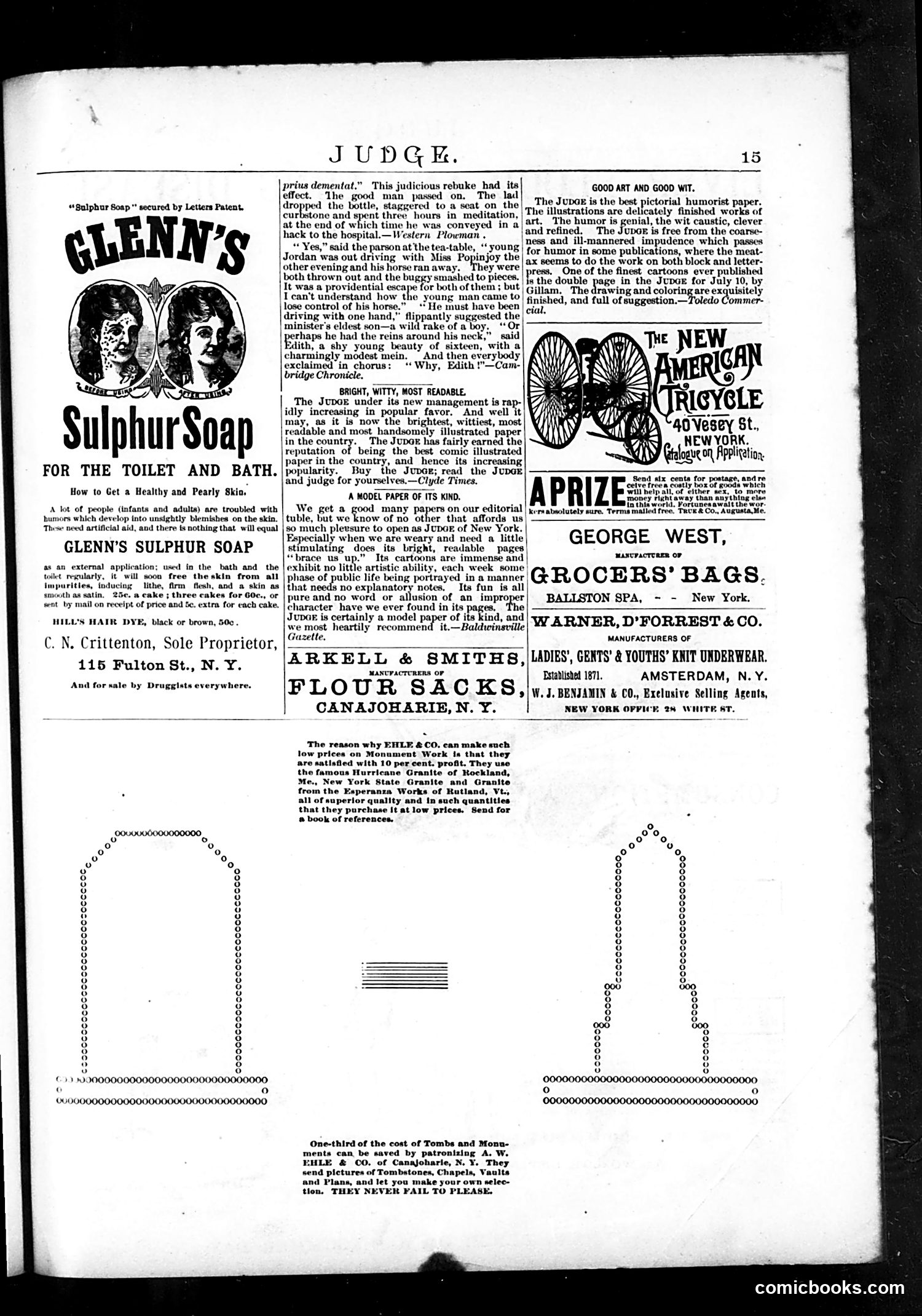
This page is primarily **advertising and promotional content** rather than editorial cartoons. The main elements are: **Glenn's Sulphur Soap advertisement**: A patent medicine ad promising to cure skin blemishes and impurities. The two portrait images show before/after results. **Editorial testimonials**: The page reprints favorable reviews of *Judge* magazine itself from other publications (Clyde Times, Baldwinsville Gazette), praising it as "a model paper of its kind" with "the brightest, wittiest" illustrations and "immense" cartoons depicting public life without improper content. **Trade advertisements**: For flour sacks, hair dye, tricycles, grocers' bags, knit underwear, and monument/tombstone companies. The content reflects late 19th-century American commercial culture—patent medicines were ubiquitous, and *Judge* used competitor testimonials to promote itself. There are **no identifiable political figures or satire** on this particular page; it's essentially a commercial/promotional issue.
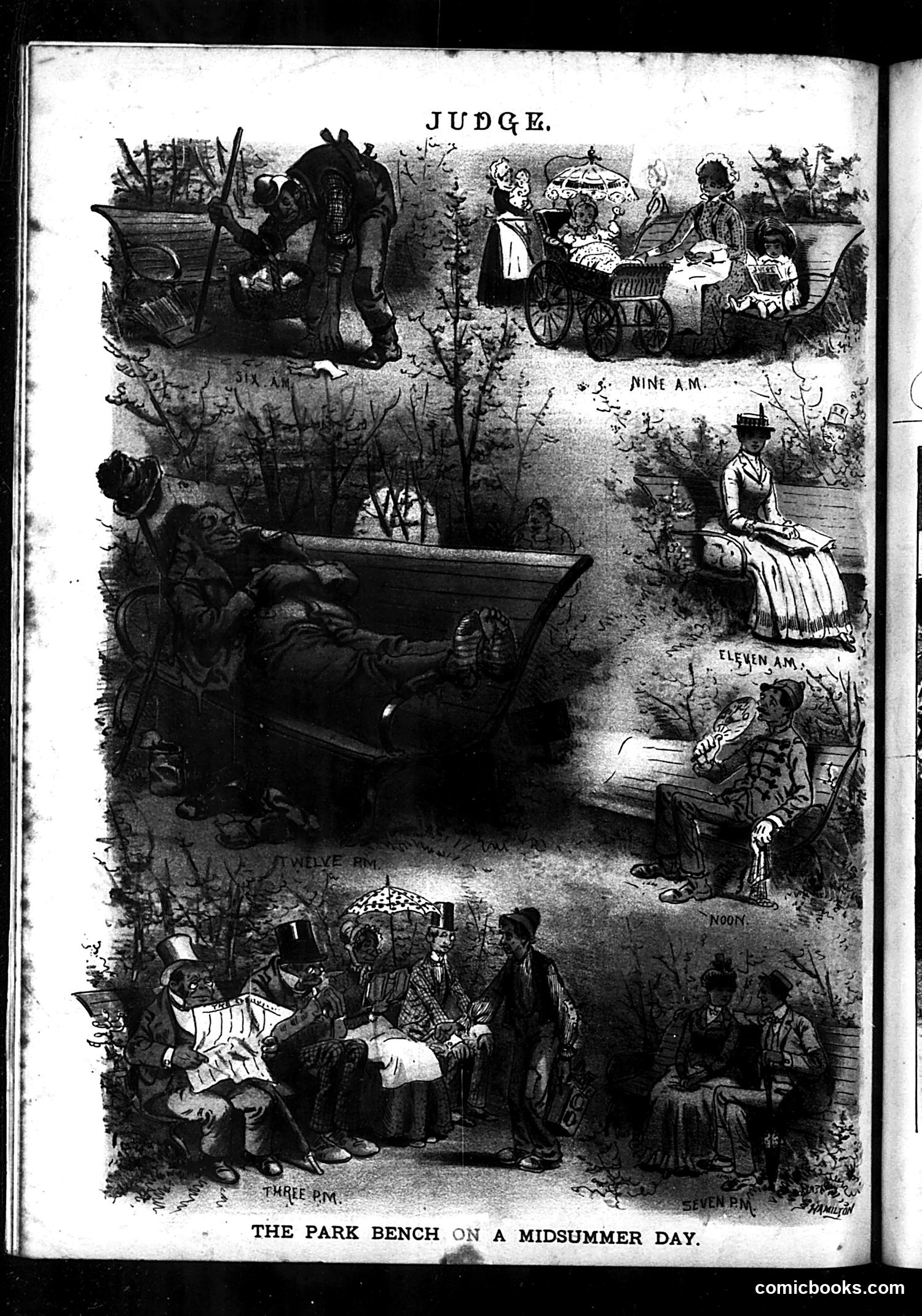
This page shows a single satirical cartoon titled "Judge" depicting a park bench throughout different times of day (9 AM, 11 AM, noon, 3 PM, 7 PM). The cartoon observes how the bench's occupants change as hours pass—from well-dressed women with carriages and children in the morning, to working-class people resting during lunch hours, to vagrant figures and homeless individuals by evening. The satire critiques class divisions in urban park life, suggesting that public spaces become increasingly occupied by society's poorest as the day progresses. The "respectable" classes use parks during daylight hours when socially acceptable; the marginalized claim them as evening shelters. It's social commentary on Victorian-era urban inequality and who "belongs" in shared public spaces.