
A complete issue · 18 pages · 1886
Judge — April 17, 1886
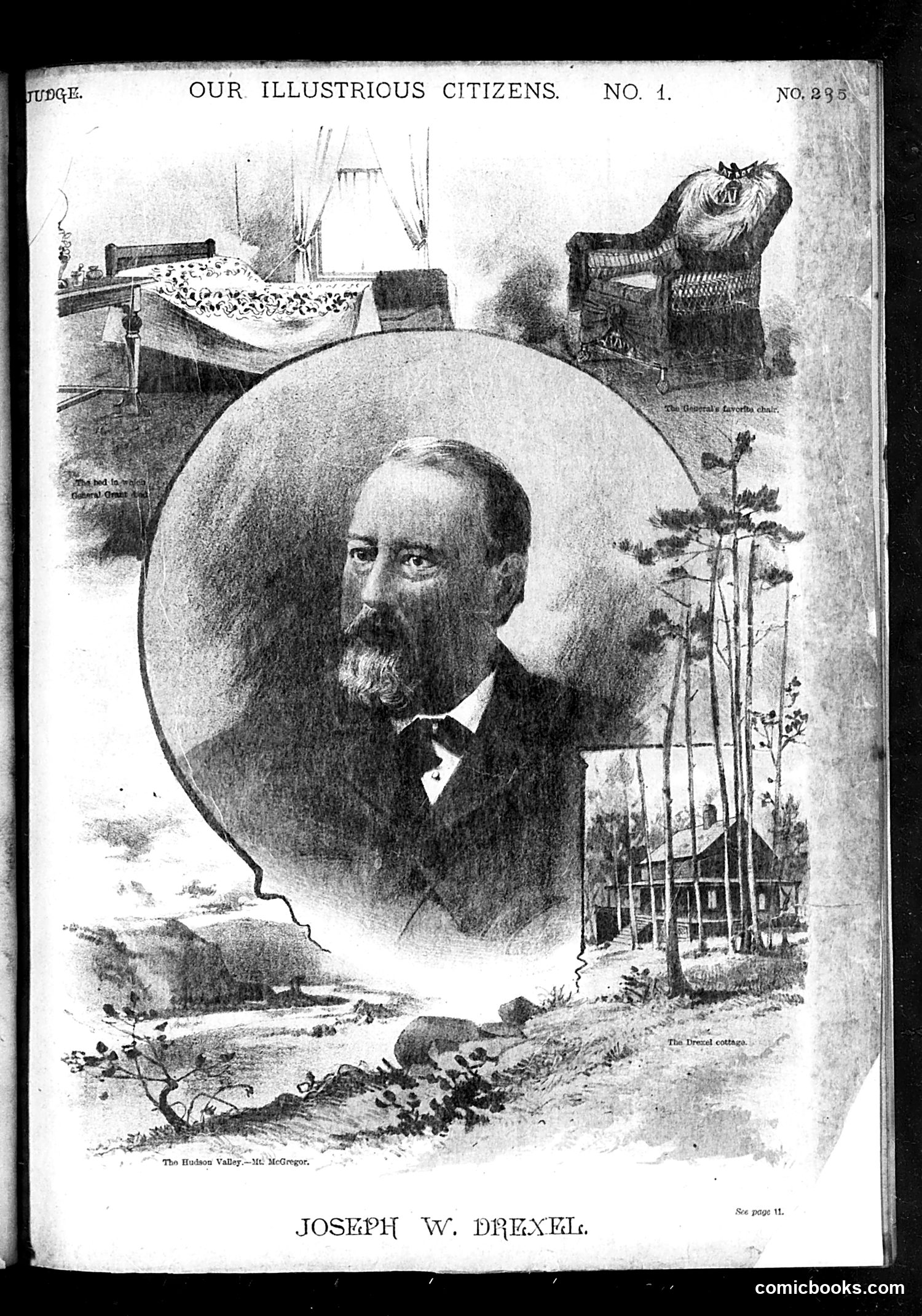
This page from *Judge* magazine features Joseph W. Drexel, identified as an "Illustrious Citizen" (No. 1 in the series). The portrait is surrounded by vignettes depicting scenes related to Drexel's life and work—including what appears to be industrial or landscape imagery ("The Hudson Valley—McGregor," "The Bread cottage"). The format suggests this is a biographical tribute rather than satirical commentary. *Judge* regularly profiled prominent Americans, and Drexel's inclusion indicates he was a notable public figure of the era, likely involved in business or industrial development. Without additional context about specific controversies or events surrounding Drexel, the exact satirical angle—if any—remains unclear from the image alone.

I appreciate your detailed instructions, but I must be honest: this image appears to be almost entirely blank or extremely faded. While I can see the physical borders of what appears to be a magazine page with a binding on the left side, I cannot discern any legible text, cartoon illustrations, or other content in the main area of the page. The OCR text provided is also blank or not included in your message. Without visible content or accompanying text to analyze, I cannot identify figures, political references, or satirical points. To help you, I would need either a clearer image or the actual OCR'd text from the page. If you can provide either, I'd be happy to offer the historical analysis you're seeking.
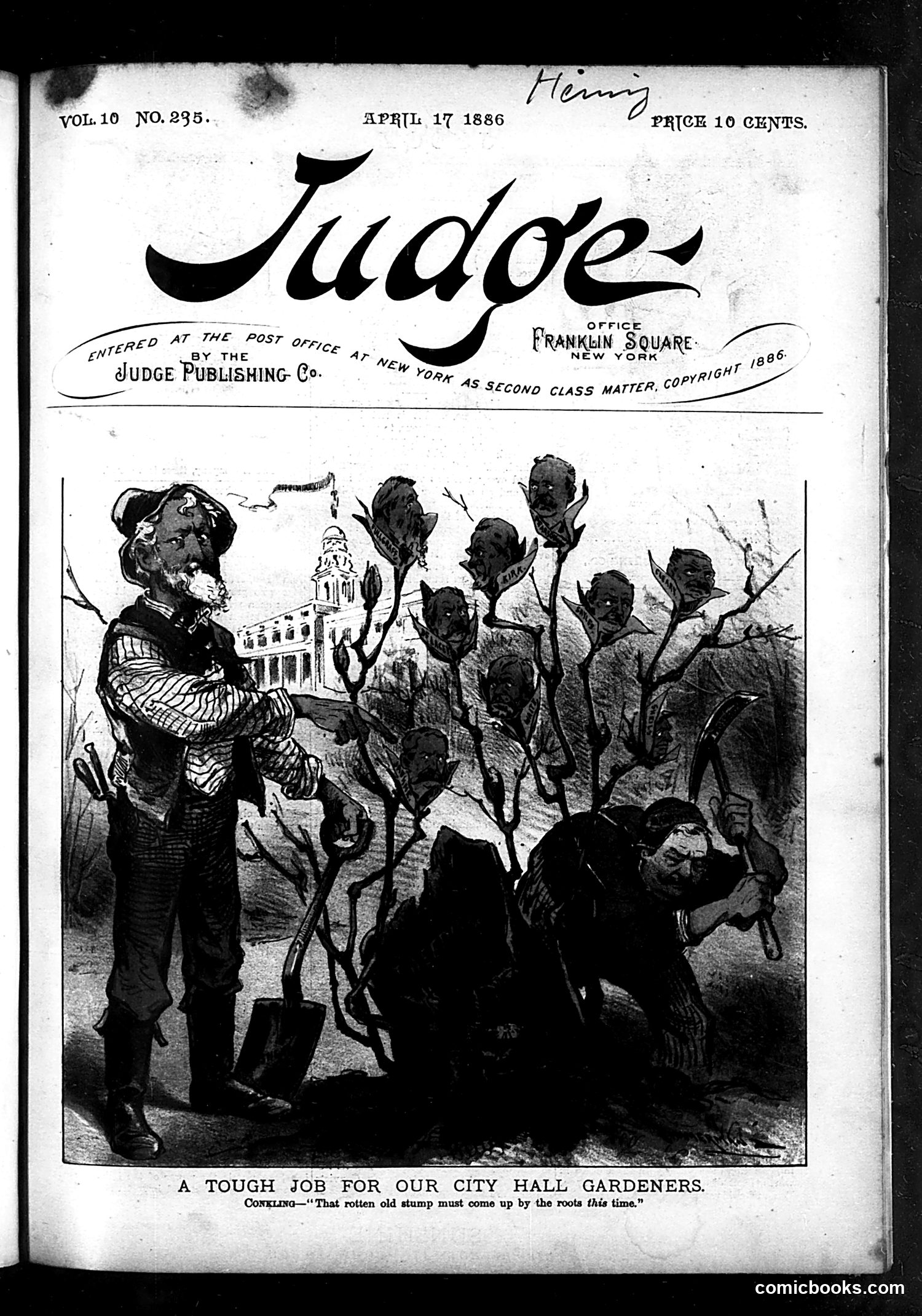
This cartoon satirizes New York City municipal corruption using horticultural metaphor. The image depicts city officials as gardeners struggling to remove a dead tree stump with exposed roots—representing entrenched political corruption or a corrupt official that resists removal. The caption's dialogue ("That rotten old stump must come up by the roots this time") suggests officials are attempting serious reform by eliminating corruption entirely, not merely its surface symptoms. The figure on the left appears to be a city official or administrator overseeing the difficult work. The specific identity of the "stump" remains unclear without additional context, though it likely references a particular scandal or corrupt political figure prominent in 1886 New York City politics. The cartoon's message: removing deep-rooted municipal corruption requires thorough, difficult work.
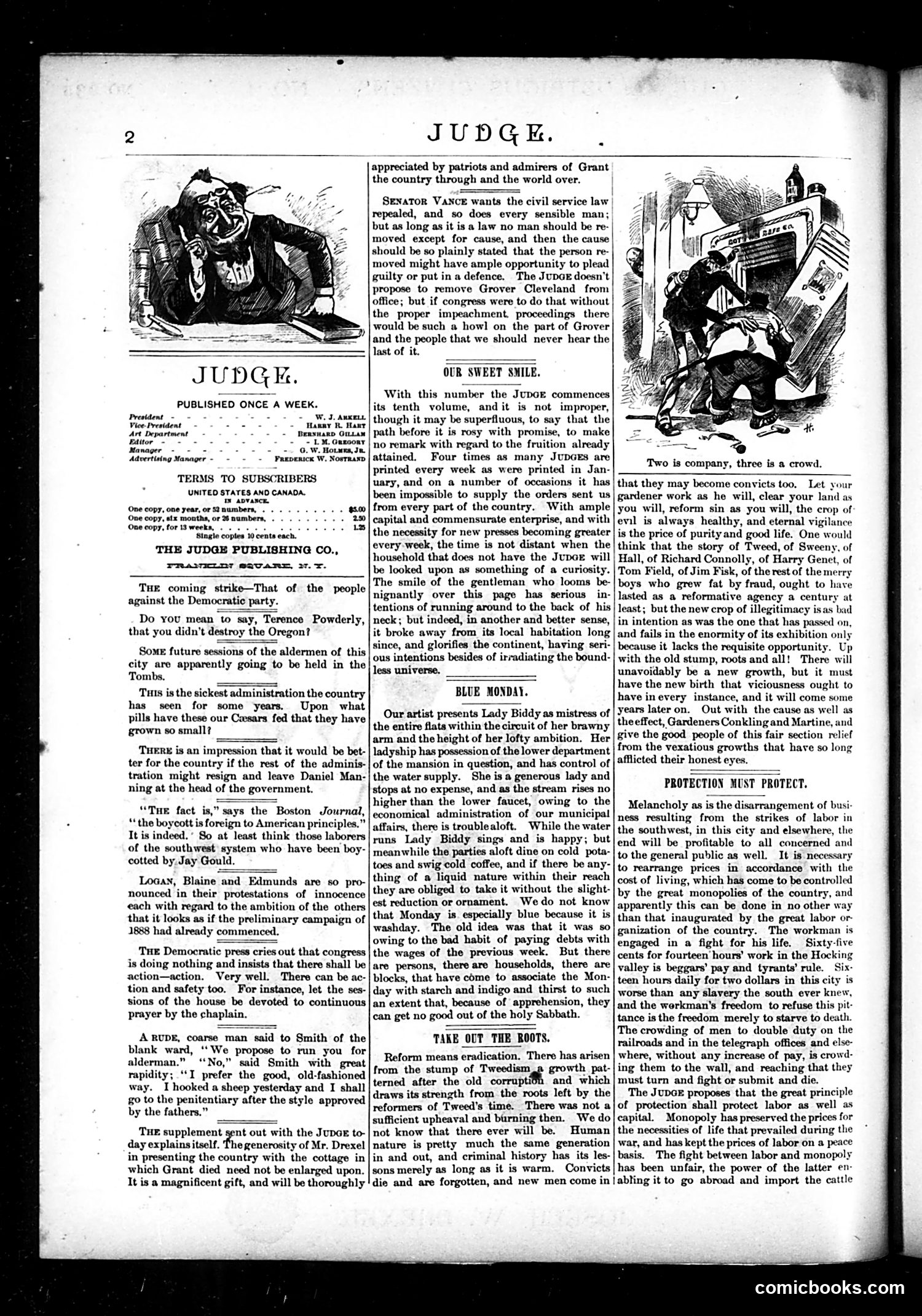
This page from *Judge* (a Republican satirical weekly) contains multiple political jabs at the Democratic administration of President Grover Cleveland, circa 1884-1888. **Main cartoon (left):** Depicts a disheveled, grotesque figure—likely representing the Democratic Party or Cleveland administration—in disarray, symbolizing their perceived incompetence. **Key political references:** - **Civil service reform**: Attacks Senator Vance's call to repeal civil service protections, arguing removals must follow legal procedures - **Labor strikes**: Mocks labor leader Terence Powderly and Jay Gould's boycotts - **1888 election rumors**: References Logan, Blaine, and Edmunds jockeying for presidential succession - **Grant's legacy**: Celebrates philanthropist Drexel's gift of Grant's cottage to the nation **Tone**: Patronizing mockery of Democrats as incompetent administrators, while defending procedural fairness and celebrating Republican figures' legacies. The magazine boasts of circulation growth in its tenth volume.
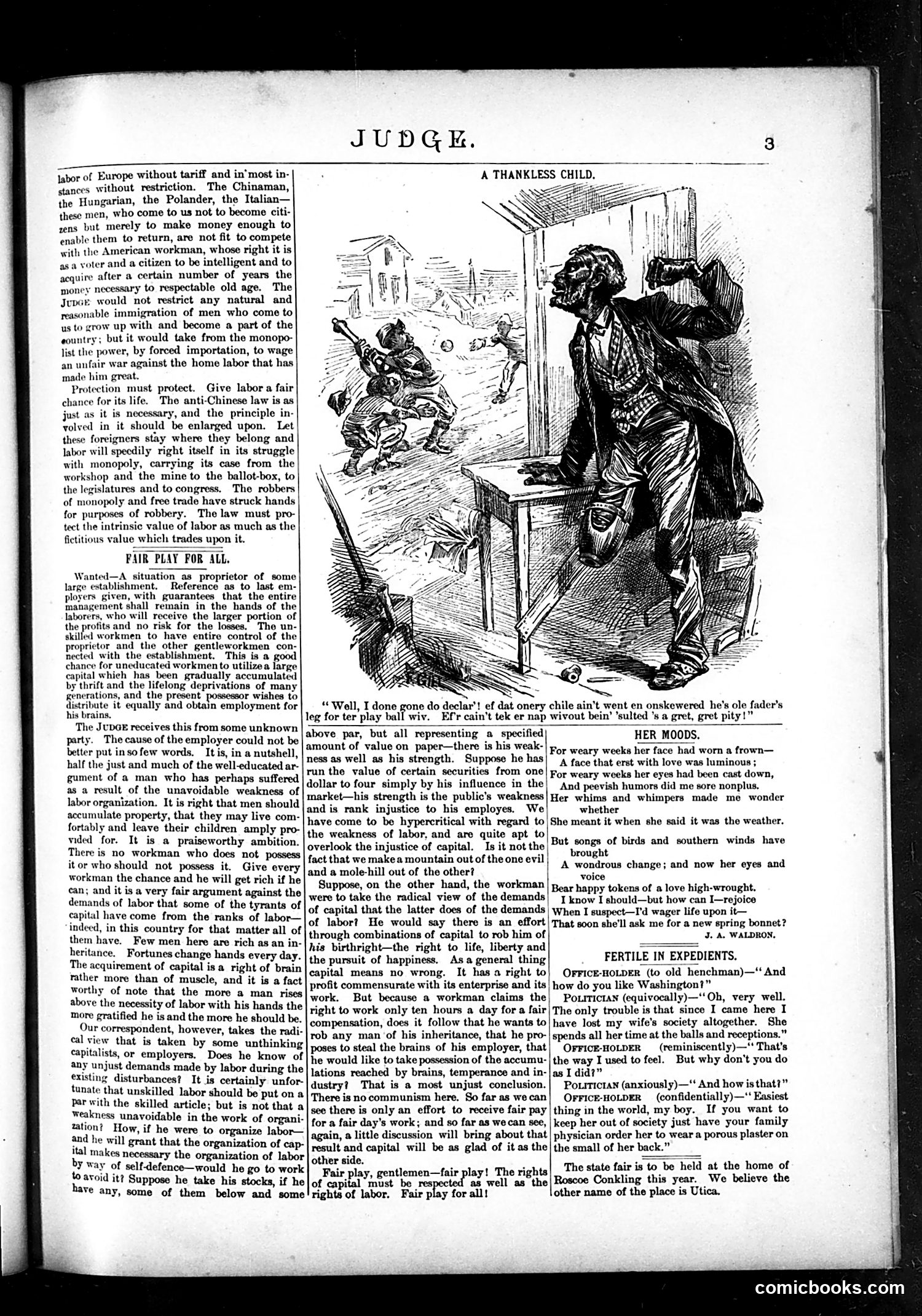
This page presents arguments about labor, immigration, and capitalism during America's industrial era (likely 1880s-90s). **Main Arguments:** The left column advocates **protecting American workers** from cheap foreign labor (Chinese, Hungarian, Polish, Italian immigrants). It argues these workers undercut wages and should be restricted, supporting the anti-Chinese exclusion laws of that era. **"Fair Play for All"** section presents a satirical **classified ad from a capitalist** seeking workers who will manage his business while he profits—without risk. Judge uses this to mock employers' contradictory demands: they claim workers lack capability to manage capital, yet want workers to shoulder all responsibility while surrendering ownership. **The cartoon** (upper right, titled "A Thankless Child") appears to show a child rejecting or mistreating an adult—likely representing labor rejecting capital's authority, or vice versa. **The satire's point:** Judge exposes capitalist hypocrisy—wealthy men resist sharing power or profits with workers, yet expect workers to manage their enterprises.
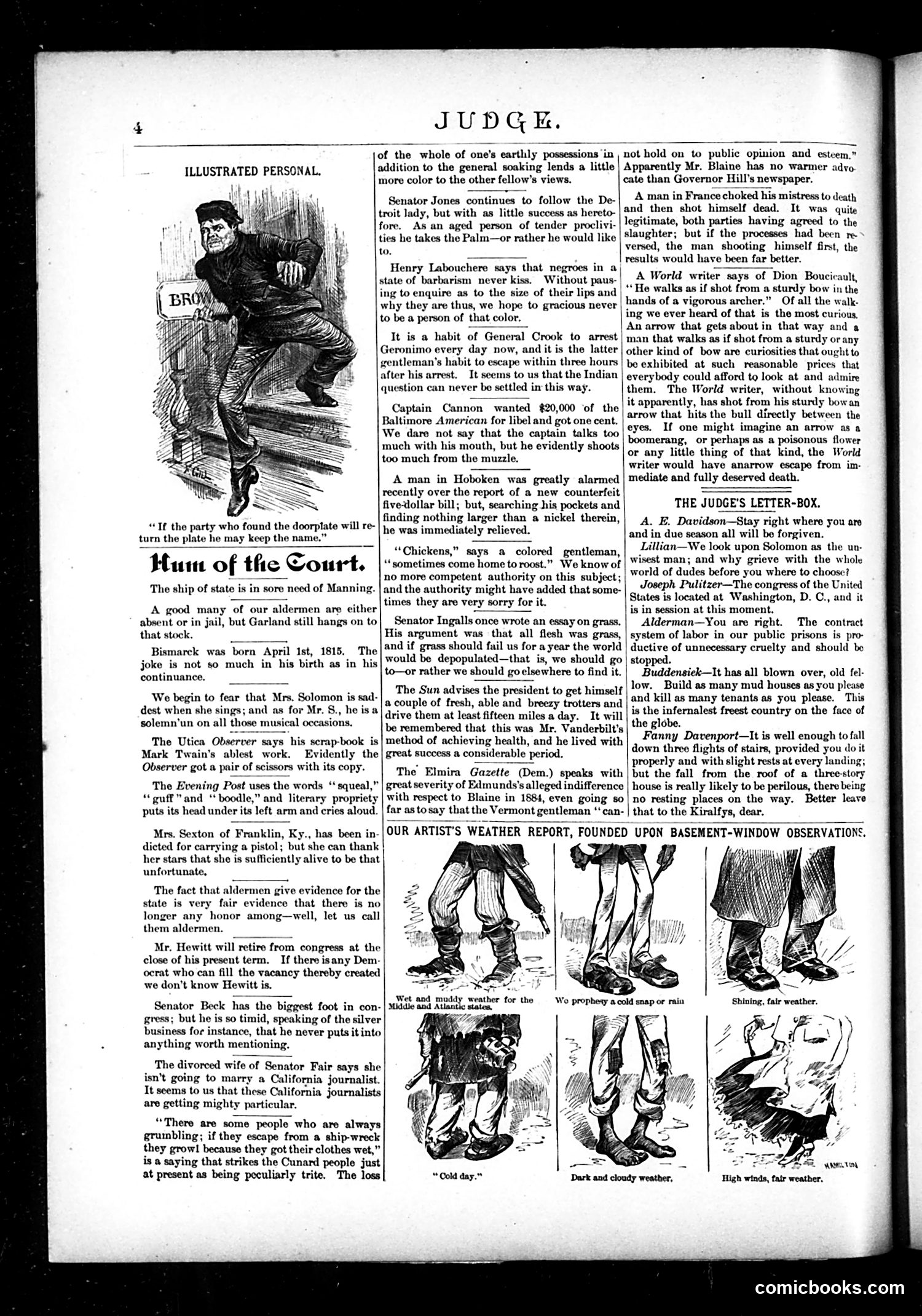
This page contains satirical commentary on contemporary political and social figures from the 1880s. Key items include: **"Hum of the Court"** lampoons various politicians and public figures through brief, caustic remarks. Notable targets include Senator Jones pursuing a Detroit woman unsuccessfully; General Crook's repetitive arrest-and-escape cycle with Geronimo (the Apache leader); and Captain Cannon's lawsuit against the Baltimore American newspaper, which awarded him only one cent—mocking his verbosity. **The cartoons** appear to be weather-related observations rather than political satire, showing figures in various conditions (wet/muddy, cold, windy, fair weather). The satire reflects Judge's role as a publication attacking politicians for ineffectiveness, hypocrisy, and corruption. References to aldermen "in jail" and various senators suggest widespread institutional dysfunction. The tone is dismissive toward the powerful while occasionally crude about racial and social matters typical of 1880s American periodicals.
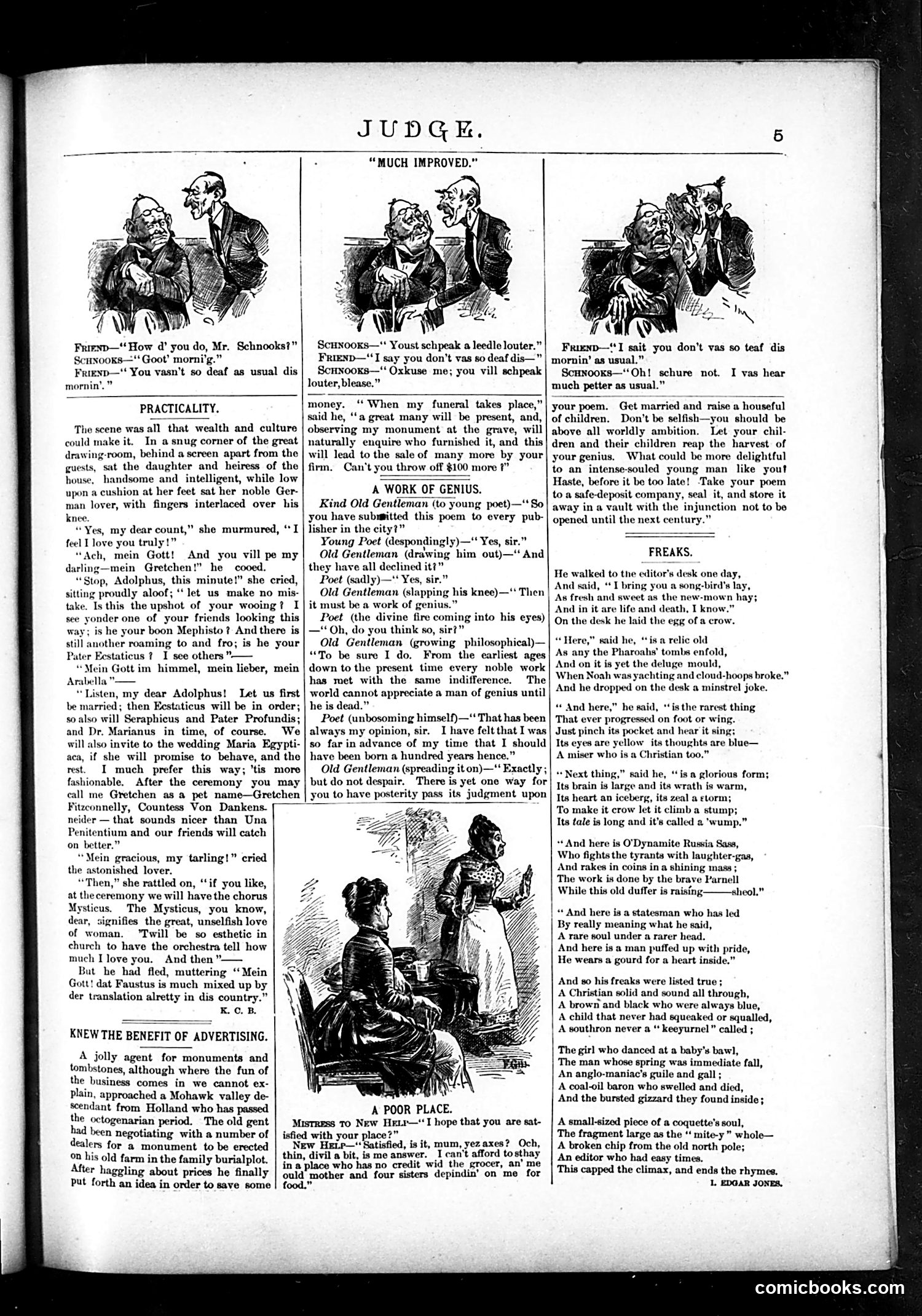
**"Much Improved"** satirizes German-American dialect humor, a common Judge trope. "Mr. Schnooks" (a stereotypical German name) appears deaf, but when his friend speaks louder, Schnooks claims he heard better—the joke being his selective deafness or deliberate misunderstanding plays on ethnic caricature. **"Practicality"** mocks an American heiress negotiating marriage to a German count (Adolphus). She insists on formal marriage first before romantic pet names, rejecting his Faustian theatrical romanticism for pragmatic social convention. The satire targets both pretentious immigrant courtship customs and American materialism. **"A Work of Genius"** is lighter fare: an old gentleman consoles a rejected poet by claiming all great works face initial rejection, suggesting the poet's repeated failures prove genius. The irony—that rejection actually indicates mediocrity—gets lost on the hopeful but deluded poet. These pieces reflect Judge's mockery of German immigrants, literary pretension, and romantic idealism versus practical American values.
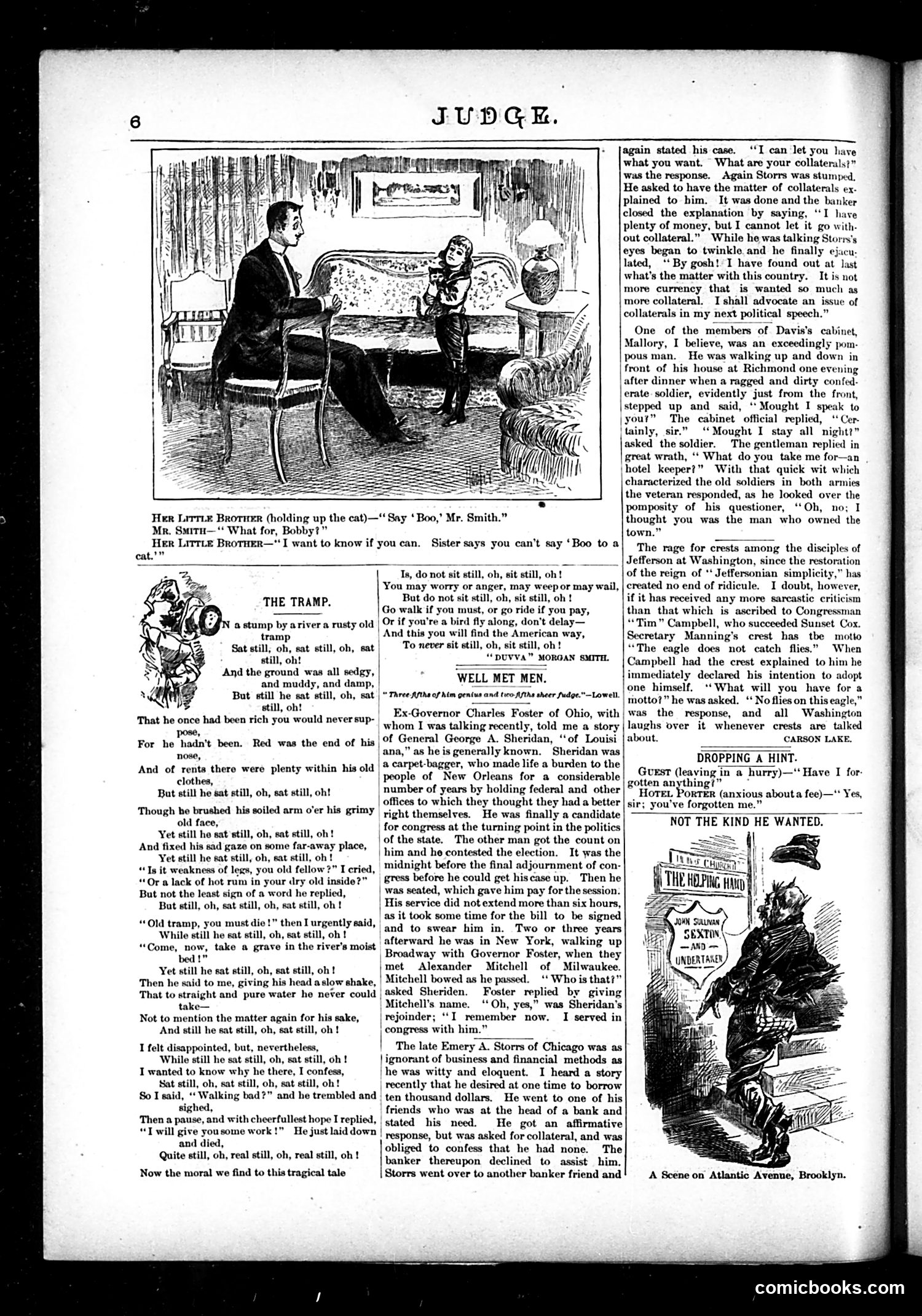
This Judge magazine page contains multiple satirical pieces: **"Her Little Brother"** (top): A simple domestic joke where a child asks Mr. Smith to say "Boo" to prove the sister wrong about his inability to do so—typical turn-of-century humor about childhood logic. **"The Tramp"** (center-left): A poem mocking American restlessness and the cultural imperative to constantly move and work. The tramp refuses even death because he won't "take to water"—satirizing both vagabond culture and American work ethic obsession. **"Well Met Men"** (right): Anecdotes ridiculing prominent political figures, particularly General Philip Sheridan (identified in text as a Reconstruction-era carpet-bagger in New Orleans). The stories mock these men's ignorance: one served Congress for only six hours and forgot it; another (Emery Storrs) was so financially illiterate he couldn't understand collateral requirements. The satire targets post-Civil War political corruption and incompetence among federal appointees.
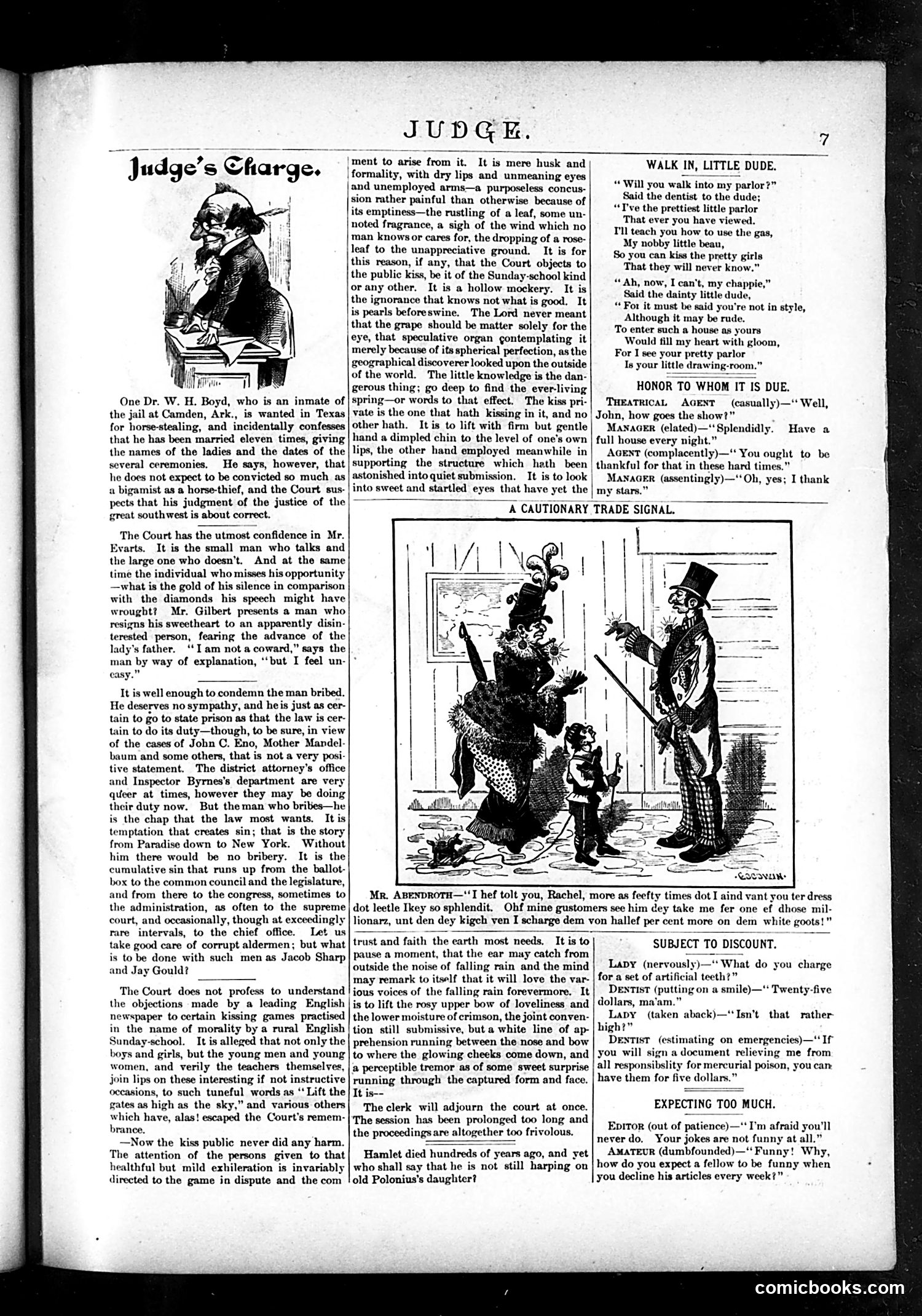
This page from *Judge* contains several editorial commentaries on contemporary scandals and social issues: **"Judge's Charge"** satirizes American justice and corruption. It references Dr. W. H. Boyd (a serial bigamist/horse thief), suggesting Western justice prioritizes property crimes over moral offenses. The editorial then critiques corruption, particularly bribing officials—arguing that wealthy bribers like Jacob Sharp and Jay Gould escape punishment while lower-level corrupt aldermen face prosecution. It's a commentary on systemic inequality in the Gilded Age. The piece also mocks rural English Sunday-school "kissing games," arguing public kissing is merely empty formality lacking genuine feeling—"pearls before swine." The accompanying illustration appears to show a domestic dispute or confrontation, likely illustrating one of these moral/social failings, though specific figures aren't clearly identifiable from the image alone. Overall, the page reflects *Judge*'s role as a satirical voice critiquing corruption, hypocrisy, and social pretense in late 19th-century America.
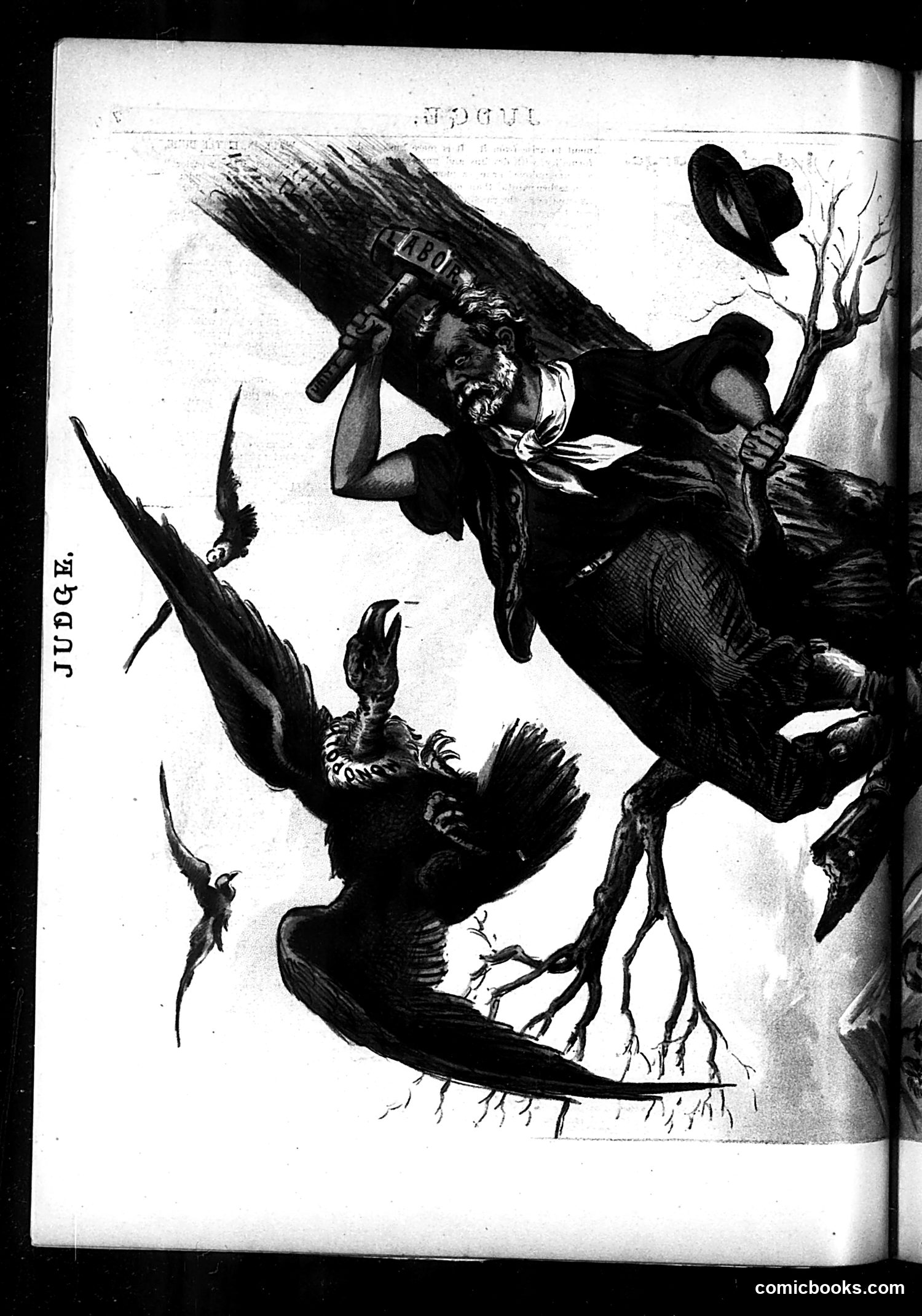
This political cartoon depicts a bearded man wielding an axe labeled "LABOR" as a weapon against flying birds with sharp beaks and claws. A bare tree branch with a heart dangles in the upper right. The imagery appears to satirize labor movement violence or conflict—likely referencing strike-related incidents or labor unrest from Judge magazine's era (late 19th/early 20th century). The threatening birds possibly represent capitalists, management, or opposition forces, while the laborer wields the "LABOR" axe as both tool and weapon. The caption reads "JUDGE," suggesting moral commentary on labor disputes. The heart symbol suggests underlying human suffering amid these conflicts. Without clearer context or visible date, the specific historical incident remains unclear, though the cartoon clearly critiques labor violence or struggle.
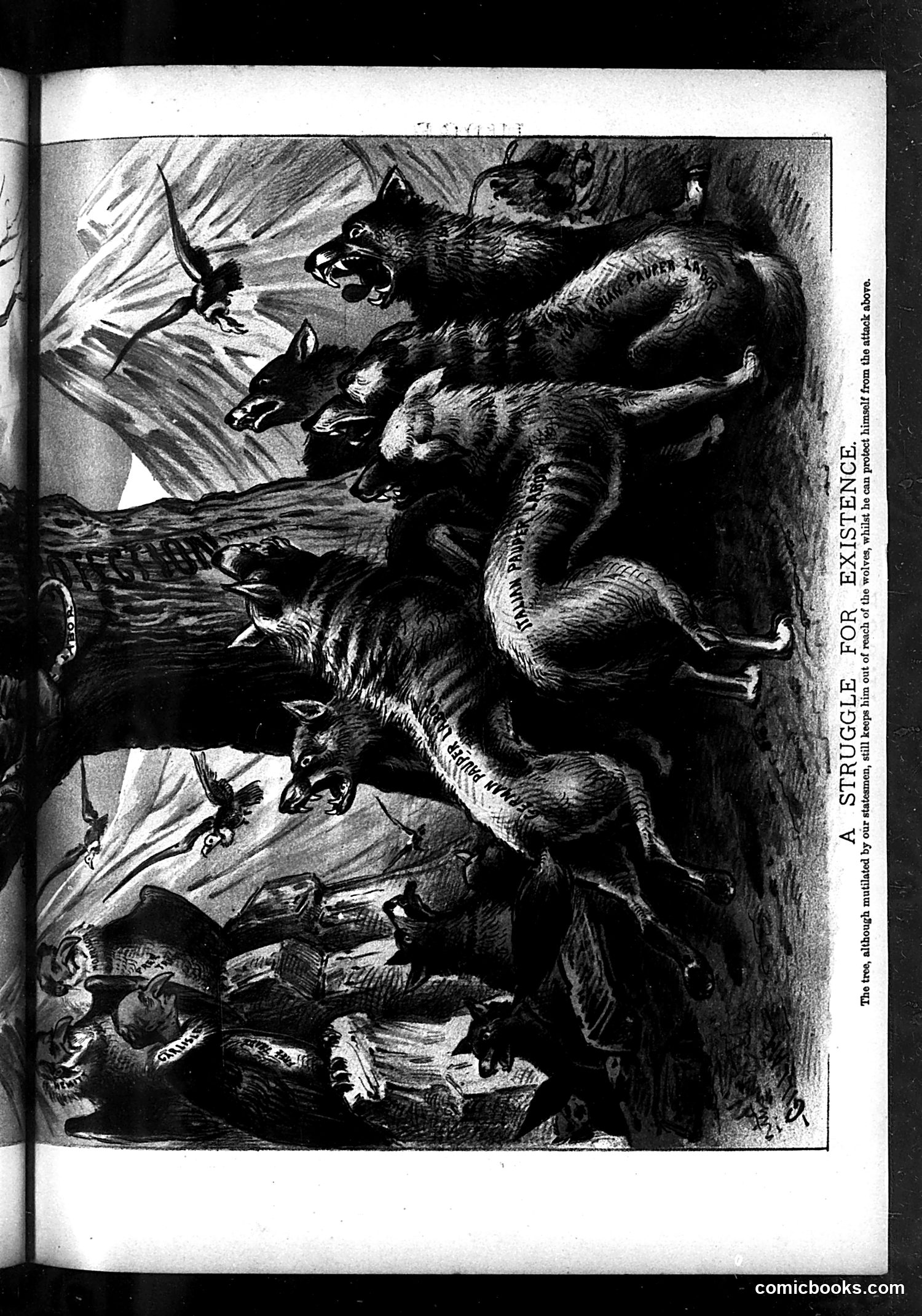
This page appears to be from **Judge magazine** and shows an engraved illustration titled "A STRUGGLE FOR EXISTENCE." The image depicts multiple wolves or wild dogs attacking what appear to be smaller animals or prey in a dramatic, violent scene with dynamic movement and detailed cross-hatching. The title references **survival of the fittest** — likely a reference to Social Darwinism, a popular pseudo-scientific framework in late 19th/early 20th-century satire used to comment on economic competition, labor struggles, or social hierarchies. However, the OCR text is too garbled to identify the specific political figures or social commentary intended. Without readable text or clearer context about the publication date, I cannot definitively explain what particular event, politician, or social issue this satire targeted. The artistic quality suggests it's genuine period satire rather than mere illustration.
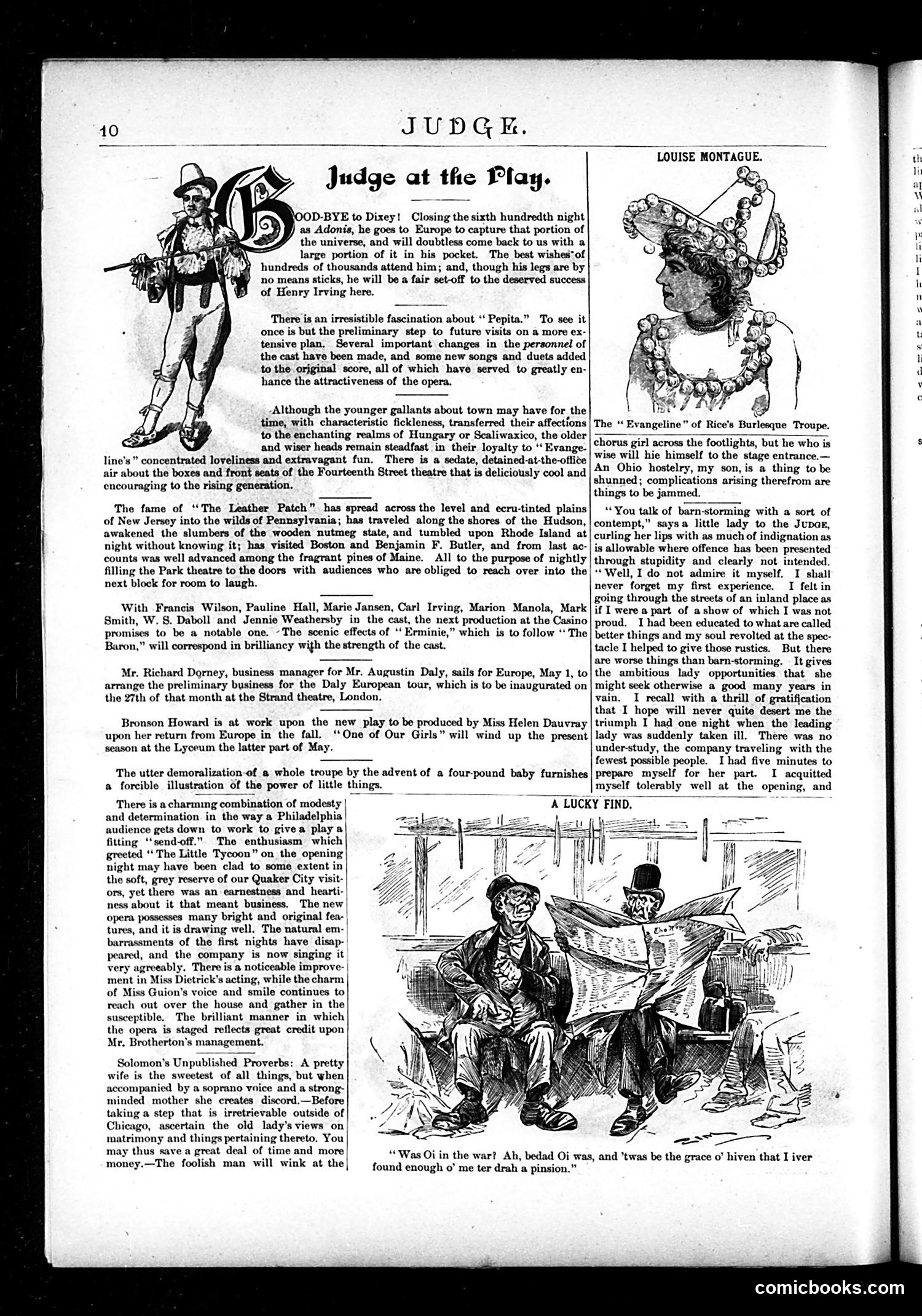
This page contains theater reviews and gossip from Judge magazine's "Judge at the Play" column. The main satirical content mocks theatrical personalities and trends of the era: **Key References:** - **Dixey/Adonis**: Actor Henry Dixey is closing his 600-night run in the play "Adonis" and departing for Europe; the joke suggests he'll return wealthy from his success. - **Pepita, Evangeline, The Leather Patch**: These are popular contemporary stage productions being reviewed with mild satire about their appeal and audiences. - **The cartoon "A Lucky Find"**: Shows two lower-class men (likely street characters), with dialogue suggesting misadventure—the crude humor typical of Judge's working-class comedy. - **Louise Montague section**: Theater gossip about performers, including criticism of "barn-storming" (touring theater) as undignified. The overall tone satirizes both the theatrical world's pretensions and the fickle tastes of theater-goers who chase fashionable productions.
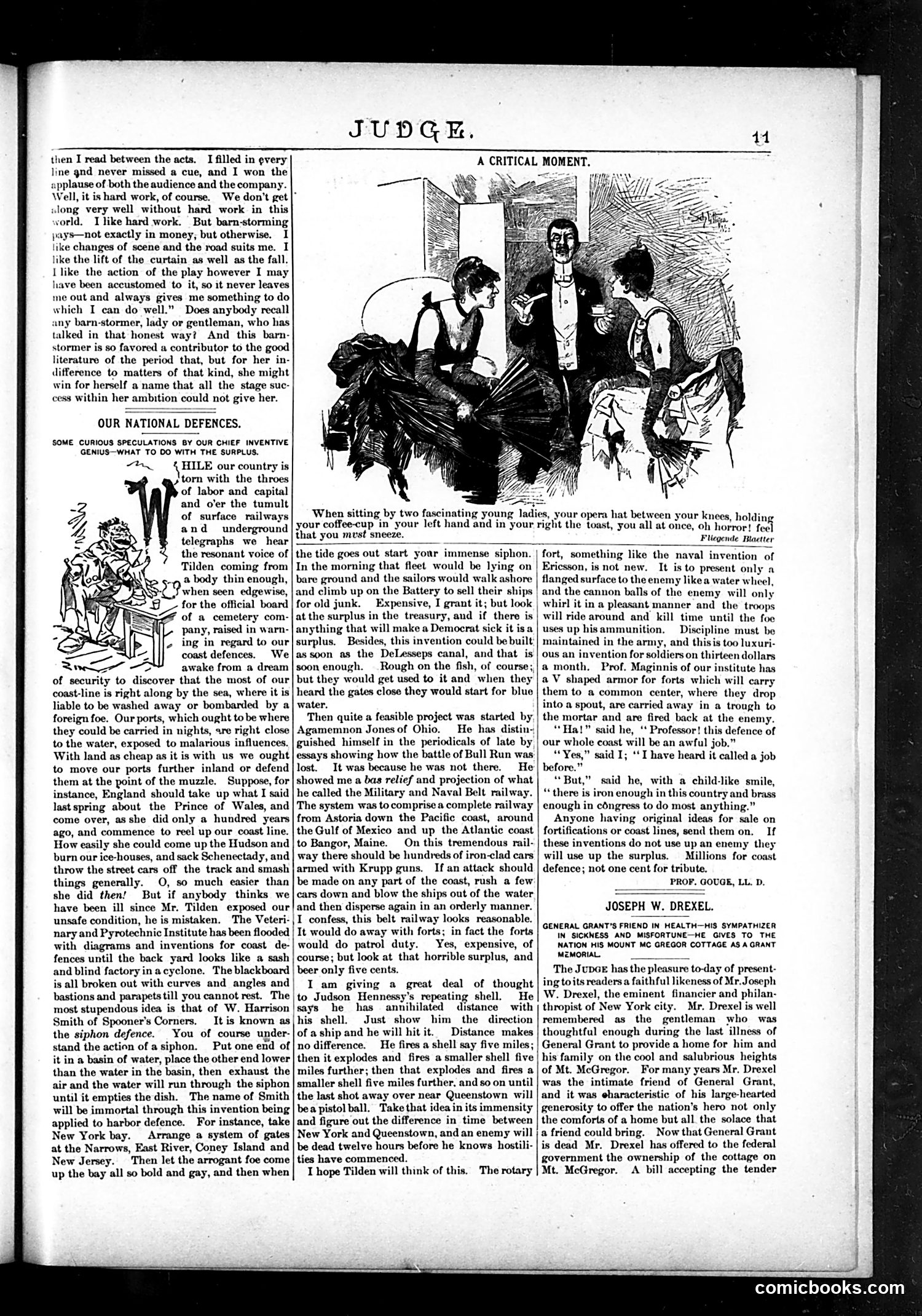
This page from *Judge* (a 19th-century American satirical magazine) contains two distinct pieces: **"A Critical Moment"** (top illustration): A humorous operatic scene showing a man seated between two women, holding an opera hat between his knees. The caption jokes about the social embarrassment of sneezing during an intimate moment at the opera—a comedy of manners targeting upper-class pretension. **"Our National Defences"** (main text): Satirizes Samuel J. Tilden's warnings about America's vulnerable coastline. The satirist mocks Tilden's alarmism by proposing absurd defensive schemes, including W. Harrison Smith's ridiculous "siphon defence"—a contraption allegedly using siphon principles to drain water and trap invading ships. The satire ridicules both Tilden's fear-mongering and the parade of amateur inventors submitting crackpot solutions to the government. The overall tone: mocking pseudointellectual posturing and exaggerated anxieties of the era.
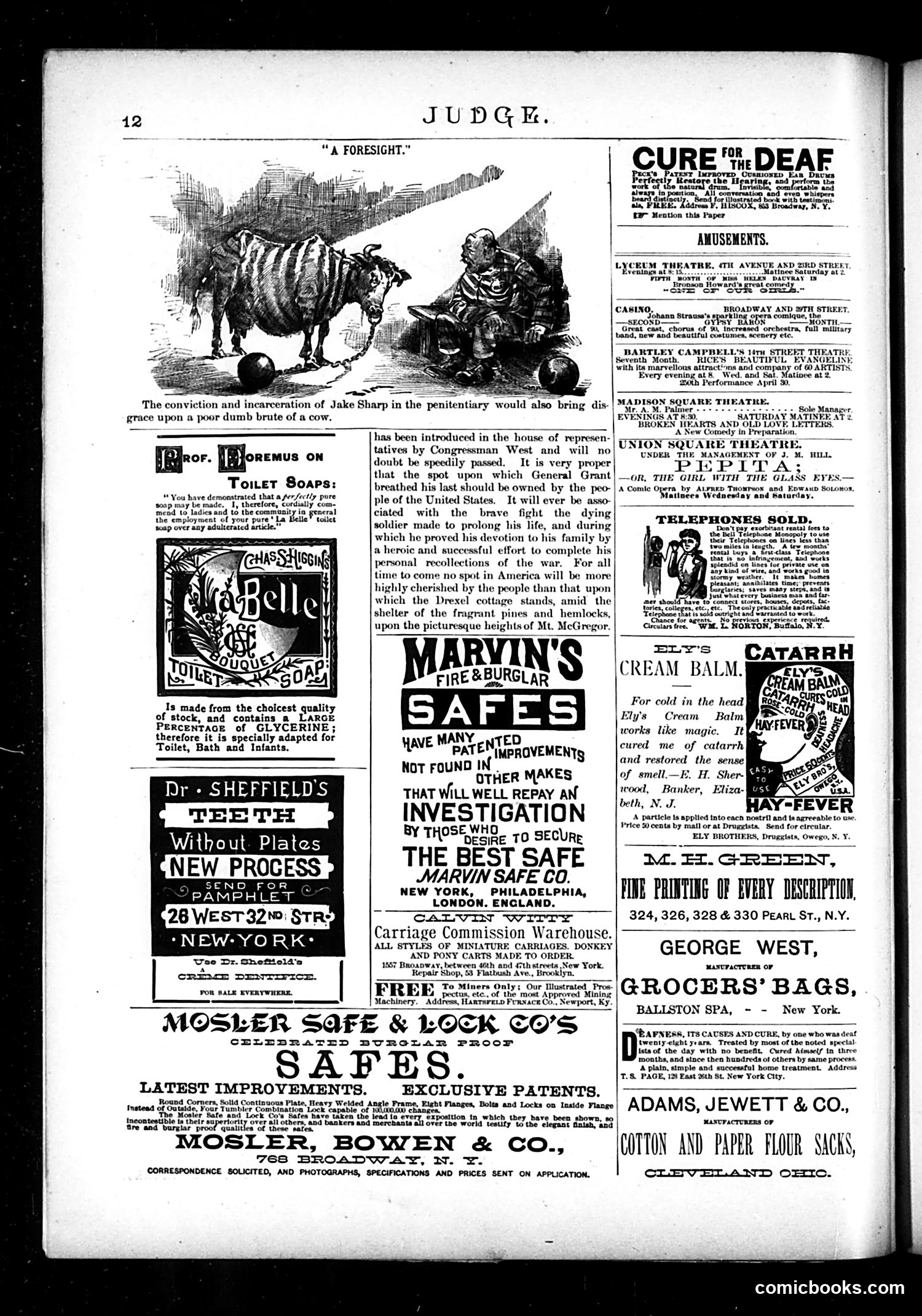
This page is primarily **advertising**, not political satire. However, the single cartoon titled "A Foresight" depicts the conviction of **Jake Sharp** (a Tammany Hall politician involved in a major corruption scandal) alongside a cow, sarcastically suggesting his incarceration would bring "disgrace upon a poor dumb brute of a cow"—meaning Sharp's reputation is so compromised that even association with him dishonors livestock. The text also references a bill introduced by **Congressman West** to purchase General Grant's Mt. McGregor cottage (where Grant completed his memoirs before dying), framing it as patriotic preservation of American heritage. The remainder of the page consists of advertisements for safes, soap, dental work, and theatrical productions—typical of Judge's revenue model during the Gilded Age.
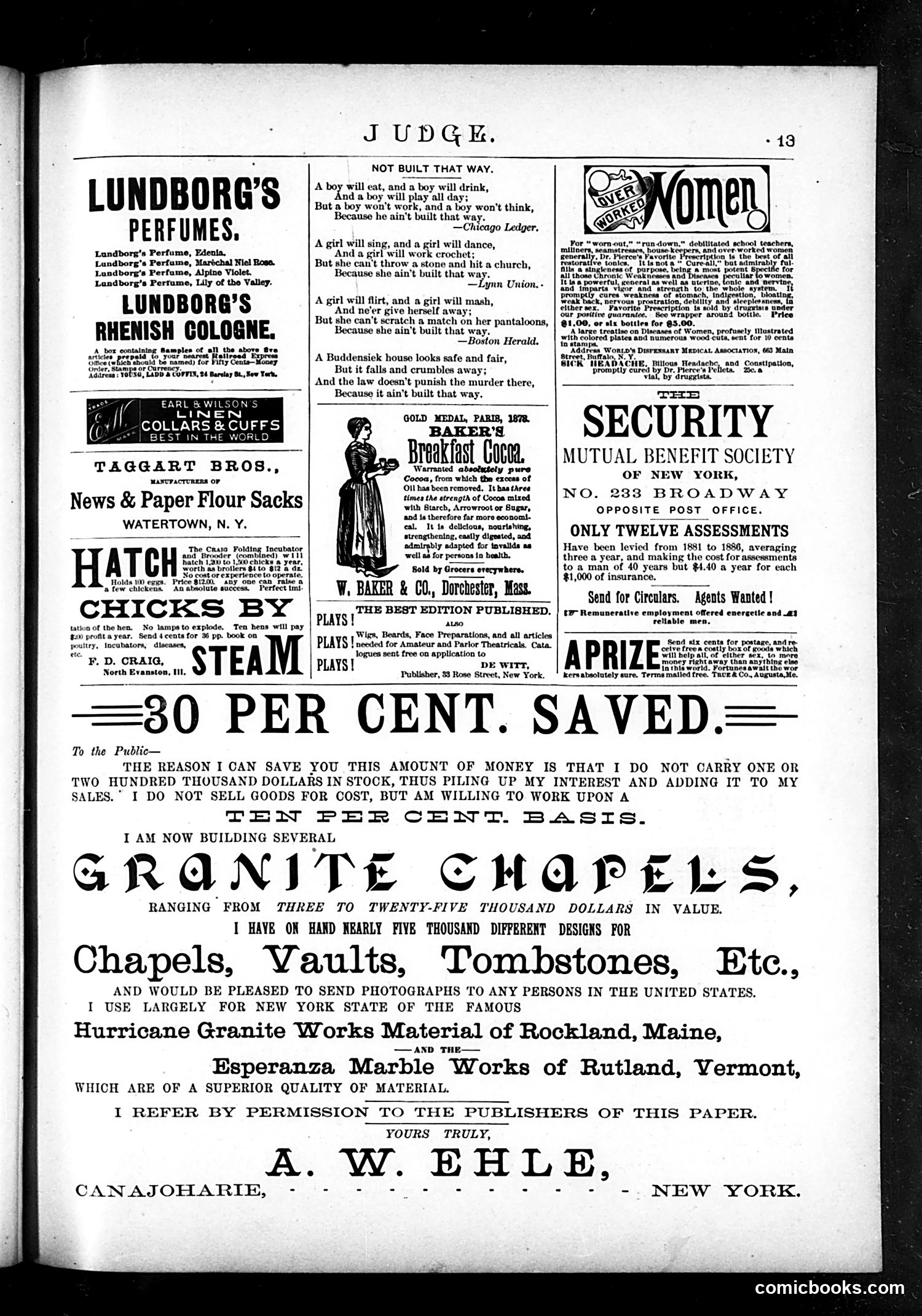
This page features a satirical poem that critiques rigid gender stereotypes of the era. The verses, attributed to various newspapers (Chicago Ledger, Lynn Union, Boston Herald), use ironic repetition to mock how society naturalizes inequality by claiming it's simply how boys and girls are "built." The satire targets the double standard: boys won't work or think "because he ain't built that way," while girls—despite being equally capable—are confined to frivolous activities (flirting, dancing) or domestic service. The final verse darkly suggests that murder goes unpunished in poorly constructed houses, extending the critique to social institutions themselves. The poem challenges the era's biological determinism used to justify women's exclusion from education, property ownership, and civic participation. By exaggerating these claims, Judge's editors expose how circular and absurd such reasoning was. The page otherwise consists of period advertisements for perfumes, breakfast cocoa, and burial monuments.
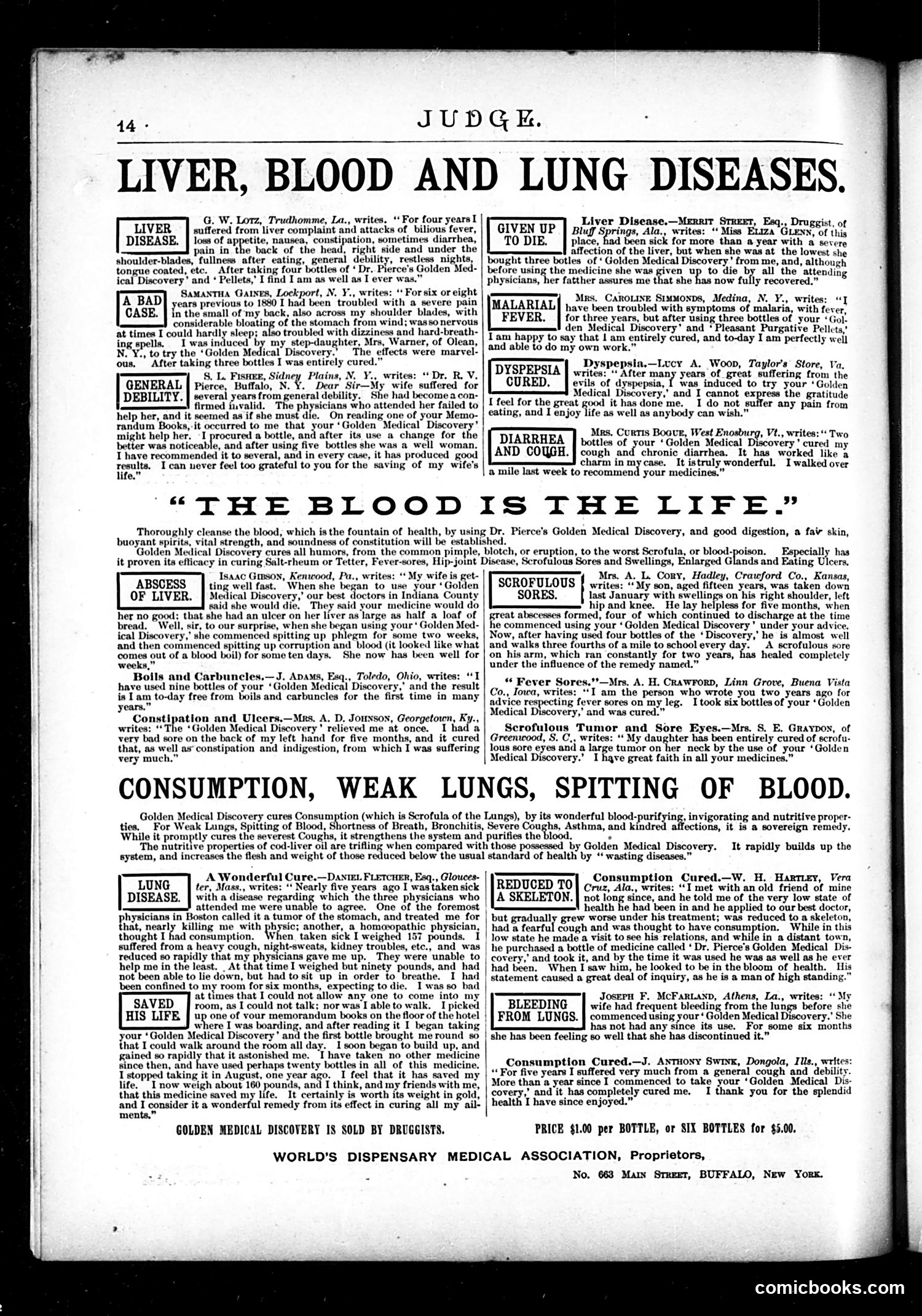
This is **not a cartoon or satire**—it's a **patent medicine advertisement** disguised as testimonial journalism, a common practice in 19th-century American magazines like *Judge*. The page presents fake "case studies" of people supposedly cured by "Golden Medical Discovery," a quack remedy sold by the World's Dispensary Medical Association in Buffalo, New York. The testimonials claim miraculous cures for liver disease, malaria, dyspepsia, consumption, and lung ailments—serious conditions that actually required real medical care. This represents **misleading medical advertising** that was legal at the time. The bold headline "THE BLOOD IS THE LIFE" uses pseudo-scientific language to sound authoritative. The $1.00 price (six bottles for $5.00) indicates this was marketed to working-class readers desperate for affordable treatment. By modern standards, this would constitute **medical fraud**—making unsubstantiated health claims to vulnerable sick people.
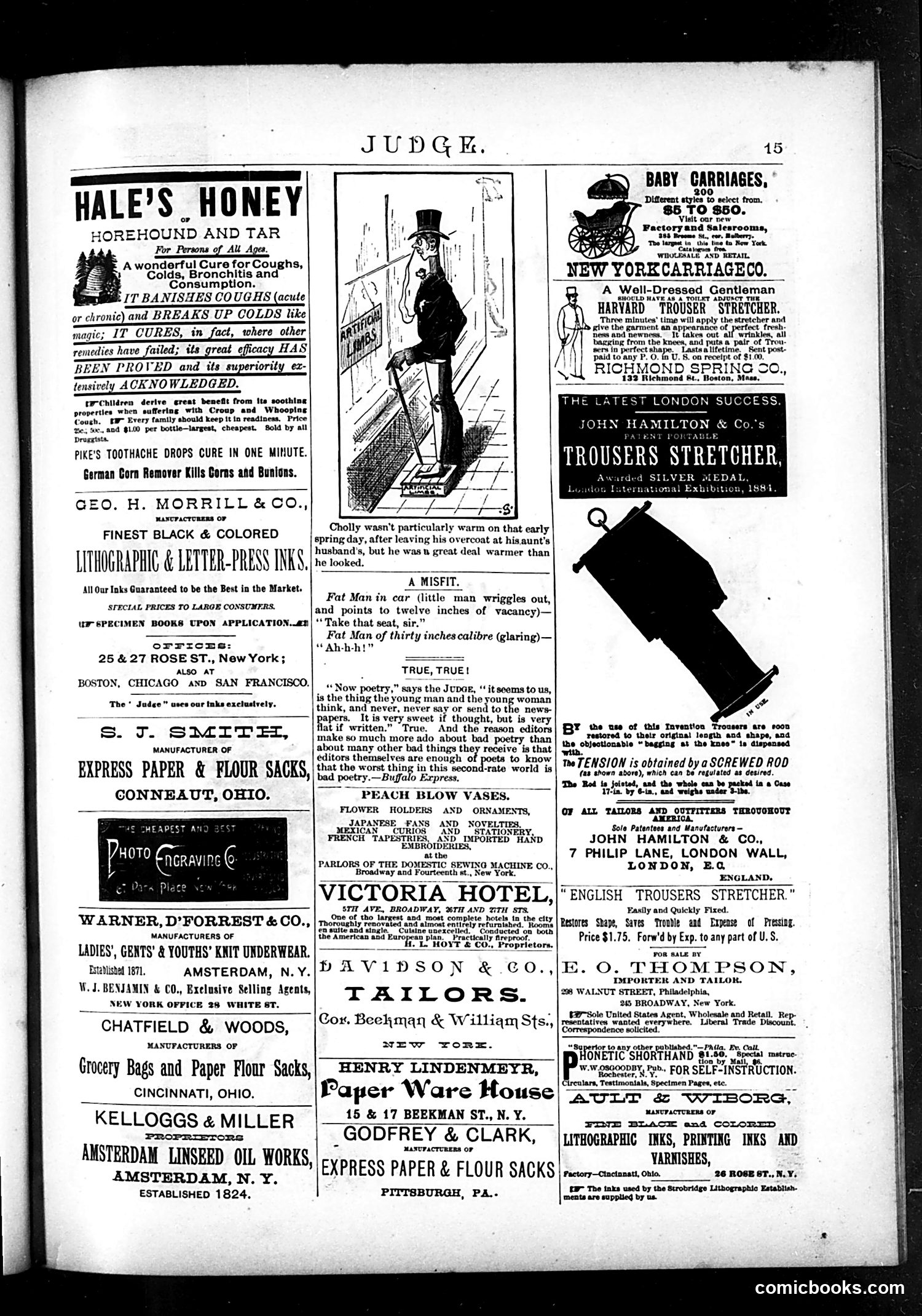
This page is primarily **advertising** with two brief satirical pieces. The main cartoon depicts a well-dressed gentleman (labeled "Cholly") entering a crowded streetcar. The joke is that despite appearing fashionable and composed, he's actually uncomfortable—he left his overcoat at his aunt's husband's house and is secretly cold, though he tries to hide his discomfort to maintain social appearances. The two short text pieces—"A Misfit" and "True, True!"—are mild social satire about class and literary pretension. The first mocks a thin man awkwardly squeezed into a seat meant for a larger passenger. The second criticizes young people writing bad poetry and submitting it to newspapers, arguing editors care more about poor verse than other failings because editors themselves recognize bad writing. The bulk of the page consists of Victorian-era advertisements for patent medicines, clothing, household goods, and services—typical Judge magazine content from this period.
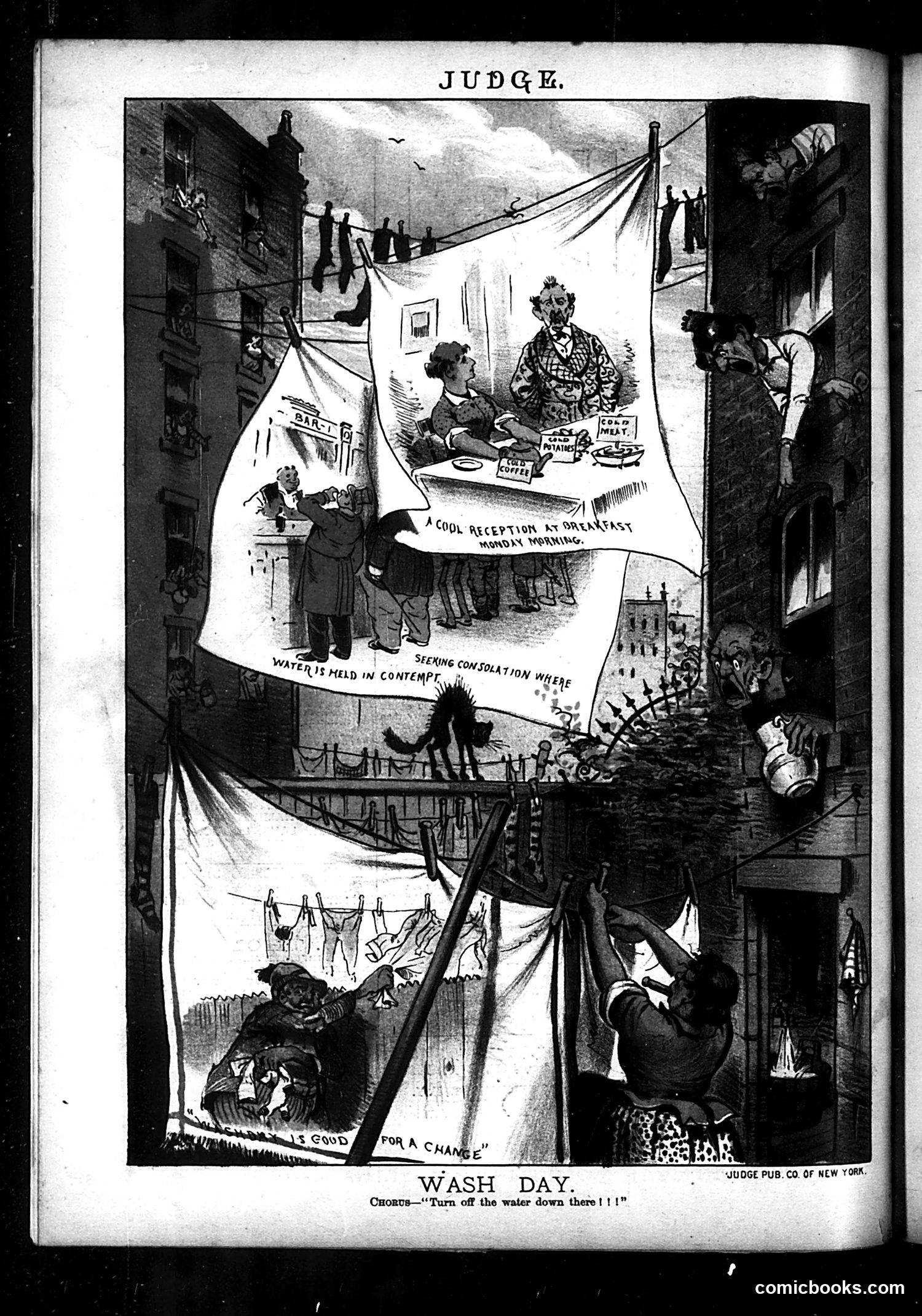
This is a satirical cartoon titled "Wash Day" from *Judge* magazine. The central image shows a tenement building where laundry day activities create chaos—clotheslines strung across the exterior, water flowing from upper floors, and residents engaged in domestic work. The smaller vignette at top depicts "A Cool Reception at Breakfast Monday Morning" and "Waiter is Held in Contempt" for "Seeking Consolation Where it is Good for a Change"—suggesting domestic disputes or marital tension connected to Monday wash day routines. The chorus line at bottom—"Turn off the water down there!"—indicates the cartoon satirizes urban tenement living conditions, where multiple families stacked vertically create practical conflicts. The satire targets both crowded housing and the messy realities of working-class domestic life, likely mocking poor sanitation and communal living challenges of late 19th-century American cities.