
Judge, 1886-04-17 · page 4 of 18
Judge — April 17, 1886 — page 4: what you’re looking at
What you’re looking at
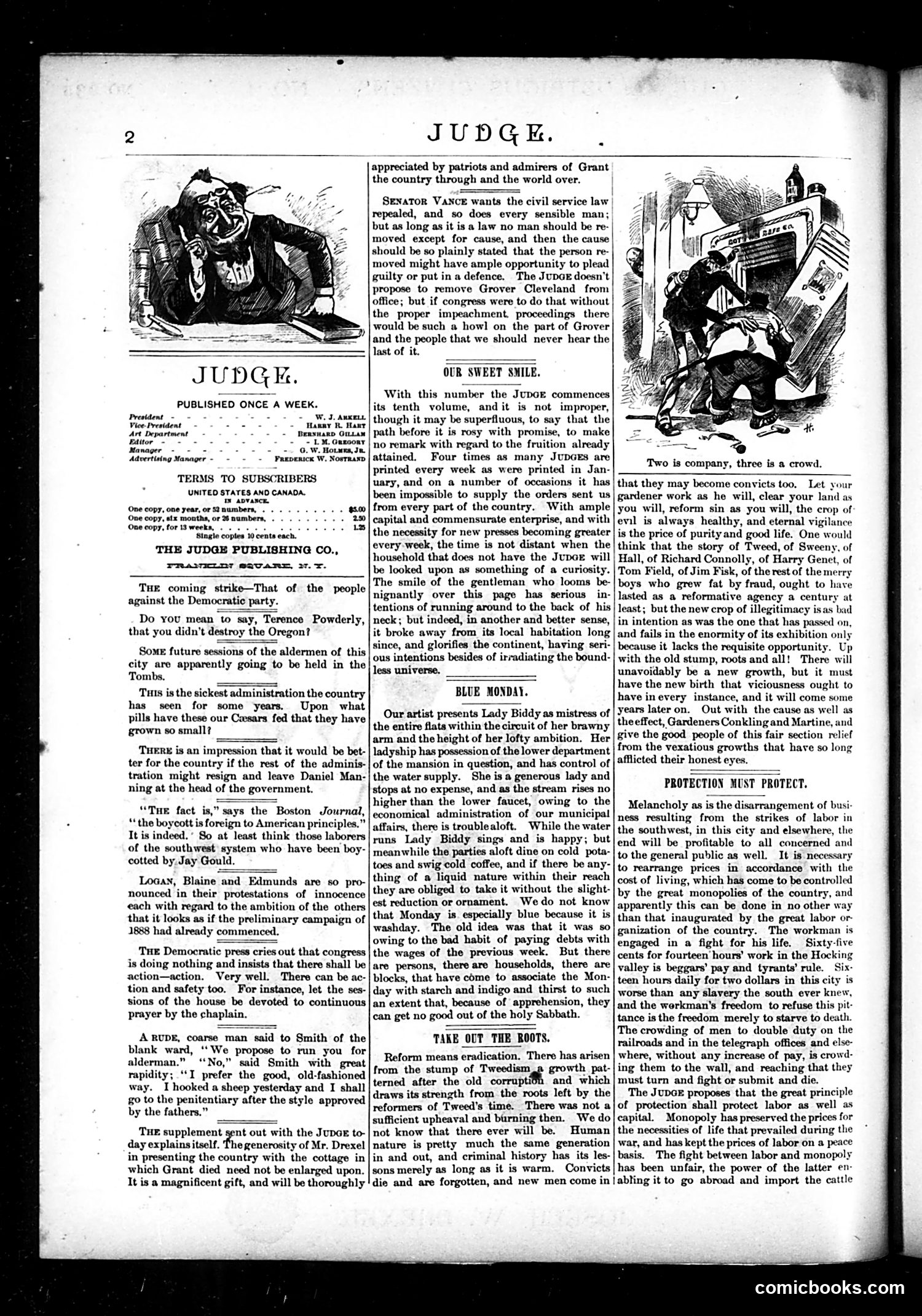
This page from *Judge* (a Republican satirical weekly) contains multiple political jabs at the Democratic administration of President Grover Cleveland, circa 1884-1888. **Main cartoon (left):** Depicts a disheveled, grotesque figure—likely representing the Democratic Party or Cleveland administration—in disarray, symbolizing their perceived incompetence. **Key political references:** - **Civil service reform**: Attacks Senator Vance's call to repeal civil service protections, arguing removals must follow legal procedures - **Labor strikes**: Mocks labor leader Terence Powderly and Jay Gould's boycotts - **1888 election rumors**: References Logan, Blaine, and Edmunds jockeying for presidential succession - **Grant's legacy**: Celebrates philanthropist Drexel's gift of Grant's cottage to the nation **Tone**: Patronizing mockery of Democrats as incompetent administrators, while defending procedural fairness and celebrating Republican figures' legacies. The magazine boasts of circulation growth in its tenth volume.
📄 Transcribed text from this page (OCR, searchable)
Machine-transcribed from the original scan — historical spelling and the odd misread are preserved.
JUDGE. PUBLISHED ONCE A WEEK. President - = =~ - + W. J. AmxeL Vice-President - 7 ee Art Department ~ -- Fittor ~ - - - - + = é Manager - - - - os ele Advertising Manager - ~~ Hany R. Hart Bernard OnLax = LM. Guroony 0, W. Horses, Jn. Paxpenicx W. NosreaxD TERMS TO SUBSCRIBERS UNITED STATES ANO CANADA. 1 ADVANCE, One copy, one year, or 82 numbers, One copy, six months, of 2 numbe One copy, for 1S weeks... . Single coptes 10 cents each. THE JUDGE PUBLISHING CO., rms? SqUARS, 2.5. + 80 20 Ls Tux coming strike—That of the people against the Democratic party. Do you mean to say, Terence Powderly, that you didn’t destroy the Oregon? Some future sessions of the aldermen of this city are apparently going to be held in the Tombs. Tuis is the sickest ad: istration the country has seen for some years. Upon what pills have these our Czesars fed that they have grown so small? Tuere is an impression that it would be bet- ter for the country if the rest of the adminis- tration might resign and leave Daniel Man- ning at the head of the government. “Tue fact is,” says the Boston Journal, ‘the boycott is foreign to American principles.” It is indeed,’ So at least think those laborers of the southwest system who have been boy- cotted by. Jay Gould. Loaax, Blaine and Edmunds are so pro- nounced in their protestations of innocence each with regard to the ambition of the others that it looks as if the preliminary campaign of 1888 had already con d ‘Tu Democratic press cries out that congress is doing nothing and insists that there shall be action—action. Very well. There can be ac- tion and safety too. For instance, let the ses- sions of the house be devoted to continuous prayer by the chaplain. A RUDE, coarse man said to Smith of the blank ward, ‘We propose to run you for alderman.” “No,” said Smith with great rapidity; “I prefer the good, old-fashioned way. I hooked a sheep yesterday and I shall go to the penitentiary after the style approved by the fathers.” THE supplement sent out with the JUDGE to- day explains itself. The generosity of Mr. Drexel in presenting the country with the cottage in which Grant died need not be enlarged upon. It is a magnificent gift, and will be thoroughly appreciated by patriots and admirers of Grant the country through and the world over. Senator VANCE wants the civil service law | repealed, and so does every sensible man; but as long as it is a law no man should be re- moved except for cause, and then the cause should be so plainly stated that the person re- moved might have ample opportunity to plead guilty or put ina defence. The JupGE doesn't propose to remove Grover Cleveland from office; but if congress were to do that without the proper impeachment. proceedings there would be such a howl on the part of Grover and the people that we should never hear the last of it. OUR SWEET SMILE. With this number the JupGe commences its tenth volume, and it is not improper, though it may be superfluous, to say that the path before it is rosy with promise, to make no remark with regard to the fruition already attained. Four times as many JUDGES are printed every week as were printed in Jan- uary, and on a number of occasions it has been impossible to supply the orders sent us from every part of the country. With ample capital and commensurate enterprise, and with the necessity for new presses becoming greater every week, the time is not distant when the household that does not have the Jupce will be looked upon as something of a curiosity. The smile of the gentleman who looms be- nignantly over this page has serious in- tentions of running around to the back of his neck; but indeed, in another and better sense, it broke away from its local habitation long since, and glorifies the continent, having seri- ous intentions besides of irradiating the bound- less universe. BLUE MONDAY. Our artist presents Lady Biddy as mistress of the entire flats within the circuit of her brawny arm and the height of her lofty ambition. Her ladyship has possession of the lower department of the mansion in question, and has control of the water supply. She is a generous lady and stops at no expense, and as the stream rises no higher than the lower faucet, owing to the economical administration of our municipal affairs, there is troublealoft. While the water runs Lady Biddy sings and is happy; but meanwhile the parties aloft dine on cold pota- toes and swig cold coffee, and if there be any- thing of a liquid nature within their reach they are obliged to take it without the slight- est reduction or ornament. We do not know that Monday is. especially blue because it is washday. The old idea was that it was so owing to the bad habit of paying debts with the wages of the previous week. But there are persons, there are households, there are blocks, that have come to associate the Mon- day with starch and indigo and thirst to such an extent that, because of apprehension, they can get no good out of the holy Sabbath. TAKE OUT THE ROOTS. Reform means eradication. There has arisen from the stump of Tweedism.a growth pat- terned after the old corruptiSh and which draws its strength from the roots left by the reformers of Tweed’s time. There was not a sufficient upheaval and burning then. We do not know that there ever will be. Human nature is pretty much the same generation in and out, and criminal history has its les- sons merely as long as it is warm. Convicts die and are forgotten, and new men come in Two is company, three is a crowd. that they may become convicts too, Let your gardener work as he will, clear your land as you will, reform sin as you will, the crop of evil is always healthy, and eternal vigilance is the price of purity and good life. One would think that the story of Tweed, of Sweeny, of | Hall, of Richard Connolly, of Harry Genet, of Tom Field, of Jim Fisk, of the rest of the merry boys who grew fat by fraud, ought to have lasted as a reformative agency a century at least; but the new crop of illegitimacy isas bad in intention as was the one that has passed on, and fails in the enormity of its exhibition only because it lacks the requisite opportunity. Up with the old stump, roots and all! There will unavoidably be a new growth, but it must have the new birth that viciousness ought to have in every instance, and it will come some years later on. Out with the cause as well as theeffect, Gardeners Conkling and Martine, and give the good people of this fair section relief from the vexatious growths that have so long afflicted their honest eyes. PROTECTION MUST PROTECT. Melancholy as is the disarrangement of busi- ness resulting from the strikes of labor in the southwest, in this city and elsewhere, the end will be profitable to all concerned and to the general public as well. It is necessary to rearrange prices in accordance with the cost of living, which has come to be controlled by the great monopolies of the country, and apparently this can be done in no other way than that inaugurated by the great labor or ganization of the country. The workman is engaged in a fight for his life. Sixty-five cents for fourteen’ hours’ work in the Hocking valley is beggars’ pay and tyrants’ rule. Six- teen hours daily for two dollars in this city is worse than any slavery the south ever knew. and the werkman's freedom to refuse this pit- tance is the freedom merely to starve to death. The crowding of men to double duty on the railroads and in the telegraph offices and else- where, without any increase of pay, is crowd- ing them to the wall, and reaching that they must turn and fight or submit and die. The JUDGE proposes that the great principle of protection shall protect labor as well as capital. Monopoly has preserved the prices for the necessities of life that prevailed during the war, and has kept the prices of labor on a peace basis. The fight between labor and monopoly has been unfair, the power of the latter en- labling it to go abroad and import the cattle comicbooks.com