
Judge, 1886-04-17 · page 13 of 18
Judge — April 17, 1886 — page 13: what you’re looking at
What you’re looking at
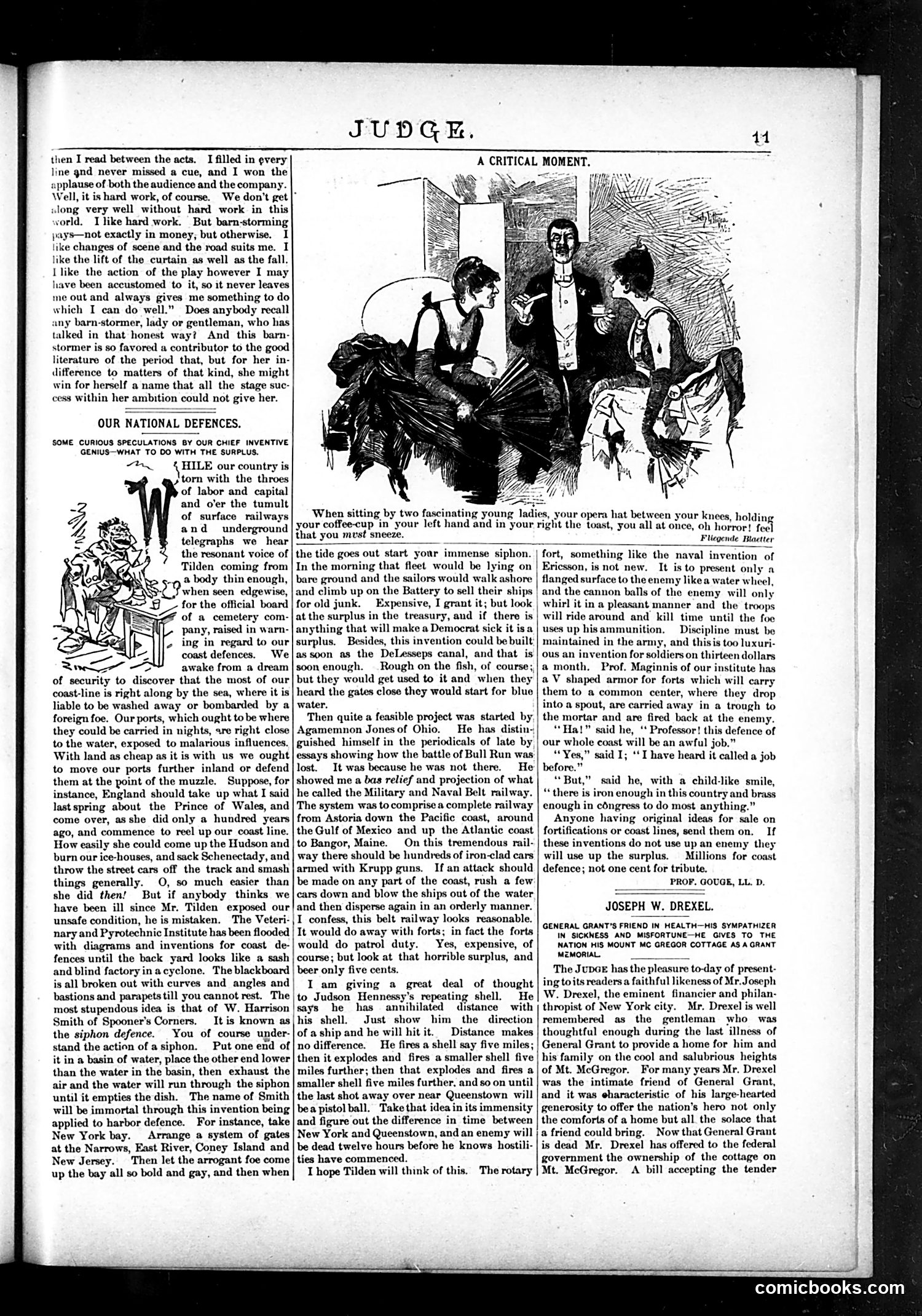
This page from *Judge* (a 19th-century American satirical magazine) contains two distinct pieces: **"A Critical Moment"** (top illustration): A humorous operatic scene showing a man seated between two women, holding an opera hat between his knees. The caption jokes about the social embarrassment of sneezing during an intimate moment at the opera—a comedy of manners targeting upper-class pretension. **"Our National Defences"** (main text): Satirizes Samuel J. Tilden's warnings about America's vulnerable coastline. The satirist mocks Tilden's alarmism by proposing absurd defensive schemes, including W. Harrison Smith's ridiculous "siphon defence"—a contraption allegedly using siphon principles to drain water and trap invading ships. The satire ridicules both Tilden's fear-mongering and the parade of amateur inventors submitting crackpot solutions to the government. The overall tone: mocking pseudointellectual posturing and exaggerated anxieties of the era.
📄 Transcribed text from this page (OCR, searchable)
Machine-transcribed from the original scan — historical spelling and the odd misread are preserved.
then I read between the acts. I filled in every line gnd never missed a cue, and I won the applause of both the audience and the company. Well, it is hard work, of course. We don't get |" slong very well without hard work in this vorld. I like hard work. But barn-storming ys—not exactly in money; but otherwise. 1 like changes of scene and the road suits me. I like the lift of the curtain as well as the fall. like the action of the play however I may have been accustomed to it, so it never leaves out and always gives me something to do which I can do well.” Does anybody recall any barn-stormer, lady or gentleman, who has talked in that honest way? And this barn- stormer is so favored a contributor to the good literature of the period that, but for her in- difference to matters of that kind, she might win for herself a name that all the stage suc- cess within her ambition could not give her. OUR NATIONAL DEFENCES. SOME CURIOUS SPECULATIONS BY OUR CHIEF INVENTIVE GENIUS—WHAT TO DO WITH THE SURPLUS. -*. — { HILE our country is , torn with the throes of labor and capital and o’er the tumult of surface railways and underground telegraphs we hear the resonant voice of Tilden coming from a body thin enough, when seen edgewise, for the official board of a cemetery com- pany, raised in warn- ~ ing in regard to our coast defences. We i awake from a dream of security to discover that the most of our coast-line is right along by the sea, where it is liable to be washed away or bombarded by a foreign foe. Our ports, which ought to be where they could be carried in nights, are right close to the water, exposed to malarious influences. With land as cheap as it is with us we ought to move our ports further inland or defend them at the point of the muzzle. Suppose, for instance, England should take up what I said last spring about the Prince of Wales, and come over, as she did only a hundred years ago, and commence to reel up our coast line. How easily she could come up the Hudson and burn our ice-houses, and sack Schenectady, and throw the street cars off the track and smash things generally. 0, so much easier than she did then! But if anybody thinks we have been ill since Mr. Tilden exposed our unsafe condition, he is mistaken. The Veteri-} nary and Pyrotechnic Institute has been flooded | with diagrams and inventions for coast de- fences until the back yard looks like a sash and blind factory in acyclone. The blackboard | is all broken out with curves and angles and bastions and parapets till you cannot rest. The most stupendous idea is that of W. Harrison Smith of Spooner’s Corners. It is known as the siphon defence. You of course under- stand the action of a siphon. Put one end of it in a basin of water, place the other end lower than the water in the basin, then exhaust the air and the water will run through the siphon until it empties the dish. The name of Smith will be immortal through this invention being applied to harbor defence. For instance, take New York bay. Arrange a system of gates at the Narrows, East River, Coney Island and New Jersey. Then let the arrogant foe come When sitting by two fascinating young ladi your coffee-cup in your left hand and in your that you mvst snee: ie ri ‘our opera hat between your knees, holdin the toast, you all at once, oh horror! feel Fliegende Blaetter the tide goes out start your immen: In the morning that fleet would be 1] bare ground and the sailors would wal and climb up on the Battery to sell their ships for old junk. Expensive, I grant it; but look at the surplus in the treasury, and if there is anything that will make a Democrat sick it isa surplus. Besides, this invention could be built: as soon as the DeLesseps canal, and that is soon enough. Rough on the fish, of course;, but they would get used to it and when they heard the gates close they would start for blue water, Then quite a feasible project was started by, Agamemnon Jones of Ohio. He has distin- guished himself in the periodicals of late by essays showing how the battle of Bull Run was: lost. It was because he was not there. He showed me a bas relief and projection of what he called the Military and Naval Belt railway. The system was to comprise a complete railway from Astoria down the Pacific coast, around the Gulf of Mexico and up the Atlantic coast to Bangor, Maine. On this tremendous rail- way there should be hundreds of iron-clad cars armed with Krupp guns. If an attack should be made on any part of the coast, rush a few cars down and blow the ships out of the water and then disperse again in an orderly manner. I confess, this belt railway looks reasonable. It would do away with forts; in fact the forts would do patrol duty. Yes, expensive, of course; but look at that horrible surplus, and beer only five cents. I am giving a great deal of thought to Judson Hennessy’s repeating shell. He says he has annihilated distance with his shell. Just show him the direction of a ship and he will hit it. Distance makes no difference. He fires a shell say five miles; then it explodes and fires a smaller shell five miles further; then that explodes and fires a smaller shell five miles further, and so on until the last shot away over near Queenstown will bea pistol ball. Take that idea in its immensity and figure out the difference in time between New York and Queenstown, and an enemy will be dead twelve hours before he knows hostili- ties have commenced. up the bay all so bold and gay, and then when T hope Tilden will think of this. The rotary . | fort, something like the naval invention of Ericsson, is not new. It is to present only a flanged surface to the enemy like a water wheel, and the cannon balls of the enemy will only whirl it in a pleasant manner and the troops will ride around and kill time until the foe up hisammunition. Discipline must be ed in the army, and thisis too luxuri- invention for soldiers on thirteen dollars a month, Prof. Maginnis of our institute has a V shaped armor for forts which will carry them to a common center, where they drop into a spout, are carried away in a trough to the mortar and are fired back at the enemy. “Hal” said he, ‘ Professor! this defence of our whole coast will be an awful job.” “Yes,” said I; ‘‘I have heard it called a job before.” “But,” said he, with a child-like smile, “ there is iron enough in this country and brass enough in congress to do most anything.” Anyone having original ideas for sale on | fortifications or coast lines, send them on. If these inventions do not use up an enemy they will use up the surplus. Millions for coast defence; not one cent for tribute. PROF, GOUGE, LL. D. JOSEPH W. DREXEL. GENERAL GRANT'S FRIEND IN HEALTH—HIS SYMPATHIZER IN SICKNESS AND MISFORTUNE—HE GIVES TO THE NATION HIS MOUNT MC GREGOR COTTAGE AS A GRANT MEMORIAL. oa WE The JupaE has the pleasure to-day of present- ing toits readers a faithful likeness of Mr.Joseph W. Drexel, the eminent financier and philan- thropist of New York city. Mr. Drexel is well remembered as the gentleman who was thoughtful enough during the last ‘illness of General Grant to provide a home for him and his family on the cool and salubrious heights of Mt. McGregor. For many years Mr. Drexel was the intimate fri of General Grant, and it was eharacteristic of his large-hearted generosity to offer the nation’s hero not only the comforts of a home but all the solace that a friend could bring. Now that General Grant is dead Mr. Drexel has offered to the federal government the ownership of the cottage on Mt. McGregor. A bill accepting the tender comicbooks.com