
Judge, 1886-04-17 · page 7 of 18
Judge — April 17, 1886 — page 7: what you’re looking at
What you’re looking at
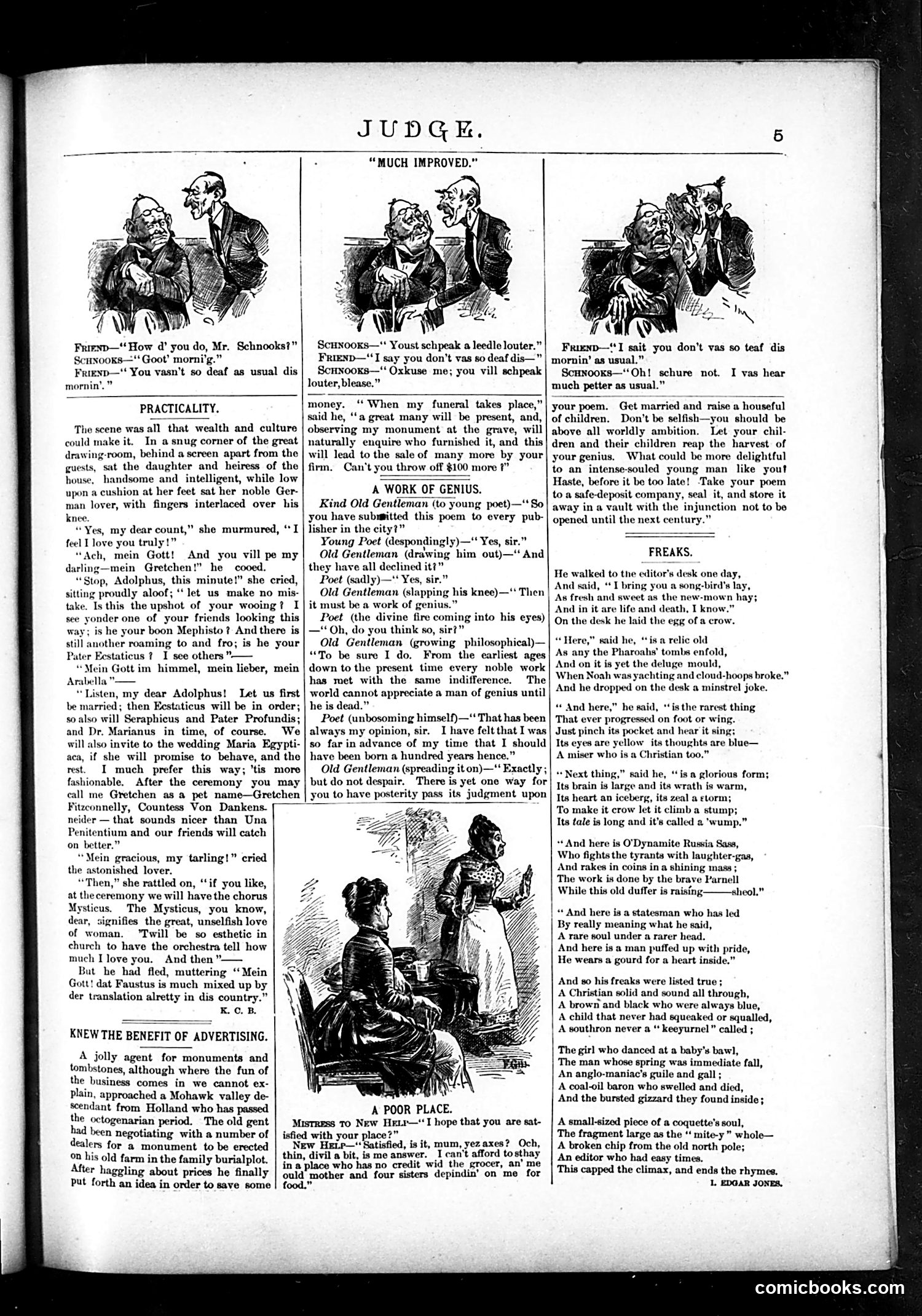
**"Much Improved"** satirizes German-American dialect humor, a common Judge trope. "Mr. Schnooks" (a stereotypical German name) appears deaf, but when his friend speaks louder, Schnooks claims he heard better—the joke being his selective deafness or deliberate misunderstanding plays on ethnic caricature. **"Practicality"** mocks an American heiress negotiating marriage to a German count (Adolphus). She insists on formal marriage first before romantic pet names, rejecting his Faustian theatrical romanticism for pragmatic social convention. The satire targets both pretentious immigrant courtship customs and American materialism. **"A Work of Genius"** is lighter fare: an old gentleman consoles a rejected poet by claiming all great works face initial rejection, suggesting the poet's repeated failures prove genius. The irony—that rejection actually indicates mediocrity—gets lost on the hopeful but deluded poet. These pieces reflect Judge's mockery of German immigrants, literary pretension, and romantic idealism versus practical American values.
📄 Transcribed text from this page (OCR, searchable)
Machine-transcribed from the original scan — historical spelling and the odd misread are preserved.
JUDGE. Frienp—‘ How d’ you do, Mr. Schnooks?” ScuxooKxs—"Goot’ morni’g.” sp—‘‘ You vasn't so deaf as usual dis mornin’. ” “MUCH IMPROVED.” ScuNooxs—'* Youst schpeak a leedle louter.” FRIEND—'‘I say you don't vas so deaf dis—” Scuxooxs—‘ Oxkuse me; you vill schpeak louter, blease.”” Frienp—‘'I sait you don't vas so teaf dis mornin’ as usual.” Scurooxs—‘Oh! schure not. much petter as usual.” I vas hear PRACTICALITY. The scene was all that wealth and culture could make it. In a snug corner of the great drawing-room, behind a screen apart from the guests, sat the daughter and heiress of the house, handsome and intelligent, while low upon a cushion at her feet sat her noble Ger- man lover, with fingers interlaced over his knee. “Yes, my dear count,” she murmured, “I feel I love you truly!” ch, mein Gott! And you vill pe my darling—mein Gretchen!” he . “Stop, Adolphus, this minute!” she cried, sitting proudly aloof; ‘let us make no mis- take. Is this the upshot of your wooing? I ‘onder one of your friends looking this is he your boon Mephisto? And there is other roaming to and fro; is he your fein Gott im himmel, mein lieber, mein Arabella" “Listen, my dear Adolphus! Let us first be married; then Eestaticus will be in order; so also will Seraphicus and Pater Profundis; and Dr. Marianus in time, of course. We will also invite to the wedding Maria Egypti- aca, if she will promise to behave, and the rest. I much prefer this way; ‘tis more fashionable. After the ceremony you may call me Gretchen as a pet name—Gretchen money. “When my funeral takes place,” said he, ‘a great many will be present, and, observing my monument at the grave, will naturally enquire who furnished it, and this will lead to the sale of many more by your firm. Can't you throw off $100 more *” A WORK OF GENIUS. Kind Old Gentleman (to young poet)—" So you have submitted this poem to every pub- lisher in the city?” Young Poet (despondingly)—“ Yes, sir.” Old Gentleman (drawing him out)—“ And they have all declined it?” Poet (sadly)—"* Yes, si Old Gentleman (slapping his knee)—"‘ Then it must be a work of genius. Poet (the divine fire coming into his eyes) —Oh, do you think so, sir?” Old Gentleman (growing philosophical)— “To be sure I do. From the earliest ages down to the present time every noble work has met with the same indifference. The world cannot appreciate a man of genius until he is dead.” Poet (unbosoming himself)—" That has been always my opinion, sir. I have felt that I was so far in advance of my time that I should have been born a hundred years hence.” Old Gentleman (spreading it on)—" Exactly; but do not despair, There is yet one way for you to have posterity pass its judgment upon Fitzconnelly, Countess Von Dankens. neider — that sounds nicer than Una Penitentium and our friends will catch on better.” “Mein gracious, my tarling!” cried the astonished lover. “Then,” she rattled on, ‘‘if you like, | at theceremony we will have the chorus ticus. The Mysticus, you know, ignifies the great, unselfish love of woman. ‘Twill be so esthetic in church to have the orchestra tell how much I love you. And then ”— But he had fled, muttering “Mein Gott! dat Faustus is much mixed up by der translation alretty in dis country.” K. ©. B. KNEW THE BENEFIT OF ADVERTISING. A jolly agent for monuments and tombstones, although where the fun of the business comes in we cannot ex- Plain, approached a Mohawk valley de- Scendant from Holland who has passed the octogenarian period. The old gent had been negotiating with a number of dealers for a monument to be erected on his old farm in the family burialplot. After haggling about prices he finally put forth an idea in order to save some thin, divil 9 bit, is me answer. | t in a place who has no credit wid the grocer, an’ me ould mother and four sisters depindin’ on me for a Mistress To New Hri1—‘I hope that you are sat- isfied with your place?” New Heip—' “Satisfied, is it, mum, yez axes? Och, T can't afford tosthay your poem. Get married and raise a houseful of children. Don’t be selfish—you should be above all worldly ambition. Let your chil- dren and their children reap the harvest of your genius. What could be more delightful to an intense-souled young man like yout Haste, before it be too late! Take your poem to a safe-deposit company, seal it, and store it away in a vault with the injunction not to be opened until the next century.” FREAKS. He walked to the editor's desk one day, And said, “I bring you a song-bird’s lay, ‘As fresh and sweet as the new-mown hay; And in it are life and death, I know.” On the desk he laid the egg of a crow. “Here,” said he, “is a relic old As any the Pharoahs' tombs enfold, And on it is yet the deluge mould, When Noah was yachting and cloud-hoops broke.” And he dropped on the desk a minstrel joke. “ And here,” he said, “is the rarest thing That ever progressed on foot or wing. Just pinch its pocket and hear it sings Its eyes are yellow its thoughts are blue— A miser who is a Christian too.” “Next thing,” said he, “isa glorious form; Its brain is large and its wrath is warm, Its heart an iceberg, its zeal a etorm; To make it crow let it climb a stump; Its tale is long and it’s called a ‘wump.” “And here is O'Dynamite Russia Sass, Who fights the tyrants with laughter-gas, And rakes in coins ina shining inass ; The work is done by the brave Parnell While this old duffer is raisfng——sheol.” | “ And here is a statesman who has led By really meaning what he said, A rare soul under a rarer head. And here is a man puffed up with pride, He wears a gourd for a heart inside.” And #0 his freaks were listed true ; A Christian solid and sound all through, A brown and black who were always blue, A child that never had squeaked or squalled, A southron never a ‘ keeyurnel” called ; The girl who danced at a baby's baw], The man whose spring was immediate fall, An anglo-maniac’s guile and gall ; A coal-oil baron who swelled and died, And the bursted gizzard they found inside; A small-sized piece of a coquette’s soul, The fragment large as the “ mite-y” whole— A broken chip from the old north pole; An editor who had easy times. This capped the climax, and ends the rhymes. L EDGAR JONES. comicbooks.com