
Judge, 1886-04-17 · page 9 of 18
Judge — April 17, 1886 — page 9: what you’re looking at
What you’re looking at
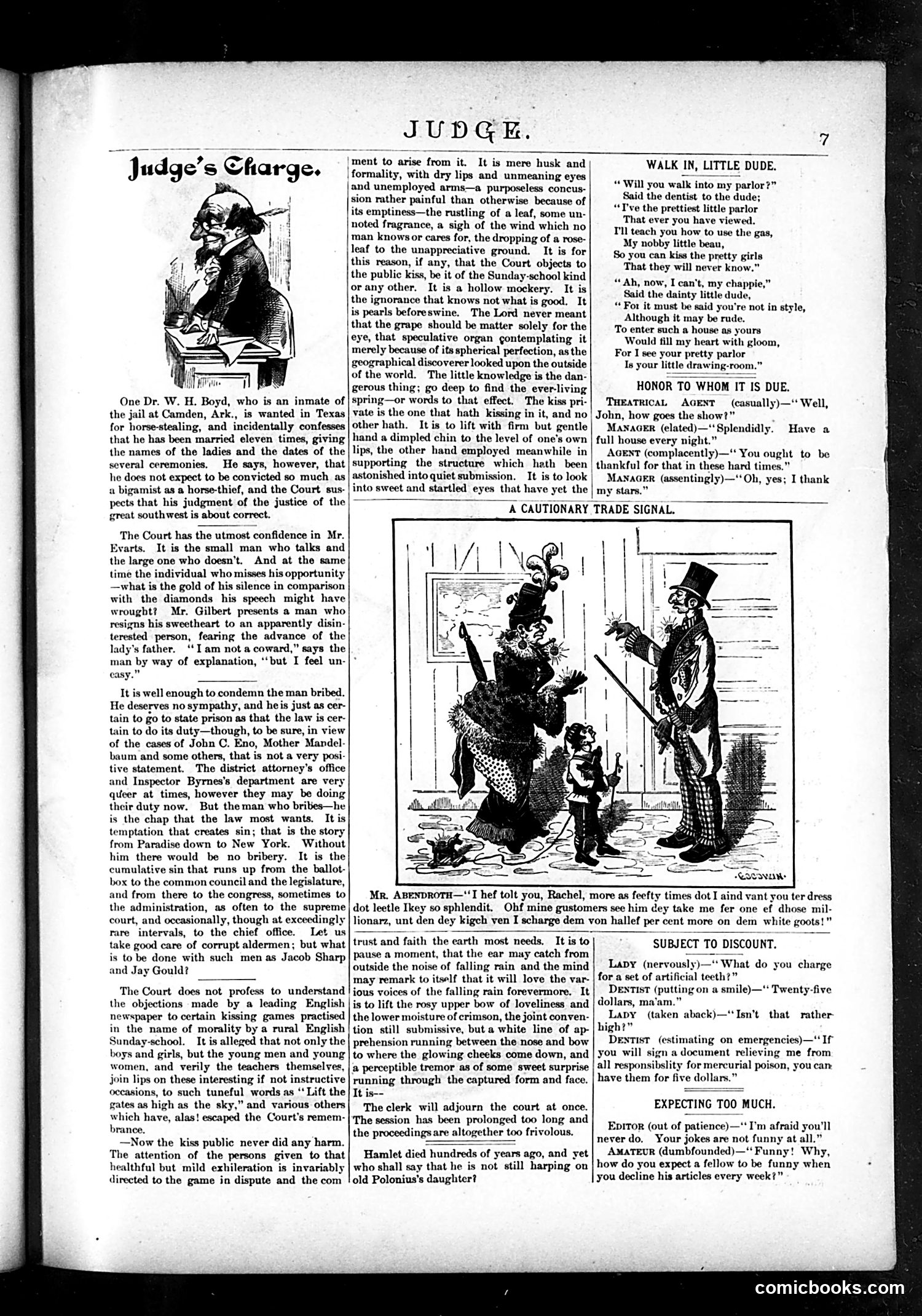
This page from *Judge* contains several editorial commentaries on contemporary scandals and social issues: **"Judge's Charge"** satirizes American justice and corruption. It references Dr. W. H. Boyd (a serial bigamist/horse thief), suggesting Western justice prioritizes property crimes over moral offenses. The editorial then critiques corruption, particularly bribing officials—arguing that wealthy bribers like Jacob Sharp and Jay Gould escape punishment while lower-level corrupt aldermen face prosecution. It's a commentary on systemic inequality in the Gilded Age. The piece also mocks rural English Sunday-school "kissing games," arguing public kissing is merely empty formality lacking genuine feeling—"pearls before swine." The accompanying illustration appears to show a domestic dispute or confrontation, likely illustrating one of these moral/social failings, though specific figures aren't clearly identifiable from the image alone. Overall, the page reflects *Judge*'s role as a satirical voice critiquing corruption, hypocrisy, and social pretense in late 19th-century America.
📄 Transcribed text from this page (OCR, searchable)
Machine-transcribed from the original scan — historical spelling and the odd misread are preserved.
4 Judge’s Charge. One Dr. W. H. Boyd, who is an inmate of the jail at Camden, Ark., is wanted in Texas for horse-stealing, and incidentally confesses that he has been married eleven times, giving the names of the ladies and the dates of the several ceremonies. He says, however, that he does not expect to be convicted so much as a bigamist as a horse-thief, and the Court sus- pects that his judgment of the justice of the great southwest is about correct. The Court has the utmost confidence in Mr. Evarts. It is the small man who talks and the large one who doesn’t. And at the same time the individual who misses his opportunity —what is the gold of his silence in comparison with the diamonds his speech might have wrought? Mr. Gilbert presents a man who resigns his sweetheart to an apparently disin- terested person, fearing the advance of the lady's father. ‘Iam not a coward,” says the man by way of explanation, ‘‘but I feel un-|* easy. It is well enough to condemn the man bribed. He deserves no sympathy, and heis just as cer- tain to go to state prison as that the law is cer- tain to do its duty—though, to be sure, in view of the cases of John C. Eno, Mother Mandel- baum and some others, that is not a very posi- tive statement. The district attorney's office and Inspector Byrnes’s department are very queer at times, however they may be doing their duty now. But theman who bribes—he is the chap that the law most wants. It is temptation that creates sin; that is the story from Paradise down to New York. Without him there would be no bribery. It is the cumulative sin that runs up from the ballot- box to the common council and the legislature, and from there to the congress, sometimes to the administration, as often to the supreme court, and occasionally, though at exceedingly rare intervals, to the chief office. Let us take good care of corrupt aldermen; but what is to be done with such men as Jacob Sharp and Jay Gould? The Court does not profess to understand the objections made by a leading English newspaper to certain kissing games practised in the name of morality by a rural English Sunday-school. It is alleged that not only the boys and girls, but the young men and young women, and verily the teachers themselves, join lips on these interesting if not instructive occasions, to such tuneful words as “Lift the gates as high as the sky,” and various others which have, alas! escaped the Court's remem- brance. —Now the kiss public never did any harm. The attention of the persons given to that healthful but mild exhileration is invariably directed to the game in dispute and the com JUDGE. {ment to arise from it. It is mere husk and |formality, with dry lips and unmeaning eyes jand unemployed arms—a purposeless concus- sion rather painful than otherwise because of its emptiness—the rustling of a leaf, some un- noted fragrance, a sigh of the wind which no man knowsor cares for, the dropping of a rose- leaf to the unappreciative ground. It is for this reason, if any, that the Court objects to the public kiss, be it of the Sunday-school kind or any other. It is a hollow mockery. It is the ignorance that knows not what is good. It is pearls beforeswine. The Lord never meant that the grape should be matter solely for the eye, that speculative organ gontemplating it merely because of its spherical perfection, as the geographical discoverer looked upon the outside of the world. The little knowledge is the dan- gerous thing; go deep to find the ever-living spring—or words to that effect. The kiss pri- vate is the one that hath kissing in it, and no other hath. It is to lift with firm but gentle hand a dimpled chin to the level of one’s own lips, the other hand employed meanwhile in supporting the structure which hath been astonished into quiet submission. It is to look into sweet and startled eyes that have yet the =z A CAUTIONARY WALK IN, LITTLE DUDE. “ Will you walk into my parlor?” Said the dentist to the dude; “T’ve the prettiest little parlor That ever you have viewed. Tl teach you how to use the gas, My nobby little beau, So you can kiss the pretty girls That they will never know.” “Ah, now, I can't, my chappie,” Said the dainty little dude, “ For it must be said you're not in style, Although it may be rude. To enter such a house as yours Would fill my heart with gloom, For I see your pretty parlor Is your little drawing-room.” HONOR TO WHOM IT IS DUE. THEATRICAL AGENT (casually)—‘ Well, John, how goes the show?” ManaGeER (elated)—“' Splendidly. full house every night.” AGENT (complacently)—“ You ought to be thankful for that in these hard times.” MANAGER (assentingly)—‘‘Oh, yes; I thank my stars.” TRADE SIGNAL. Have a scary Mr. ApenprotH—“'I hef tolt you, Rachel, more as feefty times dot I aind vant you ter dress dot leetle Ikey so sphlendit. Ohf mine gustomers see him dey take me fer one ef dhose mil- lionarz, unt den dey kigch ven I scharge dem von hallef per cent more on dem white goots!" trust and faith the earth most needs. It is to pause a moment, that the ear may catch from outside the noise of falling rain and the mind may remark to itself that it will love the var- ious voices of the falling rain forevermore. It is to lift the rosy upper bow of loveliness and the lower moisture of crimson, the joint conven- tion still submissive, but a white line of ap- prehension running between the nose and bow to where the glowing cheeks come down, and ‘a perceptible tremor as of some sweet surprise running through the captured form and face. It is-- The clerk will adjourn the court at once. ‘The session has been prolonged too long and the proceedings are altogether too frivolous. Hamlet died hundreds of years ago, and yet who shall say that he is not still harping on old Polonius's daughter? "SUBJECT TO DISCOUNT. Lavy (nervously)—" What do you charge for a set of artificial teeth?” Dentist (putting on a smile)—‘‘ Twenty-five dollars, ma’am.” Lapy (taken aback)—‘‘Isn't that rather- hight” DENTisT (estimating on emergencies)—“ If you will sign a document relieving me from all responsibslity for mercurial poison, you can. have them for five dollars. EXPECTING TOO MUCH. Eprtor (out of patience)—" I'm afraid you'll never do, Your jokes are not funny at all.” AMATEUR (dumbfounded)—“ Funny! Why, how do you expect a fellow to be funny when you decline his articles every week?” comicbooks.com