
Judge, 1886-04-17 · page 8 of 18
Judge — April 17, 1886 — page 8: what you’re looking at
What you’re looking at
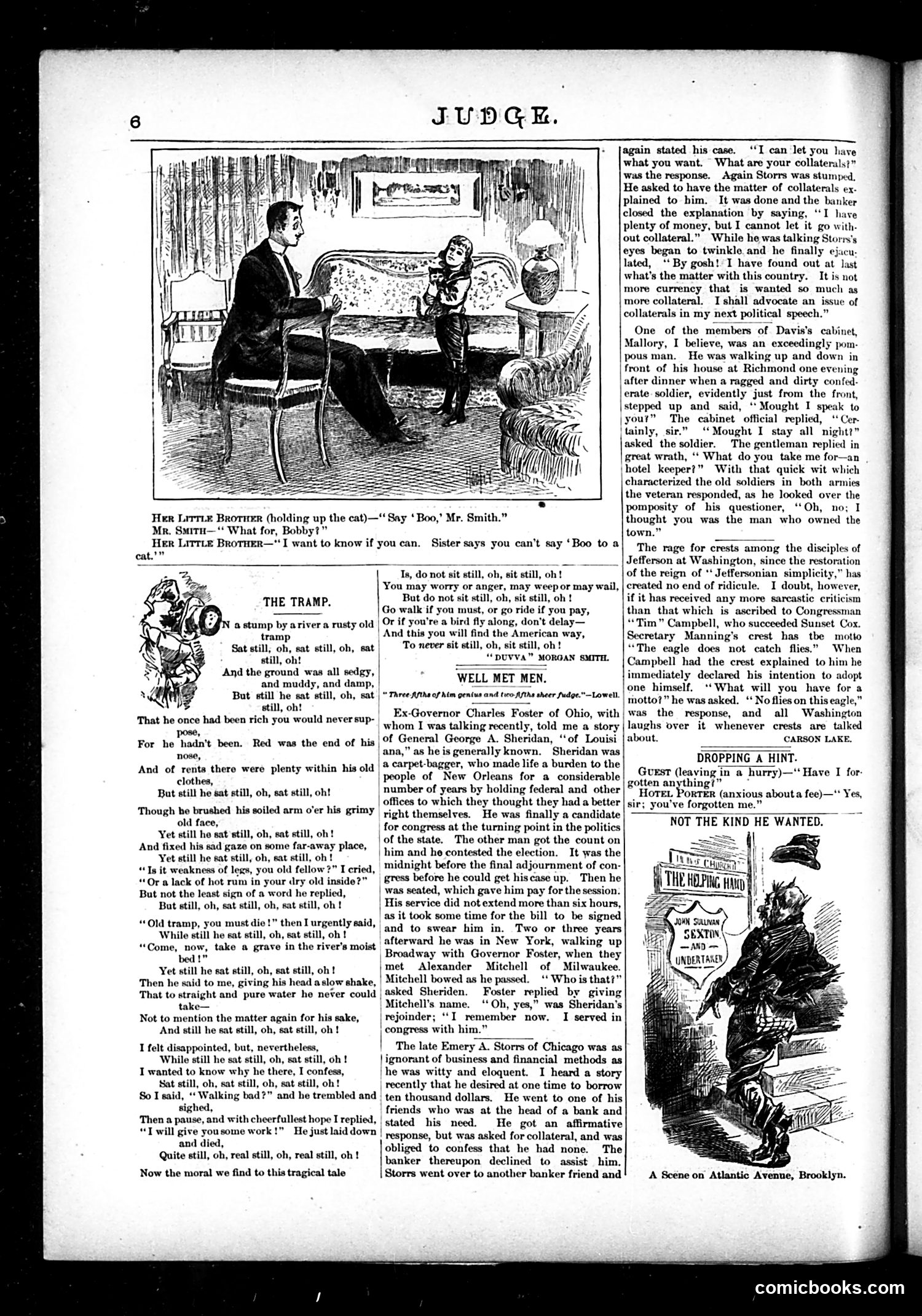
This Judge magazine page contains multiple satirical pieces: **"Her Little Brother"** (top): A simple domestic joke where a child asks Mr. Smith to say "Boo" to prove the sister wrong about his inability to do so—typical turn-of-century humor about childhood logic. **"The Tramp"** (center-left): A poem mocking American restlessness and the cultural imperative to constantly move and work. The tramp refuses even death because he won't "take to water"—satirizing both vagabond culture and American work ethic obsession. **"Well Met Men"** (right): Anecdotes ridiculing prominent political figures, particularly General Philip Sheridan (identified in text as a Reconstruction-era carpet-bagger in New Orleans). The stories mock these men's ignorance: one served Congress for only six hours and forgot it; another (Emery Storrs) was so financially illiterate he couldn't understand collateral requirements. The satire targets post-Civil War political corruption and incompetence among federal appointees.
📄 Transcribed text from this page (OCR, searchable)
Machine-transcribed from the original scan — historical spelling and the odd misread are preserved.
Her Lrrtie Broruer (holding up the cat)—“ Say ‘Boo,’ Mr. Smith.” Mr. Suitu—‘‘ What for, Bobby?” Her Littte BrotrHEr—‘'I want to know if you can. Sister says you can't say ‘Boo to a Is, do not sit still, ob, sit sti You may worry or anger, may weep or may wail, THE TRAMP. But do not sit still, oh, sit still, oh ! a Go walk if you must, or go ride if you pay, ‘astump by ariver a rusty old | Or if you're a bird fly along, don't delay— tone “ oN" | And this you will find the American way, Sat still, oh, sat still, oh, sat| To never sit still, oh, i, oh! still, oh! “DUVVA” MORGAN SMITH. And the ground was all sedgy, —— and muddy, and damp, WELL MET MEN. But still he sat still, oh, sat |" ThreeAasof him gentua and tico-Aths sheer fudge.” —Lowell still, oh! That he once had been rich you would never sup- ana,” as he is generally known. Sheridan was a carpet-bagger, who made life a burden to the | people of New Orleans for a considerable number of years by holding federal and other ee "____| offices to which they thought they had a better Though heme his soiled arm o'er his grimy ight themselves. He was finally a candidate bet eloped for congress at the turning point in the politics Yet sill he say sell, obs ent etl ch! ig {ot the state. ‘The other man got the count on Ae eee eee ck) Pw | him and he contested the election. It was the «Tpit weakness of logs, you old fellow?” Teried, ™idnight before the final adjournment of con- “Or a lack of hot rum in your dry old inside?” | BTeSs before he could get hiscase up. Then he But not the least sign of a word he replied, | was seated, which gave him pay for the session. But still, oh, sat still, oh, sat still, oh! | His service did not extend more than six hours, as it took some time for the bill to be signed and to swear him in. Two or three years afterward he was in New York, walking up Broadway with Governor Foster, when they met Alexander Mitchell of Milwaukee. Mitchell bowed as he passed.‘ Who is that?” asked Sheriden. Foster replied by giving Mitchell’s name. “Oh, yes,” was Sheridan's rejoinder; “I remember now. I served in j congress with him.” The late Emery A. Storrs of Chicago was as | ignorant of business and financial methods as he was witty and eloquent. I heard a story recently that he desired at one time to borrow ten thousand dollars. He went to one of his friends who was at the head of a bank and stated his need. He got an affirmative response, but was asked for collateral, and was obliged to confess that he had none. The banker thereupon declined to assist him. | Storrs went over to another banker friend and nose, And of rents thero were plenty within his old clothes, But still he sat still, oh, sat still, oh! “Old tramp, you must dio!” then I urgently said, While still he sat still, oh, sat still, oh! “Come, now, take a grave in the river's moist nd Yet still he sat still, oh, sat still, oh! | Then he said to me, giving his head aslow shake, That to straight and pure water he never could take— Not to mention the matter again for his sake, And still he sat still, oh, sat still, oh! I felt disappointed, but, nevertheless, While still he sat still, oh, sat still, oh! I wanted to know why he there, I confess, Sat still, oh, sat still, oh, sat still, oh! So I said, “Walking bad?” and he trembled and sighed, Then a pause, and with cheerfullest hope I replied, “Twill give yousome work!" He just laid down | and died, Quite still, oh, real still, oh, real still, oh ! Now the moral we find to this tragical tale Ex-Governor Charles Foster of Ohio, with | whom I was talking recently, told me a stot For he hadn't been. Red was the end of his Of General George A. Sheridan, “of Louisi again stated his case. ‘I can let you have what you want. What are your collaterals?” was the response. Again Storrs was stumped, He asked to have the matter of collaterals ex- plained to him. It was done and the banker closed the explanation by saying, ‘I hav. plenty of money, but I cannot let it go with. out collateral.” While he was talking Storr eyes began to twinkle and he finally ejacu- lated, “By gosh! I have found out at last what's the matter with this country. It is not more currency that is wanted so much as more collateral. I shall advocate an issue of collaterals in my next political speech.” One of the members Davis's cabinet, Mallory, I believe, was an exceedingly pom. pous man. He was walking up and down in front of his house at Richmond one evening after dinner when a ragged and dirty confed- erate soldier, evidently just from the front, |stepped up and said, ‘ Mought I speak to your” The cabinet official replied, “ Cer- ly, sir.” “Mought I stay all night?” asked the soldier. The gentleman replied in great wrath, ‘‘ What do you take me for—an hotel keeper?” With that quick wit which characterized the old soldiers in both armies the veteran responded, as he looked over the pomposity of his questioner, “Oh, no; I thought you was the man who owned the town.” The rage for crests among the disciples of Jefferson at Washington, since the restoration of the reign of * Jeffersonian simplicity,” has created no end of ridicule. I doubt, how if it has received any more sarcastic criticism than that which is ascribed to Congressman “Tim” Campbell, who succeeded Sunset Cox. Secretary Manning’s crest has tbe motto “The eagle does not catch flies.” When Campbell had the crest explained to him he immediately declared his intention to adopt one himself. ‘‘What will you have for a motto?” he was asked. ‘ No flies on this eagle,” was the response, and all Washington laughs over it whenever crests are talked about. CARSON LAKE. DROPPING A HINT. Guest (leaving in a hurry)—‘ Have I for- gotten anything?” . Hore Porter (anxious abouta fee)—* Yes, sir; you've forgotten me.” NOT THE KIND HE WANTED. SEXTON _ AND \ iy A Scene on Atlantic Avenue, Brooklyn. comicbooks.com